

Key Takeaways
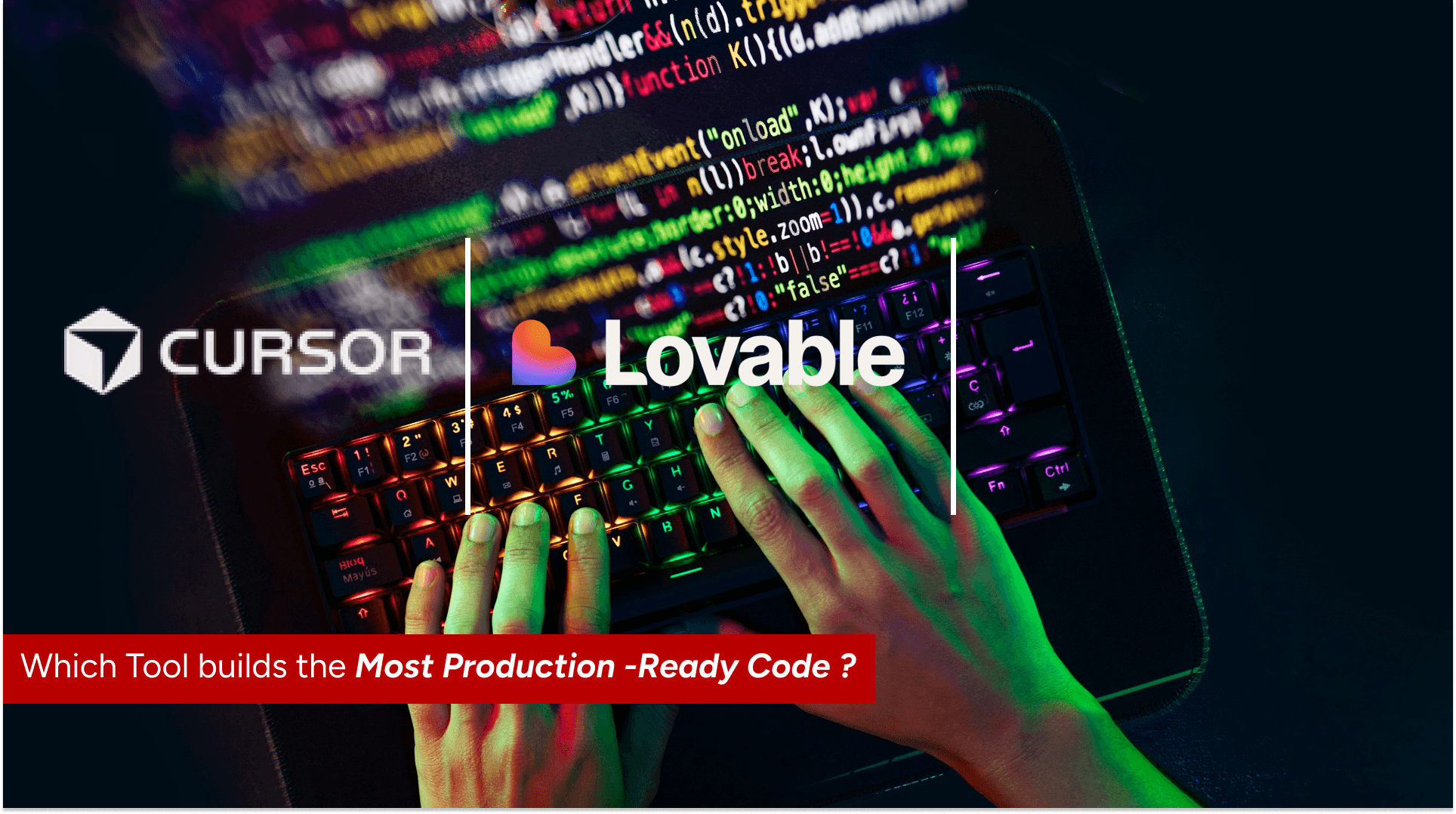
- This guide compares Cursor, Lovable, and Replit through an enterprise lens, evaluating each tool on production readiness, governance, maintainability, and scalability.
- Production-ready AI-generated code requires more than speed. Engineering teams must assess code ownership, deployment flexibility, security, and long-term maintainability before choosing a platform.
- Each tool serves a distinct use case. Cursor fits engineering-led teams, Lovable suits rapid MVP workflows, and Replit supports early experimentation and quick deployment.
- The right vibe coding tool depends on your product stage, team structure, and compliance requirements. No single platform is the right fit for every organization.
Why Enterprises Can No Longer Ignore Production Readiness in AI-Assisted Development
Every enterprise buyer GeekyAnts works with is navigating the same pressure: ship faster, reduce engineering costs, and maintain the operational standards that production systems demand. Vibe coding tools have made the first two easier. The third is where most teams are getting hurt. What we consistently see across enterprise accounts is a gap between AI adoption velocity and governance maturity. Teams are generating code faster than their review processes can validate it. The enterprises that close that gap are not the ones with the best AI tools. They are the ones with the most disciplined engineering culture around those tools.
Vibe coding is no longer a niche prototyping trend. It is a capital-backed software delivery model attracting institutional investment at scale. Cursor has crossed $1 billion in ARR. Replit reached a $9 billion valuation following a $400 million Series D. Lovable grew its ARR from $300 million to $400 million within a single month. Investors are no longer treating AI development platforms as experimental tooling. They are treating them as foundational infrastructure.
Enterprise software delivery expectations have shifted in parallel. CXOs are under pressure to ship faster, reduce engineering bottlenecks, and increase output without proportional headcount growth. AI coding tools have become a direct response to that pressure. But organizations are no longer evaluating these tools on demo speed or UI generation alone. The focus has moved to maintainability, architectural consistency, and long-term product ownership.
The governance gap remains the most underaddressed risk. Research highlights silent logic failures, weak defensive programming, and compliance gaps in AI-generated codebases. Enterprises that prioritize speed over governance accumulate operational debt that becomes expensive to reverse at scale.
This guide is written for:
CTOs evaluating AI-assisted development workflows
- Engineering leaders balancing delivery speed with scalability and governance
- Startup founders moving from MVP to production
- Enterprise teams operationalizing AI development within compliance frameworks
Your AI Stack Is Only as Strong as the Engineering Behind It. Let's Build It Right.
The conversation with enterprise buyers has shifted. A year ago, they were asking whether AI coding tools were worth adopting. Today, they are asking why their AI-generated systems are creating more technical debt than their traditional development cycles ever did. The organizations that get this right are the ones that treat governance as a delivery requirement, not an afterthought. Speed without engineering accountability is not a business advantage. It is a liability that compounds.
 Kunal KumarChief Revenue Officer
The Enterprise Standard for Production-Ready AI-Generated Code
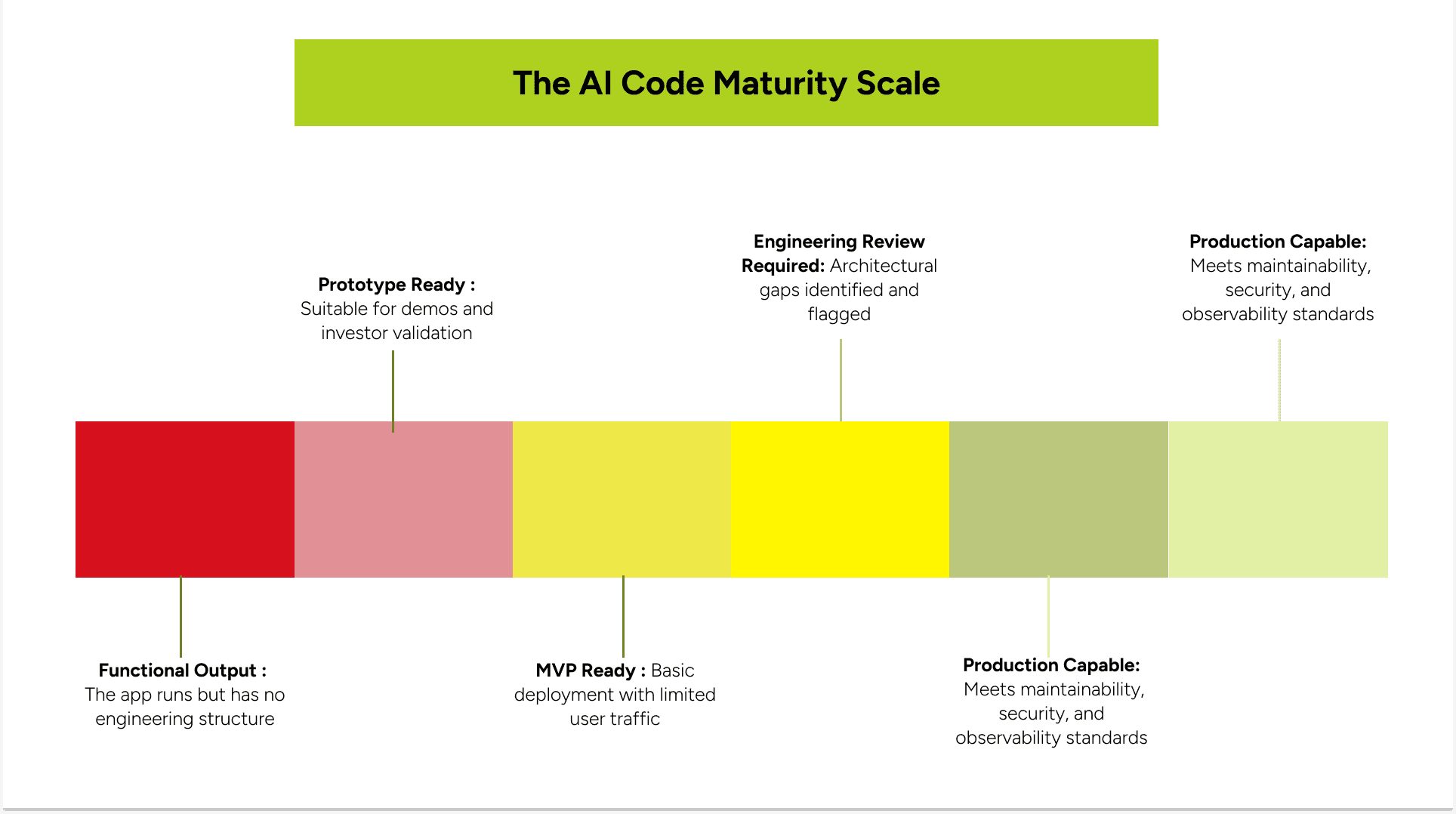
AI-generated code that passes a functional test is not the same as code that passes an engineering review. The most common gap teams miss before moving to production is structural, not functional. When AI generates code without architectural boundaries, business logic, UI, and data handling end up in the same layer. The system works in isolation but becomes difficult to extend, debug, or hand off. The clearest signal that AI-generated code is production-ready is testability. If an engineering team cannot write automated tests against the codebase without significant rework, the system is not ready for production, regardless of how well it performs in a demo environment.
A working prototype and a production-ready system are not the same thing. AI coding tools can generate functional applications in hours, but functional output does not meet the bar that enterprise engineering teams operate against. Production readiness is defined by whether engineering teams can safely maintain, scale, govern, and evolve a system after deployment, not by whether the application runs at demo.
This distinction carries measurable consequences. A 2026 study analyzing large-scale AI-generated applications found that systems averaged nearly 17,000 lines of code and contained thousands of design issues despite high functional correctness. The most common problems included code duplication, oversized methods, poor exception handling, and weak separation of concerns. The systems worked. But they violated critical software engineering principles that determine long-term operational viability.
For CTOs and engineering leaders, production readiness must be evaluated against a defined set of operational criteria before any platform decision is made.
Maintainability
Can engineering teams understand, modify, and extend the codebase without introducing new failures? AI-generated codebases with inconsistent architecture accumulate technical debt that becomes expensive to reverse at scale.
Scalability
Can the system handle real production workloads as the product grows? Platforms that optimize for generation speed rarely provide the infrastructure control that scaling requires.
Security and governance
Does the platform support structured review workflows, clear code ownership, and auditable deployment decisions? Without these controls, AI-generated systems ship with compliance exposure that compounds over time.
Observability and deployment readiness
Does the system support monitoring, logging, and debugging from day one? Production incidents cannot be managed without the infrastructure to detect and diagnose them.
Testing and human review
AI-generated output requires engineering validation at every stage. Delegating QA entirely to AI tools creates regression risk that surfaces after deployment, not before.
The Real Cost of Choosing the Wrong AI Coding Tool: Technical Debt, Security Risk, and Delivery Delays
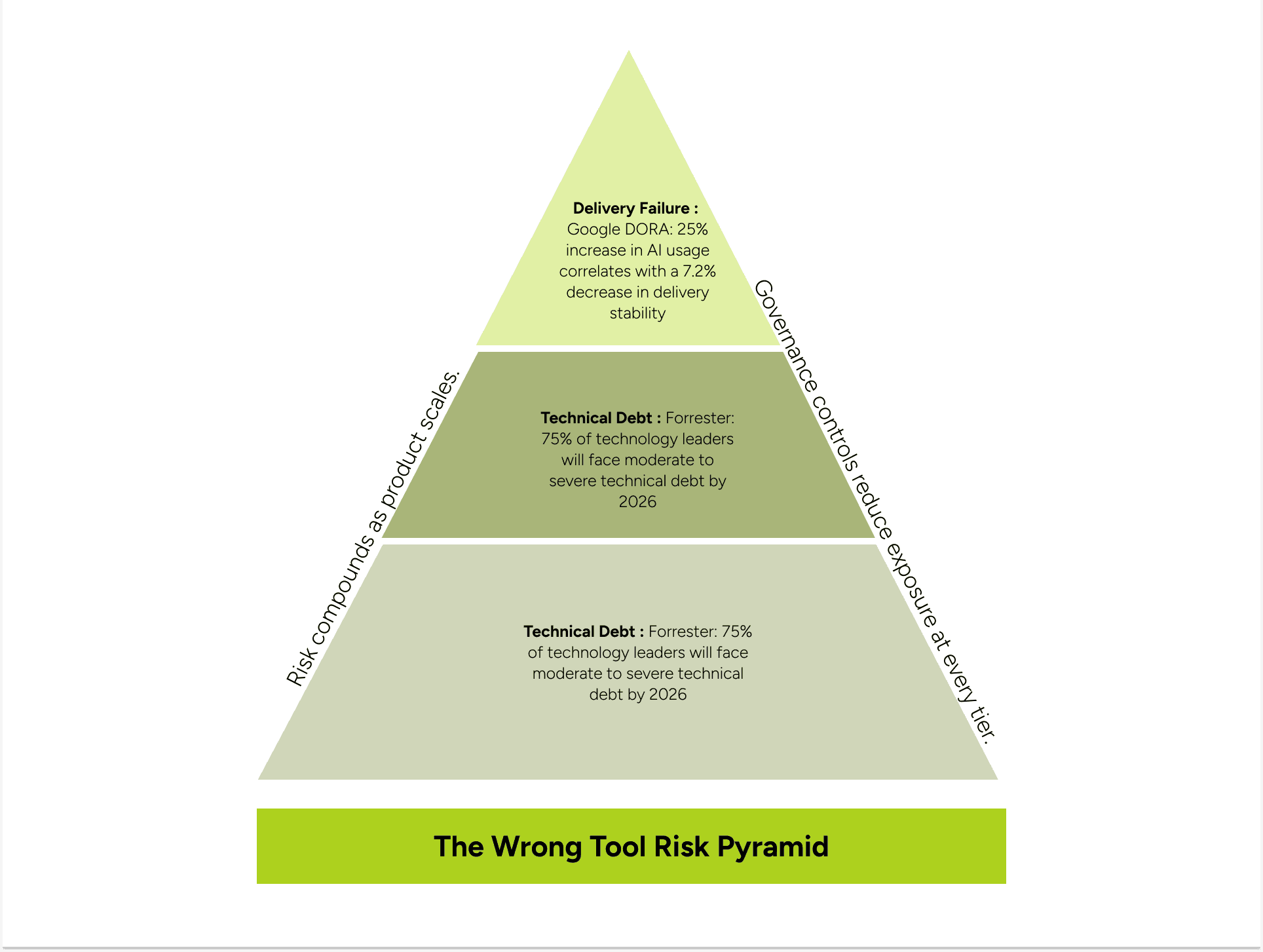
Selecting an AI coding tool is not a productivity decision. It is a strategic engineering and operational decision with consequences that extend well beyond the initial build phase. The wrong platform, matched to the wrong team or product stage, creates structural liabilities that grow more expensive to resolve the longer they remain in production.
The data makes this concrete. Forrester projects that by 2026, 75% of technology leaders will face moderate to severe technical debt problems, driven by AI-accelerated coding practices without disciplined engineering oversight. GitClear's analysis of over 211 million lines of code found an eightfold increase in duplicated code blocks as AI tool adoption scaled across enterprise repositories. Google's 2024 DORA report found that a 25% increase in AI usage correlates with a 7.2% decrease in delivery stability.
The security and governance exposure compounds the problem. Research shows that 45% of AI-generated code contains security vulnerabilities, with AI-generated code carrying 2.7 times higher vulnerability density than human-written code. Platforms that lack structured review workflows, clear code ownership policies, and auditable deployment decisions do not just generate vulnerable code. They generate ungoverned systems where accountability is unclear, and compliance exposure accumulates silently.
Teams that select platforms optimized for rapid generation, without evaluating maintainability or infrastructure portability, find themselves rebuilding systems rather than scaling them. Debugging AI-generated code, managing unreviewed dependencies, and resolving governance gaps consume the engineering capacity that AI adoption was supposed to free. Platform selection must therefore be evaluated against the full operational lifecycle of the product, not just the speed of the initial build.
Cursor vs. Lovable vs. Replit: An Enterprise Framework for Evaluating Production-Ready AI Coding Tools
Most comparisons of Cursor, Lovable, and Replit focus on speed, ease of use, and feature checklists. That framing serves individual developers and early-stage founders evaluating tools for the first time. It does not serve CTOs, engineering leaders, or product heads making platform decisions with long-term operational consequences.
Platform selection at the engineering organization level carries procurement, governance, and delivery risk. The wrong tool, adopted at the wrong product stage, creates codebase dependencies that are expensive to unwind, governance gaps that fail compliance reviews, and architectural constraints that block scaling. These are not tooling preferences. They are organizational commitments with budget and delivery consequences.
This section evaluates all three tools as a procurement and architecture decision. The criteria below reflect what engineering teams and founders preparing for production scale need to assess before committing to a platform.
How We Evaluated Cursor, Lovable, and Replit
Code ownership
Who controls the codebase when the platform relationship ends? Full ownership means the code lives outside the platform's infrastructure with no dependency on proprietary abstractions.
Git workflow support
Does the platform fit into established version control processes, or does it require teams to operate outside standard branching, review, and merge workflows?
Production deployment flexibility
Can teams deploy to their own infrastructure and CI/CD pipeline, or does the platform control where and how software ships?
Governance and security
Does the platform meet the access control, audit, and compliance requirements that regulated industries and enterprise procurement processes demand?
Maintainability
Will the generated codebase support long-term engineering work, or will teams face structural rewrites as the product scales?
Refactoring support
Can engineering teams make targeted changes across the codebase as requirements evolve, or does the platform limit intervention at the code level?
Team collaboration
Does the platform support multi-contributor engineering workflows, or is it built around individual use?
Vendor lock-in
Can teams migrate off the platform without losing their codebase, architecture, or deployment infrastructure?
Scalability
Does the platform support systems that grow in complexity, user load, and team size without requiring a rebuild?
Startup vs. enterprise suitability
Does the platform align with speed-first MVP validation, or does it support the governance and engineering maturity that enterprise delivery requires?
Criteria | Cursor | Lovable | Replit |
|---|---|---|---|
Best Use Case | Engineering-led development on complex codebases | Rapid MVP generation and visual prototyping | Early-stage experimentation and quick deployment |
Ideal Team Type | Experienced engineering teams | Non-technical founders and early-stage product teams | Developers and founders in the early build phase |
Code Ownership | Full ownership, code lives locally | Full ownership via GitHub export | Full ownership, tied to a cloud environment |
Deployment Maturity | High, integrates with any CI/CD pipeline | Moderate, platform-hosted by default | Moderate, improves with paid plans |
Collaboration Support | Strong, integrates with Git workflows | Limited, improving with multiplayer features | Strong, real-time collaborative IDE |
Enterprise Suitability | High, enterprise plan with SSO, audit logs, SCIM | Low to moderate, limited governance controls | Moderate, SOC 2 Type II certified |
Lock-in Risk | Low, local codebase with standard tooling | Low to moderate, Supabase dependency creates backend lock-in | Low, supports 50+ languages with GitHub integration |
Speed to MVP | Moderate, requires engineering setup | High, fastest path from idea to working prototype | High, full-stack deployment in minutes |
Maintainability | High, supports multi-file refactoring | Moderate, complexity increases with product scale | Moderate, depends on engineering discipline |
Category | Strongest Tool |
|---|---|
Production Readiness | Cursor |
MVP Validation | Lovable |
Early Experimentation | Replit |
Code Ownership | Cursor |
Deployment Flexibility | Cursor |
Enterprise Governance | Cursor |
Onboarding Speed | Lovable |
Backend Flexibility | Replit |
Winner by Category
The right platform decision depends on your product stage, team structure, and the operational standards your delivery process must meet. Each tool has a distinct ceiling, and selecting beyond that ceiling is where engineering risk begins.
Most enterprise teams evaluate AI coding tools the same way they evaluate SaaS products: they look at the feature list and run a trial. That is not sufficient for a platform decision that affects your codebase, your deployment infrastructure, and your compliance posture. The evaluation framework has to go deeper, into code ownership, governance controls, deployment flexibility, and long-term maintainability, before any platform commitment is made.
 Konakanchi Venkata Suresh BabuPrincipal Technical Consultant.
An enterprise tooling evaluation framework for AI coding platforms is not a feature comparison exercise. It is a procurement and architecture decision that requires engineering leadership to assess how each platform interacts with existing workflows, compliance requirements, and infrastructure ownership standards.
The criteria that matter most are not visible in a demo environment. Code ownership policies, Git workflow compatibility, deployment portability, and governance controls only become visible when engineering teams test the platform against real codebase conditions, not greenfield projects built from a single prompt.
Organizations that build their evaluation framework around operational criteria rather than generation speed make platform decisions they can defend at scale.
See How GeekyAnts Helps Engineering Teams Build Production-Ready AI Products.
Cursor: Built for Engineering-Led Teams That Demand Control and Governance
The productivity gains that Cursor delivers are real, but they concentrate risk at a specific point in the engineering workflow: the pull request review stage. As code generation accelerates, review volume increases faster than review capacity. Engineers begin approving AI-generated pull requests based on surface-level correctness rather than architectural soundness. The gaps in logic, edge case handling, and structural consistency that get through at the review stage do not disappear. They accumulate in the codebase and surface in production, where the cost of resolving them is significantly higher than catching them at review. Developer productivity in AI-assisted development is only a net gain when engineering oversight scales at the same pace as code generation.
Cursor sits at the intersection of AI-assisted development and the engineering discipline. It is designed for teams that cannot afford to trade governance, code ownership, or review accountability for speed.
Where Cursor Delivers the Most Value
Competitor blogs position Cursor as the best option for advanced developers. That framing undersells its enterprise value. Cursor is strongest where engineering maturity, codebase complexity, and governance requirements intersect. It reads the entire repository, plans changes across files, and verifies output through tests before applying edits. As of early 2026, Cursor is deployed across more than 64% of Fortune 500 companies, with enterprise seat commitments growing from 25% of revenue in late 2024 to nearly 60% at the $2 billion ARR mark.
The Right Team Profile for Cursor
Cursor fits organizations where engineering teams own the codebase, control the deployment pipeline, and operate against defined review and compliance standards. It is the right platform when AI-assisted development must integrate into existing Git workflows and CI/CD processes without disrupting engineering accountability structures.
What Cursor Gets Right for Production
Cursor supports multi-file refactoring, codebase-wide context, and flexible model selection across Claude, GPT, and Gemini. Its enterprise plan includes SSO, SAML/OIDC, audit logs covering 19 event types, SCIM seat management, and centralized usage analytics. Admins can enforce team-wide conventions and require coding standards across the organization from a cloud dashboard. Code stays local, giving engineering teams full ownership with no platform dependency.
Where Cursor Falls Short in Production
Cursor does not offer a self-hosted deployment option as of early 2026, meaning AI requests pass through Cursor's infrastructure. For organizations in regulated industries requiring on-premise data handling, this creates a compliance constraint that procurement teams must evaluate before adoption.
When Engineering Must Take Over
Cursor accelerates delivery but does not replace engineering ownership. GitClear data from 2024 to 2025 shows code churn rose from a 3.3% baseline to between 5.7% and 7.1% as AI-assisted development scaled. Engineering teams need pull request review workflows, branch protection policies, and defined code ownership standards to ensure AI-generated output is validated before it reaches production.
Lovable: When MVP Speed Is the Priority and Engineering Tradeoffs Are Understood
Most discussions around Lovable center on speed, accessibility, and ease of use. That framing is accurate but incomplete. The more important question for any team evaluating Lovable is not how fast it builds, but what it costs operationally when the product needs to scale.
Where Lovable Delivers Real Value
Lovable is strongest in the earliest phase of the product lifecycle, where the priority is validating an idea fast and getting a working prototype in front of users or investors. Its browser-first workflow removes the need for local development setup, version configuration, or engineering environment management. It generates polished, full-stack web applications through natural language prompts with two-way GitHub synchronization built in.
The Right Team Profile for Lovable
Lovable fits non-technical founders and early-stage startups where speed to validation matters more than architectural control. It is not the right platform for teams that need complex business logic, regulated data handling, or long-term codebase ownership without engineering involvement.
What Lovable Gets Right
Lovable generates React and TypeScript code with GitHub sync, giving teams the option to export the codebase and continue development in a standard engineering environment. It handles authentication, database connectivity through Supabase, and basic deployment workflows out of the box.
Where Lovable Falls Short in Production
Lovable carries a 60 to 70% production readiness ceiling for mission-critical systems. It lacks centralized governance controls, RBAC, SSO, and audit logging. Its backend is tied to Supabase, limiting architectural flexibility at scale. In September 2025, over 170 Lovable-built applications were found to have exposed API keys in their code, a direct consequence of ungoverned, prompt-driven development.
When Engineering Must Take Over
Engineering oversight is required before any Lovable-generated application handles real user data, payment workflows, or compliance obligations. The transition from prototype to production is an engineering project, not a configuration change.
The appeal of Lovable is real. It compresses the time from idea to working prototype in a way that no traditional development cycle can match. But speed at the prototype stage creates a false signal about delivery quality. Engineering practitioners across developer communities consistently flag that Lovable's generated code is not developer-friendly. Poor readability and inconsistent structure increase review time significantly when engineering teams try to understand, extend, or debug what the platform has produced. The architectural issue that surfaces most at the handoff stage is tight coupling between the frontend and the Supabase backend. Database logic, authentication, and UI are integrated with Supabase's specific APIs in a way that limits flexibility as the product scales. Teams that treat Lovable's output as a starting point for engineering work, rather than a finished product, manage this transition. Teams that do not, rebuild.
Lovable Got You to MVP. GeekyAnts Gets You to Production.
Replit: When Speed of Experimentation Matters More Than Engineering Control
Replit has been positioned as the easiest path from idea to deployed app.
That is accurate for the experimentation phase. Where those comparisons fall short is in addressing what happens when a Replit-built application needs to move beyond early validation into a scalable production environment.
Where Replit Delivers Real Value
Replit combines a browser-based IDE, AI agent, hosting, database, and deployment in a single environment with no local installation required. It supports over 50 programming languages and deploys to a live URL within minutes. For rapid iteration, internal tooling, and early-stage validation, Replit removes more friction than any other platform in this comparison.
The Right Team Profile for Replit
Replit fits developers and early-stage founders who need to move from idea to working application fast, without managing infrastructure. It is not suited for organizations that require dedicated cloud infrastructure, advanced DevOps workflows, or enterprise compliance controls.
What Replit Gets Right for Production
Replit holds SOC 2 Type II certification and supports GitHub and GitLab integration, giving teams a version control foundation that most browser-first platforms do not offer. Autoscaling deployments and reserved VMs provide a baseline level of deployment control for applications with predictable workloads.
Where Replit Falls Short in Production
Portability is Replit's most significant production constraint. Its hosting and database infrastructure is platform-specific, and migrating to external cloud environments introduces dependency management challenges and data migration risk. Enterprise-grade SSO, compliance audit logs, and access controls are not yet at the level enterprise procurement requires. Compute-based pricing scales unpredictably as demand grows.
When Engineering Must Take Over
Any Replit-built application that moves beyond limited user traffic requires a structured migration to external cloud infrastructure, with engineering teams owning deployment architecture, portability, and observability.
Replit is built for experimentation, and within that boundary, it delivers real value. The problem is that the qualities that make it fast for experimentation also make it unsustainable as an engineering foundation. Browser-based abstraction, managed infrastructure, and simplified deployment remove friction during the build phase but limit infrastructure ownership when the product needs to operate reliably at scale. Engineering teams that migrate a Replit-built application to a production-grade cloud environment without planning for database migration, secrets management, and CI/CD pipeline reconstruction consistently underestimate the effort involved. That gap between experimentation speed and sustainable engineering is where delivery timelines extend, and technical debt accumulates.
Security, Compliance, and Governance Risks Every Enterprise Must Address in AI-Assisted Development
Security is treated as a footnote in most vibe coding comparisons. For enterprise engineering teams, it is a primary evaluation criterion. The data makes the stakes concrete: AI-assisted developers produce commits at three to four times the rate of their peers but introduce security findings at ten times the rate, creating a security debt that accumulates faster than organizations can remediate.
The vulnerability profile of AI-generated code is not improving at the pace vendor messaging suggests. Veracode tested over 100 large language models and found that 45% of AI-generated code samples introduce OWASP Top 10 vulnerabilities. AI-assisted commits expose secrets at twice the rate of human-written code, at 3.2% versus 1.5%. Within Fortune 50 enterprises, security findings grew from approximately 1,000 to over 10,000 per month between December 2024 and June 2025 as AI tool adoption scaled.
Dependency Management
AI-generated code introduces third-party libraries without structured review, expanding the attack surface in ways that standard SAST tooling is not configured to catch. Enterprise teams need AI-specific scanning integrated into every CI/CD pipeline before AI-generated code reaches production.
Infrastructure Visibility and Auditability
Platforms without audit logs, deployment tracking, and code ownership records leave organizations unable to trace decisions back to specific systems, a requirement under EU AI Act Phase Two, SOC 2, and ISO 27001.
Compliance Obligations
According to JetBrains' Developer Ecosystem Survey 2025, 85% of developers now regularly use AI tools for coding, while governance frameworks across enterprise organizations have not kept pace with adoption. Organizations in regulated industries must map AI coding workflows to PCI DSS, HIPAA, and SOC 2 controls before auditors begin asking.
Operational oversight is the control layer that ties all of these risks together. Security review must be structural, not optional, built into every stage from code generation through deployment. For CTOs and engineering leaders evaluating vibe coding platforms, governance capability is not a secondary consideration. It is a procurement filter. A platform that cannot demonstrate audit trails, dependency controls, and compliance alignment should not advance past the evaluation stage, regardless of how fast it generates code.
Risk management in AI-assisted engineering workflows is not a security problem. It is an accountability problem. The most consistent gap across enterprise teams that have adopted vibe coding platforms without structured oversight is the absence of a defined code owner. AI-generated systems reach production without anyone being accountable for reviewing, maintaining, or securing them. When a vulnerability surfaces or a system fails, the response is slow because ownership was never assigned. Organizations that define engineering ownership before deployment, and build their security review, compliance mapping, and governance controls around that ownership structure, are the ones that can respond to production incidents without scrambling to determine who is responsible.
How Cursor, Lovable, and Replit Handle Collaboration, Code Ownership, and Engineering Accountability
The standard approach to evaluating these tools centers on individual developer productivity. For engineering managers and platform leaders, the more relevant question is how each tool supports cross-functional delivery, engineering accountability, and long-term codebase ownership.
Cursor
Cursor integrates with Git natively, supporting branching, pull requests, and code review processes without disrupting established practices. Its enterprise plan adds admin controls, usage analytics, and audit logs that give engineering leaders visibility into AI contributions. Integration with Slack, Linear, and GitHub keeps engineering work connected to broader product and delivery workflows.
Lovable
Lovable offers two-way GitHub synchronization and allows non-technical stakeholders to participate in the build process without coding knowledge, bridging product and engineering teams during early development. However, when a Lovable-generated prototype is handed to an engineering team, the receiving team inherits a codebase built for speed rather than maintainability, requiring architectural review before production work begins.
Replit
Replit offers the strongest real-time collaboration experience of the three, with multiplayer editing that allows cross-functional contributors to work simultaneously. However, its platform-specific hosting and database infrastructure mean team handoff requires a migration plan, not just a code export.
For engineering managers, the handoff question is as important as the build question. A platform that accelerates initial development but creates friction at the point of team handoff adds organizational cost that does not appear in the speed-to-MVP metric.
Cursor vs. Lovable vs. Replit: Choosing the Right Tool for Your Team, Use Case, and Product Stage
Most tool comparisons in this space push a single-tool recommendation narrative. The operational reality is that no single platform is the right fit across all team structures, product stages, and delivery requirements. The right choice depends on where your product is, where your team is headed, and what governance standards your delivery process must meet.
The Right Vibe Coding Tool for Non-Technical Founders
Lovable is the strongest fit for non-technical founders who need to validate an idea fast, build a working prototype for investor demos, or launch a simple web application without engineering resources. It removes the need for local development setup and generates polished, full-stack applications through natural language prompts. The transition to a production-grade system will require engineering involvement, but for early validation, Lovable delivers the fastest path from idea to working product.
The Right AI Coding Tool for Engineering-Led Teams
Cursor is the strongest fit for engineering teams working on existing codebases who need AI-assisted development to integrate with established Git workflows, code review processes, and CI/CD pipelines. It supports multi-file refactoring, codebase-wide context, and flexible model selection without disrupting engineering accountability structures.
The Right Platform for Startup MVP Validation
Replit fits startups in the earliest experimentation phase, where the priority is moving from idea to deployed application fast. For startups building backend services, internal tools, or early prototypes without dedicated engineering resources, Replit provides the most complete all-in-one browser-based environment. Teams building SaaS products should treat Replit as a validation platform, not a long-term infrastructure decision, and plan for a structured migration to dedicated cloud infrastructure as the product scales.
The Right AI Coding Tool for Enterprise Product Delivery
For enterprises modernizing legacy systems, building SaaS products at scale, or delivering internal tools within regulated environments, Cursor provides the governance controls, audit infrastructure, and deployment flexibility that enterprise procurement requires. Unlike engineering team adoption, enterprise product delivery also demands compliance alignment, infrastructure portability, and organizational accountability structures that go beyond individual developer workflows.
Criteria | Cursor | Lovable | Replit |
|---|---|---|---|
Startup Fit | Moderate | High | High |
Enterprise Fit | High | Low | Moderate |
Technical Complexity | High | Low | Moderate |
Maintainability | High | Moderate | Moderate |
Governance Readiness | High | Low | Moderate |
Onboarding Speed | Moderate | High | High |
Engineering Flexibility | High | Moderate | Moderate |
Why GeekyAnts Is the Engineering Partner That Takes AI-Generated Code to Production
Most AI implementation partners position themselves around ideation, tool integration, and rapid deployment. GeekyAnts operates at a different layer. As an AI-powered digital product engineering and consulting company founded in 2006 and recognized as an official service partner by Google and AWS, GeekyAnts bridges the gap between AI-generated prototypes and production-ready systems that can scale, comply, and operate under real business conditions.
GeekyAnts recently introduced a 6 to 8-week AI Product Engineering Sprint that combines product strategy, full-stack engineering, AI integration, cloud deployment, quality assurance, observability, and handoff documentation into a single structured engagement. Delivery outcomes include a 50% reduction in validation cycles, an 80% reduction in mean time to recovery following cloud migration, and a 50% reduction in cloud infrastructure costs.
The engagement model is built for organizations that need more than a prototype. GeekyAnts works as a long-term engineering partner across the full product lifecycle, from initial architecture decisions and AI integration through to post-launch support, performance monitoring, and product iteration. Every engagement is structured around engineering accountability. AI-generated output is treated as a starting point, not a finished product. GeekyAnts builds the governance, architecture, and infrastructure layer that makes AI-generated systems safe to operate, maintain, and scale in production.
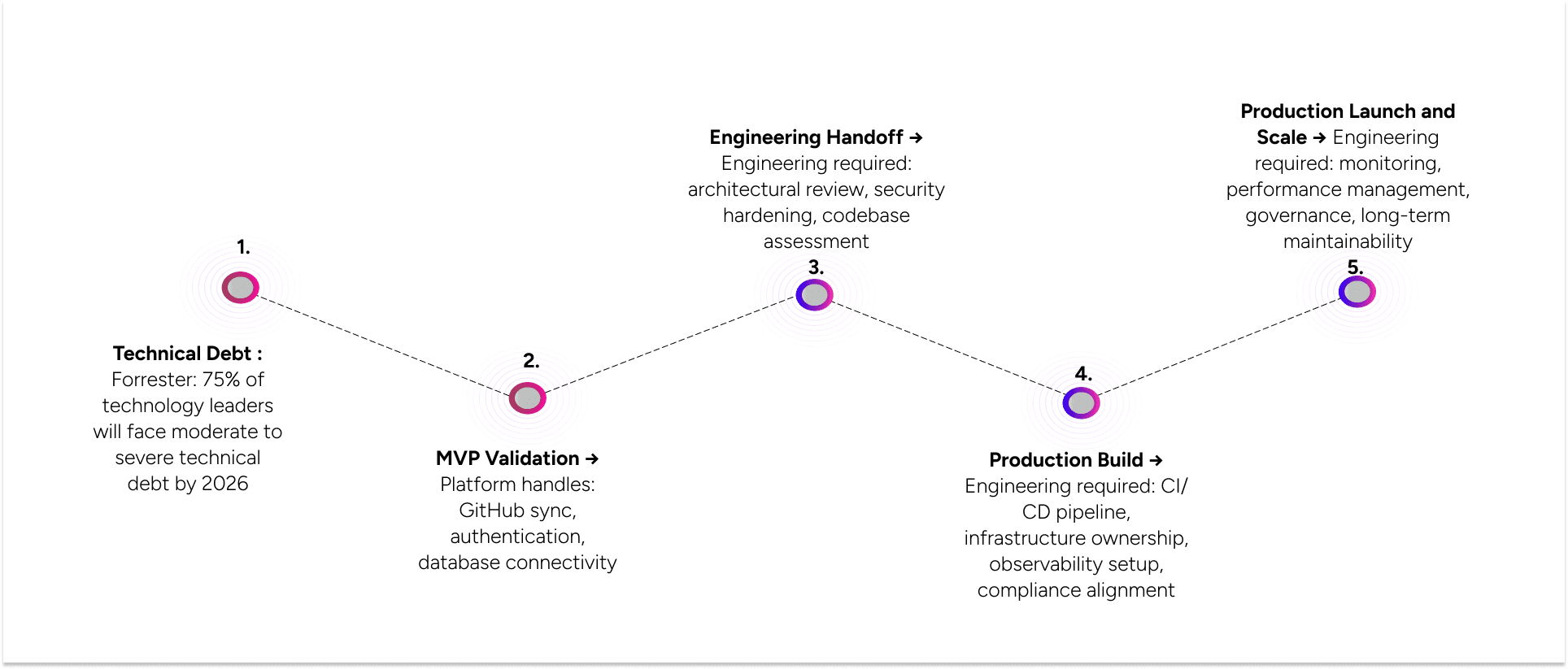
We have made it easy to build prototypes. That is not progress on its own. What used to take weeks now takes hours and creates the illusion of momentum. But most of that momentum does not survive contact with production. At GeekyAnts, we built our entire engineering model around closing that gap. Because the real measure of an AI engineering partner is not how fast they generate code. It is whether the systems they build can launch, scale, and operate under real business conditions.
 Kumar PratikFounder & CEO
Stop Guessing Which Tool Wins. Hire the Team That Makes Any Tool Production-Ready.
Conclusion
Cursor, Lovable, and Replit each serve a distinct role in the AI-assisted development landscape. Cursor fits engineering-led teams that need governance and production-grade delivery. Lovable accelerates MVP validation for non-technical founders. Replit supports early experimentation without infrastructure overhead.
The tool is only one part of the decision. AI-generated code requires engineering oversight, governance frameworks, and production infrastructure that no vibe coding platform provides by default. Organizations that treat platform selection as a speed decision accumulate technical debt, security exposure, and delivery risk that compounds over time.
Production readiness is not a feature AI coding tools add automatically. It is a standard that engineering organizations must enforce with the right platform and the right engineering partner.
Sources and Citations
- https://finance.yahoo.com/news/ai-rush-fueling-tech-debt-060000778.html?guccounter=1
- https://www.gitclear.com/ai_assistant_code_quality_2025_research
- https://cloud.google.com/blog/products/devops-sre/announcing-the-2024-dora-report
- https://www.veracode.com/resources/analyst-reports/2025-genai-code-security-report/
- https://techcrunch.com/2026/03/02/cursor-has-reportedly-surpassed-2b-in-annualized-revenue/
- https://cloud.google.com/blog/products/devops-sre/announcing-the-2024-dora-report
- https://cursor.com/enterprise
- https://blog.jetbrains.com/research/2025/10/state-of-developer-ecosystem-2025/