
Key Takeaways
- Bridging the 5% Chasm: Secure long-term ROI by prioritizing architectural scalability over isolated model experiments to ensure your pilot survives the transition to production.
- The Enterprise-First Mandate: Avoid late-stage project stalls by integrating compliance, legacy system middleware, and stakeholder alignment directly into the MVP’s initial blueprint.
- Eliminating the Rebuild Tax: Prevent costly structural overhauls and technical debt by making strategic development choices that align with production-grade requirements from day one.
- Strategic Capital Allocation: Navigate the $300K+ production cost gap by investing in robust MLOps and high-integrity data pipelines during the early validation phase.
Why 95% of AI MVPs Stall Before the Finish Line
Enterprises are spending at a scale that should produce results. McKinsey projects global AI spending will reach $2.52 trillion by the end of 2026, with infrastructure alone accounting for over $401 billion of that total.
The outcomes do not match the investment.
Data from S&P Global Market Intelligence’s 2025 enterprise survey, which included more than 1,000 organizations in North America and Europe, shows that 42% of companies abandoned the majority of their AI initiatives this year — up from 17% the previous year. Across organizations, an average of 46% of AI proofs of concept were dropped before reaching production.
The reasons are split into two categories. The first is widely discussed. The second is not.
The reasons everyone talks about:
- MVPs are built as experiments, not as systems designed to reach production
- No scalable architecture from day one
- Data that is not ready for AI workloads
- Misalignment between what the AI does and what the business actually needs
The enterprise-specific reasons that get less attention:
Informatica's CDO Insights 2025 survey identifies the top obstacles: data quality and readiness at 43%, lack of technical maturity at 43%, and shortage of skills at 35%. These numbers describe the enterprise reality.
Enterprise AI MVPs also fail because:
- Compliance is not designed in. Regulated industries, such as financial services, healthcare, and insurance, cannot treat security and audit trails as features to add later. A startup can move fast on security configurations and address gaps when auditors ask. An enterprise in a regulated industry is audited continuously and faces regulatory consequences for security gaps.
- Legacy system integration is underestimated. Most enterprise AI projects are not greenfield. They have to connect to ERP systems, data warehouses, and APIs that were not built for AI workloads. The integration layer is where timelines and budgets collapse.
- Stakeholder alignment breaks late. An MVP that passes a technical review but fails a procurement, legal, or compliance review at the pilot stage has cost the organization months of work and significant capital.
- The model is treated as the product. The model is one component. The data pipeline, the serving infrastructure, the monitoring layer, and the integration architecture are the product. Teams that focus on the model and treat everything else as implementation details produce demos.
CEO Perspective
“The biggest misconception about AI MVPs is that a working demo means the problem is solved. In reality, the hard part begins after the prototype. Production AI requires architecture, governance, and operational maturity — not just a good model.” — Kumar Pratik, Founder and CEO, GeekyAnts
Enterprise AI MVP vs. Startup AI MVP: What Changes Completely
The current guidance on MVPs in AI startups largely operates from an ecosystem perspective. The underlying processes and timeframes presuppose a fast-moving team that frequently changes direction and delays any thoughts about security until later down the road. AI enterprise development happens under much more rigorous constraints. Acknowledging this limitation represents the beginning of developing products that go past prototyping and into production.
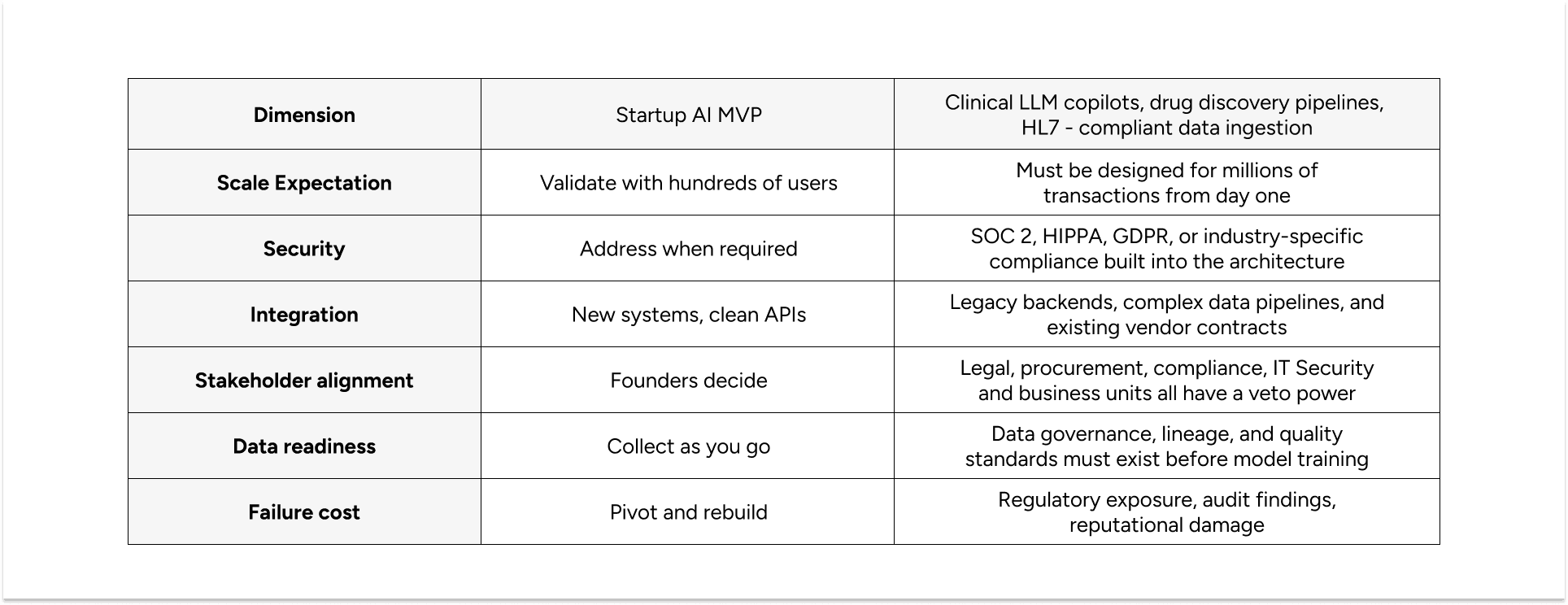
Large enterprises operate with established infrastructure, strict compliance requirements, and complex stakeholder interests. The startup approach to building an MVP, with its focus on speed above all else, is often not a viable model.
The implication is direct because enterprise AI MVPs require architecture decisions at the start that a startup would defer until later. Deferring them in an enterprise context creates a rebuild.
The 5 Stages of AI Maturity in the Modern Enterprise
Most enterprises treat AI maturity as binary: either you have AI, or you do not. The reality is a sequence of stages, and skipping stages is the most reliable way to waste the investment.
Each stage has different success criteria. Treating a pilot like a prototype, or a prototype like a production system, produces the failure modes that show up in the statistics at the top of this post.
Stage 1: Prototype (Idea Validation)
Prove the technical concept in a controlled environment. The question at this stage is whether the AI can do what you think it can do, using your data, in your context. Success means a working demonstration — not a production system.
Stage 2: MVP (Market Validation)
Prove that the AI solves a real problem for real users at a small scale. Architecture decisions made here determine whether Stage 3 is an engineering project or a rebuild. While the MVP is minimal, the architecture should still be designed for what comes next.
Stage 3: Pilot (Controlled Scaling)
Deploy to a defined subset of users or a single business unit. This is where integration complexity, compliance requirements, and data pipeline reliability get tested against real conditions. Most enterprise AI projects stall or die here.
Stage 4: Production (Enterprise Rollout)
Increase deployment throughout the company with comprehensive monitoring, SLAs, and support systems in place. Accomplishing this requires MLOps capabilities such as monitoring, drift detection, and incident management that MVP designs usually do not have built into their initial design.
Stage 5: Scale (Global Optimization)
Scale implementation across regions, business units, or additional use cases. Reuse core components across AI initiatives wherever possible. Organizations that reach Stage 5 approach AI as a platform capability instead of a set of individual projects.
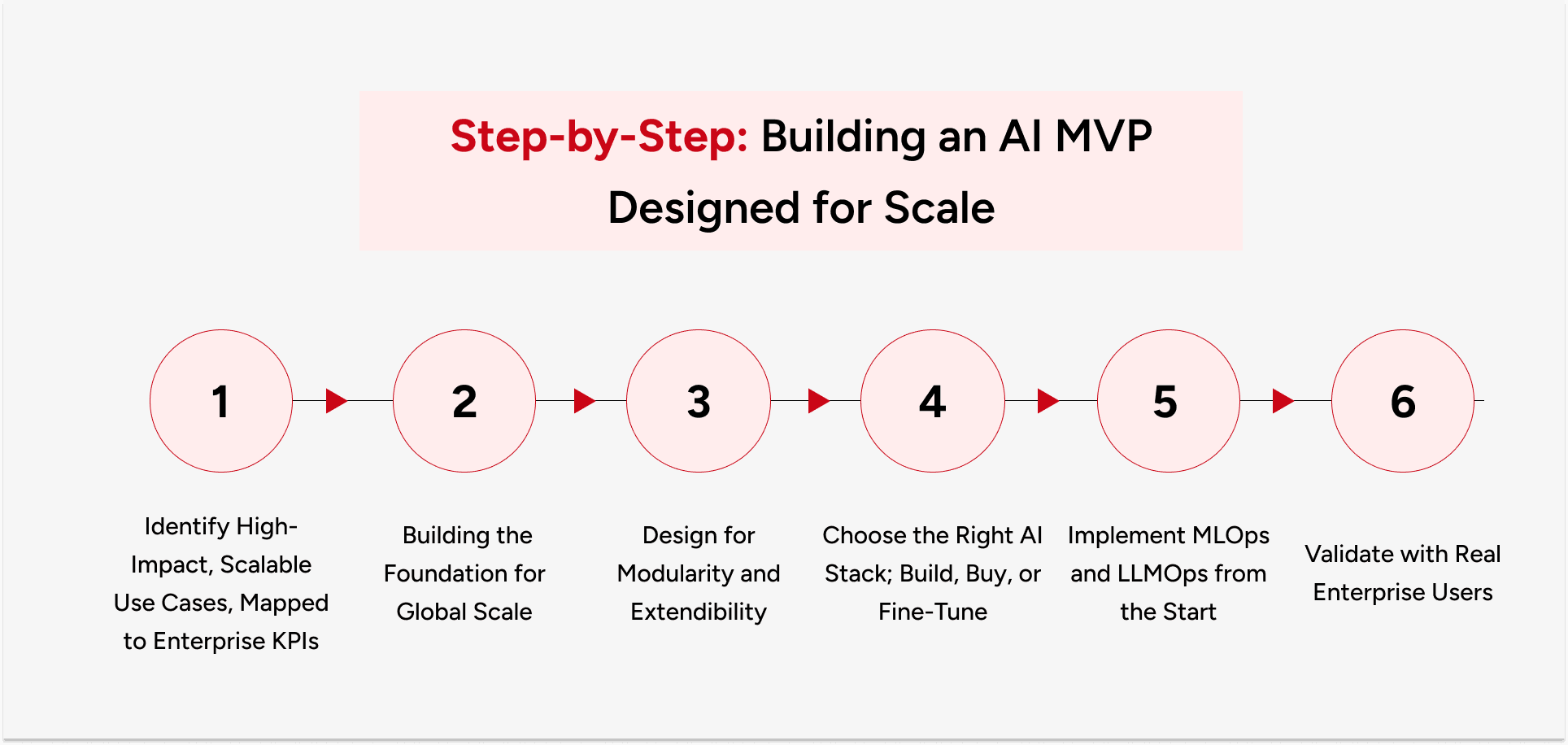
Step 1: Identify High-Impact, Scalable Use Cases, Mapped to Enterprise KPIs
The most common mistake at this stage is selecting a use case because it is technically interesting. The question that matters is whether solving this problem moves a metric that the business is accountable for.
Map every candidate use case to one of three categories:
- Revenue Impact: Is it about converting more people, reducing churn, or developing a new stream of revenue?
- Cost reduction: Is it about removing manual intervention, reducing errors, or lowering operational costs?
- Customer experience: Is it about cutting down resolution times, improving accuracy, or making a crucial journey frictionless for customers?
Any use cases that cannot be quantified through a KPI will not make it through the business case process during the piloting phase; all you have is a demonstration.
For enterprise specifically, add a fourth filter: can this use case clear compliance review? A high-impact use case that requires handling data in a way the compliance team will not approve is not a viable starting point.
Step 2: Building the Foundation for Global Scale
Your MVP’s architecture acts as the ceiling for its future growth. You need a four-tier blueprint to succeed. Start with the Data Layer, where rigorous ingestion and quality controls ensure long-term reliability. Next, select a Model Layer that aligns with your specific latency and budget constraints.
The Application Layer ensures the AI integrates naturally into employee workflows through robust API design and fallback behaviors. Finally, the Integration Layer identifies every touchpoint with legacy systems. Addressing these connections early prevents the pilot purgatory that typically kills 80% of corporate AI initiatives.
Step 3: Design for Modularity and Extendibility
As more users use your product, developers move to modular and extensible coding rather than a monolithic MVP approach. They achieve greater flexibility, faster release cycles, and cost efficiency once systems start scaling up. Specifically, this means: API-first development: Any function is accessible via an API, so individual components are easily changeable, upgraded, or even reused elsewhere.
Microservice architecture: Data processing, machine learning algorithms, and other application layers continue to operate independently from each other and can be scaled or updated without having to restart the entire system. Model layers are flexible: The platform isn’t limited to using just one algorithm. If necessary, developers can swap it for another.
Step 4: Choose the Right AI Stack; Build, Buy, or Fine-Tune
This decision affects cost, control, compliance, and long-term maintenance burden. There is no universally correct answer. There is only the answer that fits your use case, your data, and your regulatory environment.
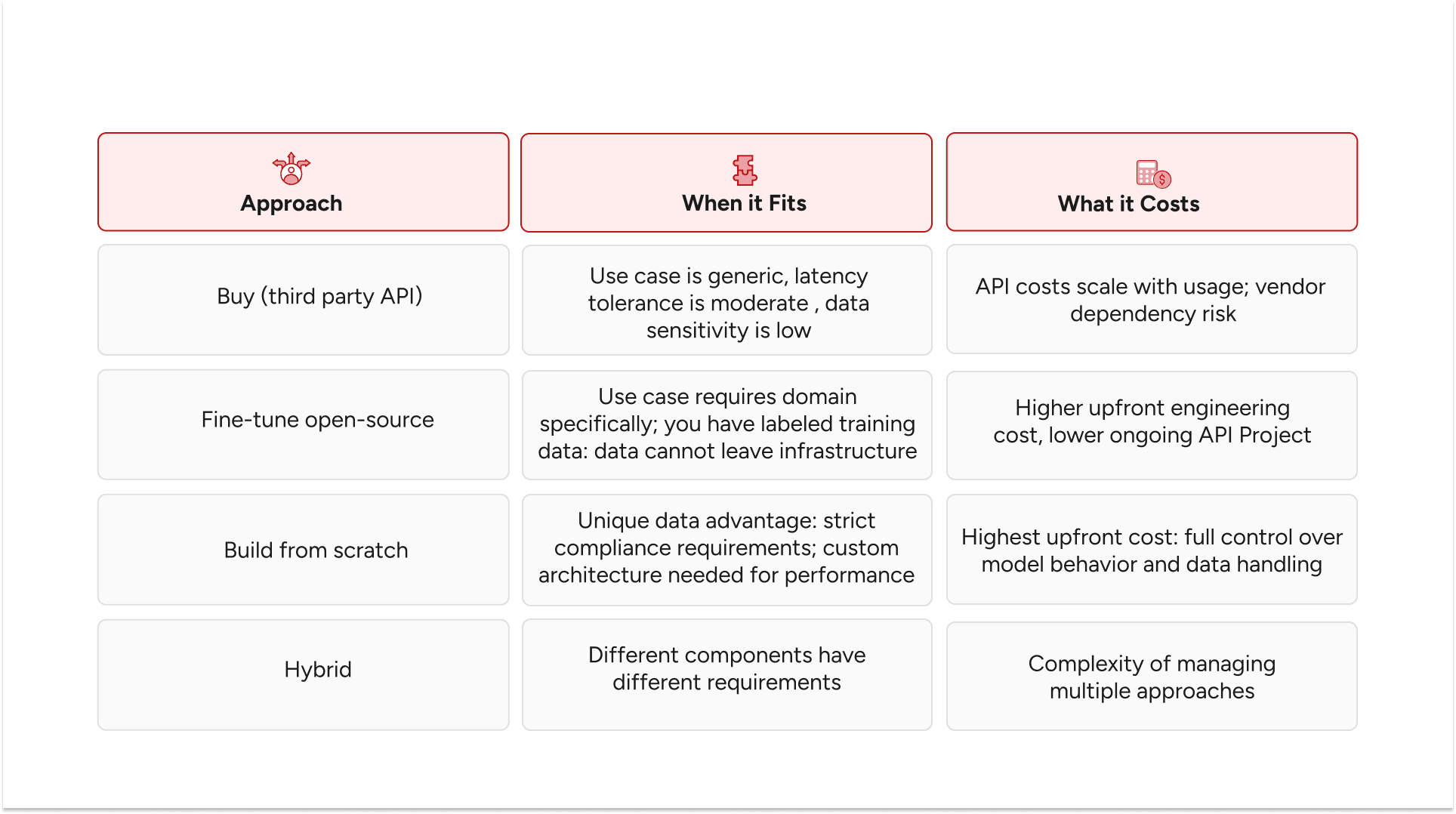
For regulated industries, the data handling implications of each approach matter as much as the performance characteristics. A model served through a third-party API that processes patient records or financial transactions has different compliance implications than a self-hosted model.
Step 5: Implement MLOps and LLMOps from the Start
The most common and expensive deferral in enterprise AI development is treating MLOps as a post-launch problem. It is not.
Production AI systems require:
- CI/CD for AI: Automated processes for retraining, testing, and deploying models with the same level of diligence as software code.
- Model monitoring: Monitoring the model’s output continuously for quality criteria beyond just uptime to ensure that it continues to perform accurately and effectively.
- Drift detection: Models degrade as the real-world data they operate on changes. Drift detection identifies when a model's performance has degraded to the point where retraining is required, before users notice the quality drop.
- Rollback capability: The ability to revert to a previous model version when a new deployment underperforms, without system downtime.
Teams that defer these capabilities build systems that work at launch and fail silently over the following months.
Step 6: Validate with Real Enterprise Users
Synthetic testing tells you whether the system works as designed. Real users tell you whether it works for the problem it was designed to solve.
For enterprise AI, real-user validation requires structured feedback loops:
- Define success metrics before the pilot begins, so evaluation is against agreed criteria, not impressions.
- Capture failure cases systematically, where does the model produce outputs that users override, ignore, or escalate?
- Build iteration cycles into the pilot timeline. A pilot that runs for eight weeks with no mechanism for incorporating feedback is a demonstration.
Reference Architecture: AI MVP to Enterprise Production
The architecture that connects an MVP to a production enterprise system has five components that must be designed, not assembled after the fact.
RAG Pipeline: Retrieval Augmented Generation links the model to your organization’s knowledge base — private documents, catalogs, historical data — so that model outputs are informed by your data instead of the general training data. This is especially critical in highly regulated industries since hallucinations from the model can lead to regulatory non-compliance issues.
Vector Database: This stores embeddings for semantic search and retrieval. There are three primary vector databases that organizations typically utilize in their production environments — Pinecone, Weaviate, and pgvector. It will determine how quickly queries can be made, how frequently vectors are updated, and how the vector database is hosted.
API Gateway: It manages authentication, rate-limiting, routing, and logging of all AI service API requests. It is the interface through which the AI capability is surfaced in an organization.
Model Serving Layer: This manages model deployment, versioning, and routing traffic. In large-scale enterprise settings, it must enable A/B testing among models, canary deployments, and failover support.
Monitoring Tools: These are responsible for monitoring the health of both the system (latency, error rate, throughput) and the model itself (accuracy, drift, quality of outputs). Sentry, Datadog, and New Relic manage the former, but model-specific monitoring tools are required for the latter.
What Enterprises Must Budget for When Scaling AI
The gap between building an AI demo and running a production AI product is where most cost overruns live.
Cost Category | MVP Stage | Production Stage |
|---|---|---|
Infrastructure (cloud/GPU) | $5K–$20K | $40K–$200K+/year |
Model costs (API vs self-hosted) | $2K–$15K | $30K–$150K+/year |
MLOps tooling | Often skipped | $20K–$80K/year |
Data engineering | $10K–$30K | $50K–$200K+/year |
Talent | 2–4 engineers | 6–15+ engineers |
Compliance and security | Light | Significant |
Total MVP | $80K–$180K | — |
Total Production | — | $200K–$450K+ |
The planning implication is direct: if the production budget was not part of the AI MVP business case, the organization is likely to face a budget conversation at exactly the moment when the pilot has validated the use case, and the pressure to move fast is highest.
The Decisions That Kill AI Scaling — and the Stage They Show Up
The failure modes in enterprise AI are not random. They follow patterns.
Over-engineering the MVP
Adding capabilities to the MVP that are not needed to validate the core hypothesis delays the pilot, increases cost, and produces a system that is harder to change when the pilot reveals that some assumptions were wrong. The MVP should be minimal in scope and maximal in architecture quality.
Deferring infrastructure decisions
The organizations that clear the failure statistics treat AI implementation as a capability-building exercise rather than a technology deployment. Infrastructure — data pipelines, monitoring, serving architecture — is the capability. Deferring it produces a demo that cannot be operationalized.
No model monitoring in production
Models degrade. Data distributions shift. User behavior changes. A production AI system with no monitoring is a system that degrades silently until a user or an auditor notices the problem. By that point, the damage is done.
No clear ownership
Enterprise AI systems require clear ownership across three dimensions: the model (who is responsible for performance and retraining), the data (who owns quality and governance), and the application (who is responsible for the user experience and business outcomes). When ownership is unclear, issues fall between teams and compound.
Real-World Enterprise AI MVPs That Reached Production
Fraud detection
PayPal's AI fraud detection processes over 19 billion transactions annually, blocking $6 billion in fraudulent activities with 99.5% accuracy. The architecture that makes this possible — real-time transaction scoring, behavioral pattern analysis, continuous model retraining — was not built as a feature. It was designed as the system from the start.
87% of global financial institutions have now deployed AI-driven fraud detection systems, up from 72% in early 2024. The institutions that deployed successfully built data pipelines and model monitoring infrastructure before they built the model.
Customer support AI
Enterprise customer support AI that reaches production is built on a RAG architecture that grounds the model's outputs in the organization's actual documentation, policies, and historical resolution data. The failure mode, a model that gives confident but wrong answers, is an architecture problem, not a model problem. Systems that do not ground outputs in verified enterprise knowledge are not suitable for production deployment in a regulated or customer-facing context.
AI recommendation engines
At GeekyAnts, we built a scalable meal recommendation backend using machine learning to adapt recipes based on real-time pantry inventory — supporting a library of 3,000+ recipes with instant updates. The result: a 40% reduction in meal decision time and a 2x increase in daily active usage during pilot. The architecture that enabled this was modular from the start — the recommendation engine, the inventory sync layer, and the user preference model were built as separate components with clean APIs between them.
How GeekyAnts Helps Enterprises Scale AI from MVP to Production
From AI MVP to AI Platform Strategy
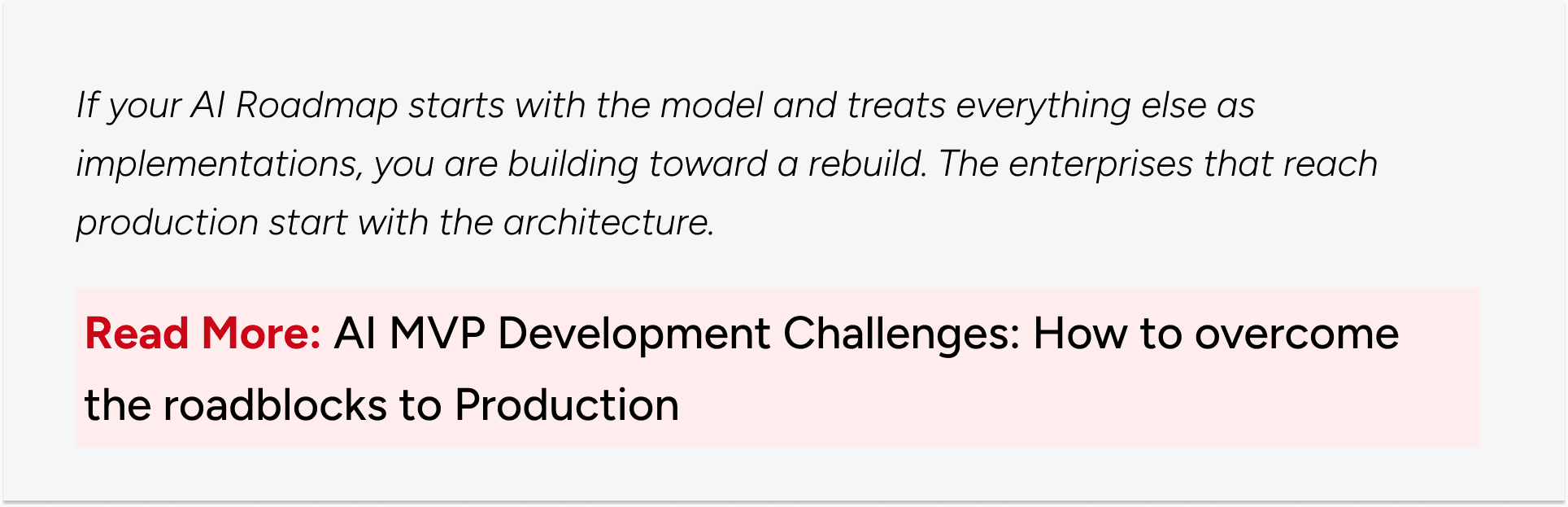
Most AI consulting engagements start with the model. We start with the architecture.
Our AI Pods model is built specifically to close the gap between prototype and production — the stage where most enterprise AI initiatives stall. We bring platform engineering and AI engineering together in a single team, so the infrastructure that makes an AI system production-ready is not an afterthought built by a different group after the model is finished.
What this means in practice:
- Architecture that survives the pilot. We design for the production state from the MVP stage — data pipelines, serving infrastructure, monitoring, and compliance requirements are scoped and designed before implementation begins.
- Platform engineering is built in. AI systems require the same infrastructure rigor as any production software. Our teams cover MLOps, cloud infrastructure, and system integration alongside model development.
- Enterprise-grade delivery. We have shipped AI systems in fintech, healthcare, construction, and enterprise SaaS environments with real compliance requirements, legacy integration complexity, and stakeholder alignment challenges.
Sources & Citations:
- McKinsey & Company – Global AI investment trends
- S&P Global Market Intelligence – Enterprise AI adoption survey
- Informatica – CDO Insights Report
- Gartner – AI maturity & data foundations
- MIT Technology Review
- IBM – AI and legacy integration insights
- FinOps Foundation
- European Commission – EU AI Act
- Forbes Technology Council
- PayPal AI fraud detection insights
- GeekyAnts Case Studies
The question we always ask before we write a line of code is: what does this system need to look like in 18 months? Because the architecture decisions you make at the MVP stage are the ones you live with at production.
 Kumar PratikFounder & CEO
The organizations at Stage 5 of the maturity model are not managing a collection of AI projects. They are operating an AI platform — a set of reusable components, shared data infrastructure, and internal capabilities that can be applied to new use cases without rebuilding from scratch each time.
The path to that state starts with how the first MVP is built. Every architectural decision made during MVP development either contributes to a reusable platform or creates technical debt that has to be retired before a platform can be built.
Build the first system right. The second one will be faster. The third one is faster still.
Step-by-Step: Building an AI MVP Designed for Scale
"The teams that build AI systems that actually reach production start with a different question than everyone else. They ask what the business needs to be true in two years, and then they work backward to the architecture."
— Kumar Pratik, Founder and CEO, GeekyAnts