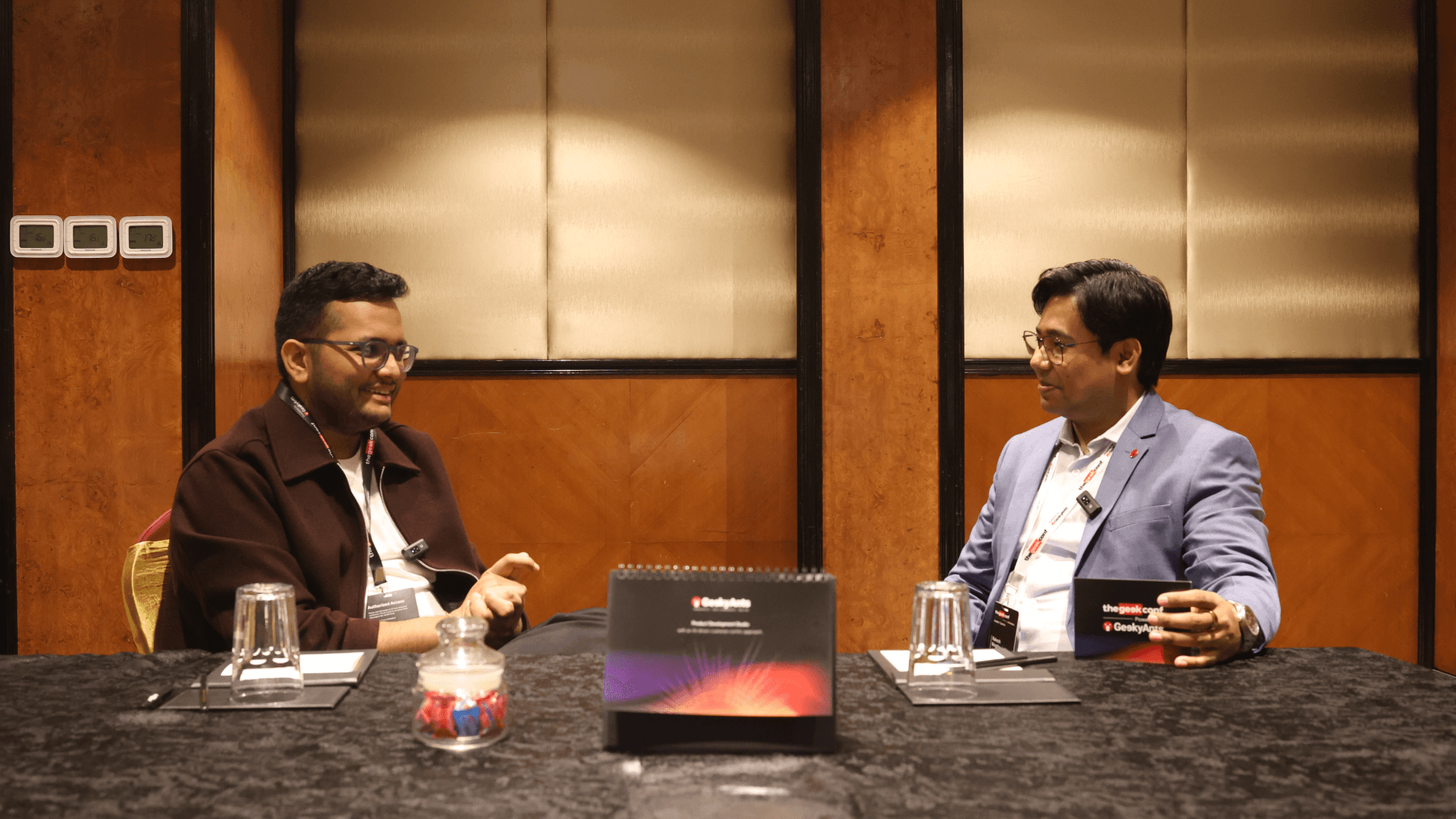

Editor’s Note: At thegeekconf 2025, Arsh Goyal, AI enthusiast and engineer, met with Rakesh Ningthoujam, Head of Growth Marketing at GeekyAnts, to discuss the reality of vibe coding—the practice of using AI to rapidly build prototypes— and its impact on software development. While AI tools have made rapid prototyping more accessible, Arsh Goyal argues that scaling a product for the global stage still requires solid engineering skills. From the AI tools he relies on to his advice for aspiring developers, Arsh offers practical guidance for navigating an industry transformed by AI.
RN (Rakesh Ningthoujam): As an influencer and an engineer, you are likely reviewing new technology constantly. Which specific AI capability or tool are you personally using the most right now?
Arsh Goyal (AG): There are so many use cases now for writing, reviewing, and migrating code. I explore almost everything that comes out to see how it improves on the previous version. For core development, I use Cursor and Claude extensively across different use cases. I also look at how companies build MCPs (Model Context Protocols) and how to integrate them into various projects. For testing, I use TestSprite to automate test cases. On the content side, Gamma is great for presentations, and Napkin helps create the illustrations I need.
RN: What about "vibe coding" platforms—tools where you can just put an idea in front of people quickly?
AG: Those vibe coding tools like Lovable or Replit are very good for quick POCs (Proof of Concepts). If you have an idea and want to build a beta version to float among 50 or 100 users for feedback, it’s a great phase.
RN: Once you’ve "vibe coded" a POC, how do you move that to something scalable that works in production?
AG: Solid engineering is still required to solve for scale. AI has become much better at generating UIs—I don't have to write nearly as much HTML or CSS myself anymore—but you can't trust these automated tools with a massive user base yet. Tools like Riff (formerly Databutton) can integrate your database and handle backend tasks, and they are great for a pitch, but you still need a solid engineering team to scale to thousands of users.
RN: What percentage of that initial AI-generated code actually survives in the final production-grade product?
AG: It varies by project. For a major B2B use case, it might be less than 20%. For others, it could be 30% to 40%. You can tweak the frontend—the images and the content—but for the global market, you absolutely still need proper systems architects.
RN: Does that mean the "one-person company" built purely on vibe coding is a myth?
AG: It has been happening, and some are doing good revenue, but those founders usually have an engineering background. They aren't just vibe coding blindly; they either have that knowledge themselves or are getting deep technical consultation. If you don't understand the "in and out" of scaling, you risk security vulnerabilities and losing customer data. Craftsmanship is still vital.
RN: For the new generation of developers who have free access to Gemini, Perplexity, and ChatGPT, what should their approach be to stay relevant?
AG: Access to information is now very quick and refined—Deep Research models can pull from books and the internet in minutes—but people in India aren't using these tools to their full advantage yet. You can take information from a GPT, but you need strong engineering fundamentals to actually execute on it. Otherwise, using that information becomes a challenge.
RN: Is there a risk that our ability to search and think is being diminished because the AI does the "heavy lifting" of research?
AG: There are studies claiming that human thinking power might reduce. Five years ago, a person would write an essay themselves; now, they might struggle to do it without help. We have to take it with a pinch of salt. The goal is to use AI to learn better and save time for the "best things" we are meant to do.
RN: If you were starting your first year of engineering college today, what roadmap would you follow?
AG: I would still focus on the fundamentals of programming. You should learn a programming language like C or C++, but use AI to refine the process so you can learn Data Structures and Algorithms faster. Solid problem-solving skills are not going away soon; tech companies are still hiring based on them because if you are a good problem solver, you can easily learn to use AI to solve for a specific company. When it comes to development, you should learn the fundamentals of HTML, CSS, and JavaScript, but use AI to assist with UX designs and participate in hackathons to see how things work in the real market. Finally, don't just use the tools; go into the Machine Learning and Deep Learning route to understand the math behind the algorithms, as that deep fundamental knowledge is what separates a researcher from a tool user.
RN: Which designation do you think will be the most popular over the next two years?
AG: Forward Deployed Engineer and MLOps Engineer. A Forward Deployed Engineer is someone who knows the project from start to finish—they know the AI use cases, but they also know how to get them into production and scale them.
RN: How would you summarize the pulse of the market right now in one word?
AG: It's exciting, but a bit chaotic.