

Key Takeaways
- A production-ready AI telehealth platform goes beyond video consultations to deliver remote monitoring, intelligent triage, patient engagement, and secure EHR integrations working as one clinical workflow.
- AI in telehealth app development is an infrastructure decision, and enterprises that treat it as a bolt-on will face compliance gaps and scalability ceilings.
- The highest-impact investments in telehealth app development are in inference reliability, audit-ready data architecture, and clinical governance.
- Production-ready AI telehealth products require deliberate sequencing of use cases, architecture, and compliance controls from day one.
The global telehealth market was valued at $123.26 billion in 2024 and is on track to reach $455.27 billion by 2030, growing at a CAGR of 24.68%, according to Grand View Research. That growth is being driven by the demand for continuous, integrated, AI-enabled care delivery at scale.
According to the American Medical Association, 66% of physicians were using AI in their practice by 2024, up from 38% in 2023. In the same year, 71.4% of physicians reported using telehealth on a weekly basis. On the patient side, a McKinsey Consumer Health Insights survey conducted in November 2021 found that 55% of patients reported greater satisfaction with telehealth compared to traditional in-person appointments, and 40% to 60% expressed interest in broader telehealth solutions beyond video visits.
The deals that stall in healthcare are the ones where the product lacks evidence. Enterprise health systems want to see compliance documentation, audit trails, and clinical validation before they sign. The teams that come to us after losing a procurement cycle almost always say the same thing: we built the product, but we did not build the trust infrastructure around it. That is what production readiness actually means in healthcare.
 Kunal KumarChief Revenue Officer
At GeekyAnts, the majority of healthcare product teams that approach us are carrying a telehealth product that has cleared a pilot but cannot clear enterprise procurement. The blockers are consistent across engagements: compliance documentation that was not built into the architecture, EHR integration that was scoped for the demo but not for production, and an AI layer that has no governance framework around it. The gap between a working prototype and a production-ready telehealth platform is where most healthtech investments stall, and it is the gap GeekyAnts is built to close.
Global private sector investment in digital health reached $25.1 billion in 2024, according to McKinsey. Investors and health systems are funding telehealth as core clinical infrastructure. The implication for product teams is direct: a telehealth product that cannot handle real clinical workflows, audit requirements, EHR data exchange, and regulatory scrutiny will not survive enterprise procurement.
This guide is written for healthcare enterprises modernizing care delivery, hospital networks expanding virtual care programs, provider groups building scalable clinical workflows, payer platforms managing population health, and growth-funded healthtech startups preparing for enterprise sales. If you are deciding what to build, how to prioritize, or whether your current telehealth product is ready to scale, this guide gives you a decision framework grounded in production engineering.
The sections ahead cover the full product surface of a production-ready AI telehealth platform: the architecture principles that separate scalable systems from brittle ones, AI triage design that keeps clinicians in control, patient engagement systems tied to measurable care outcomes, EHR and device integrations that drive enterprise adoption, HIPAA compliance and AI governance frameworks that accelerate procurement, and the team model that delivers all of it without overbuilding.
Video Consultations Are the Baseline: What a Production-Ready Telehealth Product Does After the Call Ends
A video consultation marks a checkpoint in a patient's care journey. For patients managing chronic conditions or complex medication regimens, the period between appointments is where care either holds or breaks down. A telehealth product built only around scheduled video visits cannot address that reality.
Video consultations are now the baseline expectation in digital healthcare. According to the American Medical Association, 71.4% of physicians used telehealth on a weekly basis in 2024. What separates a commodity telehealth tool from a production-ready care platform is what happens between those consultations.
The Care Gap Problem
The most significant clinical failures in telehealth occur after the appointment. Chronic care follow-up, symptom monitoring, medication adherence, asynchronous check-ins, patient education, and care-team alerts all require infrastructure that video calls cannot support. Research on chronic gastrointestinal conditions found that prescription fill rates for telehealth patients reached 92.2%, compared to 81.6% for in-person visits. Data cited by the University of Pittsburgh Medical Center found that RPM reduced hospital readmission rates by 76%. These outcomes require clinical workflows where patient data flows from monitoring devices into care-team dashboards, triggers alerts based on risk thresholds, and closes the loop on decisions made during the consultation.
Enterprise and Startup Relevance
For enterprises, this means workflow integration across care plans, monitoring data, and clinical alerts, driving operational efficiency and care continuity.
For startups, asynchronous check-ins, medication reminders, and post-visit education modules are what drive retention and produce the measurable outcomes enterprise buyers require.
AI makes this scalable as the infrastructure that connects every post-consultation touchpoint into one continuous care workflow.
What to Build First: A Decision Framework for AI Telehealth Product Teams
Most telehealth product teams fail because they tried to build too many things at once without a clear sense of which capability would deliver the most value for their specific buyer, clinical context, and stage of growth.
This framework converts AI telehealth use cases into a prioritization decision. Use it to determine what to build first, what to defer, and what your ICP actually needs before you commit engineering resources.
Business Problem | Best-Fit Module | Buyer Value | Complexity | Risk Level | Ideal ICP |
|---|---|---|---|---|---|
High readmission rates | Reduced costs, better outcomes | Medium | Medium | Enterprises, hospital networks | |
Long wait times, intake inefficiency | AI Triage | Faster routing, lower clinical risk | High | High | Enterprises, provider groups |
Low medication adherence, poor follow-up | Patient Engagement | Retention, care plan completion | Low | Low | Startups, payer platforms |
Clinical documentation burden | AI Documentation | Physician time savings, EHR accuracy | Medium | Medium | Provider groups, startups |
Fragmented patient data across systems | EHR Integration | Interoperability, enterprise readiness | High | Medium | Enterprises, hospital networks |
Care team coordination gaps | Provider Dashboards + Care Coordination | Workflow efficiency, utilization | Medium | Low | Enterprises, provider groups |
For Enterprises
Enterprise buyers evaluate telehealth products against four non-negotiable criteria: workflow integration, risk controls, interoperability, and auditability. A product missing EHR connectivity, audit logs, and documented risk escalation protocols will not clear procurement. Prioritize EHR integration and compliance infrastructure before expanding the product surface.
For Startups
The most common mistake growth-funded healthtech startups make is building a broad feature set before validating a single use case with measurable ROI. Pick one high-value module, such as AI triage or patient engagement, validate it with a pilot, document the outcomes, and use those outcomes to open enterprise sales conversations. The path from MVP to scale runs through proof.
The Architecture Decisions That Separate a Scalable AI Telehealth Platform From One That Fails in Production
Most telehealth products fail because architecture decisions made during early development create ceilings that cannot be raised once the product is in clinical use. Production readiness in AI telehealth products is a set of deliberate decisions made before the first line of code is written.
Production readiness in healthcare is about the decisions you make before you write the first line of code. Every architecture choice, from how you structure your backend services to how you monitor your AI outputs in production, either builds clinical trust or erodes it. The teams that treat architecture as a business decision from day one are the ones that ship products clinicians actually use and enterprises actually buy.
 Manav GoelPrincipal Technical Consultant.
One pattern I have seen repeatedly in telehealth product builds is teams that treat Security as a post-launch concern. The AI model is solid, the clinical workflows are mapped, but observability, rollback procedures, and inference layer separation are deferred. The product performs well in a controlled environment and struggles the moment real patient data and clinical load are applied. Retrofitting production-ready infrastructure into an existing telehealth product always costs more than building it right the first time, in both engineering hours and clinical confidence.
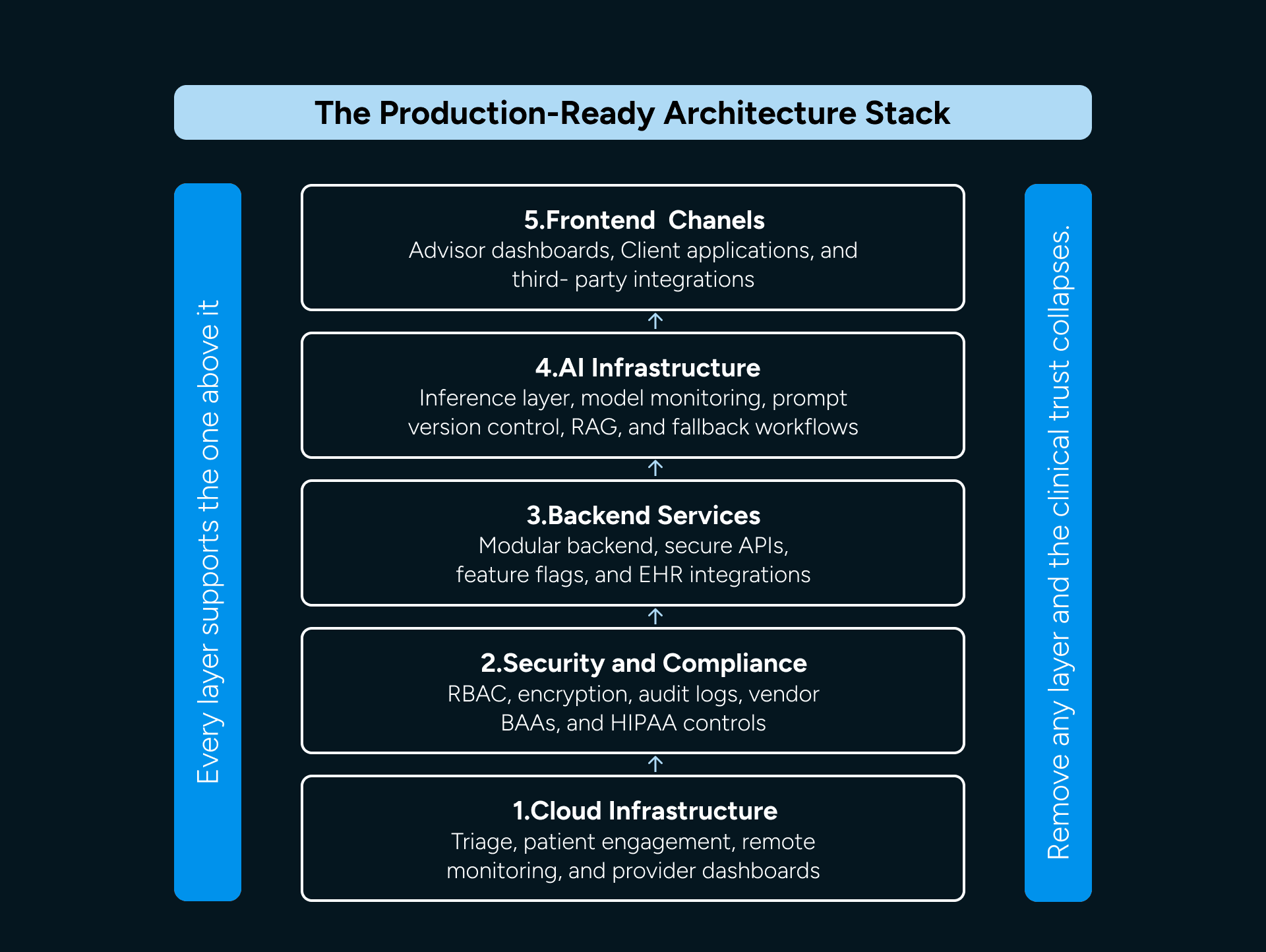
Backend and Infrastructure Checklist
- Modular backend with clearly separated services for clinical data, AI inference, user management, and integrations, so individual components can be updated without system-wide risk.
- Secure APIs with authentication, rate limiting, and input validation at every endpoint.
- Scalable cloud infrastructure with auto-scaling policies tied to patient load, not static capacity estimates.
- Role-based access control (RBAC) defining what each user type, clinician, patient, administrator, and payer, can access and modify.
- Immutable audit logs capturing every clinical action, data access event, and system change for compliance and liability protection.
- CI/CD pipelines that automate testing and deployment so updates reach production without manual error risk.
- Feature flags allowing specific capabilities to be enabled or disabled per user group without a full deployment cycle.
- Observability stack covering logs, metrics, and distributed tracing so engineering and clinical teams can identify failures before patients are affected.
- Rollback plans for every deployment with documented recovery procedures and tested restoration timelines.
AI-Specific Architecture Checklist
- Inference layer designed for low latency with defined SLAs, because a delayed triage response is a patient safety issue.
- Model monitoring tracking accuracy, drift, and output distribution in production.
- Prompt and version control treating every prompt change as a code change, with review, testing, and rollback capability.
- RAG where the product requires source-verified responses such as clinical protocol lookups or medication guidance, reducing hallucination risk in high-stakes interactions.
- Evaluation pipelines running automated tests against clinical scenarios before any model update reaches production.
- Fallback workflows routing to human clinicians when AI confidence falls below a defined threshold.
- Latency planning with defined response time budgets per use case, triage, engagement, and documentation each carry different tolerance levels.
- AI cost monitoring tracking inference spend per feature so teams can optimize without cutting clinical capability.
A Note on Microservices
Microservices introduce operational complexity and significant DevOps overhead. Unless there is a clear case for independent scaling, separate compliance boundaries, or multi-team deployment autonomy, a well-structured modular monolith delivers the same clinical reliability with lower operational risk and faster time to market.
Why Architecture Is a Business Decision
UX decisions must be tied to backend architecture from the start. A clinician-facing dashboard that cannot render real-time monitoring data because the backend lacks a proper event-streaming layer is an architecture problem. Audit logs determine whether you pass enterprise procurement. Fallback workflows determine whether clinicians trust the product. Rollback plans determine whether a failed deployment becomes a patient safety incident or a contained engineering event. Production readiness is the infrastructure that makes clinical trust, enterprise sales, and regulatory compliance possible.
AI-Powered Triage in Telehealth: How to Reduce Wait Times Without Compromising Clinical Safety
Research published in peer-reviewed journals shows that AI-based triage systems outperform conventional methods in diagnostic precision and time efficiency. The real question for product teams is whether AI triage can be deployed safely at scale without introducing new clinical risk.
The answer depends on how the product is designed.
How AI Triage Works in a Clinical Workflow
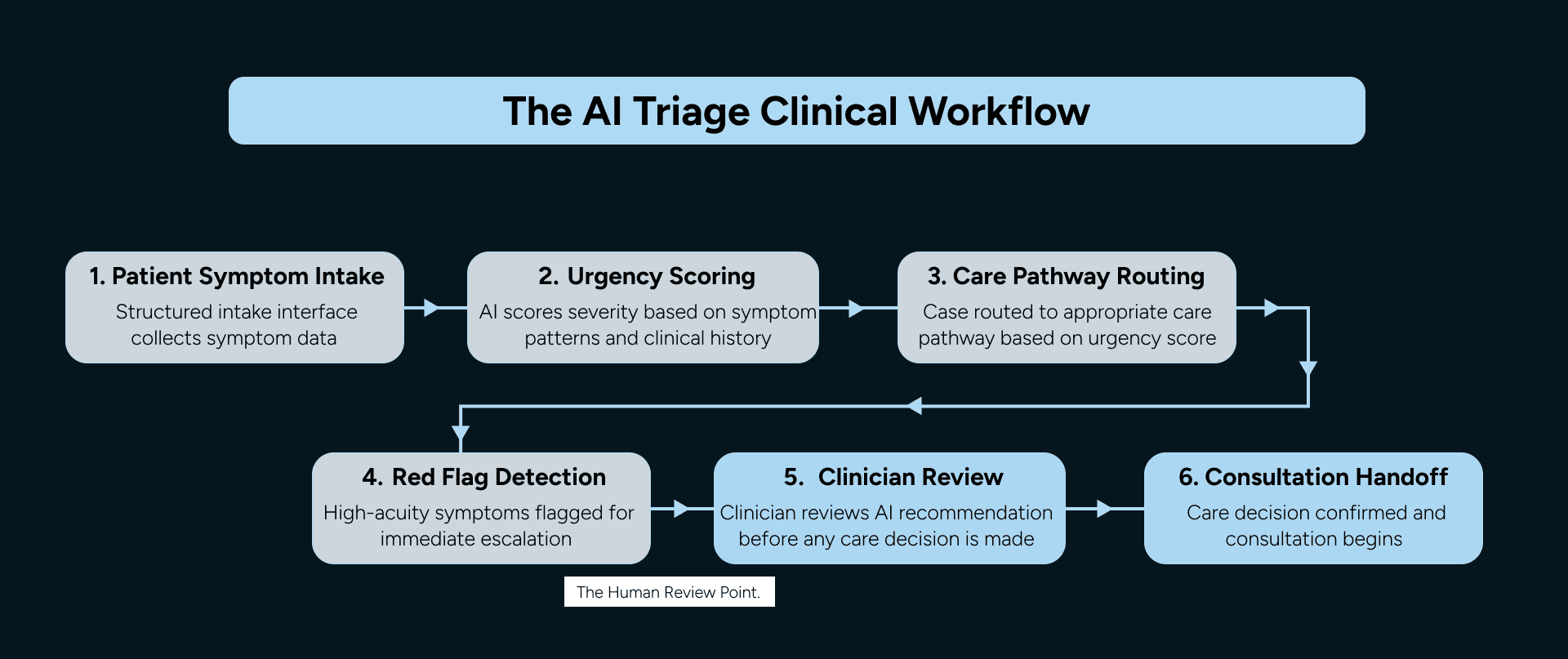
AI triage in a telehealth product is clinical decision support structured around a workflow that keeps the clinician in control at every stage.
A patient submits symptoms through a structured intake interface. The AI scores urgency, routes the case to the appropriate care pathway, flags red-flag indicators for escalation, and hands off to a clinician for review before any care decision is made. A product that positions itself as decision support with documented escalation logic, transparent confidence scoring, and clinician override capability will earn clinical adoption because it works with clinical judgment.
Safety Guardrails That Cannot Be Optional
- Human-in-the-loop review at every routing decision with clinician override capability and documented rationale.
- Confidence thresholds that trigger automatic escalation when AI certainty falls below a defined level.
- Red-flag detection with zero tolerance for missed escalation on high-acuity symptoms.
- Audit logs capturing every intake event, AI recommendation, clinician override, and routing outcome.
- Escalation rules defined by clinical protocol.
- Bias monitoring tracking performance across patient demographics and language groups.
- Clinical validation conducted against real patient cohorts before deployment.
Every AI triage system I have worked on has a moment where the model encounters a case it was not trained for. Confidence scoring tells you when that moment is happening, escalation logic determines where that case goes next, and human review ensures a clinician makes the final call before it reaches the patient. These three elements are not add-ons to an AI triage system. They are the clinical safety boundaries that determine whether the system is safe to operate in a healthcare environment.
Manav GoelPrincipal Technical Consultant.The most consistent gap I see in AI triage implementations is the absence of a clearly defined confidence threshold. Teams deploy a triage model, it performs well on benchmark datasets, and the assumption is that it will perform the same way on real patient inputs, but it does not. Real symptom data is messier, more ambiguous, and more varied than any training set. Without a confidence scoring layer that triggers human review when the model is uncertain, that ambiguity gets routed as a decision. In a clinical environment, an uncertain AI recommendation that reaches a patient without clinician review is not a product limitation. It is a safety boundary violation.
Enterprise and Startup Relevance
For enterprises, a governed AI triage system reduces patient wait times, cuts intake processing time for care teams, and produces an auditable record of every routing decision. These outcomes reduce liability exposure, satisfy governance requirements during procurement, and improve care team utilization without adding clinical headcount.
Safe AI triage positioning is a direct sales asset for growth-funded healthtech startups. Enterprise buyers do not purchase triage tools without documented safety guardrails. A startup that can demonstrate confidence thresholds, bias monitoring, and clinician override protocols has a procurement conversation that competitors without those features cannot have.
Beyond Reminders: How AI-Driven Patient Engagement Systems Improve Care Outcomes at Scale
Patient engagement in AI-powered telehealth is improved through personalized reminders, educational content, care-plan nudges, and follow-up communications tailored to each patient's condition, risk profile, behavior patterns, language preferences, and care history. The World Health Organization estimates that 50% of patients with chronic diseases in developed countries do not follow their prescribed treatment recommendations. Patients disengage between appointments, miss medication schedules, and lose connection to their care plans, and when that happens, care quality deteriorates regardless of how strong the clinical intervention was during the consultation. A telehealth product that does not address this gap is a scheduling tool.
AI-driven patient engagement systems close that gap by making continuous, personalized communication operationally feasible at scale.
What an AI Patient Engagement System Does
A production-ready engagement system covers the full post-consultation journey: automated appointment reminders, medication nudges, asynchronous check-ins, AI chatbot support, care plan delivery, educational content, and post-visit follow-ups. These are coordinated touchpoints that keep patients connected to their care plan between clinical interactions, directly supporting care quality by reducing the behavioral gaps that lead to poor outcomes.
AI personalizes each touchpoint based on the patient's condition, risk level, care plan stage, language preference, accessibility needs, and prior engagement history. A diabetic patient with low adherence history receives different nudges at different intervals than a post-surgical patient in week two of recovery.
Product Metrics That Matter
Engagement systems must be measured against clinical and operational outcomes. The metrics that matter are activation rate, appointment completion rate, medication adherence rate, message response rate, CSAT, retention, and care-plan completion rate. These are the numbers enterprise procurement teams evaluate when assessing population health impact.
Enterprise and Startup Relevance
For enterprises, AI-driven engagement connects to population health management. Higher adherence rates reduce emergency utilization. Better care-plan completion improves chronic disease outcomes, contributing to care continuity, care quality, and operational efficiency.
For startups, engagement features drive product retention and stickiness. A telehealth product with documented adherence improvement and care-plan completion rates has a buyer value proposition that a video-only platform cannot match.
EHR Integration, Device Connectivity, and Interoperability: What Enterprise Telehealth Adoption Actually Requires
A telehealth product that cannot connect to a health system's existing clinical infrastructure stops at the procurement stage. Integration is a workflow requirement that determines whether clinical teams can do their jobs without switching between disconnected systems, and an adoption requirement that determines whether the product gets used at all.
According to the 2025 State of FHIR Survey conducted by HL7 International and Firely, 78% of surveyed countries now have regulations governing electronic health data exchange, and 73% of those regulations explicitly mandate or recommend FHIR usage, up from 65% in 2024 and 56% in 2023. A telehealth product without FHIR-compliant APIs is not interoperable by current standards.
What Integration Covers
A production-ready AI telehealth product must connect across the full clinical workflow: EHR and EMR systems for patient records and clinical history, patient portals, scheduling and workflow management systems, e-prescription platforms, lab result feeds, wearables and connected medical devices for remote monitoring data, payment systems, CRM tools, and clinical support platforms. FHIR serves as the data exchange standard that makes these connections reliable, secure, and scalable across different vendor environments.
Integration Risks That Kill Enterprise Deals
Poor data mapping creates duplicate patient records and clinical errors. Latency in device data feeds undermines real-time remote monitoring capability. Vendor constraints on legacy EHR systems limit data exchange. Inconsistent device data formats require normalization logic that, if absent, produces unreliable outputs. Missing audit logs on data exchange events create compliance gaps that block enterprise procurement.
For Growth-Funded Startups
Integration depth defines enterprise sales readiness for growth-funded healthtech startups. A startup that demonstrates FHIR-compliant EHR connectivity, wearable device support, workflow system integration, and documented audit trails is a different category of vendor than one that operates in a data silo. Interoperability is the proof point that moves a startup from pilot conversation to contract.
HIPAA Compliance, AI Governance, and Security: How the Right Framework Accelerates Enterprise Deployment
Healthcare data breaches cost an average of $9.77 million in 2024, according to IBM and the Ponemon Institute, a figure that has led the global average for 14 consecutive years. Enterprise health systems, hospital networks, and payer platforms evaluate every vendor against the risk that number represents. A telehealth product with documented compliance and AI governance controls shortens the sales cycle and accelerates deployment confidence. For AI telehealth platforms, compliance is more than a legal obligation; it is a competitive advantage that reduces procurement friction and speeds enterprise adoption.
Security and Compliance Foundations
HIPAA governs how protected health information (PHI) is collected, stored, transmitted, and disclosed in the United States. For products operating in international markets, GDPR applies to patient data handling in the European Union. Both frameworks require the same foundational controls: end-to-end encryption of PHI at rest and in transit, role-based access control (RBAC, which defines what each user type can access and modify), patient consent management, immutable audit logs that create a complete record of every data access and modification event for audit readiness, vendor Business Associate Agreements (BAAs, legally binding contracts ensuring third-party HIPAA compliance), incident response plans, secure software development lifecycle (SDLC, meaning security is built into every stage of development), and threat modeling before deployment.
AI Governance Requirements
AI systems in telehealth carry clinical risk that standard software does not. A governance framework covers model evaluation against clinical benchmarks, bias monitoring across patient demographics and language groups, explainability where AI output influences a clinical decision, human override capability at every AI-assisted workflow, model versioning with rollback procedures, clinical review of model updates, and post-launch monitoring of output drift.
For products that include clinical decision support features, FDA Software as a Medical Device (SaMD) guidelines may apply. Any AI telehealth product that moves from decision support into autonomous clinical recommendations requires a regulatory pathway assessment before deployment.
Compliance as a Growth Enabler
A telehealth product with documented HIPAA controls, AI governance protocols, and a signed BAA framework removes the primary friction point in enterprise procurement. Clinical teams adopt AI tools with greater confidence when explainability and human override are built in. Patients trust platforms where consent management and data transparency are visible features. Compliance infrastructure built from day one is the foundation for long-term scalability and sustainable clinical trust.
From Strategy to Deployment: Why GeekyAnts Is the Right Engineering Partner for AI Telehealth Products
Building a production-ready AI telehealth product requires an engineering program that spans backend architecture, AI infrastructure, clinical workflow design, compliance controls, DevOps, UX, and QA. Engaging separate vendors for each layer creates integration risk, slows delivery, and produces systems where no single team owns the full product outcome. GeekyAnts operates as a single, dedicated product engineering partner across all of these layers, with a delivery model built for the compliance and scalability requirements of healthcare.
Every client we have worked with in healthcare came to us with a version of the same problem. They had a product that worked in a controlled environment but could not survive the scrutiny of an enterprise procurement process. What GeekyAnts brought to those engagements was a delivery model that treated compliance, interoperability, and clinical governance as first-class requirements from day one. The clients who trusted that model closed deals that their previous architecture would never have supported.
Kunal KumarChief Revenue OfficerEvery strategic decision in healthcare product engineering eventually shows up in the architecture. A team that understands compliance from day one builds systems that scale without being rebuilt. A team that treats governance as an afterthought spends its next two years paying down that debt instead of shipping. At GeekyAnts, the way we deliver telehealth products connects strategy to architecture, architecture to compliance-aware engineering, and engineering to a delivery model that gives our clients something most vendors cannot: a production-ready system that holds up in clinical environments and closes in enterprise procurement.
 Kumar PratikFounder & CEO
What GeekyAnts Brings to AI Telehealth Engineering
GeekyAnts delivers across the full product surface of a production-ready telehealth platform. Core capabilities include remote patient monitoring systems, AI-driven symptom checkers, EHR and EMR management, secure data sharing infrastructure, prescription management, AI clinical support tools, and scalable cloud architecture designed for healthcare workloads. Dedicated engineering teams are structured around product delivery, not resource allocation, meaning the team assigned to a telehealth product owns its architecture, compliance controls, and delivery milestones from kickoff to launch.
Every engagement is built around compliance-aware delivery. HIPAA controls, audit logs, RBAC, and vendor BAA frameworks are built into the architecture from day one, alongside security, observability, and rollback procedures.
Value by ICP
For enterprises, GeekyAnts delivers secure, auditable, and interoperable systems that pass procurement review, integrate with existing EHR infrastructure, and satisfy the governance requirements of hospital networks, provider groups, and payer platforms. Audit readiness, uptime, and compliance documentation are treated as delivery requirements.
For growth-funded healthtech startups, GeekyAnts provides the architecture and delivery discipline that supports fast validation, enterprise sales readiness, and a technical foundation that scales from MVP to production without a rebuild. Client engagements have produced telehealth products that cleared enterprise procurement within the first sales cycle by entering those conversations with documented compliance controls and interoperability evidence already in place.
Where AI Telehealth Goes From Here: The Clinical Infrastructure That Will Define the Next Decade
The next phase of telehealth is defined by AI systems that predict deterioration before a patient calls, monitoring infrastructure that closes the gap between clinical visits, and care coordination platforms that connect physicians, care teams, payers, and patients into a single workflow.
Ambient AI documentation will reduce the administrative burden on clinical teams. Predictive analytics will shift care delivery from reactive to proactive. Wearable and implantable device data will feed continuous monitoring systems that surface risk signals before they become clinical events.
The organizations that will lead this shift are the ones that built production-ready infrastructure early, sequenced their AI investments around measurable clinical outcomes, and treated compliance and governance as architecture decisions rather than legal obligations.
The telehealth products that will define the next decade of care delivery are being engineered right now, and the decisions made during that engineering process will determine whether they scale or stall.
Sources & Citations
- https://www.grandviewresearch.com/industry-analysis/telehealth-market-report
- https://www.ama-assn.org/practice-management/digital-health/2-3-physicians-are-using-health-ai-78-2023
- https://www.mckinsey.com/mhi/our-insights/bridging-the-digital-health-gap-through-private-sector-engagement
- https://pubmed.ncbi.nlm.nih.gov/36193346/
- https://www.healthcareitnews.com/news/upmc-remote-patient-monitoring-helps-reduce-er-utilization-and-hospital-readmissions
- https://www.hipaajournal.com/cost-healthcare-data-breach-2024/
- https://www.mckinsey.com/industries/healthcare/our-insights/patients-love-telehealth-physicians-are-not-so-sure