

Key takeaways:
- AI agents go beyond automating tasks—they make decisions, adapt to context, and drive intelligent workflows.
- GeekyAnts’ AntAgents deliver enterprise-grade automation by combining LLMs, APIs, and smart goal-driven execution.
- From ticket resolution to compliance-heavy workflows, AI agents deliver measurable ROI across key U.S. industries.
Across U.S. enterprises—from healthcare to insurance—leaders are quietly integrating autonomous AI agents into their core workflows. These agents are not just “smart assistants.” They’re decision-makers. They independently handle repetitive tasks, resolve customer queries, process invoices, and even trigger entire workflows—24/7, without breaks or burnout.
Yet, despite the hype, confusion still clouds this space.
Many executives conflate AI agents with chatbots or traditional RPA tools. Others hesitate, unsure of the difference between an LLM-driven agent and legacy automation. In reality, AI agents represent a seismic shift—what Fractal.ai aptly calls “agentic AI”—an evolution beyond static rules or scripts, toward dynamic, context-aware problem solvers trained on large language models (LLMs).
This blog demystifies that shift. We’ll break down:
- What exactly AI agents are (beyond the buzzwords),
- How do they differ from traditional automation tools?
- Real-world use cases across U.S. industries,
- Implementation strategies,
- Risks, ROI frameworks, and how innovators like GeekyAnts are building their AntAgents.
Whether you're a CIO planning your 2025 automation roadmap or a product manager vetting AI solutions, this blog will equip you with actionable insights, competitive analysis, and expert-backed direction to make AI agents work on your terms.
Traditional Automation vs. LLM-Driven AI Agents
Feature | Traditional Automation | LLM-Driven AI Agents |
Flexibility | Rigid, rule-based workflows | Adaptable to new tasks and contexts |
Task Complexity | Handles repetitive tasks | Handles unstructured, evolving tasks |
Decision-Making | Predefined logic only | Context-aware, autonomous reasoning |
Learning Capability | Manual updates required | Learns dynamically via prompts & context |
Understanding AI Agents & Agentic AI
In 2023, a U.S.-based logistics firm replaced its outdated automation with AI agents. The result? Customer issues that once took hours to resolve were now handled in under a minute—without human intervention. These weren’t simple bots. They were autonomous systems that reasoned, planned, and acted in real-time.
That’s the power of Agentic AI.
What Is Agentic AI?
Agentic AI refers to intelligent systems that operate independently, make decisions, and act toward specific business goals. Unlike static rule-based bots, they adapt to real-time data, navigate across tools, and execute multi-step tasks without waiting for human input.
Key Characteristics That Set Agentic AI Apart
Autonomous Decision-Making
Agentic AI can evaluate a situation, decide what to do next, and act—without waiting for human prompts. Whether it’s resolving a customer issue or optimizing inventory routing, the agent chooses its steps in real-time.
Multi-Tool Coordination
These agents don’t live inside a single app. They orchestrate workflows across CRMs, ERPs, databases, and communication platforms, making them uniquely suited for enterprise environments.
Adaptive Learning
Unlike traditional models that need hard-coded logic or supervised retraining, agentic systems learn from context. They refine their behavior with each task, much like a new hire getting better on the job.
Goal-Oriented Intelligence
Instead of following a linear script, agents work toward outcomes, like increasing customer satisfaction or reducing time-to-resolution. They reason backwards from the goal, deciding the best path forward.
Why It Outperforms Traditional Automation
Traditional RPA is rule-bound and rigid. It breaks when conditions change. Agentic AI, on the other hand, thinks. It evaluates context, chooses the best course of action, and adapts as it goes, cutting down manual effort, reducing resolution times, and improving reliability across business functions.
In the U.S., where operational agility is key, this isn’t optional—it’s the future of automation.
How AI Agents Work in Enterprise Settings
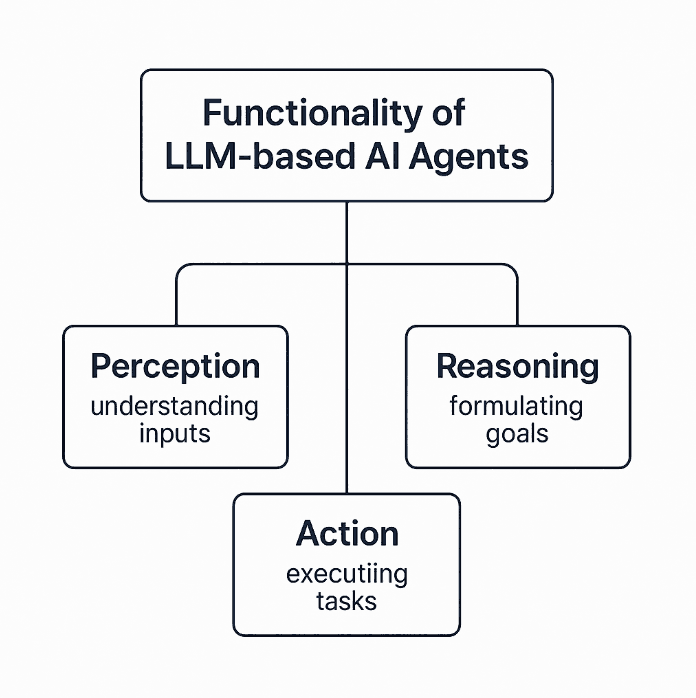
LLM-powered AI agents operate through three core layers: perception (input understanding), reasoning (goal planning), and action (task execution). These agents navigate enterprise systems like decision trees—continuously learning, adapting, and optimizing results across tools and workflows.
Key Advantages of AI Agents in Business Process Automation (BPA)
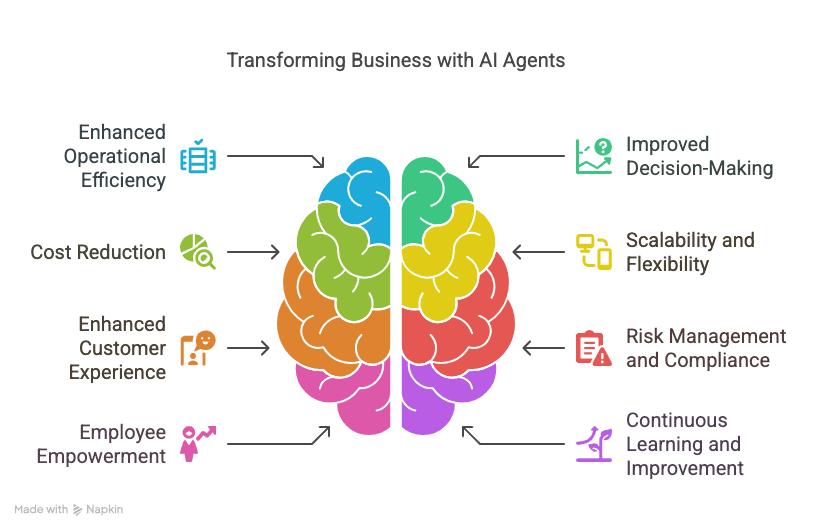
The integration of AI agents into BPA is revolutionizing how enterprises operate, offering transformative benefits that extend beyond traditional automation. These intelligent agents bring adaptability, efficiency, and strategic value to various business functions.
1. Enhanced Operational Efficiency
AI agents excel at automating repetitive and time-consuming tasks, allowing human employees to focus on higher-value activities. For instance, ServiceNow's deployment of AI agents in customer support has led to a 52% reduction in handling time for complex cases, significantly boosting productivity.
2. Improved Decision-Making
By analyzing vast datasets in real-time, AI agents provide actionable insights that enhance decision-making processes. Companies like Moody's utilize multi-agent systems for financial analysis, enabling detailed and autonomous research that informs strategic decisions.
3. Cost Reduction
Automating processes with AI agents leads to substantial cost savings. Intuit's AI-powered financial assistant, Intuit Assist, has enabled businesses to get paid 45% faster by automating invoice reminders, reducing the need for manual follow-ups.
4. Scalability and Flexibility
AI agents offer scalable solutions that can adapt to changing business needs. For example, Salesforce's Agentforce platform aims to deploy 1 billion AI agents to automate tasks across customer support, sales, and marketing, demonstrating the scalability of AI-driven automation.
5. Enhanced Customer Experience
AI agents improve customer interactions by providing instant, personalized responses. Deutsche Telekom employs AI to answer employee queries and automate HR tasks, streamlining internal processes and enhancing service quality.
6. Risk Management and Compliance
AI agents assist in identifying and mitigating risks by continuously monitoring processes and ensuring compliance with regulations. This proactive approach helps organizations maintain integrity and avoid potential legal issues.
7. Employee Empowerment
By handling mundane tasks, AI agents free up employees to engage in more meaningful work, leading to increased job satisfaction and innovation. This shift not only enhances employee morale but also drives organizational growth.
8. Continuous Learning and Improvement
AI agents learn from interactions and outcomes, continuously improving their performance. This ability to adapt and evolve ensures that business processes remain efficient and effective over time.
The integration of AI agents into BPA offers a multitude of advantages that drive efficiency, reduce costs, and enhance both customer and employee experiences. As businesses continue to navigate the complexities of the modern market, leveraging AI agents will be crucial for sustaining growth and competitiveness.
How to Integrate AI Agents into Business Process Automation
(Based on GeekyAnts’ Implementation Playbook)
In most enterprises, automation ends where judgment begins. At GeekyAnts, we have repeatedly seen workflows that appear automated but rely heavily on humans for nuanced decisions, like email triage, approval flows, or interpreting unstructured documents. These grey zones are precisely where AI agents thrive.
Based on our work building agentic systems for healthcare, logistics, fintech, and SaaS enterprises, here’s a step-by-step guide that balances strategy with technical execution.
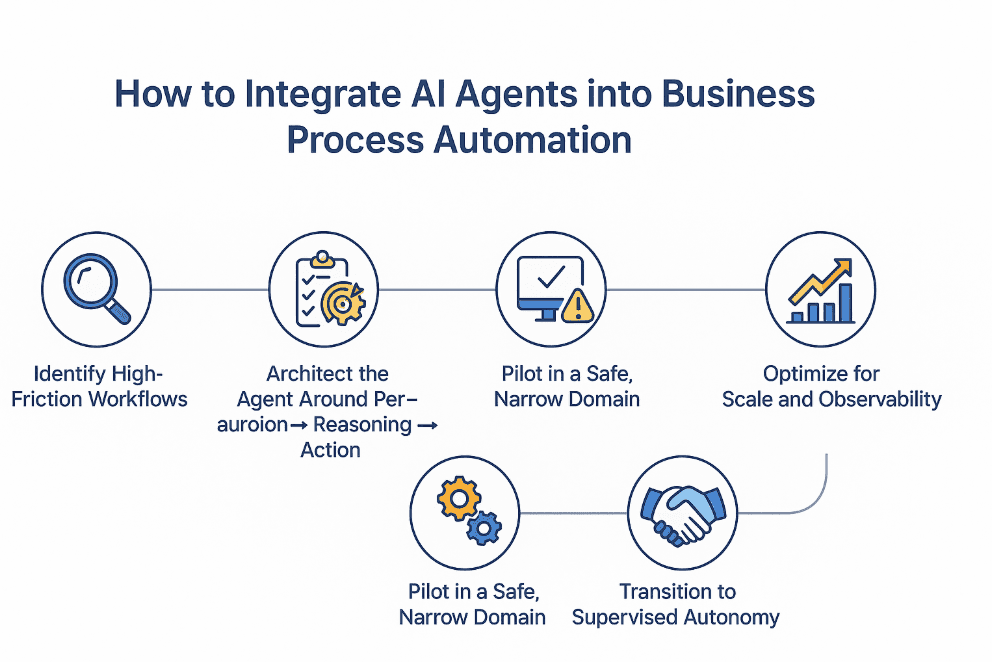
1. Identify High-Friction Workflows
Start with processes that seem “digitized” but involve backend toggling—checking past transactions, cross-referencing tools, or routing tickets manually. These are where time is lost, decisions are delayed, and RPA fails.
Case Insight: For a SaaS client, 80% of support escalations were copy-paste responses. We deployed an agent that retrieved context from CRM, checked similar past tickets, and drafted custom replies—cutting resolution time by 63%.
To identify such workflows:
- Use process mining tools like Celonis or Power Automate Process Advisor
- Analyze API call logs and RPA fallbacks to find “low-code dead ends”
- Use friction metrics:
- Average Handle Time > 3 min
- Manual retries > 20%
- Task-switch count > 3
2. Define Agent Goals and Guardrails
AI agents don’t execute checklists—they reason toward outcomes. Define the agent’s purpose and guardrails before building anything. Is it minimizing ticket backlog? Auto-classifying claims? Reducing human handoffs?
Set boundaries that keep it reliable:
- Allowed APIs or tools
- Format constraints (e.g., output JSON schema)
- Confidence thresholds for escalation
- Acceptable latency and tone expectations
Technical Tip: Use function-calling with tools like OpenAI + a schema validator. Configure fallback logic for anything below a defined confidence score.
{
  "goal": "Resolve billing queries under $100",
  "tools": ["SearchCRM", "EmailComposer"],
  "fallback_trigger": "confidence_score < 0.75 || tool_error == true"
}
Also consider logit biasing or CoT (Chain-of-Thought) prompting when reasoning must follow a strict pattern.
3. Architect the Agent Around Perception → Reasoning → Action
Every production-grade agent works in a 3-stage loop:
- Perception: Ingest input from forms, emails, support chats, audio (via Whisper), or OCR (OCRmyPDF)
- Reasoning: Uses an LLM agent framework (LangChain, Semantic Kernel) + memory (Pinecone, Weaviate) to plan actions
- Action: Executes functions—calls APIs, sends Slack messages, updates CRMs, or formats emails
Typical Agent Stack:
- LangChain + OpenAI (GPT-4) for prompt logic
- Pinecone for memory embedding and retrieval
- Tracing and observability via LangSmith or Traceloop
- Optional UI via Gradio for internal testing
Execution flow:
[Input] → [Retriever] → [LLM with Tool Selector] → [Function Call/API Trigger] → [Formatted Output]
4. Pilot in a Safe, Narrow Domain
Avoid deploying across departments upfront. Instead, select a focused task like:
- Resolving internal IT tickets
- Summarizing customer feedback
- Validating invoices from scanned PDFs
Run it first in shadow mode—where the agent recommends actions but doesn’t execute them. Capture and compare:
- Accuracy vs human benchmark
- Token usage
- Latency
- Hallucination and failure patterns
Use testing metrics like BLEU, ROUGE, or semantic diffing to validate outputs. Tools like Sentry, Prometheus, or custom dashboards help monitor early behavior.
Example: In a B2B lead gen platform, shadow mode helped us refine prompt chaining after the agent failed to detect deal size due to ambiguous sentence structure. Fine-tuning + few-shot examples fixed the issue pre-launch.
5. Transition to Supervised Autonomy with HITL
Once performance stabilizes, gradually give agents production control—with confidence thresholds and HITL fallback.
Recommended confidence tiers:
- 85% → Full autonomy
- 70–85% → Suggest with human approval
- <70% → Escalate immediately
Build a lightweight middleware logger to track:
- Prompt → output → human revision
- Latency
- Reason for fallback
- Final action taken
Implementation Tip: Use LangChain callbacks or webhook tracing into Supabase + Retool for quick review dashboards.
6. Optimize for Scale, Observability, and Compliance
After deployment, optimization matters as much as intelligence. Focus on:
- Latency reduction
- Token cost tracking
- Prompt compression and response caching (Redis)
- Security audits for logs and API triggers
Also implement:
- Alerts for hallucination spikes or output format errors (via JSON Schema + Pydantic)
- Load testing on multi-agent scaling with tools like vLLM
- Role-based access controls for sensitive data flows
GeekyAnts Case: For a healthcare client, we caught prompt drift after an OpenAI model update—responses became less compliant. Because our system logged versioned prompts + confidence logs, we resolved it within hours.
AI agents are not static bots. They are evolving systems that need to be scoped, trained, monitored, and retrained—just like junior team members. When implemented thoughtfully, they don’t just save time. They change how operations are run—from being reactive to being intelligent.
The real challenge isn’t the LLM. It’s the architecture, governance, and iteration loop around it. That’s where successful enterprises win.
Use Cases of AI Agents in Business Process Automation
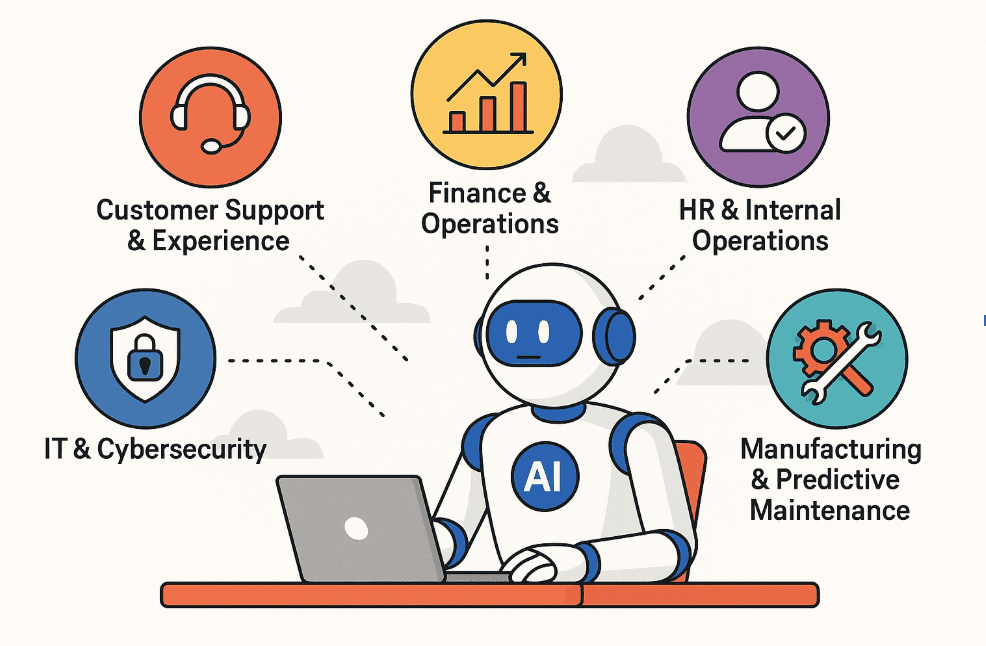
AI agents are reshaping how modern enterprises operate—not by replacing traditional automation but by extending it into areas once thought to require human judgment. From interpreting unstructured inputs to making goal-oriented decisions, these agents are enabling a new layer of intelligence across industries.
Customer Support & Experience
In customer service, AI agents are taking over high-volume, repetitive tasks—without compromising personalization. For instance, at GeekyAnts, we implemented an AI agent for a SaaS company that integrated across their ticketing system, CRM, and knowledge base. The result? 63% faster resolution times and a 40% drop in human escalations, all while improving customer satisfaction. These agents triage issues, summarize context, and even draft human-like replies—at scale.
Finance & Operations
In finance, AI agents go beyond dashboards. They monitor transactions in real time, flag anomalies, and take immediate actions like suspending risky payments or escalating fraud alerts. Financial institutions are also using these agents to automate credit scoring based on dynamic customer behavior—pulling data from APIs, CRMs, and even social signals—leading to faster loan decisions without compromising risk thresholds.
HR & Internal Operations
From resume screening to employee onboarding, AI agents are streamlining internal workflows. Enterprises are deploying them as 24/7 HR assistants—answering policy questions, routing leave approvals, and nudging managers on performance reviews. For large teams, this translates into hours saved weekly and a better employee experience across time zones.
IT & Cybersecurity
Enterprise IT teams are leveraging AI agents for proactive system monitoring and automated incident response. These agents don’t just detect anomalies—they take action: isolating endpoints, triggering failovers, or notifying the right teams. In regulated sectors like healthcare and banking, this kind of autonomous security handling is quickly becoming a baseline expectation.
Manufacturing & Predictive Maintenance
AI agents in manufacturing environments continuously ingest sensor data from machinery, compare it with historical patterns, and schedule maintenance before failures occur. This predictive layer is reducing downtime significantly—sometimes by as much as 25%. These agents also adjust production workflows in real time based on resource availability, ensuring that operations run at peak efficiency.
The Strategic Role of AI Agents in Business Automation
Legacy automation tools crumble when faced with ambiguity or change. AI agents step in with adaptive reasoning, enabling context-aware decisions that evolve with your business.
The table below breaks down exactly why AI agents are becoming indispensable in modern business automation, contrasting key limitations of traditional systems with how AI agents overcome them, backed by real-world outcomes and impact data:
Key Impact Area | How AI Agents Help | Why It Matters (Real-World Reasoning) | Example / Business Impact |
Context-Aware Decisions | Understand unstructured data, user intent, and operational history | Goes beyond static automation to handle ambiguity and variability | At a telecom firm, agents reduced manual routing errors by 48%, improving first-contact resolution |
Operational Efficiency | Automate multi-step, cross-system tasks | Cuts down redundant work and improves team velocity | SaaS client used AI agents to resolve Tier-1 support issues, reducing resolution time by 63% |
Real-Time Decision Support | Analyze data streams, provide insights, and trigger appropriate actions | Enables informed decisions under pressure (e.g. finance, logistics) | In supply chain ops, agents predicted delay risks with 83% accuracy, reducing SLA breaches |
Scalability Without Hiring | AI agents auto-scale based on load without human dependency | Supports business growth without linear cost rise | B2B startup scaled onboarding from 500 → 5000 users/month without hiring extra support |
24/7 Customer Engagement | Conversational agents handle Tier-0/Tier-1 queries continuously | Increases customer satisfaction and loyalty | Retail brand saw a 28% CSAT boost after deploying an AI-based WhatsApp support agent |
Cost Optimization | Reduces the need for full-time staff on routine tasks | Lowers operational expenditure while maintaining service levels | A fintech firm saved ~$480K annually by automating account query resolutions |
Risk & Compliance Monitoring | Constantly audit processes, flag anomalies, enforce rules | Reduces human error in sensitive areas like finance & healthcare | In healthcare, agents ensured HIPAA-compliant data transfers with zero manual steps |
AI-Powered Automation vs. Traditional Automation in Business
Aspect | Traditional Automation | AI-Powered Automation | Business Impact |
Decision-Making | Rule-based with no decision flexibility | Dynamic decisions using LLMs and vector memory | Enables autonomous workflows and reduces errors |
Adaptability | Limited to pre-defined scenarios | Adapts in real time to changing inputs | Handles exceptions and reduces downtime |
Learning Ability | No learning from outcomes | Learns continuously from feedback and data | Improves over time without reprogramming |
Context Awareness | Operates without understanding context | Understands intent and context with precision | Delivers personalized and accurate outcomes |
Tool Integration | Requires manual API connections | Uses intelligent orchestration and APIs | Reduces integration overhead and boosts ROI |
How GeekyAnts is experimenting and building own AntAgents to help enterprises
When we started our journey with AI-powered business process automation, the limitations of traditional systems were clear. Most enterprise tools offered rules-based workflows with minimal flexibility, often breaking under unexpected input or requiring expensive reconfiguration. We knew we could do better. That’s where the vision for AntAgents began—our own agentic AI framework tailored for modern enterprise needs.
At GeekyAnts, we are not simply deploying open-source agent frameworks. We’re building something fundamentally different—enterprise-grade AI agents that can reason, interact, and evolve across diverse environments and tasks. These agents are purpose-built, deeply integrated, and context-aware—capable of driving measurable outcomes without constant human nudges.
“AntAgents are not just AI tools—they are collaborative teammates that learn from your workflows, adapt on the fly, and help businesses scale intelligently. Our goal was never to chase trends—it was to reimagine how intelligence lives inside enterprise systems,” said Kumar Pratik, CEO of GeekyAnts, in a recent internal podcast.
We have applied this thinking across real-world pilots. For example, one of our insurance clients needed a solution that could triage incoming claim documents. Instead of static OCR flows, we deployed an AntAgent capable of identifying document types, extracting policy-specific metadata, and escalating anomalies—all while learning from feedback loops. The result? A 65% faster document processing time and a reduced error rate by 42%.
Each AntAgent we build is structured using three layers:
- Core Planning & Reasoning Layer: Built on LLMs fine-tuned to specific business domains.
- Toolset & Memory Interface: We integrate APIs, databases, and third-party tools as the agent's extended hands and memory.
- Guardrails & Compliance Layer: Ensures output auditability, fallback scenarios, and alignment with HIPAA, SOC2, and GDPR frameworks.
What makes AntAgents different is not just their intelligence, but their purpose. We design agents that align with real operational goals—whether it's reducing response time, improving data workflows, or automating knowledge retrieval.
Internally, we have also deployed AntAgents for managing pre-sales qualification, generating contextual proposals, and even debugging dev environments autonomously. These aren’t experiments anymore—they are becoming standard operating units in how we function.
As we expand our investments in this space, our roadmap includes:
- Launching a plug-and-play AntAgent toolkit for enterprises
- Deep integrations with industry-specific stacks (starting with logistics, healthcare, and BFSI)
- A monitoring dashboard with human-in-the-loop controls and explainable decisions
We are not building another tool—we are building the next layer of enterprise intelligence. And we are doing it agent-first.
Measuring What Truly Matters: Strategic Value & ROI of AI Agents
When enterprises deploy AI agents, they are not chasing trends—they are making strategic investments with measurable returns. At GeekyAnts, we have seen this transformation play out across industries, where automation is not just about cost-saving but value creation.
Before integrating AI agents, teams often drown in manual workflows—switching tabs, resolving routine tickets, or rerouting leads. After integration, those same workflows become streamlined, intelligent, and autonomous.
Here is what success looks like when done right:
- Up to 40% reduction in manual effort
A logistics client automated their support queries using an agent trained on past interactions, reducing daily manual triage by nearly half. - 2x Faster Time-to-Resolution
In BFSI, ticket resolution time dropped from 6 hours to under 3, thanks to agents fetching and summarizing case histories instantly. - 20–30% Boost in Customer Satisfaction Scores (NPS)
Real-time responsiveness through agent-led interactions brought down churn and improved CSAT in a consumer SaaS platform. - ROI Inflection Point in <3 Months
After deployment, the break-even point was reached within 10 weeks, driven by labor cost savings, process acceleration, and error reduction. - Reduced Escalations by 60%
An AI agent embedded in internal IT support auto-resolved common queries—VPN issues, password resets, access control—freeing up senior engineers for core work.
Industry-Specific Applications in the US Market
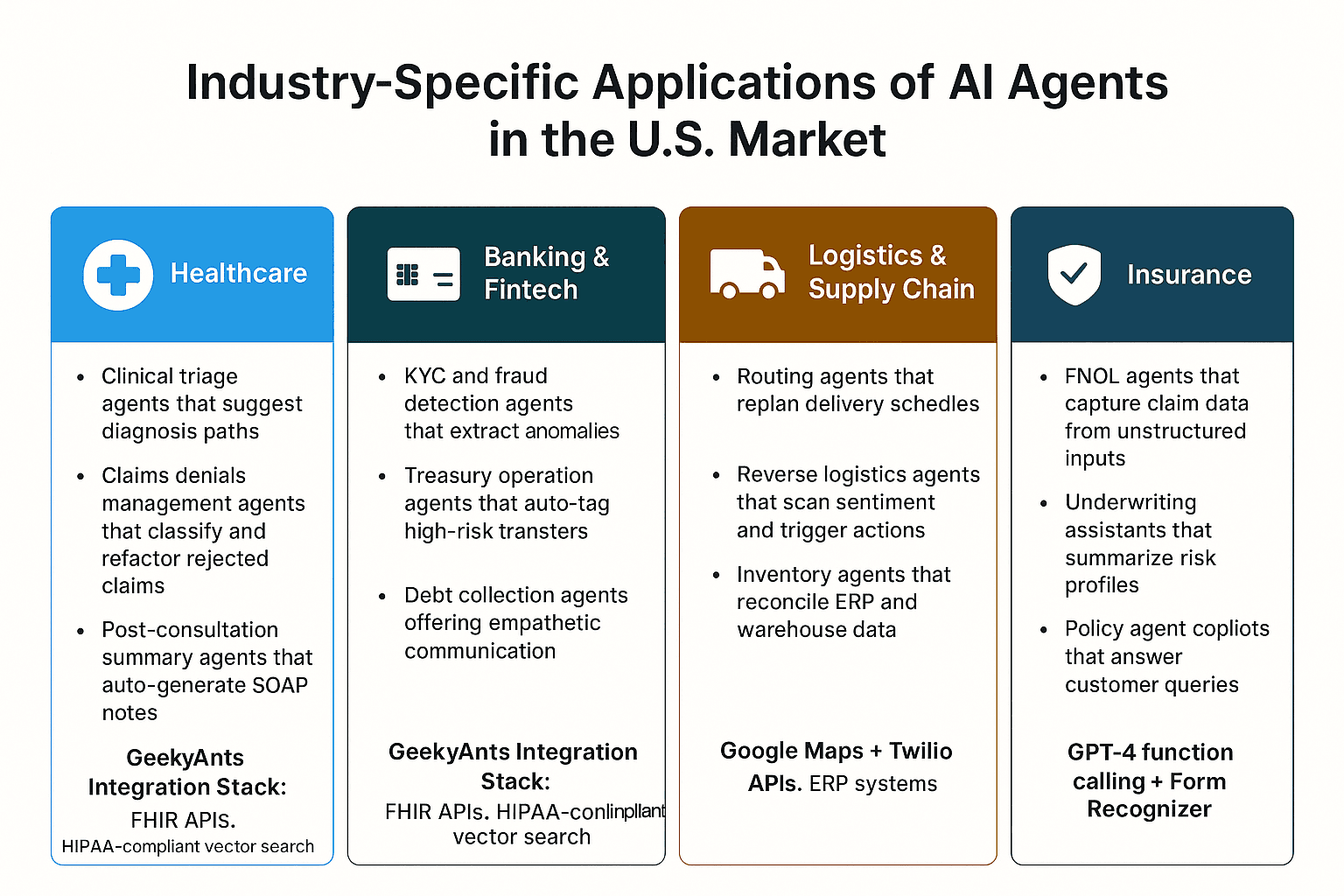
AI agents are not replacing traditional systems—they are extending them into domains where static automation has consistently failed. From compliance-heavy workflows to high-volume operational tasks, U.S. enterprises are deploying AI agents where precision, speed, and adaptability are critical. These agents are designed to meet industry-specific needs, integrating seamlessly with existing tools while ensuring regulatory alignment. Below are key examples of how agentic automation is being adopted across verticals.
Healthcare
AI agents are transforming healthcare operations by automating workflows that require both contextual understanding and regulatory sensitivity. From streamlining patient onboarding to handling prior authorizations and claims validation, agents reduce manual load while adhering to HIPAA standards. They also manage post-discharge follow-ups and appointment coordination, ensuring better continuity of care without overburdening clinical staff.
Financial Services
In finance, where real-time decisions intersect with strict compliance, AI agents are being used to monitor transactions, detect anomalies, and trigger alerts under frameworks like GLBA and SOX. They automate KYC verification, dynamically generate audit-ready reports, and even assist in portfolio monitoring by analyzing market signals—reducing operational lag without compromising on oversight or accuracy.
Retail and E-commerce
For retail and e-commerce businesses, AI agents enable personalized, always-on customer engagement. They handle high-volume queries, process returns, auto-update inventory records, and support dynamic pricing strategies. By orchestrating actions across CRMs, warehouses, and payment systems, agents improve both customer satisfaction and backend efficiency during peak demand cycles.
Logistics and Supply Chain
In logistics, where timing and routing are critical, AI agents monitor shipment data, predict delays, and coordinate handoffs across systems. They triage support tickets, automate carrier selection, and respond to fulfillment exceptions—all in real time. This automation layer enables logistics providers to maintain SLA commitments while scaling operations without adding headcount.
Insurance
AI agents assist insurers in processing complex claims, validating customer inputs, and generating policy quotes with minimal human intervention. They extract structured data from unstructured documents, evaluate eligibility against underwriting criteria, and ensure each step is logged for compliance. This reduces turnaround time while maintaining the level of rigor expected in high-stakes insurance workflows.
Risks, Compliance & Ethical Considerations
Data Risks
AI agents often rely on sensitive customer data. Without proper safeguards, risks include data leaks, hallucinations, and exposure of PII. Data masking, encryption, and role-based access controls are non-negotiable.
Compliance: US-Specific Mandates
Healthcare: HIPAA compliance for patient data handling.
Finance: GLBA and SOX adherence for data governance and reporting.
AI agents must inherit enterprise-grade compliance from Day 1.
Auditability
Maintain complete traceability of agent decisions. Every prompt, tool call, and action should be logged and version-controlled. Tools like LangSmith and PromptLayer support audit trails and regulatory scrutiny.
Human-in-the-Loop (HITL) Design
Embed fallback workflows where confidence thresholds are low. Ensure humans can review, override, or approve decisions to minimize unintended consequences.
Why Choose GeekyAnts for AI Agent Solutions
Built for Real Work. Designed to Scale.
At GeekyAnts, we go beyond chatbots. We build AI agents that solve real problems—from automating ticket responses to decision-making across tools—designed for compliance-heavy, high-stakes environments.
Why Businesses Choose Us
- Proven Delivery
Worked with U.S. clients in healthcare, retail, SaaS & logistics
AI agents built with OpenAI, LangChain, Pinecone, and observability baked in
Example: Cut support resolution time by 63% with an AI agent for a SaaS firm - Compliance-Ready
HIPAA, SOC2, and GDPR standards from day one
Human-in-the-loop workflows, secure memory, and full audit logs - Designed for Impact
Use cases delivered:
→ Auto-summarization in healthcare
→ Ticket triaging in SaaS
→ Procurement email handling in retail
Meet AntAgents — Our Proprietary Framework
While others use generic LLM wrappers, we built our own AI agent system from the ground up.
“AntAgents are built to act—not react. They are structured for real business workflows, not toy use cases.”
— Kumar Pratik, CEO, GeekyAnts
AntAgents Highlights:
- Pre-trained agent templates (resolver, classifier, summarizer)
- Built-in tool orchestration (LangChain, YAML-based configs)
- Integrated observability + fallback safety
- Easy integration with your APIs, CRMs, or backend tools
The Future of Agentic AI in Enterprise Automation
Enterprise automation is no longer about static workflows—it’s about intelligent systems that adapt, learn, and operate with intent. Agentic AI represents this next evolution. Unlike traditional automation, which is rule-bound, agentic systems act autonomously toward defined goals, making them ideal for dynamic, real-world business environments.
At GeekyAnts, our vision goes beyond LLM wrappers and narrow use cases. We see agentic AI evolving into multi-agent orchestration systems that mirror human teams—each agent with a role, memory, decision boundary, and outcome metric.
“We’re not chasing trends. We’re engineering systems that think, reason, and act—securely, ethically, and scalably.”
— Kumar Pratik, CEO, GeekyAnts
What’s Coming Next:
1. Composable Agent Architectures
Future systems will let enterprises plug-and-play specialized agents—triage agents, summarizers, compliance checkers—built on reusable templates with YAML or DSL configs.
- Example: A financial firm may deploy a risk-scorer agent alongside a regulatory alert generator—each interfacing with different datasets but working toward a unified goal.
2. On-Prem & Sovereign LLMs
With growing demand for data privacy, organizations will prefer on-prem agent stacks running models like Llama 3, Mistral, or fine-tuned proprietary LLMs over public APIs. Expect hybrid agent deployments combining local models with cloud retrieval.
3. Multi-Agent Collaboration
The future isn't one agent doing it all. It’s agents collaborating in structured ways—planning, delegating tasks, resolving conflicts, and learning from outcomes.
- Tech Enabler: Emerging frameworks like CrewAI and AutoGen Studio are already prototyping these interactions.
4. Tighter Human Feedback Loops
AI agents will continuously improve with in-product feedback loops—pulling approvals, edits, and confidence ratings from human reviewers in real time.
- Illustrative Use Case: A GeekyAnts-built support agent learns when its responses are edited, and uses that context for future queries—blending HITL with long-term accuracy.
5. Governance, Auditability & Ethical AI
As agents make business decisions, compliance will be non-negotiable. Expect agents with:
- Secure prompt & response logging
- Built-in escalation when uncertain
- Role-based guardrails and explainable outputs
Agentic AI is not the end of human involvement—it’s a new interface layer where AI handles the complexity so humans can drive strategy. As pioneers in this space, GeekyAnts is committed to building enterprise-ready agent systems that are secure, observable, and built for scale.
FAQ
1. What is an AI Agent in business process automation?
An AI agent is a goal-driven, autonomous system that can perceive data, reason over it using models like LLMs, and take action—automating tasks that traditionally required human judgment.
2. How do AI agents differ from chatbots?
Chatbots follow scripted flows and handle basic queries. AI agents go beyond—they understand context, access tools, trigger APIs, and make decisions across complex workflows.
3. Are AI agents compliant with HIPAA and GDPR?
Yes, if built correctly. Agents must use encrypted data, log interactions, maintain audit trails, and allow user data control. GeekyAnts implements these compliance measures by default.
4. What are some tools to build AI agents?
Popular frameworks include LangChain, Semantic Kernel, CrewAI, and AutoGen Studio. For memory, tools like Pinecone or Weaviate are common. For observability—LangSmith and PromptLayer.
5. How much ROI can you expect from using AI agents?
Enterprises report up to 40% reduction in manual effort, faster response times, and significant operational cost savings depending on the use case and integration depth.
6. What is the role of AI agents in business process automation?
AI agents bring adaptability and intelligence to automation—handling unstructured inputs, making decisions in real time, and scaling workflows that traditional RPA cannot manage.