

Key Takeaways
- ERP and MES integration connects enterprise planning with shop-floor execution, reducing manual reconciliation and giving manufacturing, quality, and supply chain teams a shared operational record.
- For U.S. pharma manufacturers, the strongest business case combines shorter batch-release cycles, faster investigations, stronger inspection readiness, and more reliable cross-site decisions.
- Integration supports end-to-end traceability, but it does not replace serialization, trading-partner exchange, validation, quality systems, or the controls required for DSCSA and CGMP compliance.
- The program should be managed as a business and operating-model transformation: define outcomes, data ownership, governance, change management, and scale-up rules before selecting or configuring technology.
Why Is ERP and MES Integration a Strategic Priority for U.S. Pharma Leaders?
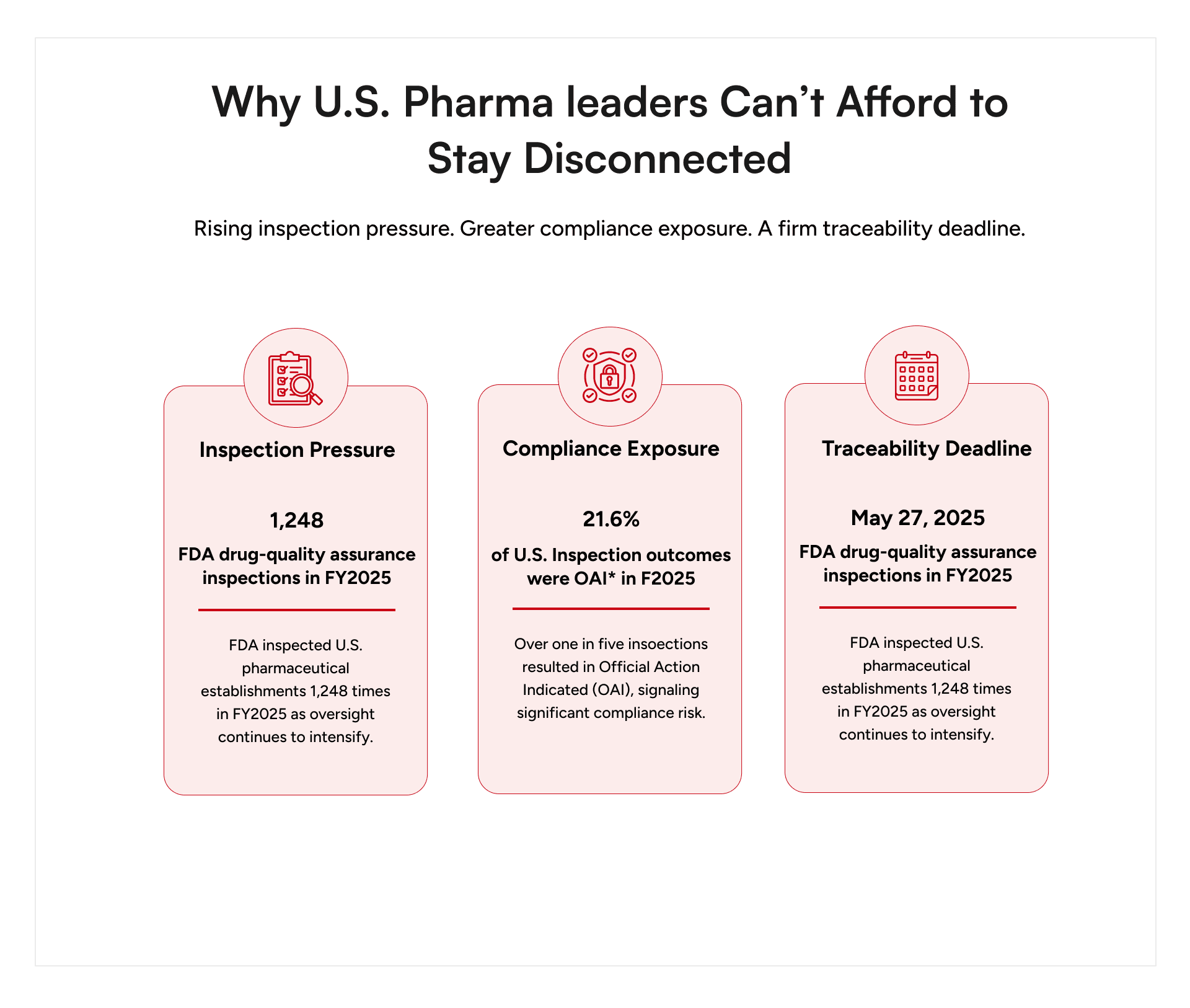
The pressure is no longer abstract. In FY2025, the FDA conducted 1,248 drug-quality assurance inspections, up from 972 in FY2024. Of the 702 U.S. inspections, 21.6% received an “official action indicated” classification. At the same time, the temporary DSCSA exemption for manufacturers and repackagers ended on May 27, 2025, reinforcing the shift toward electronic, interoperable product tracing.
These developments do not make ERP and MES integration a regulatory checkbox. They make fragmented data, delayed investigations, and spreadsheet-based reconciliation harder to defend. When production, quality, inventory, and distribution records disagree, leaders lose time establishing what happened before they can decide what to do next.
This guide is for leaders responsible for manufacturing IT, quality systems, digital transformation, operations, or supply chain in U.S.-centric pharma enterprises. It explains what integration changes at the business level, where value appears first, how to control implementation risk, and how to scale from a credible pilot to an operating model that works across sites.
What Does ERP and MES Integration Mean in Pharma?
ERP and MES solve different parts of the manufacturing problem. The ISA-95 model places ERP at the enterprise planning and logistics level and MES within manufacturing operations management. Integration creates a governed exchange between those layers instead of forcing people to re-enter or reconcile the same information.
Layer | Primary responsibility | Typical pharma information |
|---|---|---|
ERP | Plan and account for the enterprise | Production orders, procurement, inventory, material availability, costs, supply plans, product and lot master data |
MES | Execute and record manufacturing | Electronic work instructions, recipes, equipment and line status, operator actions, material consumption, yield, genealogy, exceptions |
Integrated flow | Keep plans and actuals synchronized | ERP sends authorized demand and master data; MES returns execution status, actual consumption, output, genealogy, and completion data |
Important boundary: an ERP–MES connection alone does not create complete compliance or supply-chain traceability. Pharma manufacturers still need validated processes, effective quality oversight, appropriate audit trails, serialization and verification capabilities, trading-partner exchange, and controlled interfaces with systems such as QMS, LIMS, WMS, and serialization platforms.
What Changes When ERP and MES Operate as One System?
ERP and MES remain separate systems after integration, but they begin operating as one connected environment. Production plans, material movements, shop-floor activity, quality records, and completed quantities stay synchronized, reducing the number of times teams must re-enter, verify, or reconcile the same information.
The clearest way to understand the change is to compare how everyday manufacturing decisions are handled in disconnected and integrated environments.
Business Area | Separate ERP, MES, and Spreadsheets | Integrated ERP and MES |
|---|---|---|
Batch review and release | Reviewers collect and reconcile production, inventory, and quality records after the batch is complete. | Records remain connected as the batch progresses, allowing reviewers to focus on exceptions and unresolved issues. |
Manual checks | Teams repeatedly confirm quantities, statuses, material use, and completed work across systems. | Authorized plans and actual production results remain synchronized, reducing duplicate checks and data entry. |
Traceability and investigations | Lot, equipment, operator, material, and quality information must be reconstructed from multiple records. | Shared identifiers connect the production history, helping teams assess deviations and recall impact faster. |
Planning and inventory decisions | ERP plans may rely on delayed updates, manually confirmed consumption, or incomplete production status. | Actual yield, consumption, delays, and completed quantities flow back into ERP for more reliable planning. |
Audit and inspection preparation | Evidence is assembled from different systems, spreadsheets, and local records when it is requested. | Evidence is captured as work happens, reducing preparation effort and improving response speed. |
Multi-site visibility | Plants may report similar KPIs using different definitions, formats, and reporting cycles. | Shared data and KPI definitions make plant performance easier to compare while preserving justified local differences. |
Scaling products and sites | Each rollout recreates interfaces, reconciliation processes, and local workarounds. | Reusable integration patterns, governance rules, and data standards support more controlled expansion. |
The hidden cost of disconnected operations is the time spent resolving uncertainty. Employees reconcile records, repeat checks, correct mismatched data, wait for confirmations, and depend on local experts who understand how information moves between systems. These activities may not appear as a single budget item, but they contribute to slower batch release, longer investigations, additional inventory buffers, avoidable rework, and inconsistent decisions across sites.
Integration reduces this operating drag by giving manufacturing, quality, inventory, and supply chain teams a shared view of what was planned, what occurred, and which exceptions still require attention. It does not eliminate manufacturing or compliance risk, but it helps teams identify issues earlier, investigate them faster, and make decisions using a more complete operational record.
Why Are U.S. Pharma Manufacturers Prioritizing ERP and MES Integration Now?
ERP and MES integration is moving higher on the leadership agenda because regulatory pressure, operational complexity, and digital investment priorities are converging in the same budget cycle.
Five pressures are driving the shift:
- Inspection readiness must become an everyday operating condition. Pharma teams need reliable production and quality records available throughout the manufacturing process, rather than assembling evidence only when an inspection or investigation begins.
- Manufacturing networks are becoming harder to coordinate. Complex product portfolios, contract manufacturing relationships, and multi-site operations create more handoffs where information can lose context or become inconsistent.
- Traceability expectations are increasing. DSCSA has reinforced the need for interoperable electronic product tracing across the U.S. prescription-drug supply chain, even though ERP and MES represent only part of the broader serialization, verification, and trading-partner environment.
- Leadership teams need faster, more defensible decisions. Quality, manufacturing, and supply chain leaders cannot respond quickly when production status, inventory movements, and quality records provide conflicting versions of the same event.
- Future digital initiatives depend on trusted operational data. Advanced analytics, predictive maintenance, digital twins, and AI-assisted quality workflows become slower and riskier when core manufacturing data remains fragmented.
These pressures are also changing how organizations evaluate the investment. ERP and MES integration increasingly sits alongside plant expansion, product launches, supply-chain resilience, and AI adoption because each of these priorities depends on consistent execution and trusted manufacturing data.
The cost of delaying integration rarely appears as one clearly defined expense. It accumulates through longer batch-release cycles, repeated reconciliation, duplicated data correction, extended investigations, inventory held while teams confirm records, and additional coordination each time a product, partner, or facility is added. As the manufacturing network expands, these inefficiencies can grow faster than the business itself.
Pharma Manufacturers are being asked to expand capacity, introduce products faster, and prepare for AI-enabled operations without weakening quality or control. ERP and MES integration creates the trusted operational foundation behind those priorities. The commercial advantage comes from being able to scale without adding the same level of manual coordination and risk at every new site or product line.
 Kunal KumarChief Revenue Officer
For the board, the decision is therefore about enterprise risk and growth capacity. A connected operating model makes it easier to add products, production lines, partners, and sites without multiplying reconciliation effort. It also gives leaders a stronger foundation for cross-site benchmarking, more reliable planning, predictive maintenance, digital twins, and AI-assisted quality workflows.
ISPE’s Pharma 4.0 model reflects the same broader view: digital manufacturing maturity depends on the combined progress of technology, organizational capability, regulatory alignment, and security. ERP and MES integration provides part of the operating foundation required to advance those areas together.
How Does ERP and MES Integration Support Compliance and Zero-Error Production?
“Zero-error production” should be treated as a target condition, not a promise that errors disappear. McKinsey defines the gold-standard outcome as at least 99.9% right-first-time performance, fewer than 0.01% batch failures and deviations, 8 Sigma process capability, and zero repeat errors.
ERP and MES integration contributes by reducing manual transcription, standardizing approved workflows, connecting actual production records with enterprise context, and making exceptions visible earlier. The FDA expects CGMP data to be reliable and accurate, and its Part 11 guidance emphasizes trustworthy electronic records, validation, audit trails, record retention, and risk-based controls.
How Does Integration Create Clear Accountability?
Each regulated action should have an identifiable owner, time, context, and controlled record. When systems share governed identifiers and state changes, an investigation can move directly to the event sequence instead of spending its first days reconstructing who changed what and which record is authoritative.
How Does Integration Shorten Responses to Auditors and Investigators?
Connected records reduce the time needed to retrieve production orders, material lots, execution data, electronic batch records, and release evidence. Research on smart pharmaceutical manufacturing also highlights that auditable computerized systems and integrated data are central to end-to-end traceability and batch-release decisions.
How Does Integration Improve Quality Decisions?
Quality teams make more consistent decisions when they review the same current record across sites. Integration can surface deviations sooner, show their downstream impact, and connect investigation outcomes to production and inventory status. It does not replace quality judgment; it gives that judgment a stronger evidence base.
Compliance-by-design means that the evidence needed to explain a batch is created as the work happens. ERP and MES integration helps by making ownership, data lineage, and review points part of the operating workflow instead of an audit-week reconstruction exercise.
 Manav GoelPrincipal Technical Consultant.
Why Do ERP and MES Integration Programs Fail at the Leadership Level?
MES implementation barriers are rarely technical alone. Recent research groups them across technical, organizational, human, contextual, and financial domains, while pharma transformation research repeatedly shows that scale depends on leadership, culture, skills, and operating-model choices.
ERP and MES programs usually lose momentum when ownership, success measures, and adoption are left unresolved during the early stages. Strong programs name process and data owners before implementation, involve plant teams in design decisions, and treat training as a core delivery workstream from the first week.
Manav GoelPrincipal Technical Consultant.Here are some common leadership pitfalls observed in ERP and MES integration programs:
Leadership question | What usually happens | How to avoid it |
|---|---|---|
What if we start with the platform? | Teams configure features before agreeing on the business problem, so scope grows while value stays vague. | Set one or two measurable outcomes and map the end-to-end process before vendor selection or detailed design. |
Who owns data when systems disagree? | Conflicting identifiers, duplicate records, and unresolved exceptions become permanent operating friction. | Name business data owners for materials, recipes, equipment, batches, and statuses; define the authoritative system for each. |
Why does a successful pilot stall? | The pilot works through local heroics, but there is no reusable template, funding model, or governance for the next site. | Design the pilot as the first repeatable unit. Capture configuration, validation evidence, training, metrics, and local-variation rules. |
Why does training at go-live fail? | Operators learn clicks without understanding why the workflow changed, then recreate shadow spreadsheets and side channels. | Start change management during process design. Use local champions, role-based scenarios, and feedback loops before go-live. |
Why does board support fade? | The program reports technical milestones instead of business results, so sponsorship weakens when budgets tighten. | Baseline release time, deviations, schedule adherence, audit effort, and reconciliation hours before the pilot; report movement monthly. |
As observed above, these pitfalls have a stronger emphasis around leadership approach and behavior, rather than a purely technical approach to integration. Any successful strategy for integration should take these common pitfalls into account before starting an integration exercise.
Which ERP and MES Integration Use Cases Deliver Value First?
The best first use cases are visible to the business, measurable within a pilot, and bounded enough to protect production continuity. Four commonly strong candidates are below.
Use case | Primary owner | Before integration | Integrated outcome | Leading KPI |
|---|---|---|---|---|
Faster batch review and release | VP Quality / Head of Manufacturing IT | Reviewers reconcile execution, inventory, and quality records after production. | Synchronized data and exception-led review reduce waiting and repeated checks. | Batch completion-to-release time |
Lot genealogy and investigation readiness | VP Quality | Teams trace raw materials, process events, packaging, and disposition across separate records. | A connected genealogy supports faster impact assessment and targeted response. | Time to trace a lot / investigation cycle time |
Schedule and capacity alignment | Head of Supply Chain / Operations | Plans rely on delayed production status and manually confirmed material use. | Actual progress, yield, and consumption improve scheduling and inventory decisions. | Schedule adherence / expedite rate |
Multi-site performance visibility | COO / Digital Manufacturing Leader | Sites report similar metrics with different definitions and cadences. | Common definitions create comparable views without erasing legitimate local differences. | Right-first-time and cycle-time variance by site |
The common pattern is a move from “teams debating whose numbers are correct” to “teams acting on the same governed record.” That shared record improves speed and confidence without removing the need for quality review, exception handling, or human accountability.
What Are the Best Practices for Business-Led ERP and MES Integration in Pharma?
- Define the outcome before the architecture. Choose a small set of business results—such as release lead time, reconciliation effort, or investigation speed—and make them design constraints.
- Put compliance and data integrity in the core design. Build validation, auditability, access control, record retention, and review responsibilities into each phase rather than adding them before go-live.
- Standardize identifiers and decision rules. Agree on material, equipment, recipe, order, batch, status, and exception definitions across the systems and sites in scope.
- Design with operators and local champions. Use real shift scenarios, exception paths, and floor-level feedback to make the new workflow easier than the workaround it replaces.
- Balance global templates with controlled local variation. Standardize the outcome, data model, controls, and evidence package while documenting where equipment, process, or regulatory context requires local adaptation.
- Plan for ownership after go-live. Define who maintains interfaces, master data, validation evidence, training, monitoring, and vendor coordination once the project team leaves.
How Do Pharma Leaders Move from Pilot to Full-Scale ERP and MES Integration?
Scaling ERP and MES integration across a pharma manufacturing network requires more than repeating a successful pilot. Each site may have different equipment, processes, data quality, validation requirements, and operating practices. Leaders therefore need a repeatable model that preserves enterprise standards while allowing controlled local adaptation.
This roadmap is designed specifically for VPs and Heads of Pharma Manufacturing IT and Quality Systems responsible for selecting pilots, validating outcomes, and scaling ERP–MES integration across production lines and sites.
It is most useful when they are:
- Building the initial business case for ERP–MES integration
- Selecting a pilot site, line, product, or manufacturing process
- Assessing whether a completed pilot is ready to scale
- Restarting a program that has stalled after proof of concept
- Planning a controlled multi-site rollout
The roadmap is a leadership framework rather than a detailed technical project plan. It identifies what the organization should establish, validate, and approve before committing additional budget, production scope, or operational risk.
A pilot becomes scalable when it produces a repeatable operating model alongside the technical result. Leaders should leave the pilot with proven KPIs, validated workflows, reusable documentation, trained local champions, and clear decision rights. Those assets allow the next site to move faster while preserving room for justified local variation.
Manav GoelPrincipal Technical Consultant.A senior executive sponsor should remain accountable for the roadmap from pilot selection through multi-site scale-up. Their role is to ensure that each stage ends with a clear decision: proceed, correct identified gaps, or pause before committing further budget and operational risk.
Senior sponsorship is therefore a practical control, not a ceremonial role. McKinsey found that digital transformations were 1.5 times more likely to exceed expectations when senior leaders made the effort a top priority. In an ERP and MES program, the sponsor resolves cross-functional conflicts, protects delivery capacity, and keeps manufacturing, quality, IT, and supply chain aligned around the agreed business outcome.
The roadmap below is intentionally expressed in months and decision gates rather than development sprints. Timelines mentioned here are an example, as factors like product complexity, validation scope, site readiness, vendor dependencies, and legacy conditions can extend or compress each phase.
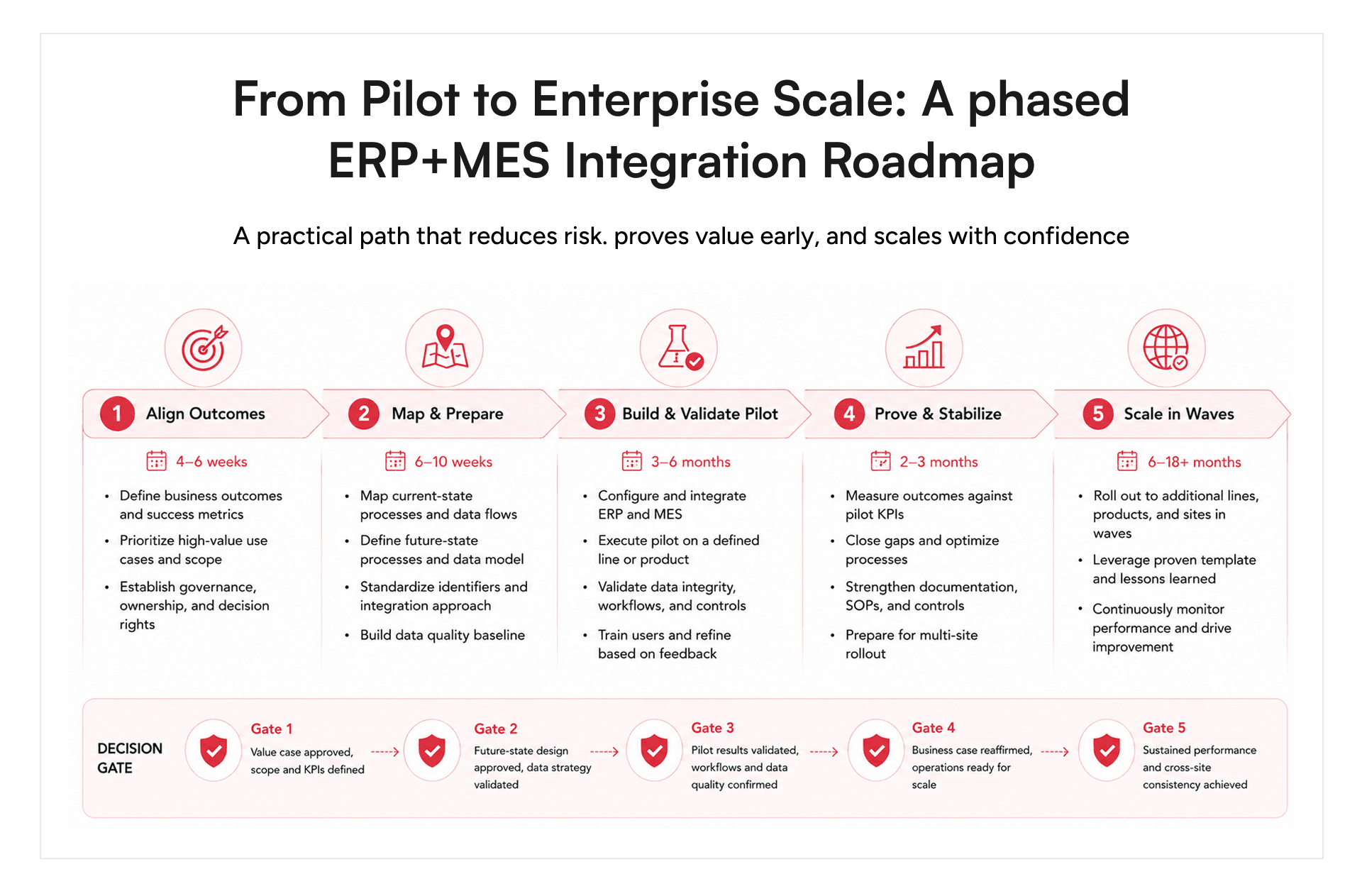
ERP and MES Integration Roadmap at a Glance
1. Align Outcomes — 4 to 6 Weeks
Define the business outcomes, use cases, success measures, ownership, and decision rights that will guide the pilot.
Decision gate: Approve the use case, scope, and pilot KPIs.
2. Map and Prepare — 6 to 10 Weeks
Document current processes and data flows, define the future-state model, standardize critical identifiers, and establish a data-quality baseline.
Decision gate: Approve the future-state design and validate the data strategy.
3. Build and Validate the Pilot — 3 to 6 Months
Integrate ERP and MES for a defined line, product, or process. Validate workflows, data integrity, controls, exception handling, and user readiness under realistic operating conditions.
Decision gate: Confirm that pilot results, workflows, data, and quality requirements have been validated.
4. Prove and Stabilize — 2 to 3 Months
Measure outcomes against the original KPIs, resolve gaps, strengthen documentation and controls, and convert pilot lessons into reusable standards for wider rollout.
Decision gate: Reconfirm the business case and approve the operating model for scale.
5. Scale in Waves — 6 to 18 Months
Extend the proven model to additional products, lines, and sites in controlled waves. Reuse approved templates while documenting justified local variations.
Decision gate: Confirm sustained performance and consistency across sites.
What Makes the Roadmap Repeatable?
Successful scale-up depends on five disciplines that continue across every stage:
- Executive alignment keeps the program tied to measurable outcomes.
- Governed data creates a trusted record across ERP and MES.
- Quality and validation are built into each phase.
- Training and change management support adoption before rollout.
- Continuous measurement turns integration into an improving enterprise capability.
The program should move forward only when evidence from one stage supports the next. A technically functional pilot is not sufficient. Leaders should also see measurable value, validated controls, trained users, reusable documentation, and clear ownership before expanding the integration.
What Does Effective Governance Look Like for ERP and MES Integration?
Effective governance defines how decisions are made, conflicts are resolved, changes are controlled, and accountability continues after go-live. It keeps the integration consistent across functions, lines, and sites.
What Governance Structure Does the Program Need?
A cross-functional steering committee should include manufacturing, quality, IT, supply chain, finance, and site leadership. It reviews KPIs, resolves conflicts, approves major changes, addresses risk, and decides whether the program can enter its next phase.
Who Should Own Processes and Data?
Ownership should sit with named individuals. Leaders should identify who owns key processes, master data, equipment records, and conflicting information. Clear accountability prevents prolonged disputes and stops poor-quality records from spreading across systems and sites.
How Should Changes and Site Variations Be Governed?
Changes to workflows, interfaces, master data, configuration, or local processes should follow one approval path. Each change should record its purpose, impact, testing or validation needs, and approver. Reusable templates remain the default, with local variations documented and controlled.
How Should Global and Local Teams Divide Responsibility?
Global teams should own enterprise standards, shared templates, governance rules, and the roadmap. Local teams adapt them to plant conditions and participate in design, testing, training, and rollout. This avoids rigid centralization and uncontrolled fragmentation.
The most common governance failures appear at the boundaries between these groups and responsibilities:
Governance tends to break first at organizational boundaries: between global and site teams, process and data owners, or quality and delivery. Strong programs make those boundaries explicit. Each critical decision has a named owner, every local variation follows a defined approval path, and every material change leaves evidence the wider manufacturing network can trust.
Manav GoelPrincipal Technical Consultant.How Can Leaders Tell Whether Governance Is Working?
Healthy governance produces timely decisions, consistent KPIs, controlled changes, and clear ownership. Warning signs include unresolved data disputes, repeated corrections, site-specific workarounds, and changes outside the agreed process. The goal is control without unnecessary delay.
Which KPIs and ROI Measures Should Pharma Leaders Track?
ERP and MES integration should be measured by the operational and business changes it creates, not by whether the systems successfully exchange data. Leaders need to know whether the program is shortening release cycles, strengthening traceability, reducing manual work, improving planning, and making quality decisions more consistent.
The right measures also help leadership distinguish early progress from long-term impact. Some KPIs reveal whether teams are adopting the new operating model and whether reconciliation work is decreasing. Others show whether those improvements are translating into faster batch release, fewer process-related deviations, stronger schedule adherence, and better inspection readiness.
The table below brings these measures into one leadership view. It explores KPIs and the business decisions connected to them. Each manufacturer should select the measures that reflect its original business case, establish a baseline before the pilot, and track performance consistently across products, lines, and sites.
KPI | What it reveals | Decision enabled |
|---|---|---|
Batch completion-to-release time | How long review, reconciliation, and disposition take after production | Where release delay is concentrated |
Right-first-time rate | How often work completes without rework, correction, or repeat execution | Which products, lines, or sites need intervention |
Data/process-related deviations | Whether integration reduces errors caused by transcription, timing, or inconsistent workflows | Whether controls are working |
Lot trace and evidence-retrieval time | How quickly teams can reconstruct material and batch history | Inspection and investigation readiness |
Schedule adherence and capacity utilization | How accurately planning reflects execution reality | Capacity, inventory, and prioritization choices |
Manual reconciliation hours | The human effort spent matching records and preparing reports | Productivity and change-adoption value |
Audit findings and response time | Whether records and ownership support timely, complete responses | Risk trend and remediation priority |
ROI should then be assessed from two perspectives. Avoided cost includes less rework, fewer data corrections, reduced investigation effort, shorter inventory holds, and lower audit-preparation effort. Created value includes faster throughput, better capacity use, improved schedule adherence, and the ability to introduce products or sites without increasing operational overhead at the same rate.
Leaders should calculate these benefits using verified baselines and measured changes rather than assigning speculative values to every incident that may have been prevented. The strongest ROI case connects operational improvements to credible financial outcomes while showing how integration reduces risk over time.
How Should Pharma Leaders Evaluate an ERP and MES Integration Partner?
The partner should reduce program risk, not simply add implementation capacity. The evaluation table below focuses on the evidence leaders should request and the risk created when a capability is missing.
Evaluation area | Evidence to request | Risk if missing |
|---|---|---|
Pharma and GxP context | How the team works with QA, validation, data integrity, and regulated change | Late compliance redesign |
ERP/MES and integration depth | Architecture examples, interface ownership, failure handling, monitoring, and vendor coordination | Brittle point-to-point connections |
Documentation discipline | Requirements traceability, design decisions, test evidence, runbooks, and knowledge-transfer samples | Dependence on individuals or vendors |
Multi-site delivery | Template strategy, local-variation governance, rollout lessons, and support model | Pilot success that cannot scale |
Change and adoption | Operator involvement, role-based training, local champions, and workaround monitoring | Shadow processes and poor usage |
Security and resilience | Access model, auditability, backup/recovery, interface protection, and incident response | New connected-system exposure |
Long-term ownership | Post-launch support, SLA, observability, improvement roadmap, and off-ramp plan | Complexity transferred back to the client |
Taken together, these criteria test whether a partner can help the organization operate and scale the integration after go-live, rather than leaving behind a solution that depends on individual consultants or undocumented knowledge.
How GeekyAnts Supports ERP–MES Integration in Pharma?
GeekyAnts can support the engineering and product-delivery layer of an ERP–MES integration program: enterprise modernization, backend and integration engineering, cloud and data platforms, QA automation, experience design, and post-launch evolution. The delivery model is vendor-neutral and can work alongside a manufacturer’s internal IT and Quality teams, existing ERP/MES vendors, validation owners, and specialist compliance partners.
The strongest engagement begins with discovery: map the current process, identify the highest-cost reconciliation or traceability gap, define the regulated boundary, establish baseline KPIs, and decide what must be proven before scale. This prevents the program from becoming a platform purchase looking for a business case.
The following engineering perspective explains why delivery evidence and post-launch ownership should be part of partner selection:
Engineering maturity in regulated manufacturing shows up in the evidence: clear boundaries, documented decisions, controlled change, repeatable testing, and a support model the client can own. The integration is only successful when the organization can operate it confidently after go-live.
 Saurabh SahuChief Technology Officer (CTO)
Conclusion
ERP and MES integration is becoming a core operating capability for U.S. pharma manufacturers that want faster release, stronger traceability, more consistent quality decisions, and scalable digital manufacturing. The business case is compelling only when technology, data, compliance, governance, and adoption move together. Start with one measurable process, prove the operating model, and scale the evidence, not just the software.
Sources & Citation
- U.S. FDA — Report on the State of Pharmaceutical Quality, FY2025
- International Society of Automation — ISA-95 Series of Standards
- U.S. FDA — Data Integrity and Compliance With Drug CGMP: Questions and Answers
- McKinsey & Company — Pharma Operations: Creating the Workforce of the Future
- McKinsey & Company — Digital Transformation: Improving the Odds of Success
- ISPE — Pharma 4.0 Operating Model