

Key Takeaways
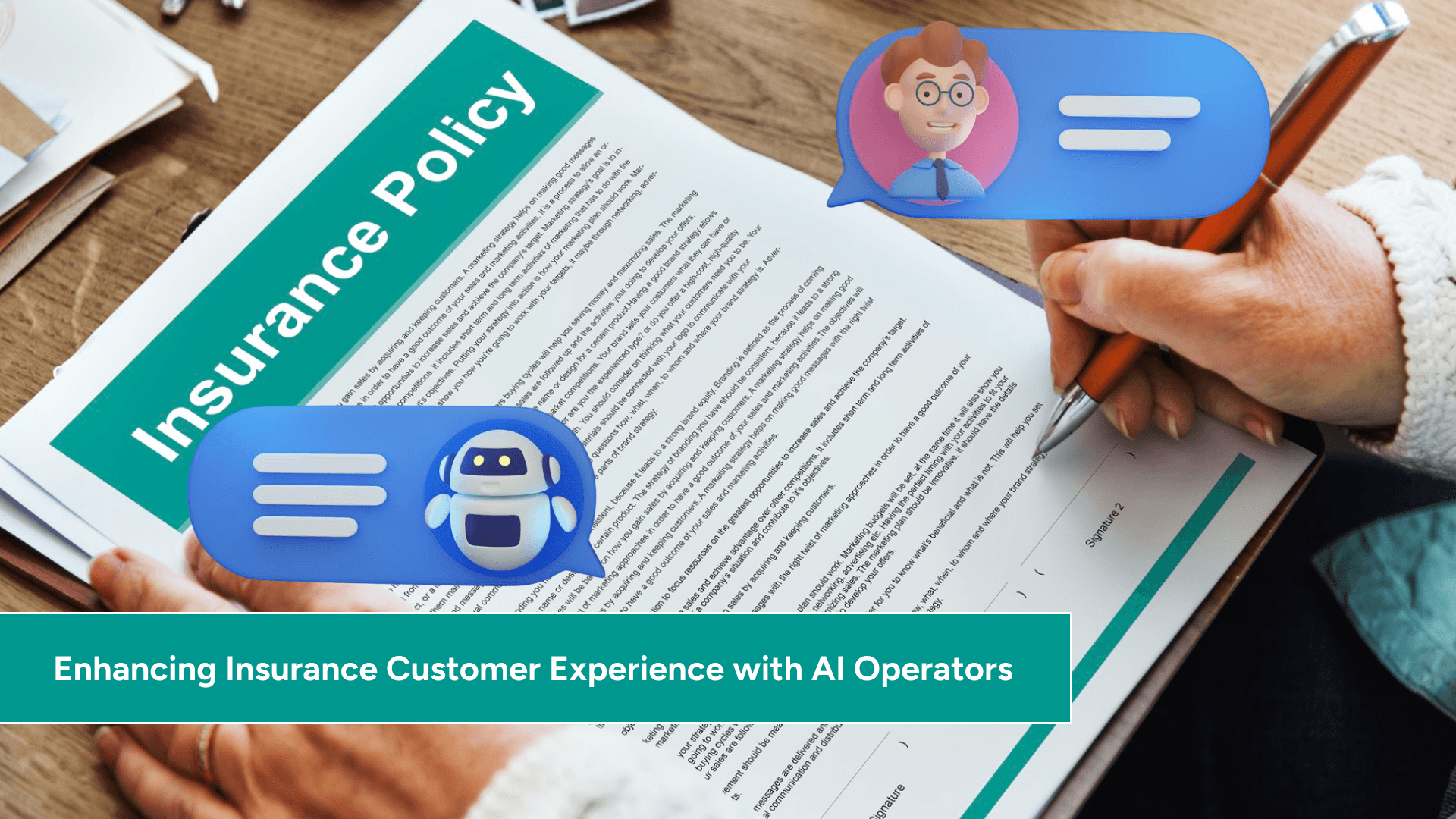
- AI in insurance is shifting beyond chatbots, as AI operators take direct action across claims, underwriting, and policy servicing rather than answering questions.
- Insurers can convert scattered customer and policy data into real-time insight, supporting faster decisions and sharper risk understanding.
- Moving from reactive support to active workflow automation helps insurers resolve issues faster and ease the load on human teams.
- Readers get a clear view of where AI Operators create the most value, how they fit into existing systems, and how to choose the right path to bring one into production.
Why Is AI in Insurance Becoming Critical for Customer Experience?
Insurance carriers are under pressure from multiple directions at once. Customers now expect the same speed and personalization they get from banking apps and retail platforms, and they compare insurers against those benchmarks, not against other insurers.
Claims resolution, once measured in weeks, is now expected in days or hours. Legacy policy administration and claims systems, built for a different era of servicing, cannot keep pace with these expectations without significant investment. Add rising operational costs, a growing need for service availability around the clock, and tightening data privacy and security requirements, and the case for change becomes clear.
Poor experiences now have a measurable commercial cost. According to Qualtrics XM Institute, poor customer experience puts nearly $3 trillion in global sales at risk each year, since more than a third of consumers cut spending after a single bad interaction. McKinsey separately identifies core-system modernization as a pressing challenge for P&C insurers, particularly where legacy technology limits service speed and integration. Gartner likewise places customer experience and AI investment among insurers’ leading technology priorities, even as IT budget growth remains constrained.
Every insurance carrier we speak with has run at least one AI pilot for claims or customer service. The ones that come to us are not looking for another proof of concept. They want a path from a working prototype to a system their compliance, legal, and risk teams will sign off on. That gap, between what the pilot proved and what the organization will approve, is where most AI programs in insurance stall. In some insurance AI programs, pilots stall for months when claim decisions cannot be traced back to policy rules, approved data, or human review points. That delay carries a cost most insurance leaders are not tracking: every quarter a pilot sits unapproved is a quarter a competitor closes the gap on customer experience. The governance layer was never part of the original plan. That is a planning failure with a real revenue consequence attached to it.
 Kunal KumarChief Revenue Officer
This guide is written for insurance technology, customer experience, and digital transformation leaders who are evaluating how AI Operators fit into their operating model. It does not treat AI as a single tool or a passing trend. Instead, it looks at AI Operators as a working layer within insurance operations, one that connects to existing systems, executes steps across a workflow, and hands off to a human when a decision requires judgment or approval.
The sections ahead cover what AI Operators are, where they create measurable value across the customer journey, how they fit into an insurance technology stack, and how a digital leader might decide between building, buying, or partnering to bring one into production.
What Are AI Operators, And How Are They Redefining AI in Insurance?
The term “AI Operator” refers to an AI-enabled operational system that can interpret a request, retrieve approved business context, invoke permitted tools, complete defined workflow steps, and escalate exceptions to a person.
This sets them apart from tools insurers already use. A traditional chatbot answers questions but cannot act on them. Rule-based automation follows fixed steps and breaks outside its script. RPA bots repeat structured tasks without understanding intent. AI copilots support a human agent but do not take action on their own. Generic AI agents can reason and respond, but without deep integration into insurance systems, they cannot carry a workflow to completion. AI Operators bring these capabilities together as a form of intelligent automation in insurance, combining understanding, action, and escalation inside real processes.
In practice, this looks like claim status updates, first notice of loss, policy renewal support, document collection, coverage explanation, billing support, and agent assist, each handled inside the workflow itself.
Where Does AI in Insurance Improve the Customer Experience Most?
AI Operators create the most value in workflows that have clear steps, but slow down inside legacy systems or manual handoffs. The following use cases show where this shift matters most for insurance customers.
Quote and Onboarding Assistance
Customers abandon a quote request when a form is long or the next step is unclear, a direct loss in new business for insurers relying on manual follow-up. Quote and onboarding assistance is one of the clearest wins for insurance process automation, since data capture, validation, and routing follow a predictable pattern. An AI Operator guides the applicant through the process, pulls in available data, and flags missing details before submission. Complex risk profiles move to a human underwriter for final review. Insurers track this through quote completion rate and conversion rate.
Policy Servicing
A simple policy change, such as updating an address or adding a driver, can mean a long hold time for the customer. Behind the scenes, manual updates to policy administration systems create backlog for service teams. An AI Operator processes these changes and confirms them in real time. Coverage disputes or contract exceptions require an agent's judgment. This shows up in average handling time and first contact resolution.
Claims Intake and First Notice of Loss
Reporting a claim is the most stressful point in a customer's relationship with an insurer, and a confusing intake form makes it worse. Manual data entry at this stage delays the whole claims cycle before it begins. An AI Operator captures loss details, retrieves the relevant policy and coverage information, validates required fields, and prepares the claim for registration. Coverage interpretation, exceptions, and high-value cases remain subject to approved rules and human review.
Claims Status Updates
Customers call to ask where their claim stands, pulling adjusters away from processing claims. An AI Operator gives customers a direct status update and sends proactive alerts when something changes. A disputed claim decision stays with a human reviewer. This reduces inbound status calls and shortens the overall claim cycle time.
Document Collection and Verification
Customers submit the wrong documents when they are unsure what a claim or application requires, and manual review of each submission adds days to the process. An AI Operator states what is needed, checks submissions for completeness, and flags anything inconsistent, a form of intelligent automation in insurance that turns a slow document exchange into one guided step. Suspected fraud or unusual documentation goes to a human reviewer. This is measured in document turnaround time and first-submission accuracy.
Renewal and Retention Support
Many customers notice a premium increase or coverage change at the moment of renewal, and by then, some have decided to leave. Manual renewal outreach cannot scale across a full book of business. An AI Operator reaches out ahead of the renewal date, explains what has changed, and presents available options. Negotiation on price or coverage becomes the agent's responsibility. Insurers track this through renewal rate and retention rate.
Complaint Handling and Escalation
A complaint that moves through several departments before reaching a resolution leaves the customer more frustrated than the original issue. An AI Operator logs the complaint, gathers the relevant case history, and routes it to the correct team without delay, a clear case of AI tools for customer experience in insurance support, since the process itself, not the outcome, drives most complaints. Regulatory complaints and sensitive cases need a human specialist. This shows up in complaint resolution time and escalation rate.
Agent Assist for Customer Support Teams
Support agents lose time switching between systems to find a customer's policy and claims history mid-call. AI agents for customer service in insurance close this gap by pulling every relevant record into one screen for the human handling the call. An AI Operator surfaces this information alongside a suggested next step. Any judgment call beyond a system recommendation remains with the agent. Insurers measure this through average handle time and agent productivity.
Workflow | Human Escalation Point | Business KPI |
|---|---|---|
Quote and onboarding | Complex risk profiles | Quote completion rate, conversion rate |
Policy servicing | Coverage disputes or contract exceptions | Average handling time, first contact resolution |
Claims intake | Catastrophic or high-value claims | Claim intake time, satisfaction at first notice of loss |
Claims status | Disputed claim decisions | Inbound call reduction, claim cycle time |
Document collection | Suspected fraud or unusual documentation | Document turnaround time, first-submission accuracy |
Renewal support | Price or coverage negotiation | Renewal rate, retention rate |
Complaint handling | Regulatory complaints or sensitive cases | Complaint resolution time, escalation rate |
Agent assist | Judgment calls beyond system recommendation | Average handle time, agent productivity |

How Does AI in Insurance Architecture Enable AI Operators?
In the last six months alone, we have taken over three insurance AI Operator builds started by other teams, some stitched together with no real architecture behind them. There was no audit trail on what the system had done to a claim, no access control separating what one workflow could see from another, and no way to trace a decision back to the policy data it came from. Response times spiked once claim volume crossed a few hundred cases a day, and no one on the client side could tell us why. Documents had been generated by AI and pushed into claims files with no human reviewing them. When we walked their own engineers through it, they were as surprised by the gaps as we were. A system built without an orchestration layer, an audit trail, and a human oversight point is not an AI Operator, it is a liability with a chatbot on top of it.
 Jani Hardik SanjayProduct Owner I
An AI Operator does not replace an insurer's technology stack, it sits on top of it, connecting to systems that hold customer, policy, and claims data. For a platform or engineering leader, the real question is not whether an operator can hold a conversation, but whether it can act inside existing infrastructure without adding fragility or risk. Five architecture layers, working in sequence, answer that question.
1. Data Layer
Policy administration systems, claims platforms, and customer records all feed into the Data Layer, giving the operator a live, accurate view of each case. This connection runs through APIs and middleware, linking to systems that hold the data, rather than requiring insurers to duplicate it elsewhere.
2. Knowledge Layer
Coverage rules, product details, and compliance requirements live in the Knowledge Layer, keeping every action grounded in what the insurer offers. Without this layer, an operator has no way to tell a valid claim from an invalid one, or a covered event from an excluded one.
3. AI Agent Orchestration Layer
Sequencing happens in this layer, which decides what to retrieve, what action to take, and when a step needs a different system or a person. Event-driven architecture and microservices give it the flexibility to react the moment a claim is filed, rather than waiting on a scheduled batch job or a single monolithic update.
4. Human Oversight Layer
This layer sits above the others, reviewing anything that carries financial or regulatory weight before it goes live. Human-in-the-loop review happens at this stage, for any action that should not run without approval.
5. Security and Compliance Layer
Running through all four other layers, this layer enforces access controls, encryption, and audit logging on every request. Secure data access keeps an operator's visibility scoped to what a given workflow requires, nothing more.
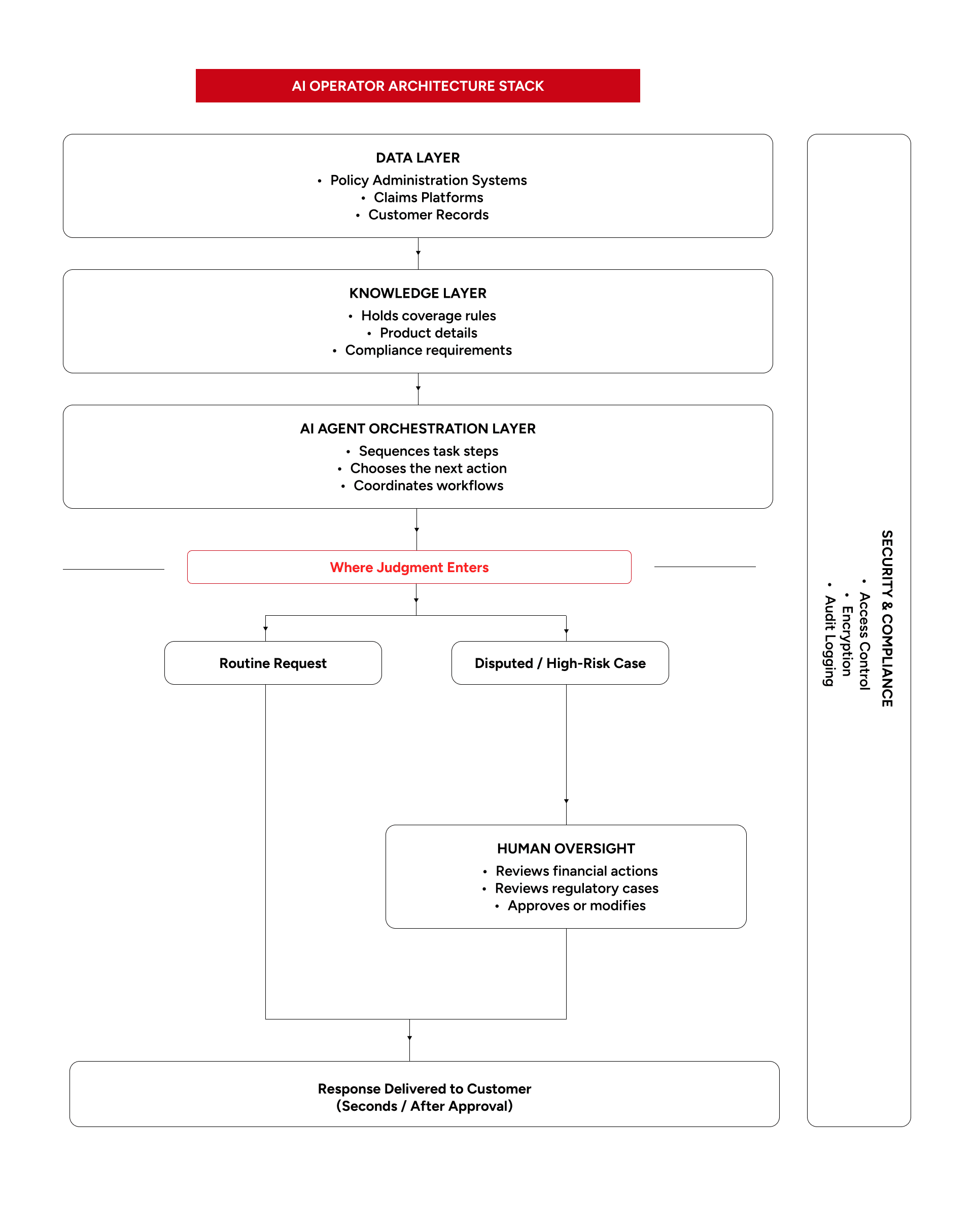
These layers connect to core insurance systems through familiar integration patterns. APIs and middleware handle direct connections to policy and claims platforms. Event-driven architecture lets an operator react the moment a claim is filed or a document arrives, instead of waiting on a scheduled batch job. Microservices keep each function, retrieval, validation, escalation, independent, so one update does not require touching the entire system. Secure data access controls what an operator can see and act on, scoped to the task at hand. Human-in-the-loop review sits at the final step for any action that should not run without approval.
A claim status request shows how the layers work together. The Data Layer pulls the current claim record. The Knowledge Layer checks it against the applicable policy terms. The Orchestration Layer decides this is a routine update with no exceptions, and prepares a response. The Security and Compliance Layer logs the request and confirms the customer's identity before any data moves. Since nothing here requires a judgment call, the Human Oversight Layer stays uninvolved, and the customer gets an answer in seconds. A disputed claim would follow the same path, but stop at the Orchestration Layer, which would route it to a human reviewer instead of generating a response. The architecture supports more than a single task, it decides, case by case, which tasks a machine should complete and which ones belong with a person.

How Are Multi-Agent Systems Powering the Next Evolution of AI in Insurance?
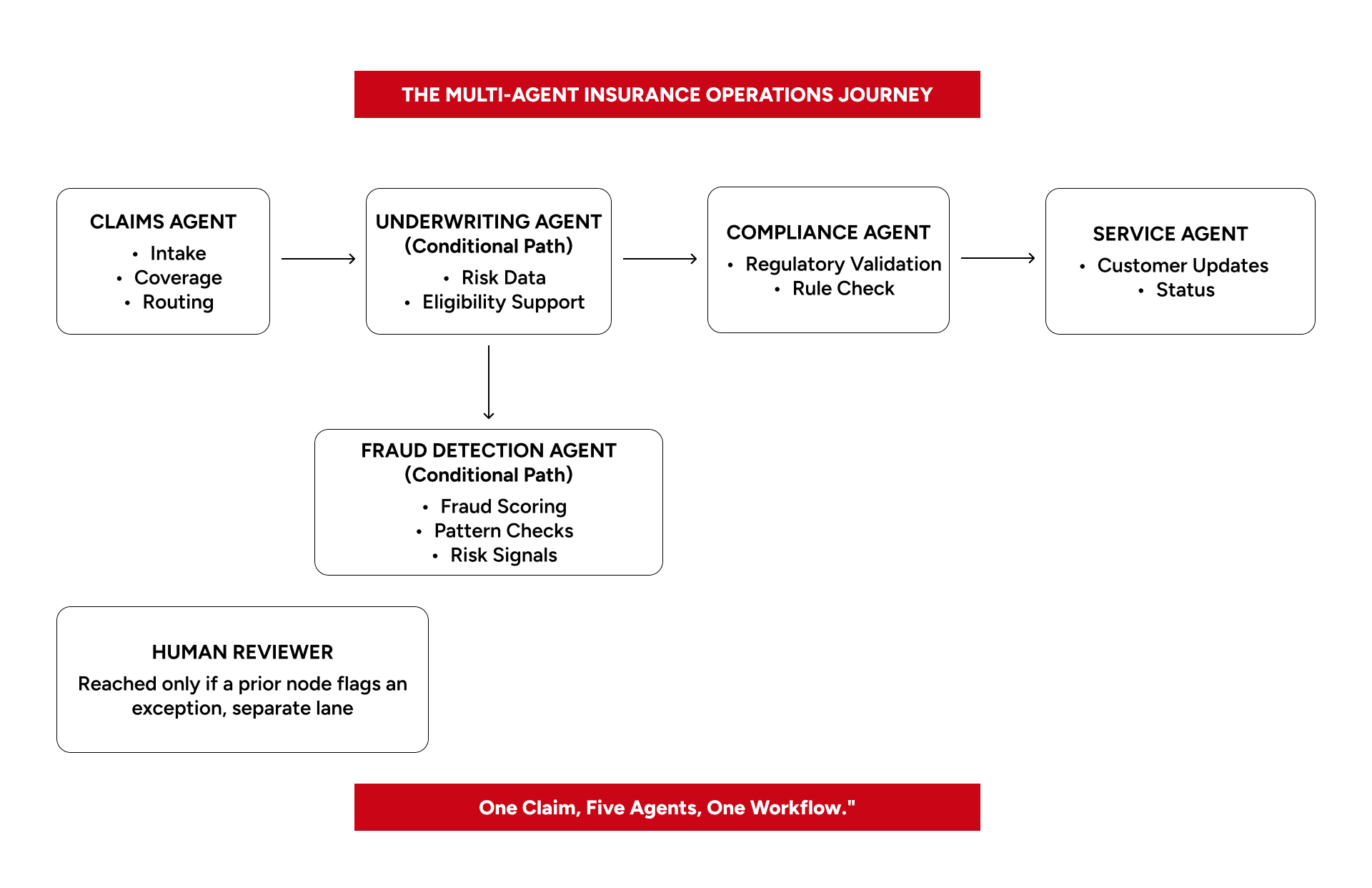
A single AI Operator can handle one workflow well, but insurance operations span claims, underwriting, compliance, service, and fraud at once. A coordinated set of specialized agents, each handling one part of the process, is what makes that possible.
What Does an AI Claims Agent Do?
A claims agent handles intake, coverage checks, and routing for a filed claim, moving straightforward cases toward settlement and preparing complex ones with a summary for adjuster review.
How Does an AI Underwriting Agent Work?
An underwriting agent gathers risk data from policy history and third-party sources, then supports a pricing and eligibility decision with documented reasoning behind it.
What Is the Role of an AI Compliance Agent?
A compliance agent checks that claims and underwriting decisions meet regulatory requirements, flags gaps against current rules, and keeps a record ready for audit at any point.
How Does an AI Service Agent Support Customers?
A service agent puts AI to work in customer service for insurance, managing policy questions, billing issues, and status updates, and handing off anything requiring judgment to a person.
What Does an AI Fraud Detection Agent Catch?
A fraud detection agent scans claims for behavioral anomalies and network-level patterns across claimants and providers, flagging cases before a payout goes out.
How Do These AI Agents Work Together?
These agents pass information to each other inside one workflow. A claim moves through intake, fraud scoring, coverage verification, and routing, with each agent completing its part before the next takes over, and a person stepping in wherever a decision needs judgment.

How Should Insurance Leaders Decide Between Build, Buy, and Partner for AI Operators in Insurance?
Every insurance leader evaluating an AI Operator strategy faces the same three paths: buy a vertical AI product, build a solution in-house, or partner with an AI product engineering team. Each path solves a different problem, and the right choice depends on what the workflow demands.
A vertical AI product is the right fit for a workflow that follows a standard pattern across the industry, the kind of insurance process automation that does not need heavy customization, where data sensitivity is low and speed to launch matters more than depth of control. This route gets a team moving fast, though it comes with a tradeoff: less say over the product roadmap and a higher risk of vendor lock-in over time.
In-house development earns its cost when the workflow touches proprietary risk models, policy logic, or claims decisions that define a competitive edge. This level of intelligent automation in insurance calls for engineering capacity able to support long-term ownership, and in return, gives full control over a system built around the business. The tradeoff is sustained investment and a longer time to market.
A partnership with an AI product engineering team suits insurers who need the customization and ownership of a build, without carrying the entire engineering lift alone. This path fits organizations facing complex workflows, real compliance exposure, and integration depth that stretches internal teams thin, since a partner brings specialized experience to move fast while keeping the resulting platform owned by the insurer, not the vendor.
Decision Factor | Favors Buy | Favors Build | Favors Partner |
|---|---|---|---|
Workflow complexity | Low | High | High |
Data sensitivity | Low | High | High |
Integration depth | Shallow | Deep | Deep |
Compliance exposure | Low | High | High |
Internal engineering capacity | Any level | High | Limited |
Customization needs | Low | High | High |
Time to market | Fast | Slow | Moderate |
Long-term platform ownership | Vendor-held | Insurer-held | Insurer-held |
Vendor lock-in risk | High | Low | Low |
None of these paths is universal, and most insurers end up mixing all three across different parts of their operations. The decision that matters is choosing with intent, factor by factor, rather than defaulting to whichever option is easiest to start with.

How Should Insurance Companies Govern AI in Insurance for Compliance and Trust?
In a regulated insurance environment, an AI Operator strategy succeeds or fails on the governance built around it, not the model behind it. A mandatory set of controls needs to sit underneath every action an operator takes.
Data Protection and Access
AI Operators need clear boundaries around what they can see and do. Data privacy and customer consent govern this first, since every action tied to a policy or claim depends on data the customer agreed to share. Role-based access control limits what each part of a workflow can view, and secure integrations keep every connection to a policy or claims system authenticated and encrypted.
Oversight and Traceability
Every action needs a record. Audit trails should capture what an AI Operator did and why it acted, what data and models informed the decision, and where human review occured.This trace needs to hold up under frameworks such as the EU AI Act, which classifies high-risk AI use in insurance and requires ongoing human oversight, and under NAIC model risk guidance in the US. Explainability keeps that trace usable, turning a decision into terms an underwriter, examiner, or customer can follow, rather than a black box output. Model monitoring checks performance over time, catching drift before it becomes a compliance problem.
Under the EU AI Act, AI systems used to assess risk and determine pricing for natural persons in life and health insurance are specifically classified as high-risk and are subject to requirements including documentation, monitoring, and human oversight. Other insurance AI use cases are not automatically classified as high-risk, but they may still be governed by applicable insurance, privacy, consumer-protection, and AI regulations.
In the United States, the NAIC Model Bulletin outlines expectations for insurer AI governance, documentation, testing, accountability, and third-party oversight. Its direct legal or supervisory effect depends on how individual state insurance regulators adopt or apply it. Alongside clear explainability, continuous model monitoring helps insurers detect performance deterioration, bias, and drift before they become operational or compliance issues.
AI-Specific Risk Controls
Two risks are unique to AI Operators themselves. Hallucination prevention keeps responses grounded in verified policy and claims data instead of a generated guess. Prompt injection defenses stop a malicious or malformed input from redirecting an operator away from its intended task.
Bias and Fairness
Bias and fairness testing checks that pricing, claims, and service decisions stay consistent across customer groups, since a pattern left unchecked in training data can become a discriminatory outcome.
Human Escalation
None of this replaces judgment. An AI Operator should not make a high-risk or irreversible decision on its own. Clear escalation policies define where a person steps in: claim denial, coverage exceptions, fraud escalation, complaint resolution, sensitive customer cases, and regulatory edge cases all need a human sign-off before anything moves forward.
Why Should Insurance Companies Choose GeekyAnts for AI Operators in Insurance Transformation?
We get called in after the first AI vendor has left, more than most people expect. The pattern repeats: a proof of concept that worked well enough to win budget, followed by a production rollout that never happened, because nobody built the parts that do not show up in a demo, the access controls, the escalation paths, the audit trail a regulator will ask for. We have picked up several insurance AI programs at that same point, stalled between a pilot everyone liked and a system compliance would approve. Those teams were wrong about what production requires. That is the gap GeekyAnts exists to close, and it is the reason we get called back after the first vendor does not.
 Kumar PratikFounder & CEO
Insurers evaluating an AI Operator strategy need a partner who understands both the technology and the industry it runs inside. GeekyAnts brings AI strategy and consulting together with AI agent development, so a roadmap for AI in Insurance turns into a working system rather than a slide deck.
This extends into AI-powered product engineering and enterprise system modernization, the work of connecting a new AI Operator to policy, claims, and underwriting systems that were never built with AI in mind. Backed by consulting experience across banking, financial services, and insurance (BFSI) clients, GeekyAnts brings dedicated engineering teams that stay with a project from architecture through production, rather than handing off after a proof of concept.
Platform and cloud modernization work supports this foundation, giving insurers infrastructure built to scale as AI Operators take on more of the workflow. The result is production-grade digital product delivery: systems built to run in a regulated, high-stakes environment, not a demo.

What Is the Future of AI in Insurance Customer Experience?
AI Operators are not a future concept for insurance customer experience, they are part of claims, underwriting, and service workflows across the industry today. Insurers that treat AI in Insurance as infrastructure, not a chatbot upgrade, gain the real advantage: faster resolution, lower cost, and a customer experience built to hold up under regulatory scrutiny. The path to that outcome runs through architecture, governance, and the right build, buy, or partner decision, not a single tool.
Sources and Citations
- https://www.mckinsey.com/industries/financial-services/our-insights/how-p-and-c-insurers-can-successfully-modernize-core-systems
- https://digital-strategy.ec.europa.eu/en/policies/regulatory-framework-ai
- https://content.naic.org/sites/default/files/cmte-h-big-data-artificial-intelligence-wg-ai-model-bulletin.pdf.pdf
- https://www.qualtrics.com/news/businesses-risk-3-trillion-sales-poor-customer-experiences-consumers-cut-spending/