

Key Takeaways
- Traditional robo-advisors handle rule-based automation. The next generation of AI portfolio management platforms must deliver predictive analytics, real-time risk intelligence, and investor-level personalization as core architecture components.
- Production readiness is the gap most platforms fail to close. Scalable infrastructure, model governance, explainability frameworks, and regulatory compliance are baseline requirements for enterprise deployment.
- The build, buy, or modernize decision defines your platform's long-term cost structure, data ownership, and competitive positioning. This guide provides a strategic framework for leaders evaluating that decision.
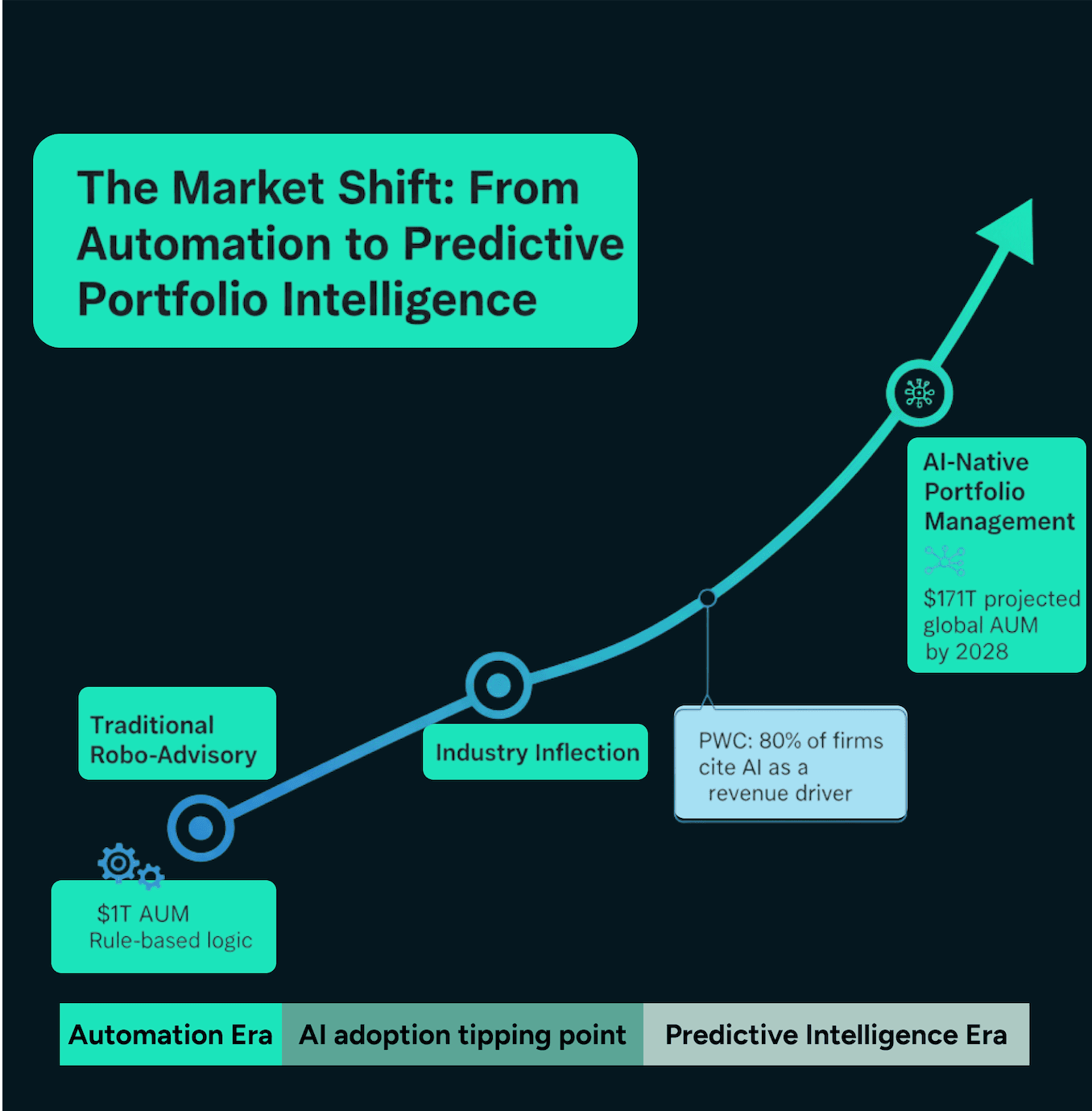
Robo-advisors managed over $1 trillion in assets by 2025, a number that signals broad adoption. Most of these platforms still operate on rule-based logic: static risk questionnaires, fixed allocation models, and periodic rebalancing triggers that automate what was manual.
The gap between automation and intelligence is where the market is headed. According to PwC's 2024 Asset & Wealth Management Report, 80% of asset and wealth management firms say AI will fuel revenue growth, with early adopters projected to see a 12% boost to revenues by 2028. Global AUM is expected to reach $171 trillion in the same period. The firms capturing that growth will not be running first-generation robo-advisors. They will be operating AI portfolio management platforms built for predictive analytics, real-time risk intelligence, and investor-level personalization.
The shift from automation to predictive intelligence is structural. Where traditional platforms react to market changes after they occur, AI-native systems identify patterns, forecast risk, and adjust portfolios before the impact hits.
Yet most enterprises and growth-funded startups struggle to operationalize AI at this scale. The challenge is building production-grade infrastructure that supports model governance, regulatory compliance, explainability, and real-time data pipelines across complex financial ecosystems.
The firms we speak with are struggling to operationalize AI. The gap between a proof of concept and a platform that handles real investor money, meets regulatory scrutiny, and scales across thousands of portfolios is where most initiatives stall. That is the problem worth solving.
 Kunal KumarChief Revenue Officer
The shift we are seeing across enterprise wealth management is about moving from isolated experiments to a connected, production-grade AI layer that sits across data pipelines, risk systems, compliance workflows, and client-facing experiences. Firms that close that gap in the next 18 to 24 months will define the competitive standard for the decade ahead.
This guide is built for platform leaders, engineering heads, and decision-makers evaluating how to build, modernize, or scale an AI portfolio management platform that meets enterprise-grade requirements.
What Wealth Management Executives Need from a Modern AI Portfolio Management Platform
The gap between a traditional Robo Advisory Platform and an AI-native portfolio management platform is a matter of architectural intent. Robo-advisors were built to automate rule-based tasks: periodic rebalancing, basic risk questionnaires, and static asset allocation models. They served a purpose, but it was narrow.
A traditional robo-advisor follows instructions. An AI-native platform learns, adapts, and acts on data that changes by the minute.
Platform Dimension | Traditional Robo-Advisor | AI-Native Portfolio Platform |
|---|---|---|
Decision logic | Fixed rules set at configuration | Adaptive models that update on new data |
Risk assessment | One-time profiling at onboarding | Continuous reassessment based on market and behavioral signals |
Rebalancing triggers | Calendar-based schedules | Predictive indicators and real-time portfolio drift |
Compliance handling | Manual review workflows | Automated audit trails with model explainability |
Personalization depth | Segment-level strategies | Individual investor-level strategies at scale |
System extensibility | Closed, vendor-dependent architecture | API-first, modular, and integrable with enterprise systems |
For platform owners, this distinction defines every build decision, from infrastructure to compliance design.
Enterprise-Grade Capabilities That Define a Production-Ready Platform
Executives building these platforms need a system that handles the full weight of enterprise wealth operations. The capabilities below are structural requirements that determine whether the platform can operate at scale, meet regulatory obligations, and deliver measurable value to both advisors and clients.
Beyond Risk Scores: Building Dynamic Investor Profiles
The system must capture investor intent, time horizons, liquidity needs, and behavioral patterns, then translate those inputs into dynamic portfolio strategies that update as circumstances change.
Allocation Logic That Moves With the Market
When market conditions shift, the platform must respond to predictive signals rather than wait for a scheduled review cycle.
Tax Efficiency and Portfolio Diagnostics at Scale
Tax-loss harvesting, wash-sale rule compliance, and lot-level optimization must operate at scale across thousands of client accounts simultaneously.
Giving Advisors the Data They Need in Real Time
Human advisors need a real-time view of portfolio health, risk exposure, and client behavior so their decisions are informed by data.
Governance and Explainability Built Into the Core
Every recommendation must be traceable, auditable, and defensible to both clients and regulators.
For any organization operating at enterprise scale, these are the baseline requirements.
AI Portfolio Management Platform Capabilities That Drive Investment Performance
Modern AI portfolio management software is no longer defined by automation alone. The platforms that deliver measurable outcomes are built on four core capability layers, each handling a specific dimension of investment intelligence at enterprise scale.
Predictive Intelligence for Investment Decision-Making
Wealth management platforms need forecasting capabilities that go beyond historical trend analysis. This layer processes market signals, macroeconomic events, and alternative data to surface investment opportunities before they become consensus.
Time-Series Forecasting at Portfolio Scale
The platform analyzes price movements, volume patterns, and cross-asset correlations to generate forward-looking portfolio signals.
Market Signal Intelligence
Real-time feeds from equity markets and fixed income instruments are processed continuously to identify emerging patterns that inform allocation decisions.
Macro-Event Prediction
The system monitors central bank activity and economic indicators, then models their potential impact on portfolio positions.
Alternative Data Analysis
Non-traditional sources such as satellite imagery, transaction data, and sentiment feeds are integrated into the investment decision layer beyond conventional market data.
AI-Powered Risk Intelligence for Wealth Platforms
Risk management in an AI-native platform is a continuous process that runs parallel to portfolio operations, flagging exposures before they translate into losses.
Dynamic Risk Scoring
Every portfolio position carries a risk score that updates in real time based on market conditions, correlation shifts, and investor-level constraints.
Volatility Forecasting
The platform models volatility across asset classes, giving advisors advance visibility into potential drawdown scenarios.
Scenario Simulation and Stress Testing
Portfolio performance is tested against historical market crises and custom stress scenarios to measure resilience before adverse conditions materialize.
Portfolio Anomaly Detection
The system identifies irregular patterns such as concentration drift or correlation spikes and flags them for advisor review.
Personalization Engines for Investor-Level Portfolio Strategies
Personalization at scale requires more than segmenting investors into risk buckets. The platform must build individual strategies that reflect each client's financial goals, behavior, and life stage.
Investor Profiling and Behavioral Segmentation
The system builds multi-dimensional investor profiles combining financial data, stated goals, and behavioral patterns to inform strategy construction.
Goal-Based Portfolio Construction
Investment strategies are mapped to client-defined goals, with allocations adjusting as progress toward those goals changes.
AI Recommendation Systems and Real-Time Personalization
Recommendation engines generate portfolio actions at the individual investor level, triggered by market movements, life events, or behavioral shifts.
Conversational AI and Financial Co-Pilot Systems
Advisors and clients need portfolio intelligence without navigating complex dashboards. Conversational AI delivers that access through natural language interfaces connected to live portfolio data.
LLM-Powered Portfolio Insights
Large language models process portfolio data and market commentary to generate plain-language summaries that advisors can act on without manual analysis.
Natural Language Portfolio Queries
Advisors and clients can query portfolio performance, risk exposure, and allocation breakdowns through conversational interfaces without technical input.
Advisor Augmentation
The co-pilot layer surfaces recommendations, compliance alerts, and client insights directly within advisor workflows, reducing the time between data and decision.
The Architecture Behind High-Performance AI Portfolio Management Platforms
The platforms that fail in production aren't failing because of bad models. They're failing because nobody solved the data foundation first. I've seen teams spend six months perfecting their recommendation engine while their ingestion layer is held together with duct tape. Get the first 90 days wrong, around data pipelines, feature engineering, and compliance integration, and you're not scaling to 10,000 portfolios. You're doing a painful rebuild at 2,000 while investors are already on the platform.
 Jani Hardik SanjayProduct Owner I
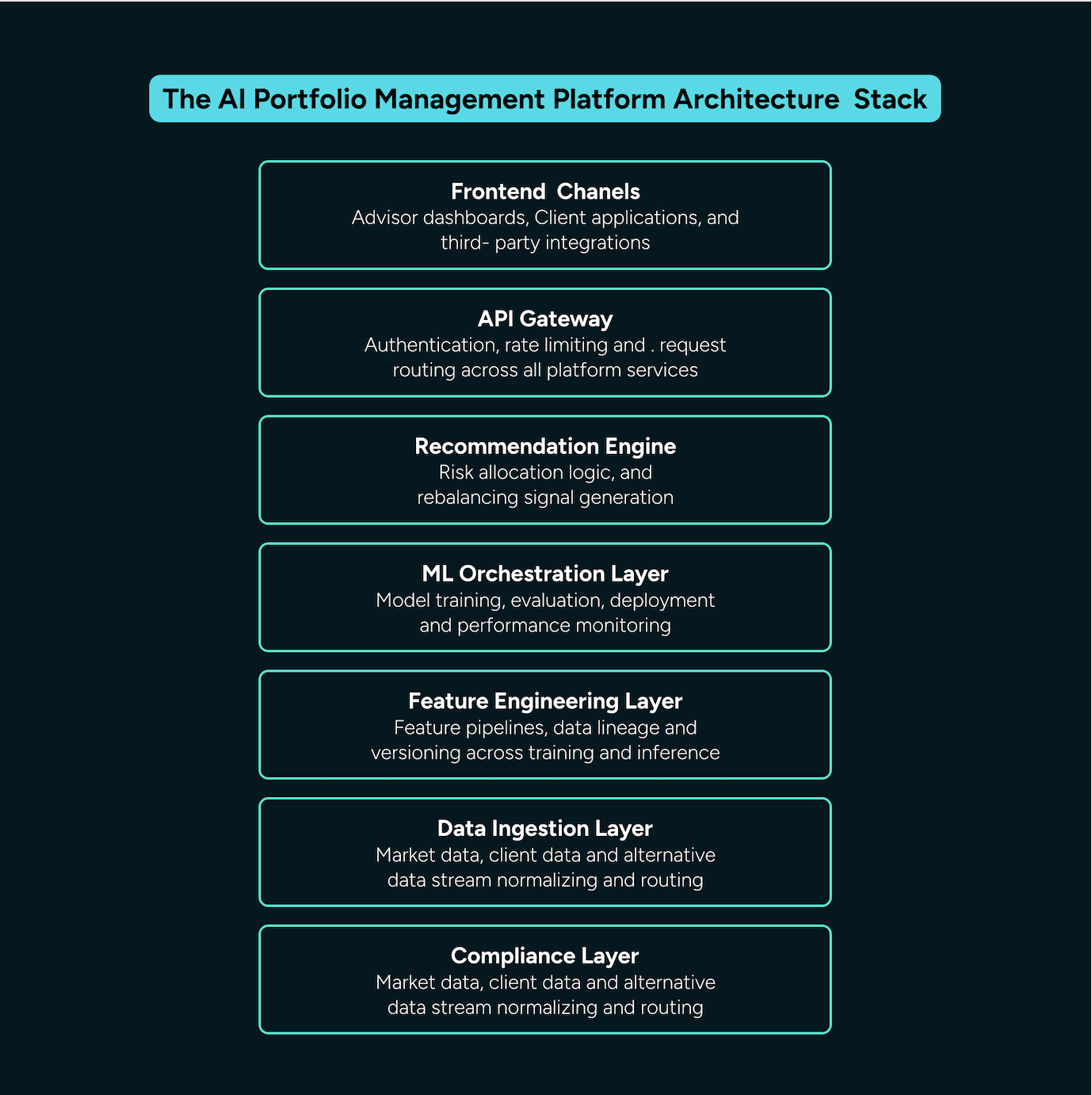
The architecture of an AI portfolio management platform is not a single system. It is a set of interdependent layers where a failure in one propagates across the rest. A real-time data pipeline that cannot handle market event spikes will starve the feature engineering layer. A model registry without governance workflows will push unvalidated models into production. An API gateway without rate limiting and authentication will expose the entire platform to security risk. Each layer must be designed with the demands of the next layer in mind. That is what separates a platform built for demonstration from one built for production
Connecting AI Investment Platforms to Legacy Wealth Management Systems
Wealth management firms rarely build on a clean slate. Most operate with order management systems, custodian platforms, CRM tools, and decades-old mainframe infrastructure. Introducing an AI portfolio management platform into this environment requires a structured integration approach that does not disrupt existing operations. Most integration efforts fail because the underlying systems were never designed to support real-time AI data exchange.
What Makes Legacy System Integration Complex
Integration complexity in wealth management is an organizational problem. Each system in the existing stack was built at a different time, for a different purpose, and with different data standards.
Custodian API Connectivity
Custodian systems expose limited or proprietary APIs not designed for real-time data exchange. The integration layer must normalize data formats and manage authentication protocols without creating latency in portfolio operations.
OMS and PMS Integration
An AI platform that cannot read from and write to order management and portfolio management systems in real time will produce recommendations disconnected from the actual portfolio state.
CRM Synchronization
Without bidirectional CRM synchronization, the AI layer operates on an incomplete investor context, undermining the personalization engine.
Breaking Down Data Silos
When data sits in disconnected systems with different formats and standards, AI models receive inconsistent inputs that produce unreliable outputs. A unified data layer that aggregates and normalizes records across all source systems is a prerequisite for production-grade deployment.
Mainframe Modernization
Wrapping mainframe functions in APIs allows the AI platform to access legacy data without a disruptive migration.
Modernization Strategies That Support AI Adoption
API-First Modernization
Every legacy system must expose data through standardized, versioned APIs with documented governance protocols.
Microservices Architecture
Decomposing monolithic systems into independently deployable services reduces coupling and makes the platform easier to scale.
Event-Driven Architecture
Trade executions, client profile updates, and risk threshold breaches propagate across the platform in real time without batch synchronization.
Hybrid Cloud Deployment
AI workloads run in the cloud while sensitive data and regulated processes remain on-premises, preserving compliance obligations.
AI Governance, Explainability, and Regulatory Compliance in Portfolio Management Platforms
Regulatory scrutiny of AI in wealth management is no longer a future consideration. The SEC and FINRA have made model transparency, audit readiness, and fiduciary accountability active examination priorities. For platform leaders, governance is a core architectural requirement that must be built into the platform at the infrastructure level before any model reaches production.
SEC and FINRA Considerations
AI Transparency
Every recommendation the platform produces must be traceable to a defined model logic. Black-box outputs are not acceptable in a regulated advisory context.
Audit Trails
The platform must maintain immutable logs of every model decision, data input, and recommendation delivered to investors or advisors, accessible for regulatory examination on demand.
Model Explainability
Explainability frameworks must translate model outputs into language that compliance teams and regulators can review without requiring data science expertise.
Regulatory Reporting
Automated reporting pipelines must align model behavior records with SEC and FINRA filing requirements, reducing manual compliance effort and reporting risk.
Responsible AI in Wealth Management
Bias Mitigation
Training data and model outputs must be audited for demographic and behavioral bias that could produce discriminatory investment recommendations.
Ethical Recommendations
The recommendation engine must operate within defined boundaries, with guardrails that prevent the platform from optimizing for performance at the expense of investor suitability.
Human Oversight
No AI recommendation should reach an investor without a defined human review checkpoint, particularly for high-value portfolio decisions.
Governance Workflows
Formal model approval, change management, and retirement workflows must be in place before any model enters production.
Observability for Financial AI Systems
Drift Detection
Models must be monitored for input and output drift that signals degraded performance under changing market conditions.
Hallucination Monitoring
LLM-powered components require continuous output validation to prevent fabricated financial insights from reaching advisors.
Recommendation Validation
Every AI-generated recommendation must pass through a validation layer that checks for investor suitability and regulatory filing requirements before delivery.
Model Reliability
Uptime, latency, and prediction stability metrics must be tracked at the model level, not just at the infrastructure level.
Building Secure Infrastructure for Enterprise AI Wealth Management Platforms
Enterprise AI portfolio management platforms handle sensitive financial data, real-time transactions, and regulated investor records. A security breach or infrastructure failure in this environment creates regulatory exposure, client trust damage, and fiduciary liability. Security and infrastructure design are platform design requirements.
Financial-Grade Security Architecture
Zero Trust Security
Every request to access platform data or services must be verified regardless of origin. No user, service, or system is trusted by default.
Encryption
All data must be encrypted in transit and at rest. This applies to market data feeds, investor records, model outputs, and audit logs without exception.
Identity Management
Centralized identity management with multi-factor authentication must govern access to every platform component, from data pipelines to model registries.
Role-Based Access Control
Access to sensitive data and platform functions must be restricted to defined roles with documented permissions, reviewed on a scheduled basis.
API Security
Every internal and external API must be protected with token-based authentication, rate limiting, and payload validation to prevent unauthorized data access.
Cloud Infrastructure for AI Portfolio Platforms
Cloud Provider Selection
AWS, GCP, and Azure offer financial-services-grade infrastructure with compliance certifications relevant to wealth management workloads. Provider selection must align with the firm's data residency requirements.
Kubernetes Orchestration
Container orchestration through Kubernetes enables consistent deployment, scaling, and management of AI workloads across environments.
Multi-Region Failover
Critical platform components must be deployed across multiple geographic regions to ensure continuity during infrastructure failures.
High Availability Architecture
The platform must maintain defined uptime SLAs through redundant compute, storage, and networking layers with automated failover mechanisms.
According to Gartner's 2025 Market Guide for AI Trust, Risk and Security Management, enterprises must implement layered AI governance policies across all AI use cases to ensure trustworthy and secure deployment.
Measuring Business and Engineering ROI from AI Portfolio Management Systems
Deploying an AI portfolio management platform is a capital-intensive decision. Leadership teams need a clear framework for measuring returns across business outcomes and engineering performance.
Business Metrics
Portfolio Performance Improvements
AI-driven allocation and rebalancing decisions must be measured against benchmark performance over defined periods. Outperformance relative to rule-based models is the primary indicator of predictive value.
Advisor Productivity
The number of portfolios an advisor manages and the time spent on manual tasks are direct indicators of how much the AI layer reduces operational load.
Customer Retention
Personalization quality and goal alignment directly influence client retention rates. Retention improvement is one of the clearest signals of platform value.
AUM Growth
Platforms that deliver measurable investment outcomes and superior client experience attract new assets. AUM growth rate is the most direct business-level ROI metric.
Operational Efficiency
Automation of data validation, trade routing, and compliance monitoring reduces overhead and process delays across the firm.
Engineering KPIs
Model Latency
The time between data input and recommendation output must meet defined thresholds for real-time portfolio operations.
Prediction Accuracy
Model performance must be tracked against defined accuracy benchmarks, with drift alerts triggered when performance falls below acceptable levels.
System Uptime
Platform availability must meet enterprise-grade SLAs with documented incident response and recovery time objectives.
Deployment Frequency
The rate at which new models reach production reflects the maturity of the MLOps pipeline.
AI Inference Cost
Computational cost per model inference must be monitored and optimized as platform usage scales
Build, Buy, or Modernize: Selecting the Right AI Portfolio Management Platform Strategy
From Discovery Sprint to Production-Grade AI Portfolio Management Platform: A Roadmap for Engineering Leaders
Why GeekyAnts for AI Portfolio Management Platform Engineering
We built GeekyAnts to solve the problems that sit between strategy and execution. In BFSI, that gap is widest when firms are trying to move AI from the boardroom to the balance sheet. Our engineering teams have done it across payments, wealth, and lending. We know where the complexity lives.
 Kumar PratikFounder & CEO
What separates a successful AI platform deployment from a stalled one is the depth of the engineering partner's understanding of the domain. At GeekyAnts, we bring financial services engineering experience, compliance-aware architecture practices, and production deployment expertise into every engagement. For platform leaders who need to move fast without accumulating technical debt, that combination is what makes the difference.
GeekyAnts has delivered 50+ fintech projects with a dedicated team of 40+ fintech engineers, including a digital wealth platform for Singapore-based Bambu and a global payments platform processing 400 million transactions annually. Our cloud and platform engineering practice delivers AI governance, FinOps, and security by default, with documented results including a 60% reduction in cloud infrastructure costs for a digital banking client. For BFSI and fintech leaders who need enterprise-grade AI execution without rebuilding internal engineering capacity, we operate as an embedded engineering partner across architecture, compliance, and delivery.
The Future of AI Portfolio Management: What Comes Next for Wealth Platforms
The next generation of AI portfolio management platforms will move beyond single-model decision support toward interconnected systems that operate with greater autonomy and precision.
Multi-Agent Financial Intelligence Systems
Multiple AI agents will work in parallel across data ingestion, risk analysis, and portfolio construction, coordinating decisions across the platform without human intervention at every step.
Autonomous Portfolio Rebalancing
Rebalancing will shift from scheduled or threshold-triggered events to continuous, model-driven adjustments that respond to market conditions, client goals, and risk parameters in real time.
Generative AI for Investment Research
Large language models will synthesize earnings calls, SEC filings, macroeconomic data, and analyst reports into structured investment insights, reducing research cycles from days to minutes.
Hyper-Personalized Wealth Experiences
Investor profiles will extend beyond risk tolerance to include behavioral patterns, life events, tax positions, and long-term goals, enabling portfolio strategies that reflect each client's complete financial picture.
AI and Human Hybrid Advisory Models
The most competitive platforms will give advisors AI-generated intelligence that makes every client interaction more informed and every portfolio decision more defensible.
Conclusion
Building a production-grade AI portfolio management platform is a strategic decision. The firms that will lead the next decade of wealth management are those that treat AI as a core infrastructure investment. The architecture you build today defines the outcomes you can deliver tomorrow.
- https://www.pwc.com/gx/en/news-room/press-releases/2024/pwc-2024-asset-and-wealth-management-report.html
- https://www.mckinsey.com/capabilities/risk-and-resilience/our-insights/how-generative-ai-can-help-banks-manage-risk-and-compliance
- https://www.gartner.com/en/documents/7009298
Sources & Citations
How the Core Architecture Layers Work Together
An AI portfolio management platform is a stack of interconnected layers, each with a defined responsibility. When integrated with precision, these layers operate as a unified intelligence engine.
Data Ingestion Layer
All market data, client data, and alternative data streams enter through this layer, handling normalization, validation, and routing to downstream systems.
Feature Engineering Layer
Raw data is transformed into structured inputs for machine learning models, managing feature pipelines, data lineage, and versioning.
ML Orchestration Layer
This layer coordinates model training, evaluation, deployment, and monitoring, ensuring performance degradation is detected before it affects portfolio outcomes.
Portfolio Intelligence Engine
Risk scoring, allocation logic, and rebalancing signals are generated based on processed features and model outputs.
Recommendation Engine
Client-level recommendations are filtered through investor profiles, goals, and constraints before delivery.
Compliance Layer
Every recommendation passes through automated compliance checks, maintaining audit trails and flagging exceptions for human review.
API Gateway
A secured API gateway manages authentication, rate limiting, and routing across all platform services.
Frontend Channels
Advisor dashboards, client applications, and integrations consume platform data, governed by role-based access controls.
Real-Time Financial Data Infrastructure for AI Platforms
Real-time data infrastructure determines whether the platform acts on market conditions as they develop or remains a step behind.
Market Data Ingestion
The platform ingests price feeds, order book data, and reference data from multiple providers with sub-second latency.
Event Streaming Architecture
An event streaming backbone treats every market event and system update as a stream that downstream services consume in real time, eliminating data flow bottlenecks.
Kafka and PubSub Integration
Apache Kafka or cloud-native messaging systems provide the backbone for high-throughput event distribution, ensuring no data loss during peak load.
Change Data Capture Pipelines
CDC pipelines propagate database changes downstream without full data reloads, keeping platform data consistent across layers.
Real-Time Analytics Layer
Stream processing frameworks generate risk alerts, rebalancing triggers, and anomaly notifications from incoming data without batch delays.
AI and ML Infrastructure Stack for Wealth Management Platforms
The infrastructure stack determines the platform's capacity to train, deploy, and monitor models at the scale enterprise wealth operations demand.
Feature Stores
A centralized feature store ensures transformations applied during training are also applied during inference, eliminating training-serving skew.
Vector Databases
Financial documents and research reports are stored as vector embeddings, enabling semantic search at the speed portfolio workflows require.
Model Registries
All trained models are versioned and stored in a central registry, giving platform teams visibility into production versions and rollback capability.
MLOps and LLMOps Pipelines
Automated pipelines manage the full lifecycle of machine learning and large language models, from training and evaluation to deployment and monitoring.
GPU Infrastructure
Model training and inference workloads require dedicated GPU resources, the platform provisions and scales based on demand.
Retrieval-Augmented Intelligence for Financial Research
RAG pipelines connect language models to live financial documents, giving the platform access to current information at the point of query.
SEC Filings Retrieval
The platform indexes SEC filings, allowing portfolio managers to query regulatory documents through natural language interfaces.
Earnings Call Analysis
Earnings call transcripts are stored as searchable embeddings, surfacing management commentary alongside quantitative portfolio data.
Financial Document Embeddings
Research reports and macroeconomic publications are converted into vector representations, giving the intelligence layer access to a broad and current knowledge base.
RAG Pipelines for Investment Research
RAG pipelines ground language model outputs in indexed financial documents, ensuring research outputs reflect current source material rather than model memory.
From architecture decisions to compliance frameworks, building a production-ready AI fintech robo-advisor platform demands more than good models. This guide breaks down exactly how to do it right.
The decision to build, buy, or modernize an AI portfolio management platform determines your speed to market, cost of ownership, compliance burden, and long-term competitive positioning, and no single option is the right answer for every firm. The right path depends on your firm's data advantages, integration complexity, scalability requirements, and tolerance for vendor lock-in.
When to Build In-House
Building from scratch makes sense when competitive differentiation depends on proprietary investment logic that no third-party platform can replicate. Firms with unique data assets and custom risk models will find that in-house development delivers the IP ownership and data control their business model demands. This path requires a dedicated team with AI engineering, financial domain, and MLOps expertise, along with a longer timeline and higher upfront cost of ownership.
When to Use AI Infrastructure Partners
Partnering with AI infrastructure providers accelerates time to market without sacrificing platform quality. Firms that need to deploy compliance-ready, scalable AI capabilities within a defined timeline benefit from partners who bring pre-built infrastructure, regulatory frameworks, and domain expertise. This path reduces vendor lock-in risk when contracts include data portability and API access guarantees, and lowers the overhead of maintaining GPU infrastructure and model governance frameworks internally.
When to Modernize an Existing Robo Advisory Platform
Firms with an established robo advisory platform can extend their existing infrastructure through API-first integration and microservices adoption, preserving current investments while adding AI-native capabilities. This path offers the lowest integration complexity, the least operational disruption, and the fastest route to AI-native functionality for firms already operating at scale. Customization remains possible through modular AI layer additions without replacing core infrastructure.
Ready to build your AI portfolio management platform with an engineering team that knows BFSI inside out?
Work With GeekyAnts
Moving from concept to production requires a phased approach that accounts for data readiness, infrastructure complexity, compliance obligations, and model governance before a single model reaches investors.
Discovery and AI Readiness Assessment
Evaluate existing systems, identify data gaps, and define high-impact use cases aligned with business objectives and regulatory constraints.
Data Engineering and Pipeline Architecture
Build data pipelines that consolidate market, client, and transactional data into a unified, model-ready layer across all source systems.
Model Development and Validation
Develop and validate ML models for forecasting, risk profiling, and client segmentation against defined accuracy benchmarks and compliance requirements.
Platform Integration and Quality Assurance
Integrate models into portfolio systems, trading platforms, and advisory tools, with rigorous testing for accuracy, scalability, and regulatory alignment.
Governance and Observability Setup
Implement model registries, drift detection, audit trails, and explainability frameworks before any model reaches investors.
Ongoing Monitoring and Optimization
Monitor model performance, regulatory updates, and system reliability against defined SLAs and accuracy thresholds on a scheduled basis.
Most AI prototypes never survive contact with real portfolios, real compliance, and real scale. Yours will.
Take It to Production