

Key Takeaways
- A production-grade AI robo-advisory platform requires compliance, security, and AI infrastructure to be foundational architecture decisions.
- An AI-powered MVP in the US market costs between $190,000 and $335,000, with SEC compliance engineering and cybersecurity certifications as the primary cost drivers.
- Every AI recommendation must include a traceable, human-readable rationale that satisfies both SEC examination standards and client trust requirements.
- The monetization model chosen at the start of a build directly determines the platform's data architecture, billing infrastructure, and scalability requirements.
The way wealth gets managed is changing faster than traditional financial institutions were built to adapt. Investors today expect portfolio intelligence, real-time recommendations, and personalized financial planning available on demand. AI-native robo-advisory platforms are meeting that expectation in ways that rule-based, first-generation robo-advisors never could.
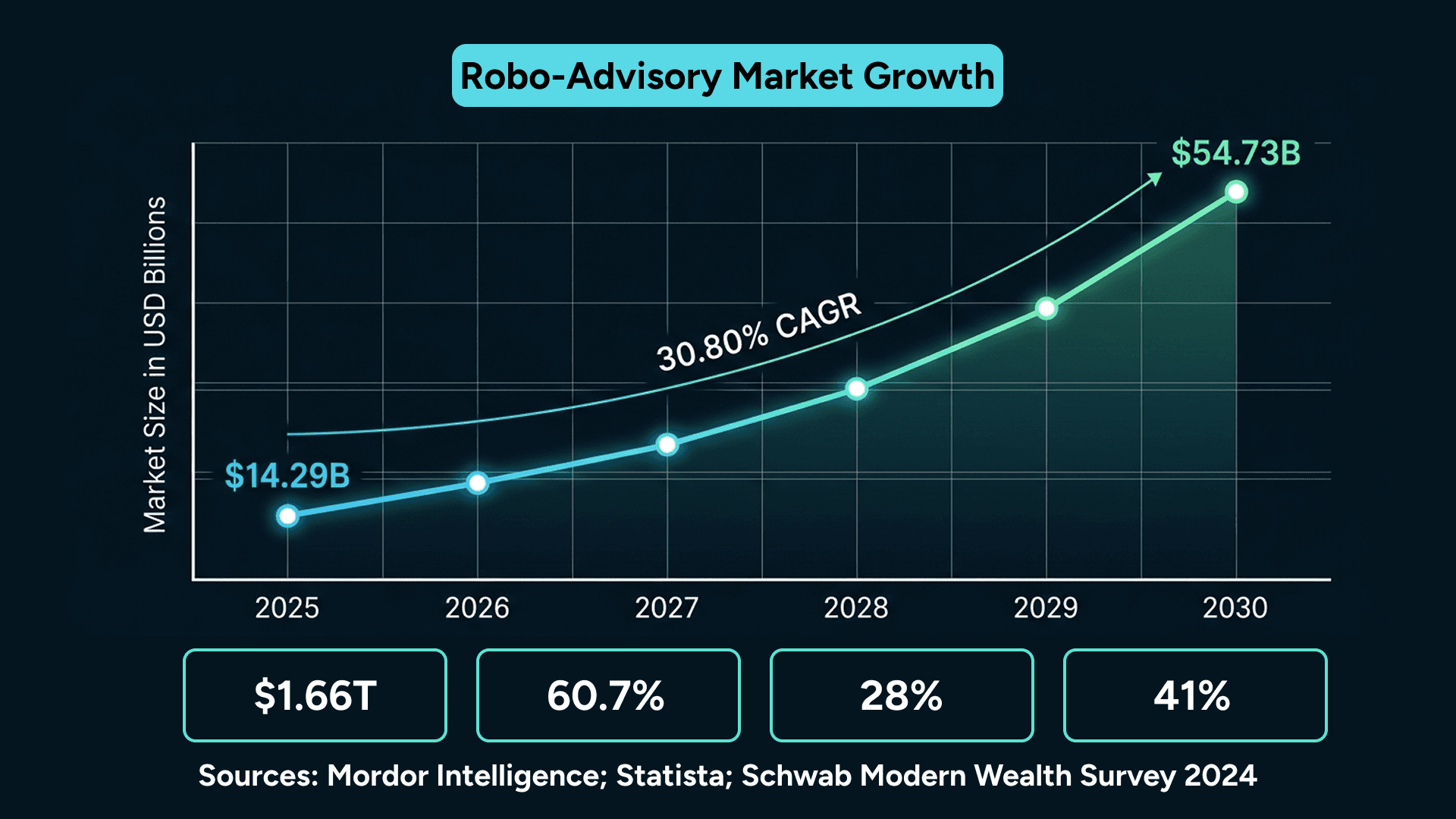
The numbers reflect this shift. The global robo-advisory services market is estimated at $14.29 billion in 2025 and is projected to reach $54.73 billion by 2030, growing at a CAGR of 30.80%. In the United States alone, robo-advisors are projected to manage $1.66 trillion in assets in 2025. This is no longer a niche segment, it is a core infrastructure category within modern fintech.
For engineering leaders and CTOs building in this space, the opportunity is real but the execution is complex. SEC and FINRA compliance, infrastructure that scales under load, AI models that produce explainable and auditable recommendations, and the ongoing cost of maintaining all three are the variables that determine whether a platform survives past its MVP.
This blog breaks down the architecture, compliance requirements, technology decisions, and cost structure involved in building a production-grade AI robo-advisory platform for the US market.
Most fintech teams we speak to understand the product they want to build. What they underestimate is the cost of getting the compliance architecture wrong in the first sprint. In the US market, that single decision determines whether the platform reaches institutional clients or stays stuck at the MVP stage. The teams that move fast and get it right are the ones that treat regulatory readiness as an engineering problem, not a legal one.
 Kunal KumarChief Revenue Officer
The demand for AI-native robo-advisory platforms in the US market is no longer coming from startups alone. Regional banks, independent RIAs, and embedded finance operators are all evaluating builds or modernization projects in 2025 and 2026. What has shifted is the expectation. Institutional buyers now require explainable AI, SOC 2 certification, and audit-ready infrastructure as baseline requirements before they will engage a development partner. Platforms that cannot demonstrate compliance readiness from day one are losing deals before the first technical conversation.
Robo Advisory Platform Use Cases and Business Models for Banks, Fintechs, and Wealth Platforms
AI robo-advisory is not a single product category. The architecture, compliance requirements, and feature set change significantly depending on who is building the platform and who it serves. Below are the six primary B2B models shaping how banks, fintechs, and wealth platforms are deploying robo-advisory today.
Digital Wealth Management for Banks
Banks with an existing retail customer base are building robo-advisory layers on top of their core banking infrastructure. The goal is to retain deposits, increase wallet share, and offer investment products without expanding their human advisor headcount. The platform must integrate with existing core banking systems and meet SEC and FINRA requirements.
Robo-Advisory MVP for Fintechs
Startups entering the wealth management space need a lean, functional platform that can acquire users, demonstrate product-market fit, and attract institutional investment. The priority is speed to market, a defensible feature set, and a compliance foundation that holds up during due diligence.
Embedded Investment Advisory
Platforms with an active user base are embedding investment advisory as a value-added feature inside their existing product. This model runs on API-first architecture and requires the robo-advisory layer to match the host platform's user experience, navigation patterns, and data security standards.
White-Label Robo-Advisory
Wealth managers who want to offer automated portfolio management without building proprietary technology license a white-label platform. The platform carries their brand, investment methodology, and fee structure, while the underlying infrastructure is managed externally.
Hybrid Advisor-Assisted Platform
This model pairs AI-driven portfolio intelligence with licensed advisor access, creating a tiered service model where automation handles routine rebalancing and the advisor handles complex financial decisions.
Internal Advisor Productivity
This model gives advisors AI-powered tools to manage more clients with greater accuracy. The platform surfaces portfolio insights, flags rebalancing opportunities, and generates recommendation summaries that advisors review before client delivery.
Why Most Robo-Advisory Platforms Never Make It Past MVP
Most robo-advisory platforms fail because foundational architecture decisions made in the first few development sprints create a ceiling the platform cannot grow beyond.
1. A team builds on a rule-based engine or a white-label solution that performs well for the first few hundred users. Then the product roadmap expands to include a new asset class, a new broker integration, and a new regulatory requirement. Because the core system was never designed for modularity, each addition requires changes that touch multiple components. Within 18 months, every new feature introduces regression risks across the existing codebase, and the team rebuilds from scratch instead of scaling.
2. The SEC and FINRA require every portfolio recommendation, rebalancing decision, and risk assessment to be logged, explainable, and auditable. Platforms that treat compliance as a post-launch concern rather than a foundational layer consistently fail regulatory audits and risk losing their operating license.
3. Real-time market feeds, user behavioral data, and portfolio performance signals need to flow through a single coherent pipeline. Platforms that stitch together multiple data sources without a unified infrastructure layer end up with latency issues and AI models that produce unreliable recommendations under market stress.
These are the structural reasons why most robo-advisory platforms in the US market never move beyond their initial MVP.
Core Features of a High-Trust AI Robo-Advisory Platform
The features that separate a production-grade robo-advisory platform from a functional prototype are not visual. They sit in the decision logic, the data pipeline, and the compliance layer.
AI-Based Risk Profiling
The platform uses behavioral data, financial history, and dynamic questionnaires to build an accurate investor risk profile that updates as market conditions and user financial behavior evolve.
Automated Portfolio Rebalancing
The system continuously monitors asset allocations and triggers rebalancing when portfolios drift from their target mix. This removes manual intervention from a process that directly affects client returns and risk exposure.
Goal-Based Financial Planning
Users define financial objectives such as retirement, education funding, or wealth accumulation. The platform builds and manages portfolios aligned to those goals, with performance tracked against defined milestones.
Conversational AI Financial Assistants
LLM-powered assistants handle client queries, explain portfolio decisions, and surface actionable insights in plain language. This reduces advisor workload while maintaining consistent, documented client communication across every interaction.
Tax-Loss Harvesting
The platform scans portfolios for underperforming positions that can be sold to offset taxable gains, then replaces them with correlated assets to maintain market exposure. In the US market, this feature alone can justify the platform's subscription cost within a single tax season.
Explainable Investment Recommendations
Every recommendation the platform generates includes a traceable rationale. This satisfies SEC and FINRA audit requirements and builds client trust in AI-driven decisions.
Multi-Asset Portfolio Support
The platform manages equities, fixed income, ETFs, and alternative assets within a single portfolio engine, giving clients diversified exposure without requiring separate tools.
ESG and Personalized Investing Preferences
Clients can align portfolios with environmental, social, and governance criteria or apply custom exclusions based on personal values. This is an increasing requirement among younger investor segments.
Core Architecture of a Production-Grade AI Robo-Advisory Platform
The six layers in a robo-advisory architecture are only as strong as the contracts between them. In my experience, platforms that break in production almost always have the same root cause: two layers that were designed to depend on each other's internal state rather than communicate through clean, versioned interfaces. That decision, made in the first sprint, is what you spend the next 18 months paying for.
 Jani Hardik SanjayProduct Owner I
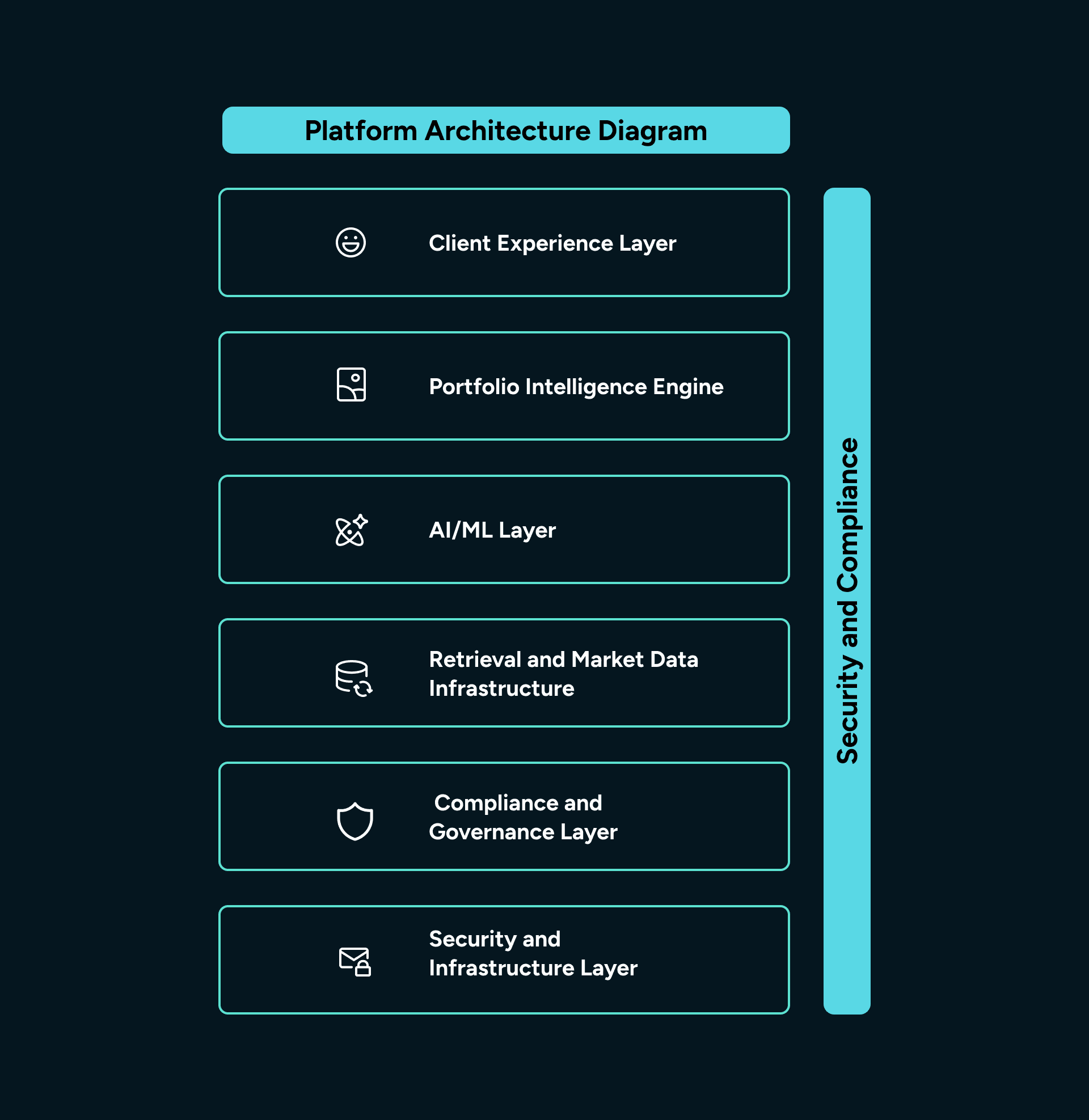
A robo-advisory platform is a set of interconnected layers, each with a specific responsibility, that must work together without creating bottlenecks, compliance gaps, or data inconsistencies. Below is a breakdown of the six architectural layers that form a production-grade AI robo-advisory platform.
Client Experience Layer
This is the layer users interact with directly. It includes mobile applications, web-based investor dashboards, and conversational AI interfaces. The engineering priority at this layer is data accuracy, session integrity, and response speed. Every interaction generates data that flows into the portfolio intelligence and AI layers below.
Portfolio Intelligence Engine
This layer contains the platform's core investment logic. Asset allocation models determine how capital is distributed across asset classes. Risk scoring systems assign and update investor risk profiles based on behavioral and financial data. Predictive analytics models surface forward-looking signals that inform rebalancing decisions. Goal-based investing frameworks tie everything to the client's defined financial objectives.
AI/ML Layer
This layer powers the platform's decision-making capabilities. Recommendation engines process portfolio data and market signals to generate investment suggestions. LLM-powered financial copilots handle natural language interactions and explain complex decisions in plain terms. Market forecasting models analyze historical and real-time data to anticipate price movements. Behavioral finance AI identifies patterns in user activity that indicate shifts in risk appetite or financial goals.
Retrieval and Market Data Infrastructure
This layer manages the data that the platform depends on. Real-time market feeds deliver live pricing, NAV updates, and volatility signals. Financial APIs connect the platform to brokers, custodians, and payment gateways. Vector databases store and retrieve high-dimensional financial data at the speed the AI layer requires. RAG enables AI models to pull current, context-specific information rather than relying on static training data.
Compliance and Governance Layer
This layer ensures every decision the platform makes is traceable and defensible. Audit trails record every portfolio action with timestamps and decision context. Explainability modules generate human-readable rationales for AI recommendations. AI decision logging captures model inputs, outputs, and confidence scores. SEC and FINRA monitoring tools flag anomalies and generate reports required for regulatory submissions.
Security and Infrastructure Layer
This layer protects the platform at every level. Encryption covers data at rest and in transit. Zero-trust architecture ensures no internal system is granted implicit access to another. Cloud security configurations enforce access controls and threat detection. Identity management systems handle authentication, authorization, and session integrity for both end users and internal operators.
US Regulatory Compliance Framework for AI Robo-Advisory Platforms
Building a robo-advisory platform in the US market without a compliance-first architecture is a liability. The regulatory framework governing AI-driven investment platforms is multi-layered, and each layer carries direct consequences for platform operations, licensing, and client trust.
SEC Regulations for Robo-Advisors
Robo-advisory platforms that provide investment advice must register with the SEC as Registered Investment Advisors (RIAs). This registration requires the platform to meet fiduciary standards, disclose fee structures, and demonstrate that every recommendation serves the client's best interest.
FINRA Compliance Requirements
Platforms that execute securities transactions must comply with FINRA rules governing trade reporting, suitability, and customer communication. FINRA also requires broker-dealer registration for platforms that handle order execution directly.
KYC and AML Verification Systems
Every user must be verified before onboarding. Automated KYC and AML systems validate identity, screen against sanctions lists, and flag suspicious activity in real time. These systems must meet FinCEN requirements and maintain records for a minimum of five years.
Data Privacy and Consumer Protection
The California Consumer Privacy Act (CCPA) governs how platforms collect, store, and share user data in the US market. Platforms must implement data minimization practices, provide opt-out mechanisms, and maintain documented data handling policies.
AI Explainability Requirements in Finance
Regulators expect platforms to explain how AI models arrive at investment recommendations. Black-box models that cannot produce a traceable decision rationale do not meet SEC examination standards and will fail compliance reviews during regulatory audits.
Auditability and Governance for AI Recommendations
Every portfolio decision must be logged with timestamps, model inputs, and decision outputs. This audit trail is the primary evidence that regulators examine during compliance reviews.
Building Human-in-the-Loop Approval Systems
For high-value transactions and complex portfolio decisions, platforms must incorporate human oversight checkpoints. These approval systems ensure that AI recommendations are reviewed before execution, reducing the risk of model errors reaching client portfolios.
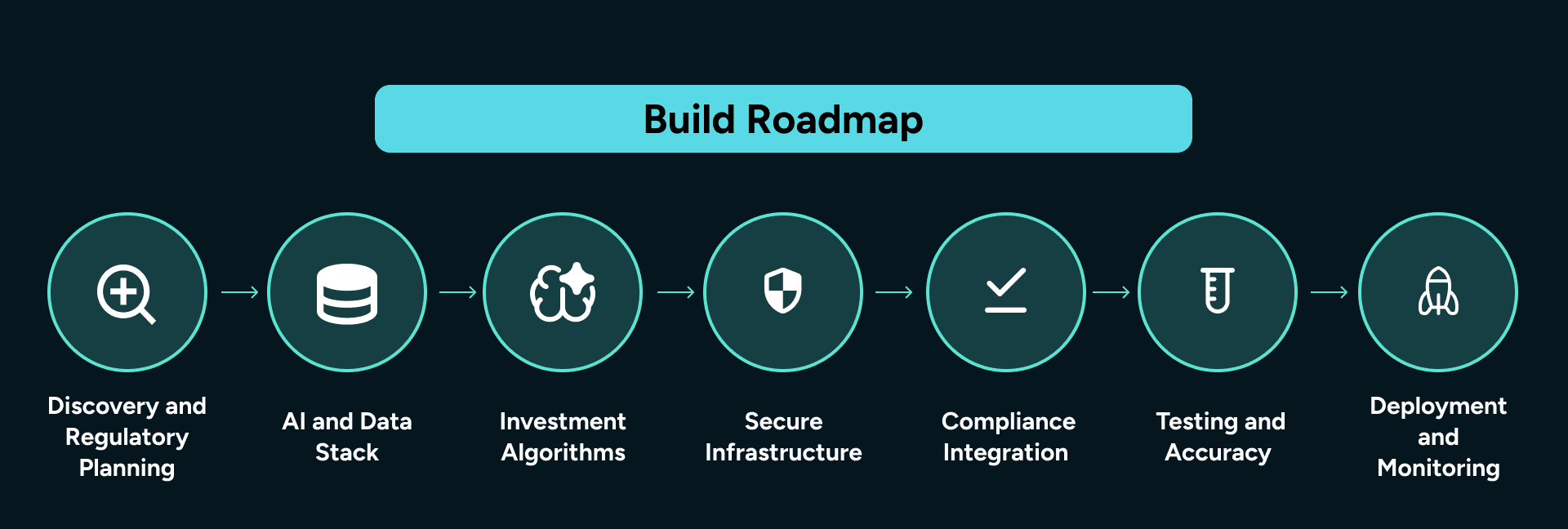
From Blueprint to Production: How to Build an AI Robo-Advisory Platform
The step most teams cut when they are under pressure to launch is backtesting. I have seen platforms go live with portfolio strategies that had never been validated against a single market downturn. A robo-advisory platform that has not been stress-tested against historical volatility is not a liability waiting for the wrong market conditions.
Jani Hardik SanjayProduct Owner IIn 2026, the bar for what constitutes a production-ready robo-advisory platform in the US market has risen significantly. SEC examination teams now review AI model documentation as part of standard compliance audits. Broker partners require SOC 2 certification and penetration test results before granting API access for trade execution, and institutional buyers are evaluating explainability infrastructure alongside feature sets during vendor selection. For engineering teams, this means the build sequence matters as much as the build itself. Platforms that front-load compliance and infrastructure decisions are reaching institutional clients in 6 to 9 months. Those that do not are still rebuilding at the 18-month mark.
Building a robo-advisory platform is a financial infrastructure project that requires software engineering discipline. The sequence of decisions made before a single line of code is written determines whether the platform scales, passes regulatory scrutiny, and earns client trust.
Discovery and Regulatory Planning
The first step is defining the platform's scope, target investor segment, portfolio offerings, and revenue model. These decisions directly shape the architecture. More critically, this is where regulatory mapping happens. In the US market, platforms must determine whether they need SEC registration as an RIA, FINRA broker-dealer registration, or both. Teams that treat compliance as a post-build concern consistently face costly architectural rework later.
Choosing the AI and Data Stack
Stack decisions at this stage have long-term consequences. The AI framework, data pipeline architecture, vector database selection, and market data providers all need to align with the platform's performance requirements and compliance obligations. Decisions made here determine how fast the platform can ingest market signals, retrain models, and scale under load.
Designing Investment Algorithms
This is where user inputs are translated into portfolio decisions. Most platforms start with Modern Portfolio Theory as the foundation, then layer in risk scoring logic, rebalancing thresholds, and diversification rules. The algorithm must produce consistent, explainable outputs from day one. Any recommendation the engine generates must have a traceable rationale that satisfies both the client and the regulator.
Building Secure Financial Infrastructure
The infrastructure layer must be designed for financial-grade security from the start. This includes microservices architecture for independent scaling, end-to-end encryption, role-based access controls, and cloud infrastructure configured for high availability. Broker API integrations, custodian connections, and payment rails are established at this stage.
Integrating Compliance Systems
Compliance systems are not a separate module. They run in parallel with every other system on the platform. KYC and AML workflows, audit trail generation, AI decision logging, and SEC/FINRA reporting tools must be integrated into the core architecture, not added as an afterthought.
Testing AI Models for Bias and Accuracy
Before launch, every AI model must be tested for bias, accuracy, and consistency. Backtesting validates portfolio strategies against historical market data. Risk scoring models are stress-tested across different investor profiles and market conditions. Any model that cannot produce consistent, explainable outputs under test conditions is not production-ready.
Deployment and Production Monitoring
Production deployment uses CI/CD pipelines with blue-green or canary release strategies to minimize downtime risk. Post-launch, the focus shifts to monitoring portfolio performance, model drift, system health, and regulatory reporting accuracy. Platforms that build observability into their infrastructure from day one respond to issues before they reach clients.
Predictive analytics and personalized portfolio insights are the core of every AI-native investment platform. This guide breaks down how to build them right.
Technology Stack for a Production-Grade AI Robo-Advisory Platform
The technology decisions made during the build process determine the platform's long-term scalability, compliance posture, and operational cost. Below is the recommended stack for a production-grade AI robo-advisory platform in the US market.
Component | Recommended Technologies | Why It Matters |
|---|---|---|
Frontend | React, Angular, Flutter | Supports responsive web and mobile interfaces with real-time portfolio data rendering |
Python with FastAPI or Django, Java with Spring Boot, Node.js | Handles portfolio logic, financial data processing, and third-party service orchestration | |
AI and ML | TensorFlow, PyTorch, Scikit-learn | Powers risk scoring, recommendation engines, and market forecasting models |
Financial Data | IEX Cloud, Polygon.io, Alpha Vantage, Plaid | Delivers real-time pricing, NAV data, and user financial account connectivity |
Cloud and DevOps | AWS GovCloud, Google Cloud, Microsoft Azure, Kubernetes, Terraform | Provides financial-grade security, scalability, and infrastructure automation |
Security and Compliance | OAuth 2.0, JWT, SSL/TLS, AWS Shield, SOC 2 frameworks | Enforces identity management, data encryption, and regulatory audit requirements |
AI Robo-Advisory Platform Development Cost in the US Market
Cost is one of the most searched and least honestly answered questions in the robo-advisory development space. Most published estimates are either too broad to be useful or too outdated to reflect current compliance and infrastructure requirements. The figures below reflect what a production-grade AI robo-advisory platform costs to build in the US market in 2026, accounting for regulatory standards, AI infrastructure, and security certifications that are now baseline requirements.
MVP Development Cost
A focused MVP that covers core portfolio logic, risk profiling, KYC/AML onboarding, and SEC compliance costs between $190,000 and $335,000 in the US market. This range accounts for the engineering cost of building an immutable audit trail, explainable AI systems, and cybersecurity certifications that broker partners require before granting API access for trade execution.
Cost Category | Budget Range | What It Covers |
|---|---|---|
Legal and Regulatory Setup | $40,000 – $70,000 | RIA registration, investment advisor disclosure documents, compliance manual, and outsourced compliance oversight |
UI/UX and Client-Facing Development | $30,000 – $50,000 | Investor dashboard, mobile application, onboarding flow, and identity verification integration |
Backend and AI Development | $70,000 – $130,000 | Portfolio engine, risk scoring system, brokerage API integration, explainability layer, and RAG pipeline |
Security and Audit Certification | $35,000 – $60,000 | SOC 2 Type 1 certification, penetration testing, and encryption standards implementation |
Data and Cloud Infrastructure | $15,000 – $25,000 | Real-time market data licensing, cloud hosting, and audit log storage |
Total | $190,000 – $335,000 | Estimated delivery timeline: 6 to 9 months to soft launch |
AI Infrastructure and Market Data Costs
Real-time market data feeds from providers like Nasdaq and IEX are a recurring operational expense. Using delayed or free data sources in 2026 does not meet SEC fiduciary standards. Budget $15,000 to $25,000 annually for data licensing and infrastructure alone.
Infrastructure-Level Cost Breakdown
Most cost estimates for robo-advisory platforms stop at the development stage. What they do not cover is the ongoing infrastructure cost that determines whether a platform remains profitable at scale. Below is a breakdown that most competitors do not publish.
Infrastructure Component | Monthly Cost Range | Notes |
|---|---|---|
AI Model Inference and Hosting | $1,500 – $8,000 | Scales with active users and recommendation frequency |
Vector Database Storage | $500 – $3,000 | Depends on portfolio size and RAG pipeline volume |
Audit Log and Compliance Storage | $300 – $1,500 | Immutable storage required for SEC and FINRA compliance |
Market Data Storage and Processing | $1,000 – $4,000 | Real-time ingestion, caching, and historical data retention |
API Gateway and Network Transfer | $200 – $1,000 | Broker API calls, custodian connections, payment rails |
Monitoring, Logging, and Observability | $300 – $1,200 | Tools like Datadog, AWS CloudWatch, or equivalent |
Disaster Recovery and Failover | $500 – $2,500 | Backup infrastructure and failover system maintenance |
Total Monthly Infrastructure | $4,300 – $21,200 | Excludes development team salaries |
Compliance and Security Expenses
SOC 2 certification and penetration testing are prerequisites for broker API access. These are the baseline requirements for operating in the US market.
Team Structure and Development Cost
A production-grade build requires backend engineers with financial systems experience, an AI/ML engineer, a compliance engineer, a UX designer, and a QA engineer. Depending on whether the team is in-house or outsourced, this accounts for 60 to 70% of the total development cost.
Ongoing AI Model Maintenance
Post-launch model retraining, compliance reporting, and platform updates add $2,000 to $15,000 per month, depending on platform complexity and the frequency of regulatory changes.
Estimated Timeline by Product Complexity
Platform Type | Estimated Timeline | Approximate Cost |
|---|---|---|
Rule-based MVP | 3–5 months | $40,000 – $100,000 |
AI-powered MVP | 6–9 months | $190,000 – $335,000 |
Full institutional-grade platform | 12–18 months | $400,000+ |
The cost of building an AI-powered platform goes beyond development hours. GeekyAnts breaks down every cost variable, from infrastructure to compliance, in one complete guide.
Monetization Models and Go-To-Market Architecture for AI Robo-Advisory Platforms
Revenue models are not just business decisions. The monetization model chosen at the start of a robo-advisory build directly determines the platform's data architecture, billing infrastructure, API design, and scalability requirements.
AUM-Based Fee Model
This model charges an annual percentage of assets under management, typically between 0.25% and 0.50%. It requires a real-time AUM calculation engine that tracks portfolio values across market hours, a billing system that reconciles fees against daily NAV fluctuations, and audit-ready fee disclosure records that meet SEC transparency requirements.
Subscription and Flat Fee Model
A flat monthly or annual fee model requires a subscription management system with automated billing, dunning workflows for failed payments, and plan-tier logic that gates feature access without creating bottlenecks in the portfolio engine.
Freemium to Premium Upsell Model
This model demands feature-flagging infrastructure that controls access at the component level and a portfolio engine that scales compute resources as users move from free to premium tiers.
White-Label and B2B Partnership Model
Each institutional client requires an isolated tenant environment, a separate compliance configuration, branded UI components, and dedicated API rate limits. Multi-tenancy architecture with strict data isolation is a contractual and regulatory requirement for every institutional partner onboarded.
Go-To-Market Architecture Considerations
A B2B white-label GTM requires broker API integrations and institutional-grade SLAs from day one. A direct-to-consumer GTM prioritizes KYC/AML onboarding speed and low-latency portfolio updates. Supporting both simultaneously requires a modular architecture where GTM-specific components can be enabled or disabled without affecting core portfolio logic.
Critical Challenges in Building a Production-Grade AI Robo-Advisory Platform
Building a robo-advisory platform surfaces engineering and operational challenges that standard software development does not prepare teams for. Each challenge below has direct consequences for platform architecture, regulatory standing, and client retention.
AI Bias in Financial Recommendations
AI models trained on historical market data inherit the biases present in that data. Biased recommendations can systematically underserve specific investor profiles. Every model must be tested for bias before deployment and monitored against live portfolio outcomes.
Regulatory Uncertainty
SEC and FINRA guidelines for AI-driven investment advice continue to evolve. Platforms built on rigid compliance architectures struggle to adapt when regulations change. Compliance systems must be modular enough to incorporate new requirements without touching core portfolio logic.
User Trust and Transparency
Delegating financial decisions to software requires a level of trust that most investors do not extend by default. Platforms that cannot explain their recommendations in plain language lose users during market volatility.
Real-Time Data Accuracy
Portfolio recommendations are only as reliable as the data behind them. Stale or inconsistent market data produces inaccurate risk scores, incorrect rebalancing triggers, and recommendations that do not reflect current market conditions.
Scaling AI Infrastructure
A recommendation engine that performs well at 1,000 users creates compute bottlenecks at 100,000 users if the infrastructure was not designed for horizontal scaling from the start.
Portfolio Explainability
Black-box AI models that cannot produce a traceable decision rationale fail SEC examination standards. Every recommendation must include a human-readable explanation that satisfies both regulatory and client-facing requirements.
Build vs Buy vs Modernize: The Right Approach for AI Robo-Advisory Development
This decision shapes every architectural choice that follows. The approach chosen at this stage determines how flexible, scalable, and compliant the platform can be as requirements evolve.
Approach | Best For | Architecture Impact | Long-Term Risk |
|---|---|---|---|
Build In-House | Platforms requiring custom compliance configurations and proprietary AI models | Full control over every layer, no vendor constraints | Higher upfront cost, longer delivery timeline |
Buy (White-Label) | Early-stage MVPs with limited capital and tight launch timelines | Limited to vendor's architecture decisions and integration options | Vendor dependency, difficult to differentiate at scale |
Modernize Existing System | Financial institutions with legacy platforms and an existing user base | Existing data and workflows preserved, compliance gaps must be addressed layer by layer | Technical debt carries forward if not addressed during modernization |
Partner (BaaS/APIs) | Teams needing ready infrastructure for specific components like KYC, execution, or data feeds | Modular, but core features remain outside the team's control | Ongoing dependency on third-party SLAs and roadmap decisions |
Teams that begin with white-label or partner-led models frequently rebuild their core systems within 18 to 24 months as compliance requirements and product complexity outgrow what the vendor can support.
Building in-house delivers long-term architectural control, predictable infrastructure costs, and a compliance layer that can be modified without vendor approval. For engineering leaders building for institutional clients or operating across multiple regulatory jurisdictions, this is the approach that scales without creating dependency risks.
The exception is an early-stage MVP where capital constraints make a white-label foundation a practical starting point, provided the architecture is designed for a future migration to a proprietary system.
Why GeekyAnts Is the Right AI Fintech Development Company for Your Robo-Advisory Platform
In our experience building financial platforms for the US market, the teams that reach production without a rebuild are the ones that treat compliance and data infrastructure as architecture decisions. Agentic AI has changed what clients expect from a robo-advisory platform. They no longer want a system that reacts to input. They want a system that anticipates the next portfolio decision before the client asks for it. That is the standard we build at GeekyAnts.
 Kumar PratikFounder & CEO
GeekyAnts has delivered over 12,500 hours of AI-focused development across fintech, healthcare, and enterprise platforms, with an active presence in the US market through its San Francisco office. For robo-advisory builds specifically, the firm brings together financial systems engineering, compliance-ready AI infrastructure, and agentic AI capabilities that allow platforms to move from static recommendation engines to systems that anticipate portfolio decisions before a client requests them. In a market where institutional buyers now evaluate explainability infrastructure and SOC 2 readiness as baseline requirements, GeekyAnts' delivery model is built to meet that bar from the first sprint.
Building a production-grade robo-advisory platform requires a development partner with financial systems engineering experience. GeekyAnts has delivered more than 800 projects worldwide, many in the fintech space, including mobile-first banking, lending platforms, credit scoring systems, and portfolio management tools.
Faster Regulatory Readiness
Compliance monitoring at GeekyAnts is built into the delivery process, not added at the end. For robo-advisory builds, this means SEC and FINRA requirements are addressed at the architecture level, not retrofitted after launch.
Secure AI Infrastructure
Every fintech platform delivered by GeekyAnts, from digital banking portals to investment dashboards, is built with end-to-end encryption, role-based access controls, and SOC 2-aligned security standards from day one.
Faster Go-to-Market
With over half a decade of fintech delivery experience and products that now handle transactions in the millions, the team brings shorter development cycles, fewer integration risks, and a compliance foundation that satisfies SEC examination requirements without architectural rework.
Production-Grade Fintech AI Expertise
From fintech startups to established financial institutions, the firm specializes in AI integration, custom software product development, and enterprise modernization, with a delivery model built for the complexity of production-grade financial systems.
From compliance-ready architecture to production-grade AI infrastructure, we build platforms that scale in the US market.
Conclusion
The gap between a functional robo-advisory prototype and a production-grade platform is an architecture gap.The platforms that scale in the US market are the ones where compliance, AI infrastructure, and security are built into the first sprint.
For engineering leaders evaluating this build, the sequence of decisions made before development begins determines the cost, timeline, and regulatory standing of everything that follows.
GeekyAnts brings the financial systems engineering experience, compliance readiness, and AI development expertise to build robo-advisory platforms that are designed to scale from day one.