

Key Takeaways
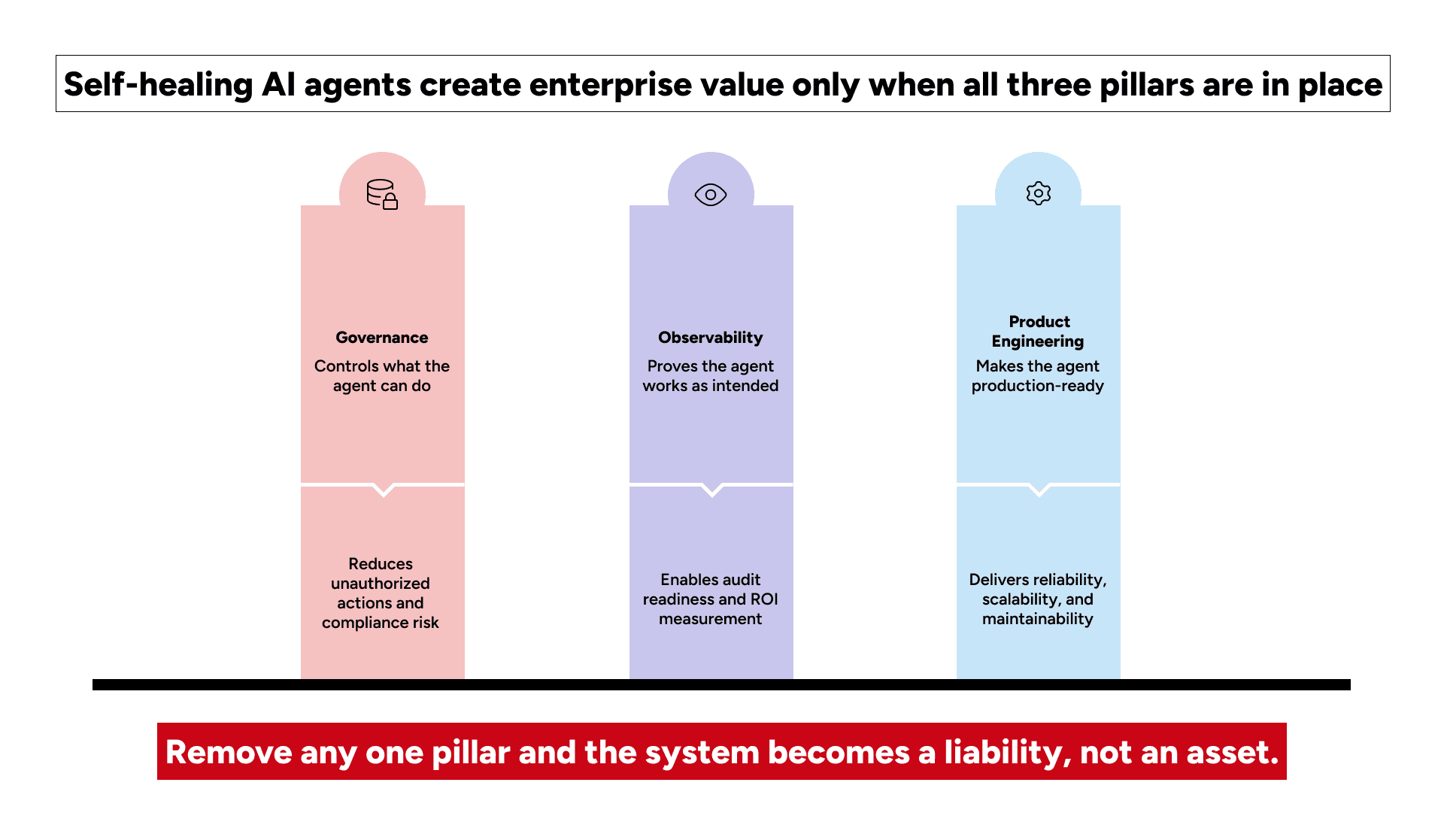
- Self-healing AI agents create value only when they are governed, observable, auditable, and product-engineered.
- Governance defines who controls agent actions, observability proves the agent works as intended, and product engineering makes the agent reliable at scale.
- Enterprises moving past chatbots into agents that act inside core workflows face a higher bar for control, accountability, and risk ownership.
- Before scaling autonomy in any workflow, teams need a readiness assessment confirming the process, data, and approvals can support an AI agent.
Why Are Organizations Moving From AI Pilots to Governed Automation With Self-Healing AI Agents?
AI adoption has reached a new stage.
McKinsey's most recent Global Survey found that 88% of organizations report regular AI use in at least one business function, and 23% are scaling agentic AI somewhere in their operations. Yet within any single business function, no more than 10% of organizations report scaling AI agents, and only 39% see a measurable financial return at the enterprise level.
The gap between using AI and trusting AI to act stays wide. Gartner adds a sharper warning: more than 40% of agentic AI projects will face cancellation by the end of 2027, driven by rising costs, unclear business value, and weak risk controls. Cost pressure, compliance exposure, and manual rework now is at the center of every automation conversation, and unreliable pilots are the reason many of these projects stall before they reach production.
Organizations are redirecting investment away from AI tools that assist one user at a time and toward agents built to act across an entire workflow. A chatbot answers a question. An AI agent observes a process, decides on an action, and executes that action across connected systems, often without a person approving each step. This redirection reflects where the business value sits: in workflows that run continuously.
Self-healing AI agents represent the next layer of this capability. These are systems built to detect a failure inside a workflow, diagnose the likely cause, and apply a fix or escalate the issue to a person, without waiting for a manual restart.
This guide is written for the teams making AI infrastructure decisions and the founders building AI-native products for enterprise buyers. The argument running through this guide is direct. Self-healing AI agents create enterprise value only after governance defines what the agent can act on, observability proves the agent behaves as expected, and product engineering turns the agent into a system a business can run with confidence. Autonomy without these three foundations turns a promising pilot into an operational liability.
Every organization we speak to has run at least one AI pilot. The ones that come to us are not looking for another experiment. They are looking for a path from a working prototype to a system their procurement, legal, and compliance teams will sign off on. That gap, between what the pilot proved and what the organization will approve, is where most AI programs stall. In some AI programs, the cost of stalled pilots can run for months when governance and observability are not designed early. And that gap has a price tag attached to it that most organizations are not tracking. The governance and observability layer was never designed. That is a planning failure with a real revenue consequence for every vendor in that deal.
 Kunal KumarChief Revenue Officer
Why Do Self-Healing AI Agents Need Governance, Observability, and Product Engineering to Work in the Enterprise?
In the rush to get AI agents live, we have seen a trend of bypassing design patterns and infrastructure fundamentals to save time. Trading engineering discipline for speed is not shipping fast. It is borrowing time from a future production failure. A system that is not observable, repeatable, and maintainable from day one cannot be scaled, no matter how well the demo performed.
 Konakanchi Venkata Suresh BabuPrincipal Technical Consultant.
Governance comes first because it sets decision rights before an agent takes any action: who owns the agent, what data it can reach, which actions require approval, and what happens when the agent meets a situation outside its design. Governance is what separates a controlled automation program from one that grows without oversight.
Once those boundaries exist, the business needs proof the agent stayed inside them. That proof comes from observability: a record of the decisions the agent made, the tools it called, the escalations it triggered, and the outcomes that followed. A security or compliance team relies on this record during an audit, and an engineering team uses it to catch a failure pattern before it repeats across a workflow.
Governance and observability only hold up inside a system built for production use, which is where product engineering comes in. This covers testing, rollback paths, integration design, cost control, and a defined approval process for changes to the agent's behavior. An AI agent without product engineering behaves like a prototype: it might work once, but carries no guarantee of working the same way the next time, or recovering cleanly when it does not. Production readiness is what allows a business to depend on an agent the same way it depends on any other core system.
Enterprises that bring these three pillars together see outcomes that matter at the business level. Workflow downtime shortens because the agent resolves known failure patterns without waiting on a person. Engineering and operations teams spend less time on manual intervention and repetitive fixes. Recovery happens faster, since the agent acts the moment a failure is detected instead of after an escalation reaches a human queue. Compliance posture improves because every action leaves a record a team can produce during review. And automation scales without expanding risk, since governance and observability grow alongside the agent rather than trailing behind it. This combination is what enterprise buyers should evaluate before bringing a self-healing AI agent into a production environment.
How Did GeekyAnts Build and Test a Self-Healing CI/CD System With an AI Agent?
CI/CD pipeline failures are a daily reality for most engineering teams. When a build breaks, the cost is not just the fix itself. It is the interrupted development cycle, the unstructured investigation, and the time an AI developer spends doing work that follows a recognizable and repeatable pattern every single time. GeekyAnts ran an internal Geekathon R&D experiment to test whether an AI agent could take on the first layer of that response, making the human review faster and better informed.
How Engineering Teams Handled CI/CD Failures Before
Before this experiment, the standard failure response followed a manual and time-consuming path. A pipeline failure triggered an alert. A developer stopped active work, navigated to the raw logs, and began reading through unstructured output to identify the likely cause. Once identified, they wrote a fix, committed it, and waited for the pipeline to rerun. If the fix did not resolve the issue, the cycle repeated from the beginning.
There was no structured diagnostic, no prioritized signal pulled from the logs, and no context passed to the next person who picked up the failure. Each investigation started from scratch regardless of whether the same failure had occurred before.
Challenges of the Manual Failure Response
1. Interrupted engineering output
Every pipeline failure pulled at least one developer away from active work, compounding across the team into hours of lost development time each week.
2. Unstructured investigation
Developers worked from raw log output with no prioritized signal, making resolution time inconsistent and dependent on individual familiarity with the codebase.
3. No institutional memory
Fixes were applied but not captured in a way that helped the team resolve the same failure faster the next time it occurred.
Results
The experiment pointed toward outcomes that compound over time. Developer interruptions reduced when the agent handled routine failures, allowing teams to stay focused on active work rather than reactive debugging. Pipelines recovered faster, which kept deployment cycles predictable and gave teams the confidence to ship more frequently. Over time, the agent built a library of known failure patterns, so common issues resolved through memory lookup rather than repeated reasoning. The longer the system ran, the more valuable it became.
What Do Enterprises Need to Govern Self-Healing AI Agents Before Scaling Autonomy?
Governance has become a procurement gate. In the last twelve months, more enterprise deals we have worked on have included governance documentation as a condition of contract than in the previous three years combined. Security questionnaires now ask specifically about agent ownership, audit trail coverage, and escalation policies. Organizations that treat governance as something to address after the agent is built are not just creating operational risk. They are disqualifying themselves from enterprise deals before the technical evaluation even begins. The vendors winning these contracts are the ones that can produce a governance architecture document on the first call.
Kunal KumarChief Revenue OfficerEvery enterprise automation failure has a root cause that predates the failure itself. An AI agent acted outside the boundaries the business thought it had set. A workflow ran without an approval gate because no one assigned one. Governance is the structure that defines what the agent can do, who owns that decision, and what happens when something goes wrong.
IBM's agentic AI governance research makes this distinction clear: conventional AI governance validates outputs from predictive models. Agentic AI governance must control actions. An agent that plans, reasons, and executes across enterprise systems carries a fundamentally different risk profile than a model that produces a recommendation a human then acts on.
Enterprises that govern AI agents before scaling autonomy answer five questions before any agent reaches production:
- Who owns the agent and is accountable for its outcomes?
- What data can it access, and under what conditions?
- Which actions require approval before execution?
- What is the escalation path when the agent encounters a situation outside its design?
- What is the process for retiring or replacing it?
These questions define an executive operating model. CIOs own the risk posture. CTOs and VP Engineering teams own the architecture that enforces permission boundaries. CISOs own data access controls and audit requirements. Heads of Automation define where human review occurs inside each workflow. Platform teams own lifecycle management from deployment through decommissioning.
Microsoft's governance research identifies agent sprawl as one of the costliest failure patterns in enterprise AI: agents created without a central registry, without lifecycle ownership, and without differentiated controls based on risk. A customer-facing agent handling financial decisions needs a different governance posture than an internal productivity agent. Governance should enable safe scaling, not create friction that slows it.
AI Agent Governance Checklist
- Assign a named owner for every agent in a production workflow
- Define data access boundaries and access conditions
- Classify every agent by risk level with differentiated controls
- Set approval gates for high-impact actions before deployment
- Create escalation paths for failures and out-of-scope situations
- Maintain an audit log of every agent action and decision
- Define a retirement process at the point of deployment
How Can Enterprises Use AI Agent Observability to Monitor Decisions, Control Risk, and Measure ROI?
The most common gap we see when we review an AI agent program is the absence of a traceable record. Teams can tell you what the model returned but not which tool it called to get there, what that tool returned, or why the agent chose that path. When a compliance team asks for evidence of what the agent did three weeks ago, that gap ends programs. Our AI Gateway captures every request, guardrail execution, policy violation, token consumption, latency, and cost in real time, giving the business a complete record it can produce on demand rather than reconstruct after the fact. That is the difference between an AI program a business can defend and one it cannot.
Konakanchi Venkata Suresh BabuPrincipal Technical Consultant.The pattern we see across programs that stall at the compliance review stage is that observability was treated as a monitoring concern rather than a governance one. By the time the question is asked, the data to answer it no longer exists. Building observability into the architecture from day one is what separates a program that scales from one that gets paused.
AI agents do not fail silently. They fail inside a chain of decisions, tool calls, and actions that a traditional monitoring dashboard was never designed to capture. A server going down is a binary event. An AI agent making a wrong decision inside a multi-step workflow is not. The inputs it processed, the tools it called, and the outcome it produced are invisible to monitoring systems built for infrastructure. That invisibility is the risk.
Observability for self-healing AI agents is the visibility layer that makes autonomous and semi-autonomous workflows auditable, measurable, and safe to scale. It captures what the agent did, why it did it, and at what cost, in a format that engineers, compliance teams, and executives can act on.
Why do AI agents need observability? Because an agent that cannot be audited cannot be trusted, and an agent that cannot be measured cannot be improved. Observability is not a debugging tool. It is the business control layer that connects agent behavior to enterprise outcomes.
In practice, observability captures decision traces that show the reasoning path behind each agent action, every tool call the agent made and the result that followed, escalation events, approval actions, policy violations, cost per workflow, latency at each step, and failure rate over time. This breadth is what separates AI agent observability from conventional monitoring: it measures behavior, not availability alone.
The business case connects to four outcomes that matter at the executive level. Budget control: when cost per workflow is visible, teams can catch cost spikes before they compound. Risk evidence: when every agent action leaves a traceable record, the organization has the documentation it needs during a compliance review. Audit readiness: when agent decisions, escalations, and policy exceptions are logged in a structured format, the business can produce a complete activity record on demand rather than reconstructing it after the fact. Incident reduction: when observability surfaces a failure pattern early, the team can intervene before it repeats.
The organizations that scale agentic AI without incident treat observability as a strategic control layer. Without it, autonomous agents can drift from their intended behavior or exceed cost thresholds without anyone in the business detecting it until the impact has already reached a workflow or a customer.
How Do You Turn a Self-Healing AI Agent Pilot Into a Production-Ready System That Scales?
In the last six months alone, we have taken on three to four brownfield AI agent programs, some built by other vendors, some generated entirely by AI, where there was no observability, no audit trail, no secret management, and no traceability. Latencies spiked after 100 to 200 users and the teams had no idea where the bottleneck was coming from. Documents in the system had been generated by AI with no human review. When we sat down with their teams, they were as surprised by the gaps as we were. A system built without observability, traces, and governance is a blind system. And a blind system cannot be debugged, scaled, or defended when something goes wrong in production.
Konakanchi Venkata Suresh BabuPrincipal Technical Consultant.The question we ask before any pilot moves forward is this: when the third system in this workflow returns an error this agent has never encountered, what does the system do? If the answer is uncertainty, the architecture is not ready for production. A production-ready agent is designed for the conditions the business cannot control: unexpected inputs, upstream failures, edge cases that never appeared during testing, and cost behavior at real workflow volumes. The engineering work that closes that gap has nothing to do with the model and everything to do with the system built around it.
Most AI agent projects fail in production for the same reason most software projects fail in production: they were built as experiments and deployed as products. A script that handles one known input behaves like a product in a demo. It stops when a real user introduces an edge case, an integrated system returns an unexpected response, or the workflow changes. A self-healing AI agent built for production must be designed from the start to handle those conditions.
Treating a self-healing AI agent as a product means applying the same engineering discipline any business-critical system demands. Workflow design determines which inputs the agent handles and which it escalates. UX design determines how the humans who review, approve, or override agent actions interact with its outputs. API and integration design determines how the agent connects to the systems it reads from and writes to. Testing covers whether the agent behaves predictably when inputs fall outside its expected range. Rollback design determines what happens if the agent fails mid-execution. Cost controls set the point at which resource consumption requires human review before the agent proceeds.
For growth-funded startups building AI-native products for enterprise buyers, this carries commercial weight. Procurement teams evaluate vendors on reliability, security posture, and operational support, not on the strength of a pilot. A startup that sells an AI agent product without production-grade engineering will lose the renewal and the reference. AWS's enterprise agentic AI architecture guidance confirms this: production-grade agentic systems require observability, security, and governance controls that span every layer of the architecture.
The maturity path follows five stages: a prototype that proves the concept, a governed pilot that introduces real workflow data and human review points, a production system with full integration and rollback capability, a monitored rollout that expands the agent to a broader workflow population, and continuous optimization that uses production observability data to reduce failure rates and expand scope over time.
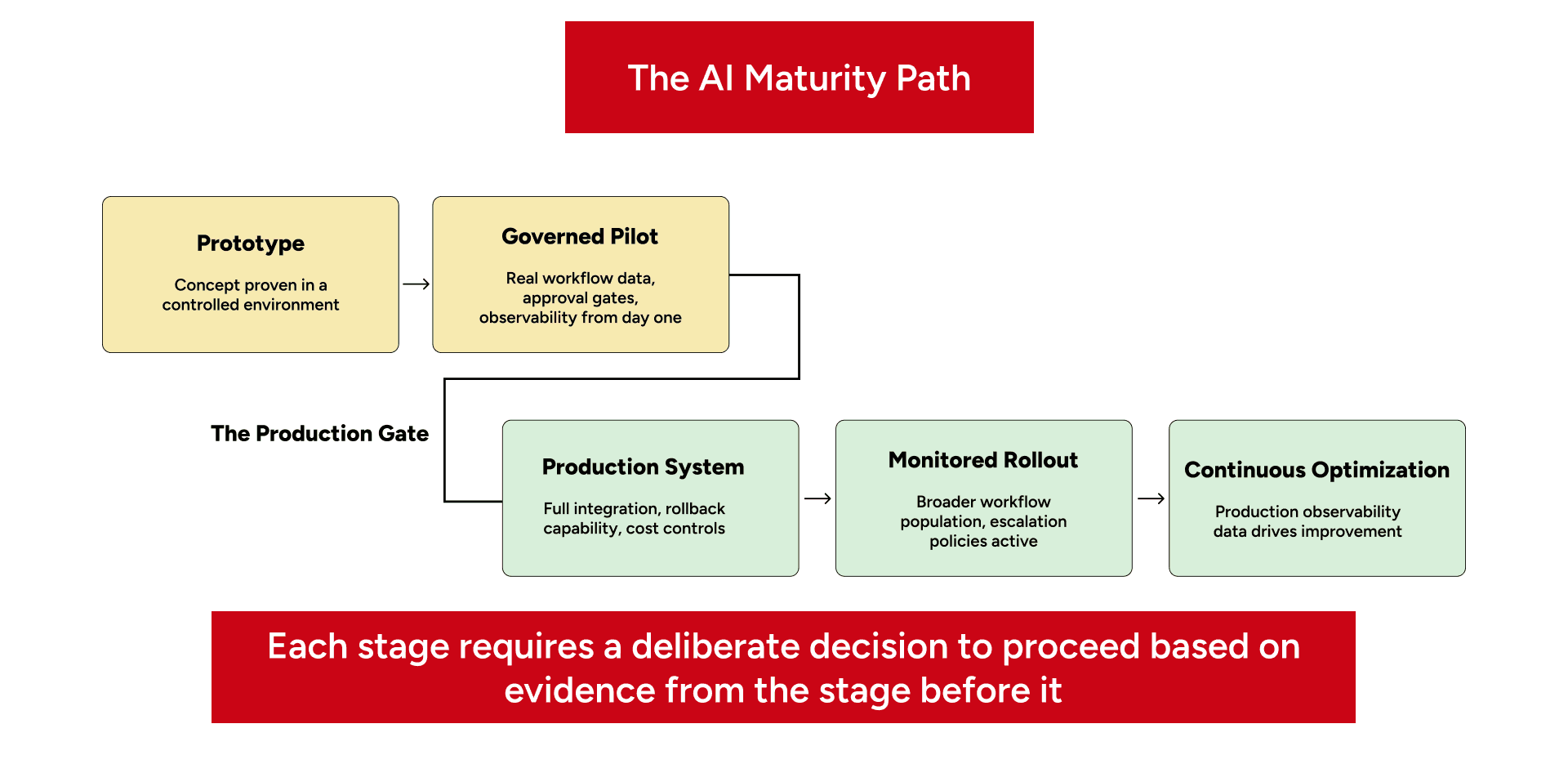
Each stage requires a deliberate decision to proceed, based on evidence from the stage before it. Moving from pilot to production without that evidence is how teams end up with AI systems that create more operational risk than they resolve.
Which Enterprise Workflows Are Best Suited for Governed Self-Healing AI Agents?
Not every workflow is ready for a self-healing AI agent. The strongest candidates share four characteristics: high volume, rules-aware process design, measurable outcomes, and an operational pain point the business has already documented and quantified.
The table below qualifies the most common enterprise use cases by business value, risk level, required controls, and the human approval point that keeps each workflow safe to automate.
Workflow | Business Value | Risk Level | Required Controls | Human Approval Point |
|---|---|---|---|---|
DevOps and CI/CD | Reduces engineering interruptions from pipeline failures | Medium | Audit logs, rollback capability, approval gates | Merge request before any fix reaches production |
IT Operations | Reduces mean time to resolution through structured alert triage | Medium to High | Escalation policies, access boundaries | Remediation on any production system |
Customer Support | Resolves tier-one queries and routes complex cases with context | Medium | Output monitoring, sensitive category workflows | Review before any customer-facing response |
Finance Operations | Flags invoice and reconciliation exceptions for human review | High | Dual approval above defined thresholds, full audit trail | All disputed or high-value items |
Compliance Workflows | Surfaces policy exceptions and document flags for team review | High | Human sign-off on all regulatory outputs | All outputs used in regulatory submissions |
Internal Knowledge Management | Surfaces relevant documentation and routes knowledge gaps to subject matter owners | Low to Medium | Access boundaries, content accuracy review | Before any output is published or shared broadly |
Product Support | Resolves known product issues and escalates bugs to engineering with structured context | Medium | Escalation policies, output monitoring | Before any resolution is confirmed to a customer |
The best first use case for any enterprise or growth-funded startup is the one where the resolution path follows defined rules more than 70 percent of the time, the failure cost is documented, and a human approval point can be placed before any output reaches a system or a customer. Start there, govern it, observe it, and build from evidence.
Should Digital Product Leaders Build, Buy, or Modernize Before Deploying Self-Healing AI Agents?
The decision to build, buy, integrate, or modernize a self-healing AI agent system is a business decision before it is a technical one. It depends on how proprietary the workflow is, how much data control the business needs, what compliance obligations apply, and how much long-term ownership the organization can sustain.
Decision Factor | Build Custom | Buy Off-the-Shelf | Integrate | Modernize Legacy |
|---|---|---|---|---|
Proprietary or differentiated workflow | Strong fit | Poor fit | Partial fit | Depends on system age |
Compliance or data sovereignty needs | Strong fit | Vendor risk | Moderate with controls | Strong fit |
Legacy systems with no modern APIs | Requires parallel build | Often incompatible | Limited without middleware | Strong fit |
Third-party integrations and data connections | Full control over integration design | Limited to vendor-supported connectors | Strong fit where APIs exist | Requires modernization before integration |
Speed to first deployment | Slower | Fastest | Moderate | Slowest |
Long-term cost predictability | Higher upfront, lower ongoing | Lower upfront, higher ongoing | Moderate | High upfront, stable ongoing |
Full ownership of agent behavior | Complete | Limited | Partial | Complete |
For growth-funded startups, investor pressure favors speed, which pulls toward off-the-shelf tools. Buyer requirements favor reliability, security, and ownership of governed AI agents, which pull toward custom engineering. The startups that win enterprise contracts treat production-grade engineering as a growth investment, not a cost to defer.
If the workflow is proprietary or compliance-sensitive, build or modernize with governance in place from the start. If the use case is generic and speed matters more than differentiation, buy and integrate, but define the governance and observability layer before the agent reaches production regardless of how it was sourced.
What Risks Must Enterprises Control Before Deploying Self-Healing AI Agents at Scale?
Autonomy without controls is not a capability. It is a liability. Self-healing AI agents carry risk that grows with the scope of action they are given. The right response is to define the conditions under which they can act, and the escalation path that activates when something falls outside those conditions.
Progressive autonomy governs this. An AI agent earns expanded scope based on demonstrated performance within a defined boundary, not based on technical capability alone. Two oversight models determine how much human involvement sits inside each workflow. Human-in-the-loop means a person approves the agent's action before it executes. Human-on-the-loop means the agent executes within defined parameters while a person monitors outputs and retains the ability to intervene. High-risk workflows require human-in-the-loop. Lower-risk, high-volume workflows can operate under human-on-the-loop once the agent has demonstrated consistent, governed behavior over a defined period.
Seven risk categories require active controls before any agent reaches production: data exposure, wrong action execution, model drift, prompt injection, cost spikes from uncapped usage, unclear ownership, and regulatory exposure from outputs the business did not anticipate. Each requires a corresponding control before deployment, not after an incident surfaces it.
Role-based oversight determines who controls each risk layer. Leadership owns the accountability structure. Engineering and platform teams own access boundaries, rollback options, and escalation policies. Security teams own data security controls and audit trail requirements. Compliance and risk teams define human approval thresholds for regulated workflows. Digital platform teams own lifecycle monitoring. Business process owners define fallback workflows. Internal legal, security, risk, and compliance teams must be involved before the agent touches any regulated workflow.
Controls Before Autonomy Checklist
- Assign a named owner accountable for the agent's actions and outcomes
- Define data access boundaries before the agent reaches any production system
- Set human-in-the-loop approval for all high-impact or irreversible actions
- Define fallback workflows for situations the agent cannot resolve
- Configure rollback options for actions that modify production systems
- Set cost thresholds and automated alerts before the agent runs at scale
- Schedule behavioral reviews to detect model drift
- Document and test escalation policies before go-live
How Can Enterprises Define and Measure the ROI of Self-Healing AI Agents Before Scaling?
The ROI case for a self-healing AI agent does not begin after deployment. It begins before the first line of design work, when the business defines what success looks like in measurable terms. Teams that skip this step build agents that work technically but cannot demonstrate value to the leadership team approving the next phase of investment.
Success metrics fall into two categories: performance outcomes and cost outcomes.
Performance outcomes measure what the agent improves. Mean time to resolution reduction tracks how much faster the agent resolves workflow failures against the manual baseline. Manual rework reduction tracks the volume of work removed from human queues. Support deflection tracks the proportion of tier-one queries resolved without human involvement. Workflow cycle time tracks the end-to-end time for a process the agent operates within. Escalation reduction tracks how often the agent resolves situations within its design rather than handing off to a person. Deployment frequency tracks how often engineering teams can ship without manual pipeline intervention. Compliance exception reduction tracks the decrease in policy violations attributable to the workflow the agent supports. Revenue leakage prevented tracks the financial value of errors the agent caught before they reached a customer or a contract.
Cost outcomes measure what the program spends: engineering effort, integration costs, observability and monitoring infrastructure, model usage at scale, compliance review before the agent touches a regulated workflow, and change management for the teams the agent works alongside.
Pilot Readiness Checklist
- Define at least three measurable success metrics before the pilot begins
- Establish a manual baseline for each metric so improvement is quantifiable
- Set a minimum performance threshold the agent must meet before moving to production
- Estimate all cost factors before build begins
- Assign a named owner responsible for tracking metrics throughout the pilot
- Define the decision criteria that determine whether the pilot proceeds, pauses, or stops
If the workflow has a documented baseline, a measurable outcome, and a named owner, the business is ready to run a governed pilot. If any of these three conditions are missing, define them first.
Why Choose GeekyAnts as Your Self-Healing AI Agent Development Partner?
Most implementation partners can explain what a self-healing AI agent is. Fewer can take one from a prioritized workflow through governed architecture, production deployment, and continuous observability without losing the business context that made the use case worth building.
GeekyAnts works with enterprises and growth-funded startups moving from AI experimentation to production-grade agentic systems. The work begins with discovery: identifying which workflows carry the highest value, the clearest success metrics, and the right conditions for a governed pilot. Workflow prioritization at this stage prevents the most common failure pattern in enterprise AI programs, which is starting with the wrong use case.
From discovery, GeekyAnts designs governed architecture that defines agent boundaries, data access controls, approval gates, escalation policies, and the observability layer before a single line of production code is written. Human review workflows are built into the design from the start, not added after a compliance team raises a concern.
GeekyAnts brings DevOps capability that connects self-healing AI systems to the deployment, monitoring, and incident response infrastructure enterprises already operate. For organizations running on legacy systems, GeekyAnts also provides enterprise modernization that creates the integration layer an agentic AI system needs to function reliably in a production environment. This is the layer most AI consulting engagements skip: the agent works in a demo but has no maintained path to production.
For growth-funded startups, GeekyAnts provides the production-grade engineering foundation that enterprise buyers evaluate during procurement. A governed, well-documented AI agent system built on a scalable product delivery model is a commercial asset, not only an operational one.
The Future of Enterprise Automation Lies in Governed AI Agents
Self-healing AI agents are not an experiment to run when the timing feels right. They are an enterprise automation capability that is reshaping how organizations manage workflows, respond to failures, and scale operational capacity.
The enterprises that see consistent results from agentic AI govern what those agents can do, build the observability layer that proves the agents are performing as intended, and treat each agent as a product with a defined lifecycle and a clear standard for production readiness.
Governance, observability, and product engineering are not constraints placed on top of self-healing AI. They are the foundation that makes it worth deploying. Without them, an agent that detects and resolves a workflow failure is still a system no compliance team can trust and no engineering team can maintain.
The organizations that define the right workflow, build the right controls, and measure the right outcomes from day one will set the operational benchmark others work to close.
Sources and Citations
Self-healing AI agents need governance, observability, and product engineering because autonomy alone cannot guarantee correct, safe, or repeatable behavior inside a business workflow. Governance sets the boundaries an agent can act within. Observability gives the business proof that the agent stayed inside those boundaries and performed as intended. Product engineering turns the agent from a working demo into a system the enterprise can run, maintain, and improve over time. Without these three pillars, a self-healing agent can detect and fix a failure, yet still introduce risk that no one in the business can see, explain, or control.