
The mental health crisis is not new, but its scale, urgency, and complexity are testing the limits of traditional care systems.
Global demand is rising, but the system is cracking under pressure. According to the World Health Organization, over 1 in 8 people live with a mental health condition—yet access to timely, affordable care remains out of reach for many. A shortage of professionals, long wait times, and persistent stigma continue to widen the treatment gap.
This is where AI is beginning to make a measurable difference—not by replacing clinicians but by extending their reach. From early detection to real-time support, AI tools are offering scalable ways to triage, monitor, and personalize mental health care.
In this blog, we examine how AI is helping bridge the care gap, enhance clinical decision-making, and shape the next generation of mental health delivery.
What’s Broken in the Current Mental Healthcare System?
Mental healthcare is gaining visibility—but access and delivery remain deeply flawed. Across much of the world, patients face long wait times for basic support. In the U.S. and U.K., it can take 6 to 12 weeks just to schedule an initial therapy session. For those in rural or underserved areas, professional help may be entirely out of reach.
Clinicians, meanwhile, are stretched thin. Rising caseloads and therapist burnout are driving attrition and limiting the time available for personalized care. Even when help is available, delivery is often fragmented and inconsistent, with little visibility into long-term patient progress.
Layered on top of this is the issue of stigma—a persistent barrier that keeps many from seeking support at all. Concerns around judgment, privacy, and social perception continue to deter early intervention.
What we are left with is a system that is reactive, under-resourced, and ill-equipped to scale. It doesn’t meet modern mental health needs—and it urgently requires intelligent, technology-driven augmentation.
How AI Is Being Used in Mental Health Today
AI technologies are already playing a measurable role in digital mental health. From self-help tools to clinical triage support, here is how they are making a difference:
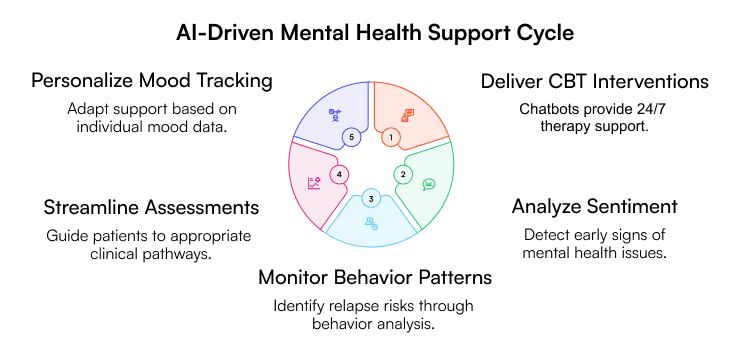
- Chatbots and virtual therapists like Wysa and Woebot deliver Cognitive Behavioral Therapy (CBT)-based interventions through these tools offer 24/7, stigma-free support and are backed by peer-reviewed studies.
- Sentiment and voice analysis platforms like Ellipsis Health detect early signs of anxiety or depression by analyzing tone, language, and pace of speech—flagging issues even before users seek help.
- Predictive analytics help monitor patterns in user behavior, tone, or engagement to identify relapse risk—enabling timely intervention.
- AI-powered screening tools streamline initial assessments, guiding patients to appropriate clinical pathways without human bottlenecks.
- Personalized mood-tracking systems use behavioral data to offer nudges, routines, and check-ins that evolve with the user’s mental state.
These tools are not isolated pilots—they are being integrated into national health systems, employer benefit programs, and telemedicine platforms at scale.
Real-World Impact: Case Studies & Results
AI’s role in mental health is not speculative—it is producing results.
- Woebot, in a clinical study published by JMIR, showed a significant reduction in depression symptoms within just two weeks of usage.
- Wysa, adopted by the UK’s NHS and enterprise partners, helped reduce therapist workloads by nearly 30%, according to pilot data.
- Ellipsis Health’s AI voice analysis has demonstrated high accuracy in identifying early signs of clinical depression—offering valuable insights to providers even before formal diagnosis.
- Talkspace, a leading teletherapy platform, uses NLP to assist therapists by analyzing patient language and tone, enhancing diagnostic precision.
These case studies highlight a key takeaway: AI can drive both clinical and operational outcomes, improving access, efficiency, and early detection.
Benefits of Using AI in Mental Health Treatment
Why are so many digital health innovators and healthcare providers exploring AI for mental wellness? Because it addresses several core limitations of the traditional model:
- 24/7 availability means users can access support anytime, without waitlists.
- Anonymity encourages those reluctant to seek help through traditional channels.
- Scalability and affordability make support more accessible across socioeconomic groups.
- Faster diagnosis is possible through pattern detection in text, voice, and behavior.
Clinician support through triaging and administrative automation frees up human experts for deeper intervention work.
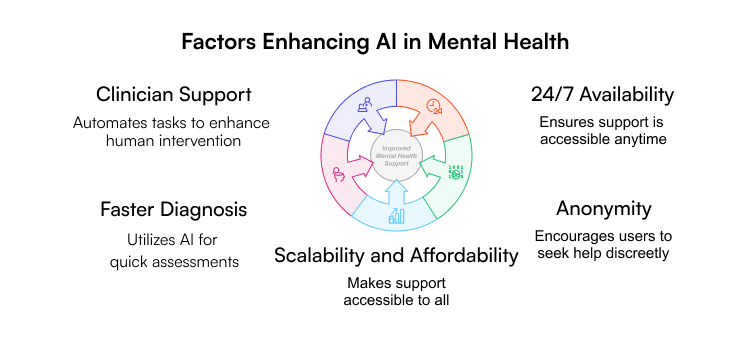
AI is not a full replacement for therapy—but it significantly enhances the reach and responsiveness of mental health systems.
Risks and Ethical Concerns
Despite the benefits, integrating AI into mental healthcare raises valid concerns that must be addressed carefully:
- Misdiagnosis risk: Without clinical context, AI models can misinterpret user input—especially in complex or high-risk cases.
- Data privacy: Sensitive mental health data must be protected under HIPAA, GDPR, and local regulations—requiring robust encryption, consent, and transparency.
- Empathy limitations: While chatbots are improving, they still lack the emotional intelligence of human therapists, which is critical in crisis care.
- Algorithmic bias: Datasets used to train AI tools may reinforce bias if not diverse or inclusive, potentially skewing outcomes for marginalized groups.
Responsible deployment demands strong clinical oversight, ethical design, and user-centric development practices.
The Future: Human-AI Collaboration in Mental Healthcare
The next frontier in mental healthcare is not human or AI—it is both. The most promising model is one of collaboration, where intelligent systems serve as clinical co-pilots rather than replacements.
In the future, AI tools will handle the heavy lifting behind the scenes—screening, triaging, and continuously monitoring patient behavior through text, voice, and biometrics. Clinicians, in turn, will focus on what they do best: delivering nuanced, empathetic, and context-rich care.
Multimodal AI will synthesize inputs from speech patterns, written language, and behavioral data to generate deeper, real-time insights. When embedded in wearables and digital health apps, this intelligence will enable passive, personalized tracking—helping detect mood shifts and risk signals long before they escalate.
As digital therapeutics gain regulatory traction, AI-powered interventions will become standard tools in care delivery—improving outcomes, expanding access, and lightening clinical workloads. Done right, this is not about automation—it is about enabling scalable, safe, and human-centred care at a time when the system needs it most.
Conclusion
AI is not a substitute for human connection, but it is a powerful accelerator for access, consistency, and early intervention in mental healthcare. By automating the routine, monitoring the invisible, and scaling the support, AI empowers professionals to focus where it matters most: delivering high-quality, empathetic care.
As adoption grows, the priority must shift toward building AI solutions that are clinically grounded, ethically designed, and privacy-first by default. The future of mental health treatment will belong to systems that seamlessly integrate human insight with intelligent infrastructure.
Partner with our AI healthcare experts at GeekyAnts to design secure, regulation-ready, and human-centred mental health solutions tailored to your organization’s needs.