

Key Takeaways
- Build when payment infrastructure is strategic or requires complex workflows; integrate a Payment Service Provider (PSP) when speed and standard capabilities matter; orchestrate when multiple providers or markets need centralized routing.
- Assess risks early, including PCI DSS scope, regulatory responsibilities, fraud, provider dependencies, reconciliation, security, and operational resilience.
- Plan the budget for payment gateway development costs ranging from $50K to $500K+, depending on integrations, markets, security, infrastructure, and payment complexity.
- Design for failure, including retries, timeouts, duplicate requests, webhook failures, reconciliation gaps, and provider outages.
According to McKinsey’s 2026 Global Payments Report, the industry generated about $2.6 trillion in revenue from 3.8 trillion transactions, representing $2.1 quadrillion in annual value flows. These numbers indicate significant changes in payment activities, which provide businesses with more routes to process the transactions.
Payment gateways seem simple on paper as a concept, where teams connect the checkout to a processor, send the transaction, receive an approval or decline, and record the result. Once a gateway expands into another country, the simplicity starts to disappear as new providers introduce different transaction statuses, additional currencies require reconciliation, and operations teams need to resolve customer queries quickly.
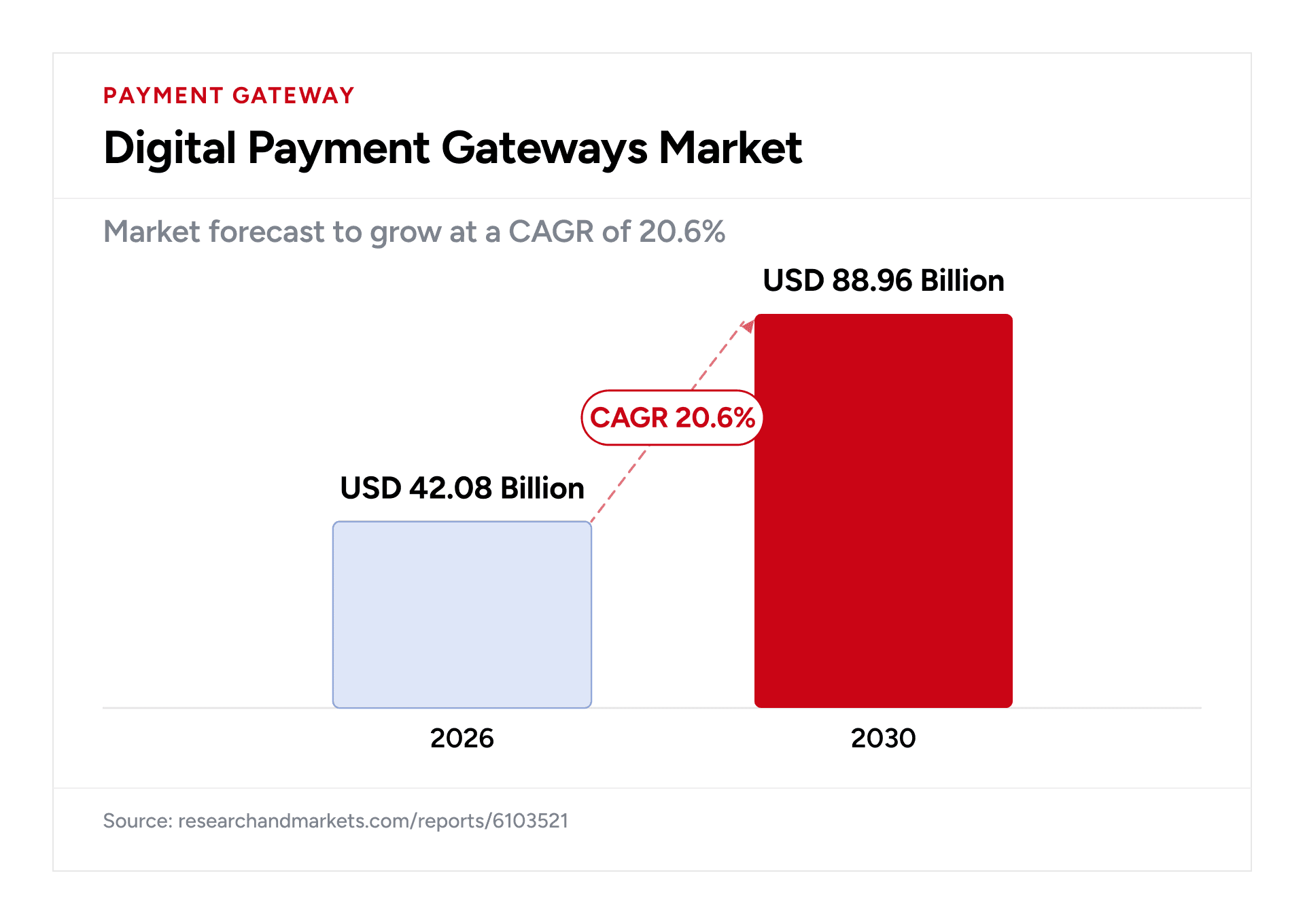
It is also important to note that the Research and Markets projects the global payment gateway market to grow from $42.08 billion in 2026 to $88.96 billion by 2030, at a CAGR of 20.6%.
Today businesses expect payment infrastructures to have real-time payment rails, embedded payment experiences, multi-currency checkout, AI-assisted fraud detection, and payment orchestration that provides them better ways to accept and route transactions.
Why Is Payment Gateway Development Now A Strategic Infrastructure Decision?
For a digital fintech product, a payment gateway is a part of the payment infrastructure. It may need to connect with several processors or acquirers, support different payment methods and currencies, apply fraud and authentication checks, manage retries, handle webhooks, maintain transaction records, and support reconciliation.
These decisions also determine the amount of responsibility that a business needs to take up. Tokenization, PCI DSS (Payment Card Industry Data Security Standard) requirements, encryption, access controls, audit trails, and security testing influence the architecture from the beginning.
What we have seen is that payment-related complexities tend to show up during expansion. When a team adds a market or payment provider, suddenly, they are spending more time tracing failed transactions, reconciling records, and handling exceptions. This is the point where payment setup needs to be considered before moving toward the expansion stage.
 Kunal KumarChief Revenue Officer
In this article, we’ll cover how payment gateway architecture, development stages, security and compliance, development cost, build-versus-integrate decisions, and post-launch operations enable teams to define the requirements before committing to a particular development time and budget.
What is a Payment Gateway, and How Does the Payment Flow Work?
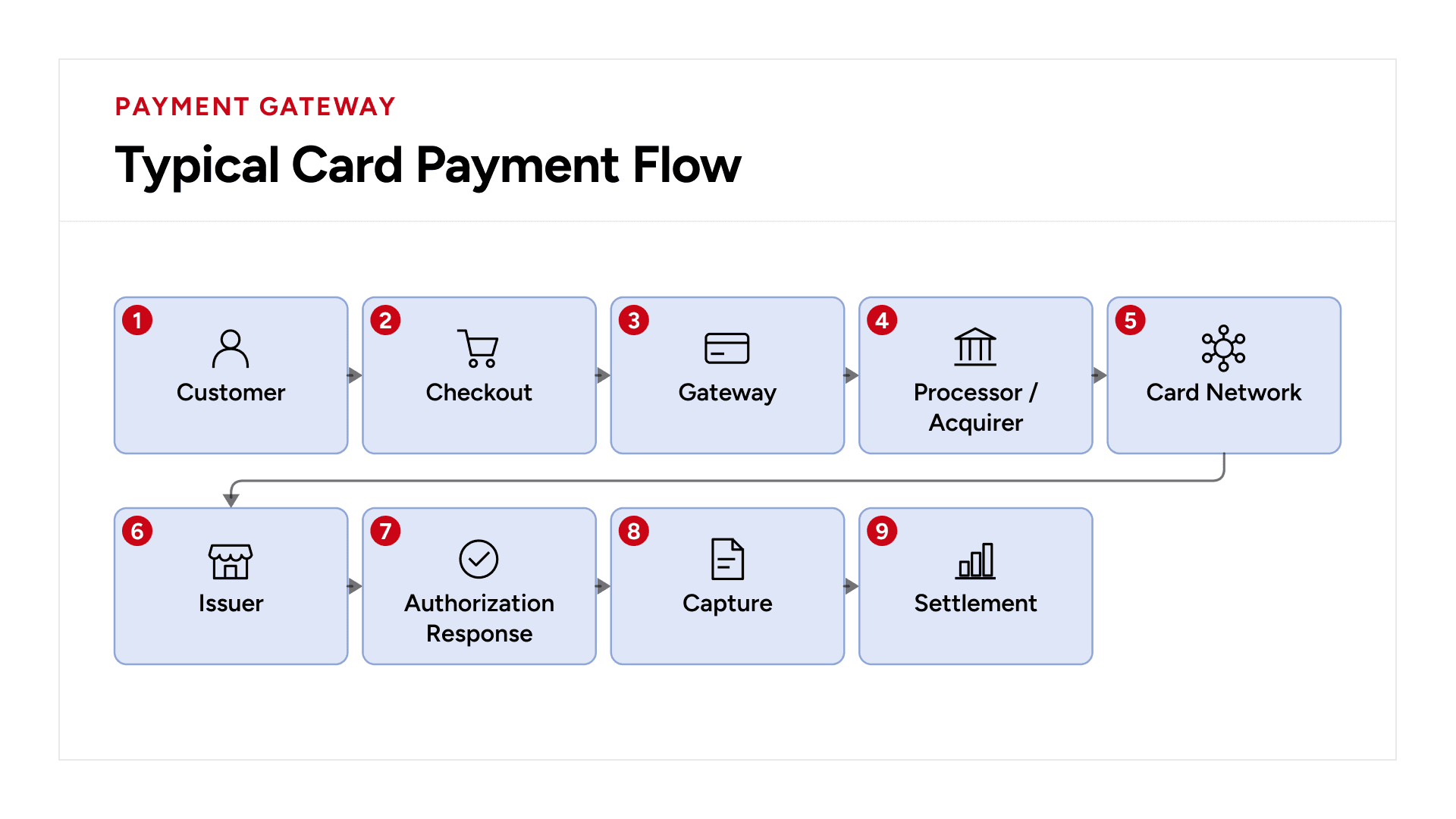
A payment gateway connects a merchant’s checkout with the financial systems that authorize a customer’s payment. When a customer clicks Pay, the gateway captures and transmits payment data, passes the transaction into the processing flow, and returns the approval or decline to the merchant. The exact flow varies by payment method and setup, but the card payments typically involve the merchant, gateway, processor, acquirer, card network, and issuing bank.
The card transaction usually moves through three stages:
- Authorization: The issuer checks the transaction and decides whether to approve or decline it.
- Capture: The merchant or its payment provider instructs the acquirer to capture an approved payment.
- Settlement: Funds move through the payment system to the merchant’s acquiring account.
How Do Payment Gateways, Processors, and Orchestration Layers Differ?
A payment gateway collects and transmits payment information and facilitates communication between the merchant and the payment-processing infrastructure.
A payment processor handles transaction processing and communication between the acquiring and issuing sides. The acquirer is the financial institution that processes payments for the merchant and receives funds on its behalf.
A payment orchestration layer connects multiple payment providers or processors and can route transactions between them based on rules instead of relying on one processing path.
Where Do Tokenization, Fraud Checks, and 3DS Authentication Fit?
Security and risk-related control systems enter the flow at different points. Tokenization can replace sensitive card credentials with payment tokens, which reduces the need to handle the underlying card number across systems. The fraud detection screen can evaluate transaction and device signals before authorization, while the 3DS authentication request proceeds depending on transactions and the flow of authentication.
How Should Payment Gateway Architecture Be Designed to Scale Financial Products?
A payment gateway architecture can look simple from the outside, where it accepts a payment request, sends it for authorization, and provides the required result. The engineering problem starts when thousands of transactions arrive all at once, where a processor may time out, a customer retries the same payment, or an acquirer returns a response that does not match the gateway’s records.
A payment architecture has to be designed for uncertain transaction states from day one. If the architecture cannot identify that transaction and handles the retry safely, the same payment can be submitted twice. Idempotency and transaction state management are core payment requirements.
 Saurabh SahuChief Technology Officer (CTO)
What are the Core Components of a Production-Ready Payment Gateway?
A production-ready payment gateway typically includes these layers:
Component | What it Does? |
API Gateway | Authenticates merchant requests while applying rate limits, managing API versions, and routing traffic to internal services. |
Checkout and Payment Interface | Collects payment details and supports payment methods, currencies, localization, and authentication flows. |
Payment Orchestration and Routing | Selects a processor, acquirer, or payment provider based on configured routing rules, availability, market, payment method, or other transaction attributes. |
Transaction Processing Engine | Manages authorization, capture, voids, refunds, and transaction state. |
Tokenization and Vault | Replaces sensitive payment credentials with tokens and controls access to protected payment data. |
Fraud and Risk Engine | Applies rules and risk signals before or during authorization to identify suspicious transactions. |
3DS Authentication | Handles applicable customer authentication flow required by the payment method or risk decision. |
Provider and Acquirer Integrations | Connects the gateway to processors, acquirers, card networks, and other payment providers. |
Webhook and Event Processing | Receives and publishes payment-status events without making the core transaction flow depend on every downstream system responding immediately. |
Payment Ledger | Maintains the gateway’s financial record of transaction states, adjustments, refunds, and related entries. |
Settlement and Reconciliation | Matches gateway records with processor, acquirer, and bank reports and identifies discrepancies. |
Merchant and Admin Dashboard | Gives authorized users access to transactions, reports, configuration, disputes, and operational information. |
Monitoring and Observability | Tracks latency, errors, authorization outcomes, provider health, infrastructure metrics, and transaction events. |
What are the Design Principles for High-Volume Payment Systems?
- Idempotency: Should be built into the payment API so that a retry does not create a second charge when the first request has already succeeded.
- Retry and failure handling: Should distinguish between safe-to-retry failures and transactions whose final state is unknown.
- Horizontal Scalability: Allows transaction-processing capacity to increase without scaling every service at the same rate.
- High Availability and Fault Tolerance: Requires redundancy across infrastructure and payment providers where the business model supports it.
- Event-driven processing: Decouples webhook delivery, notifications, reporting, and reconciliation from the synchronous authorization path.
- API Versioning: Protects existing merchant integrations when payment APIs evolve.
- Low-Latency Processing: Keeps the authorization path focused on the steps required to complete the payment decision.
- Multi-Region Disaster Recovery: Defines how payment services and transaction data will recover if a region becomes unavailable.
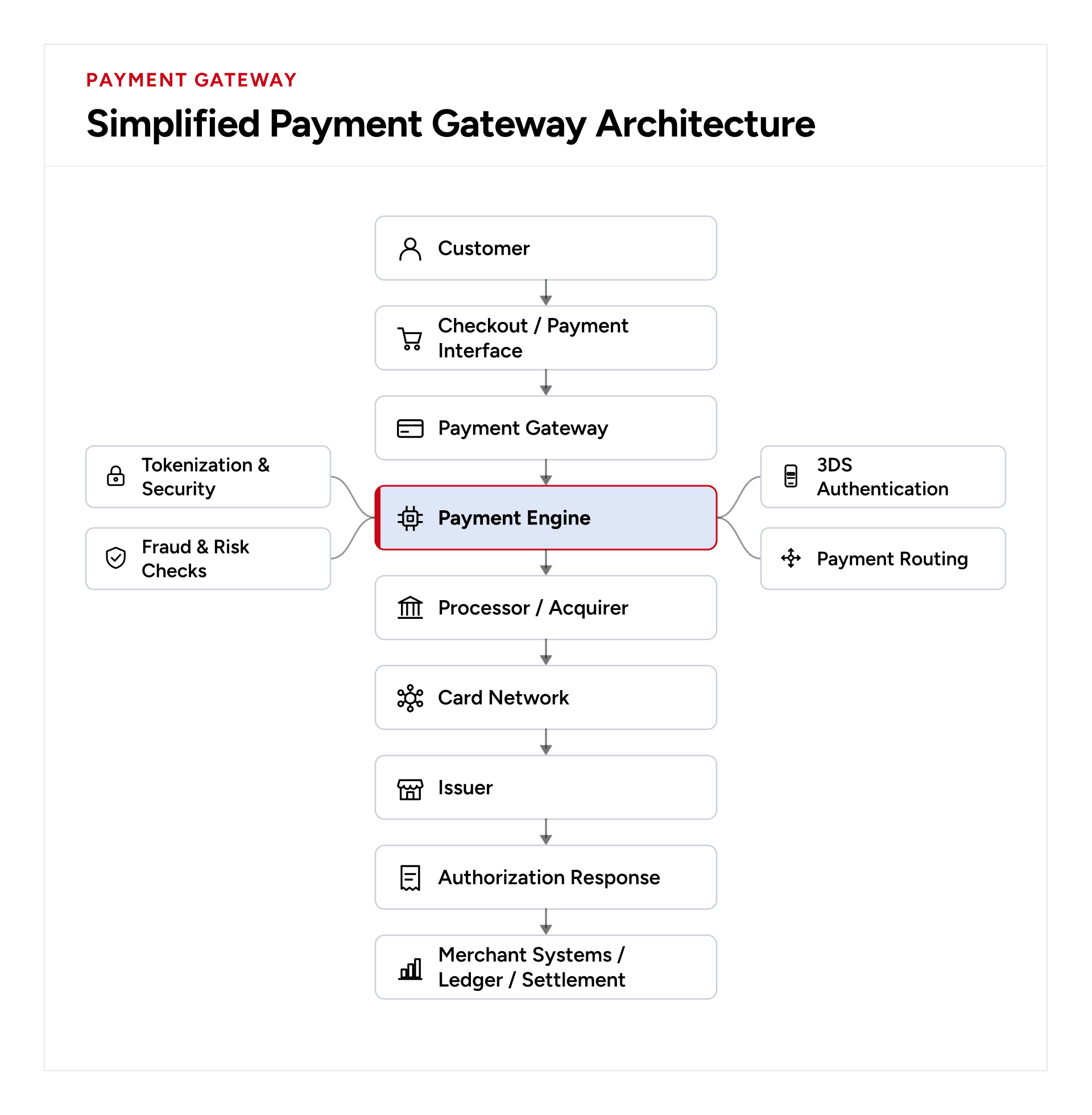
What Does Payment Gateway Architecture Diagram Look Like?
A simplified enterprise payment gateway architecture can be represented as:
How Does Security and Compliance Shape Payment Gateway Architecture?
Security and compliance should influence the architecture before the development process begins. PCI DSS applies to entities that store, process, or even transmit cardholder data, as well as systems that can affect the security of the cardholder data environment. Here, the current standard is PCI DSS v4.0.1.
This makes the data flow design a technical decision, not a compliance task at the end of the development process.
1. PCI DSS and Card-Data Security
Tokenization can reduce how widely card data moves through the environment. Encryption protects data in transit and at rest wherever applicable. Secure key management, access controls, audit logging, and vulnerability testing also need to be designed into the system.
2. Authentication and Fraud Detection
3DS2 and fraud detection controls also add another layer. Here, the gateway may use risk-related signals to determine whether additional authentication or fraud detection screening will be required. The access control, audit logging, and vulnerability/security testing depend on the payment method, market provider setup, and applicable rules.
3. North American Regulatory Considerations
Regulatory responsibility also depends on what the platform actually does. In the US, FinCEN has recognized circumstances in which merchant payment processing can fall within payment-processor exemption, while money-transmission status depends on the facts and activities involved. Canada has its own framework; the Bank of Canada supervises payment service providers that fall within the Retail Payment Activities Act (RPAA).
How to Build a Payment Gateway: Development Roadmap
Building a payment gateway starts before the first payment API is written. One of the useful ways to approach payment gateway software development is to treat it as five connected phases.
The fastest way to lose time on a payment gateway project is to start coding before the payment flows are settled. We define what happens when a payment succeeds, fails, times out, gets retired, refunded, or reversed before we build the APIs around it. Getting those decisions right early prevents teams from rewriting payment logic during integration and testing.
 Janhavi Mukesh MoneSenior Business Analyst II
Phase 1: Define the Payment Gateway Scope
Start with the payment flow that the business actually needs, define the target markets, currencies, payment methods, expected transaction volume, merchant types, recurring payments, refunds, disputes, and settlement requirements.
The team should decide whether the business requirements need to build, integrate, or orchestrate payment infrastructure. Compliance is also an important factor to consider at this stage, where PCI DSS provides a baseline of technical and operational requirements for protecting payment account data, while equally depending on the architecture and responsibilities of the parties involved.
Phase 2: Design the Architecture and Security Model
Define the API contracts, transaction states, routing rules, data flows, tokenization approach, authentication model, and provider integrations. Decide how the system will handle duplicate requests, timeouts, retirements, partial failures, and transactions where the final provider response is unknown. A payment gateway should have recovery time and recovery point objectives and compliance architecture, along with tested procedures for the same.
Phase 3: Build the Payment Gateway MVP
The first release should prove that the complete lifecycle supports every payment method at once. The MVP can start with a defined checkout experience, merchant-facing payment APIs, authorization and capture, refunds, transaction status, webhooks, basic reporting, and one processor or acquirer integration.
The payment engine should maintain explicit transaction states so the system can distinguish between an authorized, captured, failed, refunded, reversed, or unresolved transaction. Idempotency should prevent a network retry from creating a second charge.
The team should also be able to establish the first version of the ledger and reconciliation process, since an MVP also needs a reliable answer to basic financial questions if the gateway’s record can match with the processor or the acquirer.
Phase 4: Integrate, Certify, and Test
After the flow of the core system starts working, teams should expand the payment ecosystem around the system. Certifications are also provider- and network-specific within the PCI (Payment Card Industry). For example, Visa describes a process that can launch applicable products.
Run authorization, capture, refund, reversal, webhook, reconciliation, fraud detection, and 3DS scenarios, and then test what happens when a processor times out, an API returns an unexpected response, a database becomes unavailable, or traffic increases beyond normal levels.
Security testing should also include vulnerability assessment and penetration testing appropriate to the environment; load testing should measure latency and throughput at expected and peak volumes. Failure testing should verify that the system can recover without creating duplicate charges or inconsistent financial records.
Phase 5: Roll Out to Production and Scale
Do not make the first production deployment an all-or-nothing switch. Start with a controlled pilot involving selected merchants, payment methods, markets, or transaction volumes. Monitor authorization rates, latency, provider errors, webhook delivery, fraud decisions, reconciliation exceptions, and system health before increasing traffic.
Incident response should have defined owners and escalation paths, and reconciliation should continue after the launch, with automated matching and exception queues for transactions that do not align across gateway, processor, acquirer, and settlement records.
Once the core system is stable, the platform can be scaled in multiple regions and can be incorporated in additional payment methods and be at a point at which business can process payments while tracing every transaction.
How Much Does Payment Gateway Development Cost?
Payment gateway development costs can range from $50,000 to $500,000+ depending on various factors. The cost of developing a payment gateway varies by scope, so the ranges provided below should be treated as indicative planning estimates. The table below provides a starting point for creating a budget for a custom payment gateway.
Payment Gateway Type | Estimated Cost (USD) | Typical Timeline | What It Usually Includes | Best Fit |
Basic/MVP | 50K-100K | 3-5 months | Card payments, one currency, basic merchant dashboard, core transaction APIs, essential security controls | Startups and single-market products |
Mid-scale | 100K-250K | 6-11 months | Multiple payment methods, recurring payments, fraud rules, multiple integrations, reporting, multi-currency support | Growing businesses |
Enterprise | 250K-500K+ | 10-18+ months | Multi-region processing, multiple acquiring connections, advanced fraud controls, complex settlements, high availability, extensive compliance work | Banks, payment companies, large platforms |
Which Factors Increase Payment Gateway Development Cost?
Payment gateway development costs increase with the number of integrations, payment methods or currencies, or automates more financial decisions.
1. Payment Methods and Currencies
Every payment method introduces its own integration and testing requirements. A gateway supporting only card payments has fewer transaction paths than one supporting cards, bank transfers, digital wallets, buy-now-pay-later services, and local payment methods.
Payment Scope | Cost Impact |
Single card payment method | Low |
Multiple card networks | Low-Moderate |
Digital wallets | Moderate |
Bank transfers and local rails | Moderate-High |
Multiple regional payment methods | High |
2. Bank and Processor Integrations
Payment gateway development requires integrations with acquiring banks, payment processors, or payment service providers. Each integration needs its own authentication, transaction mapping, status handling, refund flows, reconciliation, and failure testing process. Hence, a useful planning range includes:
Processor/Bank Integration Scope | Indicative Engineering Cost (USD) |
One primary processor | 10K-20K |
Two to three processor or bank integrations | 25K-50K |
Several acquiring and banking connections | 50K-100K |
3. Security and Compliance
Security and compliance can account for 15-20% of development spending on a payment gateway, depending on the system’s scope and compliance requirements.
Security Requirement | Possible Budget Impact (USD) |
Encryption and secure API design | 5K-15K |
Tokenization and payment-data controls | 10K-30K |
Security testing and penetration testing | 10K-30K |
Compliance preparation | 10K-40K+ |
4. Fraud Detection
A basic gateway includes transaction rules like velocity limits, blocked countries, suspicious IP addresses, and repeated payment attempts, while a larger platform may need device intelligence, machine-learning models, and real-time decisioning.
Fraud Capability | Indicative Development Cost (USD) |
Basic rules engine | 5K-15K |
Rules and risk scoring | 15K-40K |
Real-time fraud platform | 40K-100K |
Custom ML-based fraud detection | 75K-150K+ |
5. Geographic Expansion
The platform could require a new payment method, local banking connection, regulatory workflow, or reporting requirement based on expansion of its operations across multiple regions.
Geographic Scope | Cost Impact |
One country | Baseline |
Two to three countries | Moderate increase |
Four to six countries | High increase |
Global multi-region operation | High and likely variable |
6. Typical Monthly Infrastructure Budget
Infrastructure costs increase when the gateway processes payments during hardware failures or regional outages, whereas specialized hardware security services can add recurring infrastructure costs.
Infrastructure Setup | Typical Monthly Infrastructure Budget (USD) |
Basic cloud environment | 1K-5K |
Scaled production environment | 5K-15K |
High-availability setup | 15K-40K+ |
Multi-region payment infrastructure | 30K-100K+ |
Hidden and Recurring Payment Gateway Costs
Payment gateways usually incur hidden and recurring costs after launch; some of the factors causing this include:
1. Annual and Maintenance Support
The starting budget is 15-20% of the original development cost per year for maintenance and engineering support. For a gateway that cost $200,000 to build, that translates to $30,000-$40,000 per year for this maintenance and engineering-support allowance.
Recurring Cost | Indicative Annual Range (USD) |
Technical support and monitoring | 5K-25K |
Security patches and updates | 10K-30K |
Bank and processor API maintenance | 10K-30K |
Performance optimization | 10K-30K |
Compliance and security reviews | 10K-50K+ |
2. Infrastructure and Operational Costs
Cloud spending continues after launch, so the gateway typically requires around $3,000 per month. Multi-region infrastructure with high availability, monitoring, security services, databases, backups, and disaster recovery can reach $30,000-$100,000+ per month. The infrastructure budget should therefore be modelled against expected transaction volume.
3. Payment Processing and Network Fees
Since the commercial model varies by provider and country, payment processing and networks should not be treated as a universal percentage, as certain payment methods can introduce additional charges. Keeping these categories separate prevents a $200,000 development estimate from being mistaken for the total cost of operating the gateway.
How Does Payment Gateway Development Cost Compare With First-Year Operating Costs?
The initial development budget covers the cost of building the gateway, while first-year operating costs continue after launching the product, several stages that are involved later run in parallel. The timeline below provides a better view to understand how the development budget is spent across various stages.
Development Stage | Typical Timeline | Approx. Budget Share |
Discovery and architecture | 3-6 weeks | 5-10% |
Core payment engine development | 12-24 weeks | 25-35% |
Bank and processor integrations | 8-20 weeks | 15-25% |
Security and compliance implementation | 6-16 weeks | 15-25% |
Dashboard and frontend development | 6-12 weeks | 5-10% |
Integration, performance, and security testing | 6-12 weeks | 10-15% |
Production deployment and launch | 2-4 weeks | 5-10% |
Should You Build, Buy, or Orchestrate Payment Infrastructure?
The right payment model depends on how much of the payment stack the business needs to control.
When Does Building a Payment Gateway Make Sense?
Building becomes more practical when payment infrastructure is part of the product or when existing providers cannot support the required payment flows. It can make sense when a business has:
- High Transaction Volume: At scale, payment fees, routing performance, and provider dependencies can have a material effect on unit economics.
- Multiple Payment Methods or Markets: Supporting different currencies, local payment methods, processors, and acquiring relationships can create requirements that one PSP may not cover.
- Need for Routing Control: An in-house routing layer can apply rules based on geography, payment method, or other business requirements.
- Complex Payment Workflows: Marketplaces, platforms, and financial products may need payment flows involving split payments, recurring billing, refunds, reconciliation, or multiple parties.
- Proprietary Fraud or Payment Logic: A business may need risk-related rules or transaction logic that does not fit into a provider’s standard configuration.
- Less Dependence on One Provider: Owning more of the payment stack can reduce reliance on a single processor, although it also transfers more engineering and operational responsibility to the business.
When is Integrating an Existing PSP a More Practical Approach?
Direct PSP integration is often the simpler path when the payment requirement is standard and getting to market is more important than controlling the underlying infrastructure. This model is suitable for businesses that need to launch in a limited number of markets, have a standard card or digital payments requirement, and do not need complex engineering or compliance requirements, or custom routing across several processors.
When Does Payment Orchestration Make More Sense Than a Full Gateway Build?
Payment requirements can exist between single-provider integration and building the entire payment stack. The business can connect different PSPs, processors, or acquirers through an internal layer while leaving selected payment responsibilities with those providers.
How To Compare Between Building, Buying, and Orchestrating Payment Workflows?
Consider the following table:
Decision Factor | Build | Buy/PSP Integration | Orchestrate |
Control | Highest control over the payment stack | Provider controls much of the underlying infrastructure | Control over routing and selected payment logic |
Time to Market | Usually longest | Usually shortest | Falls between the two, depending on scope |
Upfront Investment | Highest | Lower initial engineering investment | Moderate, depending on the orchestration layer |
Compliance Responsibility | More responsibilities remain with the business | More responsibilities are handled by the provider, subject to the integration model | Responsibilities are shared based on which components each party operates |
Scalability | Can be designed around the business requirements | Depends on provider capabilities and limits | Supports multiple providers and routing strategies |
Vendor Dependency | Lower dependency on a single provider, but external processors may still be required | Higher dependency on the selected PSP | Can reduce single-provider dependency by connecting multiple providers |
What Does It Take to Run a Payment Gateway After Launch?
Once transactions start flowing, the teams need to consider:
- Transaction and Authorization Monitoring: Shows whether payments are moving through the required flow. A sudden change can help narrow an issue before it affects a larger share of transactions.
- Fraud and Risk Tuning: Teams need a process for reviewing outcomes that are caused by fraud signals and adjusting rules without weakening legitimate payment approval.
- Reconciliation: Exceptions need to be identified and investigated so that transaction status, merchant records and settlement amounts do not drift apart.
- Chargeback Management: The exact responsibilities depend on the payment model and the parties involved, so the gateway environment should provide enough transaction data to support investigation and dispute workflows.
How Should Security, Capacity, and Provider Changes Be Managed?
Payment infrastructure depends on external providers, so their API changes affect the gateway. Security patches are also needed for vulnerability remediation, access reviews, security testing, logging, and applicable PCI DSS validation.
Capacity planning is also necessary for monitoring traffic patterns, database loads, queues, provider limits, and infrastructure capacity so that a traffic spike does not become a payment failure. In addition, incident response and disaster recovery need to be tested before an outage exposes gaps.
Where Does Custom Payment Gateway Development Make Sense Across Industries?
Custom payment gateway development makes sense when payments are tied to workflows that require multiple processors, recurring billing, marketplace payouts, regional payment methods, complex refunds, or payment data that must be connected within the internal systems.
1. Banking and FinTech Companies
Banks and FinTech companies need payment infrastructure that connects customer accounts, merchant systems, and payment providers.
2. E-Commerce and Retail Businesses
Custom infrastructure can connect multiple processors or acquirers, support local payment methods, manage refunds, and apply routing rules without forcing every market through the same provider.
3. SaaS Platforms
SaaS products need payment logic that follows how customers are billed which can then connect these billing rules with payment providers while keeping payment status aligned with customer accounts.
4. Healthcare Platforms
In the healthcare platforms, the payment infrastructure supports workflows such as online bill payments, copay collection, refunds, and payment-status updates.
5. Travel and Hospitality Businesses
Travel and hospitality platforms deal with deposits, cancellations, refunds, multiple currencies, and payments that may be completed at different points in a booking.
6. Insurance Companies
Insurance payments often follow policy-specific schedules, so payment infrastructure can connect these payment events with policy and customer systems.
7. Online Marketplaces
Custom payment infrastructure can provide the transaction state, ledger, and reconciliation logic needed to track these relationships.
Which Other Businesses Can Benefit From Custom Payment Gateway Development?
Logistics and freight, billing, payment services, software platforms, and enterprise marketplaces are also some of the businesses that can benefit from custom payment gateway development.
Build and Scale Payment Infrastructure With GeekyAnts
Payment infrastructure needs to work across APIs, transaction states, providers, currencies, users, and operational workflows. This makes the engineering partner part of the payment strategy, especially when a platform needs to expand into a new market or support a higher transaction volume.
As a payment gateway software development company, GeekyAnts brings 20 years of engineering experience across fintech and other product environments. Since 2006, the team has delivered 550+ engagements across products and enterprises, including systems that support global payment processing.
GeekyAnts Experience With Payment Product Engineering
GeekyAnts worked on a global fintech platform that processes more than $400 million in payments on an annual basis. The work covered mobile and web applications, backend services, transaction monitoring, regional expansion, and administrative controls. The team also has experience in building fintech products that operate across multiple markets. Our Flowcash case study involved a North American payment processing company serving users across the UK, Canada, Europe, and Australia.
Case Study: How GeekyAnts Worked On a Global Payment Processing Platform
For Flowcash, the challenge was to make global transactions much easier to manage while giving the business more control over expansion. The platform lets administrators add destination countries and manage services without depending on technical teams for every process.
GeekyAnts built the platform with React, Node.js, Redis caching, AWS infrastructure, and automated testing. ECS auto-scaling helped handle higher user loads, while caching reduces repeated network and database calls.
The resulting platform has more than 120,000 active users across the UK, Canada, Europe, and Australia and has also recorded more than 350,000 downloads across iOS and Android.
Why Work With GeekyAnts on Payment Gateway Software Development?
GeekyAnts provides payment gateway development services across architecture and backend development, mobile and web applications, testing, cloud infrastructure, and ongoing modernization. Their work includes fintech platforms as well as products used by organizations such as Darden, WeWork, SKF, Thyrocare, ICICI, Olive Garden, and PayPoint.
For companies evaluating a payment gateway development company, the starting point should be the payment flow, markets, providers, compliance scope, and systems the business needs to own.
Conclusion
A payment gateway should be built around the transactions a business expects to handle, the risks it needs to control, and the parts of the payment flow it intends to own.
The next phase of payments will bring more payment methods, live transaction experiences, cross-border use cases, and greater choice between processors and providers. When businesses build the product and adapt to these changes, they will switch or combine providers and introduce new payment flows without rebuilding the foundation each time.
Sources and Citations
- https://www.mckinsey.com/industries/financial-services/our-insights/global-payments-report
- https://www.researchandmarkets.com/reports/6103521/digital-payment-gateways-market-report
- https://www.fincen.gov/resources/statutes-regulations/administrative-rulings/application-money-services-business
- https://www.bankofcanada.ca/regulatory-oversight/retail-payments/supervisory-framework/