

Key Takeaways
- HL7 and FHIR readiness for AI healthcare platforms is what determines whether a product passes enterprise integration reviews, clears compliance audits, and advances from pilot to production contract.
- Enterprise health system buyers and payer technology teams evaluate PHI handling, consent enforcement, and audit trail completeness as procurement requirements, not implementation details.
- AI governance and workflow reliability depend directly on interoperability quality. Gaps in FHIR mapping and HL7 legacy data handling produce unreliable AI outputs at the model layer.
- Production-ready AI healthcare platforms require an engineering partner with demonstrated capability across interoperability, compliance architecture, AI product engineering, and scalable delivery.
How Does HL7 and FHIR Readiness Drive AI Healthcare Product Success?
HL7 and FHIR readiness for AI healthcare platforms determines whether a product can move from a controlled demo to a live clinical environment. Without it, data pipelines break, compliance reviews stall, and pilots do not convert to production contracts.
A McKinsey survey conducted in Q4 2024 found that 85% of healthcare leaders across payers, health systems, and healthcare services and technology groups were exploring or had already adopted generative AI capabilities. The ONC data brief from the same period found that the two fastest-growing AI applications in U.S. hospitals were billing automation and scheduling, both of which depend on reliable EHR integration and FHIR-based data exchange. The CMS Interoperability and Prior Authorization Final Rule has added regulatory pressure on payer-provider data exchange, with API compliance deadlines set for January 2027. Enterprise buyers evaluate the interoperability layer, compliance architecture, and data governance controls of an AI healthcare product, and failures across these areas create the procurement delays and compliance gaps that prevent products from reaching production.
This guide is for founders, CTOs, product leaders, payer technology teams, health system innovation teams, and compliance-led platform teams building or scaling AI healthcare products toward enterprise deployment.
How Do HL7, FHIR, and SMART on FHIR Build the Foundation of AI Healthcare Products?
HL7, FHIR, and SMART on FHIR are the data and authorization standards that determine whether an AI healthcare product can access, process, and act on clinical information in a live environment. Together, they form the governed clinical data layer that enterprise-ready AI products are built on.
HL7 and HL7 v2
For AI healthcare products, HL7 v2 is the messaging standard most likely to surface in live EHR environments alongside FHIR APIs. Healthcare systems use it for lab results, admission and discharge records, and order communications. An integration layer that cannot handle HL7 v2 alongside FHIR will produce an incomplete clinical context before data reaches the AI layer, which affects workflow automation, care coordination outputs, and the reliability of AI-driven decisions.
FHIR
FHIR determines the quality and completeness of the clinical context your AI layer receives. It structures clinical and administrative data into modular resources that AI systems can consume in a consistent format, and its profiles and implementation guides adapt those resources to specific clinical contexts and regulatory requirements. Resources such as Patient, Observation, Condition, MedicationRequest, Encounter, and DiagnosticReport carry the clinical data that AI workflows process to generate outputs.
Misalignment in FHIR profiles across EHR vendors, hospitals, and payer systems produces gaps in the data your AI layer receives that no model improvement can correct. FHIR also governs consent enforcement, data traceability, and auditability across your product architecture, which are the controls enterprise buyers assess during procurement.
SMART on FHIR
SMART on FHIR determines what your AI product can access, for which patient, and under what conditions, at the point of EHR connection. It defines the authorization scopes and launch context that govern consent enforcement and access traceability in live clinical environments. Without it, AI products cannot launch within EHR workflows or demonstrate the access controls that compliance reviews require.
FHIR requires continuous governance because every new EHR vendor, payer system, or clinical workflow your product touches will test how well that layer was built. The teams that get this right early build products that hold up through enterprise pilots, compliance reviews, and scale without accumulating integration debt.
 Janhavi Mukesh MoneSenior Business Analyst II
What Does an HL7/FHIR Checklist Reveal About Your AI Healthcare Product?
An HL7/FHIR readiness checklist reveals whether your AI healthcare product is built to hold production weight or built to pass a demo. It surfaces gaps in data infrastructure, compliance controls, and integration architecture before those gaps surface during an enterprise pilot or a procurement review.
The following checklist covers the core readiness areas that determine whether an AI healthcare product is ready for enterprise deployment. Work through each area and identify what is in place, what is partial, and what is missing. The goal is not to explain how each layer should be built. The goal is to help you determine whether your product is ready for the scrutiny that comes with enterprise deployment.
Does Your FHIR Mapping Support Reliable AI Outputs?
The quality of AI outputs in a healthcare product is determined by the completeness and consistency of the data entering the model. If your FHIR implementation mapping is incomplete or inconsistent across source systems, the clinical context your AI layer receives will be fragmented. Before go-live, confirm that all relevant FHIR resources have been mapped to your data model, that mapping logic has been reviewed against actual EHR data from at least one live environment, and that field-level validation rules are in place to catch malformed or incomplete records before they move downstream.
Gaps here produce AI outputs that reflect missing patient data rather than actual clinical conditions. In an enterprise review, this surfaces as a trust problem, and it rarely gets a second chance.
Does Your Product Account for Legacy HL7 Data?
Health systems operating on HL7 v2 feeds alongside their FHIR implementations require a product integration layer that can ingest, translate, and normalize legacy message formats without losing data quality. If your product connects to live EHR environments, it will encounter legacy message formats. Confirm that your integration layer can ingest and translate legacy message formats into FHIR-compatible structures, that transformation logic has been tested against real-world message variability, and that your team has a documented process for handling format inconsistencies without dropping or corrupting records.
Products that assume a clean FHIR environment stall at the first enterprise integration. Legacy HL7 v2 data handling is a production requirement that health system buyers will test during integration review.
Is Your EHR Integration Testing Complete?
EHR integration for AI platforms varies across vendors, and integration testing against a live system surfaces behavioral differences that affect how your product performs in a clinical environment. Before an enterprise pilot, your product should have completed integration testing against at least one target EHR in a non-production environment, documented known behavioral differences across vendor implementations, and established a process for managing version updates or API changes without breaking existing workflows.
Enterprise health system buyers run their own integration checks. An untested connection will surface during a buyer's integration review and create delays at the point of procurement.
Are Your PHI Controls Enforced at the Right Layer?
PHI controls enforced at the data layer ensure that access restrictions hold across every component that touches patient data, including AI models, enrichment pipelines, and output delivery systems. HIPAA requires covered entities to limit PHI access to what is necessary for each specific use or disclosure, and that requirement extends to every third-party service handling PHI on your behalf. Your checklist should confirm that PHI access is restricted at the data access layer, that consent logic is enforced at the same level, and that your product carries a documented data retention policy. A Business Associate Agreement must be in place with every vendor that handles PHI, including any AI model provider.
A gap in PHI handling during a procurement review can end a deal before the technical evaluation begins.
Does Your AI Layer Have the Right Monitoring Controls?
AI monitoring controls that track output quality, model behavior, and source attribution across every clinical workflow are what enterprise buyers assess when evaluating whether an AI layer is safe for production deployment. Your team should be tracking the quality of AI outputs against known clinical benchmarks, flagging outputs that fall outside acceptable ranges before they reach end users, and maintaining logs of model behavior that can be reviewed in the event of a clinical incident. If your product uses a large language model, output validation and source attribution checks should be built into the delivery layer.
Stanford Health Care's work building its ChatEHR platform illustrates the level of infrastructure this requires. The team found that connecting AI to real-time clinical data required parallel processing, intelligent caching, and a logging architecture that made every model interaction traceable. Every capability in that architecture was a prerequisite for safe operation in a clinical environment.
Does Your Audit Trail Cover the Full Data Path?
An audit trail that covers the full data path logs every data access event, every AI output, and every workflow action taken on that output, from ingestion through to clinical delivery. Every data access event, every AI output, and every workflow action taken based on that output should be logged with timestamps, user identifiers, and source attribution. Confirm that your audit log architecture captures the full data path from ingestion through AI processing to output delivery, and that logs are stored in a format that supports external review.
Health systems that deploy AI tools are accountable for what those tools do with patient data, and they will pass that accountability requirement to their vendors.
Does Your Product Have a Defined Human Review Process?
A defined human review process for high-risk outputs and a documented failure handling protocol are production requirements for any AI healthcare product. Confirm that your product has clear escalation paths for outputs that fall below a confidence threshold, that clinical staff can override or reject AI recommendations without disrupting the underlying workflow, and that failure events are logged, reviewed, and fed back into your quality process.
The absence of a human review layer is one of the most common reasons enterprise health system pilots do not convert to production contracts. Buyers in regulated environments require it, and its absence signals that the product was not built with clinical accountability in mind.
Readiness Area | What to Check | Risk if Missing |
|---|---|---|
FHIR mapping and data quality | All relevant FHIR resources are mapped to your data model and validated against live EHR data | Fragmented clinical context produces outputs that lack the completeness enterprise buyers evaluate during procurement |
HL7 v2 legacy data handling | Legacy message formats translated into FHIR-compatible structures and tested against live EHR message variability | Failed enterprise integration at the first live EHR connection |
EHR integration for AI platforms | Integration tested against at least one target EHR in a non-production environment, with vendor behavioral differences documented | Procurement delays when enterprise buyers conduct their own integration evaluation |
Consent and PHI controls | PHI access is restricted at the data layer, consent is enforced, retention policy is documented, and BAAs are in place with all third-party vendors | Compliance failure that blocks procurement before technical evaluation begins |
AI monitoring and output validation | AI output quality tracked against clinical benchmarks, source attribution and validation rules in place, and model behavior logged | Unvalidated AI outputs reach clinical workflows without the controls required for production deployment |
Audit logs and traceability | Every data access event, AI output, and workflow action is logged with timestamps, user identifiers, and source attribution | Failed buyer review or compliance audit |
Human review and failure handling | Escalation paths, override capability, and failure handling are documented and testable | Clinical accountability gap that enterprise health system buyers identify during pilot evaluation. |
How Do AI Healthcare Teams Move From HL7/FHIR Integration to Production in 90 Days?
A 90-day HL7/FHIR implementation plan moves AI healthcare teams from integration discovery to production readiness through three structured phases: workflow discovery and data mapping, HL7 FHIR integration build and sandbox validation, and pilot readiness with production planning. Each phase has a defined scope, clear team accountability, and measurable outcomes that reduce the risk of stalling at the point of enterprise deployment.
AI healthcare teams that move from a working demo to a production-ready product without a structured implementation plan consistently encounter integration failures, compliance gaps, and enterprise pilot delays that set back their timelines significantly. A 2025 ONC data brief found that while 71% of U.S. hospitals used predictive AI integrated with the EHR in 2024, governance, monitoring, and workflow fit remained inconsistently operationalized across deployments. A phased 90-day plan builds those operational conditions into the execution timeline from the start.
First 30 Days: Workflow Discovery, Data Mapping, and Risk Assessment
The first 30 days establish the foundation every subsequent phase is built on. The work in this phase is focused on understanding the clinical and operational environment your product will work within before a single connection is built.
Your product team, engineering leads, and compliance stakeholders should work together to map every data source your AI workflows will rely on. This includes EHR systems, lab feeds, claims data, and any legacy HL7 v2 message streams active in the target environment. For each source, document the data format, the update frequency, the owner, and any known quality issues. This inventory becomes the baseline against which all integration decisions are made.
Risk assessment runs in parallel. Identify the workflows where incomplete or delayed data would produce the highest clinical or operational impact. These are the areas that require the most rigorous mapping, the most thorough testing, and the clearest human review protocols. Prioritizing risk at this stage shapes the sequencing of everything that follows.
By the end of day 30, your team should have a documented data map, a prioritized risk register, and alignment across product, engineering, and compliance on what the integration layer needs to handle before sandbox testing begins. Leadership should have visibility into the risk register at this stage so that resourcing decisions reflect actual integration complexity.
Days 31–60: Integration Layer, Sandbox Setup, and AI Workflow Validation
The second phase moves from planning to building, and its quality is determined by how thorough the first phase was. With a clear data map and risk register in place, your engineering team has the context to build an integration layer that reflects actual source system behavior.
Set up a sandbox environment that mirrors the target EHR configuration. Test your FHIR implementation mapping logic against real message variability, including missing fields and legacy HL7 v2 formats that will appear in live environments. Integration logic built only against well-structured test data will not survive contact with a live system.
AI workflow validation runs alongside integration testing. Feed your AI layer with the data outputs your integration produces in the sandbox and evaluate whether the clinical context reaching the model is complete, consistent, and traceable. Outputs that fall short of your quality benchmarks at this stage point to issues in the data pipeline that need to be resolved before the pilot begins. Catching this in the sandbox protects both your timeline and your buyer relationships.
This phase should also produce the first version of your audit log architecture and your output validation framework. Enterprise buyers will ask for both during procurement, and having them documented before pilot readiness is assessed puts your team in a defensible position.
Days 61–90: Pilot Readiness, Security Review, and Production Planning
The final phase prepares your product for the scrutiny of enterprise deployment. By day 61, your integration layer should be stable, your AI workflows should be producing validated outputs, and your team should be shifting focus from build to operational readiness.
Confirm that PHI handling, access controls, encryption, and Business Associate Agreements are in place across every component. Review audit log completeness and confirm that every data access event and AI output is traceable to a source. If your product connects to payer systems, the CMS Interoperability and Prior Authorization Final Rule sets API compliance requirements for impacted payers, with deadlines extended to January 1, 2027. Any payer-facing workflows in your product need to be evaluated against these requirements during this phase.
Production planning addresses the operational model your team will maintain after go-live. Define escalation paths for AI outputs that require human review, establish monitoring thresholds that trigger alerts, and document the process for managing EHR vendor API changes without disrupting live workflows. Assign ownership for each of these responsibilities before the pilot begins. Enterprise health system buyers evaluate the product's capabilities along with the operational plan your team has in place for post-deployment.
Build, Buy, or Partner: What Is the Right HL7/FHIR Execution Model for Your AI Healthcare Team?
The right HL7/FHIR execution model depends on where your AI healthcare product sits today in terms of timeline, internal capability, compliance requirements, and how central interoperability is to your product's long-term value. The three options are building in-house, purchasing middleware or integration tooling, and partnering with a specialist engineering team. Each model fits a different set of conditions, and selecting the wrong one at the wrong stage creates procurement delays, compliance gaps, and scalability problems that are difficult to recover from.
By the time a healthcare AI product reaches enterprise evaluation, buyers assess whether the integration layer holds under live EHR variability, whether PHI controls are enforceable, and whether the team can support the product after go-live. The execution model determines whether the product meets that standard.
Decision Matrix
Execution Model | When to Choose | Best Fit | Watch For |
|---|---|---|---|
Build in-house | Interoperability is core IP, internal FHIR expertise exists, and your team has the capacity for long timelines and full ownership | Teams differentiating on data architecture with deep, custom AI workflow requirements and dedicated compliance engineering | Long build timelines and compliance gaps without sufficient healthcare engineering depth |
Buy middleware or tooling | Connectivity needs are narrow, stable, and low complexity, with no deep AI workflow requirements | Teams needing a single, well-scoped EHR connection with limited compliance depth and standardized workflows | Vendor-dependent ownership and integration claims that do not hold against live EHR environments |
Partner with specialists | Speed, compliance depth, AI workflow capability, and scalability need to advance together on an accelerated timeline | Teams building for enterprise buyers, scaling across multiple EHR environments, or operating under regulatory scrutiny | Weak FHIR experience, undocumented PHI handling, and no AI observability in the delivery model |
Build HL7/FHIR Integration
Building in-house gives your team full control over architecture, data handling, and long-term roadmap. It fits teams where HL7/FHIR interoperability is a core part of the product's differentiation and where the engineering team carries deep healthcare domain experience. The risk is that a production-grade HL7/FHIR integration layer with proper consent controls, audit logging, and AI workflow validation requires healthcare-specific engineering experience that general software teams do not carry. As compliance requirements increase, that gap becomes a material risk to go-live timelines and enterprise buyer confidence.
Buy HL7/FHIR Integration Tooling
Purchasing middleware or integration tooling offers speed of initial setup for teams with narrow, stable connectivity needs and limited AI workflow complexity. It fits products that require a single, well-scoped EHR connection with no complex AI workflow requirements. The risk is that commercial tools differ in their capacity to handle live EHR variability, PHI controls, and AI observability requirements. A tool that cannot be audited for bias or documented for PHI handling will create compliance and procurement problems at the point of enterprise evaluation.
Partner with HL7/FHIR Specialists
Partnering with a dedicated development team brings speed, compliance depth, AI engineering capability, and scalability together under one execution model. It fits teams building for enterprise buyers, operating under regulatory scrutiny, or scaling across multiple EHR environments. When evaluating a partner, screen for weak FHIR implementation experience, undocumented PHI handling practices, no AI observability in the delivery model, and promises of rapid integration without evidence of live EHR testing.
Healthcare AI buyers have become significantly more rigorous in how they evaluate platforms. Integration reviews, compliance documentation, and production-readiness assessments are now standard parts of the enterprise procurement process. An engineering foundation that cannot hold up to that level of scrutiny will not make it past the evaluation stage.
 Kunal KumarChief Revenue Officer
How Does HL7/FHIR Architecture Impact AI Healthcare Workflow Performance?
The architecture underneath an AI healthcare product determines how reliably clinical context moves from source systems into AI workflows and how traceable that context remains across every layer. A weak architecture creates incomplete patient context, unreliable AI outputs, failed enterprise pilots, and procurement delays that are difficult to recover from.
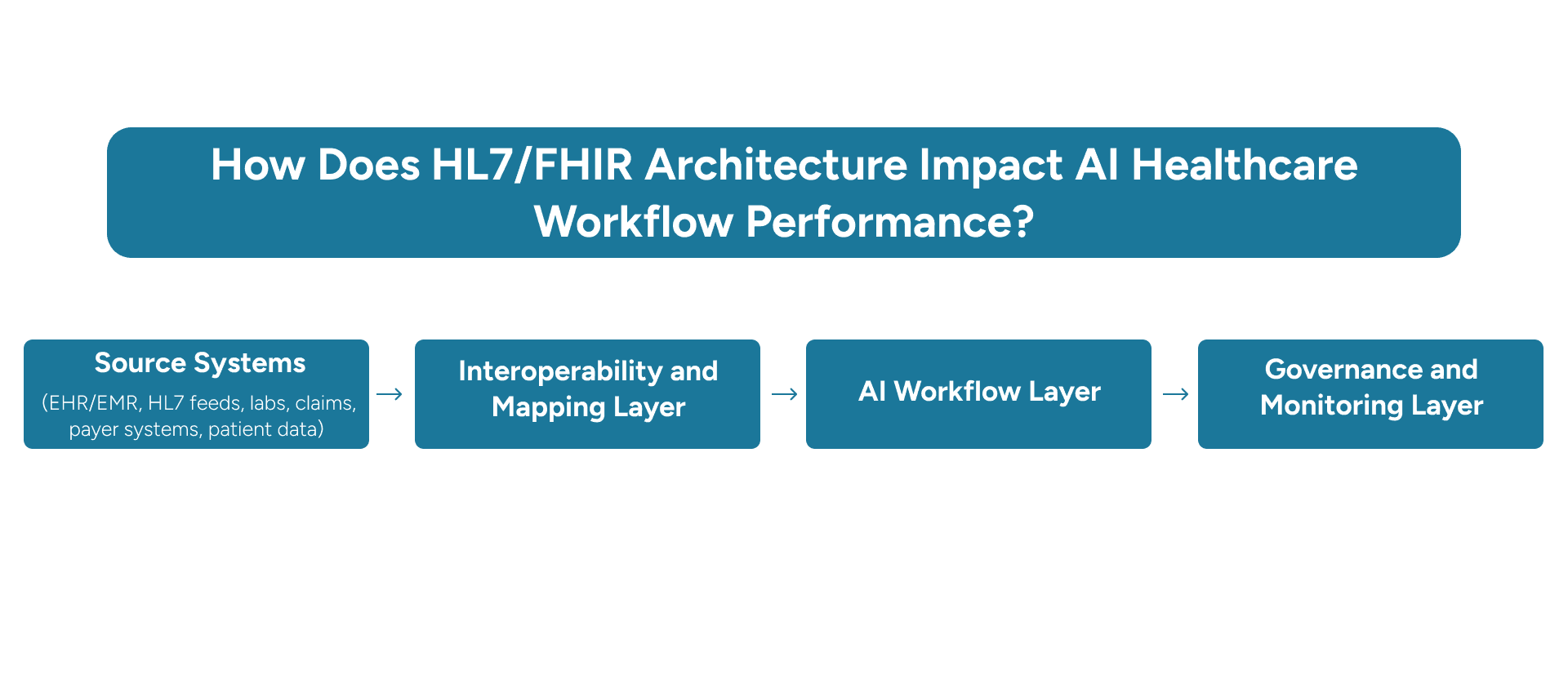
The core architecture of a production-ready AI healthcare product spans four layers: source system connectivity, an interoperability and mapping layer, an AI workflow layer, and a governance and monitoring layer. Each layer depends on the one before it, and a gap in any one of them affects the integrity of everything that follows.
Source System Connectivity
Source system connectivity determines the completeness of clinical data before it reaches any other layer. This layer pulls data from EHR and EMR systems, HL7 v2 message feeds, lab systems, claims data, payer systems, and patient-generated data. These sources operate on different formats and update at different frequencies. A production architecture must handle this variability without losing data quality. Legacy HL7 v2 feeds require transformation into FHIR-compatible structures before they can feed into AI workflows. Where source data is incomplete, enrichment logic needs to be documented and traceable so it is clear what came from the original record and what was added downstream.
Interoperability and Mapping Layer
The interoperability and mapping layer standardizes incoming data into FHIR resources that AI workflows can consume. This layer carries consent enforcement, field-level validation, identity resolution, and data provenance controls. Consent logic enforced at this layer ensures PHI access restrictions hold across every workflow that draws from the same data pipeline. Mapping decisions made here determine the completeness of the clinical context reaching the AI layer, and incomplete mapping at this stage cannot be corrected further downstream.
AI Workflow Layer
The AI workflow layer is where clinical context meets the model, and its output quality is a direct reflection of the two layers beneath it. For this layer to perform in production, the data it receives must be complete, structured, and traceable to a source. AI outputs generated from fragmented or poorly mapped data produce clinical recommendations that cannot be verified, which creates liability for the platform and erodes trust with enterprise buyers. This layer requires output validation logic, source attribution, and confidence thresholds that route outputs below an acceptable range to human review before they reach end users.
Governance and Monitoring Layer
The governance and monitoring layer provides the audit trail, bias and drift monitoring, human review workflows, and incident response procedures that enterprise buyers require before signing a contract. Every data access event, every AI output, and every workflow action taken on that output should be logged with timestamps and source attribution. Bias and drift reviews should be scheduled rather than reactive. Human oversight protocols should be documented and testable. An architecture that cannot demonstrate these controls at the point of procurement will not advance past the evaluation stage.
When we assess a healthcare AI product's architecture, the first thing we look at is whether clinical context can be followed end to end, through every transformation, every AI call, and every workflow action. Products that advance through enterprise pilots and compliance reviews are the ones where that audit trail was built into the architecture from day one.
Janhavi Mukesh MoneSenior Business Analyst IIWhat Compliance and Security Controls Does Your AI Healthcare Product Need Before Go-Live?
Compliance for an AI healthcare product covers the full data path from ingestion through AI processing to workflow action, not just the storage layer. The controls that matter to enterprise buyers span PHI handling, consent, access management, encryption, audit trails, AI-specific risk controls, and human oversight, and all of them must be in place before a production deployment begins.
Recent HHS/OCR updates and proposed changes to the HIPAA Security Rule signal that regulators expect stronger documentation, security controls, and risk remediation across systems that process PHI. The proposed changes remove the distinction between required and addressable safeguards, making every control mandatory. For AI healthcare products, this means every component that processes protected health information is subject to the same security standards as the rest of the platform.
PHI Handling, Consent, and Access Control
PHI access, governed at the data layer, with consent logic enforced at the same level, is the foundation of a compliant AI healthcare product. Every component that touches patient data, including AI models, enrichment pipelines, and output delivery systems, must operate under minimum necessary access principles. Access controls should be role-based, documented, and auditable. Consent must be enforced before data enters the pipeline, not at the application layer, where it can be bypassed by downstream components. Every third-party service in your product stack that processes PHI must be evaluated for its own compliance posture, including the AI model provider, before it is connected to a live environment. A Business Associate Agreement formalizes that accountability and defines breach notification obligations on both sides.
Encryption and Data Retention
Encryption across every layer of the product architecture and a documented data retention policy are baseline requirements for enterprise procurement. All PHI must be encrypted in transit and at rest. Data retention policies must define how long patient data is held, under what conditions it can be accessed after the primary use has ended, and how it is disposed of when retention periods expire. These policies need to be reviewed and documented before any enterprise evaluation begins.
Audit Trails and Prompt Logging
A complete audit trail for an AI healthcare product covers every data access event, every prompt submitted to a model, every AI output, and every workflow action taken on the basis of that output. Each entry should carry timestamps, user identifiers, and source attribution. The January 2025 HHS proposed Security Rule update reinforces that covered entities must demonstrate not just that risks were identified, but that they were acted on with documented remediation. An audit trail that captures only data access events will not satisfy this standard.
AI-Specific Risk Controls
AI healthcare products carry a category of compliance risk that access controls and encryption alone do not address. Research on LLM-assisted clinical data processing has identified hallucination of non-existent attributes and mismatches in data granularity as failure modes when models process FHIR-structured clinical records. Your product requires hallucination detection logic, source attribution checks, and output validation rules built into the AI layer before go-live. Research on concurrent FHIR access has also identified race condition vulnerabilities in environments where multiple systems access shared patient resources at the same time. These vulnerabilities require architectural attention in products that connect to multiple EHR systems and are not covered by standard authentication controls.
Human-in-the-Loop Review
A documented, testable, and auditable human review pathway is a compliance requirement for AI outputs that inform clinical decisions. High-risk AI outputs must pass through a documented human review process before they inform clinical decisions or trigger workflow actions. Enterprise health system buyers will assess whether this pathway functions in practice, an
Why Choose GeekyAnts for HL7/FHIR-Ready AI Healthcare Platform Development
GeekyAnts is built for teams that need interoperability, AI engineering, compliance readiness, and scalable delivery to move together on a single production timeline. Most AI healthcare teams fail because those layers were handled as separate workstreams instead of one production system.
GeekyAnts delivers production-ready AI healthcare platform development across interoperability architecture, FHIR-based data mapping, EHR/EMR integration, HIPAA-ready engineering practices, AI workflow design, cloud infrastructure, DevOps, and dedicated engineering team models. The result is a product that can pass integration reviews, compliance audits, and enterprise procurement checks.
The challenges covered in this guide, from legacy HL7 data handling and FHIR mapping to audit trail completeness, AI-specific risk controls, and go-live security reviews, require engineering capability that spans the full production stack. GeekyAnts brings that capability together across custom healthcare software, patient portals, healthcare AI solutions, AI consulting, and dedicated engineering teams, so product teams do not carry the coordination burden across multiple vendors.
The challenges covered in this guide, from legacy HL7 data handling and FHIR mapping to audit trail completeness, AI-specific risk controls, and go-live security reviews, require engineering capability that spans the full production stack. GeekyAnts brings that capability together across custom healthcare software, patient portals, healthcare AI solutions, AI consulting, and dedicated engineering teams, so product teams do not carry the coordination burden across multiple vendors. For a dental practice management platform, that engineering model delivered a 40% reduction in onboarding completion time through AI-driven clinical workflow modernization and a restructured clinical data pipeline.
Enterprise health system buyers and payer technology leaders evaluate the interoperability layer, compliance architecture, and scalable delivery of an AI product with the same rigor they apply to clinical tools. Interoperability and compliance architecture have moved from implementation details to procurement criteria, and that shift has fundamentally changed what it takes to win and retain enterprise healthcare contracts.
Kunal KumarChief Revenue Officer
What Does It Take for AI Healthcare Products to Earn Enterprise Trust?
Enterprise trust in an AI healthcare product comes from the layers beneath the model: the interoperability architecture, the compliance controls, the audit trail, and the operational model that sustains the product after deployment. These are what procurement teams, health system buyers, and payer technology leaders evaluate before a contract is signed, and a working demo alone will not meet that standard.
The teams that reach production build products that can pass integration reviews, survive compliance audits, and support deployment across multiple EHR environments. HL7 and FHIR integration, PHI handling, audit readiness, and scalable product engineering are the ongoing operational standards that enterprise-ready AI healthcare platforms are held to across every pilot, every review, and every deployment.
Sources and Citations
- https://hai.stanford.edu/news/how-to-build-a-safe-secure-medical-ai-platform
- https://www.hhs.gov/hipaa/for-professionals/covered-entities/index.html
- https://www.hhs.gov/hipaa/for-professionals/security/laws-regulations/index.html
- https://healthit.gov/data/data-briefs/hospital-trends-use-evaluation-and-governance-predictive-ai-2023-2024/
- https://www.cms.gov/priorities/burden-reduction/overview/interoperability/policies-regulations/cms-interoperability-prior-authorization-final-rule-cms-0057-f
- https://www.hipaajournal.com/when-ai-technology-and-hipaa-collide/
- https://arxiv.org/abs/2507.03067
- https://hl7.org/fhir/summary.html
- https://build.fhir.org/ig/HL7/smart-app-launch/
- https://www.mckinsey.com/industries/healthcare/our-insights/generative-ai-in-healthcare-current-trends-and-future-outlook