

Key takeaways-
- Build a solid AI SaaS strategy with strong data pipelines, scalable architecture, and user-focused design for long-term adaptability.
- Use custom AI integration to automate workflows, improve decisions, and deliver personalized user experiences.
- Work with AI SaaS experts like GeekyAnts to speed up development by 30%, reduce risk, and ensure secure, compliant solutions.
AI-powered SaaS solutions are at the forefront of digital innovation, enabling automation, predictive analytics, and personalized experiences that elevate how businesses operate and grow. The market momentum is clear—the global AI SaaS sector is projected to exceed $150 billion by 2030, with the U.S. leading in adoption (Statista, 2025).
For founders, CTOs, and B2B leaders, this growth represents an opportunity to build platforms engineered for scalability, intelligence, and long-term value creation.
This blog provides a step-by-step roadmap for building a custom AI SaaS product, covering U.S. market dynamics, AI integration strategies, must-have features, cost frameworks, common challenges, and real-world success stories designed to guide your product journey from concept to scalable success.
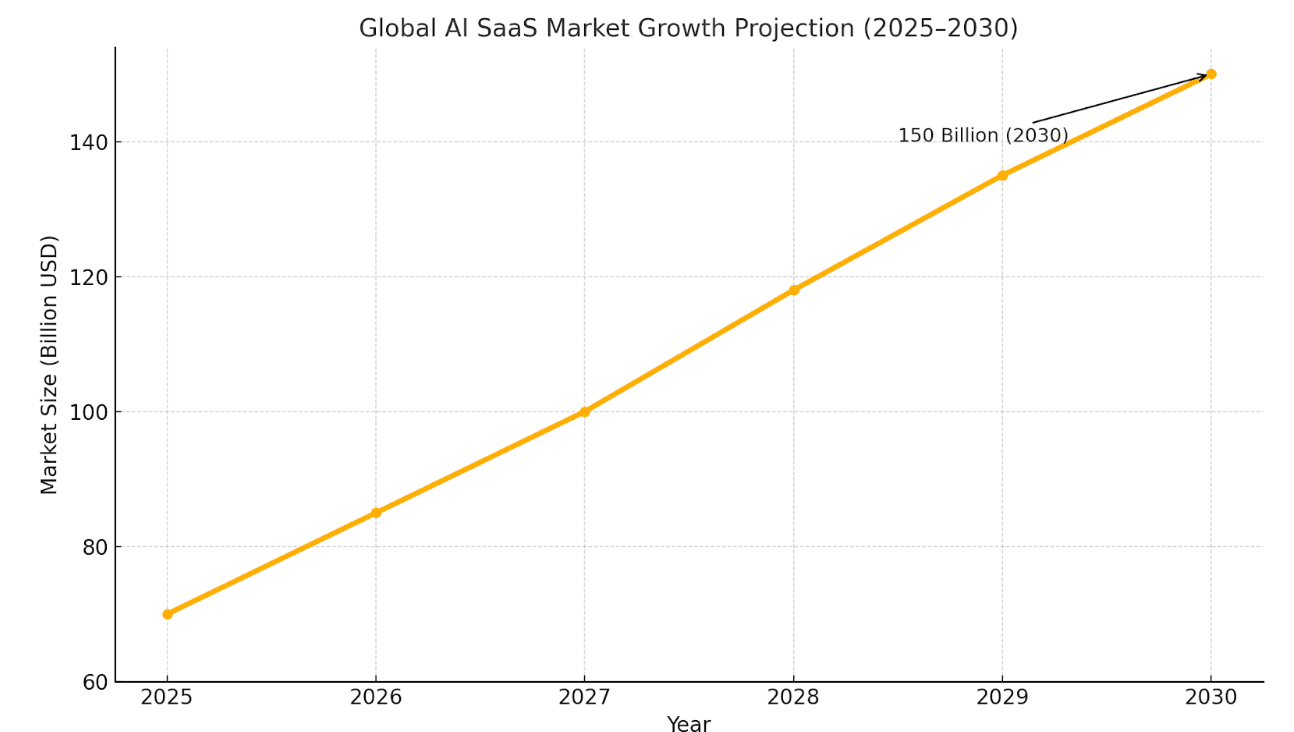
Source: Statista 2025
About the SaaS and AI Market in the USA
The combination of Software as a Service (SaaS) and Artificial Intelligence (AI) is reshaping how digital platforms deliver value. Together, they form a powerful foundation for building products that not only meet current demands but also evolve with changing markets. SaaS provides the scalability and accessibility businesses need, while AI brings intelligence—turning static tools into adaptive ecosystems capable of making predictions, automating workflows, and personalizing user experiences at scale.
In the United States, adoption of AI-powered SaaS has accelerated significantly. Enterprises are embedding AI into core SaaS applications for functions such as predictive analytics, customer experience management, and operational automation. The U.S. market is also driving growth in industry-specific AI SaaS platforms, particularly in regulated sectors such as healthcare, finance, and manufacturing, where compliance, data security, and real-time insights are critical.
Several trends are fueling this momentum:
- Rapid enterprise adoption of AI SaaS for enhancing decision-making and streamlining operations.
- Increasing participation from small and medium businesses, enabled by subscription-based models that reduce upfront investment.
- Focus on verticalized AI SaaS solutions tailored for niche industries, delivering specialized capabilities out of the box.
- Advancements in cloud infrastructure and machine learning frameworks, allowing faster deployment and easier scaling.
These dynamics position the U.S. as a leading market for AI-driven SaaS innovation, providing fertile ground for developing products that can scale rapidly, adapt to industry-specific needs, and generate long-term business value.
Why Businesses Are Shifting Towards Custom AI SaaS Solutions
The next wave of digital transformation is being led by custom AI-powered SaaS solutions, designed to offer precision, automation, and insights tailored to each business’s unique needs. Generic tools often lack flexibility and struggle to meet the unique workflows or compliance requirements of specific industries. Custom AI SaaS solutions, on the other hand, deliver intelligence and adaptability designed around business goals.
The Drivers Behind the Shift
1. Personalization at Scale
AI allows platforms to learn from user behavior and offer highly personalized experiences—whether it’s predictive analytics for sales teams, dynamic customer support, or intelligent supply chain recommendations.
2. Operational Efficiency
By automating complex processes such as data analysis, demand forecasting, and workflow management, businesses see faster decision-making and reduced operational costs.
3. Strategic Flexibility
Custom solutions allow companies to integrate AI features that are unique to their industry or customer base, ensuring they are not limited by the constraints of off-the-shelf SaaS tools.
Evidence of Growing Adoption
Recent studies show 70% of SaaS providers have already integrated AI capabilities into their products, with the majority reporting accelerated innovation cycles and measurable ROI in the first year. Enterprises adopting AI-powered SaaS solutions have achieved faster product rollouts and up to 30% efficiency gains in processes like sales, marketing, and operations.
Why AI and SaaS Together Are Transformative
The synergy between AI and SaaS lies in their complementary strengths:
- SaaS provides scalability and accessibility, enabling businesses to deploy software globally without heavy infrastructure investment.
- AI delivers intelligence and automation, turning static platforms into adaptive ecosystems capable of learning, predicting, and evolving with business needs.
This combination is why businesses are rapidly shifting toward custom AI SaaS solutions—to build platforms that are not only cloud-based but also outcome-driven, setting the stage for long-term growth and innovation.
Key Approaches to Integrating AI into SaaS Products
Integrating AI into a SaaS platform requires a deliberate approach to architecture, data management, and feature design to ensure the product remains scalable and future-ready.
AI as a Core Part of the Architecture
Successful AI SaaS products are built on an API-first, modular microservices architecture where AI engines operate as independent, upgradeable components. This structure enables rapid deployment of new AI features, seamless scaling as workloads grow, and safe experimentation with models. Combining this with cloud-native infrastructure, vector databases, and event-driven pipelines ensures real-time data processing and low-latency performance is critical for building fast, responsive platforms.
Designing Features That Deliver Value
AI integration must enhance the user experience at its core, not sit as a decorative layer. Predictive analytics for forecasting, personalized recommendation engines, and natural language interfaces turn raw data into actionable insights. Automating workflows, like ticket routing, anomaly detection, or user onboarding, creates efficiency while delivering tangible value for customers.
Continuous Learning and Evolution
AI isn’t static. Platforms need feedback loops and structured data pipelines so models continuously learn and adapt to user behavior and market shifts. This evolution transforms features from static tools into adaptive, context-aware intelligence that gets smarter over time.
Operational Practices for Longevity
Robust architecture, valuable AI features, and continuous improvement turn SaaS products into intelligent ecosystems built to anticipate future opportunities.
Step-by-Step Guide to Building a Custom AI SaaS Product
(Based on GeekyAnts Expertise)
Every great AI SaaS product starts with a bold question: What if your software could think, learn, and adapt in real time?
Turning that vision into reality takes far more than plugging an algorithm into an existing platform. It requires strategic clarity, robust data engineering, intelligent architecture, and a multidisciplinary team working in perfect sync. At GeekyAnts, we have seen firsthand how this approach transforms concepts into scalable, high-impact AI SaaS products that deliver measurable value from day one.
Here is a practical, experience-driven roadmap for building a custom AI SaaS product from concept to scalable deployment, backed by real-world insights and proven engineering practices.
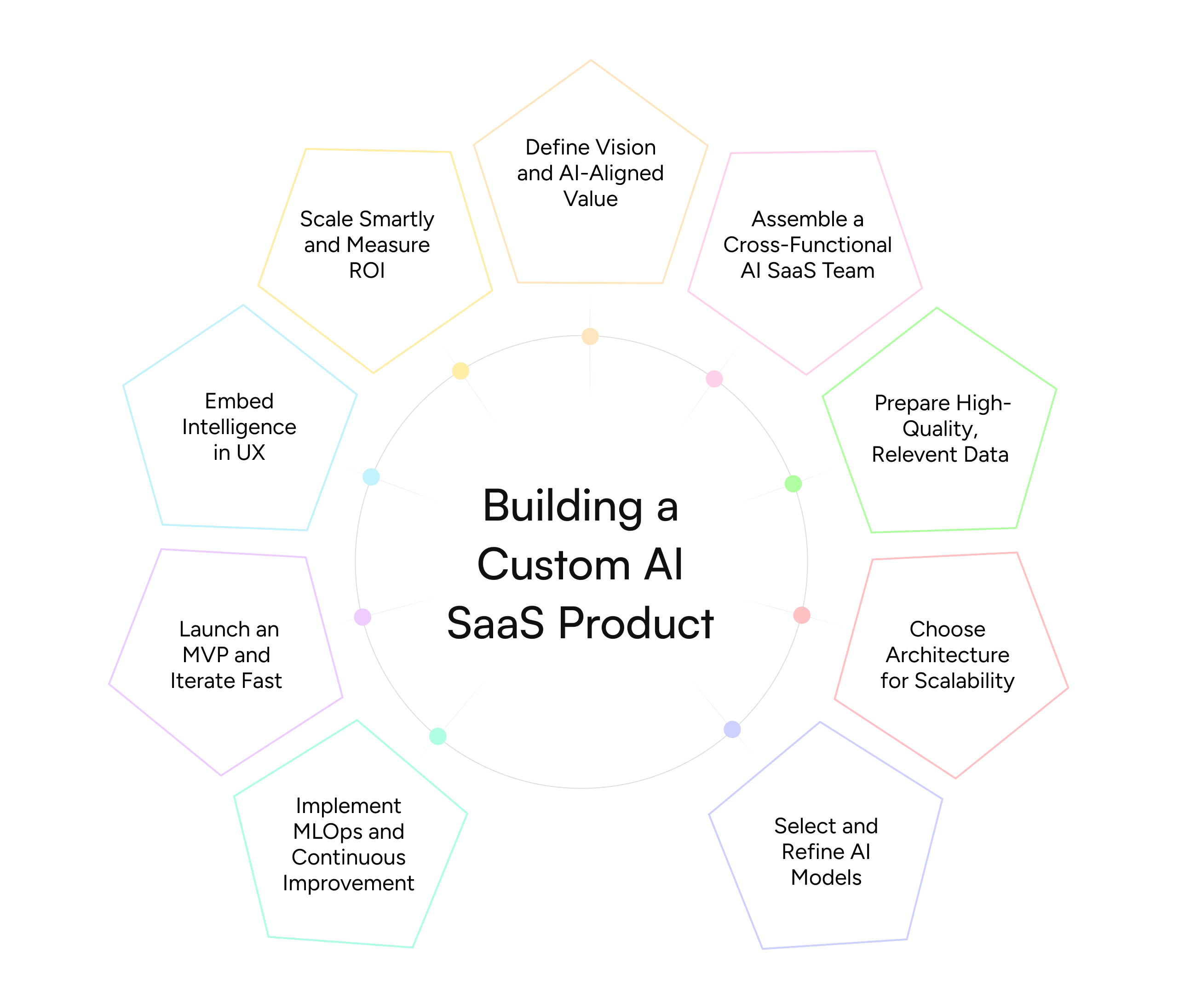
Step 1: Define Vision and AI-Aligned Value
Defining a clear vision is where an AI SaaS product truly begins. One of our recent projects started with a simple but critical question: “How can we respond to customer queries faster without expanding the support team?” That clarity led to a focused goal—automating ticket classification and routing using NLP. The result? A 40% reduction in response times and an 18% boost in customer satisfaction within months of launch.
To create the same clarity in your product journey:
- Business Alignment: Identify the specific pain points AI can uniquely address—be it predictive inventory optimization, automated claims processing, or personalized customer engagement.
- Data Availability: Ensure the required data exists in usable form. Many AI SaaS products fail not because of poor modeling but because of incomplete or biased data pipelines.
- Measurable Outcomes: Define success metrics early, such as “Reduce manual ticket classification by 60% within six months” or “Increase retention by 15% using personalization.”
Step 2: Assemble a Cross-Functional AI SaaS Team
Great AI SaaS products are not built by coders alone, they are built by specialized teams working in sync. In one of our healthcare projects, success hinged on how well product managers, AI engineers, and UX designers collaborated. While engineers focused on deploying a real-time prediction engine, UX designers ensured the insights were delivered in an interface simple enough for doctors to act on instantly. That tight collaboration reduced delivery time by 25% and created a product doctors actually loved to use.
Here is what a strong AI SaaS team looks like:
Role | Core Responsibility |
|---|---|
Product Manager | Defines AI use cases, sets roadmap, aligns product goals with business KPIs.Data 2 |
Designs, trains, and deploys machine learning models tailored to business objectives. | |
Data Engineer | Builds pipelines for reliable, clean, real-time data ingestion and storage. |
Backend Developer | Implements microservices, APIs, and integrates AI modules with core systems. |
Frontend Developer | Delivers seamless user interfaces that present AI-driven insights intuitively. |
UX Designer | Designs workflows that hide AI complexity and create user-friendly experiences. |
MLOps Specialist | Manages model deployment pipelines, monitoring, and continuous improvement. |
Validates the accuracy, reliability, and performance of AI features. |
When these roles work in harmony, your AI SaaS product moves from concept to production faster and with fewer costly reworks.
Step 3: Build High-Quality, Reliable Data Pipelines
AI is only as powerful as the data it learns from. In one of our logistics projects, the turning point wasn’t the algorithm itself but the data pipeline behind it. Raw GPS signals from delivery vehicles were noisy and inconsistent, causing inaccurate route predictions. By building a real-time streaming pipeline with data validation and transformation, we not only cleaned the data but also enabled predictive route optimization that reduced delivery costs by 12% within the first quarter.
For your AI SaaS product, building a robust data foundation is non-negotiable:
- Data Sources: Identify where your data lives—CRM systems, IoT devices, application logs, or third-party APIs—and ensure it’s accessible.
- Data Engineering: Implement ETL or streaming pipelines capable of processing, validating, and standardizing data in real time. This ensures your AI models receive clean, structured, and context-rich inputs.
- Data Governance: Establish policies for data quality, freshness, and compliance (critical in industries like finance and healthcare).
Well-engineered data pipelines don’t just fuel your AI models—they enable continuous learning and performance improvement as your product scales.
Step 4: Design an Architecture for Scalability
A scalable architecture ensures your AI SaaS product can handle growing data volumes, more users, and the rapid deployment of new AI capabilities without disruption. One of our fintech products had to process thousands of transactions per second, detect anomalies in real time, and scale instantly during peak hours. The success came from designing an API-first, modular architecture that treated AI as a native component, not an add-on.
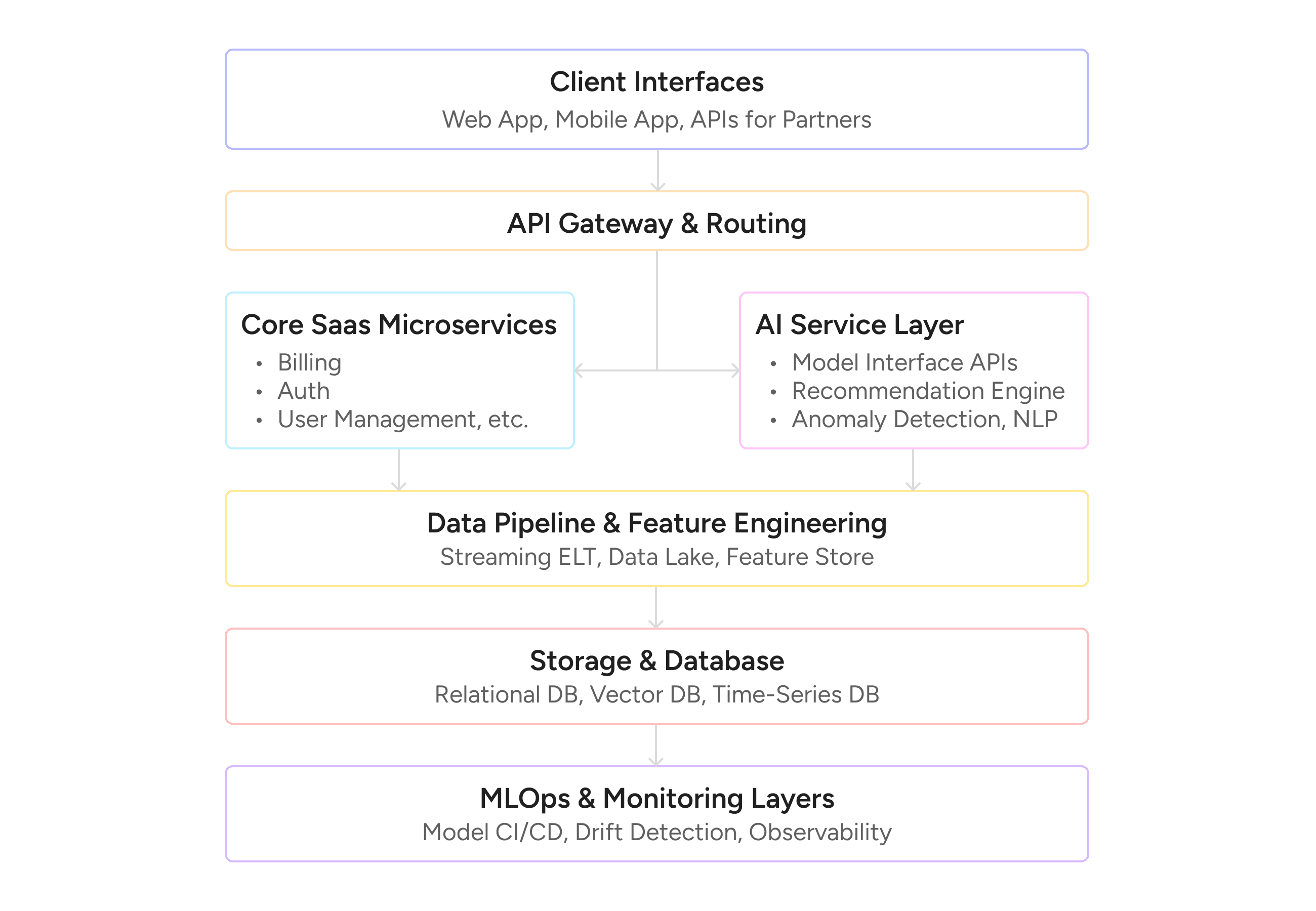
Core Architectural Principles
- Microservices for Flexibility: Each core function (user management, AI engine, billing, analytics) operates independently, allowing updates without downtime.
- AI as a Dedicated Service Layer: AI models run as isolated microservices, enabling rapid experimentation and independent scaling based on workload.
- Cloud-Native Infrastructure: Use container orchestration (Kubernetes or ECS) to handle auto-scaling, load balancing, and service discovery.
- Event-Driven Pipelines: Adopt technologies like Kafka or AWS Kinesis to enable real-time data processing for AI tasks like predictions or anomaly detection.
- Vector Databases & Feature Stores: Integrate vector search (like Pinecone or Weaviate) and feature stores for handling embeddings and real-time model serving.
Step 5: Select and Refine AI Models for Feature-Level Intelligence
The focus should always start with business impact: Which tasks, if automated or enhanced by AI, will deliver the greatest value?
Choosing the Right Model Approach
For broad use cases like chatbots or recommendation engines, pre-trained models (e.g., GPT-based APIs or cloud AI services) can dramatically reduce development time and cost. However, when addressing domain-specific needs, such as financial risk assessment or healthcare diagnostics, custom models trained on proprietary data often deliver better accuracy and compliance.
In one of our SaaS projects for retail, we integrated a hybrid approach: starting with a pre-trained recommendation model for immediate deployment while simultaneously building a domain-specific model tuned with user behavior data. This strategy allowed the product to launch quickly and, over time, increase upsell revenue by 22% as the custom model adapted to seasonal buying patterns.
Embedding AI at the Feature Level
AI should feel like a native part of the experience, not an add-on.
- Personalized Dashboards: Present KPIs and insights that adapt based on user preferences and actions.
- Dynamic Workflows: Automatically route tasks, like support tickets or sales leads, using predictive models trained on historical outcomes.
- Conversational Interfaces: Offer users NLP-powered chat interfaces for self-service and faster resolutions, reducing support workload while improving user experience.
Enabling Continuous Learning
Your models should evolve with your product and users:
- Feedback Loops: Capture and feed real-time user behavior into model retraining pipelines.
- Model Drift Detection: Monitor when accuracy drops because of changing data patterns and trigger automated retraining.
- A/B Model Testing: Continuously compare variants to ensure your product is powered by the best-performing model at any given time.
This strategic approach to model selection and refinement ensures your SaaS product delivers intelligent, personalized, and evolving experiences that grow in value as user needs change.
Step 6: Launch an MVP and Iterate Fast
The fastest way to validate an AI SaaS product is to launch a focused MVP, not a stripped-down product, but one that delivers a single, high-value AI capability solving a core problem. This approach minimizes risk, accelerates feedback, and guides future development with real-world insights.
Why Start Small?
- Faster Market Entry: Delivering a valuable feature early builds user trust and creates immediate impact.
- Focused Learning: You can observe how users interact with the AI, what outcomes they value, and what requires adjustment.
- Smarter Resource Allocation: Avoid over-engineering features that may not matter, concentrating efforts on what drives measurable results.
Iterative Development Best Practices
- Rapid Feedback Loops: Integrate analytics dashboards and monitoring from day one to capture performance and usage trends.
- Data-Driven Enhancements: Use collected user behavior to refine models, improve UI workflows, and prioritize new AI features.
- Continuous Experimentation: Treat the MVP as a living system—launch, learn, and evolve quickly based on actual usage.
A well-planned MVP strategy ensures your AI SaaS product evolves in sync with user needs, saving months of guesswork and significantly improving your go-to-market success rate.
Step 7: Launch an MVP and Iterate Fast
Treat your MVP like a scout—built to explore, learn, and adapt quickly. Focus on one AI feature that solves a real pain point and launch fast. In a fintech project, this approach delivered immediate value by detecting 85% of fraudulent transactions in the first month and generating data that boosted accuracy to 94% in later iterations.
Why this works:
- Speed beats perfection – you learn faster when users interact with a real product, not a concept deck.
- You see what matters – user behavior reveals which AI features drive actual business impact.
- Risk stays low – you invest where data and feedback justify it.
A well-executed MVP is not a “lite version”; it’s a learning engine—the foundation for a product that continuously adapts and thrives.
Step 8: Implement MLOps and Continuous Improvement
Keeping AI models accurate and reliable as data and users grow is a challenge. MLOps (Machine Learning Operations) solves this by automating monitoring, detecting performance drift, and retraining models before they degrade. In one healthcare SaaS project, these pipelines restored model accuracy by 12% within weeks—without any service interruptions.
Key MLOps Practices
- Automated Model Deployment: Use CI/CD pipelines to roll out updates seamlessly.
- Monitoring & Drift Detection: Continuously track accuracy, latency, and fairness to catch performance issues early.
- Versioning & Rollback: Maintain model versions and enable instant rollback if a new model underperforms.
- Cost & Performance Optimization: Monitor compute usage to balance cost with scalability.
Continuous Learning & Feedback
Integrate user feedback and real-world data into retraining pipelines, enabling the AI to adapt as business needs evolve.
A strong MLOps foundation ensures your AI SaaS product remains accurate, scalable, and trusted, even as it grows in complexity and scale.
Step 9: Scale Smartly and Measure ROI
Once adoption picks up, scale AI services independently to avoid bottlenecks and maintain performance under heavy load. Introduce feature versioning for controlled rollouts and experiment safely without impacting all users. Measure ROI using metrics like automation rate, time saved, user engagement uplift, and feature adoption. This ensures every enhancement justifies its cost and contributes directly to business outcomes.
Must-Have Key Features for a Scalable AI SaaS Product
1. Adaptive AI Integration
AI should power core workflows, not sit as an add-on. For example, in a logistics SaaS platform, adaptive AI rerouted delivery fleets in real time based on traffic and weather, reducing delays by 18%. Features like predictive analytics, recommendation engines, and automated decision-making ensure the product remains valuable as user data grows and patterns shift.
2. Enterprise-Grade Security and Compliance
AI SaaS platforms often handle sensitive data. Features like end-to-end encryption, role-based access controls, and AI-driven anomaly detection reduce the risk of breaches. In healthcare SaaS, for instance, AI-enabled monitoring identified irregular data access patterns and prevented compliance violations before they escalated.
3. Seamless Integration & Interoperability
Most enterprise customers already run complex tech stacks. API-first architectures and pre-built connectors make it easy to integrate with CRMs, ERPs, and analytics tools. A retail AI SaaS product that plugged directly into Shopify and Salesforce cut onboarding time from weeks to days and accelerated adoption.
4. Elastic Scalability & Multi-Tenancy
Workloads in AI SaaS can spike unpredictably—like during a seasonal sales surge or a sudden demand spike for AI-driven features. Cloud-native, containerized infrastructure with auto-scaling and multi-tenant isolation keeps performance stable. Netflix’s AI-powered recommendation system is a real-world proof point, scaling to handle billions of daily requests without downtime.
5. Real-Time Analytics & Continuous Insights
Users no longer want static dashboards—they expect actionable insights in real time. A manufacturing SaaS with real-time anomaly detection prevented $2M in downtime losses by spotting production issues before they escalated.
6. Intelligent User Experience (UX)
AI-driven UX customizes navigation, recommendations, and workflows. A SaaS platform for sales teams that used behaviour-based UI adjustments and predictive deal scoring saw a 25% boost in daily active usage.
7. Continuous Learning & Product Evolution
Your AI models need to evolve with user behavior. Drift detection, automated retraining, and A/B model testing keep predictions accurate. A financial SaaS product retrained its risk assessment model quarterly, reducing false positives by 40%.
AI SaaS platforms succeed when they are built for adaptability, security, and user trust from day one. Prioritizing the right features creates products that scale effortlessly and stay relevant as technology and customer needs evolve.
 Saurabh SahuChief Technology Officer (CTO)
Custom vs Off-the-Shelf AI SaaS: What’s Best for Your Business?
Comparison Table
Factor | Custom AI SaaS | Off-the-Shelf AI SaaS |
|---|---|---|
Tailoring to Business Needs | Built around your unique workflows and objectives. | Limited customization; follows pre-defined use cases. |
Time to Deploy | Longer build time; requires design, development, and testing. | Quick deployment; ready to use after setup. |
Scalability | Scales as your business evolves and needs grow. | Scalability limited to vendor’s roadmap and features. |
Cost Structure | Higher upfront investment; lower long-term modification cost. | Lower initial cost but recurring licensing fees can add up. |
Integration | Seamless fit with existing infrastructure and data pipelines. | May require workarounds or additional connectors. |
Ownership & Control | Full control over data, model updates, and IP ownership. | Limited control; dependent on vendor updates and policies. |
Innovation & Flexibility | Easy to adapt and add new features quickly. | Feature set fixed by vendor; innovation pace depends on them. |
Maintenance | Requires dedicated support and updates internally or via partner. | Vendor handles updates and general maintenance. |
Which One Is Right for Your Business?
If your business operates in a specialized industry such as healthcare compliance or fintech fraud detection, or requires unique features to stand out, a custom AI SaaS solution provides full control and a long-term competitive advantage.
If speed and low initial cost are your priorities, an off-the-shelf AI SaaS solution is the better choice. It allows for quick deployment and immediate access to AI capabilities without heavy upfront investment.
Overall, for startups and mid-size businesses, starting with an off-the-shelf solution is often practical. As your business grows and requires tailored functionality, transitioning to a custom AI SaaS ensures your product can adapt and scale without being limited by a vendor’s roadmap.
Cost of Developing a Custom and Scalable AI SaaS Product
Building an AI SaaS product in the U.S. is significantly influenced by labor rates, infrastructure costs, and compliance requirements. Below is a breakdown of costs for key components, with pricing reflective of U.S.-based development teams:
Cost Component | Description | Estimated Cost (USD) |
|---|---|---|
Product Scope & Complexity | Feature planning, roadmap, and complexity handling. MVP with limited AI vs. full-scale feature set. | $75,000 – $180,000 |
AI Model Development & Training | Building custom models, dataset preparation, or integrating APIs (e.g., OpenAI, AWS AI, Azure AI). | $45,000 – $120,000 |
Data Infrastructure & Pipelines | Data ingestion, ETL pipelines, streaming architecture, and data lakes. | $30,000 – $75,000 |
Architecture & Scalability | Microservices, auto-scaling, multi-tenancy, and performance optimization. | $60,000 – $150,000 |
Design & User Experience (UX) | AI-powered dashboards, adaptive workflows, conversational UI, and testing for accessibility. | $22,000 – $55,000 |
Security & Compliance | Encryption, role-based access, compliance frameworks (HIPAA, SOC 2, PCI DSS). | $22,500 – $75,000 |
Ongoing Maintenance & MLOps | Model monitoring, drift detection, retraining pipelines, and system updates. | $40,000 – $90,000 / yr |
Total Cost Range (U.S. Market)
- MVP Stage (Core AI + Basic SaaS): $75,000 – $180,000
- Full-Scale Enterprise AI SaaS: $300,000 – $650,000+ (one-time build)
- Annual Maintenance & AI Operations: $40,000 – $90,000
Developing a custom, scalable AI SaaS product in the U.S. comes with a higher initial investment but ensures better control, scalability, and compliance alignment. For early-stage businesses, starting with an MVP in the $75k–$180k range and iterating based on feedback is recommended. As adoption grows, scaling to a $300k+ enterprise-grade product delivers long-term ROI, competitive differentiation, and infrastructure resilience.
Common Challenges and Solutions in AI SaaS Platform Development
Developing an AI SaaS platform is a different game altogether; it blends the complexity of AI model development with the expectations of scalable, secure, and user-friendly SaaS delivery. Here are the most frequent challenges we have encountered and the practical solutions that worked in real projects.
1. Data Quality and Availability
AI is only as good as the data that fuels it. Many teams face fragmented, incomplete, or poorly labeled datasets, which directly affects model accuracy. In one of our logistics projects, training a route optimization engine became nearly impossible because location and delivery data came from multiple outdated systems with mismatched formats. We solved this by building an automated data pipeline that validated, normalized, and cleaned data in real time while enriching it with synthetic data to fill gaps. The result: a 20% boost in model accuracy and a faster path to MVP launch.
Solution: Invest early in automated data validation pipelines, establish strong governance policies, and leverage synthetic data generation when historical records are thin.
2. Model Performance and Scalability
A model performing well in a controlled lab often fails under real-world traffic loads or with noisy live data. In a healthcare SaaS product we built, an NLP model worked perfectly in staging but lagged by several seconds in production when processing millions of patient records daily. We implemented an MLOps pipeline that continuously monitored drift and automated retraining based on live data trends. Pairing this with containerized infrastructure on Kubernetes enabled us to auto-scale model instances and maintain <200ms inference time even at peak load.
Solution: Deploy an MLOps framework from day one, automate retraining triggers, and use elastic infrastructure to ensure your models scale without compromising performance.
3. Integration with Existing Systems
Enterprises often run on legacy systems and proprietary databases that don’t play well with modern AI stacks. One retail client had a decade-old ERP that lacked modern APIs, slowing down AI feature adoption. We solved it by introducing an API-first architecture with a dedicated middleware layer and pre-built connectors, enabling seamless data flow without touching legacy code. The client’s time to integrate new AI-driven analytics dropped from months to just two weeks.
Solution: Build API-first architectures, provide low-code/no-code connectors, and leverage middleware or iPaaS to simplify integration with existing ecosystems.
4. Security and Compliance
AI SaaS products often handle sensitive data, financial records, health information, or personal identifiers, which makes security non-negotiable. During a fintech project, an attempted intrusion triggered anomaly detection systems we had integrated using AI-powered behavioral analytics, stopping the breach before data exposure. Beyond monitoring, we embedded compliance-as-code practices into the CI/CD pipeline and adopted federated learning, enabling model training without moving sensitive data across borders.
Solution: Adopt end-to-end encryption, role-based access control, and AI-driven anomaly detection while embedding compliance checks directly into your development workflow.
5. User Adoption and Trust
Even the best AI features fail if users do not trust them. In one customer support platform, agents initially hesitated to rely on AI-generated ticket resolutions. We addressed this by redesigning the UX to show confidence scores and reasoning for each AI recommendation (explainable AI) and added quick feedback options so agents could correct results. Within a month, adoption rates improved by 35%, and feedback loops further refined model accuracy.
Solution: Prioritize transparent AI features, embed feedback mechanisms, and introduce AI in assistive roles first before moving toward autonomous decision-making.
6. Cost Overruns and Timeline Delays
AI SaaS projects can quickly spiral out of budget due to underestimated complexities. For a startup building a fraud detection tool, initial estimates missed the complexity of model training, causing both delays and scope creep. Switching to a lean MVP approach focusing on one high-value AI feature allowed the team to launch within budget and scale additional capabilities later. Leveraging pre-trained APIs initially also reduced costs by 40% compared to custom model development.
Solution: Adopt a phased approach, start with an MVP focused on one or two core AI features, use pre-trained APIs for early iterations, and expand features and models as the product matures.
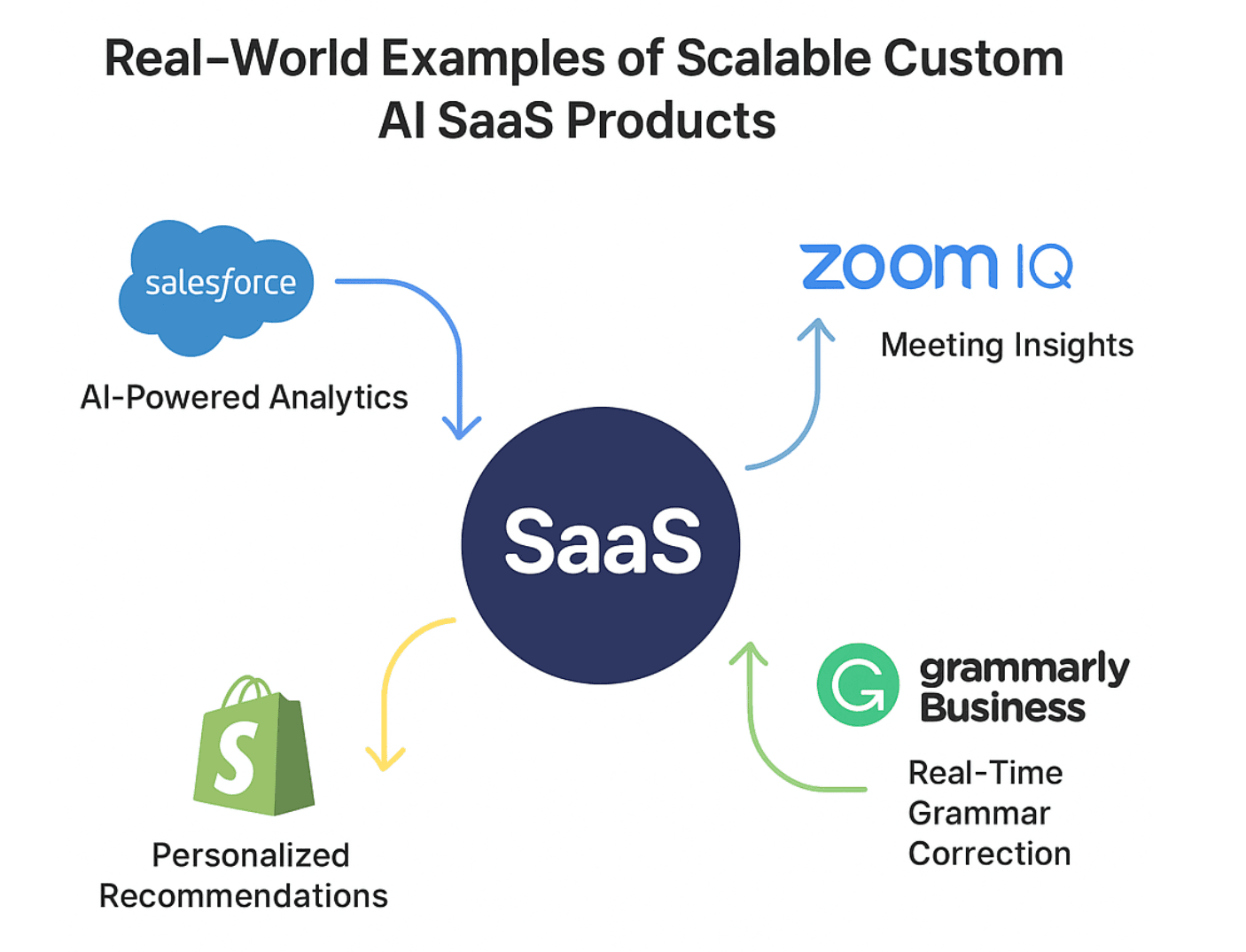
Real-World Examples of Scalable Custom AI SaaS Products
1. Salesforce Einstein
Salesforce Einstein brings AI-powered analytics, lead scoring, and sales forecasting directly into CRM workflows. Its scalability allows enterprises to handle millions of transactions daily, enabling real-time insights across global sales teams. Features like predictive deal scoring and customer sentiment analysis have helped companies improve conversion rates by up to 30%.
2. Zoom IQ
Zoom IQ uses AI to provide meeting insights, conversation analytics, and real-time performance feedback. Its scalable architecture handles thousands of concurrent video sessions with low latency. Built-in AI assistants help automate note-taking, track action items, and suggest next steps, increasing user productivity without additional manpower.
3. Grammarly Business
Grammarly Business leverages natural language processing to deliver real-time grammar correction, tone detection, and content optimization for enterprises. Its cloud-native design scales to support millions of daily active users, ensuring consistent performance and privacy compliance even for heavily regulated industries like finance and healthcare.
4. Shopify AI
Shopify integrates AI to power personalized recommendations, demand forecasting, and fraud detection for merchants. Its AI-driven automation enables small businesses to scale operations as if they were enterprise-level, supporting seasonal spikes without compromising checkout speed or user experience.
One of our clients scaled their AI-powered SaaS platform from a pilot with 5,000 users to over 1.2 million active users within a year—without a single hour of downtime. The key was a modular architecture and intelligent data pipelines that allowed the platform to evolve feature by feature as adoption grew. Delivering that kind of stability and scalability is what we focus on every day at GeekyAnts.
Saurabh SahuChief Technology Officer (CTO)Why Choose GeekyAnts for AI SaaS Product Development?
Full-Cycle AI SaaS Solutions
GeekyAnts builds end-to-end AI SaaS products, from concept and architecture to deployment and scaling. Our expertise covers:
- AI & ML Engineering: Model integration, MLOps pipelines, real-time analytics, and AI-driven personalization.
- Scalable SaaS Architecture: Cloud-native, multi-tenant platforms designed for millions of concurrent users.
- User-Centric Experience: Intuitive, AI-driven interfaces that ensure adoption and retention.
Proven Expertise Across Complex Products
- FinTech SaaS Platform: Delivered a secure, AI-powered solution for transaction analysis and fraud detection with real-time anomaly detection and 99.99% uptime.
- Healthcare SaaS Solution: Built HIPAA-compliant care coordination software with predictive patient analytics, enabling faster triage and a 30% improvement in care team efficiency.
- Retail AI SaaS MVP: Developed a demand forecasting and personalized recommendation engine for a U.S. retailer, deployed in 4 months, resulting in 22% increase in upsell revenue.
Structured, Transparent Delivery Model
- Specialized Teams: AI/ML engineers, SaaS architects, UI/UX experts, and QA specialists working as one integrated unit.
- Agile Execution: Sprint-based approach with transparent progress tracking and quick iteration cycles.
- Flexible Engagement: From lean MVP builds to enterprise-scale deployments, we adapt to your roadmap and scale resources as needed.
Outcomes That Matter
- Accelerated Time-to-Market: Reduced development timelines by up to 30% through reusable SaaS modules and pre-built AI accelerators.
- Cost-Optimized Scalability: Architectures that support high-volume workloads without exponential cloud costs.
- Security & Compliance: Systems built to meet industry standards like HIPAA, SOC 2, and GDPR from day one.
Trusted by Global Clients
We align with client time zones for real-time collaboration and leverage distributed teams for cost efficiency and speed. Whether it’s a 2-member POC or a 20+ engineer enterprise engagement, we maintain clear communication and predictable outcomes.
Your AI SaaS Journey Starts Here
GeekyAnts brings the engineering depth, domain expertise, and proven delivery framework to build AI SaaS products that scale with your vision.
Book a Free Consultation today.
Final Thoughts
A well-planned AI SaaS strategy sets the foundation for long-term growth and market leadership. Businesses integrating AI into their core products today are shaping customer experiences, automating decisions, and driving efficiencies at a scale that generic solutions cannot match.
The focus should be on adaptability, scalable infrastructure, intelligent workflows, and user-centric design, ensuring your platform evolves with shifting market demands and emerging technologies.
Now is the time to move from concept to execution. Whether launching an MVP to validate your idea or deploying a full-scale enterprise platform, investing in a robust AI SaaS foundation positions your business to lead in an AI-first economy.
FAQs about AI SaaS Product Development
1. Is it possible to add AI to a pre-existing SaaS product?
Yes, AI can be integrated into an existing SaaS product without rebuilding it from scratch. The most common approach is to start with AI-powered APIs or cloud services for features like chatbots, recommendation engines, predictive analytics, or anomaly detection. For businesses with unique workflows, custom AI models can be developed and embedded into the product. The integration process includes reviewing current infrastructure, preparing clean and structured data, and adding model inference pipelines while ensuring minimal disruption to your existing user experience.
2. How long does it take to develop an AI SaaS platform?
The timeline depends on the scope and complexity of the platform. A lean MVP (Minimum Viable Product) with one or two core AI features can take around 4–6 months, including architecture setup, data pipeline integration, and basic model deployment. A full-scale AI SaaS product with multiple AI modules, advanced integrations, and production-ready MLOps usually takes 9–15 months. The use of pre-trained AI models or cloud-based AI services can significantly reduce development time, while projects involving custom model training on proprietary data require additional time for data preparation, experimentation, and optimization.
3. What are the benefits one can expect from an AI SaaS platform?
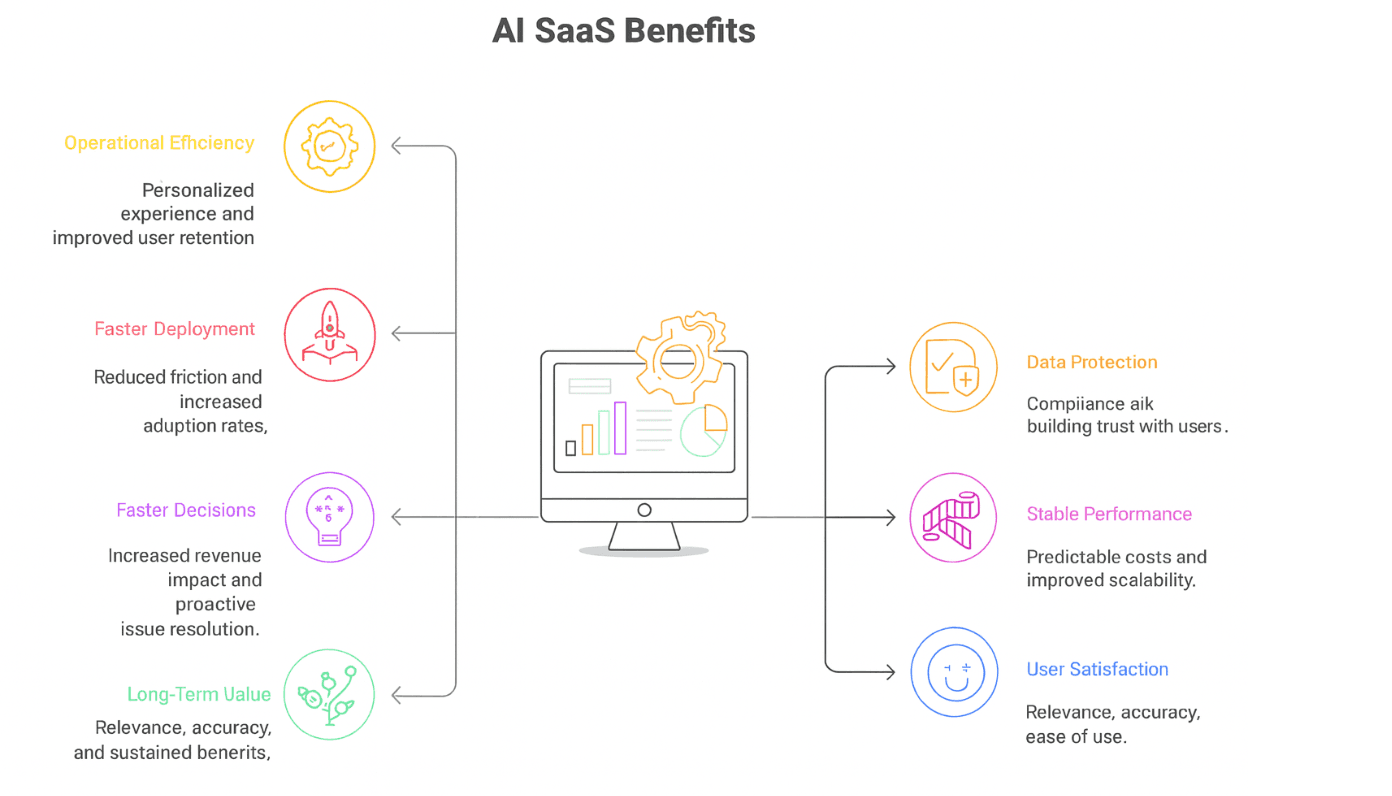
An AI SaaS platform enhances both operational efficiency and customer experience. AI-driven automation reduces manual tasks such as ticket routing, fraud detection, and lead scoring, enabling teams to focus on strategic work. Predictive analytics and recommendation engines improve decision-making and boost sales or engagement metrics. Personalized user experiences, like contextual dashboards and conversational AI support, increase user satisfaction and retention. Overall, AI SaaS delivers measurable outcomes such as lower operational costs, faster time-to-decision, and higher revenue opportunities through smarter, data-driven functionality.
4. Do I need a large dataset to build an AI SaaS product?
Not always. Pre-trained AI models and transfer learning techniques allow businesses to start with small or medium-sized datasets and still gain meaningful results. These approaches are ideal for companies beginning their AI journey or operating in niche markets where data availability is limited. For advanced use cases requiring domain-specific intelligence (like custom fraud detection or healthcare diagnostics), having a larger and high-quality dataset accelerates model training and improves accuracy. The right approach depends on your product goals, and hybrid strategies—combining external AI models with your proprietary data—can often deliver the best results.
5. How do you manage project management for software development projects?
AI SaaS development requires both software engineering best practices and AI-specific workflows. We follow an Agile methodology, executing projects in sprints with clear deliverables and iterative development cycles. Tools like Jira are used for tracking tasks, GitHub for code reviews and version control, and Figma for real-time design collaboration. We maintain transparency through weekly sprint reviews, progress reports, and continuous communication. For AI-specific tasks, our MLOps pipeline ensures model experimentation, deployment, and monitoring happen in parallel with core SaaS development, keeping timelines predictable and reducing risk.
6. Do you develop software for both mobile and web platforms?
Yes, we specialize in building cross-platform solutions that work seamlessly across mobile and web. For mobile apps, we use frameworks like React Native and Flutter to create high-performance, native-like experiences with a single codebase. For web platforms, we leverage modern frameworks like React, Next.js, and Angular to deliver responsive and scalable interfaces. This unified approach accelerates development, ensures consistent design and functionality across devices, and reduces long-term maintenance costs while still allowing for platform-specific optimizations where needed.