
Editor’s Note: This blog is adapted from a talk by Aman Soni, an AI/ML Engineer at GeekyAnts and multi-patent holder. In this session, he explored how autonomous agents can automate complex tasks—from coding to querying private databases. Backed by real-world examples and a weekend project, his talk offered a hands-on look at the future of AI-driven workflows.
Let Me Start With a Quick Intro
I am Aman Soni, and I’ve been working as an AI/ML Engineer at GeekyAnts. I have had the opportunity to contribute to several government-backed innovations, and I currently hold over ten patents across different domains. In this blog, I want to take you through a topic that’s close to my heart—and possibly your daily work life, too: automating repetitive tasks through AI agents.
We will start simple, cover real case studies, and then dive into how I built a weekend project that turns SQL queries into conversations. Let’s go.
From Traditional Hierarchies to Autonomous Dev Teams
We all know how software development typically works—there is a hierarchy. The CEO passes the requirement down to the CTO, then the devs, then the testers. It’s slow, layered, and packed with handovers.
Now, imagine this entire workflow run by agents.
That’s what a research team tried with a concept called ChatDev. They simulated a dev team using LLMS as the CEO, CTO, developer, and tester. The task? Build a ping-pong game. And the result? Within minutes, the agents collaborated, wrote code, tested edge cases, and fixed bugs—all on their own.
Every failed test case was reported back to the dev agent, and it resolved the issue. No Slack messages. No wait time. Just autonomous coordination.
The Shopping Problem That Agents Could Solve
Let’s take a more relatable example.
You land in Bangalore for a wedding but forget your suit. You have got three days. You bounce between Myntra, Ajio, and Amazon, filtering by size, price, delivery time, and fabric. It’s time-consuming.
Now, imagine an agent system.
One tool scrapes all relevant items. Another filters them based on your requirements. A third one places the order—all triggered by a simple sentence like: “Find me a navy blue suit under ₹3000 that delivers to Koramangala in 2 days.”
Sounds futuristic? It’s already being tested. Walmart is using such agents—not for customers, but for their employees. A new joiner can ask a chatbot about stock, inventory, or the location of items and get answers instantly in natural language.
When Public Data Is Not Enough
One big problem I noticed was that LLMS, even powerful ones, are limited to public or pre-trained data. That’s a blocker for internal use cases.
Let’s say you want insights from your private SQL database—things like:
- Which employees earn above a certain amount?
- How many have more than 5 years of experience in a domain?
You either need to know SQL or build something smarter.
My Weekend Project: Querying Databases Like Chatting With a Friend
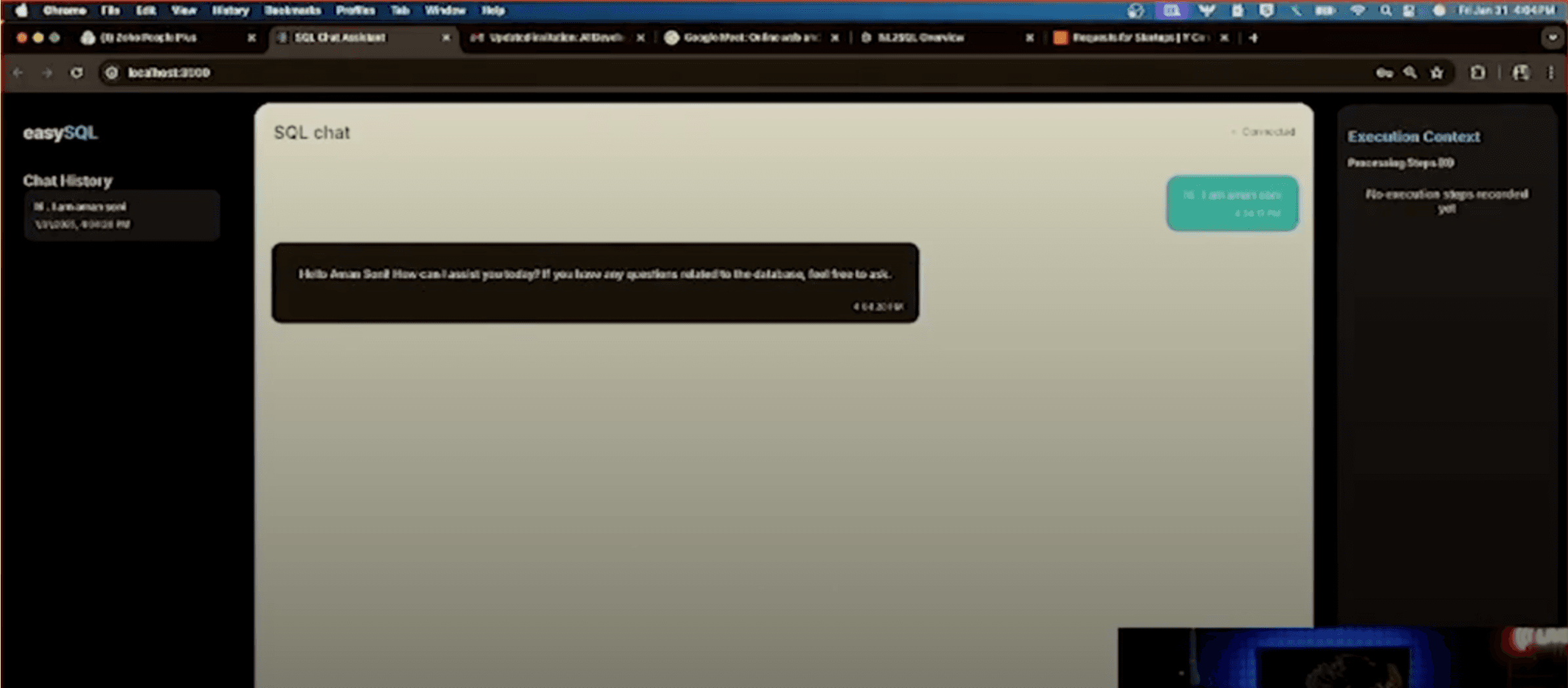
I built a weekend project that does exactly that.
Here’s how it works:
- You ask a question in plain English, like “Who earns the most in this company?”
- Agent 1: Generates the SQL query.
- Agent 2: Validates it against the schema.
- Agent 3: Tests it and checks if the result makes sense.
- Final Agent: Converts it into a natural language response.
You get both the SQL query and the answer, with full transparency and zero coding. Plus, the agents talk to each other in real time—you can see them negotiating over the best query or result.
Real Use Cases Across Industries
This goes beyond concepts—these agents are already making an impact across a wide range of industries:
- Healthcare: Summarizing therapy sessions using voice-to-text and AI.
- Finance: Auto-generating reports and filtering fraud patterns.
- Retail: Like Walmart, enhancing employee training and ops.
- Education: Students no longer rely solely on Stack Overflow—they ask LLMs.
- Legal: Extracting lease terms or contract insights in seconds.
No matter the domain, if there is repetitive decision-making, agents can help.
But What About Trust? Let’s Talk Explainability
This brings me to a critical point: Can we trust AI agents? And more importantly, can we explain their decisions?
Traditional ML uses tools like LIME and SHAP to explain model outputs. But generative models? They are like black boxes. Transformers predict the next word, and that’s hard to rationalize.
That’s why I’ve been exploring new ways to evaluate agents:
- Human-in-the-loop approaches
- Attention-based decision tracking
- Custom metrics for agent accuracy and precision
Explainability in agent workflows is still an open challenge—and one worth solving.
Final Thoughts: The Agent Era is Already Here
From ChatDev to real-world use at Walmart, the rise of agentic AI isn’t a distant dream—it’s already reshaping how we build, search, decide, and deploy.
Whether you’re in product, ops, or engineering, I’d encourage you to think about what you could automate today—not months later.
If a weekend project can help people query a private database like a conversation, imagine what a focused team could build in a sprint.
Thanks for reading—and feel free to reach out if you want to jam on agent use cases. Let’s build smarter, not harder.