
Key Takeaways
- Enterprise AI success begins with clear, measurable business goals. Vague intentions like "we need AI" lead to misaligned partnerships, wasted budgets, and systems that never reach production.
- The right AI product development company delivers working production systems with full lifecycle support, from discovery and data readiness to deployment, scaling, and continuous monitoring.
- Security, compliance, and governance are baseline requirements for US enterprises, not features to evaluate after a partner is selected.
- Proven delivery capability matters more than impressive demos. Evaluate the actual team structure, domain understanding, and post-launch accountability before you sign.
Why the Choice of an AI Product Development Company Defines Enterprise Success in 2026
Enterprise AI investment across the United States is growing at a pace that most organizations were not prepared for. Companies are deploying AI to improve operational efficiency, accelerate decision-making, and build intelligent systems that serve both internal teams and end customers. The business case for AI adoption is strong, and enterprise budgets are reflecting that.
But investment alone does not produce results. 70% of companies are testing AI, yet fewer than one in three report measurable financial returns. Budgets get consumed without a working system in production, pilots stall before they reach scale, and governance gaps surface after deployment, triggering compliance reviews that delay or derail entire programs. Systems that performed well during evaluation fail under real operational conditions.
The pattern is consistent across industries: the technology is rarely the problem, but the partner almost always is.
This guide is written for enterprises, growth-funded startups, CTOs, CIOs, Heads of Product, and AI transformation leaders who are making a significant AI investment. If you are evaluating vendors, comparing proposals, or trying to understand what separates a capable AI product development company from one that will cost you more in rebuilds than it saves in delivery, this guide gives you a practical framework to make that decision with confidence.
Enterprise AI investment is accelerating, but returns lag because most companies jump in without clarity on data, ownership, or outcomes. The gap is in execution and partner capability. The companies seeing real ROI are the ones choosing partners strategically.
 Kumar PratikFounder & CEO
Why Selecting the Right AI Product Development Company Is One of the Most Consequential Enterprise Decisions You Will Make
AI partner selection isn’t procurement because the scope evolves with data, integrations, and business realities. Treating it like vendor onboarding pushes teams to optimize for cost, not outcomes. The real cost shows up later in rework, delays, and systems that never reach production.
 Sanket SahuCo-founder
Selecting an AI product development company is not a vendor procurement task. It is a strategic business decision that shapes execution quality, compliance readiness, integration success, internal adoption, customer trust, and the return on every dollar your organization invests in AI.
AI systems operate on sensitive business and customer data. Model performance must be measurable and accountable. In regulated industries, AI decisions must be traceable and auditable. Every AI solution must integrate into existing enterprise infrastructure and data environments. These are business requirements that the wrong partner will fail to meet.
Why Enterprise AI Failure Is Often a Partner Problem, Not a Technology Problem
Most enterprise AI projects do not fail because the underlying technology is inadequate. They fail because of poor discovery, weak delivery discipline, bad planning, or an absence of governance from the start. When a partner does not invest time to understand your business environment before building, the gap between what gets delivered and what the business needs grows with every phase. By the time that gap becomes visible, the cost of correction is one that most enterprises did not budget for.
What Enterprises Risk When They Choose the Wrong AI Partner
The consequences of selecting the wrong AI product development company are commercial, not just operational. Pilots that cannot scale force organizations to rebuild from the ground up. Hidden technical debt accumulates beneath a surface that appears functional until real pressure is applied. Compliance exposure grows when governance is treated as an afterthought. Lost time-to-market hands a competitive advantage to organizations that made better partner decisions. Budget waste compounds when leadership has to approve a second investment to fix what the first should have delivered.
Partner selection shapes AI return on investment, scalability, and long-term adoption. It deserves the same level of scrutiny as any other high-value enterprise decision.
Learn how AI solutions are built to work inside real business environments.
An Enterprise-Grade Framework for Evaluating an AI Product Development Company
The biggest damage isn’t delay, it is building systems that break when scaled or integrated. Poor architecture creates hidden technical debt that’s expensive to fix later. Over time, failed AI efforts erode internal trust and slow down future innovation.
Sanket SahuCo-founderChoosing an AI product development company is not a step that benefits from speed. What follows is a structured evaluation framework designed to help enterprise buyers compare vendors on the factors that signal delivery maturity, not just technical capability.
Business Alignment and Use-Case Clarity
The most common reason enterprise AI investments underdeliver is a failure to define what success looks like before the first line of work begins. Enterprises that approach partner selection with a vague mandate like "we need AI" create the conditions for misalignment from day one.
Before evaluating any AI product development company, your organization must answer three questions with precision: What specific business problem does AI need to solve? What measurable outcome will indicate that the solution is working? Where does the data required to support that outcome live, and is it usable?
A partner worth engaging will push you on these questions during discovery. If a vendor moves straight to solution design without grounding the engagement in defined business outcomes, that is a signal about how the rest of the project will be managed.
Technical Depth Across Product, Data, and Engineering
In 2026, many companies present themselves as AI specialists. Not all of them have the depth to deliver for enterprise environments. Some are software agencies that have rebranded. Others can build a working prototype but lack the capability to take it into production at scale.
Evaluating technical depth requires looking beyond the sales presentation. A capable AI product development company should demonstrate experience across the full delivery stack: AI model development, data engineering, backend systems, integrations with enterprise platforms, and operational infrastructure. Ask for production case studies, not proof-of-concept examples. The answers will tell you more than any capability deck.
Security, Compliance, and Governance Readiness
For US enterprises, security and compliance are not features to be addressed after a partner is selected. They are evaluation criteria that must be satisfied before a contract is signed. AI systems interact with sensitive business data, customer information, and, in many cases, regulated workflows.
A credible AI product development company should demonstrate a clear position on data handling, model hosting, access controls, and audit trails. Governance must be built into the delivery process from the start, not retrofitted after the system is live. If a vendor cannot give you direct, specific answers to questions about data security and compliance readiness, that is a reason to continue evaluating other options.
Production, Delivery, and Long-Term Support Capability
Many enterprise AI projects produce a working demo and nothing more. Production delivery requires deployment discipline, performance monitoring systems that detect when model output degrades, and a support structure that can respond when issues arise in a live environment. It also requires a partner that treats post-launch performance as part of the engagement, not a separate conversation to be had after the contract ends.
When evaluating an AI product development company, ask about their post-deployment process. How do they monitor live systems? What does model performance review look like over time? What is the escalation path when a production issue is identified? A mature partner will have clear, structured answers.
Communication, Accountability, and Delivery Transparency
Delivery quality in enterprise AI is shaped as much by how a partner manages the engagement as by how they build the solution. Stakeholder reporting, ownership structures, escalation processes, and delivery discipline determine whether an enterprise can maintain visibility and control over a project that may run for months.
A serious AI product development company will define accountability from the start. Who owns delivery outcomes? How are decisions escalated when scope changes or blockers arise? How often does the partner communicate progress to senior stakeholders? Enterprises should treat the answers to these questions as indicators of delivery maturity.
What an Enterprise AI Product Development Company Actually Does in 2026
A true AI development partner operates across the full lifecycle of an AI initiative: discovery, AI roadmap planning, data readiness assessment, architecture planning, solution design, product engineering, system integrations, deployment, performance monitoring, and continuous optimization.
From Discovery to Deployment: The Full Scope of AI Product Engineering
Enterprise AI does not begin with building. It begins with understanding. A serious partner invests time in discovery to identify the right use cases, define expected outcomes, and assess whether the data environment can support the solution being proposed. Architecture planning and solution design establish the structural foundation that determines how well the system scales, integrates, and performs under real conditions.
Integration is where many AI projects expose their weaknesses. A production-ready AI system must connect to existing enterprise platforms, data sources, and operational tools. A partner with limited integration experience will deliver a system that works in isolation but fails to create value in the context of how your business runs.
Deployment, monitoring, and continuous optimization complete the lifecycle. Models degrade over time as data patterns shift and business conditions change. A serious AI product development company builds monitoring into the delivery from the start, with clear processes for detecting performance degradation and managing updates in a controlled way.
Why Enterprises Need More Than Model Development in 2026
Model development is one component of enterprise AI delivery. Vendors that position model building as their core offering are delivering one part of what enterprise AI requires, and enterprises that engage them on that basis tend to find themselves holding a technical asset they cannot operationalize.
Enterprise-grade AI product engineering covers strategy, data infrastructure, system architecture, product execution, compliance readiness, and post-launch support. The distinction between AI development and AI product engineering is a measure of delivery scope and long-term accountability. Enterprises that understand this distinction make better partner decisions and get more value from their AI investment.
Understand how AI-driven product engineering delivers scalable, enterprise-grade solutions.
What Should Enterprises Look for in an AI Development Company?
Evaluating an AI product development company requires more than reviewing a capabilities deck or attending a product demonstration. Enterprise buyers need concrete evidence that a partner can deliver at scale, maintain compliance, and support the business long after the initial deployment.
Proven Production Readiness
There's a real difference between a vendor who's put together an impressive AI demo and one who's actually shipped something that holds up in a live enterprise environment. Before you even start shortlisting, ask them what happened after go-live. Case studies that stop at "what we built" are hiding the hard part.
Security and Privacy Discipline
When an AI system exposes the wrong data to the wrong people, you're not dealing with a bug — you're dealing with a business liability. The partner you bring in should be thinking about data handling, access controls, and privacy from the very first architecture conversation. If those things show up as a checklist item near the end of the project, that's a problem.
Architecture and Integration Capability
Most enterprise AI projects don't fall apart because the model underperformed. They fall apart because the system couldn't be wired into the existing environment without creating new headaches. A partner worth hiring has done this before — and has the scars to prove it.
Team Structure
A small, specialist team will take you a long way — until it won't. Enterprise delivery eventually touches AI engineering, backend infrastructure, QA, and ops all at once. If your partner has gaps in any of those areas, those gaps become your delays.
Governance and QA Discipline
Some teams treat testing like a final hurdle before handover. The problem with that approach is that everything you should have caught during the build shows up in production instead. The right partner runs validation continuously, not just at the finish line.
Domain Understanding
A partner who already knows your industry walks in without needing a crash course in your regulatory environment, your data constraints, or how your workflows actually operate. That prior knowledge cuts through the early discovery fog quickly — and produces something that fits your business from day one, not after several rounds of revision.
Proof of Production Readiness
The most important distinction between a capable AI partner and one that will disappoint is whether they have taken AI systems into production for enterprise clients, not just built prototypes in controlled environments. Ask for case studies that show a clear path from discovery to live deployment, how performance is tracked six months after launch, and what the partner’s role was after go-live. Vendors with genuine production experience will answer these questions with structure and precision.
Architecture, Integration, and Scalability Capability
An AI system that cannot integrate into your existing business environment will not deliver value regardless of how well the model performs in isolation. Evaluate whether the partner has experience connecting AI systems to enterprise platforms, data sources, and operational workflows. Architecture decisions made at the start of a project determine how much the system can grow and how difficult it will be to maintain.
Team Structure and Cross-Functional Delivery Maturity
Enterprise AI delivery requires professionals across multiple disciplines working within a coordinated structure. Understand who will be assigned to your engagement, what their individual areas of responsibility are, and how the team covers AI development, data engineering, backend integration, deployment, and ongoing support. Cross-functional delivery maturity is not just about having the right roles; it is about those roles working within a delivery framework that produces consistent, accountable outcomes.
Responsible AI, Security, and Compliance Readiness
For US enterprises, responsible AI practices and compliance readiness are non-negotiable evaluation criteria. Ask how the partner handles data privacy, model governance, and audit trail requirements. A partner with genuine compliance readiness will have clear, documented answers and will be able to explain how governance is built into the delivery process, not added at the end.
Make better AI decisions with a clear strategy grounded in real business outcomes.
AI Vendor vs. AI Development Partner: What Enterprises Need to Understand Before Signing a Contract
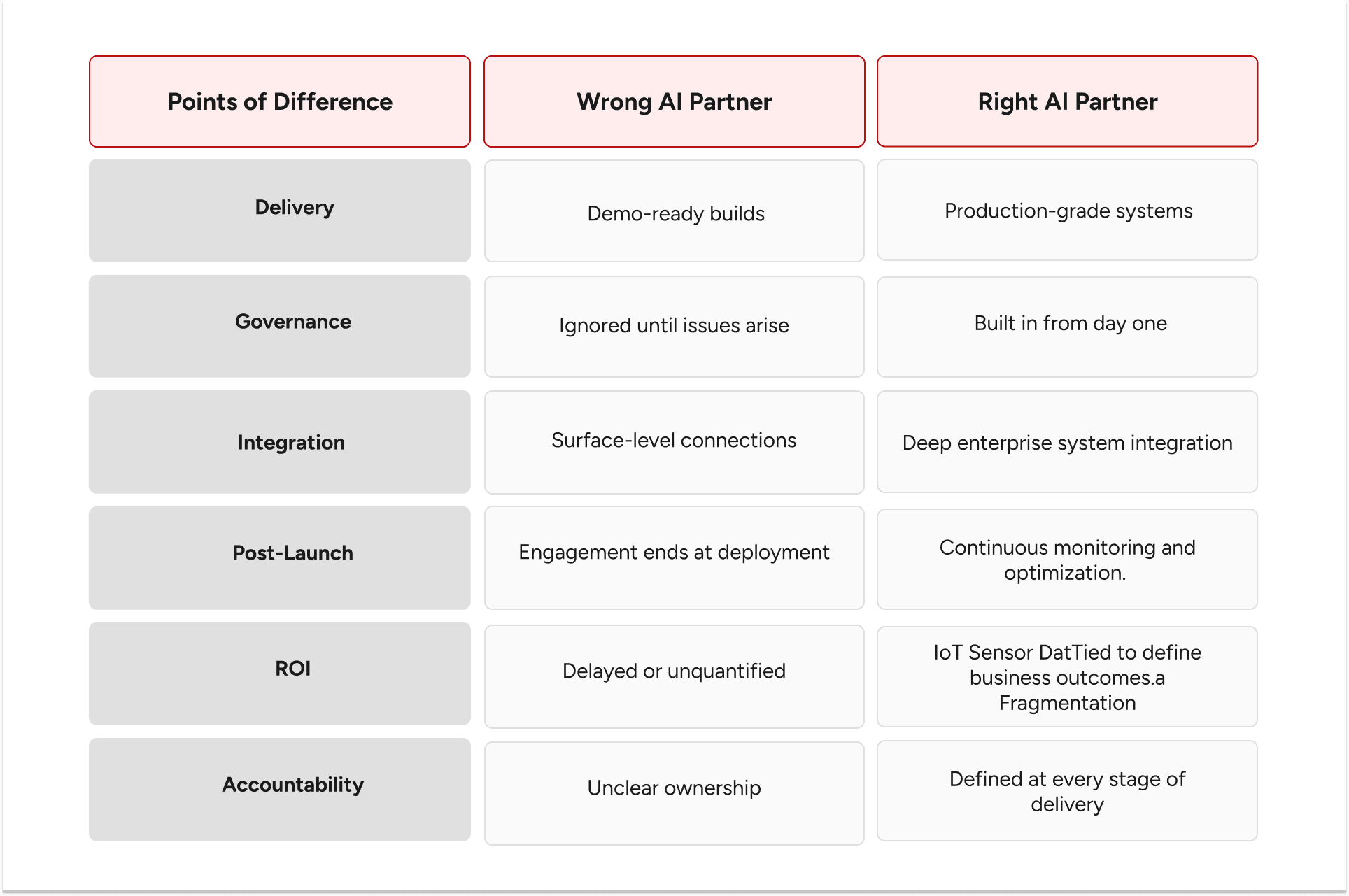
The market is full of companies that use the word "partner," but the nature of their engagement, their ownership of outcomes, and their ability to support long-term delivery vary by a wide margin.
- AI Vendor: Sells a pre-built AI product, platform, or tool. The vendor's obligation ends at access.
- AI Tool or Platform Provider: Offers AI infrastructure, APIs, or model access. They do not build on your behalf or take responsibility for how the technology performs inside your systems.
- Implementation Company: Deploys an existing AI tool or platform within your environment. They do not own the product strategy, architecture decisions, or post-launch performance.
- AI Development Partner: Works with enterprises to design, build, and deliver custom AI solutions tied to specific business goals. Involved from discovery through deployment and shares ownership of outcomes.
- AI Product Engineering Partner: The most mature engagement model. Combines AI development with product thinking, engineering discipline, and long-term operational support.
An AI Vendor Sells Capability. An AI Partner Owns Delivery Outcomes.
The difference between a vendor and a partner comes down to one question: who is accountable when the solution does not perform in production? A vendor's obligation ends at the point of sale. An AI development partner stays involved through deployment, iteration, and optimization. They have a stake in whether the solution works inside your environment, not just whether the technology functions in isolation.
Why the Difference Matters for Enterprise AI ROI
Aspect | AI Vendor | AI Development Partner |
|---|---|---|
Primary Offering | Ready-made AI tools or platforms sold as a standard product | AI solutions designed and built around your business requirements |
Customization Level | Minimal, confined to the product's existing parameters | Built to fit the specific complexity of enterprise operations |
Engagement Style | One-time or transactional in nature | Long-term and collaborative across the full delivery lifecycle |
Focus | Moving licenses and subscriptions | Driving measurable business outcomes and internal adoption |
Enterprise Fit | Suitable for straightforward, general-purpose needs | Built to handle complex workflows and enterprise-scale requirements |
Support Model | Basic setup and onboarding assistance | Ongoing governance, optimization, and performance management |
Best For | Fast access to off-the-shelf AI functionality | Strategic AI transformation with long-term ROI in focus |
How Much Does It Cost to Hire an AI Development Partner for Enterprise Projects?
Most proposals miss data readiness, integration effort, and post-launch monitoring. Governance and compliance also add ongoing overhead that isn’t scoped upfront. These costs surface later as delays, change requests, or unstable systems.
Sanket SahuCo-founderCost is one of the first questions enterprise buyers raise, and it is also one of the most misunderstood. The instinct to compare hourly rates across vendors is natural, but it is also the wrong starting point. Enterprise AI investment needs to be evaluated against total delivery value, production readiness, and the cost of getting it wrong, not against who charges the least per hour.
What Drives AI Development Cost in Enterprise Projects
Several variables determine what an enterprise AI engagement will cost. None of them operate in isolation, and changing one often shifts the others.
Use-case complexity is the primary driver. A scoped automation task costs a fraction of what a production-grade AI system with multiple integrations, real-time data processing, and compliance requirements will demand.
Data readiness has a direct impact on timelines and budget. Enterprises with clean, structured, and accessible data move faster. Those that need significant data preparation before any model work can begin will see that reflected in cost.
Infrastructure and model selection affect both build cost and ongoing operational spend. Decisions made here in the early stages often determine the total cost of ownership well beyond launch.
Team composition matters significantly. A cross-functional team covering AI engineering, backend development, integration, quality assurance, and DevOps costs more upfront but reduces the risk of expensive rework post-launch.
Governance and compliance requirements add scope to any enterprise engagement. Regulated industries such as healthcare, finance, and insurance require additional design, testing, and documentation work that must be factored into the budget from the start.
Post-launch support model is a cost that many buyers underestimate. Ongoing monitoring, model updates, performance management, and iteration are not optional for enterprise AI systems. They are the difference between a system that delivers value and one that degrades over time.
Use-case complexity is the primary driver. A scoped automation task costs a fraction of what a production-grade AI system with multiple integrations, real-time data processing, and compliance requirements will demand. Data readiness has a direct impact on timelines and budget. Infrastructure and model selection affect both build cost and ongoing operational spend. Team composition matters at every stage — a cross-functional team costs more upfront but reduces the risk of expensive rework after launch. Governance and compliance requirements add scope in regulated industries such as healthcare, finance, and insurance. Post-launch support is a cost most buyers underestimate, but it is what separates a system that delivers sustained value from one that deteriorates after go-live.
AI Project Type | Scope | Estimated Budget Range |
|---|---|---|
Proof of Concept | Limited features, internal validation | $5,000–$15,000 |
Process-specific, single system | $15,000–$40,000 | |
Recommendation Engine | Behavior modeling, dynamic output | $25,000–$50,000 |
Data modeling, forecasting, reporting | $40,000–$75,000 | |
Computer Vision System | Detection, visual analysis, real-time output | $40,000–$90,000 |
Content or data generation at scale | $100,000+ | |
Enterprise AI Platform | Multi-system integration, governance, compliance | $150,000+ |
Experience Level | Hourly Rate (USA) |
|---|---|
Junior (0–2 years) | $60–$90/hr |
Mid-Level (3–5 years) | $100–$140/hr |
Senior (5+ years) | $150–$250/hr |
Why the Cheapest AI Partner Often Becomes the Most Expensive
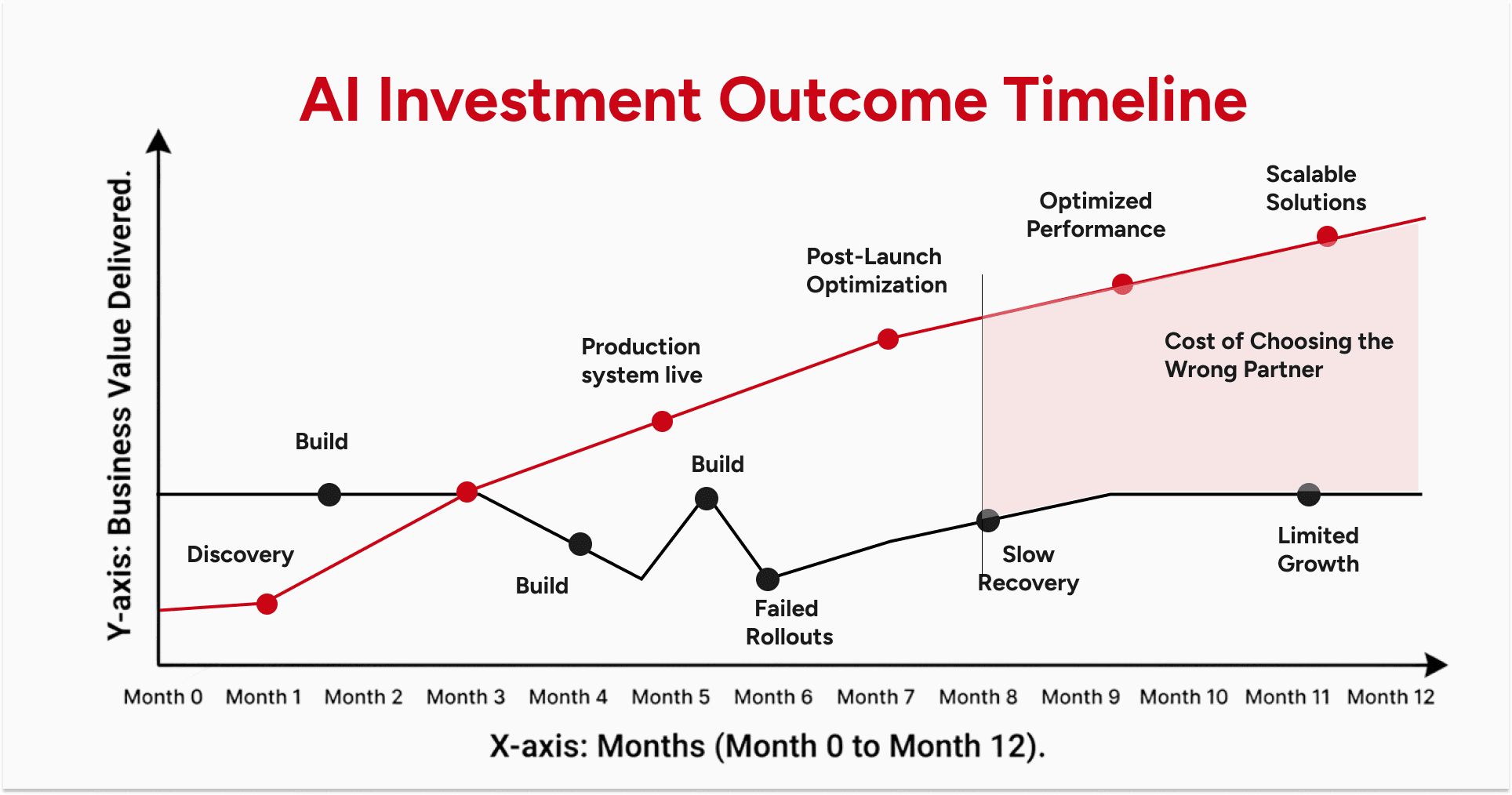
Low-cost vendors typically cut corners in the places that don't show up until later — discovery, architecture planning, the unglamorous work of governance. What you get is something that looks fine in a controlled setting and starts falling apart the moment it meets real enterprise conditions. By the time you're rebuilding a poorly structured system, patching compliance gaps nobody planned for, or trying to salvage a rollout that went sideways, you've already spent more than you saved by going with the cheaper option in the first place.
Enterprise AI projects don't reduce cost by skipping governance or cutting integration design short. They just push that cost further down the road, to a point where it's much harder — and much more expensive — to deal with.
How Enterprises Should Evaluate Pricing Beyond Hourly Rates
The hourly rate is almost never the right thing to focus on. What actually matters is what the engagement produces, how much risk you're carrying throughout, and whether your partner still has skin in the game once the system goes live.
When evaluating pricing, the real question is whether a partner can take you from early discovery all the way to production without the scope quietly shrinking, the quality slipping, or the timeline drifting. Total cost of ownership is a much wider number than most initial proposals suggest — it includes infrastructure, ongoing support, model tuning over time, and the internal bandwidth your team will need to manage the relationship.
A partner whose pricing reflects genuine accountability across the full lifecycle will almost always deliver better returns than someone who charges less but considers their job done the moment they hand things over.
Red Flags: How to Spot the Wrong AI Development Company Before You Sign
Technical Red Flags
No evidence of production deployments. A vendor that can only show demos or early-stage prototypes has not proven they can build systems that hold up under real enterprise conditions. No plan for system performance after launch is equally telling — any serious AI development company should explain how they track system behavior after deployment and how they handle failure in a live environment. Weak integration experience is a risk that will surface the moment the build begins.
Commercial and Delivery Red Flags
Guaranteed outcomes before discovery signal that the partner is pitching, not planning. Compressed timelines that ignore scope reflect poor planning discipline — enterprises that accept these often find themselves managing a rebuild, not a rollout. No clear ownership structure will become a problem during the engagement and after it.
Strategic Red Flags
A partner that leads every conversation with AI capability announcements but cannot walk you through their discovery process or delivery methodology is not structured for enterprise work. A partner that cannot address data security and governance with specificity is a risk that grows larger the deeper the engagement goes.
The partners that fail enterprise buyers are rarely the ones that lack technical skill. They are the ones that lack the delivery structure, accountability, and operational discipline that enterprise AI demands.
Why GeekyAnts Is a Strong Fit for Enterprise AI Product Delivery
Most vendors build models; we build systems that work in real business environments. Our focus is on integration, performance, and accountability beyond deployment. That’s where enterprises actually see value, not just in demos but in production.
 Kunal KumarChief Revenue Officer
Most enterprises reach the partner selection stage with a clear set of unresolved concerns: will the system hold up in production, who owns the outcome when it does not, and what happens after launch. GeekyAnts is structured to answer each of those concerns with the delivery of evidence, not sales positioning.
GeekyAnts works across the full delivery lifecycle — from use-case discovery and architecture planning through build, integration, deployment, and post-launch support. Every engagement begins with defined success criteria and ends with a system tested against real business conditions, not just internal benchmarks.
How GeekyAnts Helps Enterprises Move From AI Exploration to Production
AI-Powered Property Inspection System
A real estate client needed an AI system that could support buyers during physical property tours and deliver instant property insights through QR code interactions. The system had to work within the client's existing application, handle both text and voice input, maintain accuracy under varied conditions, and protect user data throughout every interaction.
GeekyAnts built a unified AI assistant integrated into the client's existing application. The system maintains conversation context across sessions, routes low-confidence queries to human agents, and keeps its property knowledge base current without disrupting live performance. Early production testing confirmed that retrieval and response accuracy met the standards defined during discovery, reducing the risk of post-launch issues and accelerating the path to deployment.
AI Interview System for Automated Candidate Screening
A hiring technology client needed a fully automated interview system that could conduct real-time, voice-based technical assessments and produce structured evaluation reports without human involvement.
GeekyAnts built the system so that each function — interview planning, question generation, voice processing, and report generation — operates as a separate component. Questions are generated from the candidate's resume and job description, adapted based on responses in real time, and feed into a performance report that hiring teams can act on immediately. The system includes built-in controls for detecting irregular behavior and supports session continuity if a candidate needs to pause. The full build was completed within a three to four-month engagement window.
Why GeekyAnts Is Better Aligned Than Generic Development Vendors
Generic AI development vendors scope projects around what they can build. GeekyAnts scopes projects around what the enterprise needs to achieve. Discovery is not a formality — it is the stage where success criteria are defined, data sources are assessed, integration requirements are mapped, and delivery risk is identified before any build work begins.
GeekyAnts brings cross-functional capability across AI engineering, backend development, system integration, and deployment operations — delivered by coordinated teams who understand how each layer of an enterprise AI system affects the others. Post-launch, GeekyAnts remains accountable for system performance. Monitoring, optimization, and iteration are built into the engagement model because a partner that disappears after deployment is not a partner.
The Right AI Partner Will Define Enterprise AI ROI in 2026
The gap between enterprises that see returns from AI and those that rarely come down to technology. It comes down to the partner behind the delivery.
The right AI product development company accelerates the time it takes to move from a validated use case to a system that operates in production. It builds the governance structures that protect the enterprise as AI regulations tighten. It delivers systems that scale without requiring a rebuild every time the business grows. And it maintains accountability for performance long after the system goes live.
These qualities do not show up in a sales presentation. They show up in delivery discipline, engineering depth, and a track record of production outcomes that enterprises can verify.
In 2026, the enterprises that compete on AI will be the ones that choose partners aligned with long-term execution, not short-term delivery. The decision made at the point of partner selection determines the speed, confidence, governance, and return that follows.
Sources and Citations
https://codiant.com/blog/how-to-choose-right-ai-development-partner-in-usa-2026/
https://www.techmagic.co/blog/ai-development-partner
https://www.bairesdev.com/technologies/ai/
https://markovate.com/enterprise-ai-development-company/
https://www.xicom.biz/blog/cost-to-hire-ai-developers-guide/
https://geekyants.com/case-studies/property-ai-rag-real-estate-inspections
https://geekyants.com/case-studies/ai-interview-system-for-automated-candidate-screening