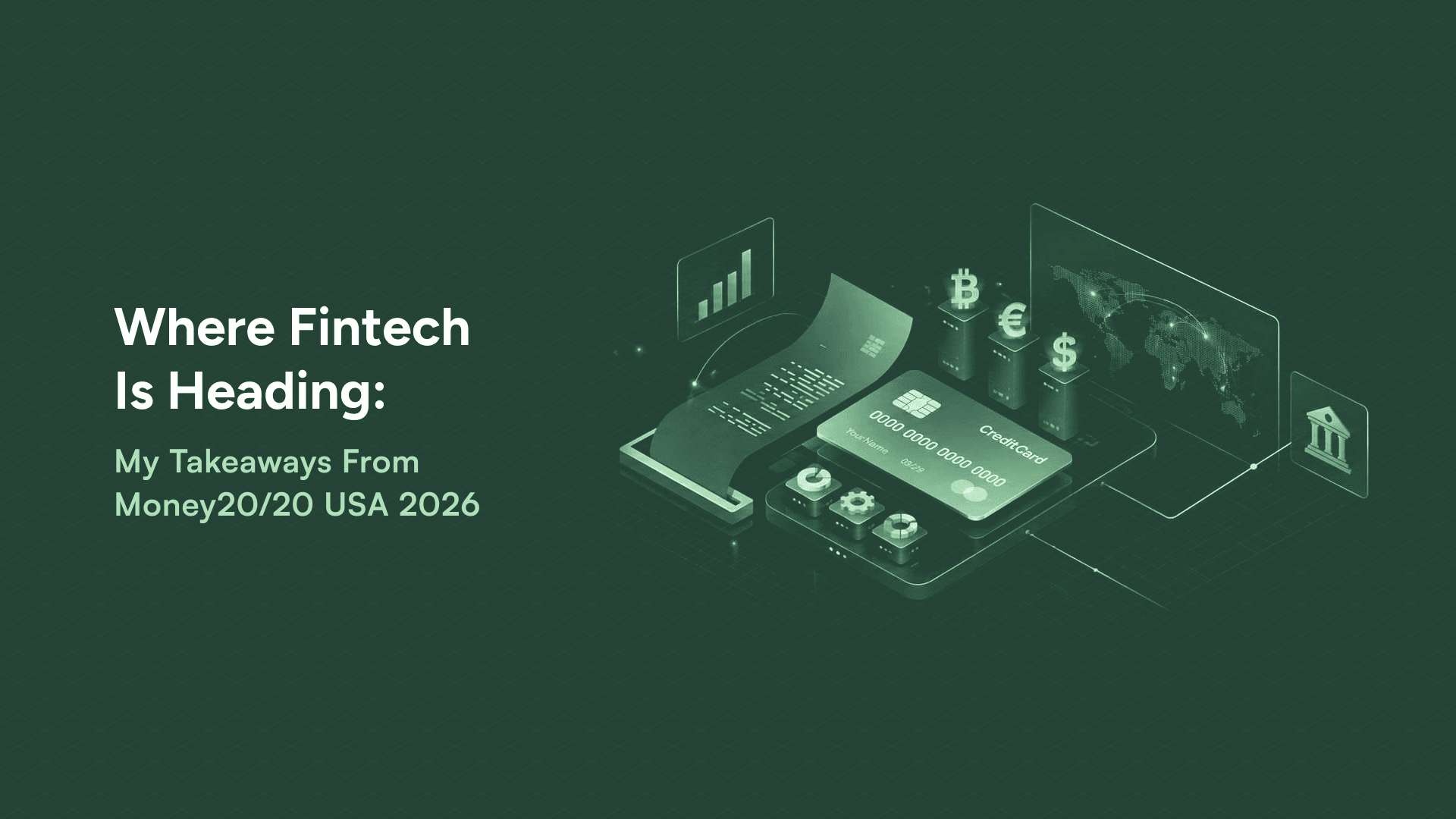

Kunal Kumar is Chief Revenue Officer at GeekyAnts, a role he stepped into after leading the company as Vice President of Strategy and then Chief Operating Officer. He attended Money20/20 USA 2026 in Las Vegas, meeting teams building across payments, identity, and digital asset infrastructure. Here he shares his takeaways on financial infrastructure, global payments, AI agents, digital assets, and the evolving role of engineering partners.
Looking back, what piqued my interest most was how these offerings connected. Together, they pointed toward a more specialized financial ecosystem, with growing demands on the engineering needed to connect its different parts.
These are the observations that I took away from Money20/20 and what I believe they could mean for the market.
Financial Infrastructure Itself Is Becoming a Product
Many of the products I came across focused on a specific capability: accepting local payments, enabling checkout through banks and credit unions, verifying identity, or supporting digital asset operations. These capabilities sit beneath the customer experience, yet they help define what a financial product can offer.
Businesses can assemble more of a service using specialist infrastructure. But someone still has to connect the components, manage data across systems, and recover when a transaction fails. I believe much of the engineering value will come from making these capabilities work together reliably.
Global Money Movement Still Depends on Local Realities
Local payment capabilities came up repeatedly in discussions about global products. Customers across markets have distinct payment preferences and expectations. These differences affect which payment methods businesses need to integrate and how they handle settlement, reconciliation, and customer support.
For me, this reinforces that expansion into a new market is a product and engineering decision as much as a commercial one. The experience must work locally while the business maintains a clear view of its payment operations.
AI Is Finding Its Place Inside Financial Workflows
AI appeared in document processing, decision support, software development, and the coordination of agents. The more specific the workflow, the easier it becomes to evaluate its value: can it reduce review time, help investigate an exception, or improve the information available for a decision?
Those questions lead to harder ones. How accurate must the system be? What happens when it is uncertain? Who reviews an action with financial consequences? What does the workflow cost once integration, monitoring, and human oversight are included?
I expect these questions to shape lasting adoption. The underlying model matters, but so do the controls and operating processes around it. ROI should be measured against an existing workflow, including the full cost of running the new one.
Agentic Commerce Makes Permissions a Product Decision
A discussion about agentic commerce brought these questions into focus. According to my session notes, a product was functionally ready in April, while work on guardrails and security continued through September. Refining when an agent should request approval, when permissions should remain active, and when access should be denied.
The discussion also raised concerns about giving agents direct access to credit card details and the potential for unintended use. What stayed with me was the amount of engineering needed to define and limit an agent's authority.
As agents gain the ability to transact, teams need explicit boundaries: what they can do, when human approval is required, how permission can be withdrawn, and how sensitive payment information is protected. These controls deserve time in the delivery plan, alongside the functionality itself.
Identity and Trust Run Through the Entire Experience
Identity verification was another visible theme. Trust has to be established when someone opens an account, accesses it, initiates a transaction, or requests a sensitive change. At each stage, teams must balance security with a smooth customer experience.
That balance requires product, engineering, security, and operations teams to work together. Identity verification must therefore be considered across the product architecture and customer journey, not just during onboarding.
Digital Assets Are Prompting Infrastructure Conversations
My notes also covered- wallets, stablecoins, and digital asset infrastructure. I was interested in the foundations needed to operate them: access management, transaction controls, and connections to business processes.
Their presence at the event does not establish how widely they will be adopted, rather, it points to investment in infrastructure for practical use. For a business exploring these capabilities, I would start with a defined problem and assess the engineering, operational, and regulatory requirements around it.
Banks' Caution Is Part of the Larger Market Reality
I had an interesting conversation about bringing in specialist partners to navigate regulatory requirements. It helped me understand why financial institutions may be cautious when evaluating new technology. A bank has to consider customer trust, security, and continuity when assessing a new capability.
As partners, we need to address these concerns when proposing and delivering technology. Involving the right expertise early, clarifying responsibilities, and providing evidence of operational readiness can help institutions evaluate a solution with greater confidence.
The Engineering Partner's Role Is Expanding
A product engineering company I spoke with described growing interest in consulting services aimed at improving development practices. I would treat that as a useful signal, rather than proof that outsourcing overall is declining.
It reinforced the opportunity to contribute earlier: helping clients decide what to build, which platforms to adopt, how to improve development practices, and where AI can create value. Discussions around platform engineering and forward-deployed engineering also prompted me to think about bringing expertise closer to the client's environment and business problem.
For GeekyAnts, the opportunity is to connect advice with implementation and measurable operational outcomes. That requires understanding the financial workflow as carefully as the technology.
What I Am Taking Back to GeekyAnts
Financial businesses have access to a growing range of specialized capabilities. The challenge is to assemble them into services customers can use confidently and teams can operate reliably.
That is where I believe engineering partners can make a substantial contribution: understanding the workflow, navigating integration choices, and making the result dependable.
Our participation in Global Fintech Fest 2026 earlier this year added to these conversations. With the Singapore FinTech Festival 2026 coming up on November 18–20, there will be another opportunity to explore how financial institutions and fintech companies are approaching these challenges and what they mean for the technology being built.