

Key Takeaways
- Retailers and distributors can introduce AI without replacing their existing commerce platforms when order processing, inventory data, and system connections support the proposed capability.
- E-commerce platform modernization should focus on specific outcomes, such as improving product discovery or reducing customer service workloads. Reliable commerce functions can remain in place while businesses address data gaps and add the required AI capabilities.
- Decisions to expand AI adoption should depend on evidence of improved performance, controlled costs, uninterrupted sales operations, and clear ownership.
- This guide helps businesses assess platform readiness, select an AI opportunity, develop an investment case, and plan implementation while avoiding unnecessary ecommerce replatforming.
Why Should Businesses Modernize Their E-commerce Platforms for AI in 2026?
Retailers and distributors need to improve product discovery, customer service, and operating efficiency without disrupting their existing commerce platforms. Large product catalogs, regional pricing rules, and connections to inventory and order systems make these decisions complex.
Customer shopping behavior is changing. Adobe's January 2026 analysis reported that visits to U.S. retail websites originating from generative AI tools increased by 693.4% during November and December 2025 compared with the same period in 2024. The measure covers visitors who followed links from AI tools to retail websites, rather than all retail traffic or purchases. The findings draw on Adobe's analysis of more than one trillion visits to U.S. retail sites.
AI adoption does not guarantee a measurable financial return. McKinsey's November 2025 State of AI report found that 88% of respondents reported AI use in at least one business function, while 39% reported some organization-level impact on operating earnings. The survey covered multiple industries, so its findings describe broader AI adoption rather than retail performance alone.
For commerce leaders, the priority is determining which AI capabilities can improve sales or reduce operating costs while retaining dependable systems. E-commerce platform modernization requires an assessment of existing data, integrations, and business processes before investment approval.
This guide covers platform readiness, modernization scope, investment planning, controlled delivery, and expansion across commerce operations.
When Can Businesses Modernize E-commerce for AI Without Replatforming?
Businesses can retain their commerce platforms when transactions are accurate, critical data is accessible, and supported integrations can accommodate AI capabilities. AI failures must remain isolated from checkout, pricing, and order processing to protect sales operations.
A readiness assessment helps determine whether the existing platform can support the intended business outcome.
Readiness Decision | Evidence Required |
|---|---|
Proceed with a limited pilot | Order and inventory accuracy meet documented business thresholds, required integrations have vendor support, and estimated integration and maintenance costs fit the approved budget. |
Resolve constraints before piloting | Product data gaps, inventory discrepancies, or integration limitations have identified causes, assigned owners, estimated correction costs, and measurable acceptance criteria. |
Investigate platform replacement | Critical data cannot be accessed through supported interfaces, essential components lack vendor support, transaction failures persist after corrective work, or maintaining the existing platform exceeds the approved cost threshold. |
A retailer with reliable checkout and inventory systems may need to correct product attributes before introducing AI-powered search. A distributor whose platform cannot expose customer-specific pricing through a supported interface faces a different constraint. Its technology team must determine whether an integration change can address the limitation.
E-commerce platform modernization retains commerce functions that meet operational requirements while improving the data and system connections required for AI. Ecommerce replatforming involves moving core commerce functions to another platform. Replacement becomes a consideration when the existing system cannot meet business requirements within acceptable cost, performance, and risk limits. The assessment gives leadership a basis for comparing the cost, operational disruption, and long-term maintenance requirements of targeted modernization and platform replacement.
How Can You Modernize an E-commerce Platform for AI Without Replatforming?
E-commerce platform modernization begins with a business problem and an examination of the systems involved in solving it. A retailer seeking to improve product discovery, for example, must understand what happens between a customer's search query and a completed order.
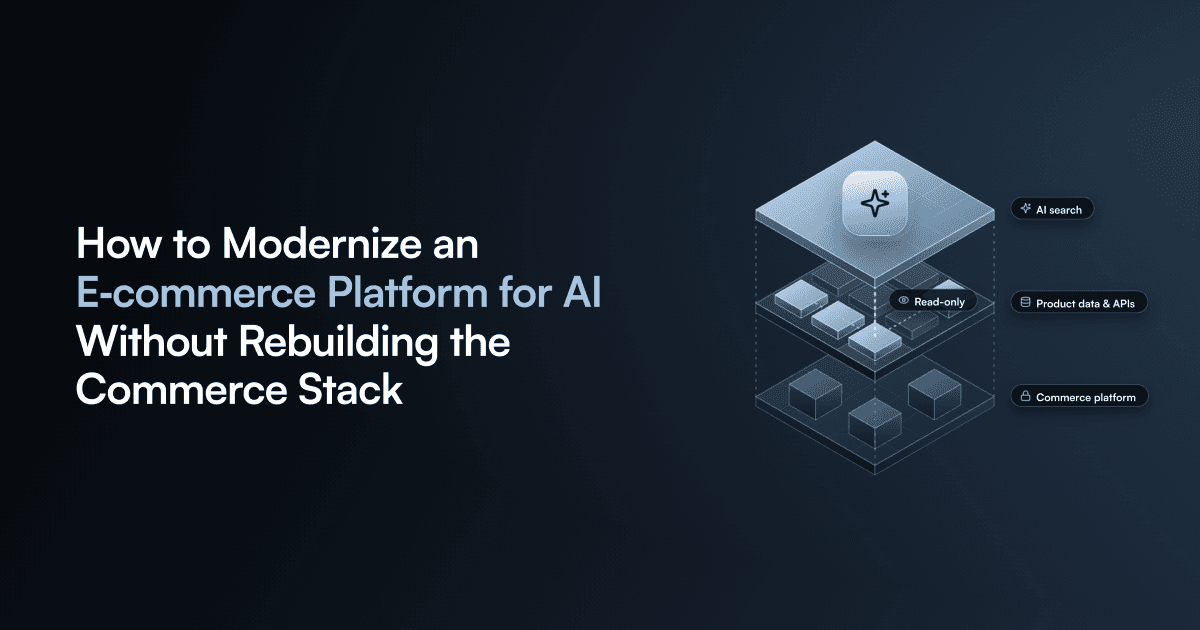
The search service identifies products, the product information system maintains descriptions and attributes, and the inventory system supplies availability. The commerce platform applies pricing rules, processes payments, and manages orders. These functions support the same buying journey, but each has different responsibilities.
Improving product discovery may require changes to catalog data and search technology without requiring changes to checkout or order processing. The framework separates the work into three decisions: which commerce functions to retain, which data and integrations to improve, and which AI capability to add.
What Should You Retain, Improve, or Add?
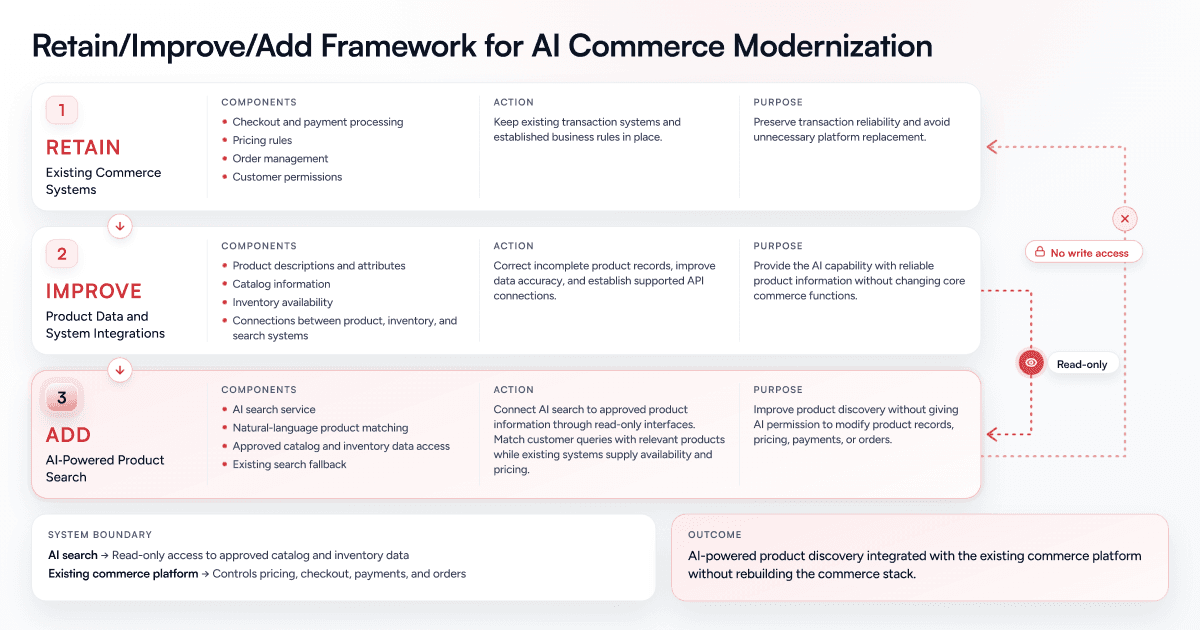
Decision | Component | Business reason |
|---|---|---|
Retain | Checkout, pricing, payments, and order management | Preserve dependable transaction processes and established business rules. |
Improve | Product descriptions, attributes, and availability records | Provide accurate information for product matching. |
Improve | Connections between product catalogs, inventory systems, and search services | Give AI access to approved information without replacing existing systems. |
Add | AI-powered product search | Help customers find suitable products through descriptive queries. |
Product and inventory teams maintain the accuracy of approved catalog information and stock records. Commerce teams retain responsibility for pricing rules and customer permissions. The AI search service receives read-only access to the information required for product matching, with system-level permissions preventing changes to product or transaction records.
How Does This Approach Work in an Existing Retail Platform?
Consider an illustrative retailer with a catalog of 50,000 products. A customer searches for a “waterproof jacket for winter travel,” but the existing keyword search misses products listed as “winter rain shells.” AI-powered search can connect these descriptions, while structured product attributes confirm that each result meets the waterproof requirement.
The retailer examines unsuccessful search queries and identifies which catalog attributes can improve matching. Product teams correct incomplete records, and the technology team connects an AI search service to the catalog through supported interfaces.
Before the storefront displays the matched products, existing inventory and pricing systems supply current availability and customer-appropriate prices. The customer completes the purchase through the established checkout process.
The retailer measures search-assisted conversion as the percentage of search sessions that lead to a purchase within a defined measurement period and attribution window. It also tracks unsuccessful searches and the relevance of returned products.
A failure in the AI search service triggers a return to the existing search function. The retailer can restore the previous experience without changing its pricing, payment, or order management systems.
The first question I would ask is whether the existing platform can support the proposed AI capability without changes to its transaction systems. A stable checkout or order management system should not be replaced because the business wants better product discovery. I would focus the assessment on data quality, integration limitations, and system dependencies. Those findings help determine where modernization is necessary and where the existing architecture can continue to serve the business.
 Konakanchi Venkata Suresh BabuPrincipal Technical Consultant.
Consider a retailer whose inventory database is accurate but whose storefront receives stock updates with a delay. Introducing AI-powered recommendations may expose that delay when customers select products that are no longer available. Replacing the inventory database would increase the project scope without addressing the synchronization problem. The engineering team can examine update frequency, event processing, and cache expiration before proposing changes. Improving the connection between inventory and product discovery may resolve the issue while preserving the existing inventory system and its business rules.
Need to introduce AI capabilities into your e-commerce platform while retaining existing commerce systems, integrations, and business workflows?
Explore Enterprise System Modernization Services
Which AI Capabilities Should Retailers and Distributors Prioritize for Business Value?
A retailer losing sales because customers cannot find suitable products faces a different problem from a distributor whose sales team spends hours preparing quotations. Both may benefit from AI, but the investment decision depends on where delays, errors, or lost revenue occur.
Retailers may prioritize product discovery when customers struggle to navigate large catalogs. Customer-service assistance becomes relevant when support teams handle repeated questions about orders, returns, or availability.
Distributors face different constraints. Contract pricing, customer-specific terms, and quote approvals can make sales assistance a stronger candidate. Catalog enrichment may deserve attention when incomplete specifications delay product publishing or prevent buyers from comparing products.
Before selecting an AI capability, the business should establish whether an existing platform feature or a process improvement could resolve the problem at a lower cost.
How Should You Evaluate AI Opportunities?
The scorecard compares potential investments against business pain, available data, expected value, implementation effort, operating risk, and accountable ownership. For each capability, the assessment team should rate implementation effort and operating risk as Low, Medium, or High based on the existing systems and required changes. The table provides a starting point for evaluation, with ratings to be completed during the assessment.
AI capability | Business pain | Available data | Expected value | Implementation effort | Operating risk | Accountable owner |
|---|---|---|---|---|---|---|
Product discovery | Poor search results | Catalog attributes, search records | Search-assisted conversion and contribution margin | Medium | Medium | E-commerce Lead |
Customer-service assistance | Repeated inquiries | Support records, order information, policies | Resolution quality and handling time | Medium | High | Support Lead |
Catalog enrichment | Publishing delays | Product specifications, supplier records | Publishing time and attribute completeness | Low | Medium | Catalog Manager |
Sales or quote assistance | Slow quotations | Contract pricing, inventory, customer terms | Quote turnaround time and accuracy | High | High | Sales Operations Lead |
Note: Ratings are indicative and assume a limited AI deployment with existing system integrations. Actual implementation effort and operating risk depend on platform architecture, data readiness, system permissions, and the scope of AI actions.
For each capability, the team examines the records required, their accuracy, and the changes needed to make them usable. A use case with strong potential returns may still be unsuitable for the first pilot if its data requires extensive correction or its operation creates unacceptable risks.
The selection decision should record why one capability takes priority and why alternatives are deferred. For the illustrative retailer with 50,000 products, product discovery becomes a candidate when search records reveal unsuccessful queries and the catalog contains attributes that can improve matching. Customer-service assistance and catalog enrichment remain options, but their expected value requires separate evidence.
How Can You Build a Business Case for AI Commerce Modernization?
A business case begins with the financial impact of the problem being addressed. A retailer considering AI-powered search needs evidence of unsuccessful searches and their relationship to purchasing behavior. A distributor considering quote assistance needs to understand how quotation delays affect sales capacity, operating costs, and customer response times.
The baseline captures current performance and the cost of maintaining the existing process. For the illustrative retailer with 50,000 products, this includes search-assisted conversion, unsuccessful search sessions, and the costs associated with the search experience.
The investment assessment compares three options over the same evaluation period: maintaining current operations, introducing a targeted AI capability, and replacing the commerce platform when structural limitations justify that expense.
The budget covers discovery, data preparation, integration, software licensing, AI usage fees, evaluation, training, maintenance, and production support.
Financial benefits can include additional contribution from sales and cash savings from reduced expenses. Incremental contribution equals additional revenue multiplied by the contribution margin rate, which represents the percentage of revenue remaining after variable costs.
Time saved creates employee capacity but does not guarantee cash savings. Savings arise when the business reduces expenditure on overtime, contractors, or planned hiring. When employees use the released capacity for other work, the benefit belongs under productivity improvement rather than cost reduction.
Assessment | Conservative scenario | Expected scenario |
|---|---|---|
Baseline | Current workflow costs, conversion performance, and service levels | Same baseline |
Assumptions | Lower customer adoption and smaller performance improvement | Forecast adoption and performance improvement |
Financial benefit | Incremental revenue × contribution margin rate + realizable cash savings | Incremental revenue × contribution margin rate + realizable cash savings |
Investment | Implementation costs, fixed operating costs, and variable costs under the conservative usage forecast | Implementation costs, fixed operating costs, and variable costs under the expected usage forecast |
Spending limit | Maximum approved pilot expenditure | Same spending limit |
Success threshold | Minimum acceptable financial contribution and operational performance | Target financial contribution and operational performance |
Alternatives | Maintain current operations, modernize the selected capability, or replace the platform | Compare the same three options |
Funding decision | Approve a limited pilot if minimum conditions are met; otherwise revise or defer | Approve the proposed pilot if forecast benefits justify the investment and risks |
Finance, commerce, and technology leaders establish the budget ceiling, measurement period, and approval criteria before funding the pilot. For the illustrative retailer, the decision depends on whether improved product discovery can generate enough additional contribution to cover integration and operating costs. The conservative scenario tests lower adoption and smaller conversion gains. The expected scenario uses forecasts based on search and sales records.
I would be cautious about approving an AI commerce initiative based on projected revenue growth alone. A higher conversion rate has limited value if the additional contribution margin cannot cover implementation, usage, and support costs. Buyers should know how much capital they are prepared to commit, what financial result would justify expansion, and which outcomes would require them to stop. Those decisions belong in the business case before the delivery engagement begins.
 Kunal KumarChief Revenue Officer
Before engaging a delivery partner, commercial stakeholders should establish how the proposed capability will be measured. For AI-powered search, this includes eligible search traffic, baseline conversion, the measurement period, and contribution margin from additional orders. The financial assessment should also distinguish fixed operating expenses from usage-based charges, since costs may increase as adoption grows.
How Can AI Commerce Modernization Protect Sales and Customer Trust?
An incorrect product recommendation may inconvenience a shopper. An incorrect refund, discount, or order update can create a financial loss or customer dispute. The potential financial and customer impact determines the safeguards required for each AI capability.
Checkout, pricing, stock availability, order status, and account permissions remain governed by the commerce platform. During an initial pilot, AI services can retrieve approved information, recommend products, or draft support responses without permission to modify transaction records.
AI capabilities that need to change orders, issue refunds, or apply discounts require separate authorization controls. The commerce platform must validate each action against established business rules. During an initial pilot involving transaction changes, an authorized employee should review and approve the proposed action. Businesses considering automated execution must define transaction limits, permission requirements, audit records, and conditions that require human intervention.
What Safeguards Should Be in Place Before the Pilot?
Acceptance criteria should cover the accuracy of AI answers or search results against source records, transaction correctness, response times, and customer complaints. The business establishes numerical limits based on its current service standards and risk tolerance.
Human escalation is necessary when the AI cannot establish a reliable answer. For example, if the commerce platform shows an order as shipped but the fulfillment system reports that it has not been dispatched, the service refers the request to an employee rather than presenting an unsupported delivery status.
The fallback process must be tested before customers use the AI capability. If AI search fails, the existing search function remains available. If a support assistant cannot retrieve order information, customers can contact the support team. Checkout and order tracking continue without the AI service.
Before the pilot begins, the E-commerce Lead approves the launch after the Technology Lead confirms that integration, permission, fallback, and recovery tests meet the agreed acceptance criteria.
During the pilot, the Technology Lead monitors AI service performance, incorrect responses, access-control alerts, and system failures. The Support Lead tracks customer complaints and requests requiring employee intervention. Both teams report issues to the incident owner.
When monitoring reveals an unacceptable error or customer impact, the incident owner follows the documented response procedure and decides whether to disable the AI capability. The technology team investigates the cause, while customer-service teams handle affected requests and communicate corrections. The E-commerce Lead authorizes the return to service after the team verifies the corrective action, repeats the affected tests, and confirms that the acceptance criteria have been met.
I would not allow an AI service failure to interrupt a customer's ability to place an order. Product recommendations and search results can use AI, but the commerce platform must remain responsible for validating prices, availability, and transactions. The team should test incorrect responses, delayed data, and service outages before launch. If the AI service fails, the customer should be able to continue through the existing search or purchasing flow without losing access to checkout.
Konakanchi Venkata Suresh BabuPrincipal Technical Consultant.Consider an AI customer-support assistant handling a refund request for an order marked as delivered. If the assistant can issue refunds without approval, an incorrect interpretation of the order history could trigger an unauthorized payment. The resulting mismatch between payment and order records may require manual reconciliation and create further customer-support interactions. A controlled workflow allows the assistant to retrieve order details and prepare a recommendation, while an authorized employee verifies eligibility and approves the refund through the existing order management system. The system records the recommendation, approval, and transaction outcome for dispute resolution.
How Can You Scale an AI Commerce Pilot into Production?
An AI pilot may improve product discovery without proving that the capability can support a larger customer base. Expanding before the business confirms accuracy, operating costs, customer adoption, and recovery procedures can expose more customers to failures.
For the illustrative retailer with 50,000 products, the first pilot could focus on customers searching for winter jackets. The retailer can measure whether AI search helps customers find relevant products while leaving pricing, checkout, and order processing under the control of the existing commerce platform.
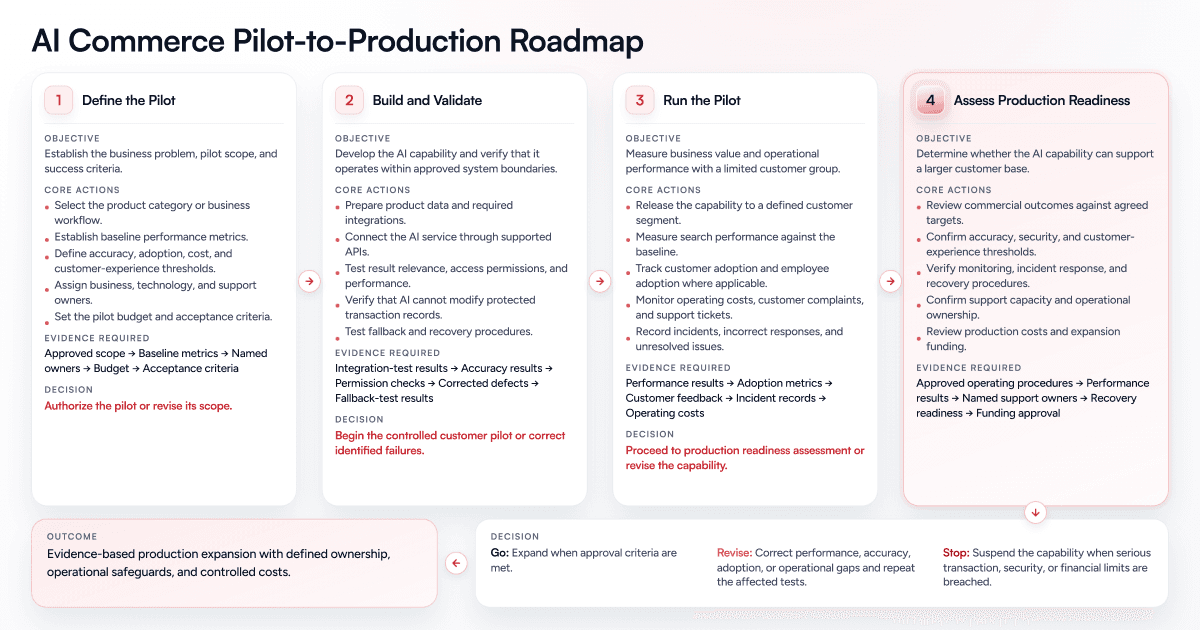
The pilot should progress through four stages, with evidence required before each decision.
What Evidence Justifies Expansion?
Pilot Expansion Checklist
- Go: The pilot meets its commercial target, result relevance or answer accuracy meets the agreed threshold, customer complaints remain within limits, and employees responsible for the workflow use the capability at the agreed adoption rate. Production support is ready, and operating costs remain within the budget.
- Revise: Transaction controls pass testing, but accuracy, adoption, customer experience, or financial performance falls below target. The team corrects the identified problem and repeats the affected tests before another expansion decision.
- Stop: Unauthorized transactions, incorrect refunds, serious access-control failures, or expenditure beyond the approved ceiling require suspension and investigation. The AI capability remains disabled until the cause and corrective action have been reviewed.
Expansion also depends on the team's ability to manage the additional workload. A rise in support tickets, unresolved incidents, or monitoring alerts can indicate that the service is not ready for a larger audience, even when search performance meets its target.
Who Owns the Capability After the Pilot?
The E-commerce Lead remains accountable for business performance and expansion decisions. The Technology Lead manages integration reliability, monitoring, and technical recovery. Product and inventory teams maintain the accuracy of source information, while the Support Lead manages customer escalations.
These responsibilities should be documented before the pilot becomes a production service. The operating agreement identifies who reviews performance, approves changes, responds to incidents, and authorizes further rollout.
For the illustrative retailer, expansion from winter jackets to footwear requires a new assessment of product attributes, search behavior, and customer expectations. Footwear may involve different sizing conventions, fit information, and return patterns. The team evaluates these differences before extending the AI search capability.
The next category can be added when its data meets quality requirements, evaluation results meet the approved thresholds, and the responsible teams have the capacity to support it.
Expansion also changes employee responsibilities. Support teams need training on identifying incorrect AI responses, escalating customer requests, and using fallback procedures. Technology teams need access to monitoring records, incident documentation, and recovery instructions. The E-commerce Lead should confirm that these teams can support the expected increase in usage before approving a wider rollout.
Expanding into another region requires a separate assessment of local product information, language requirements, pricing policies, customer permissions, and support arrangements. A capability that performs well in one market may require additional data preparation and testing before serving customers in another. The business should approve regional expansion only after these requirements meet the agreed acceptance criteria.
How Should Businesses Evaluate an AI Commerce Modernization Partner?
A partner may demonstrate strong AI development experience without understanding the consequences of changing a commerce platform that processes customer transactions. Another provider may understand complex system integrations but lack experience evaluating AI accuracy and operating costs.
The engagement requires both commerce platform modernization and AI product engineering capabilities. Buyers need evidence that the provider can connect new services to existing systems, test their behavior, and support them after deployment.
What Should Your Partner Evaluation Checklist Include?
Evaluation area | Questions to ask |
|---|---|
Commerce expertise | Which checkout, pricing, inventory, and order workflows has the provider worked with? |
System integration | How will the solution connect with commerce, inventory, and business resource planning systems? |
Modernization judgment | Which components can remain, what needs modification, and what could increase costs or scope? |
AI product delivery | How will the provider test output quality, control AI actions, and measure business outcomes? |
Production support | Who will handle monitoring, maintenance, incidents, and future releases? |
Distribution workflows | Can the provider demonstrate relevant experience with contract pricing, quote approvals, and customer-specific terms? |
What Evidence and Contract Terms Should Buyers Review?
Project evidence should identify the original business problem, delivered components, measurement period, and results. Buyers need to establish which integrations and AI capabilities the provider delivered and which responsibilities remained with the client.
The agreement should define data access, business-rule approval, acceptance testing, intellectual property ownership, support coverage, incident response, and handover obligations. Exit arrangements need to address repository access, integration documentation, configuration records, data return or deletion, and transition support.
Three warning signs deserve attention: a recommendation to rebuild the commerce platform before assessing its limitations, performance promises without supporting evidence, and unclear responsibility for production incidents or maintenance.
The proposal should identify the systems included in the engagement, the evidence supporting the recommended approach, and the conditions that could affect cost, delivery, or production support.
How Can GeekyAnts Support AI Adoption and E-commerce Platform Modernization?
GeekyAnts provides commerce platform modernization and AI product engineering services for businesses introducing new capabilities into existing systems. For e-commerce businesses, this work can involve improving integrations, preparing product data, developing AI capabilities, and testing systems for production use.
The engagement scope depends on the commerce platform, the business problem, and the engineering changes required to introduce the selected capability.
Businesses with internal platform teams can work with GeekyAnts on specific AI development, integration engineering, or modernization requirements while retaining control of checkout, pricing policies, and core commerce operations.
What Does an AI Commerce Modernization Engagement Involve?
Stage | Scope | Deliverable |
|---|---|---|
Assessment | Review the existing commerce architecture, integrations, product data, and AI use-case requirements. | Architecture assessment, identified constraints, and recommended modernization scope. |
Planning | Define the implementation approach, system responsibilities, data requirements, and success criteria. | Implementation roadmap, integration plan, ownership matrix, and pilot acceptance criteria. |
Development and validation | Develop the selected AI capability, connect it to existing systems, and test accuracy, security, performance, and fallback behavior. | Integrated capability, test results, documented controls, and deployment readiness assessment. |
Production support | Establish monitoring, incident response, maintenance responsibilities, and operational handover according to the agreed engagement scope. | Support procedures, operational documentation, and handover materials where included in the contract. |
The engagement agreement identifies who provides system access, approves business rules, conducts testing, manages deployment, and handles post-launch support. It also separates GeekyAnts' contracted deliverables from the responsibilities retained by the client's internal teams.
Businesses planning changes to their commerce infrastructure can explore GeekyAnts' E-commerce Development Services.
How Can You Start Your First AI Commerce Modernization Initiative?
Start with a defined business outcome, such as improving product discovery, reducing customer-service costs, or increasing order accuracy. Retain commerce functions that meet operational requirements and address the data or integration constraints affecting the selected capability.
Use the readiness assessment, AI opportunity scorecard, business-case worksheet, and pilot roadmap in this guide to establish the scope, investment requirements, and success criteria. Validate the results before expanding the capability.
Businesses can begin a scoped discussion with GeekyAnts by sharing their existing commerce platform, intended business outcome, and target implementation timeline.