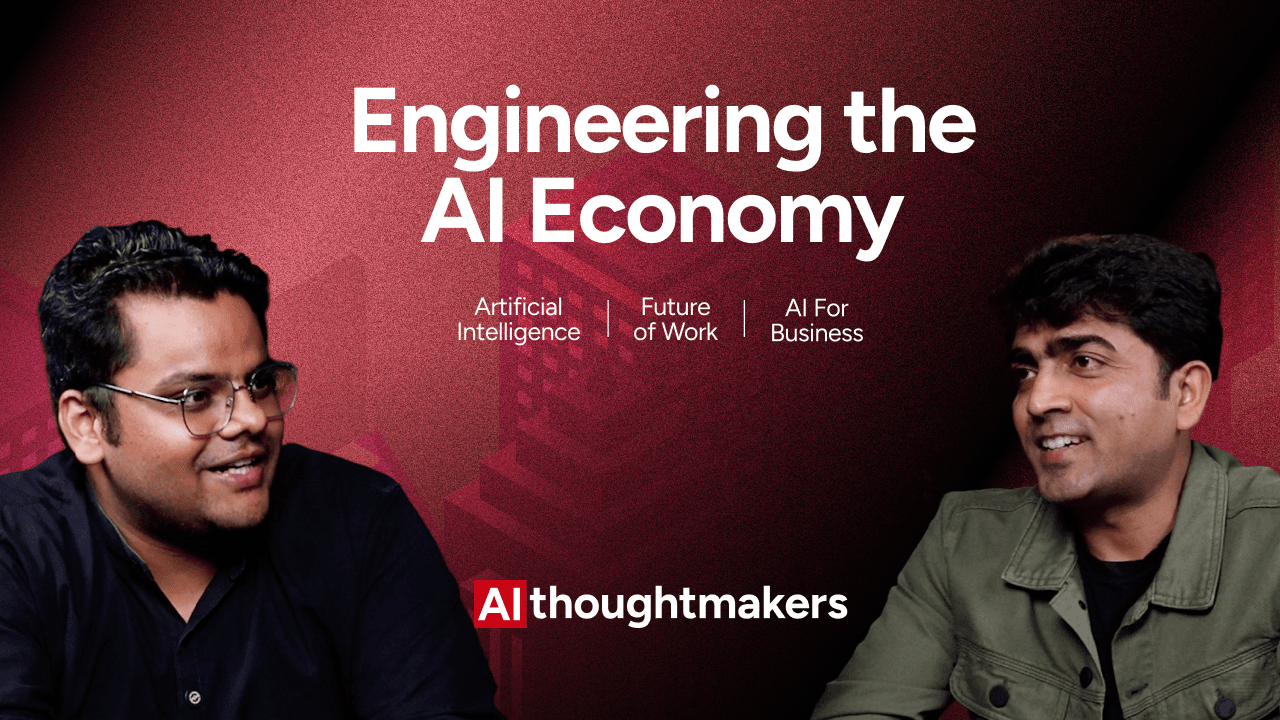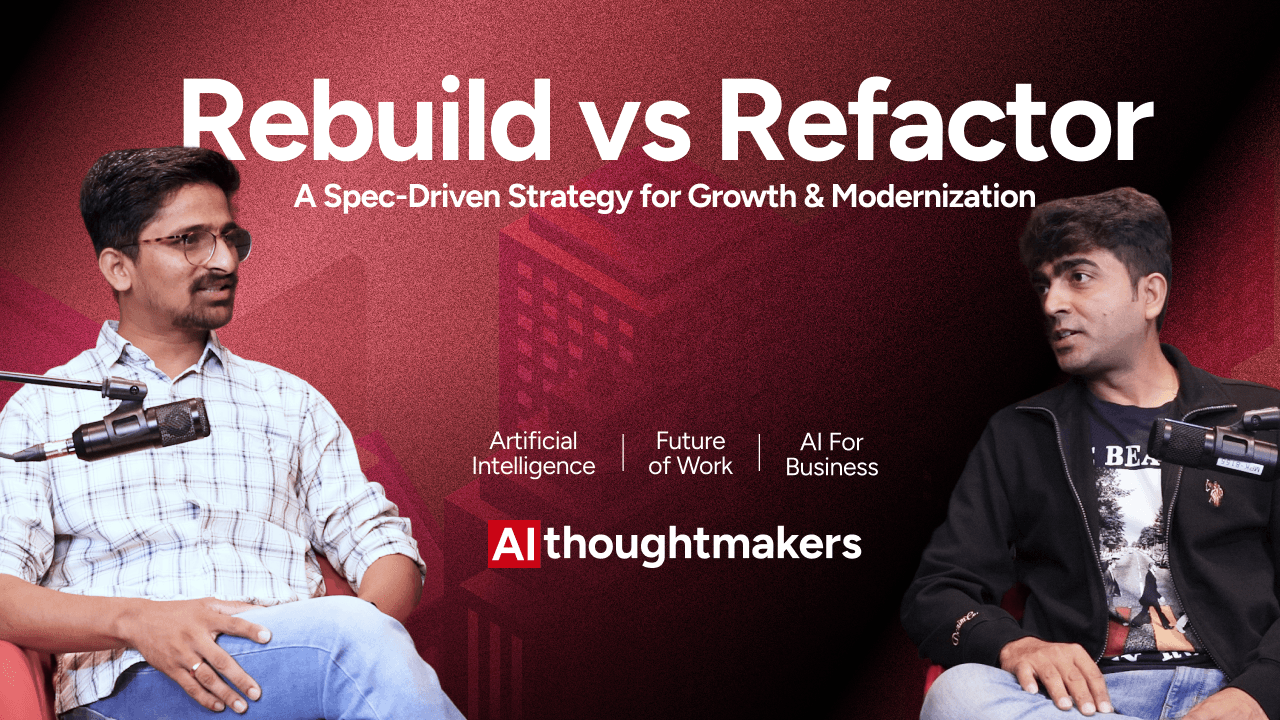


Editor’s Note: This blog is adapted from an episode of the AI ThoughtMakers podcast featuring Suresh Konakanchi, AI Solutions Architect at GeekyAnts, in conversation with host Prem Prakash Goswami. Drawing on his work building production-grade systems with AI, Suresh looks at why AI prototypes that impress in demos fail once they move toward production. He explains why leaders approve prototypes that are not ready; why the problem sits in the process and not in the AI; how spec-driven development builds production readiness from the start; how the specs decide between refactoring and rebuilding; and why clean architecture will define successful AI-first teams.
AI Prototypes Look Ready Long Before They Are
AI now generates applications end to end, and at the prototype level it does impressive work. The output is smooth and clean, and it gives the feel of a production-grade product. That feel does not make it suitable for production.
Production depends on a checklist of requirements such as security and scaling. Every product has its own checklist, and only five or six items carry across products. AI does not think in that direction yet, so prototypes succeed early and fail once they move toward production. Teams move fast with AI at the start and slow down after a few months, and the product loses its effectiveness.
Watch the full talk, straight from the AI ThoughtMakers podcast:
A WhatsApp Clone Shows What the Prompt Leaves Out
Ask AI to build a chat application like WhatsApp or Telegram, and it produces a clean, close match in three to four days. Taking that clone to production at WhatsApp’s scale is a different matter, because the AI never followed the checklist a conversational application requires.
These include security; without which all the chat can be leaked. Scaling will help the application to support hundreds and later thousands of users. Good execution requires that the app has good streaming of data and is offline-first. The user wanted an app like WhatsApp, which had chats and contacts import and nothing more to do with the production checklist. This is what makes prototypes fail in production.
Leaders Approve What the Demo Shows Them
Leaders give their approval to prototypes that aren't ready for production since they see what is being shown to them but don't know what is needed for production. The output of an AI is polished for presentation and for demo purposes. Demo works with either one user or ten users, never with 10,000 or 100,000 users.
What we get in return is false completeness of demos on a director and CXO level. Leaders ask whether the product is ready. But they don't check if it is scalable and secure or even if there is a checklist for production.
The Problem Appears in the Process
The prototype is not the problem, and neither is the AI. AI acts on human instructions. Give it a list of requirements, and it generates exactly that list. It does not add the further items production needs, because the human has to supply them.
The problem lies in the process: the prompt, the approach, and the way a team instructs AI to create the product.
Spec-Driven Development Starts With a Checklist
Teams in AI-first development should follow spec-driven development, and that starts with a clear checklist before anything gets built.
The first step is the business requirement document, since it defines the end goal: the audience, the product, and what the product must do. The technical requirement document builds on it. It combines the business requirements with the technical details, including positive flows, negative flows, and the ways users can break the application. Every edge case goes into it, along with requirements for security, scaling, observability, and tracing.
Once the specs are written clearly, AI tools and agents can create the workflow and complete the build. The result is scalable and secure enough for production, which a blind prototype is not.
A Strong Production Spec Gives a Bird’s-Eye View
A production spec has to answer one question: does the system give the team full visibility, or is it blind? Visibility means knowing what users request, which features they scroll through, and which resources they use. Without that top-level view, the product stays a blind prototype. A clear bird’s-eye view of the product is what makes it good enough for production.
The Specs Decide Between Refactoring and Rebuilding
The refactor-or-rebuild choice does not need a human decision, because the specs make it. They record how many customers the product serves, how many concurrent requests it handles, its scale factor, its observability, and metrics such as API response time and overall product behavior.
The specs also act as the source of truth for the original requirement. Each time a problem comes up, the team goes back to them, reviews the problem from the bird’s-eye view, and decides between a simple refactor and a full rebuild. The decision stays objective, and the system itself shows what will support the future.
Leaders Need a Production Checklist Before Moving Forward
Before moving to production, leaders need a production checklist. They need to know whether their team understands the difference between prototype and production, and whether the team has a clear technical vision as well as a business one. That vision covers observability, scalability, tracing, and metrics.
A One-Month MVP Became a Production-Ready Application
A recent client, a doctor serving patients, needed a product in one month and asked for an MVP. The team delivered a production-ready application instead.
The team asked the doctor for two hours a day for one week, with no compromise on that time. Before the first session, the team drafted specs from its own understanding, combining the initial business requirements with the technical details. Technical requirements change in direct proportion to business requirements, so the sessions kept both in sync. The tech lead, the customer, and a business product owner then built the specs together.
The specs covered almost every edge case. The login and sign-up feature alone had 37 edge cases, a level of coverage the traditional approach rarely reaches. Each spec ran to seven or eight pages. For execution, the technical team split each feature into four to five separate specs and ran them through sub-agents in parallel. The team used the specs as structured input for AI, which goes well beyond simple prompting, and that is how the product reached production grade.
Teams Fail When They Use the Spec as a Clipboard
Teams that adopt spec-driven development often write strong specs and still fail. Every AI model and tool has limits on context and memory management. Teams that ignore those limits copy the entire spec into the tool and expect everything to generate at once.
That approach does not work. Product owners and CXO-level members may take part in writing the specs, and the effort still fails when the team does not know how to use them effectively. The same problem comes up often in public talks across the industry.
Rapid-Fire Round
The conversation moved into a quick round of short answers.
Question | Answer |
|---|---|
One thing leaders should never delegate? | Spec-driven development. Leaders should help define what the production app looks like. |
AI-generated code: trust or verify? | Both, because trust comes only when you can verify it. |
Are specs a discipline or a survival skill? | A survival skill. Weak specs lead to a rebuild instead of a refactor. |
Speed or clarity? | Manage both. Speed means little without clarity, and chasing 100% clarity means never moving fast. |
Refactor or rebuild: your bias? | It depends on how the product shapes up. A complete shift in customer demand calls for a rebuild; otherwise, a refactor works. |
Clean Architecture Will Define Successful AI-First Teams
Successful AI-first teams will be the ones with the cleanest way of working and the right architecture, ahead of the ones with the greatest models. Without that foundation, teams end up rebuilding instead of refactoring, which costs a lot and weakens the product over the years.
Model changes show the risk. A silent GPT-4 update broke many production apps that relied on prompts instead of a sound approach. Teams with clean, well-planned architecture are the ones positioned to win over the next five years.
Conclusion
AI makes it easy to build a prototype, and the specs decide whether that prototype can become a product. Teams that write a clear business requirement and a technical requirement document with every edge case give AI the instructions it needs, and they can tell when to refactor and when to rebuild. Leaders who stay involved in the specs make that decision on evidence instead of on a clean demo.
Explore GeekyAnts AI-Powered Product Engineering to learn more about taking AI products from idea to production.
To discuss a product or engineering challenge, contact the GeekyAnts team.