

Key Takeaways
- An AI audit checklist covers system ownership, model performance, data protection, security, vendor risk, and human oversight before wider deployment.
- Leadership needs a view of customer exposure, failure consequences, and the accountable owner for each AI use case.
- Risk severity guides launch restrictions and corrective work across products and business operations.
- An evidence scorecard and remediation plan turn audit findings into release decisions, deadlines, and accountable actions.
Why Should Businesses Conduct an AI Audit Before Scaling AI?
AI adoption is moving faster than many organizations' governance processes. As pilots become customer-facing products, questions around data access, model reliability, security, vendor dependencies, and human oversight become release decisions rather than policy discussions.
Stanford University's 2026 AI Index reports that 88% of surveyed organizations used AI in at least one business function in 2025. McKinsey's 2026 AI Trust Maturity Survey found that close to 30% of surveyed organizations reached level three or higher in strategy, governance, and agentic AI controls (safeguards for AI systems that plan tasks and act through connected tools).
Commercial pressure rises as AI product pilots reach production. Investors examine capital discipline. Enterprise customers request security evidence before signing contracts. They may ask who can override an AI decision and how incidents reach the right team. Product leaders must assess releases affecting data, transactions, or service delivery.
An AI audit checklist supports CIOs and CROs facing those decisions. Used as an AI governance checklist, it supports AI governance auditing by connecting ownership and control records to the business consequences of a failed deployment. It exposes vendor, approval, and monitoring gaps before onboarding, funding, or expansion.
A product can clear a functional evaluation and face further review during procurement. A missing data-flow map or unconfirmed vendor retention term can reopen contract discussions. Capturing those requests during discovery protects the scope and timing of delivery commitments.
In enterprise conversations, I ask for evidence behind the AI demonstration. Which customer records can the product access? Which provider handles that data? Who owns the response to an incident? Answers to those questions shape the commercial commitment we can make.
 Kunal KumarChief Revenue Officer
This guide examines six audit areas, production evidence, risk priorities, and remediation decisions.
What Are the Six Critical Areas in an AI Audit Checklist?
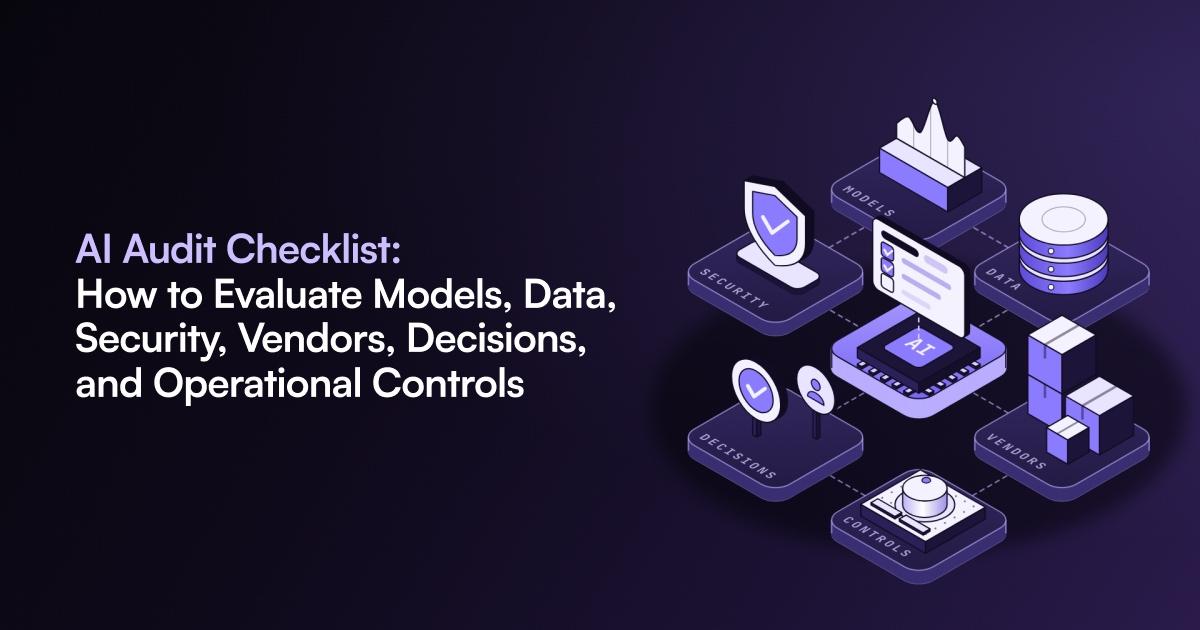
Each AI use case needs a clear business purpose, an AI inventory entry, and a named owner. Review its controls through four questions: Audit Question → Business Risk → Evidence to Request → Accountable Owner. The six areas span models, data, systems, and decisions.
An assistant linked to service records could hold permission to change account settings. Its assigned task might be answering questions, while its access rights permit changes to customer accounts. Comparing the approved workflow with service permissions and blocked-action test results reveals exposure that model evaluation reports may miss.
Model quality tells part of the story. I want to see the access granted to each connected service, the approvals required for consequential actions, and the person empowered to stop the system. Those controls determine the impact a failure can have on customers.
 Varun Kumar SahuChief Digital & Privacy Officer
How Are AI Systems Inventoried, Classified, and Assigned Ownership?
Businesses should maintain a centralized inventory covering purchased, embedded, custom, and pilot AI capabilities. Each entry should document the business purpose, user group, lifecycle stage, risk classification, accountable owner, and authority responsible for approving deployment.
Audit question: Does the AI inventory cover purchased, embedded, and custom features, with each purpose, user group, lifecycle stage, classification, and release authority?
Business risk: An omitted feature might process customer records or influence decisions outside the agreed approval process. Gaps delay incident response.
Evidence to request: Compare the AI inventory with procurement and deployment records, including features in purchased software and pilots with production access. Inspect classifications, data flows, and release approvals.
Accountable owner: The CIO owns inventory coverage; the product owner approves the use case and release.
Illustrative scenario: A SaaS team adds AI ticket routing through a purchased service. The integration appears in production records but is missing from the AI inventory. The product owner documents and approves the use case.
How Are Model Performance, Reliability, and Fairness Tested?
Businesses should evaluate AI models against defined performance thresholds, challenging inputs, and results across customer groups. Testing should identify errors that could cause financial losses, unequal outcomes, or failures in the intended workflow before release approval.
Audit question: Which test results show whether the model meets task-specific quality thresholds across customer groups and difficult inputs? How are the financial effects of false approvals and rejections assessed?
Business risk: Average accuracy can conceal costly errors or unequal outcomes.
Evidence to request: Collect evaluation plans, test data, acceptance thresholds, subgroup results (outcomes separated by customer groups), failures, and model-version approvals.
Accountable owner: The AI lead owns testing; the product owner approves acceptance criteria.
Illustrative scenario: A fintech model meets its accuracy target for domestic payments but mislabels cross-border transfers. Release approval should rest on results for those transactions and on average accuracy.
How Are Data Quality, Privacy, and Governance Verified?
Businesses should verify the quality, origin, permitted use, retention, and deletion requirements of data processed by AI systems. Assessment records should identify the information shared with external providers and confirm that data processing follows approved permissions.
Audit question: Can the business trace approved sources, permitted uses, retention, deletion, and access rights? Does each data use match customer or organizational permission?
Business risk: Outdated records can distort AI outputs. Restricted data sent to providers can breach contracts or processing terms.
Evidence to request: Inspect quality tests, source approvals, permissions, deletion results, and lineage records (data traced from source through processing to output). Check which fields reach vendors and whether deletion reaches stored outputs.
Accountable owner: The data lead owns sources; the privacy lead reviews permissions and retention.
Illustrative scenario: A support-summary feature retrieves archived conversations with payment details. The audit traces those details through data processing, checks approved access, and tests exclusion from generated summaries.
How Are AI Security and Access Controls Tested?
Businesses should test whether AI systems and connected applications can expose protected information or perform unauthorized actions. Security assessments should examine access permissions, prompt-injection risks, and blocked-action records to identify weaknesses before production deployment.
Audit question: Can users, files, or connected applications induce an AI system to reveal protected records or take actions beyond authorized access?
Business risk: Broad integration rights can expose account details or trigger unauthorized changes.
Evidence to request: Inspect security reviews, service-account permissions (access rights for software identities), and prompt-injection tests (malicious instructions used to redirect AI behavior through inputs). Test permissions held by production integrations and inspect blocked-action logs.
Accountable owner: The security lead approves tests; engineering fixes weaknesses.
Illustrative scenario: A service-desk assistant can help reset account access. A malicious instruction in a support ticket must fail to trigger a reset or disclose another employee's records without authorization.
How Should Third-Party AI Vendors and Models Be Assessed?
Businesses should assess third-party AI providers against security requirements, data processing terms, model changes, incident reporting obligations, and service continuity commitments. Vendor reviews should identify dependencies and document fallback plans for disruptions affecting customer operations.
Audit question: Which providers process business data, supply models, or support customer workflows? What terms govern changes, incidents, retention, and outages?
Business risk: Outages interrupt service; model or contract changes affect quality and costs. Provider assurance leaves the business accountable for its own application controls.
Evidence to request: Request vendor reviews, contracts, security reports, processing terms, change notices, and fallback plans. Confirm incident notice windows, permitted data use, and continuity commitments.
Accountable owner: The vendor risk lead approves suppliers; engineering reviews continuity.
Illustrative scenario: An invoice-processing product uses a hosted extraction model. A provider update changes field formatting and disrupts reconciliation. Change tests and a fallback provider reduce disruption to invoice processing.
How Are AI-Assisted Decisions and Human Oversight Controlled?
Businesses should establish human approval requirements for AI-assisted decisions that affect customers, payments, or access to services. Assigned reviewers should have the authority and supporting evidence to examine decisions, resolve disputes, reverse outcomes, and suspend affected workflows.
Audit question: Which AI recommendations require human approval? Who handles a contested result, what evidence can reviewers inspect, and how does the customer receive the decision? Can staff reverse or suspend decisions?
Business risk: AI recommendations can deny services or disrupt payments. Reviewers who lack evidence or authority may approve flawed decisions.
Evidence to request: Review approval thresholds, reviewer training, override logs, appeals, and suspension tests.
Accountable owner: The process owner approves decision limits; compliance checks obligations.
Illustrative scenario: A lending tool recommends rejecting an application. An authorized loan officer reviews the supporting factors, records the decision, and follows the approved customer review process.
What Should the Downloadable AI Audit Checklist Include?
The download includes an editable spreadsheet and a concise PDF guide. Each checkpoint captures the AI use case, lifecycle stage, audit question, audit status (Pass, Partial, Fail, or Not Applicable), evidence requirement, accountable owner, risk severity, evidence score, remediation priority, and follow-up date.
The spreadsheet consolidates risks, missing evidence, accountable owners, and priority actions for releases, vendor reviews, and planning. The PDF guide defines evidence scores and explains how teams should record exceptions. The template supports internal readiness decisions without granting audit certification.
How Should Businesses Prioritize AI Risks Before Scaling?
Audit depth depends on impact, exposure, and product maturity. Staff can check the outputs of an internal pilot before taking action, while a payment system can affect live customer transactions. Budget and executive attention should follow customer exposure and the consequences of failure.
What Should Businesses Audit Before Their First AI Launch?
For an initial AI launch, review data permissions, failure cases, ownership, and stop controls. Check customer data exposure and correction paths.
Illustrative scenario: Employees use an internal knowledge assistant built from approved documents and check answers before acting. An AI payment engine can reject legitimate transactions or trigger financial losses, so its release requires transaction-level tests and a defined human escalation path.
How Should Risk Priorities Change Across Multiple Products?
Multi-team operations need a shared AI inventory, test thresholds, approval gates, vendor reviews, and escalation. An accountable owner coordinates cross-team failures and exceptions.
Evaluate findings against four factors:
- Customer impact: Could people lose service, receive incorrect decisions, or face disclosure of protected records?
- Financial consequences: Could the failure cause transaction losses, contract penalties, or recovery costs?
- Failure likelihood: What do test failures, incident histories, and production conditions indicate?
- Detection and reversal: Can teams detect the error and reverse its consequences before harm spreads?
Set escalation outcomes:
- Block launch: Unresolved access to protected records, unauthorized financial actions, or processing that conflicts with documented legal or contractual obligations. Legal counsel confirms any legal conclusion.
- Remediate before scale: Controls fail approved tests or lack capacity for increased transaction volume.
- Scheduled review: Lower-risk gaps have safeguards, an accountable owner, and a dated corrective action.
How Should Businesses Audit AI Operational Controls in Production?
Launch tests cannot predict all production changes. Production reviews test detection and recovery.
What Should Production Monitoring Verify?
Track performance against approved thresholds, model drift (changes in input patterns or model behavior), abnormal outputs, error rates, and customer complaints. Review alert records, sampled outputs, and investigations linked to specific incidents. Include tests of logging, version history, and deployment approvals.
When Should Teams Reassess and Respond?
Set review schedules according to risk severity. Critical and High use cases require continuous monitoring and reviews after releases, incidents, or breached thresholds. Medium use cases need a documented review schedule and reassessment after model or data changes. Low use cases can follow planned governance reviews. Reassess after a model release, a new source of customer data, a change in protected-data fields, a security incident, a breached alert threshold, or deployment into a payment or eligibility workflow.
Check incident response, rollback testing, and recovery records. Engineering owns monitoring and fixes; security owns incidents. The product owner decides on restrictions or suspension until recovery tests pass.
What Evidence Should Businesses Collect During an AI Audit?
A policy describes an intended control. Operational evidence shows whether the control worked. Each audit record should identify the AI use case, model version, review date, result, and accountable owner.
Which Records Demonstrate Control Effectiveness?
Model evaluations record acceptance criteria, test outcomes, and failures. Data lineage records trace information from its source through processing. Security assessments document vulnerabilities, testing results, and corrective work. Access logs identify which accounts reached protected records and when. Vendor reviews capture provider risks and contractual controls. Approval records identify the accountable owner and release decision. Monitoring reports connect alerts with investigations. Incident records document impact, response, and recovery. Remediation evidence records retesting and closure decisions.
How Should Audit Evidence Map to Recognized Frameworks?
Use the United States National Institute of Standards and Technology (NIST) AI Risk Management Framework (AI RMF) to map controls to four functions: Govern, Map, Measure, and Manage. The following illustrative mapping shows how these functions can support the assessment of an AI payment-risk model.
Illustrative scenario: For an AI payment-risk model:
- Govern: Record the accountable owner and approval authority in the AI inventory.
- Map: Document affected customers, payment decisions, and possible financial harm.
- Measure: Attach transaction test results and approved performance thresholds.
- Manage: Record corrective work, release restrictions, and incident response decisions.
ISO/IEC 42001:2023, an international standard issued by the International Organization for Standardization (ISO) and International Electrotechnical Commission (IEC), sets requirements for an organizational AI management system. An AI governance framework can use these requirements to connect documented responsibilities, risk assessments, and monitoring records to an organization's AI management system. The resulting mapping supports an AI compliance checklist. Certification requires a separate assessment.
What Should an AI Audit Scorecard and Remediation Roadmap Include?
An AI risk assessment needs two judgments: evidence score and risk severity. Record the evidence score as 0 = No evidence; 1 = Claimed; 2 = Documented; 3 = Verified in operation. Rate risk severity as Critical, High, Medium, or Low using four factors: customer impact, financial consequences, failure likelihood, and detection and reversal. Evidence score measures the quality of proof; risk severity measures potential harm.
How Should Findings Enter the Remediation Scorecard?
Illustrative scenario: The following entries show how the record connects a finding to corrective work. Dates are proposed targets from audit kickoff.
Checkpoint | Evidence / Score | Risk Severity | Accountable Owner | Remediation Action | Target Completion Date |
Payment-data access | Access test run and failed (3) | Critical | Security lead | Restrict access, repair control, retest | Day 30 |
Support output review | Written procedure (2) | Low | Product owner | Test approval controls | Day 90 |
How Can Audit Findings Become a 30/60/90-Day Action Plan?
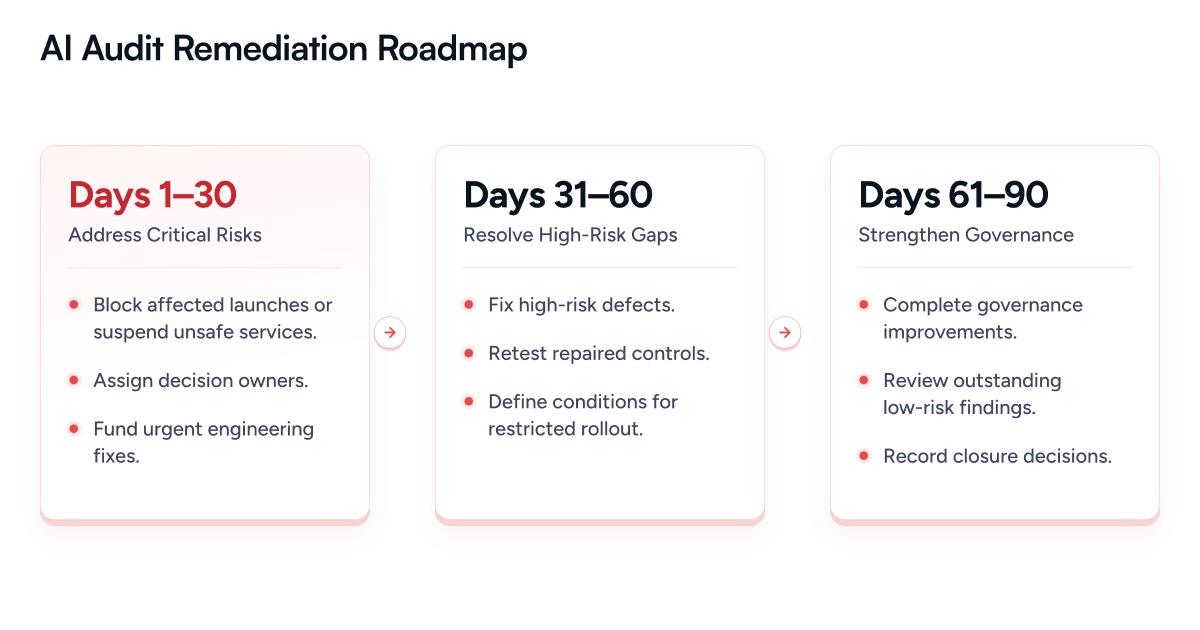
Days 1–30: Suspend affected services or block launches where critical failures remain. Assign decision authority and fund urgent engineering fixes.
Days 31–60: Resolve high-risk defects, retest repaired controls, and document conditions for restricted rollout.
Days 61–90: Complete governance improvements, check outstanding low-risk work, and record closure decisions.
Leadership should proceed when requirements are met, proceed with restrictions when approved safeguards limit exposure, remediate before rollout when release tests fail, or suspend the use case when risk remains unacceptable. A score of 3 cannot cancel a Critical risk severity rating.
How Can Businesses Use an AI Governance Checklist for Self-Assessment?
Assess six control areas. Choose Pass, Partial, Fail, or Not Applicable and record the evidence and accountable owner. Transfer gaps to the remediation scorecard.
Control Area | Audit Question | Status | Evidence | Accountable Owner |
AI inventory | Are use cases and approvals recorded? | Select | AI inventory | CIO |
Model reliability and fairness | Do models pass required tests? | Select | Test results | AI lead |
Data and privacy | Are data sources and rights verified? | Select | Source approvals | Data lead |
Security and access | Do access controls pass tests? | Select | Security tests | Security lead |
Third-party vendors | Have providers passed risk review? | Select | Vendor assessment | Vendor risk lead |
AI decisions and oversight | Can staff review or reverse decisions? | Select | Approval logs | Process owner |
Escalate failed customer-facing controls before release. Assign work and deadlines to Partial findings. Record the reason for each Not Applicable decision.
How Can GeekyAnts Support AI Readiness and Risk Remediation?
GeekyAnts is an AI-powered digital product engineering and consulting company with engineering experience dating to 2006. Its engineering approach covers AI evaluation, application architecture, security, testing, release controls, and product improvements that support production reliability.
Growth-funded AI product teams need release validation and defect resolution. Organizations integrating AI into existing systems need dependable integrations, access controls, and monitoring across departments.
In its Nexus case study, GeekyAnts developed SQL-based AI agents and benchmarking frameworks to evaluate AI models and integrate automation into business process management workflows. The team tested different AI models and established validation processes to support production readiness. The project achieved 50% fewer manual validation cycles and 30% faster internal testing workflows, demonstrating GeekyAnts' approach to AI model evaluation, testing, and workflow integration.
Critical access defects and lower-severity documentation gaps compete for the same delivery capacity. A remediation plan should reserve engineering time for release blockers and record test-based exit criteria. Commercial teams can use that plan to discuss delivery dates and restrictions with customers.
When a permission test fails, the next step is an engineering change with a clear acceptance test. I want the release plan to show the fix, the accountable engineer, and the point of approval. That converts an audit finding into work a delivery team can own.
Kunal KumarChief Revenue OfficerGeekyAnts helps identify delivery gaps, prioritize remediation, and implement dependable AI solutions. Independent audit and certification remain with qualified third parties.
What Should Businesses Do After an AI Audit Finds Critical Risks?
AI audit findings should guide release approvals, corrective work, and accountable decisions. Leaders can authorize deployment, impose restrictions, or suspend a use case based on recorded risks. Closure requires tested fixes and a documented decision.
What Questions Does an AI Audit Checklist Answer?
1. Can an AI Audit Support Investor Due Diligence Before a Funding Round?
An AI audit gives investors records of model performance, data rights, security findings, vendor dependencies, and remediation costs. These records can inform funding conditions and planned investment.
2. What AI Audit Evidence Do Enterprise Clients Expect Before Signing a SaaS or AI Product Contract?
Buyers may request access-control tests, data-flow records, model evaluations, vendor contracts, and incident procedures. The scope depends on the product, its customer data, and contractual requirements.
3. Can Businesses Launch AI Products Using OpenAI, Claude, or Other Third-Party Models Without Auditing Model Internals?
Businesses can test their own applications without access to proprietary model internals, subject to contractual and regulatory requirements. Review provider documentation and test outputs, data handling, permissions, and human approval paths.
4. What AI Risks Matter When Acquiring a Business or Its AI Product?
Review model ownership, data rights, provider terms, prior incidents, unresolved failures, and integration costs. The findings can influence valuation, contractual protections, and acquisition planning.
5. How Can Businesses Identify Hidden AI Costs Before Scaling Usage?
Forecast model requests, failed calls, retries, data storage, monitoring, human review, and fallback provider charges. Test demand and error scenarios against projected revenue and service commitments.
6. Is a SOC 2 Report Enough to Prove an AI Product Is Secure for Enterprise Customers?
A System and Organization Controls 2 (SOC 2) report, based on standards of the American Institute of Certified Public Accountants (AICPA) in the United States, examines specified service-organization controls within a defined scope. Enterprise buyers may request separate evidence for model behavior and AI decision oversight.
7. Should Businesses Audit AI Before Entering Healthcare, Financial Services, or Other Regulated Industries?
An audit helps identify requirements tied to patient information, financial decisions, privacy, and human review. Legal counsel should confirm the rules for each product, market, and operating jurisdiction before launch.
8. When Should Businesses Hire an External AI Auditor or Engineering Partner?
Use qualified independent auditors for assurance requirements established by contracts or governing rules. Engage engineering specialists for model testing, secure integrations, incident recovery, and remediation delivery.
Sources and Citations
- https://hai.stanford.edu/ai-index/2026-ai-index-report/economy
- https://www.mckinsey.com/capabilities/tech-and-ai/our-insights/tech-forward/state-of-ai-trust-in-2026-shifting-to-the-agentic-era
- https://airc.nist.gov/airmf-resources/playbook/measure/
- https://genai.owasp.org/glossary/prompt-injection/
- https://www.nist.gov/news-events/news/2026/03/new-report-challenges-monitoring-deployed-ai-systems
- https://airc.nist.gov/airmf-resources/airmf/5-sec-core/
- https://committee.iso.org/cms/live/live/en/sites/isoorg/contents/data/standard/08/12/81230.html
- https://www.aicpa-cima.com/cpe-learning/publication/soc-2-reporting-on-an-examination-of-controls-at-a-service-organization-relevant-to-security-availability-processing-integrity-confidentiality-or-privacy