

Key Takeaways
- US fintech regulations depend on the product, customers, transaction flow, data use, jurisdictions, and partner model. Founders should establish these requirements before setting budgets, architecture, and launch plans.
- Compliance requirements should shape product controls, ownership, evidence collection, and monitoring from the start of product development.
- AI features involving onboarding, credit, fraud detection, or financial recommendations require teams to assess fairness, privacy, recordkeeping, oversight, and human review requirements.
- Fintechs should define compliance responsibilities across sponsor banks, BaaS providers, and vendors. Early planning can reduce rework, launch delays, partnership friction, and enterprise-sales risk.
Why Is US Fintech Compliance a Product and Growth Priority?
Cash App shows what can happen when product growth and compliance controls fall out of step. In 2025, the Consumer Financial Protection Bureau ordered Block to pay up to $175 million in penalties and consumer redress after finding failures in fraud prevention, dispute investigations, and customer service. The order required changes to the processes used to investigate unauthorized transactions and support customers.
For fintech companies, compliance decisions start before launch. The product model, financial activity, states served, customer data, and partner structure determine which requirements need attention. Those requirements can shape transaction flows, security controls, integrations, development scope, and release plans. Expansion into new states or financial services can introduce another set of licensing and compliance requirements.
The market adds pressure to get those decisions right. US consumers reported $12.5 billion in fraud losses in 2024, up 25% from 2023. In 2025, US fintech investment reached $56.6 billion across 1,977 deals. For fintech founders and development teams, fintech compliance in the US starts with identifying the regulatory, licensing, security, and product requirements that apply to the business model. Addressing these requirements during product planning helps teams define the controls, responsibilities, and evidence needed for launch and growth.
Which US Fintech Regulations Apply to Your Product and Business Model?
US fintech regulations depend on what a product does, how money moves, what customer data it uses, where it operates, and which partners support the service. These factors determine the requirements that can affect transaction flows, data handling, integrations, access controls, architecture, and launch planning.
Those requirements can come from different sources. Federal and state laws establish regulatory obligations, while licensing authorities govern permitted financial activities. Sponsor banks, card networks, and BaaS providers can set requirements through contracts and partnership agreements. Security and payment-data standards such as PCI DSS add another set of controls. Product teams need to distinguish these sources because each can affect control ownership, required evidence, approval paths, and launch timelines.
Which Regulations Apply to Payments, Wallets, and Embedded Finance?
Payment and digital wallet products can trigger federal requirements for money services businesses, anti-money laundering controls, and state money-transmitter licensing. Embedded finance adds sponsor-bank requirements based on which party holds funds, manages customer relationships, and performs regulated activities.
Which Regulations Apply to Digital Lending and BNPL?
Consumer lending can bring federal requirements covering credit disclosures, fair lending, credit decisions, and recordkeeping. State licensing and lending rules depend on the product structure and jurisdictions served. For BNPL products, the federal position has changed since 2024. The CFPB withdrew its 2024 BNPL interpretive rule in May 2025, which had treated certain BNPL lenders as card issuers under Regulation Z. Teams should assess the credit structure, applicable federal and state requirements, and jurisdictions served with qualified legal counsel before development begins.
What Rules Apply to Investment, Crypto, and Stablecoin Products?
Investment products can face securities, brokerage, or investment-adviser requirements based on the services offered. For payment stablecoins, the GENIUS Act established a federal regulatory framework in July 2025, with implementation continuing through federal rulemaking. The framework covers areas such as permitted issuers, reserve backing, redemption, risk management, custody, and regulatory oversight. Product teams planning payment stablecoin products should account for the issuer model, reserve structure, custody, redemption, AML and sanctions controls, and applicable federal or state oversight when defining the product.
Which Federal and State Licenses Could Apply to a US Fintech Product?
Licensing depends on the financial activity and jurisdictions involved. Money transmission, lending, investment services, and other regulated activities can carry separate federal registration or state licensing requirements. State requirements can differ based on the regulated activity and the jurisdictions a product serves. A fintech should determine its licensing footprint from its business model and planned markets rather than assume that the same requirement applies across all 50 states. Founders should identify these dependencies before selecting launch markets.
Which Privacy, Consumer Protection, and Cybersecurity Rules Apply?
Fintech products can face requirements covering customer information, security safeguards, access, disclosures, and consumer protection. Teams should map what data the product collects, where it moves, who receives it, and which controls protect it.
One of the first things I look for is clarity on what the product does, how money moves, which states it will serve, and which activities carry regulatory requirements. Those answers influence architecture and partner selection before development starts. If that scope changes after the build begins, teams may have to redesign workflows, change integrations, or revisit how customer and transaction data moves through the product.
 Jani Hardik SanjayProduct Owner I
From a product perspective, money movement, credit decisions, identity verification, and sponsor-bank integrations create some of the strongest links between compliance and engineering. A change in who handles a transaction or which party owns a control can affect workflows and integrations across the product. Mapping these dependencies before development gives the engineering team a defined scope for the build.
Product-to-Regulation Matrix
Product Type | Likely Regulator | Principal Obligation | Launch Dependency |
Payments and wallets | Federal and state financial regulators | Registration, licensing, financial crime controls | Transaction flow and states served |
Federal consumer-finance and state regulators | Credit, disclosure, and lending requirements | Credit model and jurisdictions | |
Investment products | Securities regulators | Registration and investor protection | Service and advisory model |
Crypto and stablecoins | Federal and state financial regulators | Classification, registration, licensing, and controls | Asset and transaction model |
Embedded finance | Banking and financial regulators | Partner oversight and compliance controls | Sponsor-bank model |
This matrix supports an initial assessment of applicable requirements. Qualified legal counsel should determine the obligations that apply to a specific product, business model, customer base, and jurisdiction.
How Should Founders Build a US Fintech Compliance Roadmap Before Launch?
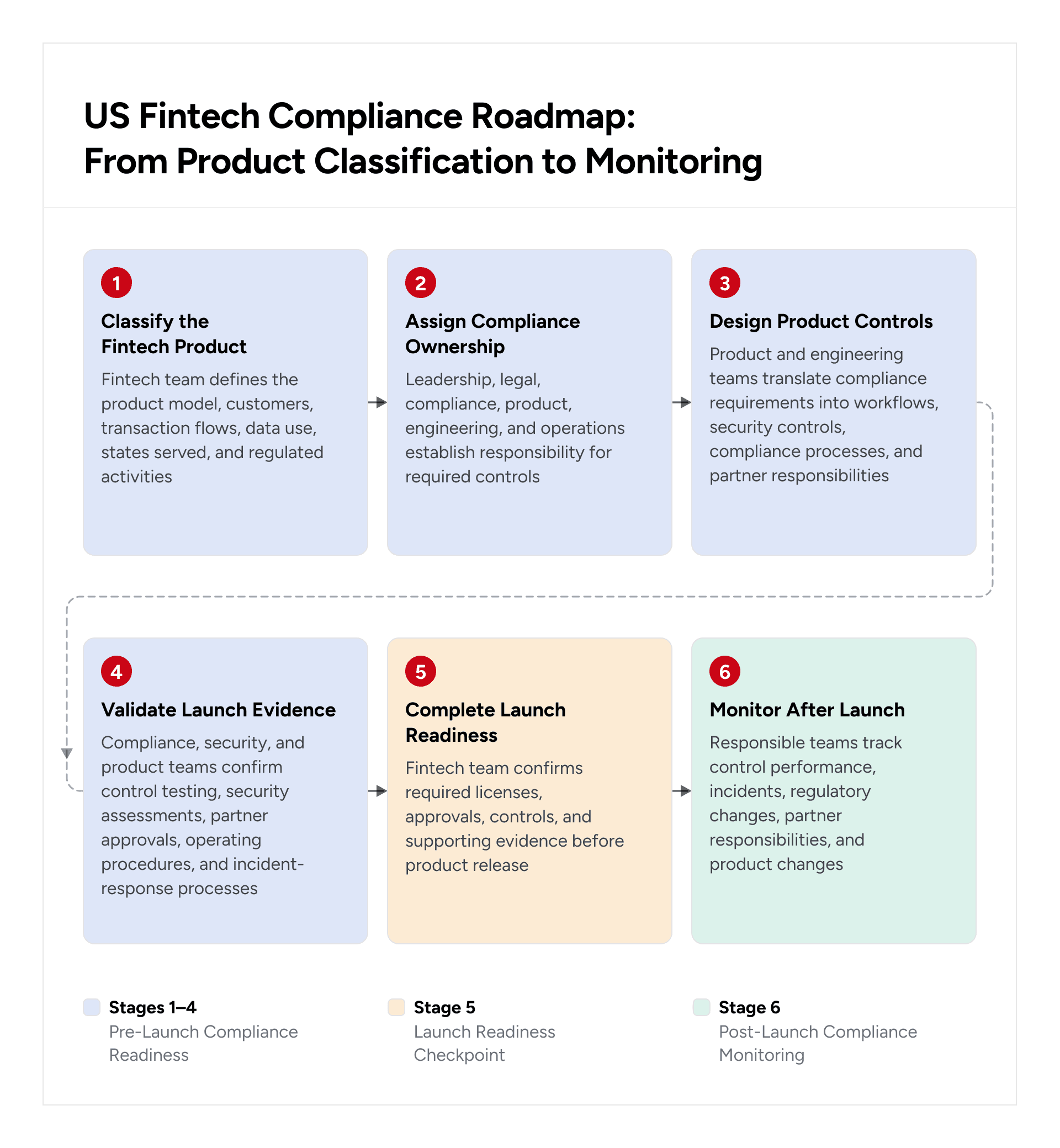
A fintech compliance roadmap should connect regulatory requirements with budgets, product scope, team responsibilities, partners, and launch milestones. The sequence should cover discovery, regulatory assessment, ownership, partner selection, implementation, validation, and post-launch monitoring.
What Should Founders Classify Before Product Development?
Discovery should identify the product model, customers, transaction flows, data use, jurisdictions, and regulated activities. Legal and compliance teams can use this information to determine licensing needs and required controls. These findings should inform budgets, architecture, product scope, and launch plans.
Who Owns Compliance Across the Fintech Team?
Leadership sets budgets and risk ownership. Legal counsel interprets applicable requirements, while compliance defines controls. Product and engineering incorporate those controls into workflows. Security addresses data and access requirements, operations manages control processes, and external partners fulfill responsibilities defined through contracts and regulatory requirements.
Which Dependencies Can Affect Fintech Launch Plans?
Licensing, sponsor-bank selection and approval, vendor reviews, security assessments, and unresolved control responsibilities can affect launch milestones. Teams should confirm these dependencies before implementing product workflows or committing to release dates.
Should Fintechs Build, Buy, or Partner for Compliance Capabilities?
Approach | Decision Basis |
Build | The control depends on product workflows or business rules. |
Buy | An established vendor provides the required capability. |
Partner | The activity requires regulated infrastructure or a licensed financial institution. |
Cost, internal expertise, integration requirements, control ownership, evidence needs, and reliance on vendors should guide the decision.
What Evidence Should Teams Validate Before Launch?
Moving from discovery to pilot requires documented requirements, assigned owners, selected partners, and defined controls. Public launch requires control-testing records, security assessments, partner approvals, operating procedures, and incident-response processes. After launch, teams should monitor control performance, incidents, regulatory changes, partner responsibilities, and product changes that affect compliance requirements.
Compliance planning has a commercial impact long before launch. When leadership understands licensing needs, partner dependencies, security requirements, and control ownership at the planning stage, it can make stronger decisions about budgets and release plans. The same preparation supports conversations with investors, sponsor banks, and enterprise buyers because the team can show what is ready, what requires approval, and what remains part of the launch plan.
 Kunal KumarChief Revenue Officer
Sponsor banks, investors, and enterprise buyers often want evidence that the product can support the commitments made during commercial discussions. The questions can cover security reviews, control ownership, testing records, partner responsibilities, and incident processes. Buyers use that evidence to assess partnership, investment, or procurement decisions. Compliance readiness therefore becomes part of commercial readiness when a fintech enters these conversations.
What Compliance Controls Should Fintechs Build Across the Customer Journey?
For fintech compliance in the US, controls should follow each stage of the customer journey, with ownership, evidence, monitoring, and escalation built into the product workflow.
KYC, KYB, AML, Sanctions, and Fraud Controls That Should be a Part of Onboarding
KYC and KYB controls establish customer or business identity before account access. AML, sanctions, and fraud controls continue across account and transaction activity. Automation can perform screening and flag exceptions for human review.
How Should Fintechs Manage Disclosures, Consent, Complaints, and Disputes?
Fintech products should capture disclosures and consent when required. Customer-support workflows should record complaints, disputes, decisions, communications, and escalations so teams can demonstrate how each case was handled.
Which Data Privacy, Security, Access, and Retention Controls Matter?
Access and security controls protect customer information throughout its use. Retention controls preserve required records, while offboarding removes access and manages account records based on applicable requirements.
What Compliance Evidence Should Fintech Products Generate?
Evidence should confirm that required checks occurred and exceptions reached the responsible owner. Verification results, screening records, consent records, transaction alerts, access logs, and complaint records can support this evidence.
When Should Fintech Teams Retest Compliance Controls?
Product releases, new jurisdictions, partner changes, and regulatory changes can alter control requirements. Teams should test affected controls, document results, assign corrective action, and confirm that failed controls receive review.
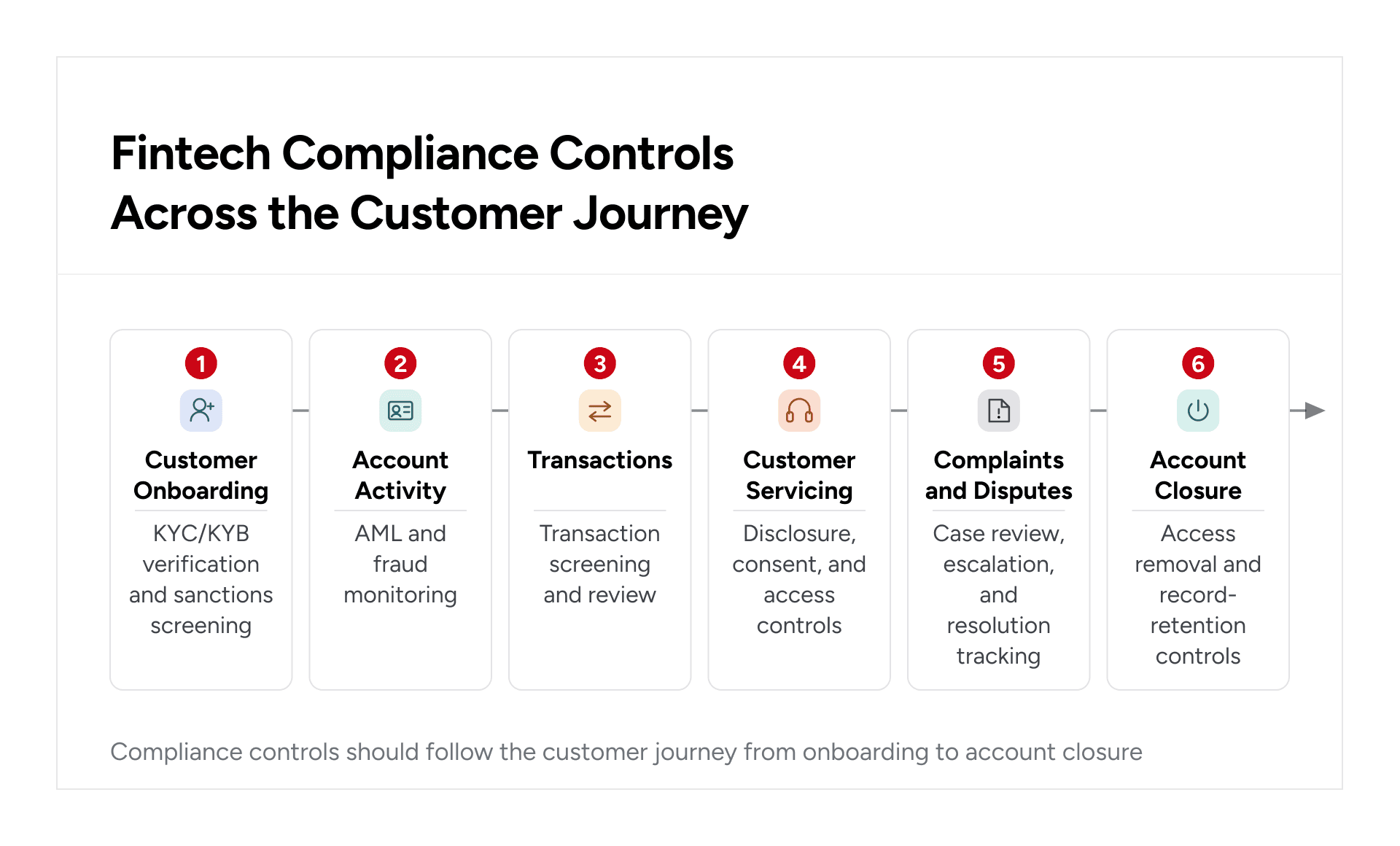
Customer-Journey Compliance Control Matrix
Journey Stage | Risk | Control | Owner | Evidence | Monitoring Frequency |
Onboarding | Identity fraud | KYC/KYB and sanctions screening | Compliance | Verification records | At onboarding |
Account activity | Financial crime | Compliance | Alerts and decisions | Risk-based | |
Transactions | Prohibited activity | Transaction screening | Operations | Review records | Per transaction |
Servicing | Missing consent | Disclosure and consent controls | Product | Consent records | At customer action |
Complaints and disputes | Consumer harm | Case review and escalation | Customer support | Case records | Per case |
Offboarding | Data exposure | Access and retention controls | Security | Closure records | At closure |
How Do US Fintech Regulations Apply to AI-Powered Financial Products?
For a fintech startup owner, AI compliance starts with the financial product, the states the company plans to serve, the customer data involved, and the role AI plays in financial or customer decisions. These factors determine which federal and state requirements apply and which controls need to become part of the product.
What Should Fintechs Assess Before Building AI Features?
Start with the financial activity the product supports. Payments, lending, investment products, digital wallets, and other financial services can carry different regulatory and licensing requirements. The states served matter because licensing and other requirements can vary by jurisdiction.
The next step is to identify how AI participates in the product. AI used for customer onboarding, credit decisions, fraud detection, financial recommendations, or compliance monitoring can affect customer access or financial outcomes. The requirements governing the underlying financial activity still apply when AI supports the decision.
For example, a lender using AI to support credit decisions remains responsible for requirements concerning adverse-action notices and the reasons provided for those decisions.
What Compliance Requirements Should Enter the Product Plan?
Once the applicable requirements are identified, product, compliance, and engineering teams need to translate them into product controls. Depending on the financial activity and AI use case, these can include identity checks, consent records, access controls, decision records, human review, testing, audit evidence, and data retention. AI features that affect financial or customer decisions also need explainability, model governance, and data lineage controls that establish how decisions are traced, which data supports them, and who owns model review.
Incident handling should define how AI errors, control failures, and customer-impact issues are recorded, escalated, and addressed. When third-party AI models or services support the product, vendor responsibilities should cover data handling, model changes, incidents, evidence, and oversight.
These requirements should inform architecture, integrations, acceptance criteria, and release reviews. A fintech leader that plans to enter another state, introduce another financial service, or add an AI use case should assess whether the change introduces licensing, data, customer-protection, or control requirements.
What Should a Fintech Startup Have in Place Before Launch?
Before launch, founders should be able to identify which requirements apply to the product, who owns each compliance control, what evidence the product generates, and which responsibilities sit with external partners.
For an AI-powered financial product, the production-readiness review should confirm:
- Model scope and ownership: The intended use, model version, owner, and approval responsibilities are documented.
- Data controls: Approved data sources, access permissions, data lineage, and retention requirements are defined.
- Decision traceability: Customer-impact decisions can be traced to the relevant inputs, model output, and decision process.
- Human review: Cases requiring human review, exception handling, and escalation have assigned owners.
- Testing and monitoring: Required testing is complete, monitoring criteria are defined, and control failures can be identified.
- Incident response: AI errors and customer-impact issues have defined reporting, escalation, investigation, and response processes.
- Change and rollback controls: Model, data, or configuration changes require review, with a defined response if a release creates unacceptable outcomes.
- Vendor accountability: Responsibilities for third-party models, data, incidents, model changes, and required evidence are documented.
After launch, product changes, new states, new partners, model updates, and changes to AI use cases can affect the original compliance scope. Compliance reviews should form part of product-change and release planning.
Where Does an Engineering Partner Fit Into Compliance Planning?
An engineering partner can help translate identified compliance requirements into workflows, integrations, security controls, testing, and evidence. For AI-powered financial products, this work can extend to model governance, decision traceability, human-review workflows, data controls, and production monitoring. Monitoring should help teams identify model changes, control failures, customer-impact issues, and incidents that require review or escalation.
GeekyAnts has worked on fintech products with regulatory and compliance requirements built into engineering decisions, including banking migrations and payment platforms. For a fintech company, this connects the compliance plan with the development scope so identified requirements can inform architecture, AI workflows, release controls, and production monitoring.
Which AI Use Cases Need Stronger Compliance Controls?
AI use cases need stronger controls when they influence customer access, financial decisions, identity verification, fraud actions, or regulated compliance processes. Credit decisions, onboarding, fraud detection, financial recommendations, customer service, and compliance monitoring can require different levels of human review, evidence, and monitoring based on their customer impact and regulatory requirements.
AI Risk Assessment Matrix
AI Use Case | Primary Compliance Concern | Control Before Release | Human Oversight | Evidence to Maintain | Production Review |
Customer Onboarding | Identity verification, privacy, fair customer treatment | Validate identity workflows, data use, and exception rules | Review failed verification and exception cases | Verification results, decision records, exception history | Review rejection patterns, verification failures, and recurring exceptions |
Fraud Detection | Financial crime controls, security, customer impact | Test detection rules and escalation paths | Investigate high-risk alerts and cases affecting customer access | Alert history, investigation records, resolution decisions | Track incorrect flags, missed risks, and unresolved alerts |
Credit Decisions | Fair lending, adverse action, decision accountability | Validate decision logic, required notices, and review paths | Review cases defined by policy or exception criteria | Decision inputs, reason codes, notices, model version | Assess lending outcomes, overrides, and changes in decision patterns |
Financial Recommendations | Consumer protection, privacy, suitability requirements | Define permitted recommendations, data use, and escalation rules | Review cases with greater customer or financial impact | Recommendation history, customer consent, review records | Examine complaints, recommendation errors, and customer-impact patterns |
AI Customer Support | Privacy, disclosures, complaint handling | Set response boundaries and routes for regulated or sensitive requests | Escalate complaints, disputes, and sensitive financial matters | Conversation records, escalations, resolution history | Review response errors, unresolved cases, and complaint patterns |
Compliance Monitoring | AML, sanctions, control effectiveness | Validate screening logic, alert routing, and case ownership | Review alerts, exceptions, and cases requiring investigation | Screening results, case decisions, investigation records | Assess control failures, unresolved cases, and changes in alert patterns |
When AI affects onboarding, fraud detection, credit, or financial recommendations, governance has to be part of the product workflow from the design stage. The team needs to know what data supports the decision, when a person needs to review it, and what record the product must preserve. If these decisions come after deployment, engineering may need to change the workflow, model integration, or review process.
Jani Hardik SanjayProduct Owner IThe AI features drawing interest in fintech tend to sit close to customer or financial decisions, including fraud detection, onboarding, credit workflows, and recommendations. For product teams, the key deployment question is whether they can trace an AI-supported decision and route the required cases to human review. Buyers need that level of control before these features can become part of regulated workflows.
Who Owns Compliance in Sponsor-Bank, BaaS, and Fintech Vendor Partnerships?
Compliance accountability follows regulated activities and agreed responsibilities, even when infrastructure or operations sit with a sponsor bank, Banking-as-a-Service (BaaS) provider, or vendor. A bank partnership can change how responsibilities are divided, but the product model and partnership structure still determine which obligations each party must address.
Who Is Accountable in Sponsor-Bank and BaaS Partnerships?
Teams should document which party performs, reviews, approves, and provides evidence for each compliance control before launch.
What Should Fintechs Check Before Selecting Compliance Technology Vendors?
Due diligence should assess security, service levels, subcontractors, data ownership, incident processes, evidence access, and business continuity.
Which Contractual Rights Support Compliance Oversight?
Contracts should define audit rights, regulatory cooperation, incident notification, data access, service commitments, and evidence requirements.
How Should Fintechs Plan for Vendor Failure and Exit?
Portability, replacement options, termination assistance, and record access support continuity and reduce dependence on one provider. These rights also protect the fintech’s negotiating position.
What Does Third-Party Compliance Oversight Require?
Partner reviews should cover control performance, incidents, subcontractor changes, concentration risk, unresolved issues, and continuity plans.
Partnership Responsibility Matrix
Responsibilities vary by program and contract and require documented allocation.
Area | Fintech | Sponsor Bank | BaaS Provider | Compliance Vendor |
Product controls | Define | Review | Perform agreed tasks | Provide checks |
Bank controls | Perform assigned tasks | Approve | Provide evidence | Provide evidence |
Data | Govern | Review | Protect | Protect |
Incidents | Coordinate | Review | Report | Report |
Evidence | Maintain | Assess | Provide | Provide |
Exit | Plan | Coordinate | Transfer | Transfer |
Why Choose GeekyAnts for Fintech Compliance and AI Product Engineering?
GeekyAnts brings fintech, compliance, AI, security, cloud, and quality engineering into one delivery team. This approach connects regulatory requirements with product controls, testing, evidence, and release planning.
We translate US fintech regulations into product workflows, integrations, security controls, data protection, testing, and audit evidence from discovery through release.
Which Fintech and AI Engineering Capabilities Does GeekyAnts Provide?
Our capabilities cover fintech application development, RegTech automation, AI engineering, cloud modernization, data platforms, security, and quality assurance.
What Regulated-Product Outcomes Has GeekyAnts Delivered?
Our banking and fintech work includes regulatory migrations that required changes across banking systems and partner integrations, along with payment products built to support transaction processing across multiple markets.
Case Studies
RBI-Mandated Banking Migration With Zero Downtime
GeekyAnts helped a large private bank migrate to RBI-mandated domains across 100+ partner integrations, meeting the regulatory requirement with zero customer disruption.
Scaling a Global Payment Platform Across Multiple Markets
GeekyAnts engineered Flowcash, a payment platform supporting 400M+ payments per year and 120K+ active users across the UK, Canada, Europe, and Australia.
In our discovery conversations, we connect the business goal, regulatory expectations, and engineering scope from the start. That gives the team a shared view of what needs to be built, which controls belong in the product, where partner dependencies exist, and what has to be ready for release. It helps us plan delivery around the product’s business and regulatory requirements rather than treating them as separate workstreams.
Kunal KumarChief Revenue OfficerFintech buyers evaluating an engineering partner look at product capability, regulated-industry experience, security practices, compliance engineering, integration ownership, and post-launch support. AI products add questions around model governance and human review. The strongest fit comes from a partner that can connect these requirements within one product plan, giving business, compliance, and engineering teams clear ownership from discovery through release.
Which Fintech Engineering Support Fits Your Current Compliance Stage?
If Your Fintech Is... | What Needs Attention | How GeekyAnts Can Support |
Planning a new US fintech product | Regulatory requirements, product scope, licensing dependencies, partner responsibilities, and architecture decisions need to be mapped before development. | Translate identified compliance requirements into product workflows, technical requirements, integrations, security controls, and a development roadmap. |
Preparing an MVP for launch | KYC, AML, data protection, customer disclosures, evidence, testing, and release controls need to work within the product. | Build compliance requirements into customer journeys, backend workflows, third-party integrations, testing, and release planning. |
Adding AI to financial workflows | AI use cases can introduce requirements around decision traceability, human review, data controls, model governance, and production monitoring. | Design AI workflows with review paths, evidence generation, monitoring, data controls, and governance requirements built into the product. |
Expanding into new US states or financial services | New jurisdictions, product capabilities, or partners can change licensing, compliance, integration, and control requirements. | Assess the engineering impact of identified requirements and update workflows, integrations, controls, and product architecture for the expanded scope. |
Modernizing an existing fintech platform | Legacy architecture can make compliance changes, monitoring, evidence collection, and partner integrations harder to implement. | Modernize affected systems, payment flows, data infrastructure, integrations, security controls, and compliance workflows without treating compliance as a separate engineering layer. |
Scaling compliance operations | Manual KYC, KYB, AML, fraud, monitoring, and evidence processes can create operational pressure as transaction and customer volumes grow. | Build or integrate compliance technology that supports automated workflows, case handling, monitoring, evidence capture, and operational controls. |
How Can Fintech Compliance Support Launch Readiness and Growth?
Fintech compliance in the US requirements depend on the product model, customer journey, states served, data use, partnerships, and AI functionality. Each area can affect the controls and evidence required for launch.
Teams can follow a clear sequence: classify the product, assign ownership, design controls, validate evidence, launch, and monitor performance.
The next step is to identify the highest-risk product dependency and assess whether its ownership, controls, and evidence support launch readiness.
Sources and Citations
- https://www.ftc.gov/news-events/news/press-releases/2025/03/new-ftc-data-show-big-jump-reported-losses-fraud-125-billion-2024
- https://kpmg.com/xx/en/what-we-do/industries/financial-services/pulse-of-fintech.html
- https://www.fincen.gov/resources/money-services-business-msb-registration
- https://www.fincen.gov/resources/statutes-regulations/guidance/guidance-existing-aml-program-rule-compliance-obligations
- https://www.csbs.org/csbs-money-transmission-modernization-act-mtma
- https://www.consumerfinance.gov/rules-policy/regulations/1002/
- https://www.sec.gov/about/divisions-offices/division-trading-markets/division-trading-markets-compliance-guides/guide-broker-dealer-registration
- https://www.ftc.gov/business-guidance/resources/ftc-safeguards-rule-what-your-business-needs-know