

Key Takeaways
- Production-ready AI in banking requires controls, fallbacks, and human review in addition to model accuracy.
- Separating AI decisions from transaction execution helps contain errors and unexpected model behavior.
- Data gaps, API failures, and infrastructure issues disrupt AI workflow even when models perform well.
- Production costs increase with increased transaction volume, inference, integrations, monitoring, and human review.
Picture a fraud-detection model that works exactly as planned in testing. It scores transactions in milliseconds, catches suspicious patterns, and sends high-risk payments for review. The demo and model look good and everyone is ready to move on to the next process.
Then it handles a live transaction.
A customer makes a purchase, but one of the signals used by the model is delayed. The feature store returns incomplete data, a third-party fraud service is unavailable, and the model still returns a score but the system doesn’t have a rule for dealing with incomplete inputs.
This is where an AI project can cause a banking problem.
Most financial institutions can build an AI pilot, however, if the model exists within the live system handling money, regulated decisions, legacy platforms, and transactions, then the user cannot wait for someone to restart the service in case it fails. McKinsey estimates that generative AI could add $200 billion to $340 billion in annual value across the global banking sector, but notes that banks still face challenges in scaling these use cases and redesigning risk and model-governance frameworks.
This is the part of AI in banking that gets less attention, where the model can be accurate in testing and still create operational problems when the surrounding architecture has weaker controls. A credit model needs an explainable decision path, an AML system needs live data and human escalation points, a fraud-detection system requires a fallback when signals fail, and an AI agent needs to know the limit on which systems it can access and which actions it can take.
This means production architecture must be able to handle model uncertainties, incorrect data, decision overrides, decision reconstruction (even the ones taking place six months later), external API issues, and system costs with the increase in transaction volume.
Modular APIs should connect AI services with existing banking and payment platforms without giving the model control over the entire workflow. Unified data pipelines must provide consistent inputs across decision-making systems, event-driven processing should handle live transactions, while governed AI layers can keep models, policies, approvals, monitoring, and audit records connected.
A successful AI pilot proves that the technology can work. Production proves that the institution can control it when the data is incomplete, the system is under pressure, or the decision carries financial impact.
 Kunal KumarChief Revenue Officer
This article breaks down five production-ready AI reference architectures for fintech and banking, the systems behind each use case, the controls needed before deployment, and the possible costs that increase at production scale. It also examines where each architecture can fail and what the fallback should look like when the model, data, or systems stop working as expected.
What Makes an AI Architecture Production-Ready for Fintech and Banking?
AI production-ready AI architectures for fintech and banking have to account for the model, systems, and the consequences of its decisions. These are the core design principles to consider:
- Separate AI Decision-Making from Transaction Execution: Let the AI score, classify, recommend, or detect a pattern. Keep the final transaction action behind a separate service that can enforce business and regulatory rules.
- Keep Deterministic Controls Around AI Decisions: Hard limits, eligibility rules, transaction thresholds, and approval requirements should not depend on a model behaving as expected every time.
- Design Human Escalation Paths: When confidence is low or the financial or regulatory impact is high, the workflow should route the case to an authorized person instead of forcing an automated decision.
- Make Every Material Decision Traceable: Store the relevant input data, model and version, decision, policy outcome, overrides, and timestamps so that teams can make changes in decisions later if needed.
- Support Both Live and Batch-based Workloads: Fraud scoring may need a response in milliseconds, while AML reviews, portfolio analysis, and model evaluation can run through scheduled or batch processes.
- Plan for Model and Data Failure as well as Infrastructure Failure: A healthy server does not help if the model receives stale features, a data feed changes format, or an external risk signal becomes unavailable. Each dependency needs a defined fallback.
What Should a Production-Readiness Checklist Cover?
A production-ready AI architecture for banking should be evaluated across the entire decision path:
- Data: Sources, quality checks, lineage, access controls, and freshness are defined.
- Model: Validation, versioning, performance thresholds, and drift monitoring are in place.
- Decision: The system defines what the AI can recommend or decide and where it must stop.
- Controls: Rules, limits, approvals, overrides, and escalation paths are enforced outside the model where required.
- Integration: APIs, event streams, core banking systems, payment platforms, and third-party dependencies have defined failure handling.
- Observability: Teams can monitor model performance, decision outcomes, latency, errors, cost, and control failures.
- Recovery: Fallback rules, manual workflow, rollback procedures, and disaster recovery paths have been tested.
- Compliance: Decision and supporting evidence can be reproduced for review, audit, and regulatory requirements.
What are the Five Production-Ready AI Reference Architectures for Fintech and Banking?
An AI model can behave very differently depending on where it operates within a financial workflow. This is why production architecture should start with the decision the system needs to make, followed by a series of steps involving data, controls, integrations, and fallback mechanisms required to support it.
The five AI reference architectures for fintech and banking below cover common production patterns across workflows.
1. How Should Banks Architect Real-Time AI Fraud Detection and Transaction Decision-Making?
Fraud detection is a race against the transaction clock. A production-ready AI architecture for fraud detection needs a decision layer around the model so that its score does not directly become a payment instruction.
Architecture
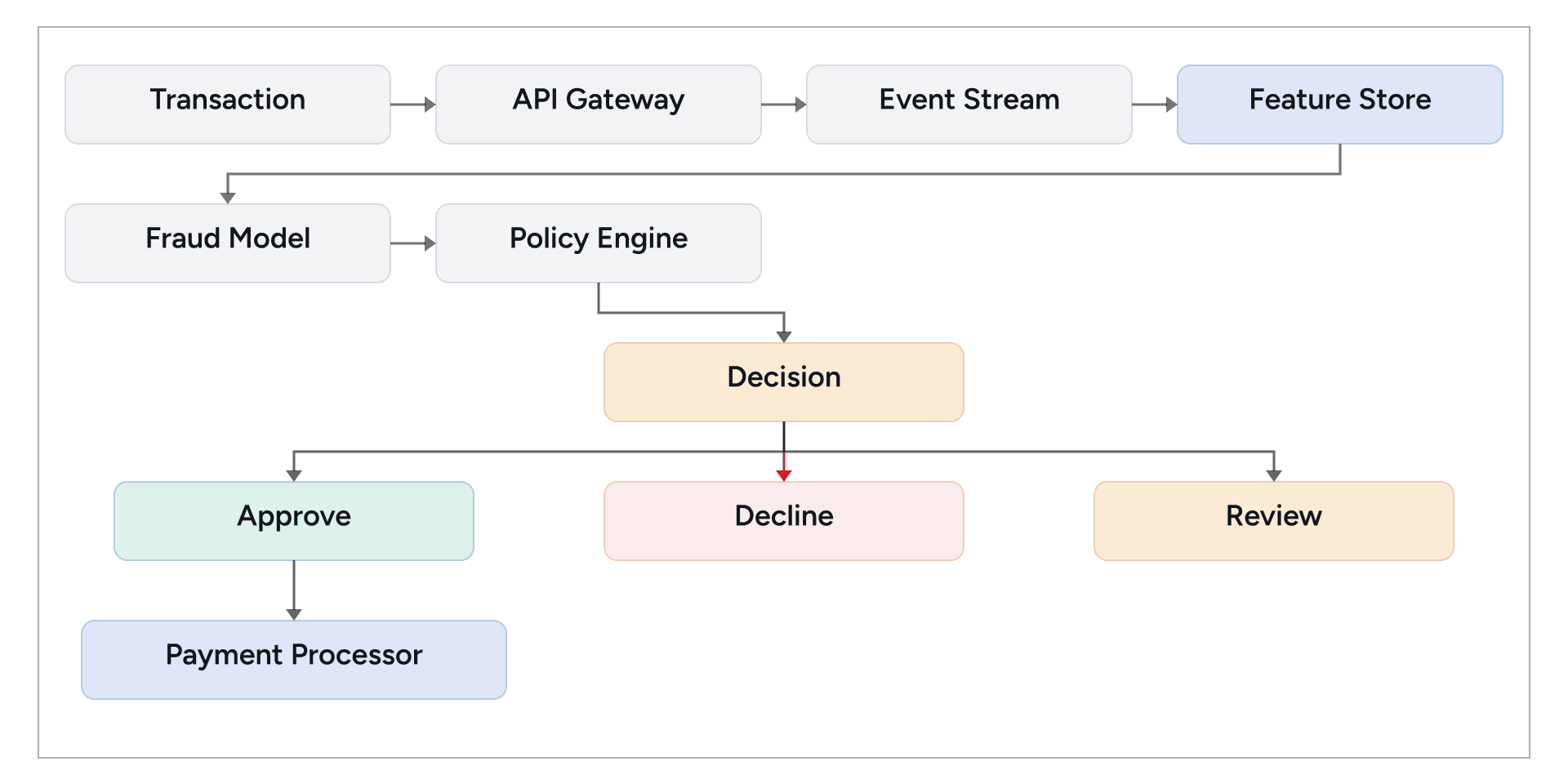
Key Components
- Real-time transaction stream: Captures payment events as they arrive
- Feature store: Provides the model with signals such as transaction history, device information, location, velocity, and account behavior.
- Fraud and anomaly models: Calculates risk scores such as transaction limits and other business constraints.
- Decision service: Combines the model output with those policies and determines whether to approve, decline, or route the transaction for review.
- Case-management system: Gives investigators a place to examine ambiguous or high-risk transactions.
- Audit and event store: Preserves the inputs, decisions, model version, and respective events for conducting investigations at a later stage.
Critical-level Control
The decision path requires a latency budget because adding more services to a payment flow can increase response time. The model’s confidence thresholds should determine when the automation is appropriate, while policy rules must override an AI recommendation when a fixed business or risk condition is applied.
Main Cost Drivers
The largest costs usually come from live inference, streaming infrastructure, feature-store operations, third-party risk signals, and model monitoring. Transaction volume is also important since every additional payment triggers several data lookups, model calls, and downstream events.
Failure Modes
False positives can increase investigation workload by sending too many legitimate cases for review, while false negatives can allow suspicious activity to go undetected. Other failure modes include stale sanctions or screening data, poor document extraction, incomplete customer information, and risk scores that investigators cannot clearly interpret or explain.
Fallback
A fallback rules engine should be able to handle failure conditions without waiting for the AI model to recover. The exact response depends on the transaction risk and business policy. Some transactions may continue under deterministic rules, while others may require step-up authentication or review.
AI is already being used across financial services for fraud detection and other risk functions; however, the production challenge involves managing the risks around those systems as they become part of live workflows.
2. How Can Banks Build Production-Ready AI for AML and KYC Decision-Making?
AML and KYC workflows have a different problem from real-time fraud detection. The system often has more time to investigate a case, but it also has to preserve evidence, explain why a case was escalated, and support human investigators. Therefore, a production architecture needs to connect automated analysis with source verification, case management, human review, and an audit record.
In financial services, the architecture has to function in a way that manages AI decision-making, approvals, data, and model trustability; these tasks shape the system more than the model itself.
 Jani Hardik SanjayProduct Owner I
Architecture
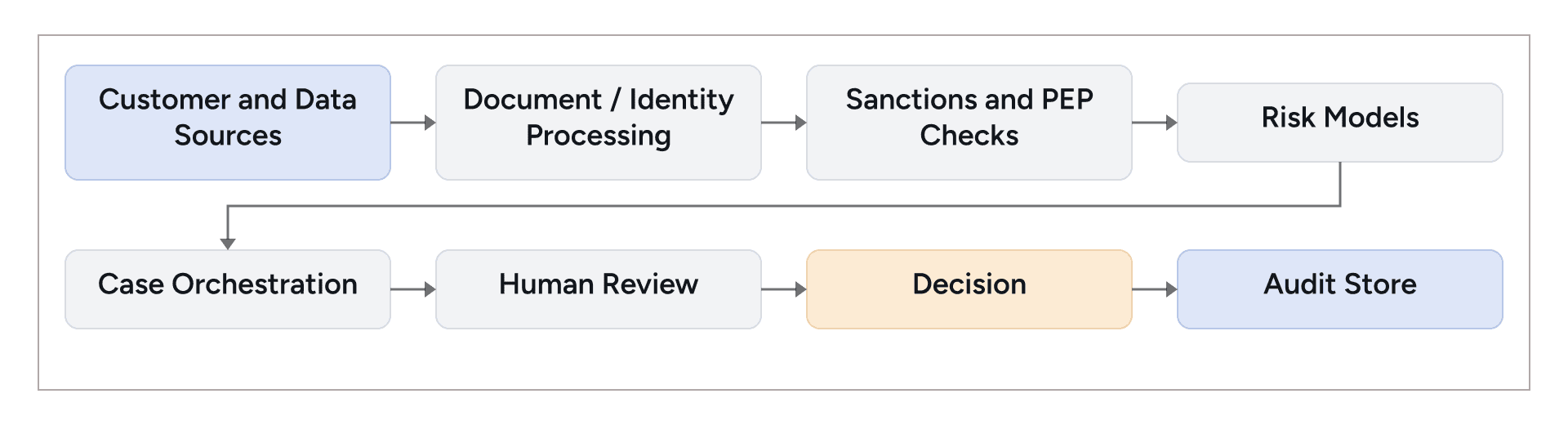
Key Components
- Customer and Data Sources: Provides identity, account transaction, and supporting information.
- Document and Identity Processing: Extracts and validates information from submitted documents and identity signals.
- Sanctions and PEP Screening: Checks relevant external datasets and internal policies.
- Risk Models: Identify patterns or assign risk scores that help prioritize cases.
- Case Orchestration: Brings the evidence and model outputs into a review workflow.
- Human Review: Handles cases that cross risk or uncertainty thresholds.
- Audit Storage: Preserves evidence, decisions, model versions, and investigator actions.
Critical-Level Controls
Risk scores should be explainable enough for investigators to understand why a case was flagged, while external screening data must undergo a freshness check. The workflow should preserve the evidence that has been used to reach a decision, and the record of who reviewed or changed the case, model version, and policy versions should also be traceable so an institution can distinguish a decision made under a set of rules from a review that will take place at a later stage.
Main Cost Drivers
Document, identity, and sanctions APIs, model inference, case-management infrastructure, data storage, and human investigation all contribute to operating costs.
Failure Modes
False positives can increase investigator workload, while false negatives can allow suspicious activity to go undetected. Other issues include stale screening data, poor document extraction, incomplete customer information, and risk scores that investigators cannot interpret.
Fallback
If automated checks cannot be completed, the workflow should be preserved and routed for the manual process while preventing incomplete evidence from being mistaken for a completed review.
3. What Should a Production-Ready AI Architecture Include for Credit Decision-Making?
Credit decision-making places AI in close proximity to the financial outcome that can affect both the lender and the borrower; therefore, the architecture needs to establish boundaries for recommendations made by the model and lending policy permissions.
Architecture
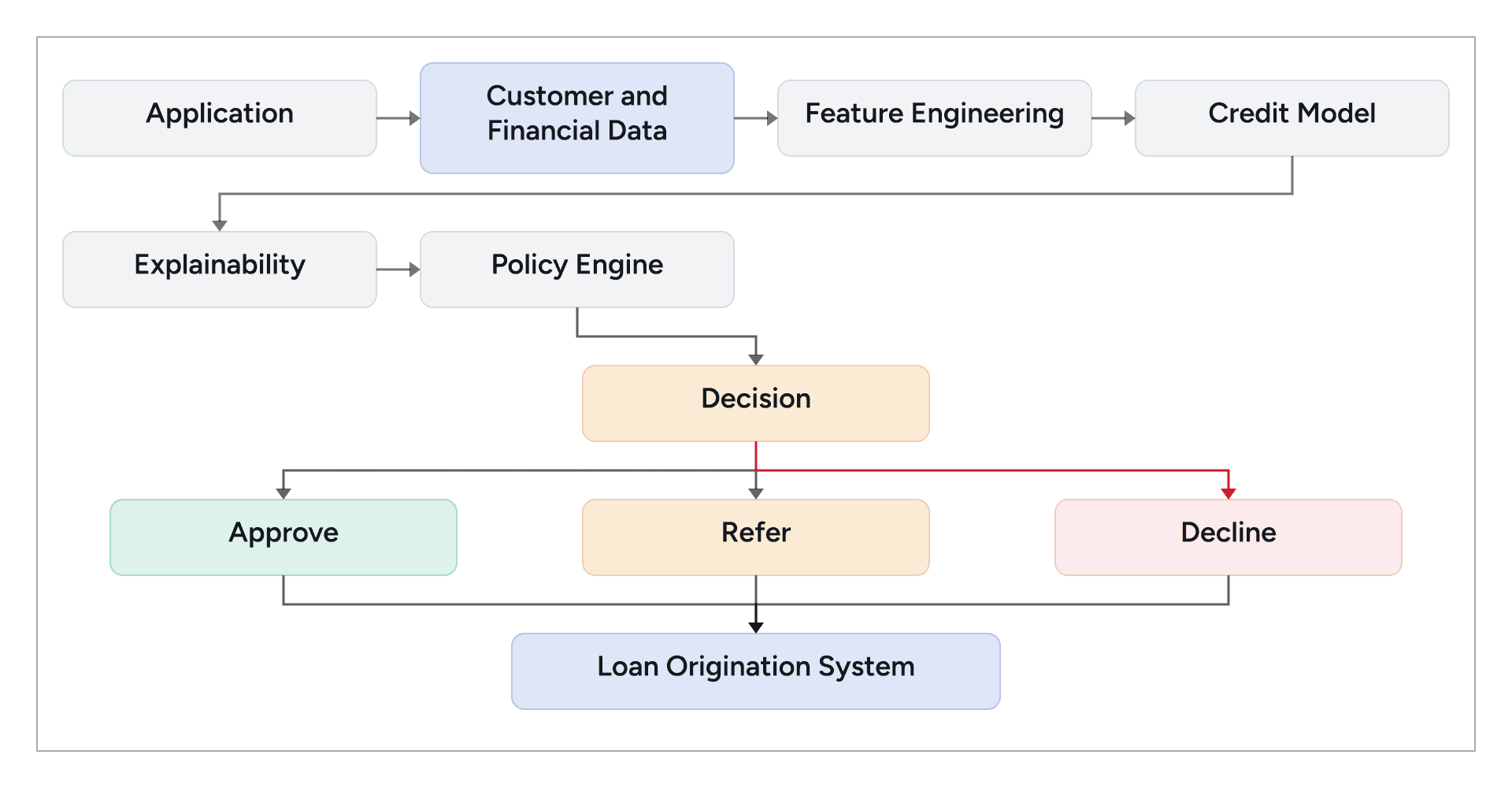
Key Components
- Application Layer: Collects the request and required information
- Customer and Financial Data: Brings together permitted internal and external data.
- Feature Engineering: Converts source information into model-ready variables.
- Credit Model: Estimates the relevant risk outcome
- Explainability Layer: Provides information needed to understand the decision.
- Policy Engine: Applies lending rules, eligibility requirements, limits, and approval conditions.
- Loan Origination System: Executes the approved workflow and records the resulting decision.
Critical-level Controls
Model validation should cover performance and relevant risk characteristics before deployment and after material changes. Fairness and bias testing should also be appropriate to the use case. Human review can be triggered for borderline cases or applications that require additional assessment, while decision history should include inputs, model version, policy version, outcome, and overrides.
Main Cost Drivers
Credit data and bureau APIs, model training and validation, data processing, real-time inference, monitoring, and human underwriting can all contribute to the cost.
Failure Modes
Poor data can produce incorrect assessments even if the model is functioning properly. Other failure modes include model drift, incorrect risk segmentation, unexpected behavior in edge cases, and failure in the external credit data service.
Fallback
A production system can route cases to manual underwriting. If the required data provider is unavailable, then the system should follow a documented policy.
Read our guide on AI lending products to learn more about credit risk, compliance, and operational controls.
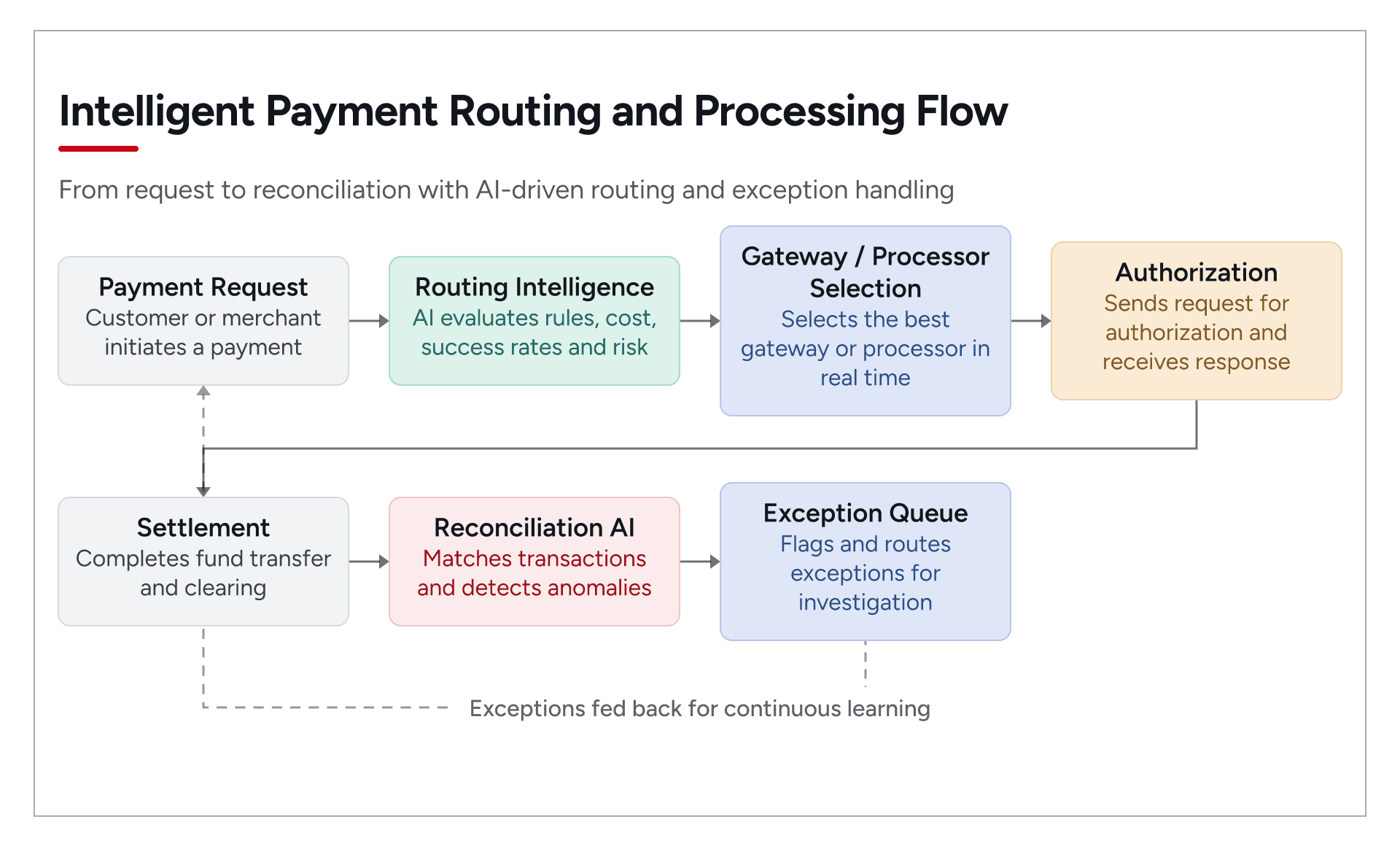
4. How Can AI Improve Payment Routing and Reconciliation Without Losing Control?
Payment routing has a different optimization problem, as it requires deterministic boundaries. The system needs to choose between gateways or processors while ensuring that transaction constraints, fees, geography, currency, and settlement requirements are handled well.
AI can help identify patterns in processor performance or reconciliation exceptions; however, the model should not select a route simply because it predicts that route will perform well.
Architecture
Key Components
- Payment Request Service: Validates and creates the transaction.
- Routing Intelligence: Evaluates available routes using permitted signals.
- Gateway and Processor Layer: Sends the transaction to the selected provider,
- Authorization and Settlement Services: Handle the payment lifecycle.
- Reconciliation Service: Compares transaction, processing, and settlement records.
- Exception Queue: Routes unmatched or unusual transactions for investigation.
Critical-level Controls
Routing should have deterministic constraints covering currencies, payment methods, geography, processor availability, transaction limits, and other business requirements.
Idempotency is essential wherever a retry could create a duplicate transaction, while reconciliation should compare expected and received settlement records.
Payment events should remain traceable from initiation through settlement, and manual override should remain available for operational scenarios.
Main Cost Drivers
Processor and gateway fees, transaction volume, external payment APIs, live inference, and reconciliation infrastructure are the primary areas that increase costs.
Failure Modes
A routing model may choose an unsuitable route while a processor could be unavailable after a route is selected. Similarly, retries can create duplicate-payment risks if the idempotency is weak while settlement records can also fail to match the original transaction.
Another risk is subtler where a route may be technically valid but financially or operationally unsuitable within current conditions.
Fallback
The system should maintain deterministic routing rules that can take over when AI recommendations are unavailable, while the exceptions must be moved to a controlled queue.
5. How Should Banks Architect Agentic AI for Banking Operations and Customer Service?
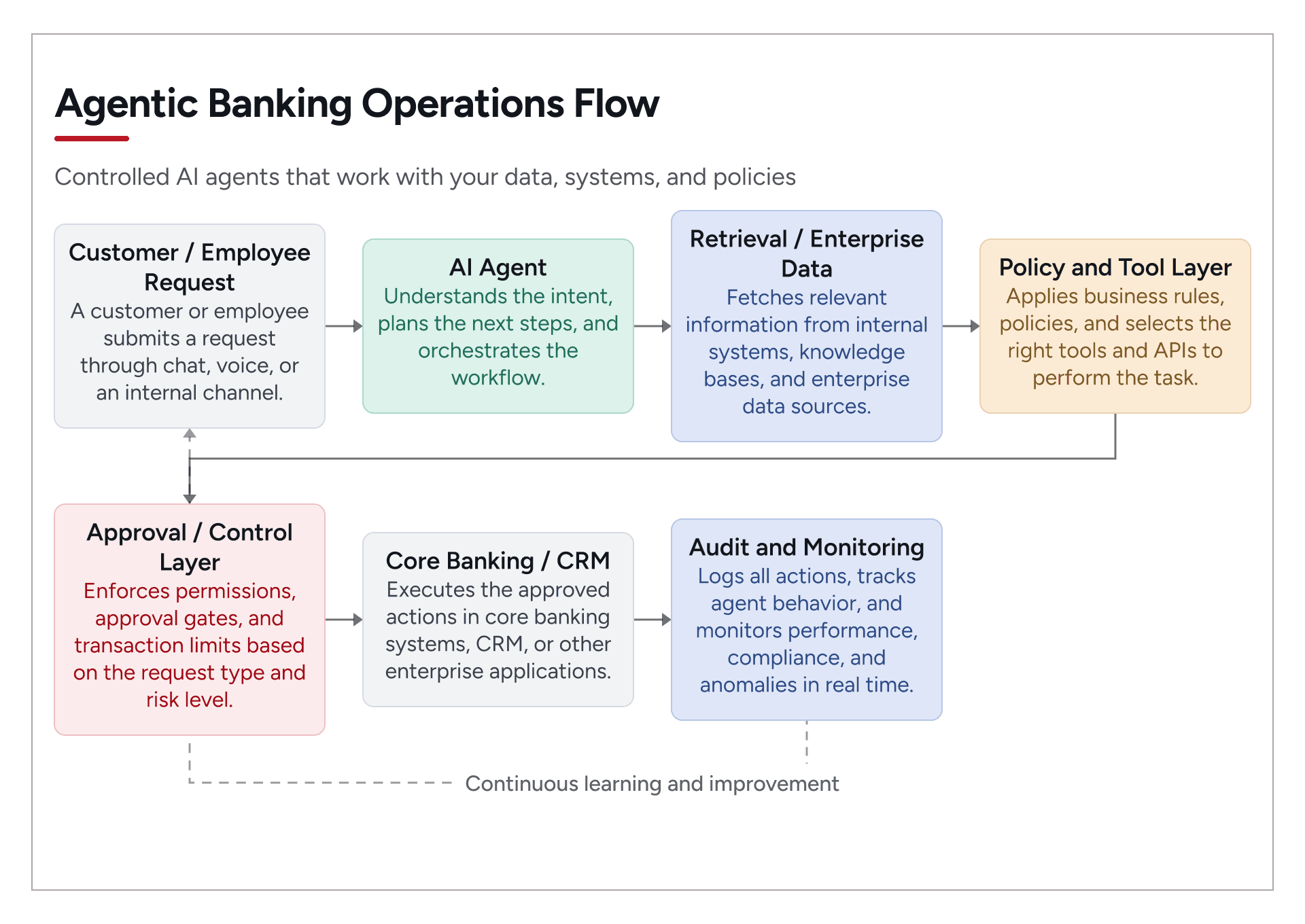
Agentic AI changes the architecture in a major way as it can retrieve information, update systems, and trigger actions. With agentic AI in banking, the critical point shifts from the response to the actions the agent is allowed to take.
Architecture
Key Components
- Request Layer: Receives customer or employee request.
- AI Agent: Interprets the request and determines which permitted steps are required.
- Retrieval Layer: Provides approved enterprise information.
- Tool Layer: Exposes specific APIs and actions.
- Policy and Control Layer: Checks whether the requested action is permitted.
- Approval Layer: Routes high-risk actions to an authorized person.
- Core Banking and CRM Integrations: Execute approved actions.
- Audit and Monitoring: Records agent decisions, tool calls, approvals, errors, and outcomes.
Here, potential use cases include customer-service assistance, account servicing, dispute handling, document processing, internal operations, and exception management.
Critical-level Controls
The agent should have permission for every tool it can call. High-risk actions should require human approval or additional verification and transaction limits must restrict the financial impact of automated actions.
Input validation should cover malicious or malformed requests while agent activity logs should capture which tools were called and the information obtained from it. Circuit breakers should stop repeated calls or unexpected agent behavior before it spreads through downstream systems.
Main Cost Drivers
LLM interface is one cost, but it is only part of the bill. Tool and API calls, retrieval infrastructure, agent orchestration, monitoring, data access, and human escalation can all increase operating costs.
Failure Modes
An agent can select the wrong tool, misunderstand an instruction, enter a repeated action loop, or produce an incorrect response. Prompt injection and other malicious inputs can also attempt to manipulate the agent into using tools that are not within the intended workflow. The highest risk failure occurs when an agent takes a consequential action without any human review process between the model’s system and the underlying system.
Fallback
High-risk actions should have a human approval path, while lower-risk can fall back to deterministic processes or a standard service workflow when the agent cannot complete the request safely.
How Do AI Reference Architectures for Fintech and Banking Compare by Cost, Controls, and Failure Risk?
The five AI reference architectures for fintech and banking solve different problems and carry different operating costs and failure risks. AI also introduces a scale-cost trade-off. McKinsey estimates that AI could reduce some banking cost categories by as much as 70%, while rising technology costs could limit the net reduction in a bank's aggregate cost base to 15-20%.
The table below compares the major trade-offs teams should evaluate before putting each architecture into production.
The table below compares the major trade-offs teams should evaluate before putting each architecture into production.
Architecture | Typical Decision Time | Main Cost Drivers | High Risk Failure | Production Control |
AI fraud detection | Milliseconds | Live inference, streaming data, feature infrastructure, and external fraud signals | A legitimate payment is declined, or a fraudulent activity passes through | Rules-based fallback, confidence thresholds, and human review for uncertain cases |
AI AML and KYC | Seconds to minutes | Identity and screening APIs, document processing, case infrastructure, investigator time | Suspicious activity is missed or false positives overwhelm investigators | Explainable risk signals, current screening data, evidence retention, and escalation paths |
AI Credit Decision-making | Seconds | Financial and bureau data, model operations, feature processing, and underwriting review | An applicant receives an incorrect or unfair lending decision | Model validation, fairness testing, policy separation, and human review thresholds |
Intelligent Payment Routing | Milliseconds to seconds | Transaction volume, processor and gateway fees, live routing, payment APIs | A payment takes the wrong route, fails, or creates an avoidable processing cost | Deterministic routing rules, idempotency, processor health checks, and manual override |
Agentic Banking Operations | Seconds to minutes | LLM inference, tool calls, retrieval orchestration, human escalation | An agent takes an action it was not authorized to take | Tool permissions, approval gates, transaction limits, activity logs, and circuit breakers |
How Should Banks Choose the Right AI Architecture for Their Use Case?
Banks should assess a few factors before choosing an architecture. They can follow a simple rule to bring these factors together which states that the greater the financial or regulatory consequences of an AI decision, the more the architecture should separate AI recommendations from policy enforcement and transaction execution.
Decision Factor | What to Ask? |
Transaction Criticality | Could an incorrect AI decision approve a transaction, credit, or block a customer? |
Decision Latency | Does the decision need to take place in milliseconds, seconds, or can it wait for review? |
Regulatory Exposure | Does the workflow affect lending, identity, fraud, AML, or another regulated decision? |
Data Maturity | Is the required data complete, reliable, live, and available at the time of making decisions? |
Human Review | Which decisions require a person to approve, reject, or investigate the AI output? |
Integration Complexity | How many systems, APIs, payment rails, or third-party services should be able to connect with the architecture? |
AI Operating Cost | How much will inference, data processing, external APIs, monitoring, and human review cost at production volume? |
Failure Tolerance | What actions must be taken when the model, data source, API, or supporting infrastructure fails? |
Explore how infrastructure, model, API, and operational costs affect an AI-powered financial product. Read the blog to estimate AI fintech development costs.
What Should Be Checked Before Deploying AI Reference Architectures?
Before an AI system reaches production, the team needs to check if they can take a major decision in case AI fails to give right answers, is unavailable, or uncertain about what step should be taken next. They can refer to the following checklist before release:
☐ Data sources and lineage are documented
☐ The model has been independently validated
☐ AI decision boundaries are documented
☐ Policy and rules are separated from the model
☐ Human escalation points are defined
☐ Audit evidence is captured
☐ Fallback paths have been tested
☐ Monitoring covers outcomes and model performance
☐ Production costs are visible
☐ Third-party dependencies are mapped before release
☐ Resilience and recovery have been tested
☐ Regulatory evidence can be reproduced
It is important to follow this sequence as data definitions, requirements, and third-party access should be settled early on instead of discovering them after starting the development process. Ownership should also be established in production deployment as the model can be technically sound and still fail the production test if nobody knows who can stop it, who handles an escalation, or how an incident will be investigated.
Why Does Production-Ready AI Architecture in Banking Require More Than an AI Model?
A production AI system in banking may face challenges related to incomplete data, legacy systems, payment dependencies, policy rules, audit requirements, and latency limits. This is where GeekyAnts brings their product engineering expertise and BFSI experience into the architecture. The team works across AI, payments, lending, compliance, cloud modernization, security, QA, and observability, so that the model can be designed as part of the financial workflow.
What Financial Product Experience Does GeekyAnts Bring?
GeekyAnts has been engineering digital products since 2006 and has delivered 550+ engagements across products and enterprises. Its work includes banking, payments, lending, wealth management, and other financial technology products. We have also worked on a global Fintech platform processing more than $400 million in annual payments. Our engineering teams have experience with systems where integrations, transaction flow, reliability, and production behavior have to work together.
In financial products, AI cannot exist on the sidelines. It has to work with the data, APIs, workflows, and infrastructure that already keeps the business running. Our focus is to make these systems work together from the start, so that the teams are not left with rebuilding the architecture when an AI use case moves into production.
Kunal KumarChief Revenue OfficerCase Study: How GeekyAnts Modernized Banking Product in the Age of AI?
GeekyAnts worked with a neo-banking company to revamp an existing mobile banking application built for younger customers. The project involved moving the application toward a modern technology stack, extending its capabilities, and building features for financial management.
The team worked with React Native, and Kotlin, and introduced solutions for state management, data fetching, animations, rewards, savings, goals, app settings, a help centre, and administrative functions. The development process was broken down in different phases, with feature-level QA, client reviews, regular demonstrations, and builds shared for verification. The engagement later expanded into a long-term collaboration.
Engineering and AI Delivery Standards
The production work also depends on how engineering teams handle information, changes, incidents, and service continuity. GeekyAnts holds ISO 9001:2015, ISO/IEC 20000-1:2018, and ISO/IEC 27001:2022 certifications covering quality management, IT service management , and information security. These certifications provide processes around areas such as information protection, access controls, incident handling, change management, and service continuity. GeekyAnts is also a registered member of the Claude Partner Network (Services Track), and builds on GPT models.
What Should Banks Look for When Moving AI into Production?
The next step is to decide where AI can create measurable value, what evidence is needed before deployment, and how the system will behave when the conditions change.
For banking and fintech teams, the focus should now move from architecture diagrams to implementation choices, control design, operating cost, and production testing. This is where a promising AI use case becomes a system that businesses can run and govern.