

Key Takeaways
- AI in finance has moved past simple support scripts. Modern deployments approve loans, settle payments, and process claims inside live transaction systems.
- A chatbot for finance carries real exposure the moment it touches payment data, and PCI DSS compliance must govern that exposure from the first line of architecture.
- Production failures in a chatbot for finance carry a direct cost: exposed data, compliance findings, and rebuilt trust with regulators and customers.
- Enterprises that treat PCI DSS compliance as a foundation avoid the rework, delays, and audit failures that stall products after launch.
AI in Finance: From Support Chatbots to PCI DSS-Ready Transactions
Finance AI chatbots have moved past simple support scripts. KPMG International's Global AI in Finance report found that 71% of organizations use AI in their finance operations, with 57% of leaders reporting returns that exceed expectations. Leading banks and fintech firms use conversational assistants to approve loans, settle payments, and process claims inside live transaction systems.
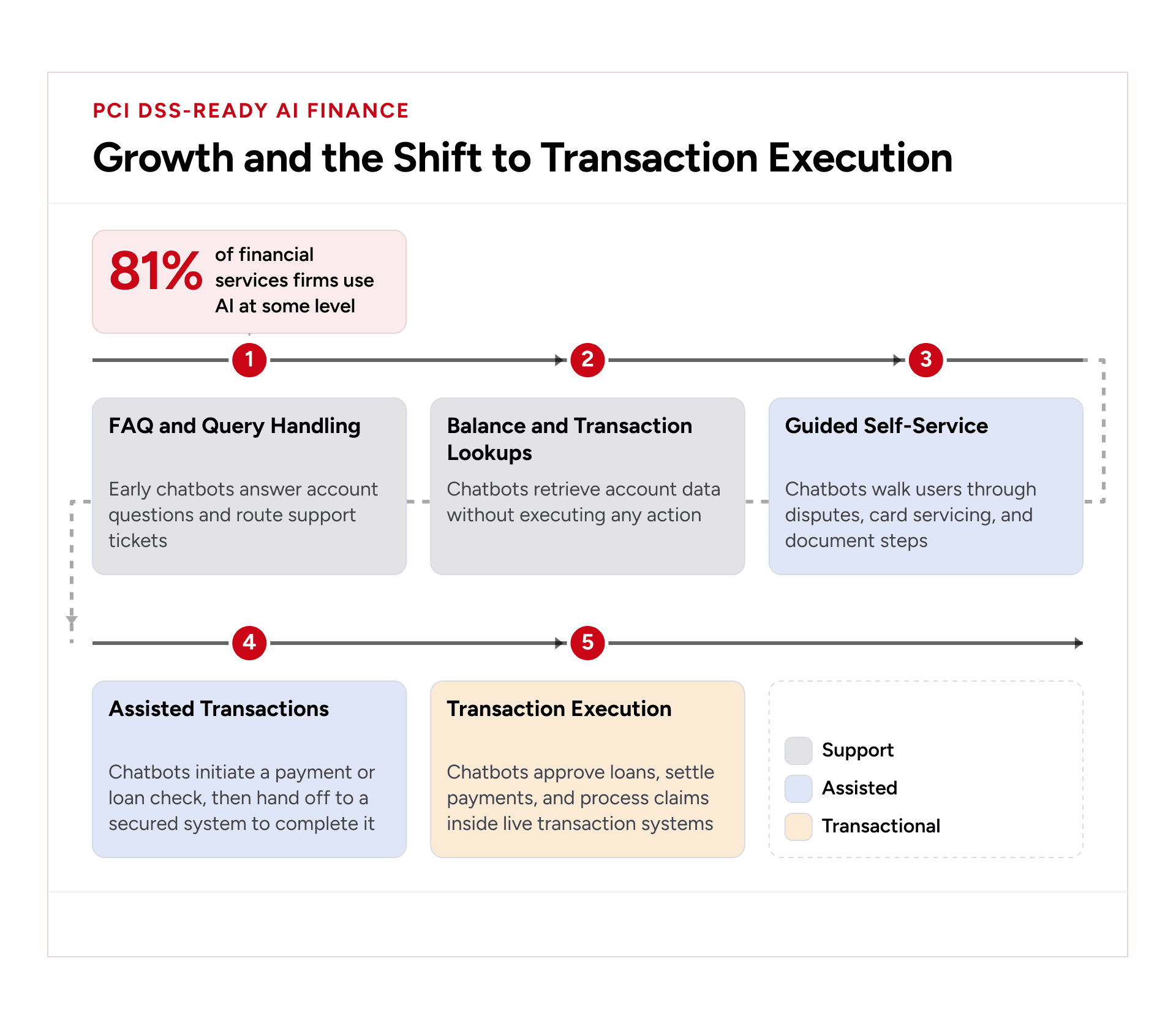
Support tickets used to close a financial conversation. A completed transaction closes it, and users treat that speed as a baseline expectation.
This creates new exposure. The moment a chatbot for finance touches payment data, it enters the scope of PCI DSS compliance, and the newest version of the standard, PCI DSS v4.0, sets even stricter requirements for authentication, encryption, and continuous monitoring across the cardholder data environment.
Fintech product leaders do need architecture decisions that hold up under compliance review, security audits, and real transaction volume. This blog lays out those decisions, from chatbot architecture to payment security to the production challenges that surface after launch.
Why AI in Finance Chatbots Are Becoming Core Banking Infrastructure
Banking transformation centers on a single interface: the chat window. Mobile app releases used to signal progress. A better signal is how much daily banking a chatbot for finance completes without human handoff, a sign of how far AI in finance has moved into core operations.
Customer support automation sets the pattern. Chatbots handle account queries, balance checks, and transaction history requests, work that used to fill call center queues. That shift freed teams to focus on complex cases.
Internal banking assistants apply the same model inside the organization. Staff use chatbots to pull records, check policy details, and resolve routine tickets, cutting the gap between a request and an answer.
Card servicing and payment dispute automation extend chatbots into transaction territory. A user can block a card, request a replacement, or file a dispute through conversation, and the chatbot routes the case through the right workflow.
Wealth management assistants add a personalization layer, analyzing spending patterns and financial goals to surface budgeting guidance or investment suggestions built around the user.
Each function reduces the cost of routine support work, since a chatbot handles a call center's daily volume without added headcount. Availability extends past business hours, so a user can resolve an issue at any point in the day rather than waiting for a branch to open. Personalization deepens engagement, since a chatbot uses account history to tailor advice instead of generic responses. Operational efficiency compounds across these gains, since chatbots integrate with existing systems and scale service without a proportional increase in staff. That combination turned chatbots from a support add-on into core infrastructure.
Every conversation with a banking client centers on transactions. In earlier engagements, teams asked for a chatbot that could answer account questions. The same teams want a system that can move money, with compliance built into the architecture from the pilot stage forward.
 Kunal KumarChief Revenue Officer
Banking clients bring transaction-ready requirements into the first meeting. Budget conversations move from chatbot licensing costs toward architecture review and compliance scope – a sign that finance AI chatbots have become core infrastructure in enterprise buying decisions.
Understanding PCI DSS Compliance for AI in Finance Products
Finance chatbots sit close to payment data, carrying real compliance weight. PCI DSS governs how that data moves, and AI systems fall under the same rules as any other system.
When does a chatbot for finance enter PCI DSS scope, and what governs it once it does?
A chatbot enters PCI scope the moment it can view, store, or influence cardholder data, whether typed into chat, passed to a processor, or saved in a log. The Cardholder Data Environment (CDE) spans every system that touches card data, from the chat interface to backend logs and the payment gateway API. Sensitive Authentication Data covers CVV codes, PINs, and chip data, barred from storage after authorization.
Hosted payment fields, tokenization, and gateway redirects route users to a secured checkout without exposing card data to the chatbot. Iframe-based capture, strict input blocking, and data flow diagrams keep the model layer separate and auditable, reducing how much of the system carries PCI obligations.
Version 4.0.1 is the current standard, with every requirement enforced since March 2025 and a stronger emphasis on continuous monitoring, authentication, and targeted risk analysis over fixed checklists. Large language models sit outside the original PCI framework, so PAN strings and card verification codes cannot reach a prompt or a training set. Any AI system that can affect payment flows, payment data handling, or security controls should be treated as part of the PCI DSS risk review and scoped carefully during architecture planning.
How Do You Architect a PCI DSS-Compliant Chatbot for Finance?
The architecture decisions that matter most, happen even before a single API gets built. Teams that map every layer, from input filtering to the core banking connection, catch compliance gaps at the whiteboard stage itself instead of during a security audit six months into development.
 Jani Hardik SanjayProduct Owner I
Enterprise finance teams treat chatbot architecture as a feature addition to an existing platform. Projects that separate the interaction layer from the payment orchestration layer from day one need fewer changes during later phases, since the security boundary becomes part of the design instead of a retrofit.
A finance AI chatbot is a set of controlled layers, each responsible for a narrow function and each enforcing its own boundary around sensitive data.
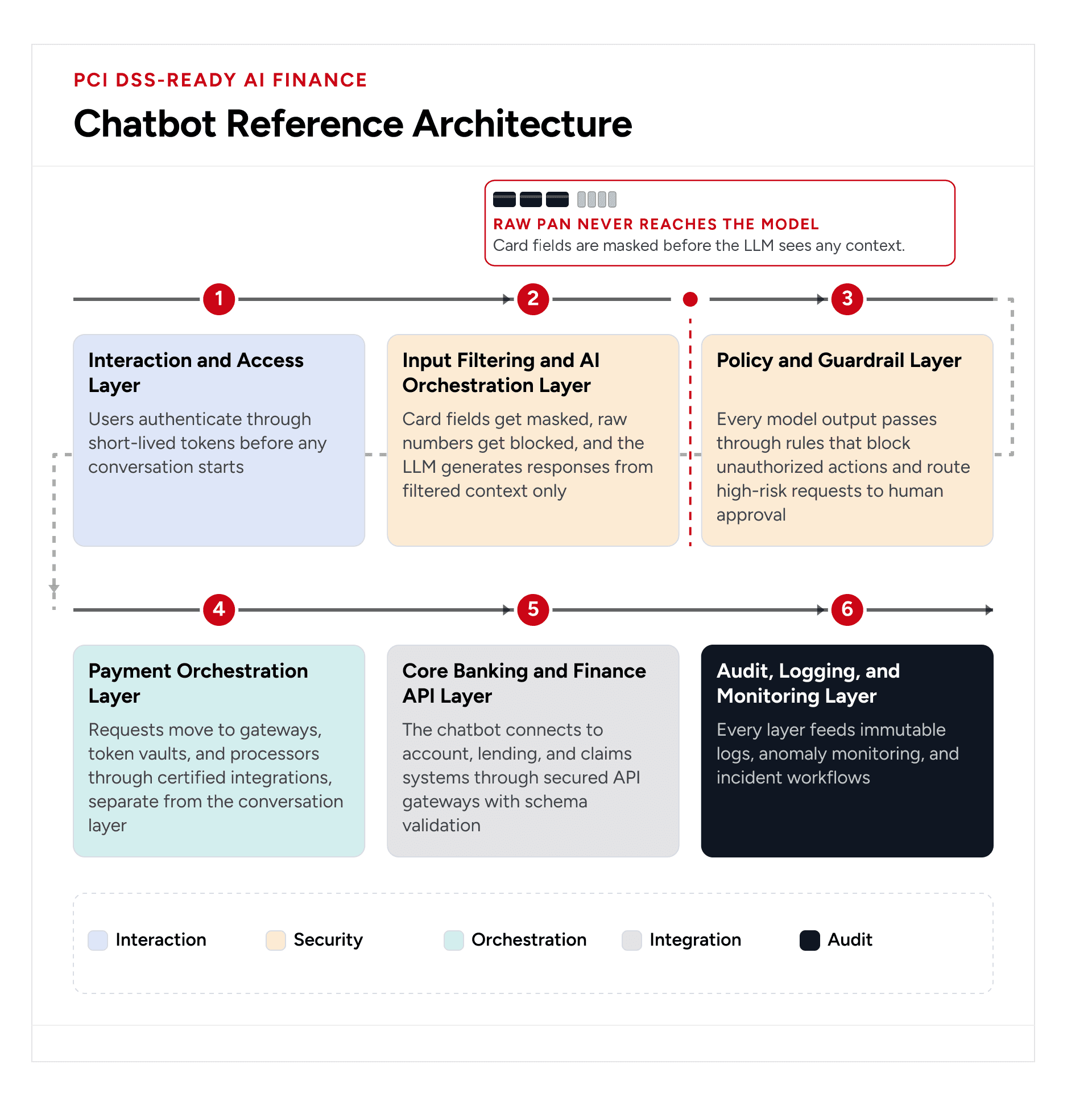
Interaction and Access Layer
Users reach the chatbot through web, mobile, or messaging channels. Authentication happens before any conversation starts, and sessions run on short-lived tokens with inactivity timeouts. Every login and session event feeds into the layers below it.
Input Filtering and AI Orchestration Layer
Before a message reaches the model, this layer masks card fields, blocks raw card numbers typed into free text, and strips sensitive data from the input. The LLM orchestration layer routes the filtered message to the model, and a RAG layer retrieves account or policy context from a knowledge base that holds no cardholder data. The model generates a response from that context, and it does not receive raw payment data at any point.
Policy and Guardrail Layer
Every model output passes through guardrails before reaching the user or triggering an action. This layer's rules block unauthorized transaction types, flag anomalous requests, and route high-risk actions to human approval before execution.
Payment Orchestration Layer
Payment requests move to gateways, token vaults, and card processors through certified integrations. The chatbot does not touch card data at this stage, since tokenization and hosted payment fields keep transaction handling separate from the conversation layer.
Core Banking and Finance API Layer
This layer connects the chatbot to account systems, lending platforms, and claims systems through secured API gateways. Strict schema validation blocks malformed or unexpected requests before they reach core systems.
Audit, Logging, and Monitoring Layer
Every earlier layer feeds this one. Immutable logs capture each interaction, API call, and model decision, with sensitive fields masked before storage. Monitoring tracks anomalies across the full chain, and incident workflows activate when a threshold is crossed.
How To Ensure a Payments Chatbot Is PCI DSS Compliant?
These decisions belong in the architecture phase of any chatbot for finance, before a single line of code ships.
Tokenization and vaulting
Card numbers become tokens the moment they enter the system. A separate vault, outside the chatbot's reach, maps tokens to real data, and the chatbot handles nothing beyond the token itself.
Encryption and dynamic masking
PCI DSS Requirements 3 and 4 call for encrypting cardholder data at rest and in transit. Any card number shown to a support agent or written to a log appears masked, with the last four digits visible and the rest hidden.
Access control and authentication
PCI DSS Requirement 7 restricts access to cardholder data by business need-to-know, so only the roles that require chatbot administration or payment configuration get access. Requirement 8 calls for multi-factor authentication on every account that can reach that access, cutting the risk from a single compromised credential.
Logging and monitoring
Every chatbot interaction and access attempt gets logged, and feeding those logs into a Security Information and Event Management (SIEM) system lets a team correlate chatbot activity with the rest of its security events in real time.
Secure secrets management
API keys, credentials, and service tokens live in a dedicated secrets manager, rotated on a schedule, kept out of the chatbot's code and its integrations.
Payment gateway isolation
The chatbot hands off payment execution to a certified gateway through a redirect or hosted field, keeping transaction processing separate from the conversation layer.
Data retention policies
Chatbots should hold transaction data for the length of time business need requires and remove it on a set schedule, cutting the volume of data exposed in a breach.
Third-party and vendor due diligence
PCI DSS Requirement 12.8 covers risk from third-party service providers, so any external chatbot platform needs a signed Attestation of Compliance and a documented review of its own security practices before it touches payment data.
What separates chatbot-assisted payment from chatbot-handled payment?
A chatbot-assisted payment guides the user toward a secured checkout, with card data passing through the gateway instead of the chatbot. A chatbot-handled payment processes the transaction inside the conversation itself. AI assisted models keep PCI scope small; handled models expand it and require a stricter set of controls.
These choices keep an AI chatbot for finance inside a narrow, defensible boundary for PCI DSS compliance. That boundary holds up as AI in finance adoption scales.
Why Does AI Governance Matter for a Chatbot for Finance?
PCI DSS protects card data. A chatbot for financial product carries risks that the standard does not cover.
What risks does AI governance address?
Prompt injection turns a normal message into a hidden command for the model. Hallucinated guidance sends a user toward the wrong action. Unsafe tool calls and unauthorized transaction triggers let a model act on something that needed human approval. Insecure RAG retrieval pulls the wrong document into a response, and PII leakage exposes data that should stay hidden. Stale policy answers and model drift pull the system out of step with current rules over time.
How does governance work in production?
Access controls limit who can change a model or its prompts, and version control tracks each change. Red-team testing probes the system before an attacker does. Policy-based tool execution limits what actions a model can trigger, and human approval covers any high-risk transaction. Fallback logic catches failures before they reach the user, and decision logs record the reasoning behind each output.
Where must auditability reach?
A complete audit trail covers user intent, retrieved context, model output, tool call, payment event, and final response.
RAG vs Fine-Tuning: Which Architecture Fits AI in Finance Products?
Every finance AI chatbot faces the same architecture decision. Retrieval-Augmented Generation (RAG) and fine-tuning solve the same problem in different ways, and the choice shapes security, compliance, and cost after launch.
Factor | RAG | Fine-Tuning |
Security | Sensitive data stays in a controlled retrieval layer | Data gets embedded into model weights |
Compliance | Easier to audit and update | Harder to prove what the model learned |
Data freshness | Updates through the knowledge base without retraining | Requires retraining for new information |
Explainability | Traceable to a source document | Difficult to trace a specific answer |
Operational risk | Lower, since retrieval can be corrected | Higher, since errors sit inside the model |
Cost | Lower setup, ongoing retrieval cost | Higher training cost, lower per-query cost |
Governance | Policy applies at the retrieval step | Requires retraining to change behavior |
RAG keeps sensitive data outside the model itself, which limits exposure and keeps the compliance trail intact. Fine-tuning locks financial information into model weights, a structure that resists correction and complicates every audit that follows. For a chatbot for finance operating under PCI DSS compliance, RAG offers a safer starting point.
What Production Challenges Surface After Prototyping a Chatbot for Finance?
PCI scope creep happens when payment data spreads into systems, logs, or prompts that sit outside the compliance boundary the architecture was built around, pulling more of the chatbot into audit territory than intended.
Scope creep doesn't show up as one bad decision. It shows up as ten small ones. A debug log that captures more than it should, a support screen that pastes in the full transaction instead of the token, a test environment that never got cleaned up. None of those feel like a PCI problem at the moment. By the time someone notices, the boundary has already moved.
Jani Hardik SanjayProduct Owner ITeams that skip a formal production-readiness review discover PCI scope creep later, once card data drifts into logs or prompts. A structured checklist covering threat modeling, PCI-zone review, and payment sandbox testing catches these gaps before a system reaches real users.
Most failures show up after the prototype stage, once a chatbot for finance meets live payment systems and real transaction volume.
Common production challenges
- PCI scope creep expands when payment data drifts into logs, prompts, or storage layers without a defined boundary.
- Payment flow failures increase when legacy systems lack real-time APIs and requests fail under load.
- Weak environment separation lets sandbox and production share access paths, widening the attack surface.
- Incomplete audit trails break the link between user input, model output, and transaction execution.
- Latency builds across multi-step payment journeys as each security check adds delay.
- Poor handoff to human support loses context when a conversation moves from bot to agent.
- Inconsistent chatbot responses return different answers to the same question across sessions.
- Insecure logging and weak role-based access controls turn routine records into a liability.
- Vendor and third-party risk grows when a platform offers limited visibility into its own data handling.
- Incomplete test coverage leaves edge cases, including partial payment failures, unverified before launch.
- Cloud cost and scaling issues emerge as inference and monitoring costs outpace usage.
Production-readiness checkpoints
- Threat modeling
- Data flow mapping
- PCI-zone review
- RAG safety testing
- Payment sandbox testing
- Load testing
- Monitoring and incident workflows
- Compliance evidence collection
Complete each checkpoint before a chatbot for finance moves past the pilot stage.
Build, modernize, or integrate?
Growth-funded buyers choose one of three paths. Building a custom chatbot offers full control and demands the most time and compliance work. Modernizing an existing system adds AI capability to infrastructure in place, a faster route when the underlying systems support it. Integrating a third-party platform offers the fastest path but shifts vendor risk and visibility gaps into the equation.
Chatbot for Finance Use Cases Across Banking, Insurance, and Wealth Management
A chatbot for finance operates across every major financial vertical.
Payments
PayPal's AI chat support handles disputes and unauthorized transaction reports, guiding users through identity checks without leaving the conversation.
Lending
HDFC Bank's Eva checks loan eligibility and returns pre-approved offers by connecting to internal credit systems in real time.
Insurance
Lemonade's AI Jim processes claims through chat, approving and paying simple cases within minutes of validation.
Wealth and Investment
Bank of America's Erica delivers portfolio updates, spending insights, and transaction assistance across millions of client interactions.
These examples show a chatbot for finance functioning as an execution layer inside real financial workflows.
Why Choose GeekyAnts as a Finance Chatbot Development Company?
Clients come to us after building a prototype that could not survive a security review. Our systems are built with compliance as an architecture decision, and that approach lets clients move from a working demo to a production system without a redesign in between.
Kunal KumarChief Revenue OfficerEnterprise buyers ask vendors for evidence of PCI DSS experience before signing a statement of work. GeekyAnts brings direct experience across banking migrations and payment platforms handling hundreds of millions of transactions, giving buyers a reference point beyond a sales pitch.
As a leading finance chatbot development company, GeekyAnts operates as an AI-powered digital product engineering and consulting company, working across secure architecture, platform modernization, RAG, and AI agents for finance products. Teams building a chatbot for finance need a partner who treats PCI DSS compliance as an architecture decision made before development starts, backed by enterprise-grade delivery standards.
GeekyAnts has executed a zero-downtime domain migration for one of India's largest private banks, updating over 100 partner integrations under an RBI mandate without a single customer disruption. GeekyAnts built a global payment platform that processes over 400 million transactions each year across four regions, an engagement that demanded the same compliance-aware architecture a chatbot for finance requires.
Case Studies
Scalable B2B Transaction Platform Powering 1M+ Payments
GeekyAnts built Vendly's transaction backend on NestJS and PostgreSQL, integrated Stripe for subscription revenue, and scaled the platform to a million-plus transaction ecosystem with 99.98 percent uptime under high-concurrency load.
Global Payment Platform for Cross-Border Transactions
GeekyAnts built a payment platform now processing over 400 million transactions each year across four regions, an engagement that demanded the same compliance-aware architecture a chatbot for finance requires.
Moving from an AI idea to a production-grade finance product starts with an architecture built for scale and compliance from day one.
Future of PCI-Compliant AI in Financial Services
The next phase moves a chatbot for finance into systems that act within strict control boundaries.
AI agents will handle full workflows: loan processing, payment execution, and claims settlement, running through predefined rules. Compliance checks will run alongside every action, validating data usage, access, and transaction rules during execution.
Hyper-personalized decisions will draw on transaction history, behavior patterns, and risk profiles to guide financial recommendations at scale. RAG pipelines will adjust retrieval by user role and context, pulling sensitive data through real-time APIs.
Regulators will raise their focus on AI-driven financial systems, making audit trails and explainability standard requirements across regions. A chatbot for finance built with compliance embedded in the architecture scales into this future with fewer barriers.
Sources & Citations
- https://kpmg.com/xx/en/media/press-releases/2024/11/ai-adoption-across-finance-functions-achieves-standout-levels-of-roi.html
- https://www.pcisecuritystandards.org/document_library/
- https://philaverse.substack.com/p/a-big-chatbot-milestone-for-bank
- https://www.americanbanker.com/news/how-bank-of-americas-erica-does-the-work-of-11-000-people