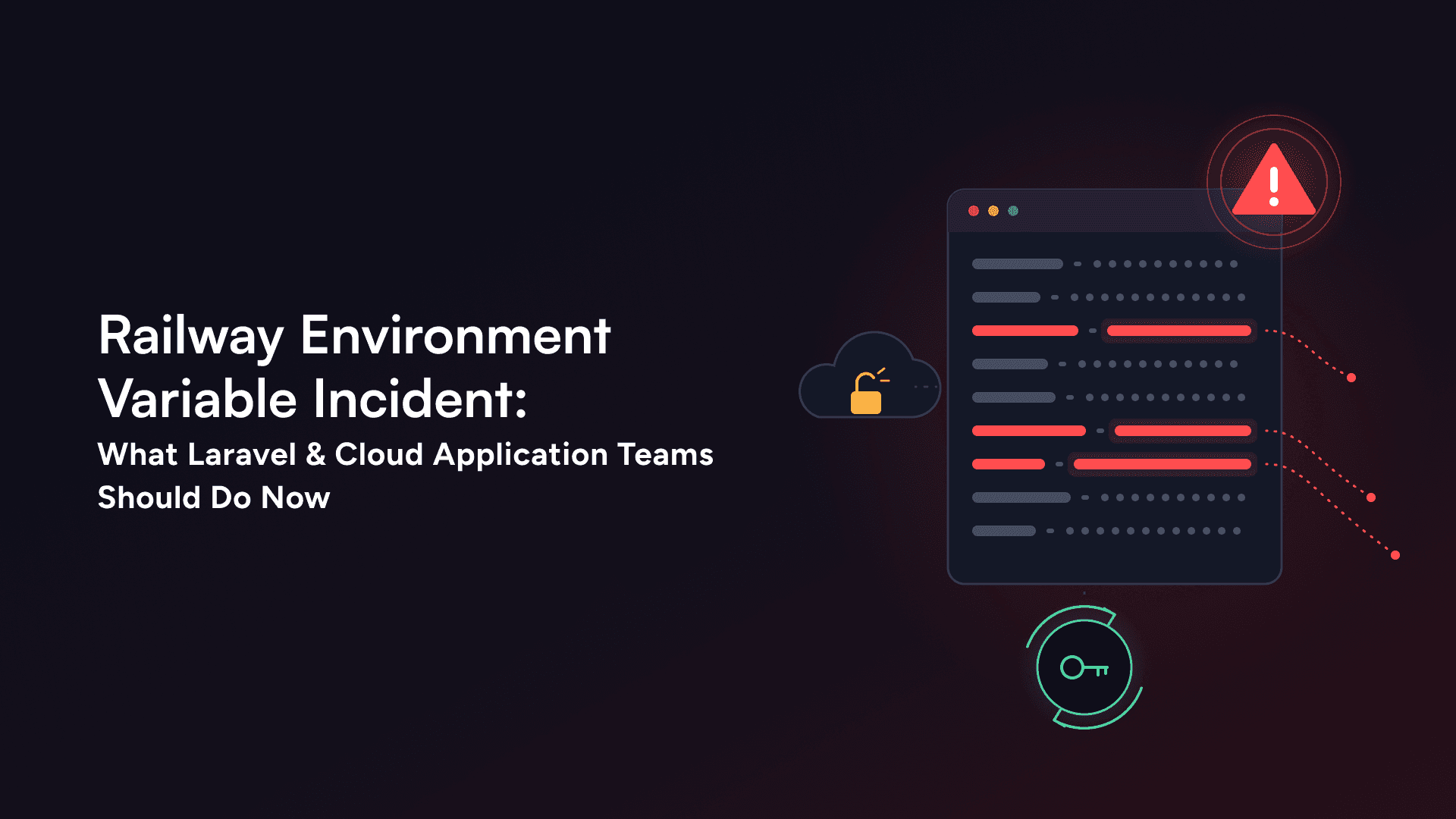


On October 21, 2026, Railway disclosed that an unauthorized third party may have accessed the systems that store its customers' environment variables. That exposes a problem that rarely comes up when engineering teams discuss cloud security: what happens when the infrastructure you depend on to recover from an incident is itself affected by that incident?
If your team deploys on a platform like Railway, you have probably already been asked the same question internally: what do we do now?
This post is a practical answer. It's written for Laravel and cloud application teams, and it deliberately avoids alarm. Incidents like this are a reasonable moment to take a breather to check your own setup, and most of what follows is good hygiene you would want in place for your team anyway.
What Exactly Happened?
The facts below come from Railway's own disclosure and from press coverage published on the first day after it. Details are still developing, so treat this as a snapshot:
- Railway said it detected unusual activity on October 21 in the systems that store customer environment variables.
- Its initial assessment was that an unauthorized party may have accessed encrypted variables and, for some of them, obtained the decrypted contents. Reporting describes the affected values as including API keys, database credentials and private registry credentials.
- Railway paused deployments while it investigated. The Defiant reported that this left customers unable to push updated applications carrying replacement credentials. Enterprise builds were restored late Wednesday, while customers on other plans were still waiting to redeploy.
- Railway's early analysis suggested the impact may be limited to a subset of users, but it still recommended that every customer rotate every stored secret and review service logs for unusual activity. It has not published a detailed scope.
- Railway described the incident as part of a series of attacks on platform companies aimed at compromising AI inference providers, and said it had notified upstream providers so they could proactively revoke potentially exposed keys.
One claim is still being examined as this blog was written. A developer has alleged that roughly $370,000 was stolen through secrets stored on Railway. On-chain analysts have tracked funds moving from a suspected attacker's wallet, but the link between that wallet and the Railway incident has not been confirmed.
Why Environment-Variable Exposure Matters?
Environment variables are the standard way to keep configuration out of code. In practice, they're also where applications keep the keys to everything else: database passwords, payment and email credentials, cloud storage keys, signing secrets and third-party API tokens.
That makes them an unusually high-value target. An attacker who reads a single set of variables doesn't need to find a vulnerability in your application. They already hold credentials that your application is trusted to use, and those credentials often work from anywhere on the internet.
Secrets Are Becoming the New Security Perimeter
There is also a structural point here, and it's the main lesson we'd draw from this incident. Secrets are the new perimeter. Attackers increasingly go after the layer that stores and manages credentials, rather than the services those credentials unlock. It's often the softer target, and it can be just as valuable if the stolen keys grant access to paid AI accounts, databases or cloud resources. Your application can be well-written and fully patched, and its security still depends on every platform that holds a copy of its secrets.
The practical conclusion is not "stop using managed platforms." They are vital in removing a great deal of operational burden for growing teams, and most teams are safer for using them. The lesson here is to design in a manner that a single vendor's bad day is survivable, because the credentials it holds are scoped, short-lived and quick to replace.
What Credentials To Review And Rotate Post the Railway Security Incident?
Railway's guidance was to rotate everything stored as an environment variable, and that's the right default for anyone affected. The harder part is knowing what "everything" includes. For a typical Laravel application, work through this list:
- Application key (APP_KEY). This encrypts sessions, cookies and any data you encrypt with Laravel's encrypter. Rotating it will invalidate sessions and make previously encrypted data unreadable unless you plan for it. Recent Laravel versions support graceful rotation through APP_PREVIOUS_KEYS, which lets old values keep decrypting while new ones are written.
- Database and cache credentials. DB_PASSWORD, any read-replica credentials, and REDIS_PASSWORD. Also check whether the database is reachable from the public internet; if it is, a leaked password is directly usable.
- Cloud and storage keys. AWS, GCP or S3-compatible access keys, plus any service-account files stored as variables. Railway noted that it would handle resets for some platform-managed items, such as storage buckets and GitHub connections, but you should confirm that rather than assume it.
- Third-party service tokens. Payment gateways (Stripe, Razorpay and similar), email and SMS providers, push and broadcasting services (Pusher, Ably), search and analytics keys.
- AI and LLM provider keys. OpenAI, Anthropic and similar keys deserve priority. They're easy to monetize, they can run up large bills quickly, and Railway has said AI inference access appears to be the attackers' target.
- Auth and signing material. OAuth client secrets, Passport or Sanctum-related keys, JWT signing secrets, and webhook signing secrets.
- Registry and deployment credentials. Private container registry tokens, package registry tokens (for example private Composer repositories), deploy keys and Git provider tokens.
- Wallet and signing keys. If any private key that can move money was ever stored as a variable, treat it as the most urgent item and move funds to a new key.
A sensible order is: anything that can spend money or move data first, then anything that grants access to customer data, then everything else. After rotating, check the logs of each connected service for activity you don't recognize in the window around the disclosure, and keep the old credentials revoked rather than just replaced.
Secret-Management Best Practices to Consider
Incident response is the expensive way to learn about secrets. These practices make the next one cheaper.
Keep a secrets inventory. You can't rotate what you can't list. For each secret, record what it unlocks, where it's stored, who owns it and when it was last rotated. Most teams are surprised by how many forgotten keys turn up.
Use a dedicated secrets manager for high-value secrets. Tools such as HashiCorp Vault, AWS Secrets Manager or Doppler give you access control, audit logs and rotation workflows that a plain variable store doesn't. For the most sensitive material, such as signing keys, use a KMS or HSM so the raw key never lands in your application's environment at all.
Prefer short-lived and dynamic credentials. A database password that expires in an hour is a much smaller liability than one that has been valid for three years. Where your stack supports it, issue credentials on demand rather than storing them.
Apply least privilege everywhere. Use separate keys per service and per environment. Give database users only the permissions the application needs. Put spend caps and usage limits on AI and payment keys, so that a leaked key has a ceiling on the damage it can do.
Make a stolen secret less useful. Put databases and caches behind private networking or IP allowlists, so a leaked connection string is not enough on its own. Where providers support it, restrict API keys by IP or referrer.
Keep secrets out of code, images and logs. Check your Git history, build logs, container layers and error reporters. In Laravel, remember that debug pages and verbose exception output can echo environment values if APP_DEBUG is left on in production.
Practice rotation before you need it. Treat rotation as a routine, scripted task. If it only happens during an incident, it will be slow, manual and error-prone.
CI/CD and deployment security
The Railway incident shows a point that is easy to miss: rotation is a deployment problem and not just a missed item on a security checklist. Telling teams to rotate secrets is only useful if they can then ship the new values. When deployments were paused, rotating a key and getting that key into a running application became two separate problems.
A few things make a real difference here:
- Keep a path to redeploy that doesn't depend on a single provider. That doesn't require multi-cloud complexity. It can be as simple as a documented, tested way to stand up your application elsewhere, with infrastructure defined as code.
- Scope CI/CD secrets tightly. Pipeline variables should be limited per environment, protected so they are only available on trusted branches, and masked in logs. Avoid one broad token that can touch every project.
- Prefer short-lived identity over stored keys in pipelines. OIDC-based federation to your cloud provider lets a pipeline obtain temporary credentials without a long-lived key sitting in a variable.
- Separate secrets by environment. Production credentials should not be present in staging or preview environments, where controls are usually looser.
- Pin and review what your pipeline runs. Lock third-party actions and dependencies, and review changes to workflow files like code, since a modified pipeline is a direct route to your secrets.
- Make rotation a one-command or one-pipeline operation. The goal is that rotating a credential and redeploying with it takes minutes, not an afternoon of coordination.
- Keep audit trails. Know who changed a secret or a deployment setting and when.
How To Think About Production Security in Light of Security Incidents?
It's tempting to respond to an incident like this in one of two ways: switch vendors, or bring everything in-house. Neither is usually the answer. Switching vendors moves the risk. Running your own infrastructure after a platform breach can make things worse, because you become the next potential breach, often with a smaller security team than the platform you left. A calmer approach is to ask a different set of questions about every system that touches production.
When a credential is exposed, the real concern is how much access that single key was allowed to have. Rotating it is the immediate fix. But if the same key can expose sensitive data or disrupt several services, that points to an architectural problem we should have addressed much earlier.
 Saurabh SahuChief Technology Officer (CTO)
Assume any single platform can have a bad day. The question is not whether your vendors are perfect but what happens to you when one of them isn't. If the answer is "we rotate a few scoped credentials and carry on," you're in good shape. If it's "everything we own is exposed," then the design itself needs a harder assessment.
Shrink the blast radius by design. Scoped keys, private networking, spend limits and separated environments are not exotic. Together they turn a potential catastrophe into a contained, boring incident.
Treat detection as part of the system. Alerts on unusual API usage, billing spikes and unfamiliar logins mean you may notice misuse before any vendor's email arrives. In some reports of this incident, teams had already rolled their keys before the notification reached them.
Do vendor due diligence that matches what you store. What a platform holds should determine how much scrutiny it gets. Ask where secrets are encrypted, who can decrypt them, what the incident communication process looks like, and how quickly you can recover if the platform is unavailable.
Keep your crown jewels elsewhere. Anything that can move large sums of money, sign on your behalf or unlock all customer data should live in a purpose-built secrets system, and ideally not within a general-purpose variable store.
Rehearse. Run a short exercise: pick a key, assume it leaked, and time how long it takes to revoke, replace and redeploy. The gaps you find in an hour of practice are the ones that would otherwise appear during a real incident.
How We Approached It Across 60+ Client Projects
The Railway disclosure wasn't the only upstream problem our teams were tracking this week. A critical PHP vulnerability, a Node.js remote-code-execution issue and a certificate authority key problem were all on the list too. None of it was code we had written, but all of it was ours to handle, because our clients' production systems depended on it.
Here is what that looked like in practice:
- We found out what runs where. The hard part wasn't patching. It was answering "which projects are affected?" quickly.
- We put everything in one tracker. Every project, its stack, its version and whether it's safe. Our DevOps team owns the sheet and makes sure every upgrade is closed, not just started.
- We called the highest-risk client first. They heard it from us before they read about it somewhere else.
- We resisted the wrong lesson. Moving to self-managed infrastructure after a platform breach would not have made our clients safer. It would have swapped one dependency for another risk.
You can't stop PHP, Node or a vendor from failing. The only number you own is time-to-safe: how fast you know, how fast you patch, and how fast the client hears from you.
Saurabh SahuChief Technology Officer (CTO)That is the idea behind everything in this post. Rotating a secret, patching a runtime and telling a client are all the same measurement: how quickly you go from "something happened" to "we know where we stand."
So here is a question worth asking your own team: how long would it take to answer "what version of Node (or PHP) is every production service on?" If the answer is more than an hour, fix that before you fix anything else.
Where Geekyants Can Help
Most teams are familiar with an ideal security stance. The difficulty is finding the time to do it while also shipping features. This is where we typically work with clients:
- Production security reviews. We audit how secrets, access and deployments are handled across your application and infrastructure, and give you a prioritized list of fixes rather than a long report.
- Cloud architecture and modernization. We help teams move from single-vendor, static-credential setups to architectures with secrets management, private networking, infrastructure as code and portable deployments.
- DevOps and CI/CD hardening. We build pipelines where rotation and redeployment are routine, and where credentials are short-lived and scoped.
- Laravel engineering. If your application is built on Laravel and you need senior help with configuration, key rotation, queue and cache setup or a broader hardening pass, you can hire Laravel developers from GeekyAnts who work on production systems every day.
If you're working through your own rotation right now, or you'd like a second pair of eyes on your setup once the dust settles, we're happy to talk it through.
A short checklist for this week
- Rotate every secret stored on the affected platform, starting with anything that can spend money or access customer data.
- Check the logs and billing of each connected service for unfamiliar activity.
- Confirm your database and cache are not reachable from the open internet.
- Build a secrets inventory with an owner and a rotation date for each entry.
- Move your highest-value secrets into a dedicated secrets manager or KMS.
- Add spend caps and usage alerts to AI and payment keys.
- Test that you can redeploy quickly with new credentials, and write the steps down.
- Keep one tracker of every project, its stack, its versions and its status, so you can answer "what runs where?" in under an hour.