
Abstract
AI-powered QA agents can investigate failures, inspect browser evidence, and propose test repairs. But putting these agents into production requires controls over which actions they can execute without human supervision. This article examines an engineering approach built around constrained tool access, deterministic policy evaluation, evidence-backed approvals, and explicit decisions to execute, request approval, or block an action. A Playwright checkout locator failure illustrates how these controls work. Seven fixed action requests were evaluated through a local policy harness. The results demonstrate policy routing behavior, not production deployment readiness or end-to-end AI-agent performance.
The failure that starts the workflow
A checkout test fails at a button locator. The test expects “Place Order”, but the rendered page exposes “Complete Purchase.” A QA agent can see the mismatch and suggest:
await page.getByRole("button", { name: "Complete Purchase" }).click();That suggestion may be correct, but the text change alone does not prove it. The product team may have renamed the button, the page may show a different checkout state, or the test may be running against the wrong build. Blindly editing the test could hide a product defect or make the test pass for the wrong reason.
The question is not whether the model can propose a repair. It is how engineering teams can control what happens next when AI-powered QA agents operate in production.
Engineering an Autonomy Boundary
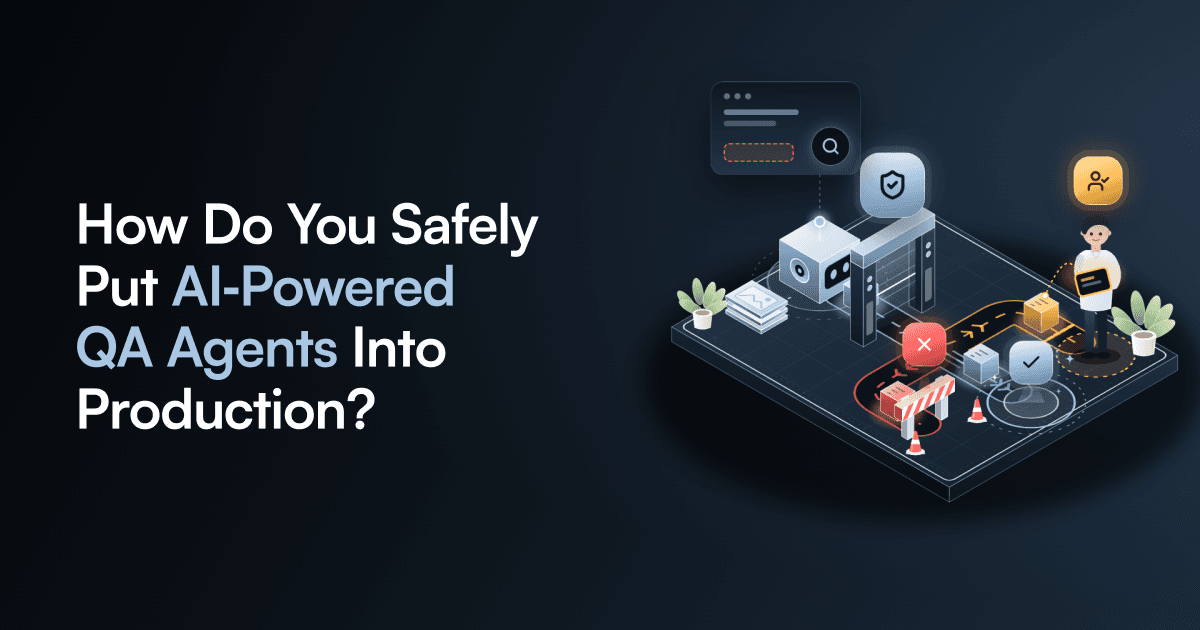
The implementation pattern separates reasoning from authority. The agent submits a structured action request; deterministic application code evaluates the request using the action type, environment, reversibility, shared-data exposure, and downstream impact. The policy layer returns one of three outcomes, regardless of the model's confidence or prompt wording.
Outcome | Example | System behavior |
|---|---|---|
Execute | Read a screenshot or rerun an approved test in an isolated staging environment | Run the allow-listed tool and record its result |
Request approval | Change checkout.spec.ts or mutate a shared test fixture | Do not execute yet; send a review request with evidence and a proposed diff |
Block | Delete shared test data or perform a destructive action against production | Reject the request and record the policy reason |
A risk label based on the tool name alone cannot account for the context of an action. create_test_data may be low risk when it creates a uniquely named fixture in an isolated environment, but high risk when it writes into a shared account. Likewise, a browser click can be harmless on a disposable test tenant and consequential when it submits a real order. Risk therefore belongs to the requested action in its context, not just to the tool name.
The following TypeScript-like example shows the policy shape. It is a compact reference implementation of the decision rules; it is not a claim that a production MCP server or a live Playwright agent was deployed.
type Decision = "EXECUTE" | "APPROVAL_REQUIRED" | "BLOCK";
type ActionRequest = {
  action: "READ_EVIDENCE" | "RERUN_TEST" | "MODIFY_TEST" |
    "WRITE_TEST_DATA" | "DELETE_TEST_DATA" | "SUBMIT_ORDER";
  environment: "isolated-staging" | "shared-staging" | "production";
  reversible: boolean;
  touchesSharedData: boolean; downstreamImpact: "low" | "high";
};
function decide(req: ActionRequest): Decision {
  if (req.environment === "production" &&
    ["WRITE_TEST_DATA", "DELETE_TEST_DATA", "SUBMIT_ORDER"].includes(req.action)) {
    return "BLOCK";
  }
  if (req.action === "DELETE_TEST_DATA" && req.touchesSharedData) {
    return "BLOCK";
  }
  if (req.action === "MODIFY_TEST" ||
    req.touchesSharedData ||
    !req.reversible ||
    req.downstreamImpact === "high") {
    return "APPROVAL_REQUIRED";
  }
  if (req.action === "READ_EVIDENCE") return "EXECUTE";
  if (req.action === "RERUN_TEST" &&
    req.environment === "isolated-staging") {
    return "EXECUTE";
  }
  if (req.action === "WRITE_TEST_DATA" &&
    req.environment === "isolated-staging" &&
    req.reversible && !req.touchesSharedData &&
    req.downstreamImpact === "low") {
    return "EXECUTE";
  }
  return "APPROVAL_REQUIRED"; // default-deny for unclassified requests
}
A production version should validate every field against a schema, authenticate the caller, bind approval to the exact action and diff, and re-evaluate policy immediately before execution. The approval must expire and must not be reusable for a different request. Otherwise, an agent could receive approval for one change and then execute a materially different one.
Constrained tools, not unrestricted execution
The agent should receive narrow capabilities such as read_test_evidence, rerun_approved_test, and request_test_change instead of arbitrary shell access or a generic tool that can edit any file. An MCP server can expose these capabilities, but the server must call the policy layer before any mutating operation. Tool registration alone is not a security boundary.
async function requestTestChange(req: ActionRequest & { diff: string }) {
  const decision = decide(req);
  if (decision !== "EXECUTE") {
    return createReviewRequest({
      decision,
      action: req.action,
      diff: req.diff,
      evidenceId: reqEvidenceId(req)
    });
  }
  return applyApprovedOperation(req);
}
In a real implementation, applyApprovedOperation must only be reachable for actions the policy explicitly permits. For approval-required actions, the handler should persist a pending request and return without changing the test file. For blocked actions, it should return a rejection reason. A model prompt saying “ask before risky actions” is useful guidance, but it is not enforceable access control.
Case study: the checkout locator repair
The workflow uses evidence collection and policy decisions to evaluate the failure before changing the test.
- The test fails. Playwright reports that the role/name locator for “Place Order” did not resolve. The run ID, test name, URL, timestamp, and assertion are recorded.
- The agent inspects evidence. It checks the screenshot and DOM snapshot around the checkout action, the Playwright trace, console errors, and relevant network requests. The agent sees a visible button named “Complete Purchase.”
- The agent proposes a repair. It suggests changing the locator but does not edit the file.
- The policy evaluates the request. MODIFY_TEST is classified as APPROVAL_REQUIRED, because a source change can alter what the test verifies. The environment and evidence may change the risk, but they do not make source modification an invisible side effect.
- The workflow pauses. The review request includes the proposed diff and supporting evidence. The current test remains unchanged.
- A human decides. The reviewer checks the product requirement or recent UI change, confirms whether the label change is intentional, and approves or rejects the exact diff. Only an approved diff can be applied and rerun.
This example demonstrates an important boundary: AI can autonomously gather evidence and formulate a diagnosis while the decision to change test intent remains under human control. If the evidence instead shows an HTTP 500 from the order API, the right next step is not to rename a locator; the agent should classify the result as a likely application failure or return UNKNOWN if the available evidence does not distinguish application, environment, and test-data causes.
Evidence before approval
An approval gate is only useful if the reviewer can make a decision without reconstructing the whole run. A representative review payload for the locator scenario might look like this:
{
  "runId": "checkout-staging-1842",
  "test": "checkout.spec.ts > completes purchase",
  "failure": {
    "type": "locator-not-found",
    "expectedRole": "button",
    "expectedName": "Place Order"
  },
  "observedEvidence": {
    "visibleButtonName": "Complete Purchase",
    "httpFailures": [],
    "consoleErrors": [],
    "trace": "artifacts/checkout-staging-1842/trace.zip",
    "screenshot": "artifacts/checkout-staging-1842/failure.png"
  },
  "proposal": {
    "file": "checkout.spec.ts",
    "change": "Use the button role with name Complete Purchase",
    "reason": "Observed accessible name differs from expected locator"
  },
  "policy": {
    "decision": "APPROVAL_REQUIRED",
    "reason": "Test source modification requires review"
  }
}
The payload is representative, not a captured production record. It shows the minimum useful shape: what failed, what was observed, which artifacts support the claim, what change is proposed, and why the policy stopped automatic execution. In an actual run, artifact paths must resolve to retained files, and the reviewer should be able to open the trace and inspect the diff.
The evidence supports reviewing the proposed locator change, but it does not establish whether the new label matches the approved product requirements. Confirming the change requires checking the documented requirements, an accepted UI update, or approval from the responsible product owner. Evidence should narrow the decision; it should not manufacture certainty. If required evidence is missing or contradictory, the diagnosis should be UNKNOWN, not a confident guess.
What the Local Policy Check Showed and Its Limitations
Comparing traditional QA, AI-only execution, and policy-controlled AI requires a recorded experiment involving a live AI model and browser execution. Without such an experiment, reporting diagnosis accuracy, repair validity, execution time, or model cost would be misleading. Instead, a small deterministic policy harness was exercised against seven fixed action requests. This check evaluates policy routing behavior, not end-to-end agent performance.
Fixed request | Expected policy outcome | Harness outcome |
|---|---|---|
Read a screenshot from staging | Execute | Execute |
Rerun a test in isolated staging | Execute | Execute |
Create a reversible fixture in isolated staging | Execute | Execute |
Modify the checkout test locator | Request approval | Request approval |
Write to a shared staging account | Request approval | Request approval |
Delete shared test data | Block | Block |
Submit an order in production | Block | Block |
In this bounded check, all seven policy decisions matched the predefined expected outcomes. Three actions were routed to execution, two required approval, and two were blocked. Two approvals would be required for this scenario set. These counts describe the policy harness, not an AI model's diagnostic accuracy or the safety of a deployed system. The cases were predefined, so the result should be interpreted as a basic rule check rather than independent validation.
Metric | Result |
|---|---|
Policy decisions matching expected outcomes | 7/7 in the fixed harness |
Incorrect AI diagnoses / valid repair suggestions | Not measured; no live agent run |
Risky actions blocked or escalated | 4/4 in this fixed set (2 approval, 2 block) |
End-to-end execution-time impact | Not measured |
Human review time | Not measured |
Model / workflow cost | Not measured |
A credible next experiment should run the same versioned scenarios through three modes: manual/traditional triage, AI-only recommendations, and policy-controlled AI. It should record the model and prompt versions, browser and application build, repeated-run count, ground-truth diagnosis, whether each repair is semantically valid, policy decision, wall-clock time, review time, and model/tool cost. That experiment is proposed work, not a result claimed here.
Why Tool-Name-Based Risk Classification Falls Short
A risk map based on tool names offers a simple classification method, such as run_test = low, modify_test = high, and delete_data = critical. However, this approach overlooks the context of each action. A test-data creation action may be safe in a disposable tenant and disruptive in a shared staging account. A rerun can also trigger side effects if the test submits an order or sends notifications.
The policy therefore needs contextual inputs and a conservative fallback. Unknown action types, missing environment labels, malformed requests, and unavailable evidence should not silently inherit a low-risk default. They should be rejected or escalated. This is also why the agent's confidence score must not override a deterministic block: confidence is a model estimate, not an authorization token.
A second practical lesson is that approval must bind to the exact change. “Approve locator repair” is too broad. The reviewer should approve a specific file, diff hash, target environment, and action scope. If the proposed diff changes after review, approval is invalidated.
CI/CD and the operational cost of safer autonomy
In CI, the agent may inspect traces, collect screenshots, classify failures, and rerun an allow-listed test in an isolated environment. It must not automatically delete a failing test, weaken an assertion, suppress a persistent failure, or change release status to green. A failed check should remain visible until the underlying issue is resolved or a responsible person explicitly accepts the risk.
Evidence collection and human review add time to the workflow compared with an unguarded repair. That cost should be measured rather than hidden. Start with low-risk, reversible, well-observed actions; require approval for source changes and shared-state mutations; block destructive production actions. Tune the policy from reviewed outcomes, but do not lower a boundary merely to improve pipeline speed.
Practical guidelines
- Separate diagnosis from mutation. Let the agent inspect and recommend before allowing it to change code or data.
- Make policy deterministic. Evaluate environment, reversibility, shared state, and downstream impact in application code.
- Constrain capabilities. Expose narrowly scoped tools, validate inputs, and avoid unrestricted shell/file access.
- Make approval evidence-based. Include the failure, artifacts, proposed diff, policy reason, and a traceable run ID.
- Fail closed. Unknown requests, missing context, and insufficient evidence should lead to UNKNOWN, approval, or block rather than an optimistic default.
- Measure honestly. Separate policy unit checks from live agent experiments, and report only timings, accuracy, and costs that were actually recorded.
Building Production-Ready AI-Powered QA Agents
Deploying AI-powered QA agents requires more than the ability to identify test failures and suggest repairs. Engineering teams need enforceable boundaries that determine which actions agents can execute, which require human approval, and which must be blocked. The checkout locator example demonstrates how deterministic policies, evidence-backed reviews, and constrained tool access can support this approach. However, the local policy checks do not establish production readiness, which requires further validation through live-agent testing and operational measurements. For teams introducing AI into their testing workflows, GeekyAnts provides Quality Assurance Engineering Services covering test automation, continuous validation, and CI/CD integration.