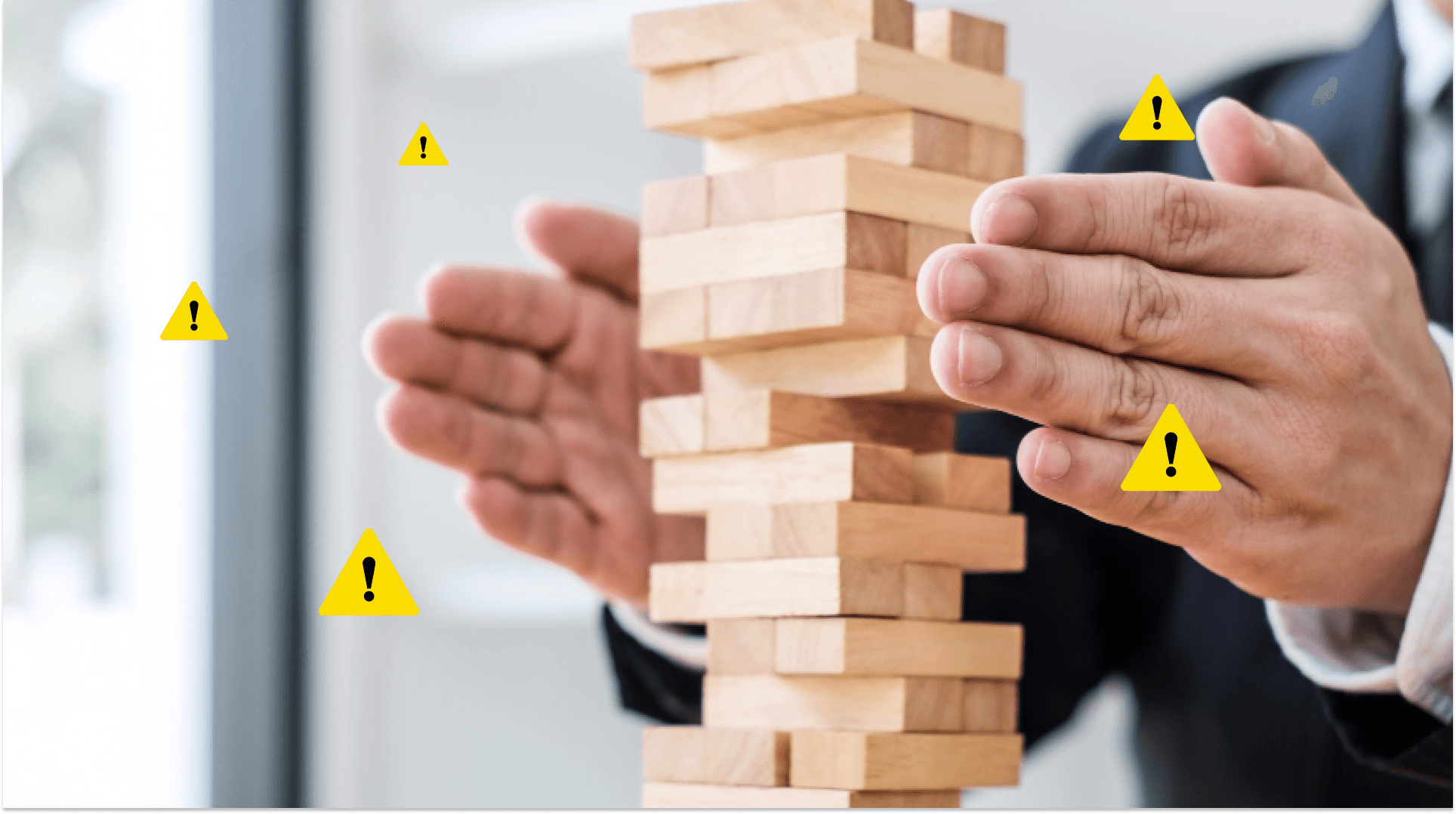

Most AI products fail because the decisions made before and during the build were never stress-tested against reality. MIT's 2025 State of AI in Business report found that 95% of generative AI pilots deliver no measurable impact on profit and loss, and S&P Global's survey of over 1,000 enterprises found that 42% of AI initiatives were abandoned before reaching production in 2025, up from 17% the year before. Despite committed budgets and assembled teams, what collapsed in most of these projects was the decision-making framework underneath it all. The real question is not whether to invest in AI. It is whether you can identify where that investment is most likely to break down before it costs you at scale.
The Warning Signs That Show Up Before Development Starts
Most AI product failures are predictable. The signals appear early, often before a single engineering sprint begins, and they tend to cluster around three patterns.
1. An AI idea without a specific problem attached to it
Teams arrive with a model or a capability in mind and then search for a use case to justify it. McKinsey's 2025 AI survey found that organizations reporting significant financial returns were twice as likely to have identified and redesigned a specific end-to-end workflow before selecting any modeling approach. Starting with the technology and working backward to the problem produces pilots that are technically functional but operationally irrelevant.
2. Data that has been assumed rather than tested
Informatica's CDO Insights 2025 survey identified data quality and readiness as the top obstacle to AI success, cited by 43% of respondents. Organizations routinely discover mid-build that the data they expected to be accessible is siloed across systems, inconsistent in structure, or restricted by legal and compliance requirements. Gartner projected that at least 50% of generative AI projects would be abandoned at the pilot stage due to poor data quality. The later this surfaces, the more it costs, in time, money, and credibility with stakeholders.
3. No measurable definition of success
Many AI initiatives launch with goals like "improve efficiency" or "enhance the customer experience." These are outcomes that cannot be tracked, which means there is no point at which a team can confirm the investment delivered value or decide it did not. Successful implementations define specific, numeric baselines before any build work begins and set realistic timelines. Most take 12 to 18 months to show a business impact of any significance.
If any of these three conditions are present at the start, the project carries a structural risk that no amount of engineering will fix later.
How to Protect Your Product Once You Decide to Build
Deciding to build is not the same as deciding to ship. The gap between those two decisions is where most of the protection work happens.
The first thing to get right is the distinction between a proof of concept, a pilot, and a full deployment. These are not phases of the same thing but distinct checkpoints that answer different questions. A proof of concept asks whether the approach is technically feasible at all. A pilot asks whether it works in a real environment with real users and real data conditions. Full deployment asks whether it can run at scale without breaking. Treating a proof of concept as a near-finished product is one of the most documented causes of early project cancellation. Stakeholders expect production behavior, but what the team delivers is a feasibility test, and that gap creates frustration that gets the project shut down for the wrong reasons.
AI systems are probabilistic, which makes this distinction more important than it is for traditional software. A conventional software proof of concept is binary: either the systems communicate, or they do not. An AI model might perform at 90% accuracy on a controlled dataset and produce different results against live production data with edge cases, varied input formats, and real-world noise. McDonald's deployed an AI voice ordering system to more than 100 US locations before discovering that it could not handle accents, background noise, or complex order modifications without failure. None of those conditions were tested before rollout. The system was pulled in 2024. The operational environment was not an optional scope for the proof of concept. It was the test.
The practical protection layer looks like this: each stage of the build must clear a defined bar before the next stage receives budget. The proof of concept must confirm technical feasibility and data readiness. The pilot must confirm that the system behaves acceptably under conditions that resemble actual use. Only then does the investment scale. This approach does not slow delivery. It removes the conditions under which expensive failures happen late, when fixing them costs far more than it would have earlier.
MIT's research adds one more protection worth noting. Specialized vendor-built AI solutions succeed at roughly twice the rate of internal builds, around 67% compared to 33%. Building in-house is not the wrong choice by default, but it carries a higher baseline risk. Teams taking that route need stronger governance, clearer milestones, and more deliberate checkpoints than teams working with partners who have already solved adjacent problems.
How GeekyAnts Approaches This
Across more than 550 engagements and 20 years of product delivery, GeekyAnts has developed a consistent view on what makes AI products survive production: scope the problem precisely, test under real conditions, and never treat speed as a substitute for architecture.
Two recent projects reflect this in practice.
A global industrial company came to GeekyAnts with a manual document translation problem inside their railway division. The process was slow, formatting was lost during translation, and communication across regions was delayed. The risk in this project was not the AI itself but it was also the integration. The solution had to work within the client's existing authentication infrastructure, across web, mobile, and Microsoft Teams, and needed to preserve document structure without requiring any reformatting afterward. GeekyAnts built an AI-powered translation system using AI Cognitive Services for real-time translation, AWS Cloud for storage, and Microsoft Entra ID for access control. The system was tested end-to-end across four regions before rollout, cutting QA time in the process. The integration worked because the operational requirements were scoped before the build began, not discovered during it.
The second project involved a North American fintech company building a global payment platform. The business problem was specific: give individuals and businesses a way to send and receive money across borders with clarity on currency, transaction status, and account activity. The platform now processes over 400 million payments annually, has 120,000 active users across the UK, Canada, Europe, and Australia, and has been downloaded more than 350,000 times on iOS and Android. That kind of scale does not happen without the architecture being designed for it from the start. Smart routing, multi-currency handling, and an admin panel built for real operational control were all scoped into the product before a line of code was written.
GeekyAnts' internal principle fits this pattern: speed without rigor is just faster failure. Both projects moved at a pace. Neither skipped the structural work that made production viable.
Getting the Decision Right Before the Budget Is Committed
De-risking an AI investment is not about building slower. It is about making sure each stage produces evidence that justifies the next one. Define the specific problem. Test the data before it becomes a dependency. Set measurable outcomes before the build starts. Treat the proof of concept and the pilot as distinct checkpoints, not accelerated versions of a full product.
The companies that generate real returns from AI are the ones that know what they are building, why it will work, and what conditions it needs to perform under before it reaches users.
If you are evaluating an AI product investment or working through what responsible delivery looks like for your organization, GeekyAnts has done this across industries and at scale. Explore our case studies or start a conversation with our team.