

Key Takeaways
- An AI-built MVP can reach production after an assessment identifies production risks and defines the hardening required for launch.
- Security, scalability, IP ownership, and open-source licensing require separate validation because each can affect customer trust, revenue, funding, or product growth.
- Unresolved risks can delay customer onboarding, weaken investor confidence, increase operating costs, and consume startup runway when remediation becomes urgent.
- A production-readiness assessment can identify where hardening or partial refactoring is sufficient, helping startups preserve working code and avoid a full rebuild without evidence that one is required.
From AI-Built MVP to Production: What Changes Before Launch?
A founder may have a functioning MVP built with AI-generated code, an AI app builder, open-source components, freelancers, or a combination of these approaches. The next milestone may involve real users, customer data, payments, fundraising, or enterprise onboarding.
A successful demo can leave production risks undiscovered. Security weaknesses can expose customer data, scaling constraints can increase costs, unclear code ownership can affect fundraising, and open-source license issues can create distribution concerns.
This guide focuses on taking an AI-built MVP to production and preparing it for commercial use. The first step is a production-readiness assessment of the existing product. The findings establish whether targeted hardening, partial refactoring, or a rebuild is required, allowing the startup to base its engineering investment on identified risks and upcoming business milestones.
Can an AI-Built MVP Reach Production Without Creating Unmanaged Risk?
Yes. An AI-built MVP can reach production after an assessment identifies risks that require remediation. The path depends on the codebase, dependencies, data, integrations, and demands expected from real users.
An AI-built MVP may combine AI-generated code, AI app builders, open-source components, and AI-assisted freelancers. A working demo confirms selected product flows under test conditions. Production requires evidence of security, scalability, reliability, maintainability, ownership, and operational readiness.
When we assess an AI-built MVP, we examine how the product handles production traffic, protects customer data, responds to failures, and supports future engineering changes. A working demo proves that the product concept can function. Production readiness requires the architecture, security controls, infrastructure, and operating processes to support the product after customers begin depending on it.
 Jani Hardik SanjayProduct Owner I
The move from MVP to production changes the standard the product has to meet. Features that supported early validation now have to work with customer data, production traffic, integrations, failures, and product changes. This makes production readiness a question of how much of the existing foundation can support the next stage and where engineering work is required before customer exposure grows.
AI-assisted development has increased the volume of code entering applications. A 2026 industry report found that 67% of surveyed organizations use AI-powered coding assistants and 98% of audited commercial codebases contain open source. The report also identified license conflicts across audited codebases, reinforcing the need for software governance.
A separate 2026 industry report recorded a 56% security pass rate in controlled AI code-generation tests. The finding reflects defined coding tasks and cannot represent the security condition of completed applications.
For startups approaching production, funding, enterprise onboarding, regulated data, or growth, unresolved risks can affect customer trust, costs, commercial commitments, and runway. Assessment should cover security, scalability, IP ownership, and open-source licensing.
AI-Built Prototype vs. Production Product
Area | Prototype | Production Product |
Purpose | Validate concept | Support commercial use |
Users | Test users | Customers |
Security | Initial controls | Validated controls |
Reliability | Test conditions | Defined requirements |
Dependencies | Selected for development | Reviewed |
Monitoring | Basic | Established |
Ownership | Contributor-dependent | Documented |
What Security Risks Can an AI-Built MVP Create in Production?
AI-generated code can perform its intended function while containing weaknesses that expose a product to unauthorized access, fraud, data loss, or service disruption. Authentication, authorization, permissions, credentials, input validation, APIs, and sensitive-data handling require security validation before launch.
The stakes increase when an application processes payments, customer accounts, personal information, or regulated data. Weak permissions can expose account information, stored credentials can provide access to connected services, and poor input or API controls can expose data and transactions. These failures can lead to fraud, customer loss, revenue impact, breach exposure, or failed security reviews.
Most AI-generated code fails securely in testing and quietly in production, because the two environments ask completely different questions about it. A test asks whether the login form accepts a valid password. Production asks what happens when someone tries ten thousand invalid ones in a minute, or requests another user's account by changing one number in a URL. Those are the questions that never come up until customers are the ones asking them.
Jani Hardik SanjayProduct Owner ISecurity risk becomes a business concern when an MVP begins handling customer accounts, sensitive data, payments, or connected services. At that stage, gaps in access control, credentials, APIs, or data handling can affect launch plans and customer commitments. Security validation helps teams identify which findings require remediation before production and which can enter a planned engineering backlog.
Launch blockers include weaknesses that could compromise accounts, expose sensitive data, enable unauthorized transactions, or prevent required security approval. Lower-priority findings can enter a remediation plan when the assessment confirms that they create no material customer, transaction, or data exposure.
Veracode's 2026 research found security weaknesses across controlled AI code-generation tasks, supporting the need to validate generated code before release. OWASP ASVS provides a framework for verifying application security controls. Application testing, manual review, and automated scanning can provide evidence for production decisions.
Security Risks to Validate Before Production
Security risk | What the founder may notice | Possible business impact | Required validation |
Authentication | Login controls lack the required protection | Accounts face compromise | Test authentication controls |
Permissions | Users receive excess access | Customer data faces exposure | Review access permissions |
Credentials | Keys appear in the source code | Connected services face compromise | Scan for exposed credentials |
Inputs | Requests accept unsafe data | Fraud or data exposure can occur | Test input controls |
APIs | Access controls have gaps | Customer data faces breach exposure | Review API controls |
Data handling | Sensitive information lacks protection | Customer trust and revenue face risk | Review sensitive-data flows |
How Do You Scale an AI-Built MVP Without Losing Control of Performance and Costs?
Performance with a small test group cannot predict how an AI-built MVP will respond to hundreds or thousands of users. Increased demand can expose database bottlenecks, inefficient queries, fragile integrations, missing rate limits, downtime risks, and weak recovery processes.
Performance and reliability failures carry commercial consequences. Slow response times and outages can disrupt customer experience, reduce conversion and retention, and put revenue at risk. Database and integration failures can interrupt payments or core product functions.
Growth can change the product's cost structure. Cloud infrastructure, third-party services, and AI APIs may charge based on usage, requests, storage, or processing. Founders need visibility into cost per user, transaction, or AI request to understand whether growth supports product margins or consumes runway.
Vendor dependence also deserves assessment. Reliance on one AI service, hosting platform, database, or proprietary tool can restrict platform portability, increase migration costs, and limit future architecture choices.
Scalability should follow product milestones. Infrastructure investment should reflect expected demand, reliability requirements, recovery needs, and cost targets. Load testing, cost monitoring, database review, integration testing, and recovery planning can show when increased capacity is required. This approach connects infrastructure decisions with product growth and available runway.
How Should Startups Establish Ownership of AI-Generated Code?
Ownership of an AI-generated codebase can involve founders, employees, freelancers, agencies, AI platform terms, and third-party contributors. Startups need records showing how code entered the product and who holds the rights required for its use.
Employee agreements should assign IP created for the product to the company. Freelancer and agency contracts should define ownership, usage rights, and handover obligations. Code provenance records who or what created the code, who reviewed it, and the terms governing its use.
The startup should control its source-code repository, domain, cloud accounts, databases, app-store accounts, and product credentials. Clear control protects product continuity during engineering handovers and ownership reviews.
In the United States, copyright protection for AI-generated material depends on sufficient human authorship. The U.S. Copyright Office states that human contributions to AI-generated outputs require case-by-case analysis. Other jurisdictions may apply different standards.
Unclear ownership can delay investment, complicate customer agreements and commercialization, affect acquisition readiness, and disrupt engineering handover. A documented chain of title gives founders evidence that the company controls the assets and rights required to operate, sell, and transfer the product.
Which Open-Source License Risks Can Affect an AI-Built MVP in Production?
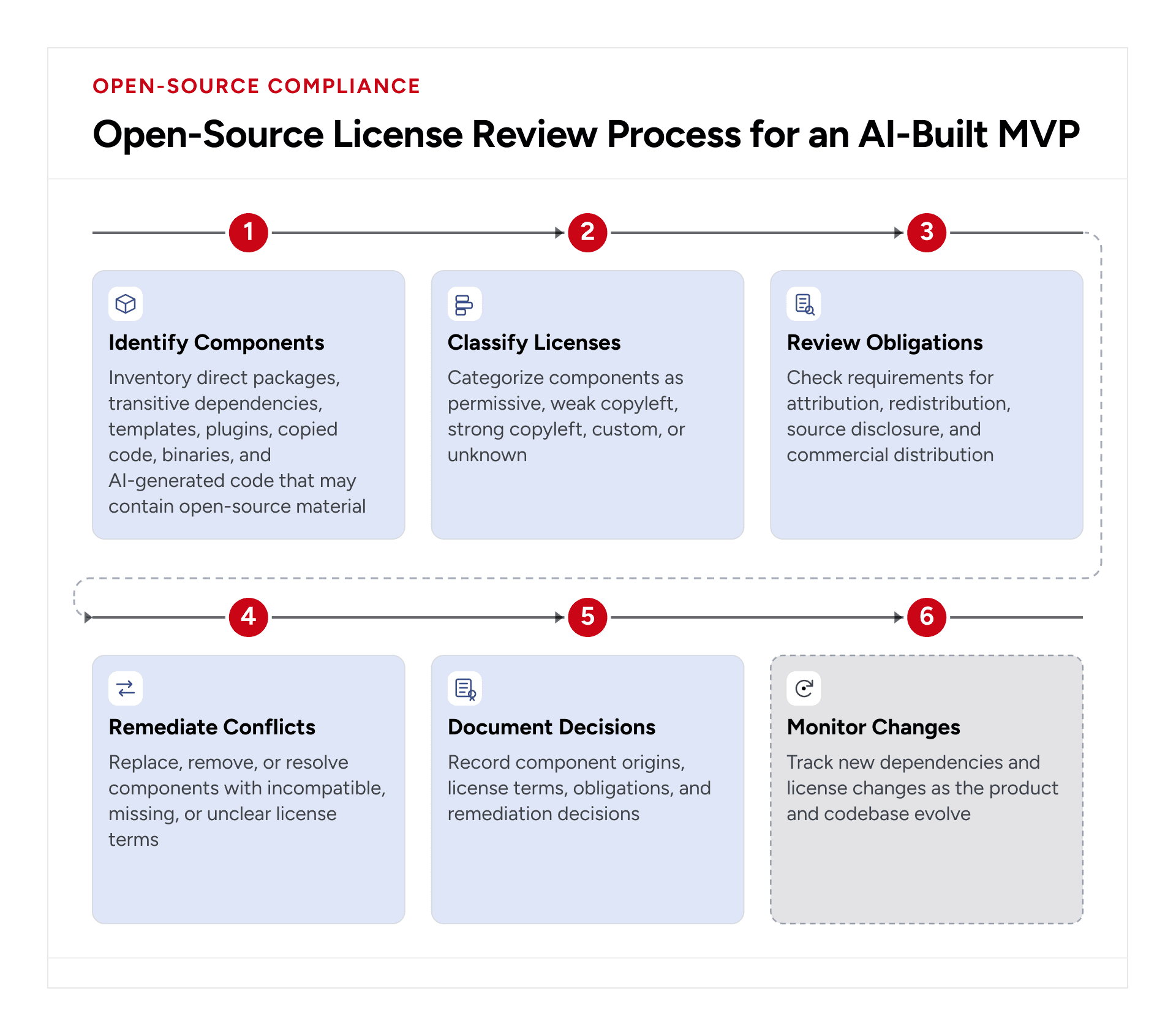
Open-source code can enter an application through direct packages, transitive dependencies brought in by other packages, templates, plugins, copied snippets, binaries, and AI-generated suggestions. Each component can carry terms that affect commercial use or distribution.
Licensing risk depends on how components are selected, combined, documented, and distributed. Permissive, weak-copyleft, strong-copyleft, custom, and missing licenses carry different obligations. These can include attribution, redistribution, or source disclosure. License compatibility also matters because combining components with conflicting terms can restrict distribution.
Black Duck's 2026 OSSRA found open source in 98% of audited codebases and license conflicts in 68%. Package-manifest scanning may miss copied snippets, undeclared components, or binaries, leaving gaps in the startup's software inventory.
The Linux Foundation advises developers using AI-generated material to consider tool terms, attribution, and third-party material. For startups, unresolved license issues can extend funding timelines, delay customer reviews or commercial distribution, and consume runway through remediation.
Open-Source License Categories
Category | Production Consideration |
Permissive | Check attribution and notice requirements |
Weak copyleft | Review modification and distribution terms |
Strong copyleft | Review source-disclosure obligations |
Unknown | Establish origin and usage rights |
How Should Startups Prepare an AI-Built MVP for Technical Due Diligence?
Technical due diligence tests whether a product can support a startup’s commercial and growth claims. Investors may examine architecture, scalability, security, data handling, testing, deployment, monitoring, and technical debt to assess growth constraints and future engineering costs.
For an AI-built MVP, evidence should cover code ownership, contributor assignments, AI-generated code provenance, open-source inventory, license records, builder dependence, and platform portability. Documentation should establish infrastructure ownership, incident history, recovery plans, and risks created when product knowledge depends on one person.
Known, documented technical debt gives reviewers visibility into remediation costs and product impact. Unknown risks create uncertainty, while undisclosed risks can weaken confidence when discovered during review. Black Duck’s 2026 OSSRA draws on commercial codebases audited across M&A transactions, showing why software composition and license records can become part of transaction diligence.
Technical due diligence tests whether the product can support the commercial plan presented to an investor, buyer, or enterprise customer. Clear ownership records, architecture decisions, security evidence, dependency information, and documented technical debt help establish what the company controls and what future engineering investment the product requires. Those findings can shape the commercial assessment of the business.
Jani Hardik SanjayProduct Owner ITechnical due diligence places the product under a different type of scrutiny. The discussion moves from what the MVP can demonstrate to what the company owns, how the system can support growth, and what engineering investment remains. Startups that can present architecture records, ownership documentation, security evidence, dependency information, and a defined technical debt plan give reviewers a clearer picture of the product they are evaluating.
Funding diligence may focus on scalability, ownership, debt, and capital needs. Enterprise reviews may prioritize security, data handling, recovery, and infrastructure controls.
Founder Technical Due Diligence Checklist
- Prepare architecture and infrastructure records.
- Provide security and testing evidence.
- Document deployment and recovery plans.
- Confirm code and contributor ownership.
- Maintain AI-code provenance records.
- Prepare open-source and license inventories.
- Record technical debt and remediation plans.
- Document incidents and access ownership.
How Should Startups Decide Whether to Harden, Refactor, or Rebuild an AI-Built MVP?
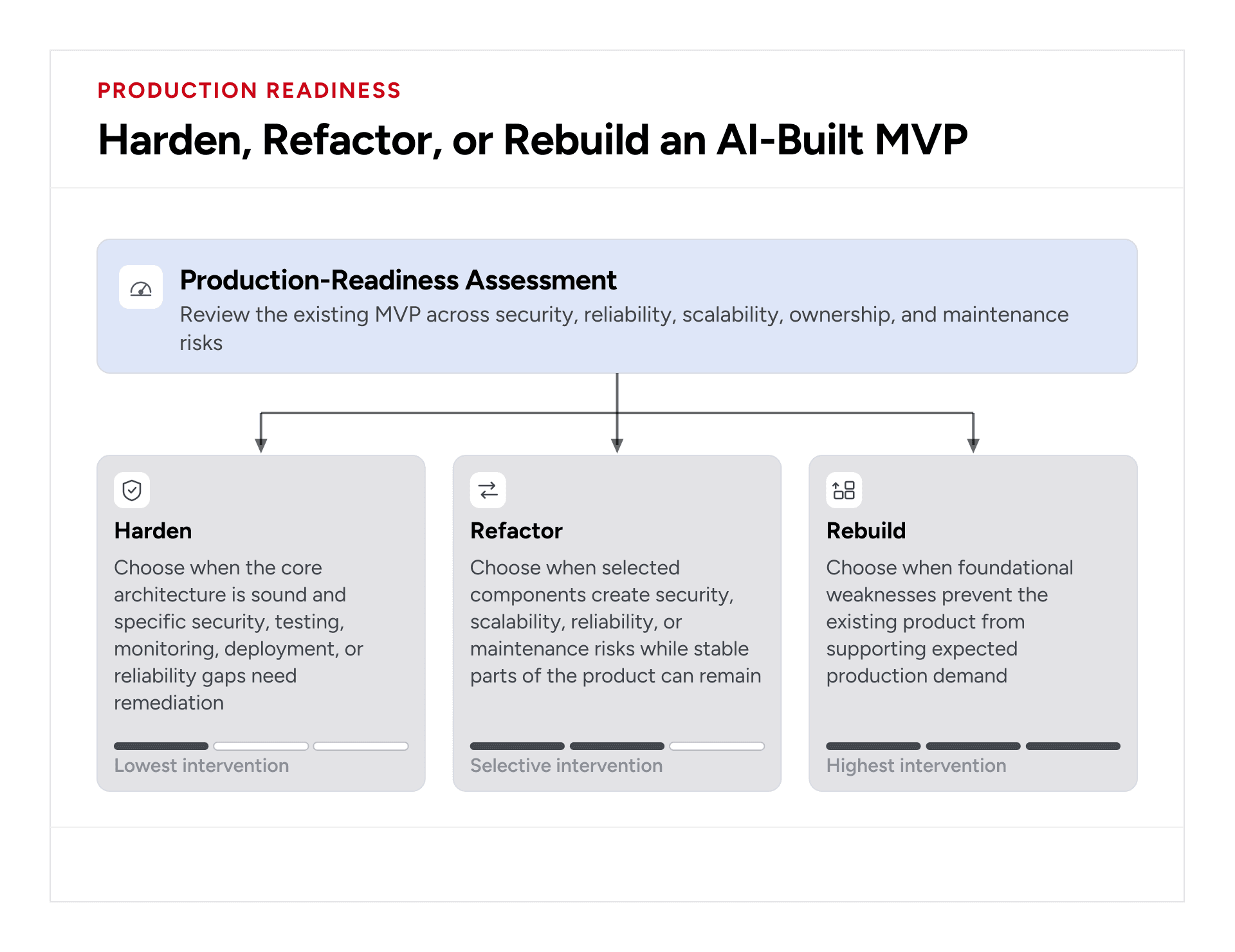
An independent production-readiness assessment should come before a rebuild decision. It can classify existing components as preserve, harden, refactor, replace, or rebuild based on security, reliability, scalability, ownership, and maintenance risks.
The findings can lead to three paths. Targeted hardening suits a sound codebase with specific production gaps, preserving runway and launch timelines. Partial refactoring fits products where selected components create material risks, requiring greater cost and time while retaining stable parts. A complete rebuild carries the highest cost and longest timeline and may be required when foundational weaknesses prevent the product from supporting expected production demand.
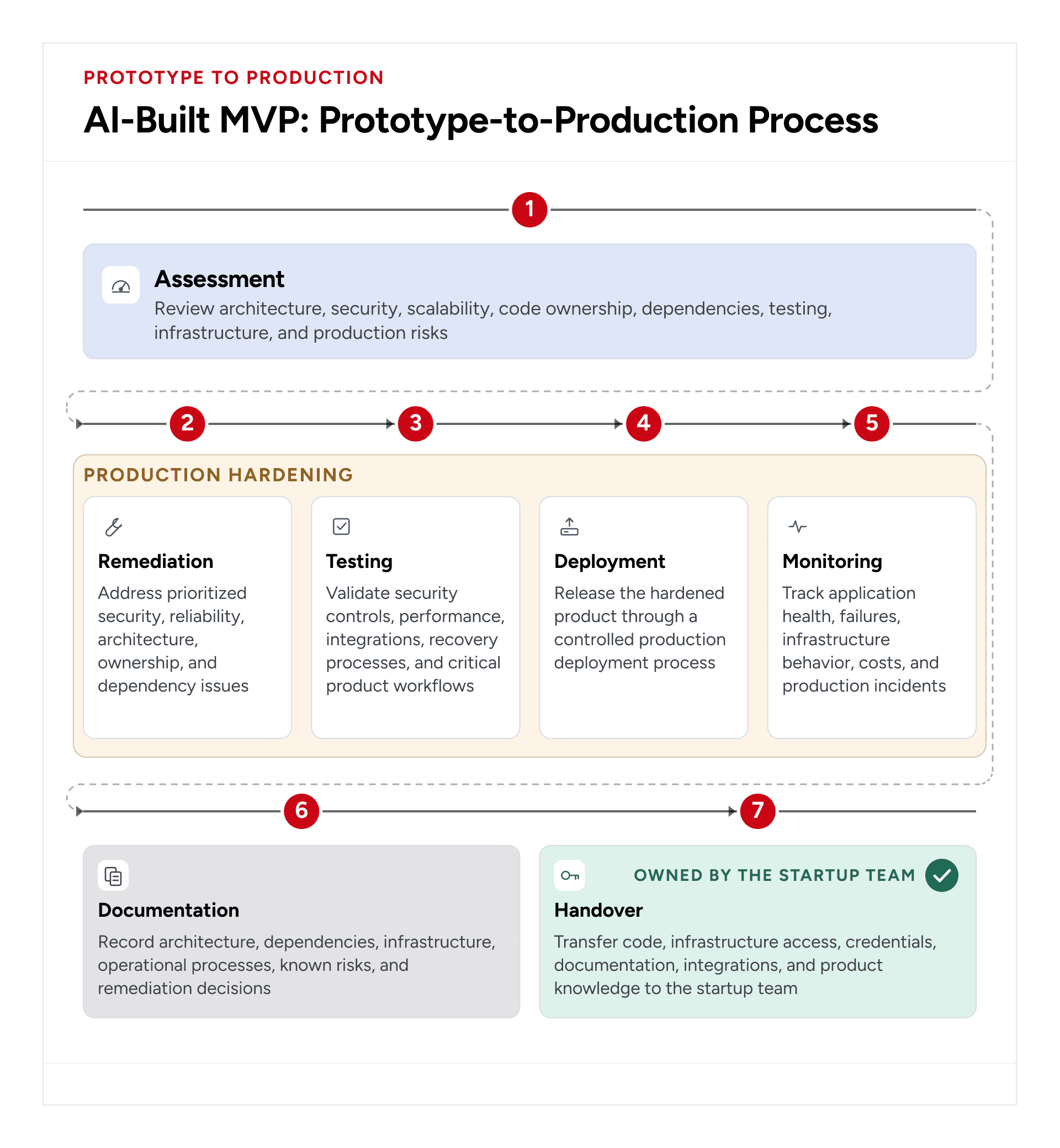
Security-sensitive, revenue-critical, and customer-facing workflows should receive priority. The production path should progress through assessment, remediation, testing, deployment, monitoring, documentation, and handover. Each phase should align with launch dates, funding milestones, customer commitments, and available runway.
What Should a Production-Readiness Assessment Deliver?
- Founders should receive a production-readiness score and a prioritized risk register.
- The assessment should document architecture, security, and privacy findings.
- It should provide a dependency and license inventory.
- It should recommend whether to harden or rebuild and provide remediation effort estimates.
- It should provide a production roadmap and an ownership and handover plan.
The startup should retain control of its code, documentation, infrastructure, integrations, and product knowledge throughout the transition.
A rebuild commits capital, engineering capacity, and time, so the decision needs evidence from the existing product. We assess which parts can support production, which components create material risk, and which areas require replacement. That assessment gives founders a path that connects engineering scope with launch commitments, customer requirements, funding milestones, and available runway.
 Kunal KumarChief Revenue Officer
The harden, refactor, or rebuild decision changes development cost, launch timing, engineering capacity, and runway. A production-readiness assessment can separate localized risks from foundational problems and define the engineering scope required for each. Founders can use that evidence to preserve viable parts of the MVP and direct capital toward security, scalability, reliability, or architecture gaps that affect production readiness.
How Can GeekyAnts Help Turn an AI-Built MVP Into a Production-Ready Product?
GeekyAnts starts with an assessment of the existing product before recommending hardening, refactoring, or rebuilding. Our product, application, QA, DevOps, cloud, security, and AI engineering teams help startups address production risks based on launch and growth priorities.
Startups with 10–50 employees can add engineering capacity based on product milestones. Code, data, documentation, infrastructure, and integrations remain under startup ownership, supporting independent development after handover.
Case Studies
Building a Scalable MVP for Market Launch
GeekyAnts helped SilverStack build a scalable MVP with AWS infrastructure, integrations, QA, and staged deployment, preparing the product for market launch and future investment.
Preparing MVP Infrastructure for Production and Scale
GeekyAnts helped Bespoke build production-ready infrastructure with monitoring, recovery, and cloud portability, achieving 95% first-attempt deployment success and 35% infrastructure cost savings.
Turning an AI-Built MVP Into a Sustainable Product
Production readiness should preserve validated work while addressing the risks that can limit the product after launch. A maintainable codebase, clear ownership, secure infrastructure, and documented dependencies create a product asset that can withstand customer and investor review.
For startups, this preparation supports customer trust, funding readiness, and sustainable growth as the product reaches more users and commercial milestones.