

Key Takeaways
- AI product development cost includes the initial build, production engineering, cloud expenses, and maintenance within the first-year budget.
- A prototype, MVP, production-ready product, and scaled product serve different business goals and require separate budget decisions.
- Growth-stage businesses should align AI development spending with runway, customer validation, and fundraising milestones.
- Scaling organizations should compare internal hiring and external engineering costs against operating expenses and expected ROI.
Why Should US Companies Plan Their AI Product Budget Beyond Development Costs?
US private AI investment reached $285.9 billion in 2025, according to Stanford's 2026 AI Index, while 88% of surveyed organizations worldwide reported using AI. McKinsey's 2026 survey found that 22% of smaller organizations were scaling AI agents in at least one business function.
Before approving an AI product, US businesses need to know how much capital they can commit to development and what remains available for launch and operations. AI product development cost includes the MVP, production engineering, cloud usage, and maintenance, with each expense affecting the investment required to reach commercial milestones.
Growth-stage businesses must protect runway until customer validation and fundraising milestones. Scaling organizations need predictable operating expenses and measurable returns before committing capital.
This guide covers MVP costs, production investment, team models, cloud spending, and first-year maintenance. For broader pricing factors and industry comparisons, see GeekyAnts' AI app development cost guide.
How Much Should US Businesses Budget for Each Stage of AI Product Development?
For budget planning, US businesses can use an estimated range of $10,000-$30,000 for an AI prototype and $100,000-$300,000 for a production build. Actual costs depend on product requirements, technical complexity, and delivery scope. A market-testable MVP, launch preparation, and first-year operations require separate budgets. Businesses should approve spending at each stage based on the evidence needed to justify further investment.
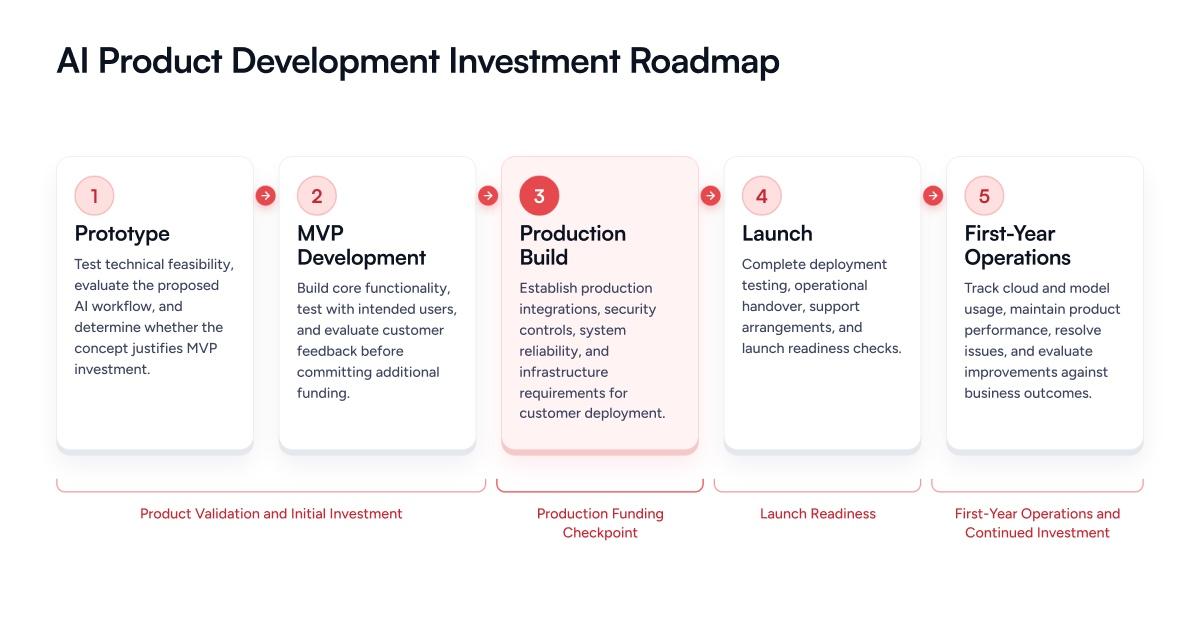
AI Product Development Cost by Investment Stage
Investment Stage | Illustrative Budget (USD) | What the Business Receives | Funding Decision |
|---|---|---|---|
Validation / Prototype | $10,000-$30,000 | A demonstration tests whether the proposed AI capability works with selected data. | Growth-stage businesses confirm feasibility, while scaling organizations assess the proposed workflow. |
Market-Testable MVP | $30,000-$100,000 | Customers test core features and essential integrations in a controlled release. | Growth-stage businesses assess demand, while scaling organizations measure pilot results. |
Production Build | $100,000-$300,000 | The team prepares the product for live use through security, reliability testing, monitoring, and integrations. | Growth-stage businesses approve investment against customer demand, while scaling organizations require evidence of operational ROI. |
Launch and Stabilization | $15,000-$50,000 | The team manages deployment, resolves defects, and monitors initial performance. | Growth-stage businesses prepare for customer onboarding, while scaling organizations confirm operational readiness. |
First-Year Operations | $20,000-$100,000+ | The budget covers cloud and API usage, maintenance, support, monitoring, and planned improvements. | Growth-stage businesses assess runway, while scaling organizations forecast recurring costs against expected returns. |
These ranges are illustrative planning estimates, not commercial quotes. Actual costs depend on data readiness, integration scope, expected usage, reliability requirements, security, and applicable compliance obligations.
One issue worth examining in US AI product budgeting is the gap between what buyers approve for an MVP and what their launch plans require. An initial estimate may assume prepared data, limited integrations, and a controlled user environment. If those assumptions remain unresolved, the budget can exclude work needed before customers can use the product. The commercial consequence is a second funding request for requirements that could have been identified during initial discovery.
When we estimate an AI product, the first question is what the business expects to deliver with that budget. We need to know which integrations are required, who owns data preparation, what usage volumes to plan for, and which security controls apply. If these details remain open, the estimate needs stated assumptions and exclusions. Without those details, the buyer cannot determine what the approved amount covers.
 Shreya MagoSenior Consultant - Technical Sales
What Drives the Cost of Moving an AI MVP to Production?
An AI MVP helps businesses test customer demand and core functionality. Production AI development cost increases when the product must handle live data, customer traffic, and service commitments. These requirements justify a separate funding approval because they introduce engineering work, infrastructure expenses, and support responsibilities beyond the MVP scope.
What Increases the Cost of Moving an AI MVP to Production?
Cost Area | Common MVP Approach | What Increases the Budget | Commercial Risk Addressed |
|---|---|---|---|
Reliability and User Volume | The team tests with limited users and traffic. | Load testing, additional infrastructure, and recovery systems increase engineering and hosting expenses. | Service outages can interrupt revenue and damage customer retention. |
Basic controls protect the test environment. | Security assessments, access controls, audit records, and applicable compliance requirements add development and review costs. | These investments reduce exposure to data breaches, regulatory penalties, and contract disputes. | |
Integration Depth | Limited integrations support selected workflows. | Production connections require data validation, error handling, and recovery mechanisms. | Failed integrations can disrupt transactions and business operations. |
Monitoring and QA | Developers rely on manual testing and limited monitoring. | Automated testing, AI response checks, and monitoring tools require additional development and service expenses. | Undetected failures can affect customers and increase support costs. |
Support and Ownership | Developers handle issues during testing. | Incident response, documentation, maintenance planning, and assigned support responsibilities create recurring costs. | Defined ownership reduces prolonged downtime and unplanned recovery expenses. |
Should You Improve Your Existing AI MVP or Rebuild Part of It?
Continue Improving the Existing MVP When | Consider a Substantial Rebuild When |
|---|---|
The core architecture can support expected traffic | The core architecture cannot meet essential reliability requirements |
Security gaps can be corrected without replacing major components | Fundamental access-control or data-handling design creates security risks |
Existing integrations can be made reliable through targeted improvements | Integrations depend on workarounds that cannot support production operations |
Testing identifies technical debt that the team can address within the planned budget and timeline | Production requirements demand widespread changes to core components |
The production funding decision changes when buyers move from testing an AI workflow to supporting customer transactions and service commitments. Integrations must handle failures, security controls must reflect actual data access, and infrastructure must accommodate expected customer volume. Support coverage also becomes a contractual and staffing consideration. These requirements affect delivery effort and recurring expenditure. A separate production estimate helps buyers understand which costs support launch readiness and which continue after deployment.
An MVP estimate tells us what it takes to validate the proposed workflow. For production, we need a separate assessment of customer volume, integration reliability, security obligations, and support coverage. Before approving additional funding, buyers should confirm service expectations, incident ownership, and the work required to make the existing MVP suitable for customer use. Those decisions determine the production scope and the operating commitments that follow.
Shreya MagoSenior Consultant - Technical Sales
Which AI Development Team Model Should US Businesses Choose?
The right AI development team model depends on how much runway a business can commit before launch and whether its product roadmap justifies permanent hiring. Recruitment delays consume capital before development begins, while external capacity introduces contract costs and knowledge-transfer requirements.
Comparing AI Development Team Models
The table compares four AI development team models based on hiring time, monthly costs, management responsibilities, delivery speed, and team continuity. Each model creates different financial commitments and delivery risks. The differences in cost control, delivery risks, and team responsibilities across dedicated AI product pods, in-house hiring, and staff augmentation can help businesses select a suitable development model.
Team Model | Time to Assemble | Monthly Cash Burn | Management Overhead | Flexibility | Speed to Production | Continuity and Knowledge Retention |
|---|---|---|---|---|---|---|
In-House Team | Recruitment may take months. | Salaries and benefits create fixed costs. | Internal leaders manage delivery. | Hiring limits capacity changes. | Recruitment may delay launch. | The business retains expertise. |
Dedicated Product Pod | Contracting and onboarding determine the start date. | Contract fees follow agreed capacity. | The partner manages delivery. | Contracts govern capacity changes. | Existing teams can shorten setup time. | Knowledge transfer requires planning. |
Staff Augmentation | Specialists join an existing team. | Fees depend on assigned capacity. | Internal managers direct delivery. | Capacity follows staffing needs. | Existing team readiness determines progress. | Internal ownership supports retention. |
Specialist Contractors | Availability determines the start date. | Fees follow defined assignments. | Internal teams coordinate specialists. | Short assignments limit commitments. | Specialists accelerate specific tasks. | Documentation preserves knowledge. |
Recruitment timelines can create a financial exposure that is missing from a comparison of engineering rates. A business may have funding available for development but lose part of its launch window while specialist positions remain unfilled. Permanent hiring also creates monthly salary commitments that continue after a delivery milestone. Contracted capacity introduces onboarding and coordination expenses. The commercial decision depends on how each option affects time to revenue, available runway, and the cost of retaining capacity.
Permanent AI hiring makes sense when the roadmap supports sustained engineering demand and the business can carry those salaries beyond launch. For a defined milestone, contracted capacity may offer a better financial fit. I would compare recruitment time, monthly commitments, delivery ownership, and the cost of retaining the team after release.
 Kunal KumarChief Revenue Officer
When Should Businesses Hire or Partner?
Growth-stage businesses should compare recruitment spending and lost development months against runway and the next revenue or funding milestone. A dedicated product pod, meaning a contracted team responsible for an agreed product scope, may reduce hiring delays.
Scaling organizations should fund permanent AI roles when an approved roadmap provides sustained work beyond launch. When future demand remains uncertain, external capacity limits long-term payroll commitments while the business validates its investment.
How Should US Businesses Budget for AI Cloud, Model, and API Costs?
AI product development cost covers building the application. AI cloud infrastructure cost includes baseline hosting expenses and usage-based charges for model requests, storage, and processing. Monthly spending depends on active users, interactions per user, documents processed, and workflow volume.
How Does Product Usage Affect Monthly AI Costs?
The following scenarios show how AI usage can affect monthly operating expenses. They use hypothetical activity levels to help businesses identify the infrastructure and model costs they need to forecast.
Scenario | Hypothetical Monthly Usage | Main Cost Drivers | Budget Decision |
|---|---|---|---|
Early Product | 500 users generate 5,000 AI interactions, averaging 10 per user. | Hosting, model APIs, authentication, and monitoring create initial expenses. | The business checks whether usage costs fit its runway. |
Growing Product | 5,000 users generate 50,000 interactions and process 20,000 documents. | Model requests, storage, document search, and processing increase charges. | The business compares customer revenue with delivery costs. |
Higher-Volume Product | 50,000 users generate 500,000 interactions and complete 200,000 workflows. | Model usage, infrastructure capacity, monitoring, and customer communications increase expenses. | The business forecasts gross-margin impact before expanding capacity. |
These activity levels are hypothetical. Actual costs depend on provider pricing, model selection, request size, and infrastructure requirements.
Example: How Much Could an AI Product Cost to Run Each Month?
Consider an AI product with 500 active users generating 5,000 AI interactions per month. Assume each interaction consumes 2,000 input tokens and 500 output tokens.
For this example, assume model pricing of $1 per million input tokens and $4 per million output tokens. These are illustrative rates used to demonstrate the calculation, not verified provider prices.
Cost Component | Monthly Calculation | Estimated Monthly Cost |
|---|---|---|
Input tokens | 5,000 interactions × 2,000 tokens = 10 million tokens at $1 per million. | $10 |
Output tokens | 5,000 interactions × 500 tokens = 2.5 million tokens at $4 per million. | $10 |
Cloud hosting | Assumed monthly infrastructure allocation. | $250 |
Monitoring | Assumed monthly monitoring expense. | $75 |
Storage | Assumed monthly storage expense. | $50 |
Total Monthly Cost | Model usage + hosting + monitoring + storage. | $395 |
Note: All prices are hypothetical and intended for illustrating the calculation. They are not verified provider rates.
Under these assumptions, the product would cost approximately $395 per month, or $0.79 per active user. This estimate excludes development, maintenance labor, authentication, document processing, and other services that may apply.
Businesses should replace these assumptions with provider pricing and expected usage before approving their operating budgets.
Which AI Operating Metrics Should Leaders Monitor?
- Monthly AI cost: Add baseline hosting expenses and usage-based service charges.
- AI cost per customer: Divide monthly service delivery costs by active paying customers.
- AI cost per workflow: Divide attributable operating costs by completed workflows.
- Gross margin: Divide revenue minus direct service delivery costs by revenue.
- Monthly usage growth: Compare changes in activity, operating costs, and revenue.
Growth-stage businesses should assess usage forecasts against runway. Scaling organizations should investigate rising costs per customer or workflow before approving expansion. If delivery costs grow faster than revenue, leaders should review usage limits, model selection, and pricing.
How Can US Businesses Calculate Their AI Product's Total Cost of Ownership Over 12 Months?
AI product total cost of ownership (TCO) combines initial development and launch spending with 12 months of operating, maintenance, and improvement costs. A monthly forecast helps founders and finance leaders identify funding requirements, track spending against revenue, and avoid unexpected cash shortages.
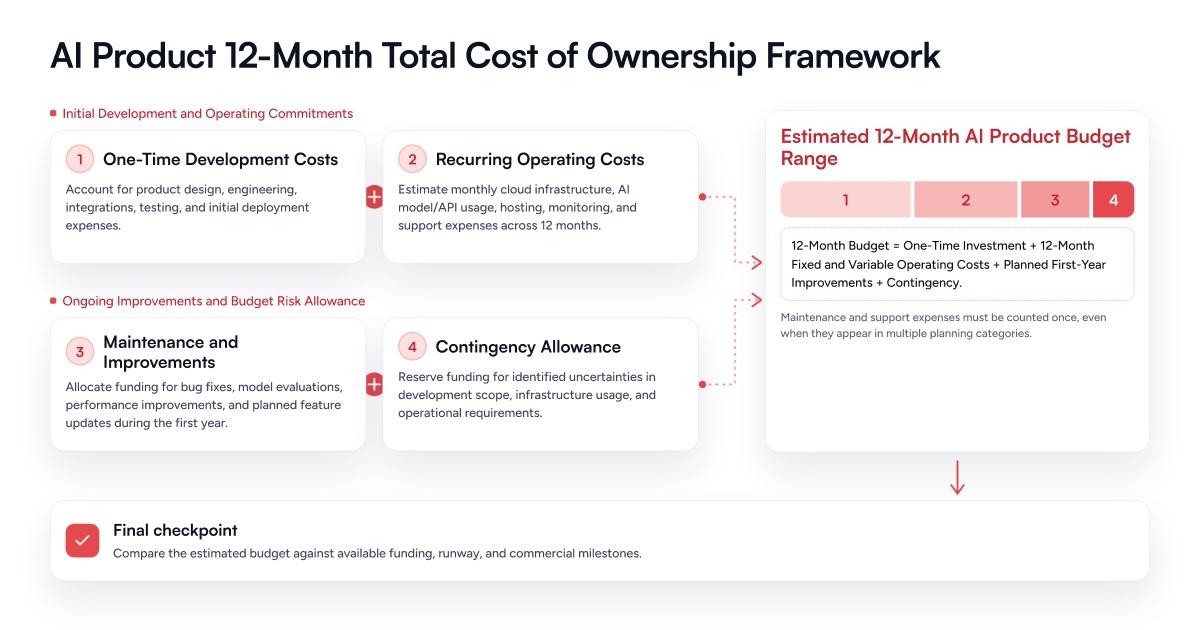
What Should a 12-Month AI Product Budget Include?
Cost Category | What to Include | Forecasting Method |
|---|---|---|
One-Time Investment | MVP development, production engineering, and launch preparation require separate approvals. | Use the earlier stage budgets once. |
Fixed Recurring Costs | Support, maintenance contracts, security reviews, and monitoring subscriptions create monthly commitments. | Sum the contracted monthly expenses. |
Variable Operating Costs | Cloud hosting, model APIs, storage, and workflow processing depend on usage. | Apply the previous section's usage scenarios to each month's forecast. |
Planned Improvements | Product iterations, QA, AI evaluations, and integration updates require allocated funding. | Schedule spending against approved milestones. |
Contingency | Incident recovery and unforeseen requirements may create additional expenses. | Estimate identified risks and approve a reserve for unbudgeted costs. |
12-month TCO = One-time investment + 12-month fixed and variable operating costs + planned first-year improvements + contingency.
The earlier first-year operations estimate is a planning allowance. Its expenses are broken down here and must not be added again. The contingency reserve must also exclude costs covered elsewhere.
Example: Calculating a 12-Month AI Product Budget
Consider a US business planning an AI product with an initial development investment of $100,000. The following hypothetical budget shows how development, recurring expenses, improvements, and contingency contribute to first-year spending.
Cost Category | Calculation | 12-Month Cost |
|---|---|---|
One-Time Investment | MVP development, production engineering, and launch preparation | $100,000 |
Fixed Recurring Costs | $3,000 per month × 12 months | $36,000 |
Variable Operating Costs | $1,000 per month × 12 months | $12,000 |
Planned Improvements | Allocated budget for product updates, QA, and integration improvements | $15,000 |
Contingency | Reserve for unplanned expenses | $12,000 |
Total 12-Month TCO | $100,000 + $36,000 + $12,000 + $15,000 + $12,000 | $175,000 |
The estimated first-year cost is $175,000, including $48,000 in recurring expenses. These figures are hypothetical planning assumptions. Actual spending depends on product scope, customer usage, infrastructure requirements, and support commitments. Each expense should appear in one budget category to prevent double counting.
How Should Spending Change Across the First Year?
- Launch (Months 1–3): Fund deployment and stabilization. Confirm that remaining cash supports the next milestone.
- Early Adoption (Months 4–6): Update usage forecasts and prioritize improvements using customer adoption and revenue evidence.
- Ongoing Operations (Months 7–12): Review maintenance, security, support, and operating costs against actual demand and gross margin.
Growth-stage businesses should test whether forecast spending preserves runway through the next funding milestone. Scaling organizations should compare monthly actuals with approved budgets before committing to further expansion.
Planning an AI product budget for the next 12 months? Estimate development, operating, and maintenance costs before approving funding.
Download the AI Product Cost Planning Worksheet for US Companies
How Can US Businesses Control AI Development Costs While Protecting ROI?
AI development budgets should fund work tied to the next commercial milestone. Growth-stage businesses must preserve runway, while scaling organizations should measure returns against revenue, retention, or operating savings.
Where Should Businesses Invest or Defer Spending?
- Fund first: Prioritize core workflows, essential integrations, security, usability, testing, and launch support.
- Defer: Postpone secondary features and market expansion until customer adoption supports investment.
- Avoid overinvestment: Limit unvalidated features, excess infrastructure, and permanent staffing before demand is established.
Underfunded integrations, security, testing, or support can cause failed transactions, service interruptions, recovery expenses, and customer losses.
How Should Businesses Compare AI Development Proposals?
Evaluation Area | What Buyers Should Verify |
|---|---|
Scope | Confirm deliverables tied to each milestone. |
Team Model | Compare staffing costs and commitments. |
Delivery Ownership | Identify responsibility for outcomes and delays. |
Ongoing Costs | Forecast infrastructure, maintenance, and support. |
Exclusions | Identify expenses outside the quoted price. |
Business Outcomes | Require measurable adoption, revenue, or savings targets. |
Fund validation against defined customer evidence. Approve production when pilot results support demand or operating savings. Release expansion funding when revenue, retention, or verified efficiency gains justify the additional investment.
Why Choose GeekyAnts to Take Your AI Product From MVP to Production?
GeekyAnts supports AI product development from MVP validation through production engineering and ongoing improvements. Our AI-powered product engineering services help US businesses plan development capacity, integrations, cloud infrastructure, and maintenance requirements around their investment priorities.
GeekyAnts Case Studies in AI Product Development and Cost Optimization
AI Document Intelligence With 99% Less Manual Effort
GeekyAnts developed an AI document intelligence solution for Pillar Engine using AWS Bedrock and Snowflake. The solution reduced manual effort by 99%, processed 10,000 pages in two minutes, and achieved response accuracy above 85%. These results demonstrate how AI automation can reduce manual processing requirements, a factor businesses should consider when evaluating the financial benefits of AI development.
AI Product Development With 3× Faster Feature Iteration
GeekyAnts developed Smart Pantry's AI-powered meal recommendation platform, achieving three times faster AI feature iteration and a twofold increase in daily active usage during its pilot. The results show how faster development cycles and pilot adoption data can inform decisions about further product investment before committing to production expansion.
Cloud Cost Optimization With $57,000+ in Annual Savings
GeekyAnts helped DollarDash reduce monthly AWS spending by 60%, from $8,100 to $3,300, while maintaining production availability and service commitments. This reduction illustrates how cloud infrastructure optimization can lower recurring operating expenses and affect the total cost of owning a production application.
How Should US Businesses Plan AI Product Costs Beyond the MVP?
AI product development cost planning should follow the investment from MVP validation through production engineering, ongoing operations, and product improvements. Each phase should have a defined budget and measurable business milestones.
Growth-stage businesses should align MVP spending with available runway, customer validation, and their next funding milestones. Scaling organizations should evaluate production investment against expected ROI and forecast recurring infrastructure, support, and maintenance expenses.
Approve production funding when customer demand or measurable business value supports the investment. Reserve capital for operating costs and future improvements, and release expansion budgets against verified revenue, adoption, or efficiency gains.