

Key Takeaways
- A custom ACH payment platform lowers per-transaction cost and gives finance teams direct control over settlement timing.
- AI-ready ACH payment software supports risk detection and reconciliation while keeping a person in the approval path.
- Build cost scales with integration depth, compliance scope, and how much of the platform runs on AI-assisted tooling.
- NACHA's 2026 fraud monitoring changes make risk-based detection a core product requirement, built into the platform before launch.
ACH Payments Software Power the US Economy. The Technology Behind Them Needs to Catch Up.
ACH is one of those systems people use constantly without thinking about it. Payroll, vendor payouts, insurance claims, and recurring collections often move through ACH - The Automated Clearing House network that transfers money directly between bank accounts without using card networks.
The rail itself is not new. What is changing is what businesses expect from the software built around it.
The ACH Network moved 35.2 billion payments worth $93 trillion in 2025, while B2B ACH volume approached 8.1 billion payments. But growth is exposing a problem: many ACH payment systems were designed for a world where batch processing, limited visibility, and rigid banking workflows were acceptable.
That world is disappearing.
Businesses now expect payment infrastructure to offer the same transparency, speed, API access, and operational control they get from modern digital products. As ACH volume grows and newer payment rails raise expectations, legacy platforms become harder to reconcile, monitor, integrate, and scale.
This is where AI-ready ACH payment processing software starts to matter. AI can help identify suspicious transactions, predict returns, surface reconciliation matches, and prioritize exceptions, without taking payment authority away from teams that are accountable.
This guide covers what it takes to build that kind of ACH product: core features, compliance requirements, costs, and the architecture needed to scale it to modern growth standards.
Why Is ACH Payment Software Becoming a Core Product Infrastructure Decision?
ACH payment software moved past its original role as a back-office payment rail into a core part of the product stack. Product and engineering teams build it into embedded payments, vendor payouts, payroll, insurance claims, lending disbursements, recurring collections, marketplace settlements, and treasury workflows. Each of these use cases depends on direct, reliable movement of funds between bank accounts, which places ACH infrastructure inside the critical path of the product rather than a support function around it. Custom payments software development lets these workflows run on rules built for the business, beyond the limits of a generic banking portal.
Leaders prioritize ACH for reasons tied to cost, control, and scale. Bank-to-bank transfers carry a lower cost than card-heavy payment flows, and direct account movement gives finance teams command over settlement timing without dependence on a third-party processor. ACH supports B2B payment volume that grows with the business, and as that volume grows, finance and operations teams need clear, real-time visibility into payment status and exceptions.
Who Cares About ACH Infrastructure, and Why?
A VP of Engineering focuses on architecture and system reliability under high transaction load. A VP of Digital Platforms focuses on the embedded payment experience inside the product, from checkout to payout. A Head of Platform focuses on APIs, ledger accuracy, and integration across banking partners and internal systems. Each role treats ACH payment processing software as infrastructure the business depends on.
Every enterprise conversation starts with a payment workflow question. Clients want to know how ACH fits their product architecture and connects with the systems they already run. That shift changed who joins the conversation: a VP of Engineering or a Head of Platform, brought in to evaluate build feasibility before procurement gets involved.
 Kunal KumarChief Revenue Officer
ACH processing can look like a commodity from the outside: money moves, a fee gets charged, and the transaction settles. But enterprise buyers increasingly evaluate what sits behind that transaction, like bank connectivity, ledger accuracy, reconciliation, exception handling, security, compliance, and system reliability. At scale, failures in these invisible layers quickly become operational and financial problems.
That is why ACH (or any other embedded finance) is becoming an infrastructure decision before it becomes a pricing decision. Engineering and platform teams want to know whether a system can integrate cleanly, trace every payment, handle growing volume, and adapt without major rework. Vendors competing mainly on transaction fees risk missing the concerns that now shape the buying decision: how reliably the platform works when complexity increases.
What Core Features Should AI-Ready ACH Payment Software Include?
A production-ready ACH payment platform coordinates these capabilities into one system, built to handle payment volume without adding operational risk.
Payment Origination and Processing
The platform originates one-time and recurring payments, supporting ACH debit and credit transactions across payroll, vendor payments, insurance claims, and customer collections. Batch processing groups transactions into defined cut-off windows to meet settlement deadlines at volume. Scheduling tools let finance teams configure future-dated and recurring runs, so a payroll or billing cycle executes without manual resubmission each period.
NACHA File Generation and Bank Account Verification
The system generates and validates NACHA files against current operating rules before submission, checking batch headers, entry detail records, and required fields to catch formatting errors ahead of transmission. Bank account verification, through micro-deposits or instant methods, confirms account ownership and status before the first transfer. This step cuts return rates tied to invalid or closed accounts.
Return Handling, Exceptions, and Approvals
Return code management classifies failed payments by reason, such as insufficient funds or an unauthorized debit, and routes each to the correct resolution path. Exception workflows flag unmatched entries, delayed settlements, and other irregular transactions, and route each to a review queue. Role-based approvals apply amount thresholds and organizational rules to higher-risk payments, with every override tied to a reason code in the audit trail.
Ledger, Reconciliation, and Security
A ledger and reconciliation module matches settled payments against bank statements using transaction IDs and remittance data, narrowing manual work at month-end close. Security controls encrypt account and routing data at rest and in transit, with tokenization for stored account numbers. Audit logs capture every action on a payment, from creation through approval and submission, tied to a user identity and timestamp.
APIs, Dashboards, and Integrations
A webhook and API layer pushes payment status changes, such as settlement or return events, to downstream systems in real time. An admin dashboard gives operations teams one view of payment queues, approval limits, and system health, without separate reporting tools. Integrations connect the platform to banking partners for file submission and to ERP, CRM, and accounting systems, keeping payment data consistent across finance and operations.
Risk Scoring, Fraud Monitoring, and Reporting
Risk scoring and fraud monitoring apply configurable limits, velocity checks, and behavior patterns to flag suspicious activity before a payment settles. Reporting and analytics convert this activity, along with volume, return rates, and settlement timing, into on-demand and scheduled views for finance and compliance teams.
What Does AI-Ready ACH Payment Software Actually Look Like?
AI-ready' gets used to mean two different things, and only one of them belongs in payments. It can mean the system makes the call, or it can mean the system hands a person everything they need to make the call faster. We build the second one. The day AI starts approving or releasing a payment on its own is the day you've traded a compliance advantage for a compliance problem.
 Jani Hardik SanjayProduct Owner I
AI-ready ACH payment software applies machine learning to specific points in the payment lifecycle and keeps decision authority with a person at each step. The software surfaces information and flags risk. A person approves the return, releases the payment, or closes the exception.
Anomaly detection models scan transaction volume, timing, and account behavior to flag activity that departs from a normal pattern. Risk-based payment review applies a score to each transaction. High-risk payments route to manual review, and low-risk payments follow standard rules a team sets and can adjust. Fraud signal monitoring tracks velocity, device, and account signals, and pattern detection connects failed payments, returns, and unusual behavior across accounts that a single review would miss.
Return prediction estimates the likelihood of a payment failing before submission, based on account history and return codes, so a team can intervene before a return occurs. Predictive balance checks apply the same approach to insufficient-funds risk. Automated reconciliation suggestions match settled payments against bank statements and present likely matches for confirmation. Exception prioritization ranks open exceptions by value and age, so operations teams work the highest-impact items first.
AI-assisted compliance evidence collection pulls the audit trail, approval history, and transaction detail into one record for an examiner or auditor. AI copilots let operations teams check payment status, pull a transaction history, or trace a return, through a chat interface tied to the ledger.
Each capability writes its output, a score, a flag, or a matched record, into the same ledger, so a flag raised at origination stays visible through reconciliation and audit review.
GeekyAnts engineers this layer directly into the ACH payment system architecture. Every AI-driven suggestion routes through a human decision point, logged and auditable, for regulated environments. This is truly AI-ready payment engineering: risk detection, decision support, reconciliation, and operational intelligence, backed by a complete audit trail.
What Compliance and Regulatory Requirements Does ACH Payment Software Need?
Compliance requirements arrive from three different places at once: bank partners, legal counsel, and the product team's own risk tolerance. My job is turning those three inputs into one requirements document before development starts, so an engineer works from a settled requirement instead of interpreting a NACHA rule mid-sprint.
Jani Hardik SanjayProduct Owner ICompliance scope creeps when it stays undefined at the requirements stage. Teams that treat NACHA rules, OFAC screening, and audit logging as engineering tasks to sequence after core development encounter costly rework once a bank partner's due diligence team reviews the system. Mapping compliance requirements against product features before development starts marks the difference between a system that passes a bank's review on the first submission and one that goes back for revisions.
ACH payment software must meet Nacha operating rules, OFAC screening, and bank-level security controls before it can move live transactions. A compliant system needs audit trails, role-based access, encryption, and SOC 2 readiness, with AML/KYC and PCI DSS added when a product's scope requires them.
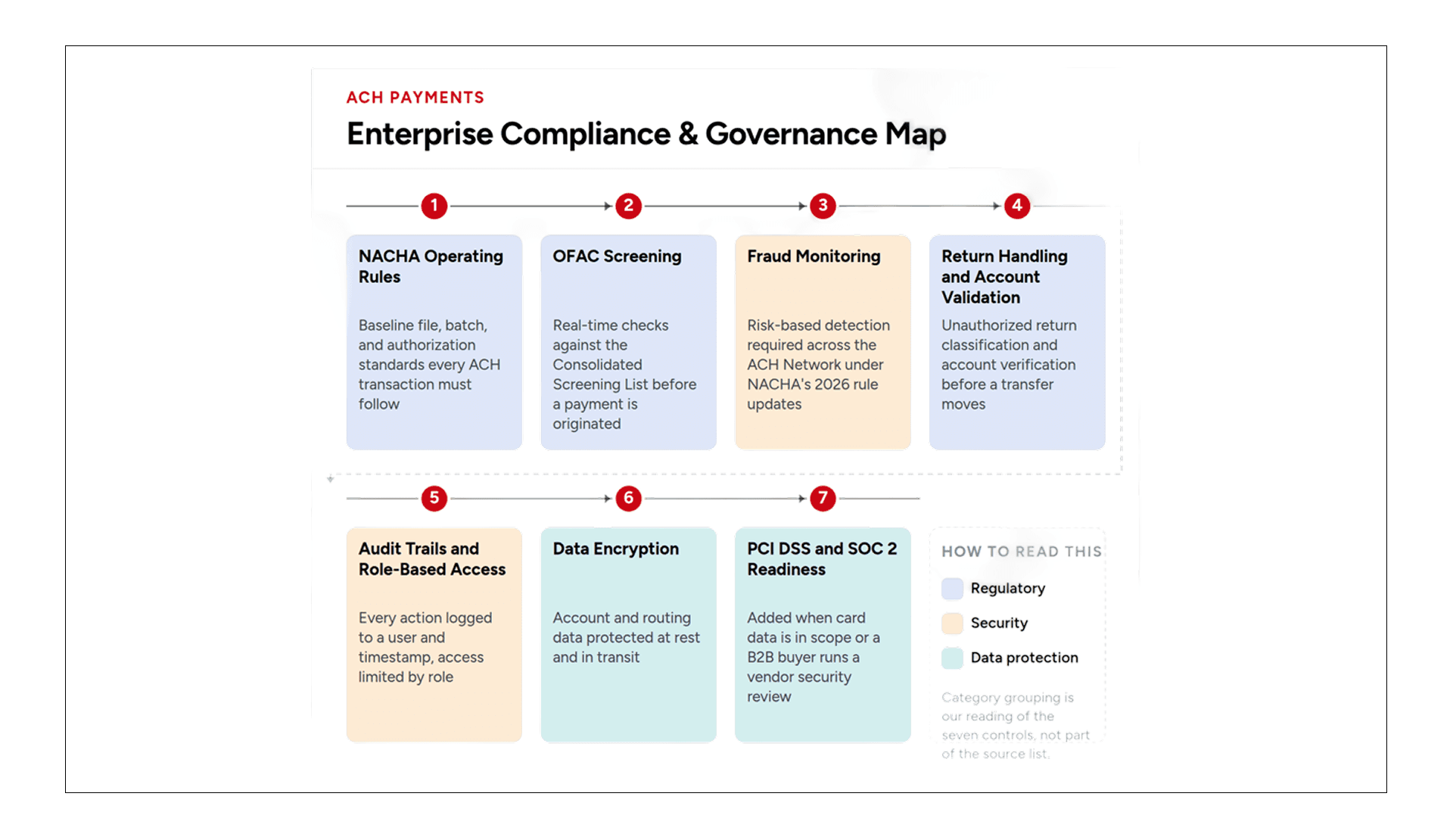
Nacha operating rules set the baseline for every ACH transaction, covering SEC codes for debit authorization, file formatting, and the roles of the ODFI and RDFI in originating and receiving payments. Same Day ACH adds cut-off windows and per-entry dollar limits that a platform must enforce before submission. Fraud monitoring carries specific deadlines under Nacha's 2026 rule changes: risk-based fraud detection from all ODFIs and large originators by March 20, 2026, and the same requirement for every remaining originator and RDFI by June 22, 2026. A platform built after these dates needs fraud monitoring built into the origination flow from the start.
Return handling and account validation reduce exposure on the front end. The ACH payment system should classify unauthorized returns as a distinct category from standard returns and validate account ownership before a debit or credit goes out. OFAC screening runs against the Consolidated Screening List before a payment is originated, to keep funds from moving to a restricted party.
Data protection covers the system underneath these checks. Every action needs an audit trail tied to a user and timestamp, access to sensitive functions needs role-based limits, and account data needs encryption at rest and in transit. AML and KYC integration apply where the product touches account onboarding or higher-risk transaction types. PCI DSS applies when the platform handles card data, and SOC 2 readiness matters for any B2B buyer running vendor security reviews. Where AI supports risk scoring, model governance, documented logic, monitored outputs, and a defined review process, keeps that scoring auditable.
How Do You Build Custom ACH Payment Software Step by Step?
The stage everyone wants to rush is architecture and rail strategy, because it doesn't look like progress, no screens, no demo. But the ledger design and routing decisions made in week two are what decide if this platform survives real volume in year two, not how many features shipped in week one.
Jani Hardik SanjayProduct Owner ITeams that skip a dedicated scoping stage and move straight into architecture discover missing requirements during development, when a change costs more time than it would have at the start. A requirements document tied to specific NACHA rules, integration points, and volume targets gives engineering a fixed target to build against, and gives a client a realistic timeline before a single line of code gets written.
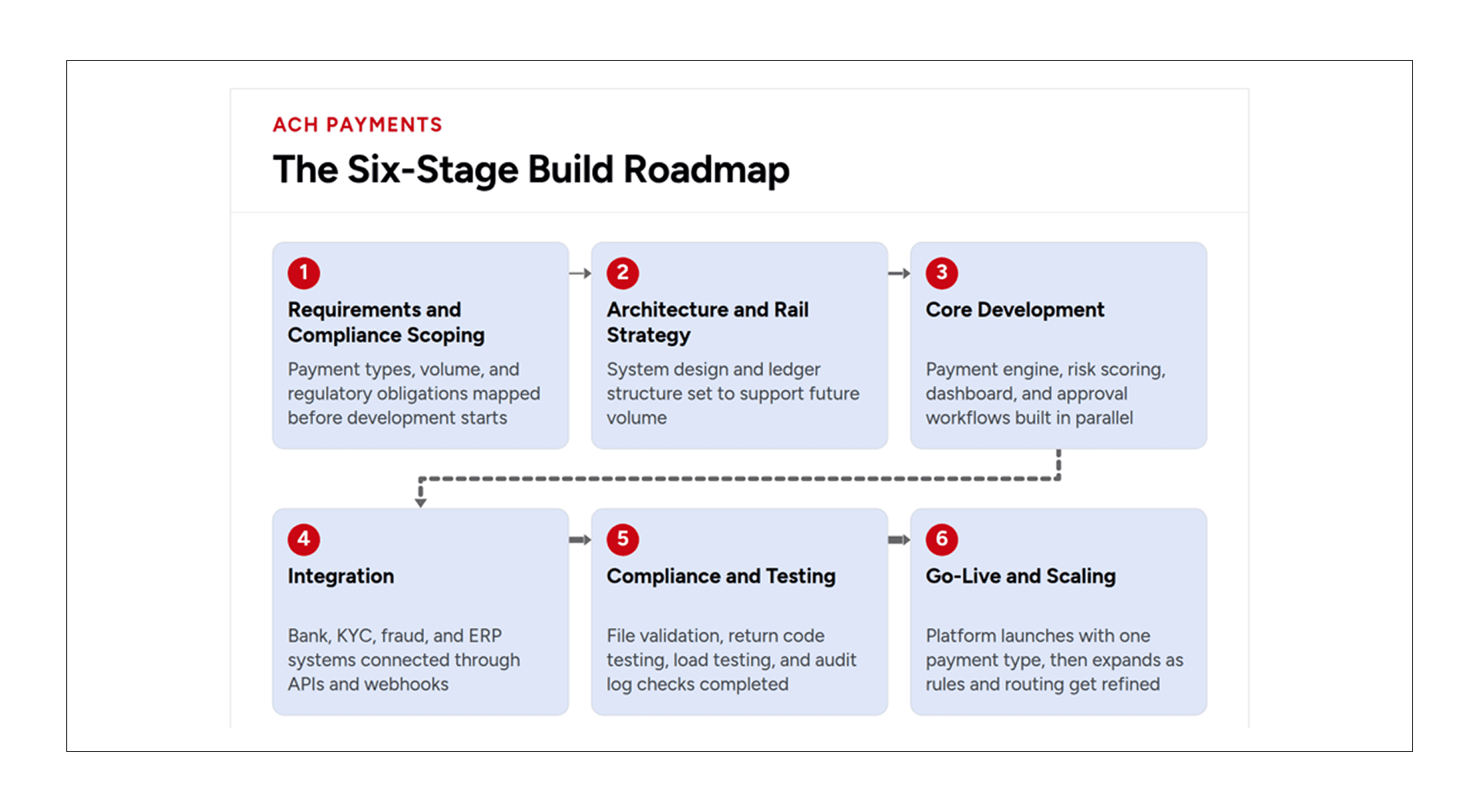
Building custom ACH payment software runs through six stages, from initial requirements to a live, scaling platform.
Requirements and Compliance Scoping
Finance, compliance, and engineering teams map payment types, expected volume, and the NACHA, OFAC, and audit requirements the platform must meet before a line of code gets written. The output is a requirements document that ties each feature to a compliance obligation, so no team rebuilds a feature to satisfy a rule missed at this stage. Teams decide at this stage whether the build stays ACH-only or expands to a multi-rail setup covering Same Day ACH, RTP, or FedNow.
Architecture and Rail Strategy
Engineering teams choose between a microservices or monolithic setup, define how batch and real-time processing split, and design the ledger as the system of record every module reads from. Routing logic sends payments through the right rail based on cost, urgency, and risk. This decision shapes platform performance once volume grows past a pilot stage, and a change after launch costs more than a correct choice at this stage.
Core Development
The payment engine, NACHA file generation module, risk scoring, admin dashboard, and approval workflows get built in parallel, each tied to the shared ledger so a status change in one module updates every connected screen and report.
Integration
The ACH payment platform connects to the ODFI, KYC and fraud tools, and ERP or accounting systems through a defined API and webhook layer. Sandbox testing with the bank partner starts at this stage, before any production traffic. An ACH payment platform that stands apart from finance tools creates manual work equal to the legacy system it replaces.
Compliance and Testing
NACHA file validation, return code testing against codes such as R01 and R03, load testing, failover testing, and audit log verification run before any bank sees production traffic. Teams test with the ODFI, alongside internal test data.
Go-Live and Scaling
Most teams launch with one payment type, such as vendor payouts, before adding payroll or collections. Operations teams train on dashboards and exception queues before launch. Rules, routing logic, and reporting get refined against real failure and fraud patterns on a set review cadence after launch.
How Much Does It Cost to Build ACH Payment Software?
The cost to build ACH payment software depends on scope, integration depth, and compliance requirements. The table below breaks this down by build maturity, from a limited MVP module to a full AI-ready platform.
Build Scope | What's Included | Estimated Cost Range |
MVP ACH module | Basic ACH debit and credit, a dashboard, simple reconciliation, limited bank integration | $40,000 – $90,000+ |
Growth-stage ACH product | Risk checks, account verification, webhook events, return handling, approval flows, analytics | $100,000 – $250,000+ |
Enterprise-grade ACH platform | Multi-entity support, advanced reconciliation, high-volume processing, compliance reporting, observability, AI risk scoring, deeper integrations | $250,000 – $500,000+ |
AI-ready ACH modernization | AI modules, fraud signals, exception intelligence, and operational copilots added to an existing payment product | $50,000 – $120,000+ |
Several factors move the number within each tier. Bank and ODFI integration complexity and NACHA file handling set the technical floor, while ledger and reconciliation depth and risk and fraud controls add engineering time proportional to how much manual review they remove. Compliance requirements, NACHA at minimum, with SOC 2 and PCI DSS where applicable, shape both build time and ongoing audit cost. Admin dashboard complexity, ERP and accounting integrations, and volume and performance needs scale with the number of systems and users the platform serves. QA, security testing, and audit readiness add a fixed cost regardless of tier, and ongoing support and maintenance continue past launch.
A cost conversation works best when we establish scope before a number enters the discussion. I spend the first conversation walking through what each tier includes, integrations, compliance depth, volume, so the number that follows means the same thing to both sides.
Jani Hardik SanjayProduct Owner ICost estimates for ACH platforms carry a wide range because the underlying scope carries an equally wide range; a basic module and an AI-ready enterprise platform share little beyond the ACH label. Buyers evaluating quotes across vendors get more value from comparing what each tier includes than from comparing the top-line number, since two quotes at the same price can represent different build depth.
Custom Build vs. Third-Party Aggregator
A third-party aggregator gets a business moving with lower upfront cost, at a per-transaction fee that scales with volume. A custom ACH payment platform shifts that cost structure toward a fixed development and maintenance investment, with the breakeven point set by transaction volume and the value placed on owning settlement timing and payment data.
How Do You Scale ACH Payment Software for Enterprise Volume?
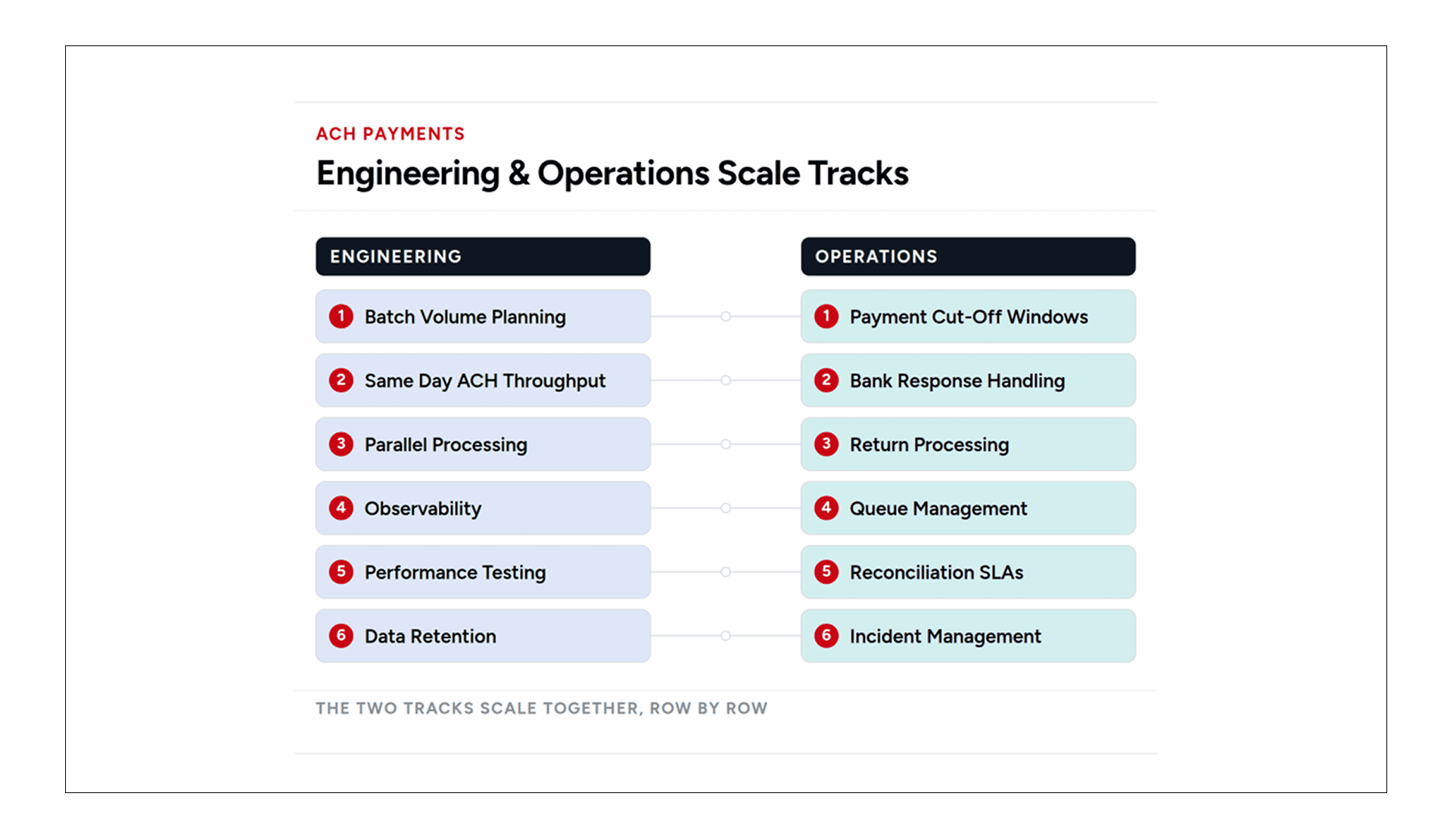
Scaling ACH payment software takes coordinated work between engineering and operations. A system built for volume needs a team built to run it at that volume.
Engineering
- Batch volume planning: size batch windows for peak transaction counts.
- Same Day ACH throughput: submit across all three daily windows, with monitoring on fill rate.
- Parallel processing: split batches across workers so a large file does not block smaller, time-sensitive payments.
- Observability: track latency, error rate, and queue depth at each pipeline stage.
- Performance testing: load test against volume above expected peak, including a return-heavy scenario.
- Data retention: separate hot storage for active records from archive storage for older files.
Operations
- Payment cut-off windows: enforce submission deadlines with a buffer built in for exception review.
- Bank response handling: process ODFI acknowledgments and file responses on a schedule matching submission volume.
- Return processing: route return codes to separate queues by type.
- Queue management: prioritize open items by payment value and age.
- Reconciliation SLAs: set match-time targets tied to the finance team's close calendar.
- Operational dashboards: give operations one real-time view of volume, failures, and open exceptions.
- Incident management: define escalation paths in advance for a processing delay or bank outage.
- Reporting: scheduled reports for finance and compliance teams, built around close cycles and audit windows.
Why Choose GeekyAnts for ACH Payment Software Development?
GeekyAnts has delivered 550+ engagements since 2006, work that spans AI-powered digital product engineering, backend and API engineering, and cloud infrastructure built for payment-grade reliability. Moving from an ACH idea, or a legacy workflow, to a production-grade payment platform takes engineering built for financial infrastructure from day one. Our fintech work covers payments and digital wallet engineering, legacy modernization, and RegTech and compliance automation, carrying a product from the first architecture decision through a system running in production, with a 99.9% uptime standard behind that delivery.
"Clients who come to us for ACH work have tried building it themselves first, or hired a team that treated it like a standard CRUD application. Payment infrastructure holds a business's cash flow and its compliance exposure at the same time, and that combination is why every payment engagement at GeekyAnts starts with senior engineers who understand banking rails, assigned to the account from day one.
Kunal KumarChief Revenue OfficerEnterprises evaluating an ACH development partner weigh a vendor's fintech-specific delivery record over general software development experience, since payment systems carry regulatory and financial risk a typical product build does not. A partner with a track record across payments, digital wallets, and compliance automation brings context most generalist teams gain through a client's production incidents.
Case Studies
Global Payment Processing at Scale for a North American Fintech
GeekyAnts built the backend and platform behind Flowcash, a global payment product processing 400M+ payments annually for 120,000+ active users across the UK, Canada, Europe, and Australia, including an admin panel that lets the client add new markets without engineering involvement.
Digital Banking App Modernization for a Younger Generation of Customers
GeekyAnts rebuilt the mobile banking experience on a modern technology stack for a digital-first fintech, an engagement that grew into an ongoing product partnership.