

Key Takeaways
- Loyalty platforms are becoming the operating core of restaurant brands. What used to be a marketing add-on is now shaping data strategy, customer retention, and even menu innovation.
- The build vs buy choice defines future scalability. Off-the-shelf SaaS tools get you started, but only custom-built or hybrid systems let brands own their data and evolve on their own terms.
- Technology is the differentiator — integration is the advantage. The real edge lies in connecting loyalty with POS, CRM, and analytics to create one seamless system that learns from every transaction.
Loyalty in dining now means joining a brand's ecosystem—one that remembers your preferences, rewards your habits, and shapes your dining experience. Building on this concept, brands like Starbucks, Panera Bread, and Chipotle have turned loyalty programs into powerful data engines.
But as loyalty platforms mature, the question has shifted from "Should we have one?" to "What's the smartest way to implement it?"
Today, restaurant chains face two clear paths: adopt a ready-made SaaS loyalty platform for speed and simplicity, or build a custom system for deeper control over data, brand experience, and long-term scalability. The decision is no longer a technical one — it defines how well a brand can personalize experiences, unify its digital ecosystem, and retain customers over time.
The right approach can strengthen retention and lift customer lifetime value. The wrong one can limit access to data, restrict integration capabilities, and slow down innovation.
This article breaks down how to evaluate both paths — build vs buy — and choose the model that drives sustainable growth for your restaurant chain.
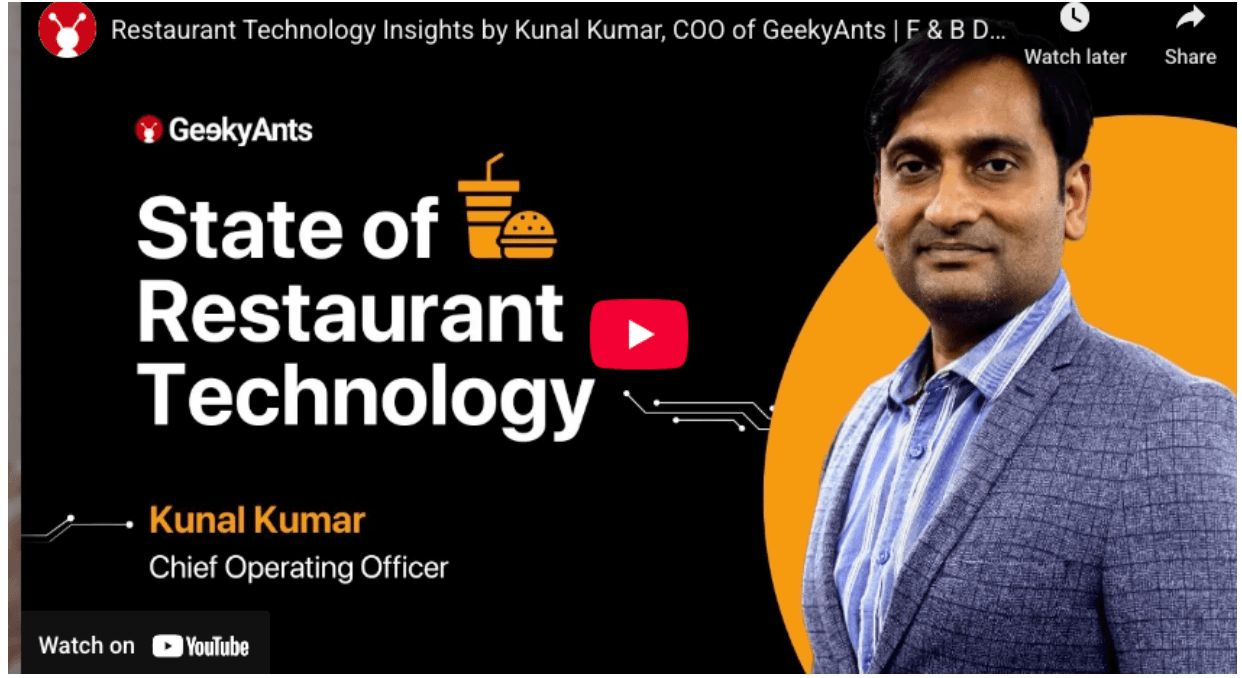
But first, have a look at how we are shaping restaurant technology.
Watch Kunal Kumar, COO of GeekyAnts, share how the company partners with U.S. F&B leaders to bring AI-driven innovation, POS integration, and personalized experiences to restaurant technology ecosystems.
Why the Build vs Buy Decision Matters More Than Ever
As competition among U.S. restaurant chains intensifies, the real differentiator is no longer menu variety or pricing—it is how well brands understand and engage their customers. Diners now expect personalized rewards, seamless mobile experiences, and real-time recognition across every interaction. For operators, that means restaurant loyalty software must do more than record transactions; it has to unify data, strengthen retention, and reinforce brand identity. Yet, most restaurant chains now stand at a crossroads:
1. The SaaS Advantage
Many small and mid-sized restaurant chains are choosing SaaS or white-label loyalty platforms to move fast. These tools offer:
- Rapid deployment with minimal technical overhead
- Lower upfront investment compared to custom builds
- Built-in analytics and dashboards to manage customer behavior and campaign performance
When you are a brand trying to get to market fast and keep things simple, SaaS platforms seem like the obvious choice. But they come with real drawbacks. You cannot fully access your customer data, you are stuck with whatever features the platform gives you, and you are basically at the mercy of whatever the vendor decides to build next. Once restaurant loyalty programs stop being just a nice marketing tactic and become central to how you actually grow your business, these limitations start feeling like a serious problem.
2. The Custom Build Edge
For larger or fast-scaling enterprises, building a custom loyalty software platform delivers long-term control and scalability. A bespoke system offers:
- Complete ownership of data and customer insights
- Full control over design, user experience, and feature evolution
- AI-driven personalization tailored to unique customer journeys
- Scalability aligned with the brand’s growth and multi-location expansion
A custom approach requires greater investment and time, but it allows restaurants to create a loyalty program experience that truly reflects their brand and integrates seamlessly with POS, CRM, and food delivery systems. For chains aiming to make loyalty a competitive moat—not a convenience—custom builds often deliver deeper value over time.
Speed helps you launch, but control helps you grow. The right loyalty strategy blends both—quick wins today and scalability for tomorrow.
 Kunal KumarChief Revenue Officer
Defining Your Restaurant Loyalty Program: What is Table Stakes
Restaurant leaders face a critical decision: should you build a custom restaurant loyalty platform from scratch, or buy an off-the-shelf SaaS solution? Before making that choice, you need to know exactly what your loyalty system must do. The answer lies in four foundational elements. If your platform delivers all four, you have built or chosen the right solution. If it lacks even one, you have made the wrong decision.
The first element is core functionality. A modern loyalty program must handle tiered rewards that incentivize higher spending. It should enable referrals so customers become your acquisition channel. Gamified challenges keep engagement high. And multi-location support means a customer in any of your restaurants receives the same seamless experience. All of this must work through a single mobile app that customers want to use.
The second element is seamless integration. Your loyalty platform cannot exist in isolation. It must connect directly to your POS system so rewards are recognized instantly when a customer orders. It needs to feed customer data into your CRM and marketing tools so you can send personalized offers. It should sync with your online ordering system to create one unified customer profile across every touchpoint. Without these connections, your system becomes fragmented, and customers get confused.
The third element is data security. Regulations like CCPA and GDPR keep getting stricter. Your loyalty platform must encrypt all data exchanges, manage customer consent clearly, and meet PCI compliance standards. This protects your customers and protects your brand from operational disruptions and legal risk.
The fourth element is actionable intelligence. Collecting loyalty data means nothing if you cannot extract insights from it. Your platform needs advanced analytics to identify which customers have the highest lifetime value. It should segment audiences so you can tailor offers to different behavior patterns. AI-driven recommendations should suggest the right incentives to the right customers at the right time. This transforms loyalty from a simple point-collection program into a measurable retention engine that drives revenue.
Building Your POS Foundation
Your loyalty platform is only as powerful as the systems it connects to. A robust POS system ensures seamless transactions, unified data, and better customer insights.
Read our in-depth guide on building a modern restaurant POS system — a must-read for any brand planning to integrate loyalty with operations.
How to Build a Restaurant POS System for Modern Businesses — A Step-by-Step Guide
Build vs Buy — Crafting a Winning Loyalty Software Strategy for U.S. Restaurants
Deciding whether to build a custom loyalty platform or buy an off-the-shelf SaaS solution is one of the most consequential technology decisions a restaurant chain can make. This single choice determines how fast you launch, how much control you retain over customer data and brand experience, and whether your system can evolve as your business grows.
Restaurant leaders must evaluate the build vs. buy decision across four strategic dimensions. Each dimension reveals a different trade-off—what you gain on one side, what you sacrifice on the other.
In loyalty, speed is important—but ownership defines the outcome. Off-the-shelf platforms help you test ideas quickly, but only custom ecosystems let you control how loyalty data connects with your brand and business strategy. For restaurant chains, that control often decides who truly owns the customer relationship.
 Rupsa DasProduct Owner I
1. Control vs Convenience
The first trade-off lies between operational convenience and long-term control. Buying a SaaS or white-label loyalty solution offers the advantage of speed and simplicity. Vendors manage infrastructure, updates, and support, allowing restaurant teams to focus on marketing and engagement rather than technology management. For smaller or mid-sized chains testing loyalty models, this path ensures quick deployment and predictable costs.
Building a custom loyalty platform software for a restaurant chain gives you complete ownership. You control how the user experience feels, where customer data flows, and what features your team develops next. It enables brands to define all interactions, including how and what rewards are offered, how and what customer intelligence contributes to CRM and campaign automation.
As an illustration, Panera Bread developed its loyalty ecosystem by developing its own to normalize design, data, and CRM interactions between dine-in, pickup and mobile orders. This combined strategy will deliver a seamless customer experience that makes brand identity stronger at each interaction point.
In a nutshell, SaaS is concerned with operational simplicity, whereas custom is concerned with artistic dominance. The correct decision lies in the fact that your brand is either interested in going swift or in establishing a long-lasting relationship with all diners.
2. Cost vs Value
Whereas the SaaSs reduce the initial expenditures, they may restrict the ability to be flexible in the long term. The custom solutions will require more upfront investment but may yield higher returns as the business starts focusing on loyalty as a core of its growth.
Criteria | SaaS / White-label | Custom Build |
|---|---|---|
Initial Cost | Low | High |
Maintenance | Vendor-managed | Internal/outsourced |
Scalability | Moderate | Unlimited |
ROI Horizon | Short-term | Long-term |
Data Ownership | Partial | Full |
SaaS solution is cost-effective and easy to use in the short run. However, in the case of restaurant chains where the loyalty leads to a repeat order and lifetime value, the ROI may be better than the startup costs of a custom system, and in particular, customer interaction may be a competitive advantage.
3. Flexibility & Scalability
Flexibility defines the extent to which your loyalty platform is able to adapt to the changing customer expectations.
Most SaaS loyalty programs only support their API to a certain extent, which means that they can only be integrated so far with your CRM or analytics stack. A bespoke system, however, can be expanded in a modular fashion - new functionality, gamification, or analytics layer can be added as the customer behavior changes.
They also provide enterprise-tier scalability, so that they can continue to perform when seasonal peaks hit or there is a region-wide growth, as well as when managing multiple restaurant brands across a single ecosystem.
Custom software development is the strategic option in case you need to integrate multiple brands or have a single data view. It makes sure that your loyalty platform is expanded with your business.
4. Speed-to-Market vs Future Proofing
The speed of entry is very important, particularly in cases where brands are introducing loyalty programs, the first time.
It is possible to implement SaaS platforms within a few weeks, and it is suitable to use them in small chains or pilot programs. They decrease the friction of implementation and enable rapid experimentation of reward mechanics and models of user engagement.
Custom platforms are, however, more expensive and time-consuming to create initially, but provide future flexibility. They are designed to scale - including new features, integrations, and models of data without reliance on vendor release processes.
One that was excellent was Chipotle, which uses both SaaS and analytics with its proprietary engagement layers on top. This model allowed scaling to speed up without sacrificing innovation or data control - a tradeoff that characterizes the contemporary loyalty strategy.
Decision Framework
- Buy → When you are launching your first program, need fast results, or lack internal tech resources.
- Build → When loyalty is a core growth pillar and you need full control over data, personalization, and scalability.
- Hybrid → When you want SaaS speed with the flexibility to extend or customize key components.
Ready to Build the Foundation for Smarter Loyalty?
Your loyalty platform works as well as the other systems it connects to. Get your cash register, customer database, app, and reporting tools talking to each other properly, and you have got something that can actually grow with your business.
Explore our Restaurant App Development Services →
How Cost Structure Impacts ROI in U.S. Restaurant Operations
When assessing loyalty software, restaurant chains must evaluate both the cost structure and return on investment (ROI). The actual economics will vary depending on the size of the chain, the scope of the loyalty program, and the complexity of your tech stack and integrations. Below is a comparative overview of two typical paths — SaaS/white-label vs custom build.
Component | SaaS / White-label | Custom Build |
|---|---|---|
Licensing / Subscription | Low-to-moderate monthly fee (e.g., ~$500–$2,000/month) | Higher initial investment (license not applicable) |
Setup & Integration | Moderate upfront cost (~$5,000–$20,000) | Significant upfront cost (e.g., $30K–$100K+) |
Maintenance | Often included in the vendor fee | Ongoing internal/outsourced expense (10-15% of build cost annually) |
Reward & Marketing Budget | ~1-2% of revenue | ~1-2% of revenue |
Estimated ROI Timeline | 6-12 months | 18-24 months |
Choosing the Right Loyalty Software Path for Your Chain – Steps to Get Started
Selecting the right loyalty approach requires clarity, not complexity. Here is a simple five-step framework to guide your decision:
- Define your goals. Decide what loyalty should achieve — stronger retention, personalized experiences, and higher order frequency.
- Audit your ecosystem. Evaluate your current POS, CRM, and ordering platforms to identify integration readiness and data gaps.
- Assess your capabilities. Determine whether your team can manage in-house development or if a technology partner is needed for execution and scalability.
- Project your ROI horizon. Clarify whether your goal is a short-term lift in engagement or a long-term ecosystem built around customer data and automation.
- Choose the right partner. Prioritize vendors or developers who understand the restaurant industry and can deliver flexible, scalable architectures that evolve with your brand.
By following this framework, restaurant leaders can align technology choices with business outcomes — ensuring that their loyalty strategy supports both speed today and scalability tomorrow.
Why Choose GeekyAnts for Your Restaurant Chain’s Loyalty Software Development?
GeekyAnts is a global product development company that helps restaurant and F&B brands build modern digital ecosystems. We design and develop digital systems that help restaurants integrate loyalty, POS, and ordering experiences — creating a seamless ecosystem for customer engagement and operational efficiency.
Why Choose GeekyAnts
- Proven F&B Expertise: We’ve worked with U.S. restaurant and food-service brands to modernize their digital operations, enhance customer engagement, and streamline multi-channel experiences.
- Custom Engineering: Our solutions include scalable POS integrations, modular engagement frameworks, and analytics dashboards purpose-built for growth and operational clarity.
- AI-Driven Personalization: Using AI and predictive insights, we help restaurants deliver personalized offers, loyalty journeys, and recommendations that drive repeat business.
- Future-Ready Architecture: Every product is built on secure, API-first foundations, ensuring smooth integrations and scalability as your business expands.
- Hybrid Development Approach: Whether extending an existing SaaS platform or developing a fully custom system, we balance speed, flexibility, and long-term control.
Turn loyalty into your strongest growth engine.
Ready to build your custom loyalty solution?
Let’s turn your vision into a scalable, data-driven system that grows with your brand.
Conclusion
The age of point-based loyalty is giving way to something deeper — experience-led retention. For restaurants, the real competitive edge now lies in building connected systems that unify customer data, digital touchpoints, and operational insights into one continuous loop of engagement.
The decision to build or buy loyalty software is no longer a technical one; it is strategic. SaaS platforms deliver speed, but custom solutions create ownership — of data, of customer journeys, and of innovation itself. The best brands will find their balance, using technology not as an add-on but as the backbone of long-term loyalty.
In the end, loyalty is not software — it is a reflection of how well a restaurant understands its diners. The technology serves as the bridge. What defines success is how seamlessly a brand uses it to turn every visit into an insight, every interaction into a relationship, and every relationship into sustained business growth.
FAQs
1. Why is loyalty software important for restaurants?
Loyalty software helps restaurants move beyond discounts to build genuine customer relationships. It tracks purchase behavior, rewards frequent diners, and delivers personalized offers that increase retention and lifetime value. The right platform turns every visit into actionable data that fuels smarter marketing and consistent growth.
2. How much does loyalty software cost per location or per user?
Costs depend on scale and approach. SaaS platforms typically charge between $500–$2,000 per month per location, while custom-built systems involve a higher upfront investment but lower recurring fees over time. The return comes from better retention, higher average order value, and reduced acquisition costs.
3. How long does it take to roll out a loyalty program across all locations?
A SaaS-based program can go live in 4–8 weeks, depending on integrations and data migration. A custom-built platform usually takes 3–6 months, allowing time for tailored design, feature development, and POS or CRM integration. The ideal approach balances speed with long-term flexibility.
4. Which loyalty software model works best for multi-location or enterprise restaurants?
Enterprise and multi-location chains benefit most from custom or hybrid models. These systems allow unified data management, brand-level customization, and deep integration with existing POS and analytics tools—capabilities that standard SaaS platforms often limit.
5. Can a loyalty program help increase online ordering share?
Yes. Integrating loyalty features into web and mobile ordering creates a direct incentive for repeat digital purchases. Rewarding online behavior—such as app orders or delivery frequency—builds habits that drive higher order volume and customer retention across channels.
6. Can existing restaurant systems integrate with new loyalty software?
Modern loyalty platforms are built with API-first architectures, making integration with existing POS, CRM, and delivery systems seamless. Whether you use Toast, Square, or a custom POS, a well-engineered solution ensures real-time synchronization of transactions, customer data, and rewards.
7. What KPIs should restaurants track to measure loyalty success?
KPI Key metrics include:
- Active participation rate: Percentage of customers engaging with the program.
- Repeat purchase frequency: How often members return within a set period.
- Average ticket uplift: Increase in order value from loyalty members.
- Redemption rate: Ratio of redeemed rewards to issued ones.
- Retention rate: Long-term impact on customer loyalty and churn reduction.
Tracking these KPIs helps operators understand performance and refine reward strategies over time.