

Key Takeaways
- Model upgrades won't fix hallucinations on company-specific data — that's a retrieval architecture problem.
- Zero-Copy RAG connects your AI to existing databases in real time via CDC, with no migration or data replication required.
- Combining semantic vector search with BM25 keyword search closes the exact-match gaps that pure vector search misses in production.
- Enterprises integrating production-grade RAG report 340% first-year ROI with a 3–6 month payback period.
The biggest problem with enterprise AI today is reliability. The same model that performs brilliantly in demos often begins failing the moment it meets real production data. At GeekyAnts, we frequently see this pattern when clients come to us with a common frustration: nothing changed—except production. This is a documented industry crisis where 95% of custom enterprise AI pilots fail to reach production due to brittle workflows and a lack of contextual memory.
This is the moment most enterprise AI teams misdiagnose the problem. They assume the model needs retraining, or upgrading, or fine-tuning. They spend three months and a substantial budget on that assumption, yet 70% of GenAI projects still hit a data quality wall within the first month of deployment. When these teams reach out to us for a rescue mission, the diagnostic is almost always the same: it is a broken RAG pipeline—or the absence of one entirely. Without a grounded architecture, even the most advanced models fall into the 30% rule, where nearly a third of outputs contain hallucinations that erode user trust and invite regulatory risk.
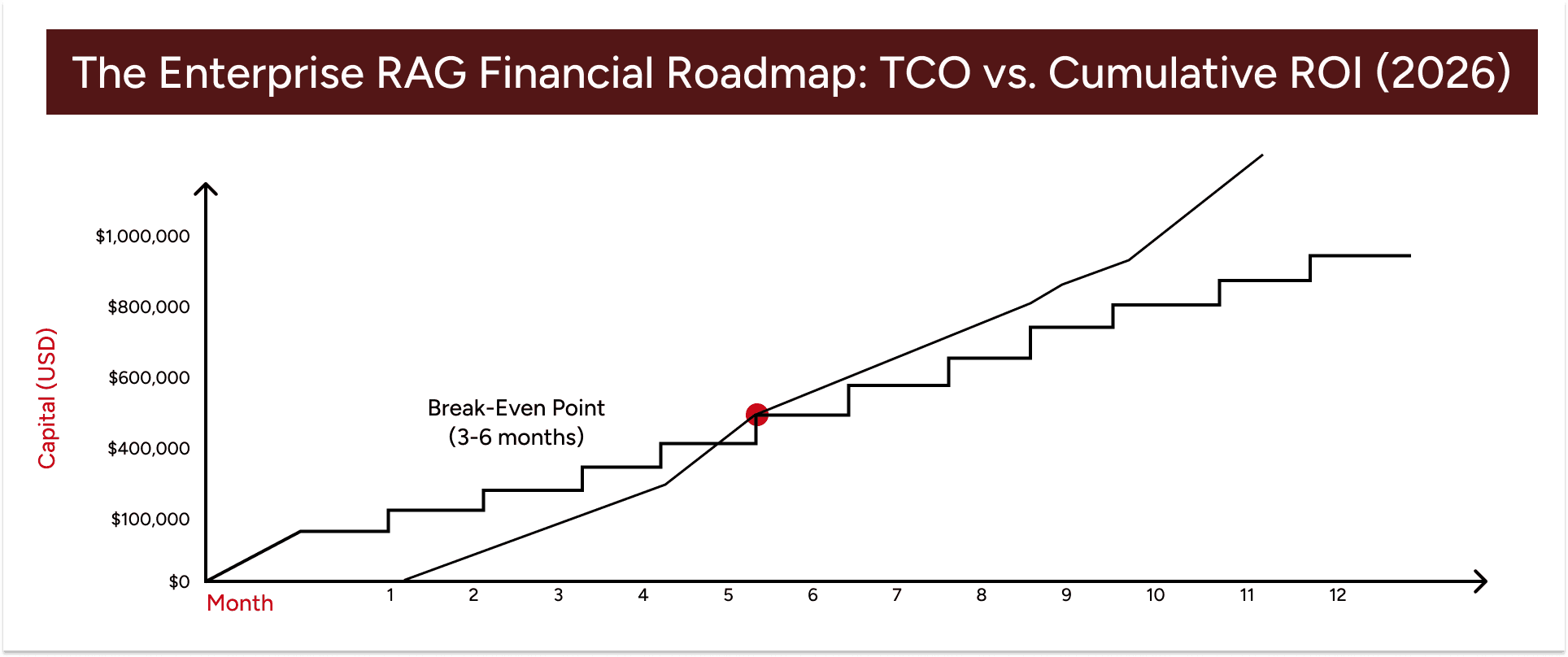
This blog provides a technical and financial roadmap for fitting Retrieval-Augmented Generation (RAG) into your existing stack. We break down the Zero-Copy Architecture for real-time data integration, the Hybrid Search layers essential for eliminating hallucinations, and a 5-phase workflow to transition from pilot to production. You will also find a Total Cost of Ownership (TCO) analysis for U.S. enterprises and real-world case studies demonstrating how to achieve a 340% ROI by transforming AI into a high-accuracy production asset.
Why 94% of AI Deployments Don't Perform at Scale
In 2026, 88% of companies use AI in some form. Only 6% qualify as high performers. That gap does not exist because high performers chose better models. It exists because they built a better integration architecture.
The single most common failure pattern: an LLM connected to static training data in an environment where business data changes daily. Pricing updates. Inventory shifts. Policies are revised. The model knows nothing about any of it.
There are three signals that your enterprise has this problem right now:
1. Your LLM hallucinates on company-specific data.
When users ask about your pricing, SKUs, or internal policies, answers are wrong or fabricated. This is not a model capability issue. It is a data access issue.
2. Your data changes faster than fine-tuning cycles allow.
Fine-tuning operates on a monthly cadence, at best. If your data changes daily—and most enterprise data does—fine-tuning cannot keep up. A RAG system retrieves live data at inference time. It doesn't need to be retrained.
3. Your users or regulators require citations.
Over 70% of GenAI initiatives require structured RAG pipelines specifically to meet auditability and compliance requirements.
If any of these match your current deployment, the path forward is a production-grade RAG integration.
Is Your Application Ready for RAG? (A Decision Checklist)
Before retrofitting your stack, US enterprises should evaluate their readiness against these 2026 benchmarks:
- Data Volatility: Does your business data (prices, policies, inventory) change more than once a week? (If yes, RAG is mandatory.)
- Audit Requirements: Does your industry (FinServ/Healthcare) require cited sources for every AI response?
- Scale: Is your unstructured data volume exceeding 50GB across silos?
- Latency Tolerance: Can your user experience support a 1.5s - 2.0s time-to-first-token?
The Risk of Waiting: With the EU AI Act and state-level laws (CA/CO) taking effect, the lack of a grounded, auditable RAG pipeline is becoming a compliance liability.
We have spent twenty years watching enterprises chase better models when their real problem was always architecture. In 2026, the gap between the 6% of AI high performers and everyone else is not the model they picked — it is whether their AI can actually see the business it is supposed to serve. A model trained on last quarter's data has no business answering questions about today's pricing or policy. That is not an AI problem. That is an integration problem, and it has a known solution.
 Kumar PratikFounder & CEO
In 2026, 88% of enterprises run AI in some form, yet fewer than 1 in 15 qualify as high performers. The differentiator is data access. Enterprises whose AI retrieves live, grounded context at inference time consistently outperform those still relying on static fine-tuning cycles that cannot keep pace with daily business changes.
The Architecture Decision That Changes Everything: Zero-Copy RAG Integration
Every client who comes to us with a broken RAG pipeline has made the same mistake: they treated data migration as the first step. It is not. The first step is mapping where your source of truth already lives — your CRM, your SQL tables, your document stores — and building retrieval around that. The moment you copy data into a new store, you have created two versions of reality. In production, your AI will eventually serve the wrong one.
 Konakanchi Venkata Suresh BabuPrincipal Technical Consultant.
Across RAG integration projects at GeekyAnts, the single most common source of retrieval failure is not the model or the vector search algorithm — it is data that has silently drifted from its source after an initial migration. Zero-Copy architecture eliminates this class of failure by design, because there is no copy to drift.
The instinct when building a RAG system is to move data. Export your CRM records, clean them, chunk them, and embed them into a new vector database. This approach has a fundamental flaw: the moment you copy data, it begins drifting from the source of truth.
The 2026 production standard is different. It is called the Zero-Copy pattern—accessing data where it already lives, without replication.
Here is how it works in practice.
The Ingestion Layer - Change Data Capture (CDC)
Rather than batch-exporting and re-indexing your database on a schedule, CDC monitors your existing SQL or NoSQL database for row-level changes and syncs them to the retrieval index in sub-minute intervals. Your product table updates at 2:14 PM. The RAG system reflects that change by 2:15 PM. No pipeline job. No nightly export. No stale cache.
Tooling & Vendor Ecosystem for RAG Systems
The build-vs-buy calculus shifted in 2026. Managed vector databases like Pinecone and Weaviate have commoditized the infrastructure layer to the point where building one in-house is a maintenance liability, not a competitive advantage. The engineering effort that once went into standing up vector stores now goes into the retrieval logic, chunking strategy, and reranking models that determine output quality. Enterprises that recognize this distinction and buy the plumbing while building the context are reaching production in 2 to 4 weeks instead of 3 to 6 months.
In 2026, the Build vs. Buy debate has a single answer: Hybrid. Use managed infrastructure for the heavy lifting, like Vector DBs and custom code for the Retrieval Logic. The right tool selection comes down to three criteria: compatibility with your existing database infrastructure, your team's operational expertise, and your latency requirements at peak load. A team already running PostgreSQL has no reason to introduce a separate vector store when pgvector handles sub-100ms retrieval at moderate scale. A platform serving millions of concurrent users with strict SLA commitments warrants a dedicated managed solution like Pinecone or Milvus, where auto-scaling and uptime guarantees are built into the contract.
The Technology Stack Snapshot
- Orchestration: LangChain remains the leader for complex agentic workflows, while Haystack is preferred by enterprises for production-grade stability and ETL pipelines.
- Vector Databases: Use pgvector if you’re already on PostgreSQL; use Pinecone or Milvus if you’re handling 10M+ vectors with sub-100ms latency requirements.
- Evaluation: Tools like RAGAS and DeepEval are now mandatory to measure Faithfulness and Answer Relevancy before every deployment.
Decision Rule: Buy the Plumbing (Infrastructure); Build the Context (Custom chunking & Reranking logic). Building a vector database in-house takes 6-12 months and usually results in 42% of projects being scrapped due to Maintenance Debt.
The Build vs. Buy Framework
Criteria | Buy (Managed RAG-as-a-Service) | Build (Custom Zero-Copy Stack) |
|---|---|---|
Time-to-Market | 2–4 Weeks | 3–6 Months |
Control | Limited to Provider APIs | Full Governance & Custom Logic |
TCO | Predictable Monthly OpEx | High CapEx + Maintenance Debt |
Best For | Standard Support/Sales Hubs | Specialized IP / Niche Compliance |
Deployment Trade-offs:
- Cloud-First: Best for rapid scaling and multi-region US deployments.
- On-Prem/Private Cloud: Resurging in 2026 for Sovereign AI needs. Organizations with strict data residency (GDPR/HIPAA) are moving vector stores to private VPCs to avoid $750k+ in lifetime data egress fees.
Step-by-Step RAG Pipeline Integration Workflow
Moving from a pilot to full-scale integration in an existing app follows a strict 5-phase staged rollout.
Phase 1: Discovery & Semantic Audit (Weeks 1-2)
Goal: Identify high-value data gravity and define the ground truth.
- Stakeholder Alignment: Conduct cross-functional interviews with IT, Legal, and Security to define hallucination tolerance and SLA targets for response latency.
- Data Inventory: Map existing data silos across SharePoint, Confluence, and SQL databases. Categorize sources by volatility (how often they change) and sensitivity (PII/PHI content).
- Semantic Mapping: Separate verified company procedures from noisy, conversational data like Slack logs. Determine the metadata schema needed for future retrieval filters, such as region, department, or document version
Phase 2: Zero-Copy Prototyping (Weeks 3-6)
Goal: Establish an accuracy baseline without the risk of data migration.
- Infrastructure: Connect RAG orchestration tools like LangChain or Haystack to a single verified source via Change Data Capture (CDC). This allows real-time indexing without moving the source of truth.
- Semantic Chunking: Implement Layout-Aware Parsing to handle complex tables and headers. Use a baseline of 512-token segments with 10% overlap to maintain context across boundaries
- Synthetic Query Testing: Generate a golden dataset of 100+ question-answer pairs using an LLM to stress-test the retriever. If Recall@5 is below 0.80, re-evaluate your embedding model or chunking strategy.
Phase 3: Hybrid Production Integration (Weeks 7-12)
Goal: Deploy a secured, live microservice within the existing application stack.
- API Gateway & Caching: Expose the RAG layer as a dedicated endpoint. Implement Semantic Caching to serve recurring queries from a local store, reducing LLM costs by up to 68% [Source: Redis, 2026].
- Metadata Filtering (RBAC): Synchronize the retrieval layer with the app's existing Identity and Access Management (IAM). Use metadata tags to ensure the AI only retrieves documents that the specific user is authorized to see
- Security Hardening: Deploy within a private VPC. Set up prompt guardrails to block injection attacks that attempt to leak system instructions or unauthorized data.
Phase 4: The RAG Triad Optimization (Ongoing)
Goal: Continuous tuning based on production-grade metrics. Use frameworks like Ragas or DeepEval to monitor the three pillars of reliability:
- Faithfulness: Ensuring the answer is entirely supported by the retrieved context.
- Answer Relevancy: Validating that the response directly addresses the user intent.
- Contextual Precision: Confirming that the most relevant chunks are ranked highest in the retrieval results [Source: GetMaxim, 2026].
Phase 5: Agentic Expansion (Multi-Source Intelligence)
Goal: Transition from linear retrieval to a reasoning-based agentic loop.
- Dynamic Routing: Deploy Agentic RAG to act as a reasoning engine. The AI agent analyzes user intent to decide whether to query a SQL tool for numbers, a Vector tool for policies, or a live API for real-time status.
- Self-Correction: Implement Corrective RAG (CRAG) patterns where a critic agent evaluates retrieved context. If confidence is low, the system triggers a secondary search or asks the user for clarification rather than guessing.
By following this 5-phase workflow, you mitigate the #1 risk of enterprise AI: the Pilot Purgatory. Whether you are starting with a single internal wiki or a global CRM, the focus must remain on iteration over implementation.
We build context-aware intelligence layers that integrate with your existing SQL, Snowflake, and data.
Explore our RAG Development Services
The Industries Driving This Adoption—and What They're Getting
This is not a future architecture pattern. It is in production across major enterprise verticals today.
Financial Services (71% adoption): Real-time fraud detection and policy lookup require data that is current to the second. A RAG pipeline connected via CDC to live transaction records and policy documentation is the only architecture that meets that requirement.
Healthcare (52% adoption): EHR summarization requires pulling from patient records that are updated continuously (MDPI, 2026). Static fine-tuned models cannot safely operate in this context. Retrieval over live records, with citations, is the standard.
E-commerce (78% adoption): Cart recovery and dynamic inventory support require knowing what is in stock, at what price, right now (Hyperleap AI, 2026). A RAG system retrieves this from your inventory database at inference time, without replication lag.
The True Cost of a RAG System
Budget decisions made without this picture produce AI projects that look profitable in the pilot and hemorrhage money in production. The enterprise that plans for TCO from the start builds a system that scales without budget crises.
The ROI Case When You Get It Right
When a RAG integration replaces manual support tiering, the financial return is measurable and fast. Enterprises report a 340% average first-year ROI with a payback period of 3–6 months.
The mechanism is direct: support tickets that require a human agent to look up policy or product information are resolved at the AI layer. The lookup is accurate because it queries the live data source. The agent handles escalations.
And it is the output of replacing a high-cost manual process with a retrieval system that has access to accurate data.
How a RAG System Processes a Query: From Raw Data to Grounded Response
Most enterprise teams focus on the output of a RAG system without understanding the sequence of decisions that produce it. Each query a user submits travels through four distinct stages before a response is generated, and failure at any stage produces a wrong answer regardless of how capable the underlying model is.
Stage 1: Query Understanding
The user's input is processed and converted into a vector representation that captures its semantic meaning. If the query contains ambiguous terms or references that require business context, a query expansion step enriches it before retrieval begins.
Stage 2: Retrieval
The system runs a hybrid search across the knowledge index, combining semantic vector search with BM25 keyword matching. The result is a candidate set of the most relevant document chunks from your live data sources, retrieved without any replication or migration.
Stage 3: Reranking
A cross-encoder model re-scores the candidate chunks against the original query. The top 5 chunks by relevance score are passed forward. Everything else is discarded. This step is what keeps the prompt window clean and the generation cost controlled.
Stage 4: Grounded Generation
The LLM receives only the reranked context alongside the user query. It generates a response grounded in that context, with source references traceable back to the original documents. No fabrication. No hallucination on company-specific data.
The integrity of this pipeline depends on the quality of data at the ingestion stage. A RAG system is only as reliable as the index it retrieves from.
The Failure Modes That Destroy Production RAG Systems
Architecture alone does not guarantee success. Three failure patterns account for most production RAG degradations.
- Semantic Drift: Your retrieval quality is calibrated to your data at launch. As your data evolves—new products, revised policies, terminology changes—the embeddings that worked at launch become less accurate. Without scheduled re-evaluation using frameworks like Ragas or DeepEval (which measure Faithfulness, Answer Relevancy, and Context Precision), you will not know you have a drift problem until users report it.
- Prompt Injection: Without guardrails, a user can craft inputs that bypass the RAG layer and instruct the model to return sensitive internal data. This is not theoretical. It is an active attack vector in production enterprise systems.
- Latency Spikes: A RAG system with a p90 Time-to-First-Token (TTFT) above 2 seconds fails in production. Users abandon it. Agents route around it. The infrastructure investment in auto-scaling for peak concurrent load is not optional—it is what keeps the system in use.
What Zero-Copy Integration Means for Your Existing Stack
The framing that matters here is that the integration challenge for North American enterprises is to inject AI into a legacy stack without breaking anything.
Zero-Copy RAG integration means your CRM stays in your CRM. Your SQL database stays in your SQL database. The RAG pipeline reads from these sources at inference time. You do not migrate data. You do not accept the risk of a dual-write architecture. You do not create a new database to maintain.
This is the architecture GeekyAnts builds. The principle behind it: your app gets a brain without losing access to its memory.
How Leading Enterprises Are Scaling By Integrating RAG into Your Existing Application
Below are several common use cases of RAG in action from our portfolio:
Healthcare & Clinical Decision Support
Clinicians gain instant, grounded access to patient history and complex medical guidelines to automate administrative burdens.
A dental technology provider integrated a RAG-powered treatment planning system that retrieves context from clinical history to draft personalized plans. This resulted in a 40% reduction in onboarding completion time.
Document Intelligence & Executive Insights
Decision-makers query massive volumes of unstructured corporate data to generate human-readable narrative summaries.
An enterprise-grade Strand Agent was built using AWS Bedrock and Snowflake to process over 10,000 pages of role confirmation data. The system achieved 85%+ accuracy while reducing manual data processing effort by 99%.
PropTech & On-Field Compliance
Field agents access real-time property history and regulatory compliance data via mobile interfaces.
A real estate platform implemented a production-grade RAG system using PostgreSQL and QR-code intelligence. This allows inspectors to fetch exact property technical notes and history instantly, eliminating on-site data fragmentation.
Productivity & Business Process Management (BPM)
Operations teams automate complex validation cycles by grounding AI in internal workflow documentation.
By connecting internal process playbooks to a RAG layer, a logistics firm saw a 50% reduction in validation cycles, ensuring that automated workflows remained consistent with evolving company policies.
Consumer Engagement & Personalization
B2C platforms generate dynamic, real-time recommendations by retrieving user preferences and live inventory data.
A meal recommendation engine utilized RAG to bridge the gap between user dietary restrictions and live ingredient databases, achieving 3x faster iteration on personalized content generation.
Start Your RAG Integration Journey with GeekyAnts
Choosing to integrate RAG is a strategic decision to stop hoping your AI is right and start ensuring it is. At GeekyAnts, we simplify the complexity of AI adoption, focusing on ROI, Scalability, and Security.
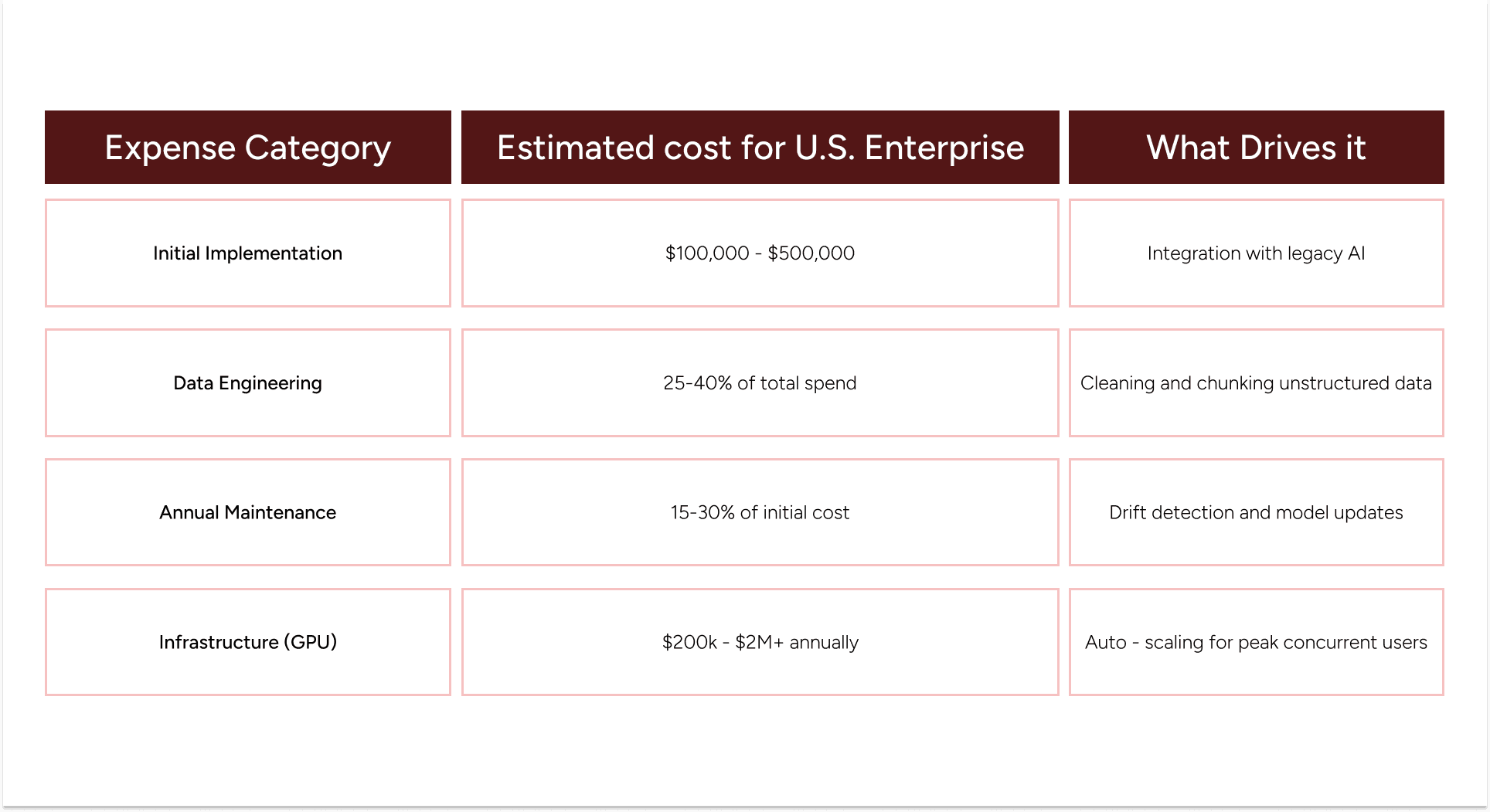
The API bill is the most visible line item in an AI budget, and that is precisely why it misleads. In every RAG integration we have delivered at GeekyAnts, the model cost has been the smallest part of the total spend. The real cost lives in data engineering: cleaning, chunking, and structuring unstructured enterprise data so the retrieval layer can do its job. Enterprises that plan their budget around the API cost alone will hit a wall within the first quarter of production.
The most expensive mistake enterprises make in AI budgeting is treating the model API cost as the total cost. It is not. The API bill is 15–30% of the actual Total Cost of Ownership.
Conclusion
The meeting where your LLM fails on a simple pricing query is a symptom of a missing retrieval layer. By moving toward a Zero-Copy, Hybrid RAG architecture, you protect your legacy data investments while giving your application the context it needs to perform reliably.
Citations
- https://redis.io/docs/latest/commands/ft.hybrid/
- https://www.gartner.com/en/documents/6922166
- https://www.gartner.com/en/newsroom/press-releases/2025-06-02-gartner-predicts-by-2028-80-percent-of-genai-business-apps-will-be-developed-on-existing-data-management-platforms
- https://docs.langchain.com/oss/python/langchain/overview
- https://cloud.ibm.com/docs/databases-for-redis?topic=databases-for-redis-best-practices
- https://milvus.io/docs
- https://www.lakera.ai/
- https://mlq.ai/
- https://www.mdpi.com
- https://aws.amazon.com/bedrock/
- https://www.snowflake.com/en/
Don't buy a new database unless your scale exceeds 10 million vectors. If you run PostgreSQL, pgvector gives you vector search inside the database you already operate.
 Kunal KumarChief Revenue Officer
The Retrieval Layer - Hybrid Search, Not Just Vector Search
Standard vector search retrieves semantically similar content. It fails on exact matches—part numbers, acronyms, product codes, and legal clause references. When a support agent asks about "SKU-4471-B" and your vector index returns a semantically close but wrong product, the consequences are real.
The 2026 production baseline combines semantic vector search with BM25 keyword search. This is called Hybrid Search. The combination improves recall accuracy by up to 9% over vector search alone. In enterprise contexts, that delta translates directly to fewer wrong answers, fewer escalations, and less liability.
The Reranking Layer - Filtering Before the Prompt
Retrieval returns candidates. Reranking selects the right ones. Cross-encoder models re-score the top 50 retrieved chunks against the user's query and pass only the top 5 into the prompt window. This keeps the context window tight, reduces hallucination surface, and keeps generation costs controlled.
By decoupling your retrieval logic from your core application backend, you ensure that your AI can evolve as fast as the model landscape does, without requiring a rip-and-replace of your legacy data stack every six months. The ultimate goal? An architecture where your app gets a brain without losing its memory.
Why Partner with GeekyAnts for RAG Integration
- Zero-Copy Focus: We prioritize architectures that connect to your existing SQL, Snowflake, or legacy DBs without costly and risky data migrations.
- Security First: Our systems are built for the U.S. enterprise landscape, ensuring GDPR, HIPAA, and SOC2 compliance through encrypted indexing and role-based metadata filtering.
- Proven Velocity: From clinical automation to executive insight engines, we deliver production-grade RAG pipelines in weeks, not years.
AI ROI depends less on the model and more on the architecture. Our mission is to remove the friction of AI adoption by building systems that respond to users in context—not just based on data, but on patterns, preferences, and real-time business truths.
Kunal KumarChief Revenue Officer