

Key Takeaways
- AI-generated prototypes require security, compliance, reliability, observability, and ownership checks before any production commitment.
- The 50-point checklist in this guide gives engineering and product leaders a structured way to identify launch blockers before they reach customers.
- The scoring framework turns the checklist into a decision-making tool that tells leaders whether to ship, harden, refactor, or rebuild before committing to a production timeline.
- Every Blocker left unresolved in security or compliance is a reason not to launch, regardless of how the rest of the checklist scores.
Is Your AI-Generated Prototype on the AI Production Readiness Checklist?
AI adoption has crossed a threshold. 88% of organizations now use AI in at least one business function, yet two-thirds have not begun scaling it across the enterprise. The gap between running a pilot and operating a production-grade AI system is where most AI investments stall.
Operationalizing an AI prototype demands infrastructure that holds under real user load, security controls that meet enterprise compliance standards, and monitoring systems that catch failures before customers do. Gartner projects that 30% of proofs of concept will be abandoned by the end of 2025 due to poor data quality, inadequate risk controls, or unclear business value.
The demo clears the room. What it does not show is the six weeks that follow, when the team discovers the access controls were never built for real users, the data pipeline fails on production volume, and the monitoring that should have been in place from day one has to be built under deadline pressure. We have been brought in at that stage more times than I can count. The cost of fixing it after a launch commitment is always higher than the cost of getting it right before one.
 Kumar PratikFounder & CEO
This guide is a 50-point production readiness checklist for CTOs, VP-level engineering leaders, and senior product and platform leads responsible for AI delivery in enterprise environments who need to determine whether an AI-generated prototype is ready for production, or whether it needs to be hardened, refactored, or rebuilt before launch.
What Separates an AI Prototype from a Production-Ready AI Product?
Getting a prototype to work under controlled conditions is a solved problem. Getting that same system to perform reliably for real users, under real load, while meeting the security, compliance, and operational standards that enterprise environments require is a different challenge entirely.
The gap between those two states covers seven dimensions: security, compliance, scalability, reliability, observability, maintainability, and customer trust. Each one represents a category of engineering work that a production environment cannot function without.
“The most common misconception is that observability and security can be added after launch. Teams treat them as operational concerns that follow the product, when in reality they are architectural concerns that shape it. Observability for AI systems means capturing the prompt, the model version, the input context, the output, and the cost of every call from day one. That has to be designed into the request and response flow from the start, because adding it later means touching every code path that interacts with the model, and it means the first months of production data are gone when the team needs them most.
Security follows the same logic. The access model, secrets management, and audit logging have to be decided before the first line of production code, not after, because retrofitting them touches everything the system depends on. The misconception is not that these things are unimportant. It is that they can wait until the product is built. Teams discover the cost of that assumption at their first enterprise security review or their first production incident.”
— Suresh Konakanchi, Tech Lead ll, GeekyAnts
Dimension | Prototype-Ready | Production-Ready |
|---|---|---|
Security | Basic access controls present | Access control, input validation, and user permissions were hardened before launch |
Compliance | Not addressed | Designed into the architecture from the start |
Scalability | Performs under demo conditions | Architected for real user load with failure handling |
Reliability | Works on expected inputs | Tested against failure conditions and concurrent load |
Observability | Absent | Logging, alerting, and monitoring are in place before launch |
Maintainability | Written for speed | Structured for extension and team continuity |
Customer Trust | Demonstrated in a controlled environment | Earned through consistent performance at scale |
Each of the 50 points in this checklist maps to one of these dimensions. Left unaddressed, any one of them becomes a launch blocker, a compliance risk, or a source of engineering debt that compounds after release.

The 5 pillars of a 50-Point AI Production Readiness Checklist
Pillar 1: Architecture and Infrastructure Readiness
A production system, unlike a prototype, is built to scale, recover, and hold up under unexpected conditions. The infrastructure decisions made before launch determine how much engineering capacity gets spent on growth versus firefighting after release.
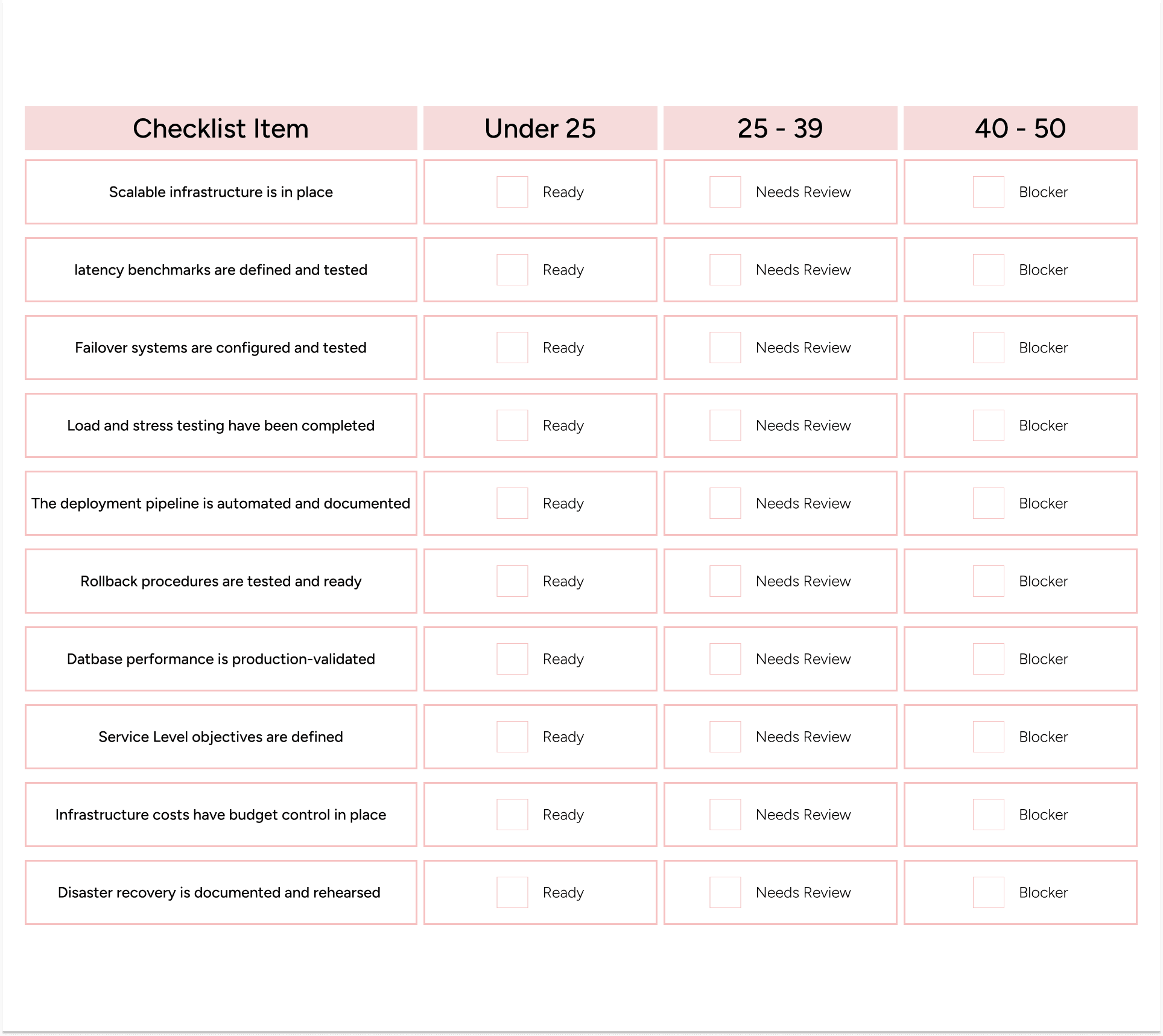
1. Scalable infrastructure is in place
Container-based deployments with auto-scaling policies ensure the infrastructure responds to traffic demand without manual intervention when real user load arrives.
2. Latency benchmarks are defined and tested
Response time targets validated under realistic load before launch prevent demo performance from becoming a user-facing problem in production.
3. Failover systems are configured and tested
Redundancy mechanisms validated before launch give the team an automated recovery path when a component fails.
4. Load and stress testing have been completed
Testing beyond expected peak load identifies breaking points and surfaces infrastructure gaps that normal load scenarios leave hidden.
5. The deployment pipeline is automated and documented
A documented release process that does not depend on manual steps ensures every failed deployment has a safe recovery path.
6. Rollback procedures are tested and ready
A rollback discovered to be untested during an active incident extends downtime and compounds user impact.
7. Database performance is production-validated
Connection pooling, query optimization, and storage capacity validated against production-level data volumes address one of the most common sources of post-launch infrastructure failures.
8. Service Level Objectives are defined
Documented SLOs for availability, latency, and error rate give the team a shared standard that replaces subjective judgment during incidents.
9. Infrastructure costs have budget controls in place
Computing spend, storage, and third-party API costs tracked against defined budgets before launch prevent financial exposure from growing faster than the revenue the system supports.
10. Disaster recovery is documented and rehearsed
A recovery plan that has never been tested carries the same operational risk as having no plan at all.
For CTOs and engineering leaders, infrastructure failures after launch are delivery credibility problems that affect stakeholder confidence and roadmap commitments.
Pillar 2: Model, Prompt, and Data Readiness
Real data differs from sample data in format, volume, and quality. Real users submit inputs that no controlled test anticipates. This pillar validates that the model, the prompts driving it, and the data feeding it are all ready for those conditions before a single user encounters them.
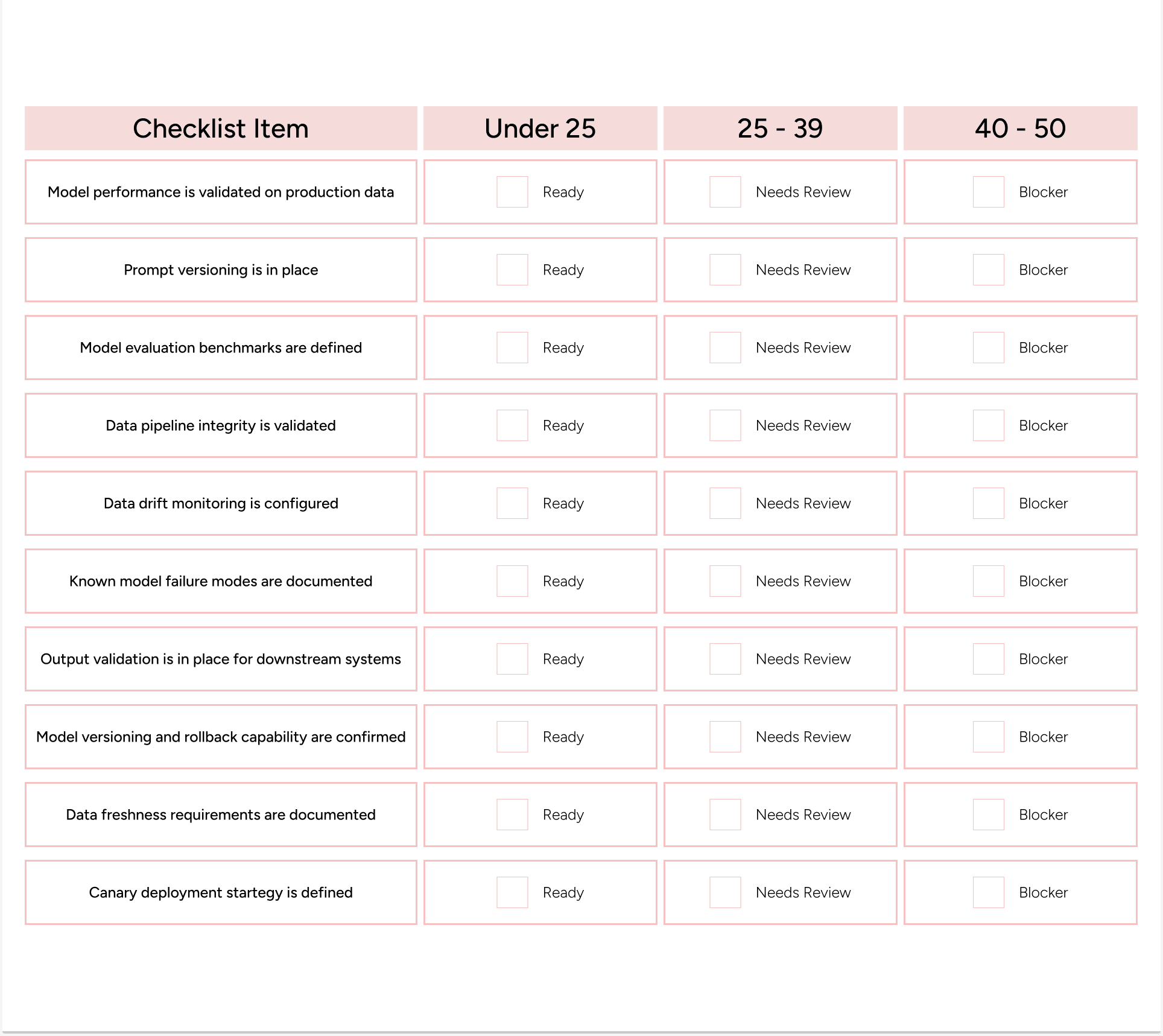
11. Model performance is validated on production data
The model must be tested on data that reflects the actual distribution, volume, and quality it will encounter in production, including edge cases and malformed inputs.
12. Prompt versioning is in place
An unversioned prompt modified in production with no record of the change is a source of output degradation that can take weeks to trace.
13. Model evaluation benchmarks are defined
Documented performance thresholds give the team an objective standard for measuring whether the model is performing within acceptable limits.
14. Data pipeline integrity is validated
A pipeline that performs cleanly on sample data can fail on production data that differs in format, size, or completeness.
15. Data drift monitoring is configured
As production data changes over time, a model trained on historical data can degrade in ways that infrastructure metrics do not surface before output quality deteriorates.
16. Known model failure modes are documented
The conditions under which model outputs should not be trusted, along with the operational response for each, must be documented before launch.
17. Output validation is in place for downstream systems
An unvalidated model output reaching a downstream system can produce cascading failures that are harder to diagnose than the original model issue.
18. Model versioning and rollback capability are confirmed
Model weights, preprocessing logic, and prompt configurations versioned together ensure a rollback restores the full system to a known stable state.
19. Data freshness requirements are documented
Whether the model requires near-real-time data or tolerates batch updates determines whether the pipeline is fit for purpose before launch.
20. Canary deployment strategy is defined
Exposing new model versions to a small subset of traffic first validates performance before a full rollout commits the change.
Data pipeline failures are the most common immediate cause of production AI incidents and among the most preventable. For engineering leaders, this pillar is the difference between controlled AI performance and discovering failures through customer complaints.
Pillar 3: Observability, Evaluation, and Feedback Loops
Production failures are gradual degradations that go undetected until users surface them. For AI systems, that pattern is more pronounced because output quality changes in ways that infrastructure metrics do not capture. The items in this pillar determine whether the team finds problems first or users do.
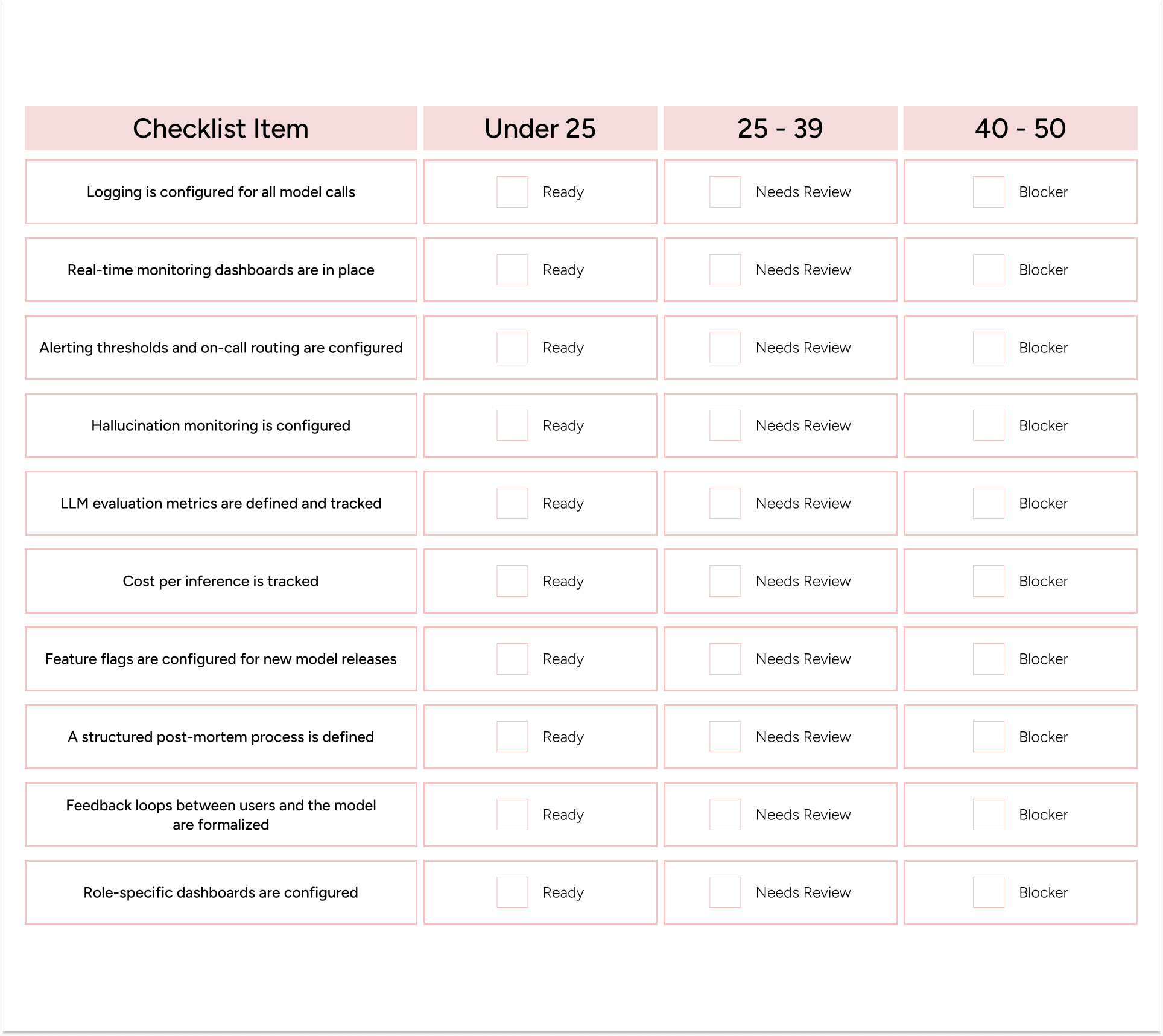
21. Logging is configured for all model calls
Every model call, including the prompt sent, the output received, and the response time, must be logged from day one.
22. Real-time monitoring dashboards are in place
Key performance indicators, including latency, error rate, and throughput, visible in dashboards before launch, give the team the operational awareness to act on problems before they reach users.
23. Alerting thresholds and on-call routing are configured
Thresholds and routing are documented before launch to ensure that when something breaks, the right engineer receives the right context without delay.
24. Hallucination monitoring is configured
Hallucination rates, toxicity checks, and output accuracy are tracked continuously with automated alerts that give the team the ability to act before degradation reaches users at scale.
25. LLM evaluation metrics are defined and tracked
BLEU, ROUGE, or human evaluation scores tracked continuously provide an output quality measure that infrastructure monitoring cannot surface.
26. Cost per inference is tracked
Token spend and compute cost per model call must be monitored continuously to prevent financial exposure from outpacing revenue.
27. Feature flags are configured for new model releases
The ability to disable a new model version for all users with a single action must be in place before the first production release.
28. A structured post-mortem process is defined
A documented process for analyzing failures and preventing recurrence turns incidents into operational improvements instead of recurring costs.
29. Feedback loops between users and the model are formalized
Output quality issues surface through support tickets and user churn when no structured feedback loop exists.
30. Role-specific dashboards are configured
Detailed system logs for engineers and cost trends for business stakeholders are kept in separate views, reducing the time between identifying a problem and making a decision about it.
Observability is the difference between proactive detection and customer-reported failure. Since AI systems degrade in ways standard monitoring cannot see, this pillar is critical to operational confidence post-launch.
Pillar 4: Security, Compliance, and Governance
Of all five pillars, this one carries the highest business consequence when gaps go unaddressed. Gartner projects that by 2029, over 50% of successful attacks against AI systems will exploit access control issues.
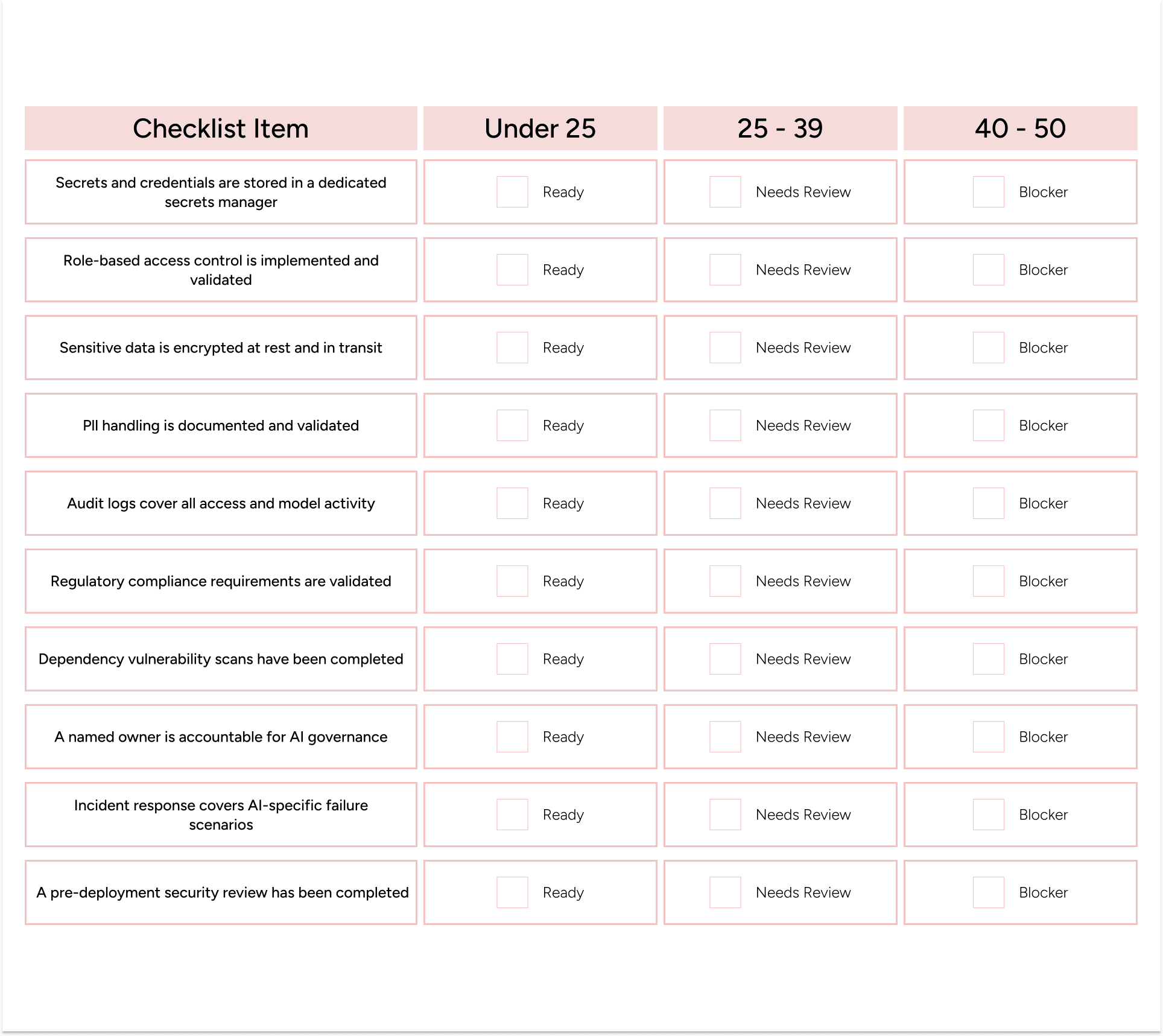
31. Secrets and credentials are stored in a dedicated secrets manager
API keys, credentials, and tokens hardcoded in the codebase create vulnerabilities that scale alongside the product and cannot be rotated without code changes.
32. Role-based access control is implemented and validated
Access control validated against the principle of least privilege before launch removes a category of vulnerability that prototype codebases carry by default.
33. Sensitive data is encrypted at rest and in transit
For products operating in regulated industries, unencrypted sensitive data is a non-negotiable launch blocker.
34. PII handling is documented and validated
PII handling must cover how personally identifiable information is used within model inputs and whether retention policies are enforced through the system.
35. Audit logs cover all access and model activity
Every access request, model prediction, and configuration change logged with enough detail to support forensic investigation must be in place from day one.
36. Regulatory compliance requirements are validated
Legal and compliance stakeholders embedded in the build process prevent audit findings from becoming operational blockers.
37. Dependency vulnerability scans have been completed
Post-launch critical vulnerabilities carry regulatory and operational consequences that are far more expensive to contain.
38. A named owner is accountable for AI governance
There must be a named individual with the authority to approve model deployment, review bias audits, and take the system offline if it causes operational harm.
39. Incident response covers AI-specific failure scenarios
Model drift, hallucinations, and prompt injection do not appear in standard incident response playbooks and must have documented, tested procedures before launch.
40. A pre-deployment security review has been completed
A structured security review completed before release gives the team documented assurance that the system has been pressure-tested.
Security and compliance gaps transfer risk to a point where the cost is higher, the visibility is greater, and the options for containment are fewer.
Pillar 5: Product, UX, and Business Readiness
A system can pass every technical check in the four pillars above and still fail in production. Real users do not behave the way a prototype assumes. When an AI system produces an unexpected output with no fallback in place, the user experience breaks in ways that erode trust faster than any infrastructure failure.
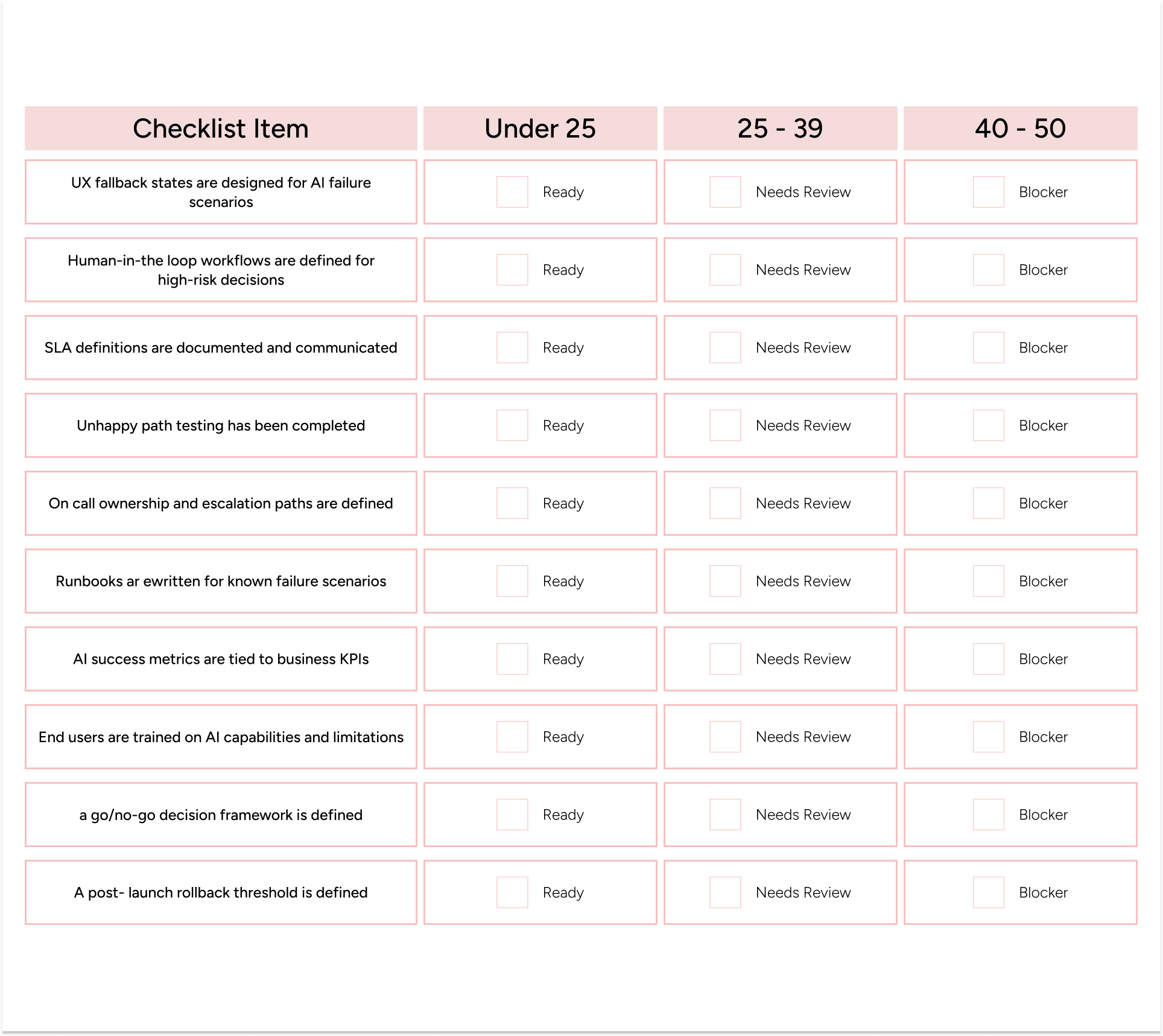
41. UX fallback states are designed for AI failure scenarios
Fallback states designed and tested before launch ensure users encounter a controlled, informative experience rather than an unhandled error at the worst possible moment.
42. Human-in-the-loop workflows are defined for high-risk decisions
Decisions involving pricing, compliance, or medical information must have a defined human review threshold before launch.
43. SLA definitions are documented and communicated
A documented standard for acceptable system performance gives the team a shared basis for measuring whether the product is meeting its obligations to users.
44. Unhappy path testing has been completed
Unexpected inputs, interrupted workflows, and edge case behaviors must be tested before launch so that real users are not the first to expose them.
45. On-call ownership and escalation paths are defined
Time spent identifying who is responsible during an active incident is time the system is degraded, and users are affected.
46. Runbooks are written for known failure scenarios
An engineer responding to a production incident should not need to reverse-engineer the system to resolve a failure that was anticipated during development.
47. AI success metrics are tied to business KPIs
Model performance metrics must connect to the outcomes the product was commissioned to deliver.
48. End users are trained on AI capabilities and limitations
Users must understand the system's capabilities and have a clear path for escalating outputs they do not trust.
49. A go/no-go decision framework is defined
The criteria for launching, delaying, or pulling the system back from production must be documented and agreed upon before that pressure arrives.
50. A post-launch rollback threshold is defined
A documented and agreed-upon threshold at which the system will be taken offline, whether that is a hallucination rate, a latency spike, or a business metric regression, must be in place before launch.
Product, UX, and business readiness failures surface after launch in ways that are visible to users and difficult to contain.
“A team we worked with had built an AI assistant for a customer support workflow. By every technical measure, it looked ready. The model was hitting its accuracy targets, the infrastructure held under load, and the security review had cleared. What nobody had built was a fallback state for the moments when the model produced a low-confidence response or could not produce one at all. In a controlled environment, those moments were rare enough that they had not been treated as a design problem.
In production, with real users sending inputs no one had anticipated, the system began returning empty responses, partial answers, and the occasional output that was confidently wrong. The technical metrics looked fine. The user experience did not. Customers escalated to human agents at a rate that doubled the workload the AI was supposed to reduce, and the business case that justified the launch was undermined within the first month. The gap was not in the model or the infrastructure. It was the assumption that a system performing well on average would perform acceptably in every individual interaction, and in the absence of a UX layer designed for the cases where it did not.”
— Suresh Konakanchi, Tech Lead II, GeekyAnts
How to Score Your AI-Generated Prototype Before Production
Each item marked Ready counts as one point. Items marked Needs Review carry partial risk. Items marked Blocker must be resolved before any launch conversation moves forward.
Total Score | Risk Level | What It Means | Recommended Action |
|---|---|---|---|
40-50 | Strong production readiness | The system has cleared the majority of production requirements | Proceed with final validation and document remaining Needs Review items |
25-39 | Moderate risk | Gaps exist across multiple pillars | Identify which pillars are driving the score down and harden before setting a launch date |
Under 25 | High risk | Gaps across four or more pillars | Do not launch. Conduct a full readiness assessment to determine whether to harden, refactor, or rebuild |
Any Blocker in Pillar 4 | Critical launch risk | A security or compliance gap creates legal and operational exposure | Do not launch until every Blocker in this pillar is resolved |
Give heavier weight to Pillar 4 and Pillar 1 scores. Security, compliance, and infrastructure gaps compound with every feature added after launch in ways that observability or UX gaps do not.
When to Ship, Refactor, or Rebuild: The AI Production Readiness Decision
The score from this checklist points toward a path. Understanding what each path demands from the business in terms of budget, timeline, and engineering capacity determines which one is right.
Decision | When It Applies | Business Risk If Ignored |
|---|---|---|
Ship | 40 or above with no Blockers in security or compliance | Minimal if the remaining gaps are documented and scheduled |
Refactor | Core logic is sound, but specific layers carry production risk | Timeline slippage and rising maintenance cost per sprint |
Rebuild | Architecture, security, or compliance foundations are incompatible with production requirements | Compounding delivery debt that grows with every feature added on an unvalidated foundation |
Organizations that make this call without an objective assessment discover the gap mid-development, under deadline pressure, with stakeholder commitments already in place. The GeekyAnts guide on Rebuild vs. Refactor covers the full decision criteria, including a scorecard across eleven production readiness dimensions and the financial exposure of each path.

How GeekyAnts Closes the AI Production Readiness Gap
Every week, an AI prototype sits in a state that is not production-ready, and the business carries a risk it has not accounted for. Security gaps widen, architecture debt compounds, and engineering capacity gets pulled toward problems that a structured readiness process would have caught before launch.
GeekyAnts brings architecture, security, cloud infrastructure, platform engineering, and customer experience engineering under a single team accountable for what ships.
Across engagements, GeekyAnts has built AI-powered document intelligence platforms that process 10,000 pages in minutes with 99% reduction in manual effort, completed cloud migrations with zero downtime and nearly 50% infrastructure cost reduction, and delivered MVP architectures that scale to production demand without the rework cycle most platforms face after launch. Output validation, data pipeline integrity, operational monitoring, access governance, and security controls are built in before launch, not added after the first production failure.
Fallback states, human-in-the-loop workflows, and SLA definitions are delivery requirements in every GeekyAnts engagement. Dedicated engineering teams remain accountable through launch and beyond.
We get brought in when an AI product has cleared the demo but is not holding up in production. The foundation was never the conversation during the build, and by the time it becomes one, the launch timeline has already absorbed costs it was never designed for. Building that foundation before launch is the work most partners skip. It is the work we start with.
Kumar PratikFounder & CEO
The AI Production Readiness Gap Starts Here
AI-generated prototypes have earned their place in the digital product development process. They compress the time it takes to validate an idea, align stakeholders, and build the case for investment. The distance between a working prototype and a functioning product is where most teams discover what they did not account for.
That gap is an engineering discipline problem. The teams that close it treat the prototype as the starting point it was meant to be, and bring the architecture, security, deployment, and operational rigor that turns a working demo into something users can depend on.
When a prototype meets real users, real load, and real business stakes, the foundation beneath it either holds or it does not. That is the transition GeekyAnts is built for.
Sources and Citations
- https://www.mckinsey.com/capabilities/quantumblack/our-insights/the-state-of-ai
- https://www.informatica.com/blogs/the-surprising-reason-most-ai-projects-fail-and-how-to-avoid-it-at-your-enterprise.html
- https://www.gartner.com/en/newsroom/press-releases/2024-07-29-gartner-predicts-30-percent-of-generative-ai-projects-will-be-abandoned-after-proof-of-concept-by-end-of-2025
- https://www.gartner.com/en/information-technology/topics/ai-readiness
- https://www.gartner.com/en/newsroom/press-releases/2025-02-26-lack-of-ai-ready-data-puts-ai-projects-at-risk
- https://www.gartner.com/en/newsroom/press-releases/2025-08-05-gartner-hype-cycle-identifies-top-ai-innovations-in-2025
- https://www.gartner.com/en/cybersecurity/topics/cybersecurity-and-ai