

Key Takeaways
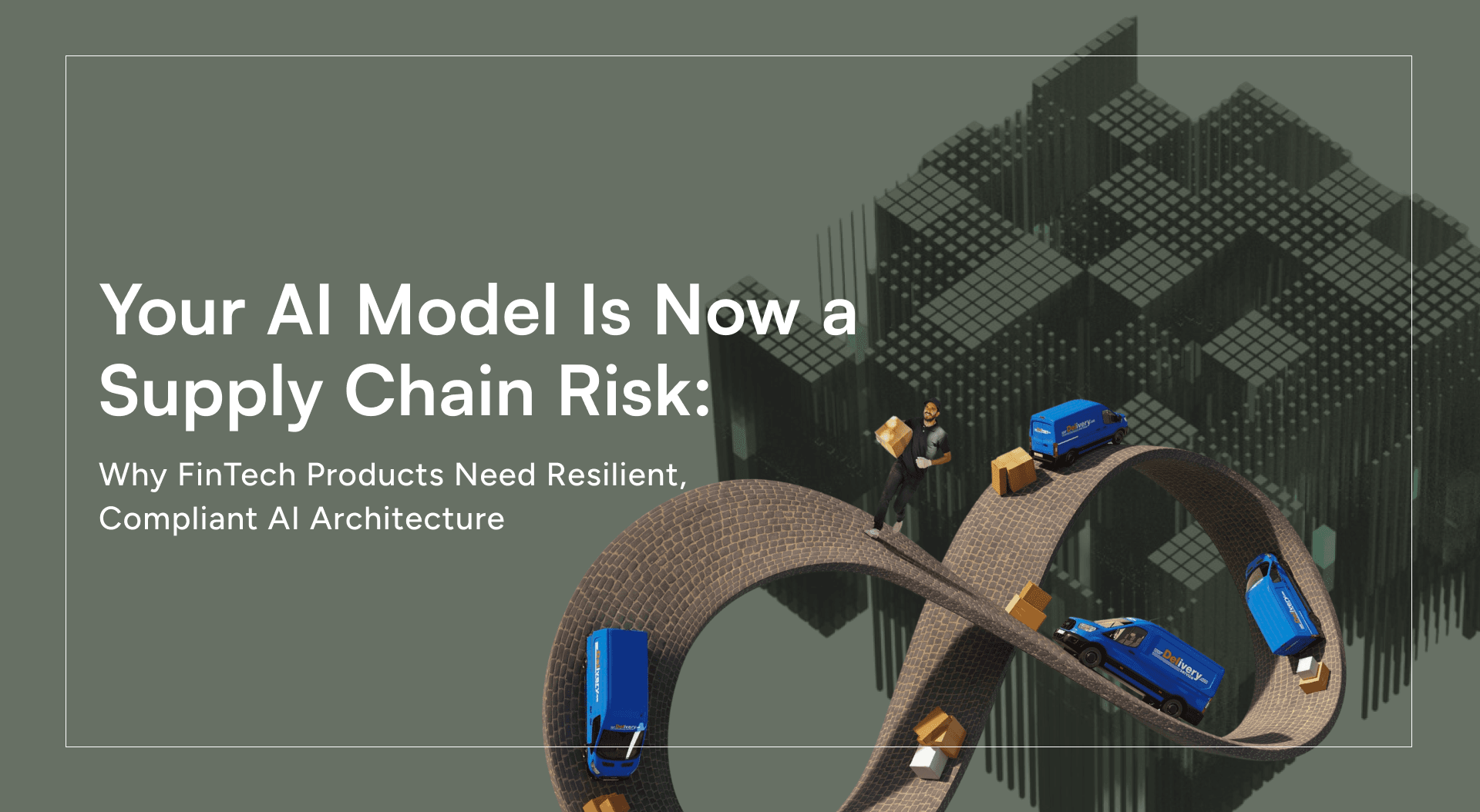
- 83% of supply-chain executives cite trade and regulatory uncertainty as a major concern. FinTech faces a similar risk when AI models, vendors, APIs, or data sources change unexpectedly.
- AI in FinTech is now a business dependency, powering fraud detection, KYC, credit, payments, and customer support.
- Map the full AI supply chain — models, data, APIs, cloud services, agents, monitoring, and fallbacks — to know where failures can occur.
- Build AI to fail safely with human review, backup options, vendor controls, incident plans, and clear records.
AI in FinTech starts to look different once a feature actually moves from demo to production.
A model supporting KYC, fraud detection, credit decisions, payments, or customer support rarely works in isolation. It relies on data sources, APIs, cloud services, model providers, logging systems, and compliance controls that can all affect the final outcome.
Production readiness therefore starts beyond the model itself. Teams need to know which dependencies sit behind each AI-enabled workflow, who controls them, and what happens when one changes or becomes unavailable.
A change in any one of those dependencies can affect the final customer outcome. Once AI reaches production, teams need visibility into every dependency behind the model and the customer workflow attached to it.
AI Dependencies in FinTech Products
EY’s supply-chain research found that 83% of supply-chain executives identified tariff, trade policy, and regulatory uncertainty as their top leadership concern. Physical supply chains show why businesses need to know where each dependency exists, what it affects, and which alternatives are available. FinTech faces a similar problem within the technology stack.
A FinTech product can depend on a model provider for fraud screening, a cloud service for inference, a third-party data source for KYC, an API for orchestration, and logs for audit evidence. If a provider changes its model, an API starts returning different results, or a data source becomes unavailable, the impact can move quickly into a payment flow, an onboarding decision, or a customer support interaction.
For leaders, that changes the conversation around AI in FinTech. They also need visibility into the customer and financial workflows that depend on it, along with a defined response when one of those dependencies changes or fails.
What we often see is that the AI model gets most of the attention during experimentation, while the dependencies around it surface once the product moves closer to production. In FinTech, a provider change, missing fallback, or incomplete audit trail can quickly affect a customer-facing workflow. That is why we look at AI readiness as an architecture question from the start.
 Kunal KumarChief Revenue Officer
How Should FinTech Teams Manage These AI Dependencies?
The NIST (National Institute of Standards and Technology) AI Risk Management Framework provides a useful reference for managing these dependencies. NIST includes practices for organizations to account for third-party software and data, maintain contingency processes for failures in high-risk AI systems, monitor third-party resources, document risks, define human oversight, and plan for incident response and recovery. Its current guidance also reflects the growing importance of post-deployment monitoring as AI moves into production systems.
In a FinTech product, those governance requirements need to translate into architectural controls.
Businesses should be able to identify which models are running, what data reaches them, which customer decisions depend on their outputs, and what gets recorded for audit purposes. They also need defined ownership to know who can override a decision, who responds to a provider outage, and what happens when a model becomes unavailable. Policies establish responsible AI requirements, while architecture implements the control needed to route failed KYC requests, restrict high-risk actions, and support human intervention.
This guide is for FinTech teams scaling AI into production. It covers architecture readiness, model and vendor dependencies, data and API risks, observability, resilience, and AI-driven customer and business workflows.
How Does AI Change Software Supply Chain Risk in FinTech?
Once a FinTech product depends on an external AI model, that model becomes a critical technology dependency. FinTech teams need to account for the entire AI supply chain for every integrated capability.
How Are Traditional Software Supply Chains Different From AI Supply Chains?
Traditional software dependencies are easier to pin down. A library or service has a version. Teams can test it, scan it, patch it, or replace it.
AI introduces dependencies that can change behavior without a corresponding change in application code. A provider updates a model. A third-party dataset changes its schema or coverage. An API returns a different result. A prompt produces an unexpected response. An agent takes an action the product team did not intend. The dependency now includes model providers, hosting platforms, data sources, vector databases, orchestration tools, agents, embedded AI features, and the systems used to log and review model activity.
How Does Every AI Dependency Expand the Operational Risk Surface?
Some of the most difficult risks exist in dependencies that are easy to miss during a traditional architecture review.
A fraud-detection engine may depend on a model provider and transaction data. A KYC flow may depend on an external data source and document-processing service. A customer-support assistant may depend on account context, retrieval systems, and an LLM API. If one dependency changes, the effect can travel through the rest of the workflow.
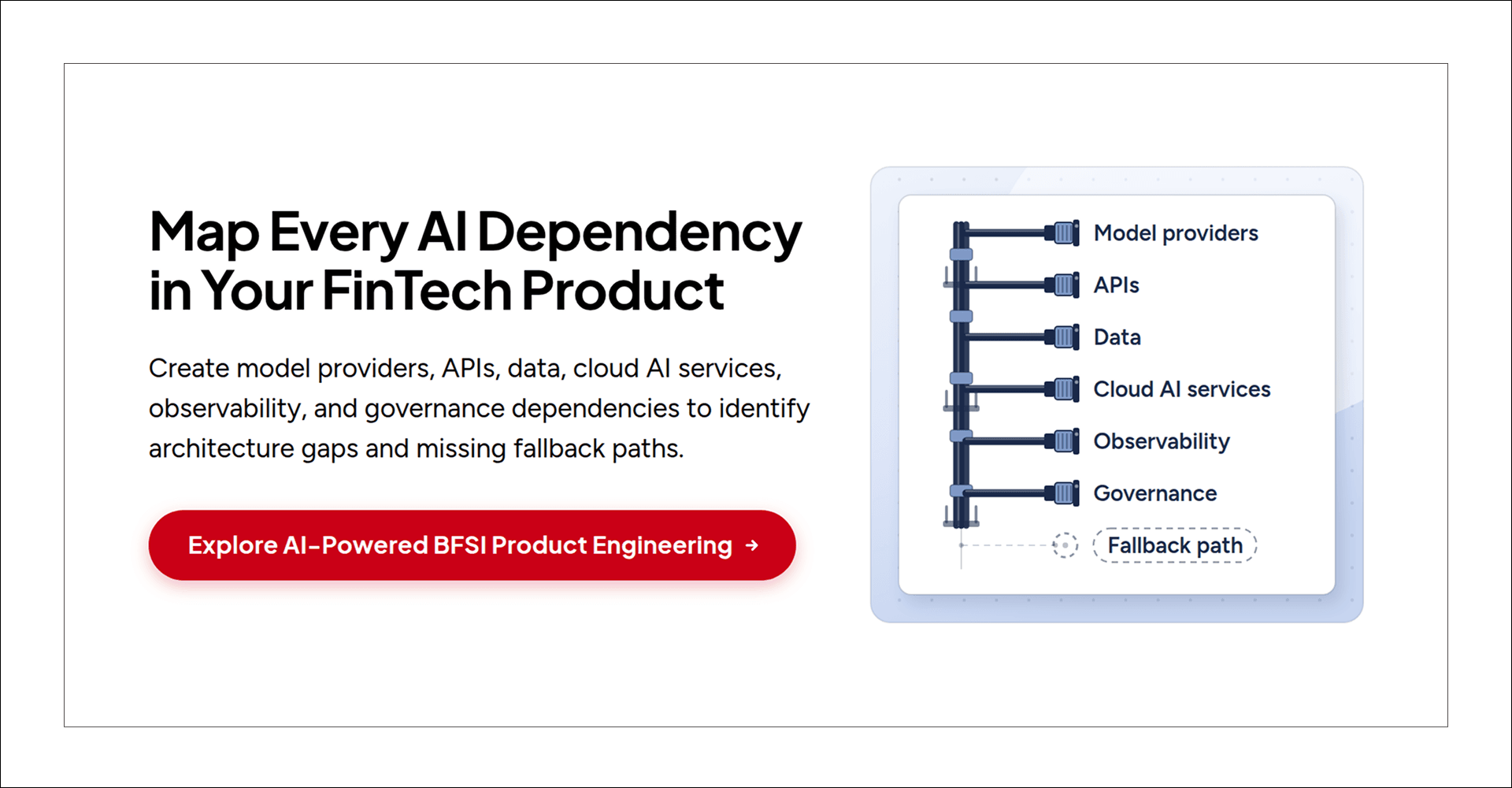
Hidden dependencies are often the ones that escape a traditional architecture review. An AI-enabled customer journey may rely on models, APIs, data sources, cloud services, and third-party providers that are not visible from the application layer alone. Mapping those connections gives teams a clearer view of where a failure could enter the workflow and which controls are needed around it.
Some of the practical questions that need to be considered include:
- Which parts of the product depend on this model?
- What data reaches it?
- Which provider or team controls each dependency?
- How will we know when its behavior changes?
- What happens when it becomes unavailable?
A proper dependency map helps teams answer those questions before a failure reaches a payment, onboarding flow, credit decision, or support interaction.
Why Do Financial Institutions Face Higher Stakes?
For financial institutions, AI errors can move quickly into workflows involving money, identity, eligibility, and customer access.
Model issues can quickly become payment failures, customer disputes, compliance gaps, support escalations, or operational incidents.
FinTech teams need to treat data pipelines, prompts, embeddings, APIs, orchestration tools, model versions, access controls, monitoring systems, and audit records as part of the same risk surface. Existing supply-chain controls were built around software that could be inspected, versioned, and tested. AI adds probabilistic behavior and opaque model components, and agents can act on behalf of users, which changes how those controls need to be applied.
What Does a FinTech AI Supply Chain Include?
A FinTech AI system connects the model with data, applications, infrastructure, governance, and customer-facing workflows. A customer may start with a simple action, let’s say, to apply for credit, verify an identity, question a transaction, or ask why a payment failed. Behind that screen, several systems may handle the request before a person even sees the result. Engineering teams need to map that chain before the feature reaches production.
- Model Layer: This layer contains the models that perform specific tasks, including foundation, fine-tuned, proprietary, open-source, and embedding models. A fraud model and a customer-support model should not be treated as the same dependency.
- Data Layer: Models need something to work with. That can include transaction records, KYC information, customer profiles, behavioral signals, synthetic data, or third-party enrichment. The key questions here are where the data travels, who can access it, and which AI workflow can use it.
- Application Layer: This is where AI becomes part of the product. It powers fraud detection, underwriting, onboarding assistants, support copilots, compliance automation, or internal operations tools. At this layer, an incorrect output could move into a business process.
- Infrastructure Layer: Cloud AI services, vector databases, data warehouses, observability platforms, security controls, and CI/CD pipelines keep the system running. If one of these services fails, the model may still be available while the feature around it stops working.
- Governance Layer: This is the evidence trail. It can include model cards, vendor records, access policies, audit logs, approval records, model versions, and incident reports. For a regulated FinTech product, this layer helps answer a basic question later: What happened, and why did the system make that decision?
- Experience Layer: The customer sees the final part of the chain. They may receive an approval, a fraud alert, an explanation, a request for more information, or a handoff to a human. A good design also defines what happens when AI cannot provide a safe answer, be it for a fallback journey, manual review, appeal process, or support escalation.
How Do Risks Cascade Across AI Dependencies?
A model update does not have to break the application to create a production incident. Consider a fraud workflow where the provider changes the underlying model while the FinTech application remains untouched. The scoring behavior shifts, legitimate transactions begin getting declined, and support volume starts climbing. Operations now have to review more cases manually, while risk and compliance may need to establish which model version produced the affected decisions.
The important point is that the failure starts outside the application boundary but becomes visible inside the customer workflow.
The chain may look like this:
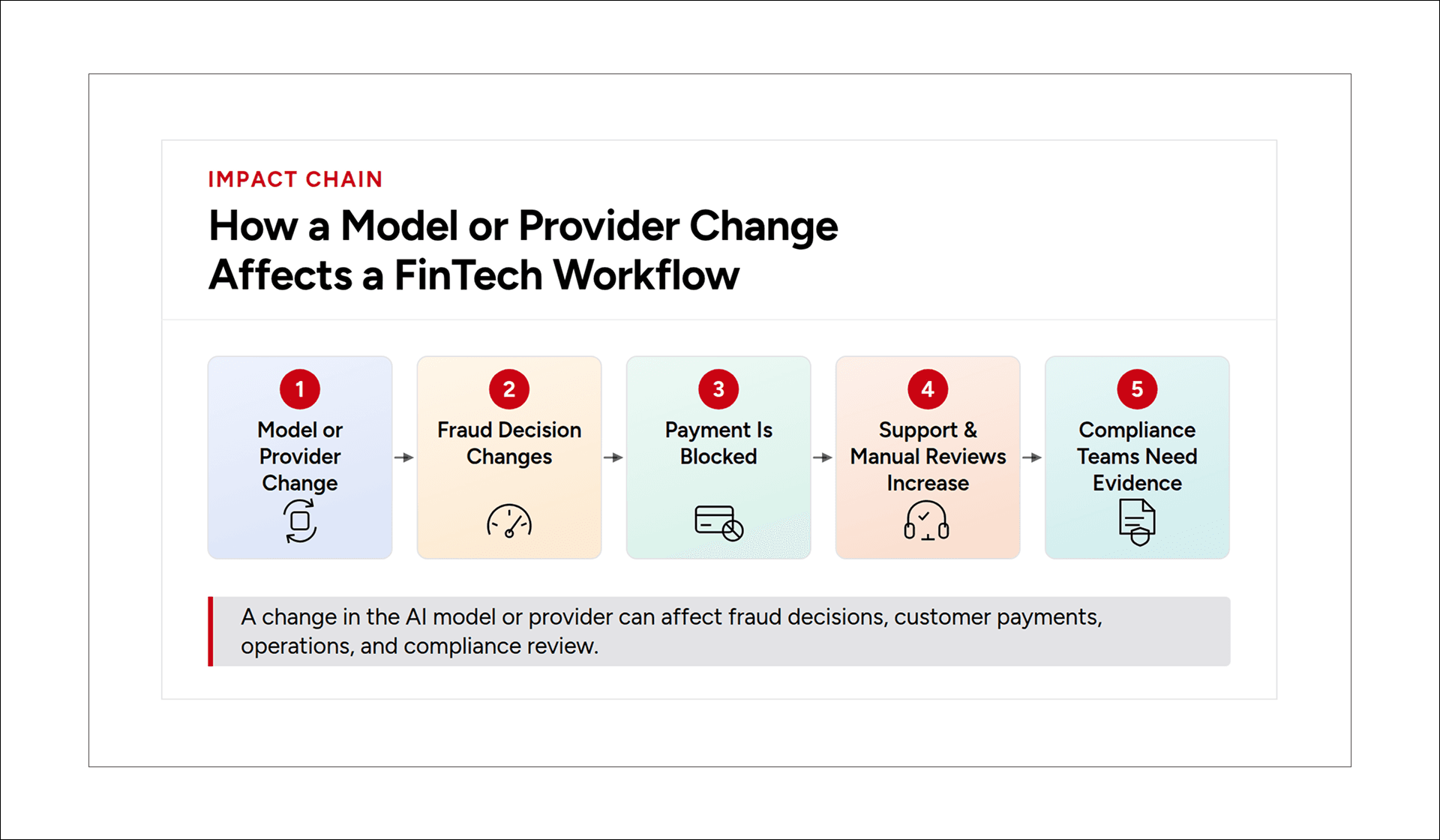
The model itself does not always have to fail. A KYC provider going offline can leave an otherwise healthy onboarding journey waiting for a response. In customer support, the LLM may be available while the retrieval layer supplies the wrong account context. An underwriting model can also remain operational while a cloud dependency around it prevents the workflow from completing.
These cases are easy to miss when AI risk is assessed model by model. The more useful view is the workflow around the model; which services it depends on, who owns them, how failures are detected, and what takes over when one of them becomes unavailable.
The FinTech AI Supply Chain Map
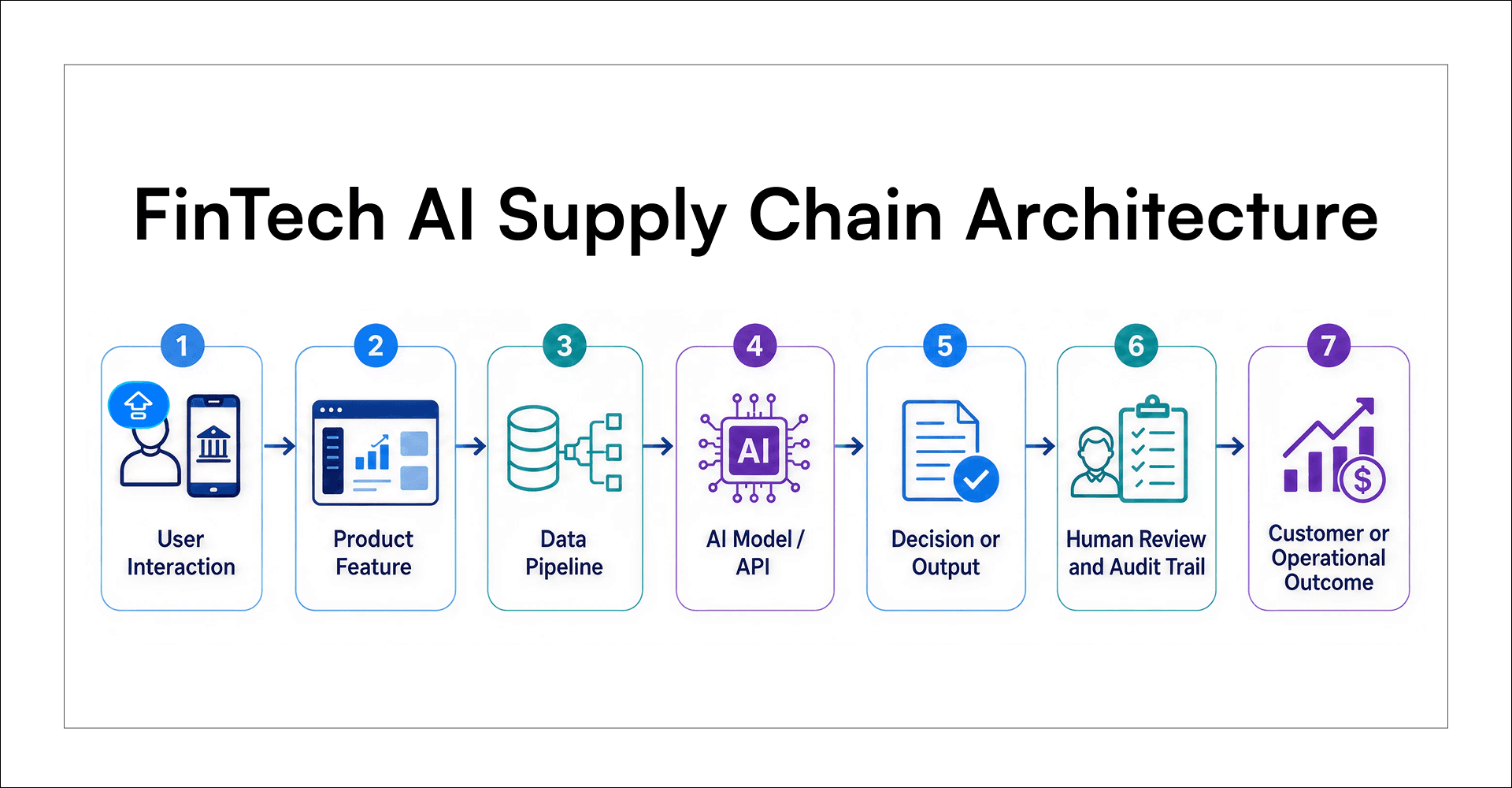
Platform and product leaders can assess model performance alongside every dependency that supports the decision, assign an owner, and determine what happens when one link fails. This supply chain forms the path from a customer action to a financial decision and therefore requires proper ownership and governance.
Where Can AI Supply Chain Failures Affect Financial Products?
AI supply-chain failures can affect approvals, fraud checks, onboarding, advice, support, and claims. The effect depends on which workflow relies on the model, data source, API, or provider that failed.
1. Lending and Credit Decision-Making
Transaction history, bureau data, third-party enrichment, model APIs, and decision rules can all contribute to the final assessment for credit decisions.
That makes seemingly small changes worth investigating. A change in the underlying data or model behavior can alter a risk score without any application release. The result may be a different credit decision, a manual review, or a customer asking why the outcome changed.
2. Fraud Detection
Fraud detection is particularly sensitive to changes in model behavior because its output can sit directly in the payment authorization path. Even a modest shift in scoring can change which transactions are approved, declined, or sent for review.
Imagine that happening during a high-volume payment period. Support receives more complaints, operations have a larger review queue, and the fraud team needs to determine whether the change came from customer behavior, transaction data, or a provider-side model update. The application may never have been redeployed.
3. AML (Anti-Money Laundering) and KYC (Know Your Customer)
KYC and AML workflows introduce different concerns related to evidence and continuity. Identity data, sanctions screening, document-processing services, external databases, and AI models may all contribute to a case.
When one of those services becomes unreliable, the immediate problem may be a delayed onboarding decision. The longer-term issue is knowing what happened to the affected cases and which data or service influenced the outcome. That information becomes important when compliance teams review exceptions or customers challenge a decision.
4. Wealth Management
AI used in portfolio analysis, research support, recommendations, or client servicing may depend on market data, financial content, model providers, and retrieval systems. Wealth management makes the data-quality side of AI supply-chain risk especially visible.
Imagine the market-data feed is delayed while the model continues operating normally. The system can still produce an answer, but the answer may not reflect the information the adviser expects it to use.
5. Customer Support
Customer support creates a different kind of failure where the AI can remain available while becoming less useful.
A customer asking why a payment failed might receive an incorrect explanation because the retrieval system supplied the wrong account context. Nothing necessarily crashes. The assistant responds, the interaction appears successful in the logs, and yet the customer leaves without an answer.
That makes evaluation and observability important beyond simple uptime. Teams need to know whether the assistant is using the right information.
6. Insurance
Insurance workflows can use AI across underwriting, claims, fraud detection, document review, and customer support. A single product may therefore have several different external models, data sources, and AI services supporting different stages of the customer journey.
Continuity becomes the practical concern. If an AI component cannot complete its task, the product needs a defined route forward, whether that means manual review, a rules-based process, or temporarily disabling one capability while the rest of the journey remains available.
There is a similar pattern across these use cases. In hidden dependencies, failures can spread from one component into the customer journey or a regulated decision. Organizations need to understand which dependencies put critical commitments at risk and which minimum capabilities must remain available during disruption.
What AI Architecture Risks Should FinTech Leaders Address?
AI risk becomes easier to manage when FinTech leaders evaluate the complete product architecture surrounding the model.
When we review an AI-enabled product, we trace the dependencies around the model first. A fraud flow may rely on a model API, transaction data, cloud services, and an agent with access to internal systems. Each dependency needs an owner, a control, and a proper response when its behavior changes.
 Jani Hardik SanjayProduct Owner I
The table below maps the main AI architecture risks in FinTech. It includes the workflows they affect, the teams that need to own them, and the controls that can reduce the possible impact.
What Can Go Wrong? | FinTech Workflow Affected | Who Should Worry? | What Reduces the Risk? |
Model provider concentration - A fraud-risk platform that depends on one foundation model or AI API inherits that provider’s outages, pricing changes, policy decisions, and service limits. If the provider goes down during a payment spike, screening may stop with it. | Fraud screening, payments, underwriting, onboarding, customer support | VP Engineering, Head of Cloud Infrastructure, Head of Platform | Avoid tying the workflow to one provider. Use abstraction layers, secondary models, rules-based paths, and tested failover options. |
Data leakage through AI workflows - Customer account details can appear in prompts, API payloads, logs, embeddings, or support transcripts. A support assistant answering “Why was my payment declined?” does not need a customer’s full transaction history. | Customer support, payments, KYC, onboarding, account servicing | Platform, Security, Risk and Compliance | Minimize the data sent to the model. Apply masking, access controls, retention limits, and provider-level restrictions on how data is stored or used. |
Prompt injection and indirect prompt injection - A malicious document, email, or message can contain instructions that an AI agent follows when processing that content. In a banking assistant, that could expose account information or cause the system to attempt an action it should not take. | Banking assistants, support automation, document processing, agentic workflows | Engineering, Security, Head of Platform | Isolate untrusted inputs, restrict tool permissions, validate actions, filter unsafe content, and require human approval before high-impact operations. |
Model or data drift, hallucination, bias, and incorrect classification - A fraud model may start rejecting legitimate transactions as customer behavior changes. A credit model may rely on proxy variables that produce unfair outcomes. A support model may invent a policy that does not exist. | Fraud detection, credit decisioning, underwriting, customer support | Product, Risk, Engineering, Head of Digital Products | Run regular evaluations, monitor drift, set confidence thresholds, maintain test datasets, and define escalation rules when model behavior moves outside acceptable limits. |
AI agent identity and permission risk - An AI agent that can call APIs, update records, approve actions, or trigger payments can cause damage if it receives more access than the task requires. It should not have the same permissions as a human administrator. | Payments, operations automation, account management, internal copilots, agentic workflows | Security, Head of Platform, Cloud Infrastructure, Engineering | Give agents scoped identities and least-privilege access. Add action-level authorization, rate limits, approval gates, and logs showing what the agent attempted and changed. |
Weak auditability and explainability - If a credit decision cannot be reconstructed, or nobody can explain why an account was flagged, the problem reaches compliance, customer disputes, and internal investigations. | Credit, fraud, KYC, onboarding, regulated customer decisions | Risk and Compliance, Product, Engineering | Record model versions, inputs, outputs, approvals, overrides, and policy changes so teams can reconstruct what happened and why. |
No fallback design - A FinTech workflow can stop even when the rest of the application is still working if the model, API, or vendor it depends on fails. A failed fraud check, for example, should not leave a payment stuck with no next step. | Fraud screening, payments, KYC, underwriting, support | VP Engineering, Head of Platform, Head of Cloud Infrastructure, Head of CX | Define the fallback before production. Route the workflow to a secondary model, rules-based check, manual review queue, or non-AI path when the primary dependency fails. |
Incomplete AI vendor risk management - An AI vendor can change its model, data practices, subprocessors, service availability, or terms after integration. Without visibility into those changes, teams may discover the risk only after it affects production. | Any workflow that relies on external models, AI APIs, cloud AI services, or third-party tools | Head of Technology, Procurement, Risk and Compliance, Cloud/Platform | Review data handling, model changes, incident notification, subprocessors, service availability, security controls, portability, and exit options before and during the vendor relationship. |
Each risk needs a named owner and a defined control before it can affect a customer.
How Should FinTech Teams Design a Compliance-Ready AI Architecture?
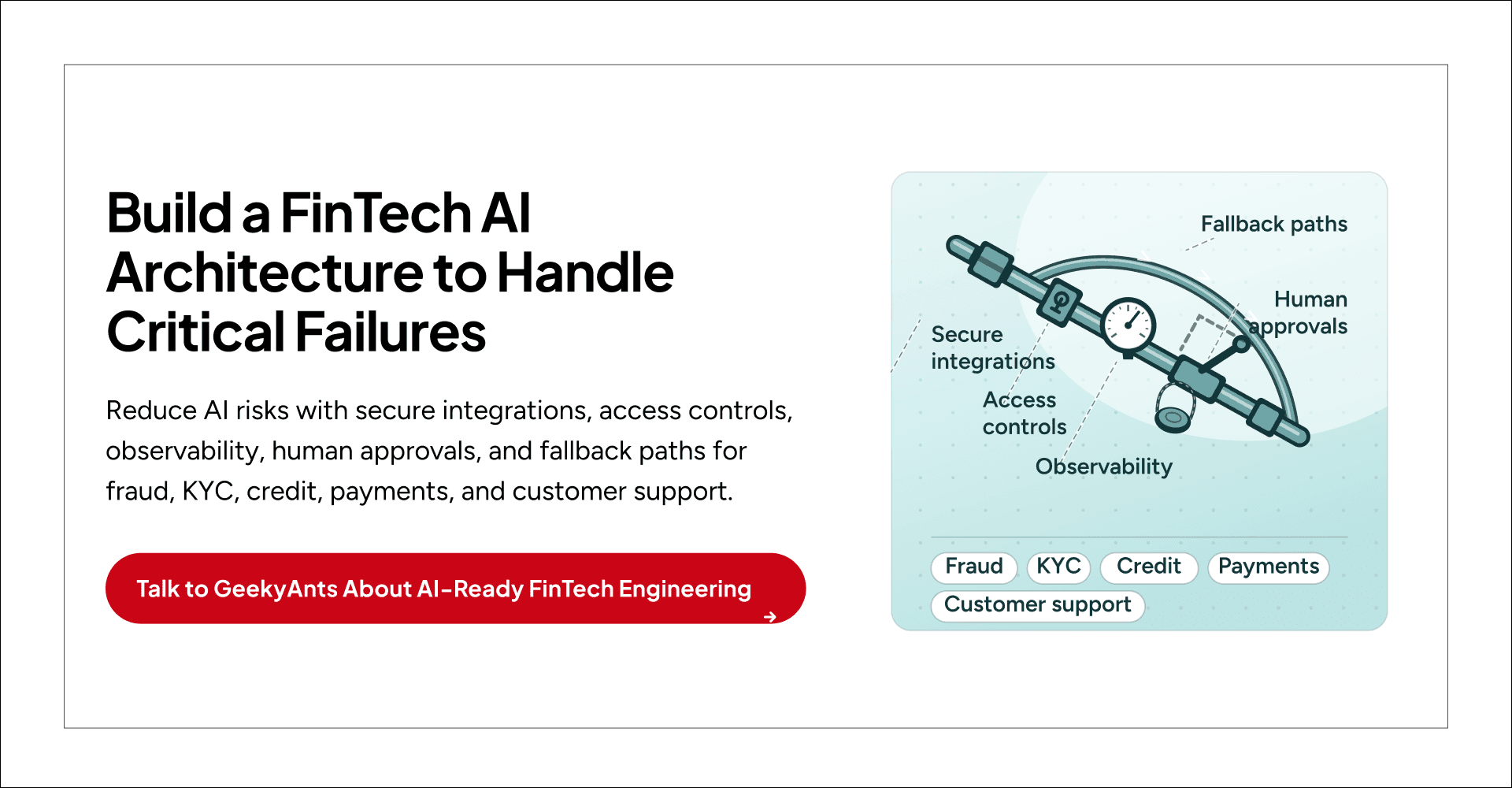
Compliance readiness should be visible in the architecture from the first production release. The NIST AI Risk Management Framework gives FinTech teams a useful structure to govern, map, measure, and manage. The value comes from turning those four functions into engineering controls.
1. Govern - Decide Who Owns the AI Risk
Start with an inventory of AI use cases, models, providers, and owners. Define who can approve a model, change it, monitor it, and respond when it fails.
For agents and AI tools, access should follow the policy. Each agent should only be provided with the data, systems, and actions required for its task. High-impact actions such as payment changes, account updates, or customer decisions should require tighter controls or human approval.
NIST also calls for governance around third-party software, data, and supply-chain risk, including contingency processes for failures in high-risk third-party AI systems.
2. Map - Before AI Goes Live
Document what the AI does, who it affects, what data it receives, and which third parties will be involved in the operations.
For a credit, KYC, fraud, or payment workflow, map:
- Customer and transaction data;
- Model providers and APIs;
- Embeddings and retrieval systems;
- Cloud services;
- Human review points;
- Vendor dependencies.
NIST’s Map function emphasizes understanding context, affected users, human oversight, third-party components, and the risks created by those dependencies.
3. Measure - Test What the Model Actually Does
Teams should monitor drift, privacy, bias, reliability, security, performance, and explainability.
Keep records of model inputs and outputs where appropriate, along with approvals, overrides, model versions, test results, and vendor documentation. If a fraud alert or credit decision is challenged, the team should be able to trace what led to its occurrence.
Customer-impacting systems also need a clear route for feedback, appeal, and review. NIST explicitly includes production monitoring, explainability, privacy, fairness, and mechanisms for users to report problems or appeal outcomes.
4. Manage - Respond When AI Risk Changes
Define the response before the incident.
A model may need to switch to a fallback, move a case to manual review, stop a feature, or route the issue to a vendor. Teams should also know when an AI system needs to be deactivated or replaced.
For compliance, security, procurement, or audit reviews, maintain an evidence pack that brings together model versions, data lineage, access records, approvals, test results, vendor documents, overrides, and incident records. This gives teams one place to show how the system was governed and what happened when something changed.
How Can Teams Build Resilience for AI in FinTech Products?
When an AI dependency behaves unexpectedly, the product still needs a safe path forward.
A model may start blocking legitimate payments, a vendor LLM may go offline during a support surge, or an underwriting service may return an answer outside a policy threshold. The product still needs to protect the customer, keep core workflows moving, and give internal teams the right instructions for the next step ahead.
A fallback works when the team has already decided what triggers it and what happens next. For a payment or KYC workflow, that could mean switching to rules, routing the case for human review, or disabling one AI feature while the rest of the product keeps running. We design and test those paths before production.
Jani Hardik SanjayProduct Owner IStart by defining the minimum capability the product must retain when AI is unavailable. The idea mirrors a broader principle, which is to identify the functions that must continue during disruption, then build the control needed to preserve them.
1. What Should Be Done When the Primary Model Fails?
Start by deciding what the workflow is allowed to do without the primary model.
For fraud detection, that might mean a secondary model, rules-based checks, or manual review. A KYC workflow may need to pause the automated decision and create a review case instead. Customer support could fall back to a non-AI help flow.
The priority is continuity. A failed AI dependency should not leave a payment, application, or customer request stuck with no next step ahead.
2. Can the Product Keep Working Without AI?
Graceful degradation keeps the rest of the product usable.
If an AI assistant is unavailable, customers should still be able to view transactions, make payments, raise a support request, or complete tasks that do not depend on the model.
This improves release confidence because AI can be updated, replaced, or disabled without taking the whole customer journey down with it.
3. When Should the System Stop AI From Acting?
Circuit breakers define the point where automation ends.
If confidence drops below a threshold, anomaly levels rise, or a policy condition is triggered, the system can stop the AI action and move the case to another path.
For a payment, that may mean a rules-based check. For credit or KYC, it may mean human review. For an agent that can change records or call APIs, it may mean blocking the action before it reaches another system.
4. How Do Teams Know an AI Workflow Is Starting to Fail?
Resilience depends on observability.
Teams should monitor the signals that show whether the workflow remains healthy, including:
- Latency and availability;
- Model and infrastructure cost;
- Output quality;
- Drift;
- Hallucination and refusal rates;
- Bias or fairness indicators relevant to the use case.
Data lineage should also show which sources influenced the model. If a fraud score changes after a data-provider update, teams need to be able to trace that connection without rebuilding the incident from scratch. The same monitoring controls can then be applied across AI-enabled products instead of being rebuilt by each team.
5. What Should Be Done During an AI Incident?
Define the incident path before production.
Teams need to know who receives the alert, which feature can be disabled, what fallback takes over, and how affected customers should be protected.
A provider outage may require traffic to move to another model. A sudden rise in false declines may require fraud automation to pause. A support assistant exposing the wrong context may need to be removed from the customer journey until the issue is resolved.
The value comes from making those actions predictable and testable.
6. When Should AI Hand the Decision to a Person?
Some cases should leave the automated path.
High-risk fraud alerts, disputed credit decisions, KYC exceptions, compliance cases, and support escalations need a route to the teams that can review the context and make the final call.
That handoff should preserve the information already collected so the customer does not have to start again.
7. Can Teams Trace the Data Behind the Decision?
Data lineage is part of resilience because model behavior often changes when the data around it changes.
Teams should be able to identify which transaction feed, customer record, third-party source, retrieval system, or feature set influenced an output.
That makes it easier to isolate a faulty dependency and limits the amount of the product that needs to be changed or disabled.
8. What Happens if the AI Vendor is No Longer an Option?
Vendor exit is rarely something teams think about when an AI integration is first launched. By the time the relationship becomes difficult to unwind, prompts may be provider-specific, evaluation data may be tied to one platform, and operational processes may depend on its APIs.
An exit plan should therefore cover more than choosing another model. Teams should know which assets can be moved, which integrations need to be replaced, how the alternative will be evaluated, and whether the product can operate temporarily without AI.
This reduces dependence on one vendor and gives teams more control over failover, cost, architecture standards, and release planning.
Resilience in physical supply chains follows a similar principle, where connected systems need visibility, fallback options, and the ability to respond when one part of the network is disrupted. For AI-enabled FinTech products, the same thinking belongs within the software architecture.
A resilient FinTech product should remain usable when an AI dependency goes down. If the model disappears for an hour, the important question is whether the AI will recover immediately while ensuring product safety.
How Ready Is Your AI in the FinTech Supply Chain?
This checklist can be used as a practical review before an AI-enabled financial product moves further into production. This will help find gaps in ownership, controls, fallback paths, and evidence before they turn into customer or compliance issues.
AI Supply Chain Readiness Checklist
1. Governance - Do We Know About the AI Tool We Are Depending On?
- Do we have an inventory of every model, AI API, agent, copilot, and embedded AI feature used in production?
- Is there a named owner for each AI-enabled workflow?
- Do we know which customer or business decisions depend on each model?
- Are approval rules defined for adding, changing, or replacing a model?
- Are high-risk use cases such as credit, fraud, KYC, payments, or account changes reviewed before release?
- Can we identify AI tools adopted outside the normal engineering or procurement process?
A useful inventory should cover the model, provider, use case, owner, data handled, and whether the workflow is automated or includes human review. Similar AI supply-chain assessments also treat inventory and ownership as the starting point for control.
2. Security - Can AI Access More Than It Needs?
- Do we know what customer, transaction, KYC, or internal data is sent to external AI services?
- Are prompts, logs, embeddings, and API payloads protected from unnecessary data exposure?
- Do AI agents use scoped identities and least-privilege permissions?
- Are high-impact actions protected by approval gates or action-level authorization?
- Can the system block or disable an agent if its behavior becomes unsafe?
- Have we tested prompt injection and indirect prompt injection paths in customer-facing and agentic workflows?
Security teams should know the blast radius of an AI compromise, what the agent can read, change, or trigger before the system stops it. The competitor reference makes the same distinction between ordinary vendor risk and AI-specific access, data, and agent risks.
3. Compliance - Can We Explain a Customer-Impacting AI Decision?
- Can we reconstruct which model version, data, prompt, rules, and approvals produced a decision?
- Are model inputs, outputs, overrides, and version changes logged where appropriate?
- Do we maintain model cards and vendor documentation?
- Are human review and appeal paths defined for high-impact decisions?
- Can compliance, security, or procurement teams access an evidence pack without rebuilding the record from several systems?
- Are AI use cases classified by business impact, data sensitivity, and regulatory exposure?
A good test is to pick one disputed fraud, KYC, or credit decision and ask: could we show what happened without relying on someone’s memory?
4. Infrastructure - What Happens When the Primary AI Dependency Fails?
- Is there a fallback model, rules-based path, manual review queue, or non-AI workflow?
- Can AI features fail without taking core payments, onboarding, account access, or support functions down with them?
- Are circuit breakers defined for low confidence, anomalies, policy violations, or service degradation?
- Have failover paths been tested rather than only documented?
- Can the team disable one AI feature without disabling the wider product?
- Do we know the minimum capability the product must preserve during an AI outage?
This is the resilience test: if the model disappears for an hour, what can the product still do?
5. Vendor Management: Do We Know What Our AI Providers Can Change?
- Do contracts cover data use, retention, training, subprocessors, and incident notification?
- Do we know whether the provider can change the underlying model without our application changing?
- Are model versions and provider-side changes tracked?
- Have we reviewed service limits, availability, hosting regions, and concentration risk?
- Is there a tested exit path if a provider becomes unavailable, non-compliant, too costly, or unsuitable?
- Can prompts, embeddings, evaluation data, or fine-tuned assets be moved if the relationship ends?
AI vendor reviews need to check model behavior, logging, training use, and the underlying infrastructure after integration.
6. Monitoring: Will We Know When AI Behavior Starts to Change?
- Are latency, availability, and cost monitored?
- Are output quality, drift, hallucination, refusal rates, and relevant bias indicators tracked?
- Can teams trace which data sources influenced a change in model behavior?
- Are alerts tied to clear actions and owners?
- Are incidents, exceptions, and overdue fixes visible in one place?
- Do we test AI incident scenarios before they happen?
Monitoring should show whether the API is available and whether the AI workflow is within its required operating limits.
Download the AI Supply Chain Readiness Template
Who Should Use This AI Supply Chain Readiness Template?
This template is designed for FinTech product, engineering, platform, security, risk, compliance, and vendor management teams responsible for AI-enabled products. Use it before moving an AI workflow into production, during an architecture or vendor review, or when assessing an existing system. It helps teams identify ownership gaps, weak controls, missing fallback paths, vendor dependencies, monitoring requirements, and priority actions across the AI supply chain.
Next Read: Explore how predictive risk sensing and resilience can move teams from reacting to failures toward identifying them earlier in “From Compliance to Predictive Resilience: Building AI-Powered Supply Chain Risk Management Systems.”
How Mature Is Your AI in the FinTech Supply Chain?
A maturity model helps financial institutions see whether AI risk is being handled as a series of fixes or as part of the product architecture.
What Are the Levels of AI Supply Chain Maturity?
The model moves through four stages: Ad Hoc → Managed → Governed → Resilient.
What Characterizes Each Stage?
Stage | What It Looks Like | Next Move |
Ad Hoc | AI tools are added case by case. Model, data, vendor, and fallback dependencies may not be documented. | Build an AI inventory and map high-risk workflows. |
Managed | Owners, model versions, vendors, and monitoring are defined. Some fallback paths exist. | Standardize controls across products. |
Governed | Access policies, audit logs, human review, vendor checks, and evidence packs are part of delivery. | Test how controls perform when dependencies fail. |
Resilient | AI workflows can fail safely, switch providers, escalate to people, and keep customer-facing services running. | Keep testing failover, monitoring behavior, and reducing provider concentration. |
How Do Financial Institutions Move Toward Enterprise-Grade Resilience?
The shift happens by gaining control over the AI models, data sources, providers, access rules, monitoring, and fallback paths behind each workflow. Teams should know what a payment, KYC check, fraud decision, or support journey depends on, how they will detect a failure, and what path takes over when one occurs.
Why Choose GeekyAnts for Resilient AI in FinTech Architecture?
Once an AI-enabled FinTech product reaches production, provider outages, data leaks, audit gaps, and failed customer journeys become product risks.
With GeekyAnts, FinTech teams can strengthen their AI-enabled products through AI supply-chain audits, architecture reviews, model integration, modernization, observability, governance, and production engineering.
Supply Dome Case Study: GeekyAnts moved a large supply-chain platform toward a micro-frontend architecture so that the modules could be deployed independently, reducing release dependencies across a 40+ member delivery environment. The platform included five modules and supported a production capacity of 215,000 units. The architecture reduced tightly coupled dependencies to give teams more control over releases, failures, and recovery.
GeekyAnts has delivered 800+ projects with 550+ engineers. Our published FinTech outcomes include $400M+ in global payments processed annually and a banking migration completed with zero downtime across 100+ integrations.
What we see in FinTech is that the problems occur after the AI use case has already proved its value. In production, FinTech products need to handle provider changes, data issues, audit questions, and failures without disrupting the customer journey. That is where architecture decisions become critical as much as the model performance.
Kunal KumarChief Revenue OfficerTeams can start with an architecture review, a high-risk AI workflow, or a production-readiness assessment. From there, the focus will be on identifying critical dependencies, reducing single points of failure, and putting the right controls in place to support reliable customer experiences and compliance readiness.
Conclusion
The strongest AI architecture is the one that keeps working when conditions change. A provider outage should trigger a fallback, a model change should trigger testing, and a disputed decision should lead to evidence.
If your FinTech product already depends on AI, now is the time to map those dependencies and find the weak points and strengthen production readiness.
Sources & Citation
https://airc.nist.gov/airmf-resources/airmf/5-sec-core/
https://www.ey.com/en_nl/ceo/ceo-outlook-global-report