

Artificial intelligence (AI) is now a cornerstone for modern businesses. From banks analyzing credit risk to a manufacturer optimizing their supply chain, AI is reforging workflows to create and deliver value. Enterprises still relying solely on large cloud providers are struggling with high costs, technical complexity, and limited control.
Enter NVIDIA Project DIGITS - Bringing AI Supercomputing to the Desktop
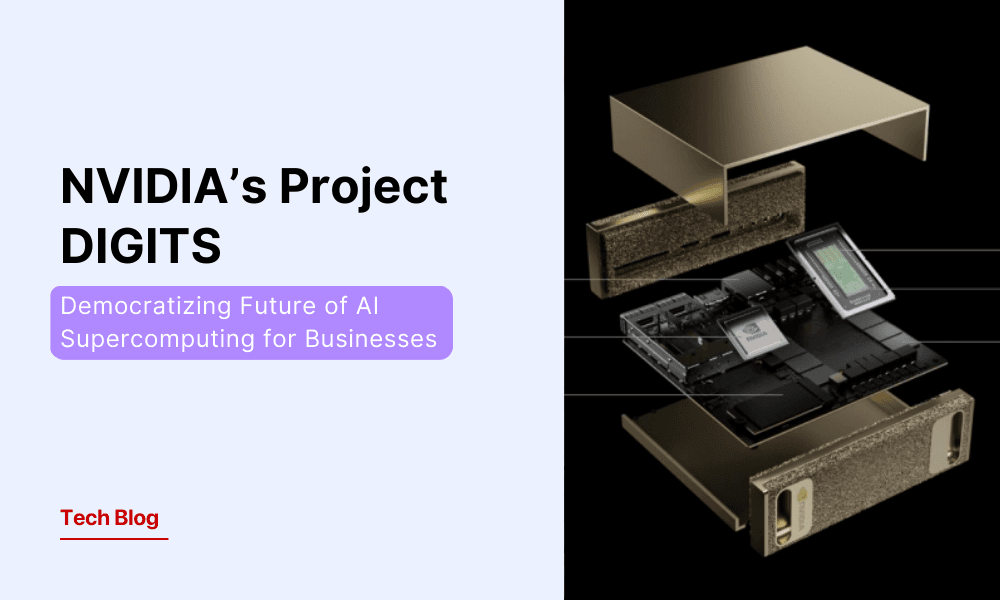
The new, desktop-sized “personal AI supercomputer” starts at $3,000. It closes the gap between cloud-based AI services and massive on-premises installations.
How does it do it:
- Reducing Upfront Capital Expenses: Cost of operations get optimized with reduction in upfront capital expenses compared to building full-scale data center hardware.
- Improving Scalability: Runs AI models with up to 200 billion parameters and even more when units are linked.
- Increasing Control and Security: Keeps sensitive data in-house, crucial for industries bound by regulatory compliance.
Project DIGITS is a democratization of AI. It places high-performance computing directly in the hands of key stakeholders in business.
- Business Decision-Makers: Evaluate new AI-driven initiatives without the unpredictability of cloud costs.
- Data Scientists and Researchers: Prototype advanced models locally, drastically cutting cloud-related overheads.
- Students and Startups: Kickstart projects without the expensive barrier to entry previously associated with large compute clusters.
In this blog we explore:
- Why Project DIGITS Matters
Understand how this desktop supercomputer tackles the pain points of AI adoption—cost, complexity, and control. - How It Works
Dive into the architecture—GB10 Grace Blackwell Superchip, memory, and networking—that makes Project DIGITS a game-changer. - Where It Delivers Value
Explore real-world use cases across diverse industries—healthcare, finance, manufacturing, and beyond.
By the end of this article, it will be evident how Project DIGITS can redefine AI adoption strategies, enabling businesses to harness cutting-edge models without the hefty infrastructure or endless cloud expenses.
Why Project DIGITS: AI Maturity Meets Hardware Bottlenecks
Since 2022, the AI industry has had a growth spurt since its inception. Large Language Models (LLMs) like GPT-4 have proven their effectiveness in diverse areas — customer service, content generation, and medical research.
But fueling these achievements, in expensive data centers, are heavy investments in hardware. High-performance GPUs are indispensable for training and running advanced models quickly.
Traditionally, businesses looking to build AI competencies have two choices:
- Rent GPU-accelerated computing power from cloud providers.
- Invest in expensive, large-scale on-premises hardware.
Both approaches present challenges:
- Cloud Costs: Over time, operational expenses (OpEx) can skyrocket if your organization frequently trains or fine-tunes models.
- On-Premises Complexity: Building a high-performance AI infrastructure usually involves massive upfront capital (CapEx), specialized IT expertise, and significant physical space for cooling and power.
Project DIGITS aims to circumvent these challenges by delivering high-end capabilities in a more compact, cost-effective format.
Democratizing AI for Smaller Teams
For a long time, only technology giants or well-funded research labs had the resources to engage in large-scale AI experimentation. Project DIGITS is part of a broader NVIDIA initiative to “democratize” AI—akin to how personal computers in the 1980s brought computing within reach of everyday professionals. This new form factor is set to spark innovation, enabling smaller companies, research institutions, and startups to experiment without incurring prohibitive cloud fees or data center overhead.
The Technology of Project DIGITS: The GB10 Grace Blackwell Superchip
Project DIGITS is powered by NVIDIA’s GB10 Grace Blackwell Superchip — a system-on-a-chip (SoC) combining an NVIDIA Blackwell GPU and a Grace CPU.
The key components are genius. Here is a breakdown:
- Blackwell GPU:
- Incorporates the latest-generation CUDA® cores and fifth-generation Tensor Cores.
- Delivers up to 1 petaflop of AI performance at FP4 precision (which strikes a balance between speed and accuracy for large-scale AI computations).
- Grace CPU:
- 20 Arm-based cores built in collaboration with MediaTek for power-efficient performance.
- Provides high-speed communication with the Blackwell GPU via an NVLink®-C2C interconnect, reducing data-transfer bottlenecks.
This co-optimized CPU–GPU design ensures a streamlined pipeline where data moves efficiently, improving overall performance and lowering the barrier to running large models.
Unified Memory and Storage
Each Project DIGITS system comes equipped with:
- 128GB Unified Memory: This large memory pool means data scientists can run and fine-tune models that would previously be too large for standard desktop GPUs.
- Up to 4TB NVMe Storage: Fast, solid-state drives help handle massive datasets, reduce loading times, and enable quick read-write operations necessary for AI training.
Networking and Scaling
A single Project DIGITS can handle AI models with up to 200 billion parameters—enough to power advanced language or vision tasks for many commercial use cases. For teams with even bigger ambitions, two Project DIGITS units can be connected through NVIDIA ConnectX® networking, enabling the training or deployment of models with up to 405 billion parameters.
The Software Ecosystem
The hardware might be the star, but the software ecosystem completes the picture:
- NVIDIA DGX OS (Linux-based): A specialized operating system that allows you to run AI workloads locally.
- NVIDIA AI Enterprise: Offers enterprise-grade support, security, and product releases of NVIDIA’s AI software stack.
- NVIDIA NeMo: Assists in the fine-tuning of large language models.
- NVIDIA RAPIDS: Accelerates data science workflows using GPU parallelization.
- Blueprints and NIM Microservices: For building “agentic AI” applications that can execute tasks autonomously.
This software ecosystem supports popular tools like PyTorch, Python, and Jupyter notebooks, making it seamless for data teams to prototype, debug, and deploy AI projects.
Projected Business Advantages
I. Cost-Efficiency and Control
Project DIGITS is a one-time purchase model, starting at $3,000. This is a pea-sized investment compared to traditional unpredictable monthly cloud bills, on-premises or desktop-based options. The total cost of ownership (TCO) for businesses that expect heavy, ongoing AI usage with Project DIGITS will be extremely lean.
II. Minimal Footprint with High Output
With the ability to run on a standard electrical outlet, Project DIGITS gets high marks for sustainability. It suits environmental goals thanks to its limited space and forgiving power requirements. This is a boon for businesses that want to embed AI development into multiple departments—like finance, marketing, and logistics. There will no longer be a requirement for building out specialized server rooms.
III Data Security and Compliance
The Project DIGITS has a strong compliance score. When dealing with sensitive data—medical records, financial transactions, or proprietary research—some organizations prefer to keep everything on-site. This desktop supercomputer ensures that confidential data remains within corporate boundaries, helping maintain compliance with regulations (GDPR, HIPAA, etc.) and reducing reliance on external cloud providers.
Potential Use Cases Across Industries
I. Healthcare and Life Sciences
- Medical Imaging: Radiology departments can deploy advanced computer vision models (for example, for lung-cancer detection in CT scans) locally and refine them without waiting for cloud resources.
- Genomic Research: High-throughput DNA sequencing projects generate terabytes of data. Project DIGITS can efficiently process and interpret these sequences on-site, accelerating drug discovery timelines.
- Drug Development: AI-driven simulations of molecular interactions can save both time and resources in pharmaceutical R&D.
II. Financial Services
- Risk Analytics: Banks and insurance companies can train predictive models to identify fraudulent transactions or assess credit risks in near-real time, all without exposing sensitive datasets to third-party infrastructures.
- Algorithmic Trading: Project DIGITS can power local trading simulations for hedge funds, enabling rapid experimentation with advanced ML algorithms.
III. Manufacturing and Supply Chain
- Predictive Maintenance: Industrial sensors produce vast amounts of data. With local AI processing, businesses can predict equipment failures and minimize downtime, leveraging real-time analytics on the factory floor.
- Logistics Optimization: Companies can develop and deploy route optimization algorithms, supply chain forecasting, and demand planning locally—improving speed and customizing solutions without the latencies or fees associated with cloud-based tools.
IV. Retail and E-Commerce
- Personalized Recommendations: Retailers processing millions of product interactions can deploy robust recommendation engines or generative AI models on-site to deliver real-time, highly-tailored customer experiences.
- Inventory Management: Faster AI analysis can help track stock levels, predict demand, and reduce waste—essential for businesses operating at scale.
V. Media and Entertainment
- Content Generation: Studios can locally refine text-to-image or text-to-video AI models for pre-visualization or even automated editing.
Localization: Real-time speech-to-speech or text-to-speech translation can be handled in-house, giving media companies better control over intellectual property.
Considerations Before Adopting Project DIGITS
I. Scaling from Prototype to Production
A crucial selling point of Project DIGITS is how smoothly it transitions from a local testing environment to a broader enterprise deployment. Teams can run pilot projects on one or two DIGITS units, then move to the NVIDIA DGX Cloud or on-prem data centers with the same Grace Blackwell architecture. This approach prevents the “reinvent the wheel” syndrome when models go from proof-of-concept to fully-fledged production systems.
II. Infrastructure and Support
Even though Project DIGITS is marketed as a relatively simple solution, businesses should still ensure they have:
- Sufficient Power and Cooling: Although it runs on a standard outlet, it’s still a high-performance system.
- In-House Expertise: Data scientists or machine learning engineers will be needed to manage ongoing training, fine-tuning, and model updates.
- Maintenance and Updates: NVIDIA AI Enterprise provides support, but organizations will want to plan for regular software updates and potential hardware expansions.
III. Data Governance
As with any AI project, data governance remains paramount. On-prem solutions might provide more direct control over data flows, but companies must still implement internal policies around data handling, backups, and version control.
The Future of AI Computing
Project DIGITS underscores a broader shift in the AI landscape, where once-exclusive hardware is now more widely accessible. By merging high-performance AI computing with a compact form factor, NVIDIA is betting on a future where innovation isn’t locked in the domain of tech giants.
For business decision-makers, this platform could lower barriers to entry, fast-track R&D cycles, and foster internal AI capabilities that are secure and cost-effective. As AI increasingly permeates every sector—from healthcare to finance to manufacturing—Project DIGITS signals a critical movement toward on-demand, local AI computing that keeps pace with business demands.
For organizations poised to harness AI but wary of the cost and complexity of cloud-centric or large-scale on-prem solutions, Project DIGITS could be a game-changer. With an expanding ecosystem of software tools and the ability to seamlessly scale toward larger infrastructures, it’s an attractive option for businesses looking to stay at the cutting edge.
If you’re exploring ways to integrate AI into your operations—be it supply chain forecasting, fraud detection, or high-end computer vision—Project DIGITS is worth your attention. This is the moment to evaluate how desktop-level AI supercomputing might fit into your roadmap, enabling your company to move faster, innovate more effectively, and maintain a competitive edge in the rapidly evolving digital economy.
For a deeper consultation on AI implementation, talk to our experts today — BOOK A CALL.