

Key Takeaways
- A modern CTMS helps detect operational delays before they affect trial timelines and budgets.
- AI delivers value when it improves specific workflows such as patient matching, site selection, protocol review, monitoring, and reporting.
- Integrations, data ownership, auditability, and validation have a greater impact on development risk than the visible interface alone.
- Clinical Trial Management System development should begin with workflow mapping and build validation, security, and compliance into every stage.
- The right strategy may be to buy, build, modernize, integrate existing systems, or add AI to one high-value workflow.
Introduction
Clinical trials are carefully controlled experiments conducted to assess the safety and effectiveness of new medicines, treatments, or medical instruments on patients. It is, therefore, vital for all stakeholders involved in the process that clinical trials are performed successfully.
A Phase III clinical trial burns through $55,716 in direct costs every single day, according to the Tufts Center for the Study of Drug Development. The issue is how silently this number builds up. It takes more time to activate a site than originally planned, enrollment falls short of expectations for a few weeks without drawing anyone’s attention, an amendment gets processed via emails while the study keeps going.
The pressure on these systems keeps climbing. Between 2015 and 2025, procedures in Phase III pivotal trials grew by more than 60%, and investigative sites per trial climbed from 65 to 106, per Tufts CSDD benchmarks.
The average Phase III protocol now generates 5.9 million datapoints, a volume growing 11% every year.
With trial operations changing faster than the clinical trial solutions managing them, the increasing gap has now become the most expensive line in clinical app development.
The market reflects the urgency. Regulators moved in the same window. The FDA's January 2025 draft guidance on AI in drug development and the January 2026 joint FDA-EMA principles turned AI in clinical trials into a compliance requirement with teeth: sponsors must document how each model works, where it sits in the protocol, and who validates its output.
This guide covers what modern clinical trial software solutions must do, what clinical trial management software development costs, how AI reshapes the architecture, and where the regulatory lines sit.
What Is Clinical Trial Management Software, and Why Does It Matter Now?
Clinical trial is a systematic process that is used to assess the safety and efficacy of any medicine, treatment method, medical device or intervention. Such clinical trials are usually carried out by pharmaceutical and biotechnology firms, research institutes, from different locations.
A clinical trial management system has become an integral part of any study.
Aside from managing various components starting from sites to budgeting to monitoring the trial lifecycle- it also serves as an ecosystem connected around it- EDC for data capture, eTMF for documents, ePRO for patient-reported outcomes.
This has been true for a decade. The difference is in the description of the task.
CTMS software manages the decentralized trials, collects wearable data, supports AI-powered risk surveillance, and creates the audit trail that the regulatory body requires in each automated decision-making process. Clinical trial application development is part of this change as the sponsor extends the trial processes to the mobile devices of the participants and investigators.
Why Clinical Trial Management Software Matters in Modern Trials
The complexity numbers from the introduction describe the workload. What they do not describe is how that workload is coordinated, and this is where most trials actually lose time.
Sponsors are running more procedures across more sites in more countries than ever before, while the operational layer holding it together often remains a patchwork of spreadsheets, email threads, and systems that do not talk to each other. Nearly 80% of trials still miss their planned timelines, and very few of those misses trace back to the science.
They trace back to operations: a site that stalled, a forecast nobody updated, a document that sat unsigned. A clinical trial management system exists to catch exactly these failures, which is why its adoption curve now tracks trial complexity almost one to one.
We have mapped a few important questions to help you better understand why clinical trial management software has become so critical.
What Is Actually Breaking Inside Trial Operations?
The average Phase III trial now works through 3.5 protocol amendments and close to 300 protocol deviations over its lifetime, per Tufts CSDD benchmarks.
Interoperability makes it worse. Enrollment is stored in the EDC, documents in the eTMF, budgets in a finance system, site communications in emails.
None of them was created to provide an answer to the simple question "where are we today?" and thus people build this answer every week manually from scratch and base their decisions on data which is outdated even before they start working with it.
Why Do Generic Project Management Tools Fail Clinical Trials?
Some teams tend to fall back on their generic project management tools until they decide to adopt a CTMS system, and the result is always predictable.
Generic tools manage tasks; clinical trials need software that manages documentation.
A task board does not know anything about audit trails that must hold up under FDA scrutiny, about workflows that account for protocol amendments’ impact on forty related activities, or about document management processes that distinguish draft from final documents. The problem lies in clinical trials being regulated processes, and CTMS systems having to provide the documentation for that process.
Moreover, the pressure increases further in decentralized and hybrid trials, where telehealth visits, wearables, local laboratories, and home-based care create more workflows outside the traditional site.
We must shift focus to if a system can include the capabilities required to control a modern trial.
Two years ago clients came to us asking for a CTMS the way they would ask for any internal tool. Now the first question is about oversight: they want to know how fast they can see a problem forming across a hundred sites, because they have all learned the same lesson, which is that in a trial, finding out late is the expensive part.
 Kunal KumarChief Revenue Officer
That shift in the first conversation says more about the market than any forecast. Sponsors have stopped buying clinical trial management systems to store information and started buying the ability to act on it while acting still matters.
The rest of this guide is organized around that demand: what the system must do, how AI sharpens it, and what it takes to build one that regulators will trust.
What Features Should Clinical Trial Management Software Prioritize?
Most CTMS platforms offer the same broad modules. However, we need to understand if those modules can help teams see the risk and act before the trial loses any time or money.
1. Study planning and protocol control
The system should connect protocol versions, milestones, approvals, training, budgets, and site activities.
When an amendment is approved, teams should immediately see which workflows and documents are affected.
2. Site and investigator oversight
A CTMS should bring feasibility, activation, contracts, investigator credentials, recruitment performance, monitoring history, and unresolved issues into one view.
The purpose is to identify underperforming sites without waiting for another manual report.
3. How should a CTMS support patient recruitment?
It should compare screening, enrollment, retention, and withdrawal rates against the original plan.
It should also connect with EDC, eConsent, ePRO, and participant-facing applications, including remote activities covered by the FDA’s guidance on decentralized clinical trials.
4. Budgeting linked to operations
Site payments, vendor invoices, accruals, amendments, and milestone delays should feed into the same financial view.
Buyers need to know not only that the budget changed, but which operational event caused the variance.
5. Regulatory documents and compliance
Clinical trial management systems must preserve document versions, approvals, signatures, protocol deviations, access changes, and monitoring records.
The FDA’s guidance on electronic records and signatures and the ICH E6(R3) guideline make traceability and fit-for-purpose systems central requirements.
6. Which analytics are actually useful?
Executives need portfolio and financial risk. Study managers need milestones and enrollment visibility. Monitors need site-level issues and overdue actions.
The CTMS should give each role the view required to decide what needs attention next.
Once these workflows are connected, AI can begin to improve forecasting, monitoring, and risk detection across the trial.
How Is AI Used in Clinical Trial Management Software?
Every CTMS vendor now has an AI slide. Very few can answer the question that matters: which workflow does it sit in, and what number does it move?
The market has already voted. The AI clinical trials market stands at $2.68 billion in 2026, heading to $8.24 billion by 2031, per Mordor Intelligence, and McKinsey estimates AI-driven trial optimization can reduce up to 1 or 2 years from development timelines. That money is following AI that lives inside trial workflows, not demos.
AI use case | Workflow it sits in | What it moves |
Patient matching | Screening | Chart review: 44.7 hrs to 2.5 |
Site selection and forecasting | Study startup | Top-site identification up 30-50% |
Protocol risk detection | Protocol design | Amendments caught pre-approval |
Risk-based monitoring | Trial conduct | Monitoring aimed at actual risk |
Document intelligence | Regulatory ops | Report timelines cut ~3x |
Real-time analytics | Executive oversight | Problems surfaced weeks earlier |
Patient Matching: From 44.7 Hours of Chart Review to 2.5
Coordinators read hundreds of charts with varying criterias. AI in clinical research instead, helps models scan both structured and unstructured EHR data, cutting review from 44.7 hours per protocol to 2.5 at 95% accuracy- Mordor Intelligence.
Site Selection: Predicting Which Sites Will Actually Enroll
Models trained on historical site performance improve top-site identification by 30 to 50% and speed up enrollment by 10 to 15%. The result is a flattening accrual curve alert within a week or two instead of a quarterly review.
Protocol Risk Detection: Catching Amendments Before They Cost
Most amendments are usually a result of decisions made prior to the first patient in. NLP systems compare your document with many protocols from the past and point out those clauses that are highly likely to require rewriting. This is the most cost-effective solution in the entire process of the trial since nothing is going yet.
How Does AI-Powered Risk-Based Monitoring Work in Clinical Trials?
Traditional monitoring verifies everything equally. We don't actually need that. AI scores sites and data streams continuously, and predictive alerts point monitors at the anomalies: odd entry patterns, outlier labs, dropout clusters.
Document Intelligence: Making Every Record Traceable
GenAI can support faster clinical reporting. McKinsey found it can reduce clinical study report timelines by about 40%. And indexed documents are documents an inspector can trace.
Real-Time Analytics: Decision Intelligence for Trial Leaders
This is where the other five pay off together. Role-based dashboards. Predictive alerts. These help answer questions like - "where are we today" in one screen instead of four spreadsheets.
One caveat before you scale any of this: every AI feature above is now a regulated feature. Documented context of use, validation, human oversight. That's the next section.
What Does a Production-Ready CTMS Architecture Look Like?
A production-ready CTMS is not a single system doing everything. It works across four connected layers, each responsible for a different part of trial operations, data, and control.
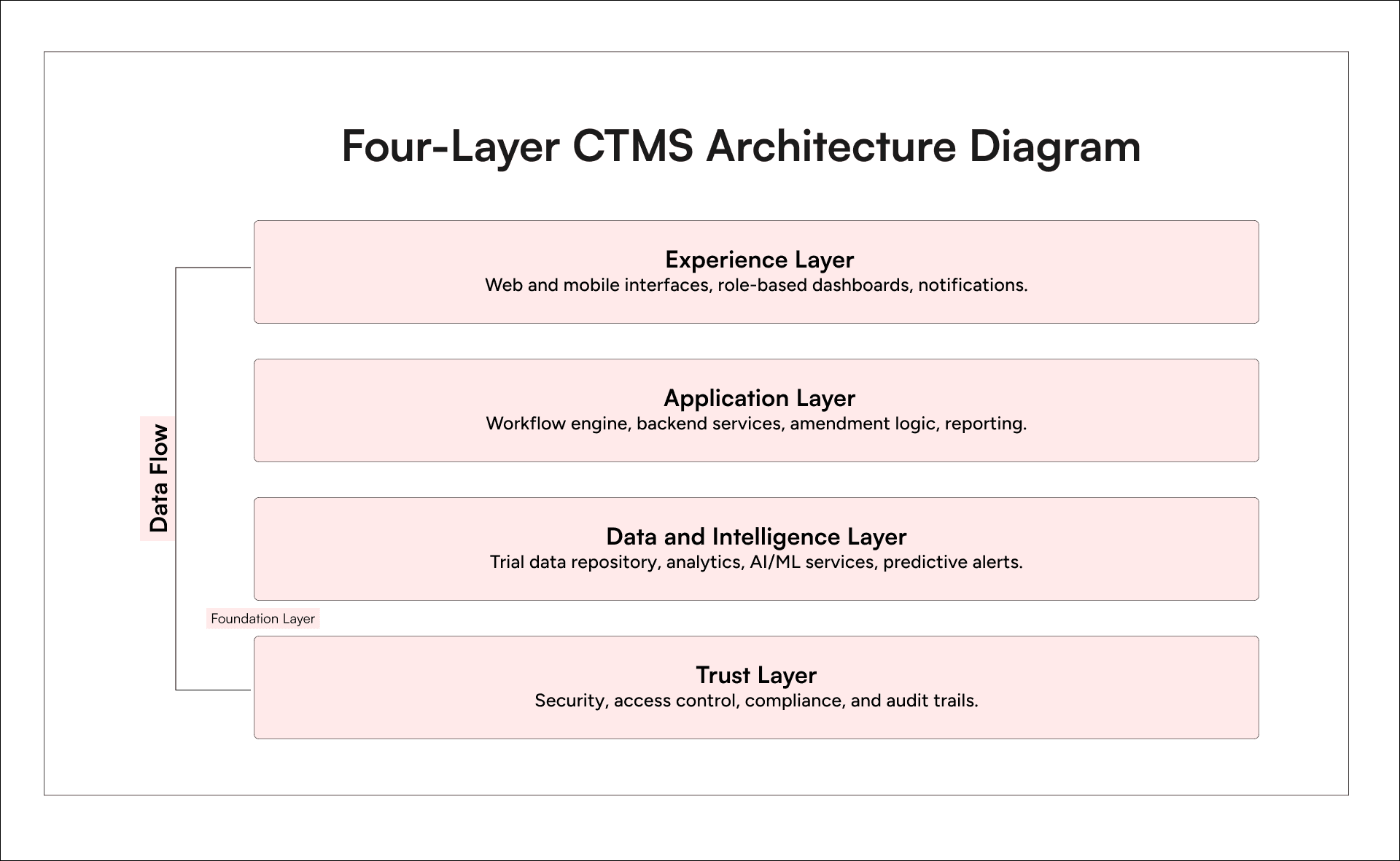
- The experience layer is what people want to see: web and mobile interfaces, role-based dashboards, the notification engine that tells a monitor a site went quiet.
- The application layer is the logic: the workflow engine that knows what an amendment triggers, backend services, and the reporting module.
- The data and intelligence layer is the trial data repository plus the analytics and AI/ML services that turn stored records into predictive alerts.
- The trust layer wraps all of it: security and access control, plus the compliance and audit layer that logs who did what, when, and why.
For these layers to work as one system, the architecture also needs to support:
- Consistent data flow between applications and trial systems
- Role-based access across teams and locations
- Clear auditability for actions and changes
- Scalability as studies, sites, and data volumes grow
What Systems Does a CTMS Need to Integrate With?
A CTMS is only as useful as what it connects to.
That splits four ways too:
- Clinical data systems (EDC, ePRO, eTMF, LIMS)
- Care systems (EHR/EMR via HL7 FHIR, wearables, remote monitoring)
- Business systems (ERP, CRM, payments, identity management)
- Registries (ClinicalTrials.gov, EU CTIS).
The integrations are where budgets and timelines actually go. Getting EHR data in cleanly through HL7 FHIR is its own engineering problem, one we've written about in depth: HL7 and FHIR for AI Healthcare Platforms: What It Takes to Build for Production.
Everyone underestimates the integration layer. The dashboards demo well, but the project succeeds or fails on whether the EDC, the eTMF, and the EHR actually talk to each other in production.
 Manav GoelPrincipal Technical Consultant.
How Do You Develop Clinical Trial Management Software for Production?
Clinical trial management software development begins with understanding how the trial operates, where information moves, and what evidence the system must retain.
The development process has to resolve these questions before they become too expensive to change.
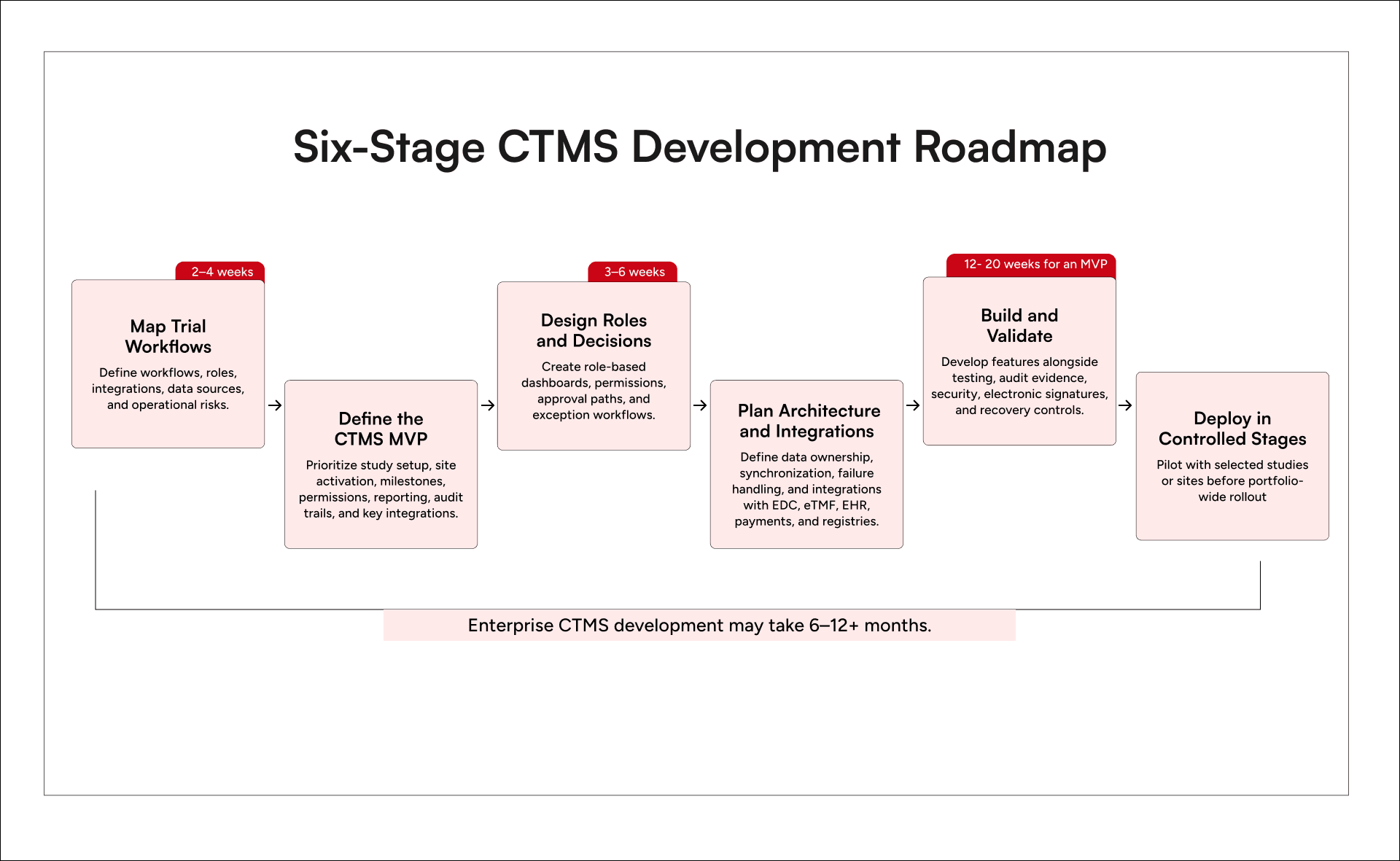
1. Map the Trial Workflow
Discovery should capture how the study actually runs across clinical operations, sites, monitors, finance, data management, QA, and compliance teams.
This includes mapping:
- Study setup and protocol amendments
- Site activation and monitoring
- Recruitment and participant activity
- Budgets, payments, and approvals
- Documents, signatures, and audit evidence
- Systems that create or consume trial data
It should produce a workflow map, role matrix, integration inventory, and risk of operations. The absence of such analysis results in development of the required features within a process that does not match the way the organization works.
Discovery and requirements planning usually take two to four weeks, depending on the number of workflows, stakeholders, and existing systems involved.
2. Define What the CTMS MVP Must Prove
The first release does not need to reproduce every workflow used across the entire trial portfolio.
An MVP for a functional CTMS would include functions such as study set-up, site initiation, milestones, roles and permissions, issue management, audit trails, reporting, and one or two key integrations.
The scope has to be linked to some measurable outcome. This can be in terms of faster site initiation, elimination of manual status reports, improved amendment documentation, etc.
3. Design Around Roles and Decisions
Study managers, monitors, site coordinators, finance teams, and executives should not receive the same dashboard or permissions.
Each interface should help its user answer a specific question:
- Which site requires attention?
- Which document is blocking activation?
- Which milestone is likely to slip?
- Which payment is waiting for approval?
- Who changed a record, and why?
Moreover, the design should take into consideration approval failures, corrections, delegation, delays, and workflow interruptions. These scenarios tend to be the areas where gaps in operations and regulations emerge.
UX design, architecture, and technical planning typically require another three to six weeks.
FDA guidance on electronic systems, records, and signatures ensures that reliability and traceability are a component of the product experience, not merely a database feature.
4. Resolve Architecture and Integration Risk Early
Architecture design must determine from where the records have been sourced, who owns the platform, the synchronization method employed, and the consequences in case of failure.
Most critical integrations like EDC, eTMF, EHR, payment systems, identity systems, and trials registry should first be tested prior to product development.
This is especially important for healthcare data exchange.
5. Build and Validate Together
Validation should run alongside CTMS development rather than begin once the product is complete.
Each requirement needs to be associated with
- An acceptance criteria
- Test cases, outcomes
- Evidence
The testing process needs to consider permissions, unsuccessful integrations, duplicates, wrong data, e-signatures, audit logs, and backups, not only user experience.
A CTMS MVP generally takes 12 to 20 weeks to develop after discovery and technical planning. An enterprise CTMS with extensive integrations, advanced analytics, mobile workflows, and compliance controls may require six to twelve months or longer.
6. Deploy in Controlled Stages
A CTMS software should first launch across a limited number of studies, sites, or user groups. The pilot should test data migration, permissions, integrations, reporting accuracy, support processes, and live workflow exceptions before portfolio-wide rollout.
The fastest CTMS projects are not the ones that shorten discovery. They are the ones that decide early who owns the data, which workflow is authoritative, and what evidence the system must retain
Manav GoelPrincipal Technical Consultant.This approach minimizes the risks associated with delivery and regulation. The remaining issues of how long it will take to build, what specialized skills are needed, and what it will cost depend on the CTMS’s level of maturity and complexity.
How Much Does It Cost to Build Clinical Trial Management Software?
There is no fixed cost for building a CTMS because the scope can change significantly between a focused trial-management product and a platform supporting multiple studies, integrations, compliance workflows, analytics, and AI.
As a broader benchmark, Clutch reports an average software development project cost of about $132,000 in 2026. CTMS development can move below or well above that figure depending on the workflows and systems involved.
For planning purposes, a custom CTMS can be considered across three broad ranges:
CTMS Scope | Directional Cost Range | What It May Include |
Basic CTMS MVP | $75,000–$150,000 | Study and site setup, milestones, roles and permissions, issue tracking, audit trails, reporting, and limited integrations |
Mid-Level CTMS | $150,000–$300,000 | Multi-study workflows, financial management, dashboards, EDC or eTMF integrations, mobile workflows, and deeper validation |
Enterprise CTMS | $300,000–$600,000+ | Portfolio-wide workflows, complex integrations, data migration, advanced analytics or AI, automation, and extensive compliance controls |
These are planning estimates rather than fixed market prices. They are based on current software-development benchmarks and the difference in scope between an MVP and a production CTMS.
Several factors can move the estimate:
- Number and complexity of integrations, especially EDC, eTMF, EHR, payment, identity, and registry systems
- Data migration from existing CTMS platforms, spreadsheets, or legacy systems
- Validation and compliance requirements, including audit trails, electronic signatures, access controls, and testing evidence
- Number of workflows and user roles across studies, sites, finance, monitoring, and operations
- Analytics and AI capabilities, particularly when they depend on several clinical data sources
- Scale, including the number of studies, sites, users, regions, and records the system needs to support
The most useful estimate therefore comes after discovery. Once the workflows, integrations, compliance requirements, and expected scale are known, the development team can estimate the CTMS against the system that actually needs to be built rather than a generic feature list.
Should You Buy, Build, Modernize, or Add AI to Your CTMS?
The most appropriate clinical trial management software development approach will rely upon current successes, where the process fails, and how much your processes deviate from typical clinical trials procedures. A whole overhaul may not be required.
CTMS strategy | Best suited for | Check first |
Buy off the shelf | Standard workflows and faster deployment. | Configuration limits, scalability, compliance, and recurring costs. |
Build a custom CTMS | Complex trials, specialized workflows, or greater platform control. | Budget, validation, engineering capacity, and maintenance. |
Modernize an existing CTMS | A functional platform held back by outdated architecture or poor usability. | Technical debt, migration scope, APIs, and compliance gaps. |
Integrate existing systems | Effective standalone tools that lack a shared operational view. | Data ownership, interoperability, reconciliation, and failure handling. |
Add an AI or analytics layer | Stable systems that need forecasting, predictive alerts, or document intelligence. | Data quality, model validation, human oversight, and governance. |
What Factors Should Drive the CTMS Strategy?
The decision should consider:
- Trial portfolio complexity and multi-site requirements
- Integration and data migration scope
- Regulatory and validation burden
- Internal engineering and product capacity
- Data maturity and readiness for AI-enabled workflows
- Need for a differentiated operating model
- Available budget and delivery timeline
Many companies find their solution somewhere between buying and rebuilding. Enhancing the weakest component of the current platform, integrating working systems or simply adding AI to a single workflow could provide the most benefits for the least disruption.
Why Choose GeekyAnts as Your Clinical Trial Management Software Development Partner?
Calling a company a trusted partner for clinical trial management software development is easy. The harder part is proving that its teams understand healthcare workflows where access, traceability, testing, and integrations affect the product from the first sprint.
GeekyAnts brings experience across custom healthcare software, EHR and EMR platforms, role-based workflows, QA, and secure application development. Its healthcare practice includes HIPAA-oriented software and systems for internal and patient-facing use. For AI-enabled clinical trial systems, this can also extend to engineering governance, risk controls, documentation, human oversight, and lifecycle processes aligned with frameworks such as ISO/IEC 42001.
Relevant Healthcare Engineering Experience
In one healthcare software engagement, GeekyAnts provided a role-based platform that incorporated reporting capabilities, automated testing, staging and production environment, and release automation. The product was delivered in 12 weeks and was ready for use by actual customers.
A CTMS partner should not begin by asking how many modules you want. The first conversation should be about which decisions are delayed, where the source of truth sits, and what evidence the system must preserve.
Kunal KumarChief Revenue OfficerThat is where GeekyAnts can act as your trusted partner for clinical trial management software development: from workflow discovery and architecture through integrations, validation, rollout, and AI modules built with the governance and oversight required for regulated healthcare environments.
Conclusion
Clinical trial management software technology now is placed in the very heart of trial execution.
With clinical research becoming increasingly decentralized, data-intensive, and highly compliant, teams require tools that would be able to streamline processes, identify risks upfront, and create a chain of evidence for all decisions made.
The correct approach could be purchasing, developing, upgrading, or even augmenting an existing CTMS solution with AI capabilities. The key here is to make sure that a chosen CTMS accurately represents the way a trial will run. When workflow mapping, integration, data ownership, and validation are done properly, a CTMS solution can protect timelines and save on costs.
Sources/ References Cited:
- https://csdd.tufts.edu/sites/default/files/2025-02/Aug2024%20Day%20of%20Delay%20White%20Paper%20Final.pdf
- https://www.fda.gov/about-fda/center-drug-evaluation-and-research-cder/artificial-intelligence-drug-development
- https://www.clinicalleader.com/doc/clinical-trial-per-patient-cost-analytics-for-procurement-and-sponsor-strategy-0001
- https://www.ema.europa.eu/en/ich-e6-good-clinical-practice-scientific-guideline
- https://www.mordorintelligence.com/industry-reports/ai-in-clinical-trials-market