









Fear of Fraud: The Professionalisation of Financial Crime
Deepfake-enabled fraud is escalating at an unprecedented speed. In Singapore, reported cases rose by 1,500 percent in 2024. In Hong Kong, the increase reached 1,900 percent in the first quarter of 2025. These surges illustrate how financial crime has entered a new phase of professionalisation, powered by artificial intelligence and accessible tools that make advanced deception routine.
The tools that once required specialised laboratories or state-level resources are now available to anyone with consumer-grade equipment. Voice cloning can be executed with minutes of audio, and synthetic video generation has become as accessible as basic photo editing. Fraud has evolved from opportunistic acts to industrial operations, creating an environment where trust in digital communication is constantly under threat.
The Mathematics of Fear
The numbers emerging from fraud reporting agencies tell a story of exponential escalation. Global financial institution fraud losses are projected to surge from $23 billion in 2025 to $58.3 billion by 2030, representing a 153% increase driven primarily by synthetic identities and AI-assisted schemes. In the United States alone, cyber-enabled fraud losses reached $16.6 billion in 2024, marking a 33% year-on-year increase that shows no signs of deceleration.
These figures represent more than statistical abstractions. Each data point corresponds to institutions grappling with threats that evolve faster than their defensive capabilities. The Federal Trade Commission reports that American consumers lost $12.5 billion to fraud in 2024, with $5.7 billion attributed to investment scams alone. The increase stemmed not from more victims, but from a higher percentage of targets actually losing money when approached by fraudsters.
The Asia-Pacific region presents particularly stark evidence of technological acceleration in criminal activity. Singapore experienced a 1,500% increase in deepfake cases, whilst Hong Kong recorded a 1,900% surge. Synthetic identity document fraud across APAC grew by 233%, reflecting the rapid adoption of sophisticated forgery techniques previously available only to state-level actors.
Even cybersecurity professionals prove vulnerable to these evolving threats. At a Singapore fraud prevention summit in 2025, more than fifty cybersecurity specialists fell victim to a staged QR code phishing demonstration, scanning malicious codes that redirected them to fraudulent sites despite their expertise. The incident underscored how psychological manipulation, enhanced by technological sophistication, can override professional training and institutional caution.
The Indian Context
India's fraud landscape reveals the complexity of measuring threats in rapidly digitising economies. The Reserve Bank of India recorded 36,075 bank fraud cases in FY24, representing a 166% increase from the previous year, though the total value of losses fell 46.7% to ₹13,930 crore. This apparent contradiction reflects improved early detection systems catching smaller frauds before they escalate, whilst also highlighting the challenge of interpreting fraud statistics in dynamic regulatory environments.
The following year brought different complications. FY25 saw fraud values reported at ₹36,014 crore, with much of the increase attributed to reclassification of earlier cases following Supreme Court directives rather than genuinely new criminal activity. Internet and card fraud showed more than 50% decline in FY25 after sharp spikes in previous reporting periods, suggesting that defensive measures can achieve tactical victories even as strategic threats continue evolving.
These fluctuations in reported fraud metrics demonstrate how institutional responses can temporarily suppress certain attack vectors whilst new ones emerge elsewhere. The challenge for financial institutions lies in distinguishing between genuine improvements in security posture and the temporary displacement of criminal activity to less monitored channels.
The Automation of Deception
Contemporary fraud has industrialised beyond individual opportunism into systematic criminal enterprises that leverage artificial intelligence as efficiently as legitimate businesses. Voice cloning technology now requires mere minutes of audio samples to generate convincing impersonations. Deepfake video generation, once requiring specialised knowledge and equipment, has become accessible through consumer applications.
Synthetic identity creation has evolved from crude document forgery to sophisticated digital personas that can pass automated verification systems. Criminal organisations maintain databases of stolen personal information, using machine learning to optimise combinations that slip through standard identity verification processes. The result is fraud that scales exponentially whilst maintaining convincing authenticity.
Ransomware attacks on critical infrastructure rose 9% in 2024, with cryptocurrency-related fraud losses surging 66%. These increases reflect not just growing criminal ambition, but improved technical capabilities that allow smaller criminal organisations to execute attacks previously limited to state-sponsored groups.
The democratisation of advanced fraud techniques means that financial institutions can no longer rely on the assumption that sophisticated attacks require sophisticated adversaries. A teenager with access to readily available AI tools can now execute schemes that would have challenged professional criminal organisations just five years ago.
The Defence Response
Financial institutions have responded to this escalation with corresponding increases in defensive spending and personnel. SEON's 2025 Global Digital Fraud Report documents rising prevention budgets and expanded security teams, with particular emphasis on artificial intelligence systems that combine automated detection with human oversight.
The most effective defensive strategies now emphasise continuous verification rather than perimeter security. Traditional approaches that authenticate users at login have proven insufficient against adversaries capable of real-time impersonation. Instead, successful institutions deploy behavioural biometrics, device intelligence, and pattern recognition that monitor user activity throughout entire sessions.
DataVisor's 2025 Executive Report reveals that financial services leaders increasingly recognise fraudsters' advantages in deploying generative AI, calling for unified, end-to-end controls across complete customer journeys. This represents a fundamental shift from reactive fraud detection to proactive threat prevention that assumes compromise rather than hoping to prevent it.
The most vulnerable demographics continue attracting disproportionate criminal attention. Americans over sixty suffered $4.8 billion in fraud losses during 2024, highlighting how psychological manipulation techniques exploit demographic characteristics that technology alone cannot protect.
Conclusion
The professionalisation of financial fraud through artificial intelligence has fundamentally altered the risk landscape for financial institutions. What once required extensive criminal networks and specialised expertise now operates through automated systems that scale deception with industrial efficiency.
The fear driving institutional responses extends beyond immediate financial losses to encompass reputational damage, regulatory consequences, and systemic trust erosion. Financial institutions that fail to adapt their defensive postures to match the sophistication of contemporary threats face not just tactical defeats but strategic obsolescence in markets where customer confidence determines competitive survival.
The evolution continues accelerating as criminal organisations integrate more sophisticated AI capabilities whilst defensive technologies struggle to match the pace of offensive innovation. Success will belong to institutions that abandon static security models in favour of adaptive systems capable of learning from attacks in real time.
In this transformed landscape, the question is not whether fraud will occur, but how quickly institutions can detect, respond, and recover from inevitable breaches. The winners will be those who build resilience into their operational DNA rather than relying on impermeable defences that no longer exist.
From Hallucinations to Instant Recall: The Rise of Cache-Augmented Generation
Standalone LLMs have a bit of a "Knowledge Problem". Meaning, if a piece of information was not present in the data that was used to train them, they would not be able to recall it, which is fine. Why? "What is not trained can never be learnt". This is the core principle that governs the entire domain of Artificial Intelligence (AI).
A model not being able to recall something that it has never learnt is an acceptable explanation. But sometimes, a model may generate completely untrue results, a condition which is termed "model hallucination". The reasons for this may be, absence of the information that was being queried in the training data, or the information was not fetched in time.
The second scenario is the foundation for why Cache may be the answer to address this problem of confabulation. You see, when an LLM encounters a query for which it does not have a clear, accurate answer in its parametric memory, it will "confidently" fill in the gaps with plausible-sounding, but fabricated information.
Enter RAG: Retrieval-Augmented Generation
Back in May 2020, Meta introduced RAG (Retrieval-Augmented Generation) in a paper titled "Retrieval-Augmented Generation for Knowledge-Intensive NLP Tasks" by Lewis et al. This was the very paper in which the term "RAG" was coined. Retrieval Augmented Generation (RAG) significantly enhances Large Language Models (LLMs) by providing them with external, up-to-date knowledge to prevent hallucination.
When a user asks a question, a "retriever" first searches a curated Knowledge Base for the most relevant documents or passages. This retrieved information is then fed directly to the LLM as additional context alongside the original query. The LLM then generates its answer, relying on this precise external data rather than just its internal, potentially outdated training. This is, in essence, how RAG works (Refer to Fig. 1 for the architecture).
The Cost of Retrieval
The problem with the above is that there is a latency that exists in the real-time retrieval process because the Knowledge Base that is used is stored externally. This "externally" could be a separate server, a database, a cloud storage, or the model may even access it via a web API. In short, the LLM queries a separate component, which is not a part of the component where the LLM is situated.
This, of course, makes the entire process inefficient, bulky, and costly, and since there are so many components in the architecture, maintaining the system as a whole is not a very pleasant thing.
Enter CAG: Cache-Augmented Generation
This brings us to the current and relatively new reason for achieving the task of retrieval. Enter CAG. Cache-Augmented Generation or CAG was introduced in December 2024, in a paper titled, "Don't Do RAG: When Cache-Augmented Generation is All You Need for Knowledge Tasks" by Chan, B. J., Chen, C. -T., Cheng, J. -H., & Huang, H. -H.
So, how does Cache Augmented Generation (CAG) work its magic? Well, it flips the script on traditional RAG. Instead of making your LLM frantically search for information every single time someone asks a question, CAG says, "Nope, we are doing things differently." Think of it like this: instead of cracking open a textbook mid-exam, a student has already memorised all the important bits beforehand.
That is CAG in a nutshell. It preloads a stable, relevant Knowledge Base directly into the LLM's extended context window before any live queries even hit. Plus, it can precompute and store something called the "Key-Value (KV) cache" for this knowledge, which basically makes accessing that preloaded information lightning fast.
Now, when you query about a thing, your LLM does not have to sit around waiting for some external retriever to retrieve facts. The information is already right there, "cached" and ready to go within its internal context and KV store. This is not just a small tweak; it slashes latency, because that time-consuming retrieval step is simply gone during inference.
CAG shines brightest when you have a pretty stable Knowledge Base, fits comfortably into the LLM's context window, and when you need super-fast response times. It is a seriously streamlined way to make your LLM smarter, faster, and without the baggage of dynamic retrieval (Refer to Fig. 2 for the architecture).
The Evolution: LLMs → RAG → CAG
So, what does this journey from standalone LLMs to RAG, and now to the intriguing realm of Cache Augmented Generation, tell us? It is clear that the quest for smarter, more reliable, and ultimately faster AI is relentless. Standalone LLMs, with all their brilliance, will always grapple with the "knowledge problem" and the occasional bout of confabulation. RAG stepped in as a powerful first responder, grounding these models in external truth, but not without introducing its own set of trade-offs in terms of latency and architectural complexity.
Now, with the emergence of CAG, we are seeing another exciting evolution. By bringing that crucial external knowledge directly into the LLM's immediate grasp, we are not just reducing retrieval overhead; we are accelerating the very heartbeat of intelligent generation. It is about making the LLM not just able to find answers, but already possessing them, cached and ready to deploy at "blink-and-you-miss-it" speeds.
While RAG will undoubtedly remain vital for vast, dynamic datasets, CAG offers a compelling vision for scenarios demanding instant, rock-solid accuracy from a more stable knowledge base. The landscape of AI is constantly shifting, and with innovations like CAG, it is becoming ever more efficient, ever more powerful, and undeniably, ever more intelligent.
Appendix: A Minimal Implementation of CAG in Python
Setup and Dependencies
To begin with, you will have to install the dependencies. To do so, run the following command in your terminal:
nginx
CopyEdit
pip install transformers torch
Example Notebook Code
Next, use Jupyter Notebook (recommended) to run the following code and see the results:
python
CopyEdit
from transformers import pipeline
# 1. Define your "Knowledge Base"
knowledge_base_text = """
The capital of France is Paris.
The Eiffel Tower is located in Paris.
The Louvre Museum is a famous art museum in Paris, France.
Jupiter is the largest planet in our solar system.
The speed of light in a vacuum is approximately 299,792,458 meters per second.
"""
# 2. Initialize a powerful LLM
print("Loading the LLM (this might take a moment)...")
try:
generator = pipeline(
'text-generation',
model='HuggingFaceH4/zephyr-7b-beta',
torch_dtype=torch.float16,
device=0
)
print("LLM loaded successfully!")
except Exception as e:
print(f"Error loading model, falling back to CPU or a smaller model: {e}")
generator = pipeline('text-generation', model='distilgpt2')
print("Fallback model (distilgpt2) loaded.")
# 3. Formulate a query
user_query = "What is the capital of France and where is the Eiffel Tower?"
# 4. Simulate CAG by concatenating the knowledge base with the query
cag_input = f"Context: {knowledge_base_text}\n\nQuestion: {user_query}\n\nAnswer:"
print("\n--- Generating response with preloaded knowledge (CAG-like) ---")
print(f"Input to LLM:\n{cag_input}\n")
response_cag = generator(
cag_input,
max_new_tokens=50,
num_return_sequences=1,
do_sample=True,
temperature=0.7,
top_p=0.9
)
print("CAG-like Response:")
print(response_cag[0]['generated_text'])
# 5. Generate response without context
print("\n--- Generating response without explicit context (Standalone LLM-like) ---")
user_query_standalone = "What is the capital of France and where is the Eiffel Tower?"
response_standalone = generator(
f"Question: {user_query_standalone}\n\nAnswer:",
max_new_tokens=50,
num_return_sequences=1,
do_sample=True,
temperature=0.7,
top_p=0.9
)
print("Standalone LLM-like Response:")
print(response_standalone[0]['generated_text'])
What Is This Code Doing?
The Knowledge Base is "literally" passed into the prompt. This simulates the effect of CAG, where the LLM's entire input includes the necessary context without needing a separate retrieval step during inference.
Notice how the cag_input has the context directly embedded. When the generator processes this, it does not need to perform any external search; all the information is immediately available within its input window.
The contrast with the "standalone" example highlights that without that immediate, preloaded context, the LLM relies solely on its internal training, which might be outdated or insufficient for specific queries.
The LLM Will See You Now: How Top Health is Revolutionizing Nutrition Tracking
“AI is perhaps the most transformational technology of our time, and healthcare is perhaps AI's most pressing application.”
— Satya Nadella, CEO of Microsoft
We have never quite shaken our obsession with food as medicine, nor our anxiety over what it means to eat "correctly." Now, in an age when even our toothbrushes collect data, a new actor steps onto the stage with the kind of confidence only afforded by silicon and code: Top Health, an AI-driven nutritional platform that doesn’t just log what you eat, but attempts to understand it—perhaps better than you do yourself.
Top Health is not a Fitbit-fueled dopamine experiment or a MyFitnessPal clone with prettier colors. Top Health is not interested in your aesthetic aspirations or the half-hearted resolution you made in January. It is a fundamentally more ambitious proposition: a convergence of artificial intelligence, nutritional science, and behavioral psychology wrapped in the sleek promise of personalized healthcare. It is, for lack of a better term, the panopticon of your plate.
First Bite Goes to the Camera
The camera eats first—an idiom once reserved for Instagrammers has now become a core feature of Top Health’s operating philosophy. At the heart of the platform lies a vision system that deploys computer vision models not unlike those used in military surveillance or autonomous vehicles. This technology doesn’t simply see; it discerns, decomposes, and diagnoses. A single photo of your lunch—once a narcissistic indulgence—is parsed for caloric content, macronutrient balance, portion estimates, and even food variety.
And here lies the seductive appeal of Top Health. What began with crude calorie tables in 19th-century military rations and blossomed into the pseudo-science of dietetic trends now enters its next logical phase: food as a computable object. Your burrito is no longer a subjective mess of carbs and shame—it’s a quantifiable unit of bioenergetic input, reduced and reassembled by AI.
Yet one must ask, as Orwell might have when faced with such a machine: Who owns the data? And what becomes of the eater once the eating is over?
The Chatbot Will See You Now
More unsettling—and perhaps more impressive—is Top Health’s conversational AI engine. This is no customer service bot with cheerful typos. This is a system built to adapt to your dietary quirks, track your emotional hunger, and maintain the kind of context that most spouses would envy. It engages in a multi-modal dialogue—text, voice, image—offering real-time feedback not just on what you've eaten, but on what you should eat next, and how you might feel about it later.
It is not difficult to imagine a not-too-distant future where this voice becomes authoritative, if not absolute. When the AI tells you to skip the crème brûlée, is it a suggestion? A recommendation? Or, as Bentham’s disciples might phrase it, a “nudge” toward socially acceptable behavior in the guise of self-care?
Ronald Razmi, in his polemic AI Doctor, writes that “AI is the solution, enhancing every stage of patient care from research and discovery to diagnosis and therapy selection.” One might add: and now, it wants to eat with us.
Architecture for the Post-Human Diet
The technical scaffolding that supports this Orwellian nutritionist is as impressive as its aspirations are unnerving. Top Health operates on an event-driven architecture, a design borrowed from systems where lives depend on speed—stock trading, battlefield command, and now... your sandwich. It processes inputs asynchronously, delivering streaming feedback that makes legacy health apps feel like rotary phones in a 5G world.
Images are analyzed in real-time. Voices are parsed with NLP models trained to detect not only linguistic nuance but also emotional valence. Over time, the system constructs a probabilistic model of your eating habits, correlating them with mood states and metabolic outcomes. This isn’t health tracking—it’s health surveillance, gilded with good intentions.
One is reminded of Foucault’s notion of the medical gaze, expanded here into a full-blown sensory apparatus that watches not just the patient, but the meal, the moment, and the mind.
The Algorithm as Apothecary
The coup de grâce is Top Health’s “intelligent health coach,” a virtual entity whose sole job is to analyze your food intake across time and deliver judgment. It offers more than daily recommendations—it offers a philosophy. You can inquire about your protein intake over the last quarter, check your fiber peaks, or trace emotional eating patterns across weeks of breakups and board meetings. It is, in essence, a confessor for the modern soul, armed with citations from medical journals instead of scripture.
But what happens when the machine knows too much? Eric Topol, in Deep Medicine, envisions AI as the tool that restores “the precious and time-honored connection and trust—the human touch—between patients and doctors.” But when that trust is outsourced to a circuit, when we turn to a chatbot for nutritional absolution, do we gain clarity or merely a deeper form of alienation?
The Road Ahead: Of Panaceas and Power
Top Health is a product of our times: a tool born of anxiety, precision, and the insatiable need to measure the unmeasurable. It is stunning in its ambition, terrifying in its scope, and brilliant in its execution. It may very well become the standard by which future health apps are judged—not by how well they collect data, but by how convincingly they impersonate wisdom.
Oliver Kharraz, CEO of Zocdoc, once remarked, “AI could enhance or replace numerous functions currently performed in healthcare, leading to more efficient and higher-quality patient care while reducing costs.” That, one imagines, is the hope. But history teaches us to regard such promises with suspicion. For every utopia, there is a shadow. And while Top Health may help us live longer, eat better, and track more precisely, one must ask: will we remain the masters of our appetites, or merely obedient eaters in the age of artificial intelligence?
As always, the future of health is not in the technology itself, but in how we choose to use it—or allow it to use us.
The Milestone That Signals a Shift
GeekyAnts released gluestack v3 on GitHub on August 4 and formally announced it on September 3, 2025, marking a new chapter in the effort to unify React, Next.js, and React Native components. The announcement coincided with crossing 100,000 downloads, a figure that represents more than numerical growth. It signals that developers are responding to a new way of thinking about how UI frameworks should work.
In a field dominated by Material UI, Chakra UI, and Ant Design, the milestone matters. Those frameworks have deep roots and wide adoption, yet their model of dependency-heavy libraries has left gaps for teams who want control and adaptability. The milestone achieved by gluestack suggests the search for alternatives is not marginal, but mainstream.
Designing with Ownership in Mind
The defining innovation of v3 is its source-to-destination architecture. Instead of scattering logic across layers, it keeps components in a single source of truth and syncs them across templates and examples. This decision is both technical and philosophical: it encourages developers to treat components as owned assets rather than abstract packages.
That philosophy extends to the copy-paste model. Developers take only what they need, drop it into the project, and immediately shape it to their requirements. The result is faster iteration and fewer compromises, as teams avoid waiting on maintainers or building workarounds to meet design goals.
The modular design reinforces this ownership. Instead of pulling in dozens of unused elements, developers select precisely the components required. Combined with Tailwind and NativeWind integration, the approach allows customisation without sacrificing performance or loading unnecessary code.
Breaking from the Library Mould
Most traditional UI libraries bundle entire design systems. They impose dependencies and conventions that lock teams into opinionated patterns, often bloating projects with features that are never used in production. For developers seeking both performance and flexibility, these libraries offer limited room to manoeuvre.
With gluestack v3, that mould is broken. Its copy-paste model gives full control over code, while universal compatibility ensures the same patterns work across React, Next.js, and React Native. Accessibility, modularity, and performance optimisations combine to position it as a lighter, more adaptable alternative.
A Framework Shaped in Public
The milestone of 100,000 downloads is meaningful, but what strengthens its significance is the way gluestack has grown in public view. Developers are not just downloading components but shaping them, refining documentation, and offering feedback in real time.
GitHub contributions provide a clearer picture of adoption. Active pull requests, discussion threads, and refinements show a community willing to invest energy back into the framework. That depth of involvement is a stronger validation than numbers alone, pointing to a foundation of shared ownership.
The pattern suggests more than popularity. It indicates a framework evolving in response to genuine needs, with improvements flowing directly from usage in real projects. That feedback loop is what transforms an emerging library into a trusted part of the development ecosystem.
From Transition to Trajectory
Upgrading from v2 to v3 has been designed with care. APIs remain intact, theming systems are consistent, and breaking changes are minimised. This planning acknowledges the risk of fragmentation and keeps teams confident that adoption will not create disruption.
Alongside this stability, GeekyAnts has outlined a roadmap that balances expansion with focus. Additions like date-time pickers and bottom sheets are planned, as well as performance optimisations through bundler plugins and tree flattening. The path forward emphasises systematic growth over feature overload.
What This Means for UI’s Future
The milestone marks more than a successful release. It suggests that developers are prioritising flexibility, ownership, and modularity over the convenience of all-in-one systems. The appetite for frameworks that hand control back to teams is stronger than many assumed.
“The release of gluestack v3 is about giving developers the freedom to own their components while ensuring consistency across platforms,” said Sanket Sahu, Co-Founder and CEO of GeekyAnts. “The 100,000-download milestone shows that this philosophy resonates with the community.”
Whether this philosophy becomes the standard or remains a specialised approach will depend on how it scales across production use cases. But the milestone makes one fact clear: what began as an alternative experiment is now a visible force. The release of gluestack v3 shows that the rules of component libraries are open to change, and the community is ready to explore new ground.
Beyond Push Notifications: iOS Live Activities in React Native
Traditional push notifications suffer from a fundamental limitation: they disappear once acknowledged, leaving users to repeatedly check applications for status updates. iOS Live Activities address this gap by providing persistent, real-time information directly on the Lock Screen and Dynamic Island, transforming how users interact with time-sensitive data.
For React Native developers, implementing Live Activities presents both significant opportunities and technical challenges. The technology promises 40% higher engagement rates than conventional notifications while enabling new revenue streams through enhanced user interaction. However, success requires bridging native iOS capabilities with cross-platform development workflows.
Real-Time Presence Architecture
Live Activities operate through a sophisticated architecture that maintains persistent visibility of critical information. The Dynamic Island on iPhone 14 Pro models provides three distinct presentation modes: minimal displays for simple indicators, compact layouts featuring leading and trailing elements, and expanded views with full interactive capabilities. This graduated presentation system ensures information remains accessible without overwhelming the interface.
The underlying technology relies on ActivityKit and WidgetKit frameworks, which manage state updates and UI rendering independently of the main application. This separation enables Live Activities to remain current even when the host application is terminated, creating truly persistent monitoring experiences.
Integration Complexity and Solutions
React Native implementation requires careful coordination between JavaScript logic and native iOS components. The process begins with creating a Widget Extension target within Xcode, followed by configuring ActivityAttributes structures that define both static data and dynamic state properties. Flight tracking applications, for example, maintain fixed information like airline and route while updating status, gate assignments, and timing data.
struct FlightActivityAttributes: ActivityAttributes {
public struct ContentState: Codable, Hashable {
var status: String // "Boarding", "Delayed", "On Time"
var gate: String // "A12", "B7", "TBD"
var countdown: Date // Departure time
}
var flightNumber: String // "AI 101"
var route: String // "DEL → BOM"
var airline: String // "Air India"
}
The native module bridge becomes crucial for enabling JavaScript control over Live Activities. Swift implementations handle Activity lifecycle management, token monitoring for push notification integration, and state updates triggered by React Native components. This architecture requires developers to write substantial native code while maintaining cross-platform compatibility.
Critical configuration steps include enabling Live Activities in Info.plist, configuring push notification capabilities, and establishing proper build phase settings. The NSSupportsLiveActivitiesFrequentUpdates key proves essential for applications requiring rapid updates, such as transportation or financial monitoring systems.
Push Notification Integration Strategy
Live Activities achieve their persistent nature through Apple Push Notification Service integration. Each activity receives a unique push token that enables backend systems to deliver updates directly to the Lock Screen interface. This approach eliminates the need for background processing while ensuring updates arrive even when applications are completely terminated.
Backend implementation requires specialised APNs payload structures that target Live Activity tokens rather than device tokens:
{
"aps": {
"timestamp": 1672531200,
"event": "update",
"content-state": {
"status": "Boarding",
"gate": "A15",
"countdown": 1672534800
},
"alert": {
"title": "Flight AI 101",
"body": "Now boarding at Gate A15"
}
}
}
The system supports both update operations for existing activities and Push-to-Start functionality introduced in iOS 17.2, which enables server-initiated activity creation. This capability proves particularly valuable for flight tracking applications that can automatically begin monitoring based on booking confirmations or schedule changes.
The push notification architecture also enables interactive elements within Live Activities. Users can trigger deep links to specific application screens or execute background actions without fully launching the application. Implementation requires AppIntents integration that handles user interactions and coordinates with React Native navigation systems.
Business Impact and User Engagement
Live Activities create measurable business advantages beyond improved user experience. Flight tracking applications report a 60% reduction in abandonment during delays and 50% higher session duration when Live Activities remain active. The persistent visibility encourages continued engagement during critical travel moments when users previously might have switched to competitor applications.
React Native integration requires a service layer to manage Live Activities from JavaScript:
class FlightActivityService {
private currentActivityId: string | null = null;
async startFlightTracking(flightData: FlightActivityData): Promise<void> {
if (Platform.OS !== 'ios') return;
this.tokenListener = activityEmitter.addListener('onTokenUpdate', (data) => {
this.currentActivityId = data.activityId;
this.registerTokenWithBackend(data.token, data.activityId);
});
}
async updateFlightStatus(status: string, gate: string): Promise<void> {
if (!this.currentActivityId) return;
await FlightActivityNative.updateFlight(this.currentActivityId, status, gate);
}
}
Revenue generation opportunities emerge through the strategic placement of interactive elements within Live Activities. Transportation applications can promote ancillary services like seat upgrades or ground transportation directly within the Lock Screen interface. Early implementations show 30% increases in ancillary bookings and 45% higher click-through rates on cross-sell offers.
The technology also reduces operational costs through decreased customer support interactions. When users receive real-time updates about gate changes or delays through Live Activities, support query volume drops by approximately 20%. This reduction represents significant cost savings for customer-facing applications in transportation, delivery, and financial sectors.
Implementation Strategy for Development Teams
Successful Live Activities implementation requires balancing technical complexity with user value delivery. Development teams should prioritise essential information display over feature completeness, focusing on data that users genuinely need during critical moments. The Lock Screen real estate is limited and valuable, making information hierarchy decisions crucial for user adoption.
The native module bridge implementation demonstrates the coordination required between platforms:
@objc(LiveActivityModule)
class LiveActivityModule: RCTEventEmitter {
private var currentActivity: Activity<FlightActivityAttributes>?
private func startFlightActivity() {
let attributes = FlightActivityAttributes(
flightNumber: "AI 101",
route: "DEL → BOM",
airline: "Air India"
)
currentActivity = try Activity.request(
attributes: attributes,
contentState: initialState,
pushType: .token
)
}
}
Technical reliability becomes paramount due to the persistent nature of Live Activities. Users develop strong expectations around accuracy and timeliness when information remains visible on their Lock Screen. Robust error handling, graceful network failure recovery, and intelligent update throttling prevent user frustration and maintain application credibility.
The investment in Live Activities technology positions applications at the forefront of mobile user experience evolution. As iOS continues expanding platform capabilities, early implementations establish competitive advantages while creating new opportunities for user engagement and revenue generation in increasingly crowded application marketplaces.
Rutland Herald Highlights GeekyAnts’ Banking Platform Overhaul
The Rutland Herald recently featured GeekyAnts for its successful modernization of a leading Indian private bank’s mobile and web applications, recognising the company’s growing role in shaping digital banking at scale. The article, published on October 27, 2025, described the project as a major step toward faster, more reliable, and secure financial transactions. For GeekyAnts, the recognition represents more than media attention. It signals the visibility of a sustained engineering practice that continues to strengthen how institutions handle performance, scalability, and trust in an increasingly digital economy.
The project involved a complete overhaul of the bank’s digital infrastructure, transforming legacy frameworks into a responsive, event-driven architecture capable of supporting millions of users. The goal was to eliminate friction in high-volume payments while meeting stringent security and compliance standards. The newly designed platform now supports real-time transaction processing, hybrid database management, and a consistent user experience across devices. Benchmark results show nearly a forty percent reduction in transaction time and a thirty-five percent drop in UPI payment failures, reflecting how design and engineering precision can directly improve financial reliability for customers.
Behind these results lies a process built on structure and discipline. GeekyAnts’ teams implemented Agile sprints, automated testing pipelines, and continuous integration frameworks to maintain quality through each phase of development. Coordination between product, engineering, and compliance functions ensured that updates reached production with minimal disruption. Maintenance downtime was reduced to under two percent, while continuous performance monitoring created a feedback system that keeps the platform stable and adaptable. The emphasis on methodical execution demonstrates how large-scale transformation depends as much on process maturity as on technology choice.
The modernization effort also required deep collaboration across vendors, gateway providers, and regulatory systems. Integrating third-party modules without compromising security demanded constant alignment between distributed teams. GeekyAnts led this coordination through shared sprint cycles, unified review channels, and transparent documentation. This structure not only shortened delivery timelines but also created consistency in code quality across independent modules. The result is an application that functions as a seamless ecosystem, where every component interacts predictably and securely, ensuring reliability even under heavy user load.
The feature in Rutland Herald captures a broader movement across financial technology: the need for systems that combine speed, scalability, and resilience. For GeekyAnts, it underscores the company’s commitment to helping institutions evolve from static infrastructure toward continuous, data-driven performance. As banks and fintechs modernise to meet new expectations of digital trust, the recognition stands as evidence of what disciplined engineering and thoughtful design can achieve. It is both a reflection of work completed and a reminder of the responsibility that comes with building the systems people rely on every day.
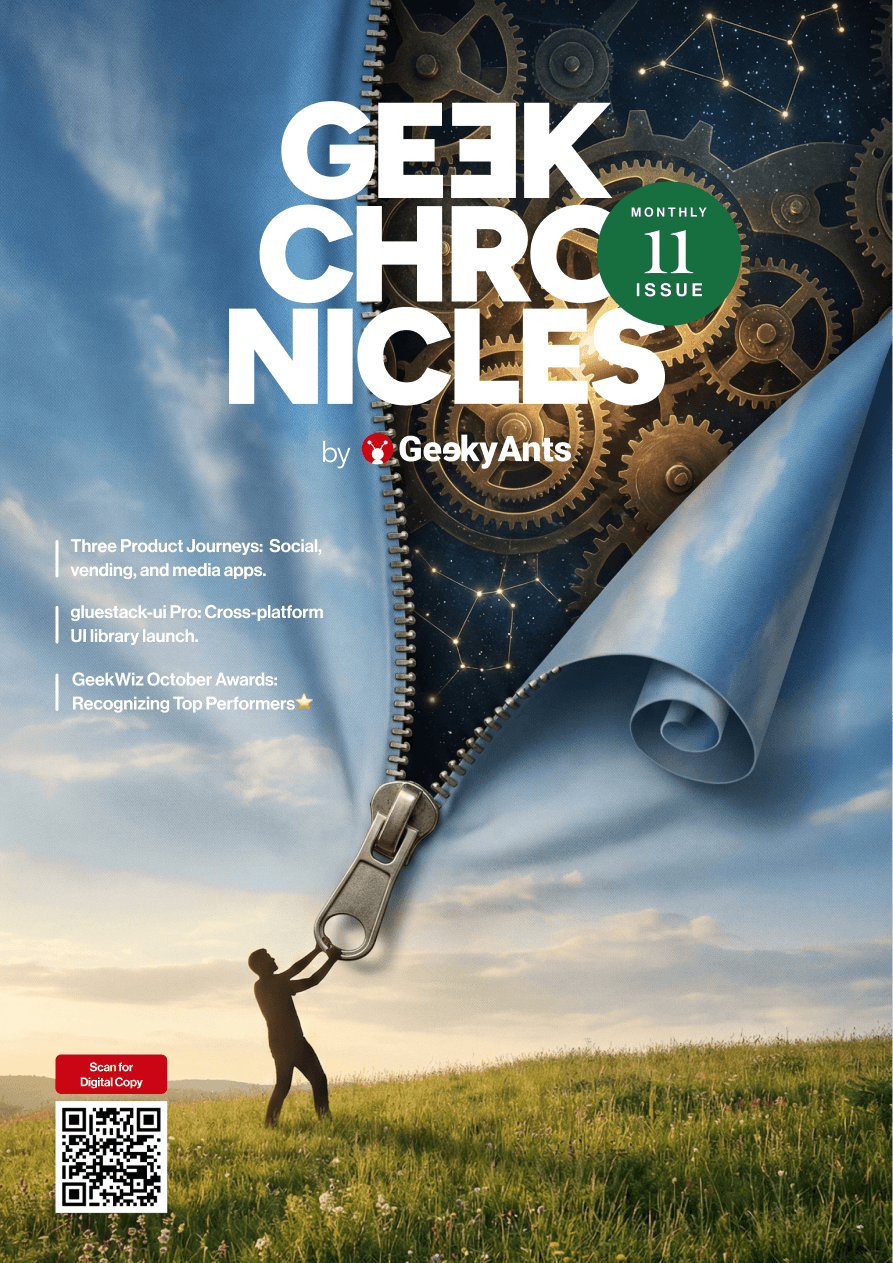
Building Modern Digital Platforms: Three Product Journeys
Three different organisations approached us with challenges shaped by fragmentation, performance limitations, and incomplete operational visibility. A European social discovery startup recognised that traditional dating platforms restricted users to narrow romantic contexts, even though people sought a wider range of social connections, including travel partners, conversation companions, and activity matches. They found themselves caught between rigid dating applications and highly dynamic social platforms, neither of which supported intentional connection-making. At the same time, a large North American vending operations platform could not track customer transactions outside its own ordering system, creating gaps in relationship management. Its equipment marketplace lived on a separate domain requiring duplicate logins, and vendors faced a friction-heavy onboarding that required full access only to review their listings.
A global media licensing and journalism content platform operated with performance bottlenecks that slowed every part of the discovery experience. Search operations took seconds when they needed to respond instantly, video upload workflows created friction for contributors, and global streaming performance varied widely across regions. Bulk downloads often failed midstream, creating frustration for professional buyers. Administrative work absorbed significant time as teams managed thousands of videos, contributors, and approval workflows. Each client needed a transition from functional yet limited systems to platforms capable of supporting modern user expectations, editorial workflows, and operational clarity.
Vision and Product Direction
The guiding visions across these products, centred on completeness, unification, and performance, are treated as a core feature. For the European social discovery startup, the product needed a framework that enabled users to broadcast real-time intentions rather than rely solely on static profiles. Connection types such as shared activities, spontaneous meetups, and short-term plans needed expressive formats that felt natural inside a mobile social environment. The technical foundation had to support real-time interactions, fluid animations, and consistent performance across iOS and Android while preserving a clean user journey.
The vending operations platform sought to become a single operational source of truth, capturing orders from every channel, including external EDI pipelines. It needed to unify its equipment marketplace under one domain, reduce vendor friction through secure preview workflows, and ensure administrators could manage orders and listings from a central dashboard. The direction required the system to detect, classify, and match incoming data automatically, enabling teams to work with complete and accurate information.
The media licensing platform aimed to match consumer-grade performance while serving professional needs. Search had to feel instantaneous, streaming needed to adapt to global network conditions, and thumbnails required dynamic generation for frame-accurate previews. Metadata preservation was essential, recognising the editorial investment behind each upload. Across all products, the broader philosophies emphasised integrated workflows, intelligent automation, and feature sets that supported contributors, buyers, and administrators through coherent, purposeful experiences.
User Experience and Functional Capabilities
The social discovery platform introduced user journeys built around expressive interactions. Profile creation balanced visual clarity with straightforward onboarding, and users could broadcast real-time intentions through animated cards reflecting availability for activities or conversations. Discovery combined deliberate profile evaluation with lightweight browsing of intention-based posts. Real-time chat, immediate notifications, and deep links allowed the experience to extend beyond the application while maintaining coherence.
The vending operations platform delivered comprehensive administrative interfaces shaped around real-world order processing. Unified views allowed filtering by status and date range while showing invoice details, financial breakdowns, and raw EDI data. Customer matching tools supported automatic and manual linking of orders to operator profiles. The equipment marketplace introduced structured browsing with vendor pages, category organisation, detailed equipment information, and dual pricing models showing both standard and member pricing. Vendors received secure review links that allowed them to preview listings without onboarding barriers.
The media licensing platform delivered a search system capable of sub-second responses regardless of dataset size or query complexity. Video detail pages presented comprehensive information with high-resolution galleries and accurate scrubbing interactions. Download workflows support both single and bulk operations, with asynchronous packaging and email delivery preventing failures during large transfers. Embeddable iframes allowed media organisations to present content on their own platforms with proper attribution and tracking.
Contributors across platforms benefited from clarified workflows. The social discovery product offered intuitive media uploads and profile tools, the vending platform provided streamlined vendor previews and administrative routing, and the media licensing platform supported uploads with background processing, metadata persistence, and clear approval states. In each case, the goal was to reduce friction while maintaining accuracy and control.
Architecture, Systems, and Technical Decisions
At the core of the social discovery application, Flutter delivered native performance on both major mobile platforms. Its animation capabilities supported expressive features such as intention cards and fluid discovery interactions. BLoC architecture structured the codebase into predictable streams and state containers, enabling feature-level isolation and parallel development. Hasura provided a strongly typed GraphQL layer with database-level security policies that enforced permission rules without complexity. Firebase supported authentication and real-time messaging, with Cloud Messaging supplying cross-platform notifications. GoRouter handled navigation and deep linking with clear route definitions and guard conditions.
The vending operations platform is integrated directly with EDI 810 pipelines to detect and classify off-platform orders. When invoices arrived from distributors, the extraction logic captured customer details, pricing, taxes, and item information. Matching algorithms compared invoice data with operator profiles using business names and OPCO codes, with fallback flows for unknown customers. Structured order records preserved raw EDI sources, supporting auditability and troubleshooting. Notifications reached administrators by email and Slack, reducing response times and ensuring processing stayed aligned with operational demands.
The unified equipment marketplace relied on database functions for secure vendor access. Token validation occurred server-side through policies preventing unauthorised previewing of equipment listings. Token expiration used scheduled cleanup jobs, ensuring short-lived access aligned with publishing cycles. Dual pricing displayed savings transparently, and credit allocation systems rewarded member purchases across the platform. These capabilities relied on consistent data models and validation rules controlling marketplace presentation and listing accuracy.
The media licensing platform restructured its search architecture through materialised views that pre-computed relationships across contributors, categories, metadata, and tags. This optimisation reduced query times from seconds to fractions of a second. Bunny.net provided adaptive HLS streaming with automatic transcoding into multiple quality levels. This ensured stable playback in regions with varied connectivity. Thumbnail pipelines processed both standard video formats and HLS streams, reading segment metadata to generate representative frames and support accurate scrubbing.
Across all platforms, administrative panels consolidated management tasks into unified interfaces. Each product implemented its own configuration of moderation tools, contributor onboarding, approval workflows, data insights, and content management. These dashboards provided complete operational visibility, reduced manual overhead, and supported scalable future development.
Collaboration, Delivery, and Iteration
Each project advanced through structured discovery and design processes. Business analysis teams conducted early research, defined requirements, and translated goals into precise technical specifications. For the social discovery platform, design teams shaped the user journeys across profile creation, intention broadcasting, and discovery flows. Their work ensured the client’s early concepts evolved into cohesive experiences supported by clear interaction patterns.
The vending operations platform required detailed alignment between technology teams and operational stakeholders. EDI processing, customer matching, and equipment listing workflows all depended on accurately modelling real business processes. Designers, backend engineers, and frontend developers collaborated closely, refining interfaces based on usability testing and stakeholder feedback. The marketplace migration and token workflows benefited from iterative adjustments that strengthened vendor and administrator usability.
The media licensing platform progressed through well-defined milestones, beginning with architectural foundations and moving toward search, streaming, and administrative features. Designers worked alongside developers to ensure visual consistency and usability across both user-facing and administrative interfaces. Quality assurance teams validated performance across network conditions, file sizes, and browser environments. Iterative cycles across Jira, GitHub, and scheduled reviews ensured each release moved forward with stability and alignment.
Outcomes, Impact, and Future Roadmap
Across all three products, the outcomes demonstrated substantial improvements in performance, usability, and operational efficiency. The media licensing platform achieved significant search performance gains and global playback stability. The vending operations platform gained complete order visibility, automated EDI handling, and unified marketplace management. The social discovery application reached a mature production state with expressive interaction capabilities, stable cross-platform performance, and a refined communication system. These systems now operate as cohesive, scalable platforms capable of serving larger user bases and more complex workflows.
Future directions include the enhancement of recommendation capabilities, predictive analytics, and deeper workflow intelligence. The social discovery platform explores personalised matching models, the vending operations platform moves toward advanced reporting and predictive customer insights, and the media licensing platform prepares for expanded contributor networks and higher global usage. Each product now stands on a technical foundation that supports ongoing innovation and long-term growth.
The BA Seat: Fixing the Gaps That Slow Teams Down
The mobility platform project was facing delays tied directly to the absence of a Business Analyst. Without structured documentation and tracking in place, visibility suffered, and accountability became unclear. A BA stepped in to establish both, building a framework that allowed the team to see progress more clearly and hold to deadlines with greater consistency. The intervention did not resolve every challenge, but it provided the project with a foundation it had been lacking.
The enterprise workflow project was stalled at the point where development was expected to begin. Client concerns about the delay had built up, and the timeline was under scrutiny. A BA worked to surface those concerns, address them directly, and realign expectations around the start of the development phase. The conversation brought the client and the internal team back into sync, and the phase moved forward.
The content platform reached completion this month, with delivery happening on schedule and without disruption. The engagement had been managed carefully throughout, and the final handoff reflected that steadiness. Separately, a change request emerged from the same client regarding the user flow on their site. The existing process was causing login errors and creating friction for users. A BA reviewed the flow, identified specific areas where the experience could be tightened, and proposed adjustments that would reduce the error rate and improve overall usability. The client moved ahead with the recommendations.
On the learning app project, one of the key screens in the design phase was at risk of being finalized without full clarity on the data flow and the metrics it needed to support. A BA collaborated with the client to walk through those requirements in detail, ensuring that the screen design was grounded in actual use. That collaboration closed the design phase on time and avoided rework that would have added cost and effort later.
Systems That Make Work Clearer
An internal project needed a better structure around how work was documented and tracked. A BA helped establish a workflow that brought more clarity to task ownership and progress visibility. The system was not complex, but it gave the team a shared reference point and reduced ambiguity in how work moved through stages.
Separately, a new approach to talent mapping was introduced, one that ties resource planning to project forecasts. The system allows leadership to see which projects are in the pipeline and which team members are likely to be involved, giving both sides more time to prepare. It is a planning tool that improves visibility before commitments are made, and it has already started to inform resourcing decisions across the team.
Shaping Work Before It Starts
The consumer platform was ready to move from design into development, but concerns from both the client and internal stakeholders complicated the transition. A BA worked through those concerns, clarifying scope, managing expectations, and ensuring that the handoff was grounded in shared understanding. The effort resulted in a six-month project moving forward with confidence on both sides. The transition was not instantaneous, but the time spent aligning all parties made the development phase possible.
The publishing client presented a different kind of challenge. The app had already been built, but the quality and overall smoothness were falling short of expectations. Multiple issues had surfaced, and the client was losing confidence in the current state of the product. The decision was made to refactor the entire app and convert the engagement into a fixed-scope project. A BA took on the work of defining that scope, starting with a comprehensive feature listing that would serve as the foundation for the refactor. The listing process required pulling apart what had been built, identifying what needed to change, and articulating those changes in a way that could be estimated and committed to. That work is still underway, but it has already given the project a clearer shape.
In the fintech pre-sales process, confusion had emerged around technical dependencies and architectural decisions. The gap between what the client expected and what the technical lead was proposing had widened to the point where the conversation was at risk of stalling. A BA stepped in to bridge that gap, clarifying dependencies, walking through the architecture with both sides, and ensuring that questions were answered before they became blockers. The pre-sales process closed smoothly, and the client is now expected to move forward with the engagement.
Recognition and What It Says About BA Work
The consumer platform client sent a message of appreciation this month, acknowledging Anusha’s collaboration throughout the project. The note recognised the steadiness that supported the engagement from early conversations to delivery. The feedback reflected how her involvement shaped the client’s experience of working with the team.
Anusha also received a GeekWiz award for Project Pioneer, recognising the coordination that kept the consumer platform moving through its phases. The award reflects internal acknowledgement of the same qualities the client appreciated: the ability to hold a project together when it could have fragmented, and the discipline to keep scope and expectations aligned across multiple stakeholders. Both forms of recognition point to a common thread in how BA contributions were perceived this month. The work held things together when they could have come apart, and people noticed.
Inside a Month of Selling: The Deals That Progressed Only After the Details Did
A client in the financial technology space asked the team to walk through their approach to database architecture for a fleet management platform. The request came with detailed expectations. Every component needed a clear explanation, every decision required a defensible rationale, and the thinking behind the design had to be consistent across the team. The client was testing for unity of understanding rather than variety of opinion, looking for evidence that the team’s proposal came from shared reasoning rather than individual interpretation.
The presentation unfolded with a steady rhythm. Each engineer answered questions from the same internal model and referred to the same architectural principles. The explanations reinforced one another, and the conversation stayed close to the client’s priorities. As the dialogue progressed, the questions began shifting toward next steps. The client gained confidence in the team’s cohesion, and the discussion moved toward planning rather than evaluation.
Commitment Through Definition
A fitness technology client had been negotiating pricing for several weeks. Both sides understood the scope, and the value of the work was clear, yet the conversation remained suspended in small revisions. The scheduled start date was drawing near, and the team recognised that the negotiation had reached a point where movement depended on firmer structure.
A condition was introduced. If the client confirmed the engagement by a specific date, the proposed terms would remain as stated. Any confirmation after that date would follow a revised commercial structure that reflected timing. The approach was presented as part of the practical realities of planning rather than pressure. The date created a framework within which the client could convert their intent into a decision.
The confirmation arrived ahead of the deadline, and the project began on schedule. The negotiation shifted because the parameters for proceeding became clear. The client had reached a point where alignment existed, and the defined boundary helped formalise it.
Framing as a Tool for Progress
A company evaluating a cloud-native payment platform reviewed a proposal that included an initial phase to establish the architectural groundwork. The phase was intended to map requirements, identify risks, and lay out a technical roadmap. The client declined. They understood the need for preparation but perceived the phase as something that delayed development rather than shaped it.
The team reconsidered how the phase was described. They began presenting the same scope of work as a Planning Phase, emphasising structure, defined activities, and decision clarity. The shift in framing changed how the client interpreted the purpose of the work. The phase now aligned with their need for direction and momentum while still offering the same technical depth.
The experience clarified how language influences decision-making. Clients respond to work based on how they understand its intention. The Planning Phase terminology created a sense of forward movement, and similar conversations have since progressed more smoothly when framed with that level of precision.
Direction Set Through Responsiveness
Another client revised their product vision during an ongoing engagement. The nature of the experience they wanted to build expanded into a dedicated environment for a broader operating system. The change affected scope and architecture, and the engagement could have slowed while the new direction was assessed.
The technical team adjusted immediately. They reviewed the updated vision, mapped the technical requirements, and prepared feasibility guidance without slowing the process. The client saw that the change could be integrated without friction, and the work advanced without interruption. The continuity came from the team’s ability to treat evolving direction as part of the process rather than a setback.
The Legal Layer: The Work That Keeps the Organisation Running
The legal department processed and reviewed thirty formal client documents across the period, a workload that included five nondisclosure agreements, three master service agreements, and nineteen additional client instruments. Each document represented a stage in building or maintaining relationships that depend on clear terms, mutual understanding, and enforceable commitments. Forty-two non-client documents moved through review and execution, covering partnerships, vendor arrangements, and internal agreements. A knowledge transfer sheet for the account management team was prepared to support continuity during handovers. Internal tracking systems were updated throughout the month, including the social publications tracker and the subcontractor onboarding tracker, both of which serve as reference points for teams working across departments.
Parallel to day-to-day documentation, the legal team began revising the standard templates used for client master service agreements and nondisclosure agreements. The revision process focused on language that could be simplified without weakening protection, terms that could be clarified to reduce back-and-forth during negotiation, and structures that would make execution faster for both the company and its clients. These templates form the baseline for how most client engagements begin, and their revision aimed to make the contracting process less cumbersome while maintaining the legal protections necessary for complex service relationships. The work moved forward with consistency and attention to detail.
Compliance and Internal Legal Clarity
The legal team completed the compliance presentation deck covering the 2024 to 2025 financial year, a resource intended to give internal teams a consolidated view of how client documentation aligned with company policy and regulatory expectations over the preceding twelve months. The deck offered clarity on completed work, areas that needed adjustment, and patterns that appeared across the portfolio of client agreements. It was shared with relevant stakeholders as a reference tool for understanding the company’s position and the adjustments that might be needed.
Work continued on the compliance deck covering the first and second quarters of 2025, with a focus on making essential legal clauses understandable for the account management team. The intention was to help non-legal staff recognize what mattered in client agreements, why certain terms appeared, and what risks particular clauses addressed. This internal education reduced the need for frequent consultation on routine questions and supported account managers in identifying issues earlier in the contracting process. The deck was developed with practical scenarios in mind and used language that assumed no prior legal training.
In collaboration with the human resources department, the legal team supported the rollout and revision of several employee policies. These policies covered areas ranging from workplace conduct to data handling and performance management, and they required drafting that balanced clarity, legal compliance, and alignment with company practices. The legal team ensured that policies reflected current employment law and that they were written in a way employees could follow. The work continued as part of an ongoing effort to formalize internal practices.
Risk, Regulation, and Organisational Protection
The legal team attended a webinar on the Digital Personal Data Protection Rules, which regulate how organizations collect, process, and store personal data. The regulations were still in the early phase of enforcement. The webinar provided insight into how companies would need to adjust internal systems, vendor agreements, and client processes to remain compliant. The learnings were shared with relevant departments, and the legal team began mapping areas where documentation, disclosures, and data handling protocols might need adjustment. The work supported coordination across technology, operations, and client services.
The company issued formal legal notices to certain parties during the month in response to instances of contractual default. The notices documented the nature of the breach, outlined the company’s position, and specified the remedies being sought. This work preserved the integrity of agreements and maintained accountability among involved parties. The notices were handled with attention to legal precision and the potential for resolution.
The registered office of the company was officially shifted from Bihar to Bangalore, a change that required coordination with statutory authorities, updates to public filings, and revisions to internal records across departments. The legal team managed the regulatory compliance aspects of the move, ensuring that approvals were obtained and that the transition was reflected accurately in company documents. The legal team also completed the renewal of the company’s commercial general liability insurance and prepared documentation for the upcoming renewal of the workmen's compensation policy. Legal formalities related to the employee health insurance policy renewal were completed as well. A key office lease agreement was renewed during the period, providing continuity of workspace and preventing operational disruption.
Legal Enablement for Operations and Growth
The legal team worked with external consultants to execute agreements supporting the implementation of a human resources performance management system and enhancements to purchase and accounts payable workflows through a Zoho-based platform. Both agreements required careful review of service terms, data security provisions, and liability allocations, given that the systems would handle sensitive employee and financial information. The agreements were finalized and executed, supporting the company’s efforts to modernize internal operations while maintaining necessary legal protections.
The legal department provided documentation and compliance support for the company’s flagship event, handling vendor agreements, website terms, and other requirements. The team completed all legal documentation required for participation in two major industry gatherings: the Global Fintech Fest 2025 and the Bengaluru Tech Summit 2025. Both events required registration formalities, exhibitor agreements, and compliance checks. The work ensured that the company could participate without administrative delays and that all obligations tied to the events were documented and understood.
Design Notes: Progress in Four Acts
Design exists in two states: the one you build and the one users meet. This month, four projects moved through that threshold—each at a different stage, each carrying the same question: Will this hold when hands touch it?
Of the four projects, two have crossed the finish line and are waiting for their verdict. Two others remain in motion, shaping themselves through feedback and iteration. Together, they reveal what design translates intention into experience, one deliberate choice at a time.
When Guidance Speaks, Does Anyone Listen?
The first project took shape when Raksha S, UI/UX Designer, currently working on a leading e-commerce app, set out to understand, “How do users respond when the app tries to guide them?”
She followed coach marks across the e-commerce app and watched how people treated them. Many skipped them without a glance. Some paused for a second. A few read them with intent. This pattern revealed that guidance works when it feels relevant.
She then widened the lens. Homepages across leading e-commerce platforms offered clues about what draws users in and what holds their attention. These patterns shaped a vision for guidance that feels useful inside the app.
To bring this vision together, Raksha worked with iOS and Android developers to map every corner of the app where coach marks appear. This joint effort exposed uneven moments—visual cues that conflicted, timing that felt off, behavior that confused. Each inconsistency pointed to a place where users might feel unsure or distracted.
These findings shaped a unified plan. Raksha proposed a tiered system: essential guidance appears at decision points, contextual tips reveal themselves on demand, and repetitive instructions fade after the first encounter.
The redesign now speaks when needed, reduces friction, and respects the user’s pace. The final review sits on the calendar, but the work holds a strong footing.
Movement as Language
So, the first project refined how the app speaks to users. The second project refined how the app moves with users.
Evangaline S, UI/UX Designer, began by taking a close look at the login and event-creation journey of a leading event platform. Her yearning was to help users get started faster and move through the app with less effort. She studied how people approached the main login screen and saw places where the flow felt heavier than it needed to be. That insight led to a path with fewer steps and clearer choices.
With that foundation set, attention moved to the event page. The experience needed more life without noise, so a short motion element stepped in to guide the user’s eye and create a sense of movement.
Each step grew stronger through steady collaboration. Designers refined the visuals, developers shaped what could ship, and the client shared what mattered most. This shared direction produced a smoother, more grounded journey. The client approved the direction. The design team waits for the next move.
Together, both projects aim for clarity, ease, and a more thoughtful rhythm inside the product. The final reviews remain pending, but the groundwork holds strength. Like seeds planted with care, both projects sit in the soil of real use, ready for the truth that users alone can reveal.
But not all works are waiting. Two projects move through different rhythms—where feedback decisions shift in real time, and the design evolves while still in motion.
Designing a Rhythm for a Global Event
Phase Two of a seasonally curated concept store began with a challenge. The event expanded to London and Düsseldorf, and the design needed to match that energy.
Sachin M, UI/UX Designer, studied the old schedule—it lived like a printed brochure. He set out to turn it into a living, moving experience.
The first step shaped the transport module. It organized shuttle routes and timings into a clearer, more interactive flow. Information gained hierarchy, movement, and direction. As the design took shape, collaboration carried the project forward. Developers helped define what each interaction could support. Frequent client sessions refined the structure and introduced new features that strengthened engagement.
This rhythm shaped a richer event experience. The interface speaks with more life, guides with more clarity, and responds with more intention. The work now carries the spirit of a global event instead of the weight of a static guide.
Self-Service That Stays on Track
For an Events App, the kiosk project began with Vineeth Kiran M, UI & UX Designer, who explored screen layout, orientations, and ergonomics to understand how people interact with a kiosk. Those observations shaped one insight— kiosks need a steady, step-by-step rhythm. Early layouts pulled ideas from the app, but tests showed they did not fit. The required flow needed clear guidance and one decision per screen. So, borrowing components from the mobile app went out the window.
With that understanding, Vineeth Kiran rebuilt the journey around focused steps that help users move with confidence.
Close collaboration with the client shaped decisions throughout discovery. Shared references clarified the tone, and quick discussions kept the path aligned. Once the new flow took shape, the team tested variations and reached a direction that felt natural for kiosk use.
The client approved the approach. The project now moves into visual design with this structure.
The Thread That Holds All
Some work waits for proof. Some work builds toward it. The best design makes the next step obvious. And when users move forward without hesitation, the work speaks for itself.
Rethinking Data Access in Modern Web Applications
By Eeshan Awasthy
A Fragmented Landscape of Data Access
In the sprawling universe of modern web development, one truth has become increasingly clear. Data management has become more fragmented than ever before. As applications scale across devices, environments, and user contexts, developers often work with a growing collection of tools. SQLite supports rapid local iteration, Supabase enables quick backend scaffolding, PostgreSQL provides production reliability, and custom APIs often sit alongside these layers.
Each solution introduces its own API, its own areas of complexity, and its own subtle behaviours. As teams move between them, a familiar question emerges. Why does accessing data feel more complex than creating the features that define an application.
This question shaped the foundations of vibecode-db, an open source project that reconsiders how developers approach data access. It also explores how they might avoid thinking about data plumbing altogether.
A Story of Growing Complexity and a Radical Simplification
Across different teams, the pattern remains consistent. A small startup may begin with an in-browser SQLite setup to move quickly during the first weeks of development. A short time later, the same team may transition to Supabase to support collaboration and a more reliable backend. As the application grows and enterprise needs surface, legacy REST systems may become part of the architecture. Each step expands the number of access patterns that must be maintained.
Vibecode-db emerges in response to this growing complexity. It offers a single point of definition through a type-safe and declarative schema. Instead of learning new APIs with every change in infrastructure, developers rely on one schema that remains stable while adapters manage the underlying systems.
This approach reduces the effort required to adjust to new backends. It also provides a consistent experience during transitions that usually introduce significant overhead.
One Schema. One API. Infinite Backends.
At the heart of vibecode-db is its adapter-based architecture. While the term may sound technical, the result is straightforward. Developers can begin with an in-browser SQLite instance, then move to Supabase or PostgreSQL for production without altering application logic.
This consistency supports a steady development cycle. Teams begin projects with lightweight storage, then shift to more capable systems as requirements evolve. The workflow remains familiar at every stage of growth.
Offline-first development fits into this structure as well. Applications can rely on local storage and later synchronise with cloud databases through the same API. This creates a smooth path for applications that operate across varying network conditions.
Type Safety as a First-Class Citizen
Type safety forms a central part of the vibecode-db experience. The system uses TypeScript to validate schemas and queries during development. Errors that might appear only in production are identified early in the process.
Developers benefit from accurate autocompletion, stable refactoring, and predictable behaviour. This improves the pace of development and helps new team members understand the structure of the application more quickly.
These qualities make the system feel dependable and consistent, especially in larger projects where clarity is essential.
CustomAdapters: Bridging Real-World Complexity
Modern applications often depend on a range of data sources. Legacy REST endpoints, third-party integrations, and internal APIs remain part of many systems. Vibecode-db acknowledges this reality and provides CustomAdapters to integrate these sources within its unified interface.
Teams can map existing endpoints into vibecode-db without rebuilding them. The application interacts with every backend through the same pattern. This allows vibecode-db to be adopted gradually alongside existing infrastructure rather than replacing it entirely.
This flexibility supports real-world engineering needs and provides room for architectural evolution.
An Open-Source Invitation to Build Together
Vibecode-db is released as an open source project. This encourages collaboration and allows the system to grow through contributions from the community. Developers can build new adapters, extend schema utilities, or create workflows that support different environments.
The project becomes a shared foundation for unified and portable data access. Its direction expands with every contributor who engages with it.
A More Mature Way to Build for the Web
As applications become distributed, collaborative, and hybrid, the need for adaptable data access becomes more important. Vibecode-db presents a steady and thoughtful approach to this challenge. It provides room for decisions to shift over time and supports environments that change as projects grow.
It gives developers a consistent way to interact with data, reduces friction during backend transitions, and strengthens long-term maintainability. The idea remains clear throughout. Write data access once. Use it across environments. Maintain confidence as the application evolves.
Introducing gluestack-ui Pro: A New Chapter in Cross-Platform UI Engineering
By Sanchit Kumar and Ujjwal Aggarwal
A New Chapter at GeekyAnts
At GeekyAnts, there has always been a steady effort to build tools that support developers in meaningful ways. Over time, gluestack-ui has grown into a dependable open source foundation for teams working across React, React Native, and various web environments. Its presence has expanded quietly, shaped by practical use rather than promotion, and it has become a familiar part of many interface workflows.
The introduction of gluestack-ui Pro marks a significant step in that journey. It carries forward the work of the earlier library while offering a more advanced and extensible direction for interface engineering. This is the first time the system is being presented to both internal teams and the wider GeekyAnts community of clients, partners, founders, and product leaders. It reflects the scale of platforms we now support and the evolving needs of the teams building with us.
Gluestack-ui Pro represents an advancement of the component library and a clearer direction for how we intend to support product teams as they design and build consistent, thoughtful interfaces across platforms. It sets the foundation for a broader design system philosophy at GeekyAnts and signals a new chapter in how we approach interface engineering across the organisation.
The Engineering Breakthroughs
Modern interface development carries expectations around branding, accessibility, performance, and consistency across platforms. These expectations place significant weight on theming systems, and it became clear through our client work and open source contributions that theming begins to feel restrictive when it slows down collaboration or behaves differently across environments. This realisation set the stage for a deeper examination of how themes should flow between the places where developers work.
The first breakthrough came through a rethinking of theme behaviour inside secure iframe environments. Iframes create boundaries that protect the browser but make real time updates difficult. Gluestack-ui Pro introduces a hybrid system that brings together URL based initialisation for immediate visual alignment, postMessage communication for real time theme syncing, and CSS variable palettes that support changes without triggering rerenders. The result is a consistent experience where parent and preview remain in alignment through every adjustment.
The second advancement focuses on right to left support. This involves more than flipping text alignment. It touches layout mirroring, spacing logic, animation direction, and accessibility. Gluestack-ui Pro introduces unified right to left behaviour across React Native and the Web, direction aware styling powered by CSS variables, instant toggling through postMessage, and native integration with React Native’s I18nManager. This foundation allows teams to move between languages and reading directions with immediate visual clarity.
Performance forms the third pillar of the engineering work. Themes update significantly faster when CSS variables take precedence over styling approaches driven by JavaScript. A context based architecture strengthens predictability as applications scale. Debounced palette updates reduce unnecessary calculations. Clean event lifecycles help large applications remain stable as they grow. These qualities work together to support high velocity teams that move between platforms and deadlines.
A Design Language Teams Can Grow With
Gluestack-ui Pro is grounded in the design principles that have shaped our internal component systems for many years. It focuses on predictable interfaces, composable building blocks, and a platform agnostic approach to design. These principles make it possible for teams to adopt the library gradually while maintaining clarity about how the system behaves.
The introduction of Pro brings additional depth to this familiar foundation. The design language supports greater control over themes, stronger alignment between platforms, and a more expressive palette of tools for teams building multi surface products. The experience feels familiar to those who have worked with gluestack-ui in the past, while offering additional capability and structure.
This philosophy places long term consistency at the centre of the system. It gives developers a reliable base that can adapt to new products, new branding needs, and new environments without requiring them to rethink the fundamentals of their interface decisions.
Try It. Explore It. Break It. Build With It.
The release of gluestack-ui Pro marks the beginning of a broader roadmap. The team is working on animation syncing, palette generation tools, accessibility focused theme presets, expanded documentation, and support for gradients and multi tone colour systems. Multi brand theme switching will also become part of this evolution as more products manage multiple identities within the same application.
Early adopters of the system will receive all upgrades for six months during the pre release period. This approach ensures that teams can begin building without waiting for later versions and can grow alongside the direction of the library.
Geek Anniversaries and New Joiners
New Joiners:
@Danish Ali – Senior Software Engineer I
Danish brings 4 years of experience in the IT industry. He worked at TCS for 3 years as a Java Backend Developer in the banking domain and later at STL Digital in the automobile domain. Skilled in Java, Spring Boot, Microservices, and cloud technologies, he’s passionate about music, movies, and travelling.
@Nagarjuna Cherukuri – AI / ML Engineer I
Based in Bangalore, Nagarjuna has 1+ years of experience in Artificial Intelligence. He previously worked at Infyshine Technologies as an Associate Software Engineer in the AI domain. Skilled in Python, GenAI chatbots, Machine Learning, and Deep Learning, he’s passionate about writing, filmmaking, and cricket.
@Subhankar Barua – UI & UX Designer I
Subhankar is a Product Designer with 3+ years of experience in creating impactful digital experiences. He’s skilled in Figma and the Adobe Creative Suite, and is exploring no-code tools like Framer, Webflow, and Protopie. Outside work, he enjoys gaming and e-sports, traveling, music, and exploring local cuisines.
@Asish Manoj K – Senior Account Manager
Welcome back, Asish! With 7+ years in B2B and 6 years in IT & product sales, he rejoins us in Account Management. A true explorer at heart, he loves road trips, forest trails, and trekking.
@phanindra.s – Senior Software Engineer II
Front-end developer with 5 years’ experience in React and React Native, with fundamentals in Node.js and AWS. Local-level cricketer, avid traveler who loves discovering under-the-radar spots, and an obsessive strategy gamer on long breaks.
@Siddhartha G – Senior Software Engineer I
Senior engineer with 3+ years’ experience building scalable apps using Java, Spring Boot, and Microservices. Previously at LTIMindtree, contributing to a Citi Bank project. Curious mind who enjoys learning new tech, travel, sports, and music.
@Shaik Anwar – Senior Software Engineer I
Backend developer with ~5 years’ experience across Java, Spring Boot, Microservices, and databases—focused on reliable, scalable services.
@Ankith S – UI/UX Designer I
From Mangaluru, with 2 years as a Product Designer and trained Architect, passionate about creating impact through design. Interests: cinematography, swimming, and architecture.
@Prerana V – Talent Acquisition Associate
Recruiter with ~1.5 years in screening and end-to-end hiring. Loves travel, content creation, and exploring new cafés; eager to learn and grow toward future leadership roles.
@Bikash Baishya – Business Associate (Partnerships)
Pursuing an MBA (Operations & Finance). Former Urban Company BDA intern (partner onboarding & training). Entrepreneurial stints: meat-supply venture (B2B/B2C, 2021–22) and a cloud kitchen serving 4 PGs. Hobbies include football, cricket, volleyball, reading, music, dancing, and occasional cooking.
@Ashika Bs – Talent Acquisition Associate
Ashika is an MBA graduate with 1.5 years of experience in talent acquisition and people operations. She’s passionate about modelling and drawing, bringing a blend of professionalism
Anniversaries
Over the past seven years at GeekyAnts, I have had the privilege of contributing to the organization’s operational excellence in the capacity of an Administration and Front Office Professional. My role encompasses comprehensive administrative support, reception management, coordination of vendor and facility services, travel and event arrangements, and fostering a well-structured and efficient workplace environment. Serving as the first point of contact for guests and employees, I remain committed to upholding the company’s standards of professionalism, responsiveness, and hospitality. Throughout my tenure, I have focused on enhancing internal processes, strengthening communication channels, and ensuring smooth day-to-day operations across the organization. The experience has not only deepened my expertise in administrative and front-office functions but has also reinforced my dedication to service, reliability, and organizational integrity.
Quote:
"Efficiency is doing things right; effectiveness is doing the right things — and in administration, I strive to deliver both every day." - Asha R
I joined GeekyAnts as part of the Admin team, and it has been a phenomenal journey ever since. I initially focused on internal maintenance and operations, which gave me a strong foundation and understanding of how things work behind the scenes.
Over time, I was given the opportunity to step into the world of events—managing meetups, conferences, and various internal programs. This transition was incredibly exciting. Handling events within tight timelines and with optimal resources brought its own set of challenges, but they were challenges I was eager to accept.
None of this would have been possible without the support and collaboration of the entire team. GeekyAnts has continuously provided me with opportunities to grow, learn, and take ownership of diverse responsibilities. I’m grateful for the trust placed in me and for the experiences that have shaped my journey here. - Prem Prakash Goswami
I joined GeekyAnts in December 2019 as a fresher, at a time when most of my peers were heading into litigation. I knew, however, that I wanted to build a career on the corporate side of law - closer to business, people, and decision-making. What started with foundational HR documentation soon led me into high-value contract negotiations, compliance work, IP and data-protection matters, and supporting teams across the company on critical issues. Some of the moments that shaped my journey have been handling high-pressure contractual escalations, watching the legal function grow into a true business partner, and being trusted to independently manage complex assignments. I’m grateful to my mentor, Mr Apoorva Sahu, for his constant guidance, and to my team, who make the day-to-day work both smoother and stronger.
One of my biggest learnings has been to take on every task, big or small, with openness and ownership. Stepping into the role of Manager–Legal and leading a small but capable team has been both humbling and rewarding. As I look back on these six years, I see a journey shaped by learning, challenges that stretched me, and trust that helped me grow. And as I look ahead, I remain committed to supporting GeekyAnts’ journey with the same passion and integrity that have guided me from the start. - Christine Swayamprabha Mathias
Value of the Month
Learn and Be Curious
Curiosity keeps you awake at odd hours, chasing down rabbit holes you never planned to explore. You learn because something catches your attention and won't let go. Questions multiply faster than answers, and somewhere in that mess, you find yourself understanding things differently than you did yesterday. The discomfort of not knowing pushes you forward more than any comfort zone ever could. You ask why, then why again, peeling back layers until you hit something real. Every project teaches you what the last one couldn't. Your toolkit expands, your perspective shifts, and you realize how much territory still lies ahead. At GeekyAnts, we build with people who carry this restless need to understand, who never quite finish asking questions.
Overthink Tank
Fact Section
Fact 1: How Reasoning Improves AI Accuracy
Chain-of-Thought prompting improves accuracy in many AI tasks, though the exact percentage varies.
Research from Google DeepMind and Stanford shows that large language models often give more accurate answers when they explain their reasoning step-by-step. The improvement depends on the task, and while some benchmarks show large gains, there is no single fixed percentage that applies everywhere.
Fact 2: Why Late Bugs Become Expensive
Bugs cost significantly more to fix after release, and some studies report increases of up to 100×.
The idea that late-stage defects are costlier is widely supported in software engineering literature. The exact multiplier varies across industries and studies. Some classic sources report costs rising by as much as 30× to 100× after release, but these figures are context-dependent rather than universal.
Fact 3: The 50-Millisecond First Impression
Users form a first impression of a website’s visual design in about 50 milliseconds.
Multiple UX studies, including work cited by Google and research by Lindgaard et al., show that people make an immediate visual judgment about a website in roughly 50 ms. This applies to first-look impressions and does not represent a deeper evaluation.
Fact 4: Most Software Cost Comes After Launch
Maintenance and evolution typically account for the majority of a software system’s total lifetime cost.
Software engineering analyses report that post-release maintenance can consume roughly 60 to 90 percent of total lifecycle cost, and one widely cited “60/60 rule” notes that about 60 percent of lifecycle cost is maintenance and 60 percent of that is spent on enhancements rather than pure bug fixing.
Fact 5: Most Code In Modern Apps Is Open Source
Recent audits show that, on average, around three-quarters of the source code in commercial applications comes from open-source components.
The 2024 Open Source Security and Risk Analysis (OSSRA) report found that 96 percent of audited commercial codebases contained community-driven code, and 77 percent of all source code in those applications originated from open-source components.
Jokes Section
1. The Office Coffee Enlightenment
Our office coffee machine is so unreliable that I have started treating it like a philosophical teacher.
Every morning it asks me the same two questions:
“Are you sure?”
And,
“Why?”
2. The Developer Who Refused To Rush
A developer told me he writes code at a “thoughtful pace.”
I asked what that means.
He said, “I like my bugs to feel deliberate.”
3. The Existential Notification
My phone sent me a notification that said, “You have not opened this app in a while.”
I stared at it for a minute and realised:
Neither has it opened up to me.
4. Git Blame
Git is more emotionally honest than most people.
It has a command that just points at your code and says, “You did this.”
5. The Quiet Catastrophe
I bought a notebook to organise my thoughts.
On the first page, I wrote “Page 1.”
On the second page, I wrote “Page 2.”
By page 3, I realised the notebook was organising me.
Riddle
Riddle 1: The Quiet Employee
I attend every meeting.
I never speak.
If I disappear, everyone panics.
What am I?
Answer: The Wi-Fi.
Riddle 2: The Perfect Feature
Everyone asks for me.
No one has time to build me.
If I ship, I am already outdated.
What am I?
Answer: The “perfect” roadmap.
Riddle 3: The Honest Mirror
I never write code.
I only show what you already did.
If you avoid me, your future self will be angry.
What am I?
Answer: Code review.
Riddle 4: The Moving Target
I am promised on the slides.
I slip in reports.
When I finally arrive, I get renamed.
What am I?
Answer: A deadline.
FAQs
1. Why is deepfake-enabled fraud receiving so much attention right now?
Because the scale has shifted dramatically. Countries are reporting rises in the range of 1,500 to 1,900 percent, and fraud has moved from isolated attempts to organised, AI-driven operations that can impersonate voices, identities, and documents with minimal effort.
2. How does Cache-Augmented Generation differ from RAG?
CAG removes retrieval from the critical path by preloading stable knowledge directly into the model’s context and KV cache. It reduces latency, eliminates external lookups, and performs best in systems that rely on fixed or slow-changing information.
3. What makes top Health companies different from typical food-tracking apps?
It uses computer vision, event-driven processing, and conversational AI to interpret meals, monitor behaviour, and link nutrition patterns to emotional cues. The system responds in real time and builds a profile that evolves with every interaction.
4. Why do iOS Live Activities matter for mobile product teams?
They place time-sensitive information on the Lock Screen and Dynamic Island, allowing users to track updates without reopening the app. This surface drives higher engagement and demands careful native-bridge engineering for React Native teams.
5. What stands out about the banking platform modernisation featured here?
The overhaul produced concrete improvements: faster transactions, fewer payment failures, consistent cross-device performance, and a stable architecture built for scale. It demonstrates how infrastructure decisions directly affect day-to-day reliability for millions of users.
6. What did the three product journeys reveal about building modern platforms?
They showed that different industries face similar pressures: fragmented data, slow workflows, incomplete visibility, and inconsistent user paths. Strong architecture, unified interfaces, and reliable search or sync layers became central solutions across all three.
7. How did this month’s design projects approach user behaviour?
They focused on specific decision points. Coach marks were redesigned to appear only where they matter, event interfaces gained clearer rhythm and pacing, and kiosk flows were rebuilt around single-step screens that guide users with less cognitive load.
8. What does vibecode-db aim to change about data access?
It introduces a single schema and adapter system that works across SQLite, Supabase, PostgreSQL, and custom APIs. This removes the need to rewrite data logic every time infrastructure changes, keeping development consistent from prototype to production.
9. What direction does gluestack-ui Pro set for interface engineering?
It establishes a system built for multi-platform consistency. Features include theme syncing across iframes, unified RTL support, CSS-variable performance gains, and a design language that adapts to branding without fragmenting codebases.
10. How does Issue 11 reflect the organisation’s broader trajectory?
It shows a shift toward systems that reduce friction: faster fraud detection, clearer data workflows, more stable interfaces, and tools that prioritise maintainability. The focus is on building foundations that hold up as products and teams expand.