
Building an AI prototype is easier than ever in 2026, yet the path to production remains a valley of death for many enterprises. While a demo might impress a boardroom, a production-grade system must handle data drift, security audits, and unpredictable inference costs at scale.
Recent industry reports suggest that up to 80–85% of AI projects never reach production or fail to deliver measurable business value. The challenge is building the system around it.
In enterprise environments, AI must operate within legacy systems, strict compliance layers, and unpredictable real-world data conditions that most MVPs are not designed for.
Key Takeaways
- Successful AI MVP development transition to production by shifting from experimental accuracy to scaling business ROI as the core success metric.
- Data audits and synthetic augmentation solve the siloed data problem before it breaks the model.
- AI MVP Development success depends on early FinOps to control scaling costs as you scale from 100 to 1,000,000 users.
- Use middleware and event-driven architectures to bridge the gap between modern AI and rigid legacy systems.
Why AI MVP Development Fails in Enterprise Environments
In 2026, the gap between a model experiment and a production AI MVP is wider than ever. Many teams celebrate when an AI agent performs well in a controlled environment, only to see it fail under the weight of enterprise constraints.
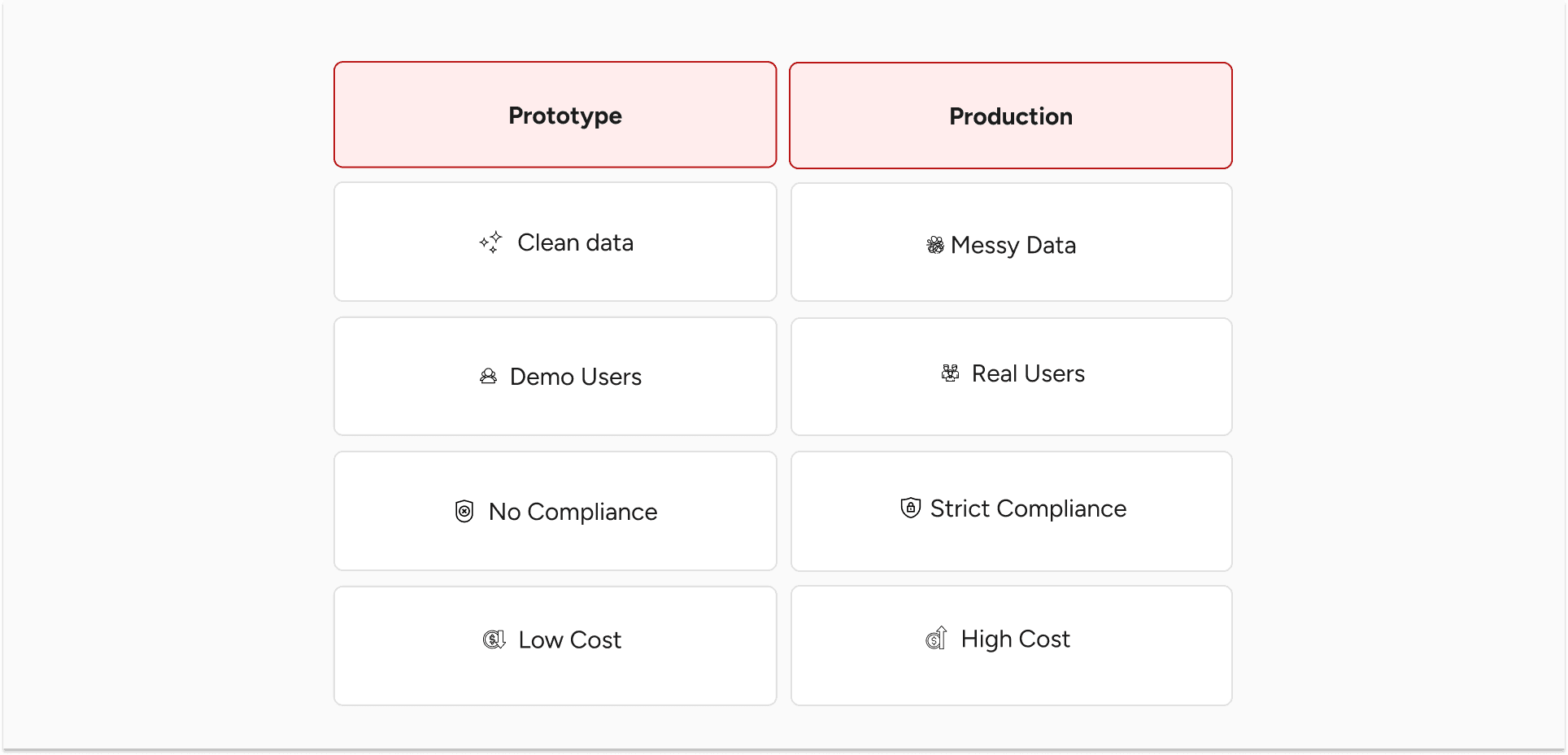
The Prototype Success vs. Production Reality gap exists because experiments ignore the complexities of the real world. A demo operates on clean, static datasets. Production, however, requires continuous data pipelines, 99.9% uptime, and strict compliance with global regulations like the EU AI Act.
Most AI MVP guides focus on speed but ignore enterprise hurdles like legacy system inertia and data silos. Without addressing these early, your AI project becomes a permanent pilot, a project that shows promise but never delivers actual business value.
A working prototype proves that the model can work. Production proves that the business can trust the entire system—data, infrastructure, compliance, and cost—at scale.
 Saurabh SahuChief Technology Officer (CTO)
Enterprise Constraints That Most AI MVP Guides Ignore
Most AI MVP guides assume clean systems and flexible environments. Enterprise reality is very different.
AI systems must integrate with legacy ERPs and CRMs, operate on fragmented data spread across multiple systems, and comply with strict regulatory requirements. These constraints introduce engineering complexity that most MVP architectures never account for.
The 9 Critical AI MVP Development Challenges (and How to Overcome Them)
The real barriers to production are not in the model; they exist in the system around it. Most organizations assume that building an AI MVP is primarily a model problem. In reality, the hardest challenges appear outside the model. Data fragmentation, unclear success metrics, infrastructure limits, and organizational misalignment often prevent AI MVPs from moving beyond the prototype stage. An AI system that performs well in a controlled demo environment can fail once it interacts with real enterprise data, real users, and production workloads. Understanding the core AI MVP development challenges helps teams design systems that can transition from experimentation to production.
“The biggest mistake teams make during AI MVP development is focusing only on the model. A successful MVP depends on the surrounding system—data readiness, infrastructure, monitoring, and cross-team alignment.” — Kunal Kumar, COO, GeekyAnts
1. Data Readiness and Quality Fragmentation
Challenge: Data readiness remains one of the most common AI MVP development challenges. The enterprise data that is generated is fragmented into disconnected sources like CRMs, data analysis platforms, internal databases, document repositories, and legacy applications. The majority of the generated data is either not structured, not consistent, or lacks comprehensiveness. AI models trained on fragmented and disjointed datasets will generate unstable predictions, regardless of their own performance.
Solution: Enterprises should consider data preparation an essential step toward developing an AI MVP solution. With data audits, teams are able to gauge the quality and completeness of their datasets. Fragmented data needs to be streamlined through data pipelines. If there isn’t enough high-quality data, data teams can also use methods like synthetic data generation for training AI algorithms. AI systems can generate stable outcomes only when backed by proper data.
2. Unclear Success Metrics for AI Systems
Challenge: Another critical AI MVP development challenge involves defining what success actually means. Many teams rely only on technical metrics such as model accuracy or response quality. These indicators reveal how the model performs but fail to capture whether the AI system generates measurable business value.
Solution: Effective AI MVP development requires teams to define two categories of metrics from the beginning. Model metrics such as precision, recall, latency, and response accuracy measure the technical behavior of the system. Business metrics such as conversion rate improvements, operational cost reduction, or support ticket deflection measure real impact. When teams connect these two layers of measurement, they can determine whether the MVP validates both technical feasibility and business outcomes.
3. Model Reliability, Hallucinations, and Trust
Challenge: The reliability of AI MVPs is still one of the significant issues in AI MVP development, particularly those using large language models in consumer-facing applications. LLMs could produce inaccurate answers, often called hallucinations, which can be plausible but pose considerable threats in the corporate world.
Solution: To overcome this problem, developers need to incorporate reliability guardrails into their MVP system designs. Guardrails prevent models from producing harmful or impossible-to-support outputs, whereas human-in-the-loop processes ensure that domain experts check important outputs. Evaluation pipelines evaluate the performance of models in different situations to detect potential flaws prior to their deployment. By integrating reliability into their MVP design systems, enterprises develop reliable AI solutions.
4. Scaling from MVP Infrastructure to Production Infrastructure
Challenge: The infrastructure choices made while developing an MVP for AI could dictate its scalability prospects. Prototypes usually rely on minimalistic setups that favor quick testing. The setup lacks the capacity to cater to production needs, such as high levels of concurrency, low latency, and uptime guarantees. Once the user base begins growing, users report slower response times, service disruptions, and poor stability.
Solution: For a scalable AI MVP, the infrastructure should bear similarities with the intended production infrastructure from day one. Cloud-based infrastructure, containerized AI applications, APIs as first-class citizens, and scaling infrastructure become possible in this scenario. The team minimizes the possibility of having to rebuild the MVP when more users adopt it.
5. Integration with Legacy Systems and Platforms
Challenge: AI systems rarely operate in isolation. Most enterprise environments rely on a complex mix of ERPs, CRMs, analytics platforms, internal APIs, and legacy software systems. One of the overlooked AI MVP development challenges is integrating the AI system into this ecosystem. Without proper integration, the MVP remains disconnected from the workflows it aims to improve.
Solution: Organizations can solve this challenge by introducing integration layers that connect AI services with existing enterprise platforms. Middleware architectures help translate data formats between systems, while event-driven frameworks enable real-time data exchange across applications. Standardized APIs and data orchestration pipelines further ensure that the AI system can access the information it needs to operate effectively.
6. Cost Explosion at Scale (The AI FinOps Problem)
Challenge: AI MVP development can appear cost-efficient during early testing. However, once usage grows, inference costs rise rapidly. API calls, vector database queries, compute usage, and storage requirements increase with every interaction. Without cost controls, the operational expense of running an AI system can exceed the value it generates.
Solution: Organizations must therefore introduce financial oversight into their AI architecture. Model optimization techniques such as distillation allow teams to replace large models with smaller, more efficient versions. Caching repeated responses reduces redundant model calls. Retrieval optimization improves efficiency in retrieval-augmented systems. Cost monitoring frameworks provide visibility into usage patterns so teams can manage expenses before they escalate.
7. Lack of MLOps and Observability
Challenge: Many AI MVPs launch without monitoring infrastructure. Once deployed, teams cannot easily detect model drift, performance degradation, or accuracy declines. Over time, changes in user behavior or incoming data cause models to produce weaker results. Without observability, organizations discover these problems only after users experience them.
Solution: MLOps practices address this challenge by introducing operational visibility into AI systems. Monitoring tools track model performance metrics and detect drift in real time. Continuous evaluation datasets allow teams to test models against updated scenarios. Experiment tracking and version control ensure that improvements remain traceable and reproducible. Observability allows organizations to maintain AI system quality long after the MVP launches.
8. Security, Compliance, and Data Privacy Risks
Challenge: The AI system built by enterprises must meet certain regulatory requirements and security standards. Laws related to data protection and other industry-related laws make compliance a big problem for building an MVP of AI solutions, especially when the model processes personal data, such as medical records, financial data, and even consumer data. An MVP that does not comply with relevant laws and regulations cannot move to the next stage of being operational.
Solution: This is solved by including governance in the overall AI architecture. Governance ensures that sensitive data undergoes data masking. The private deployment of models ensures that there is minimal contact with any external systems. Compliance is achieved using security mechanisms that ensure there is access control and encryption.
9. Organizational Misalignment and Execution Friction
Challenge: The last obstacle in building an MVP using AI is an organizational one, not a technical one. AI projects usually span across different teams: data scientists, engineers, product managers, and business leaders. When each team works independently without proper coordination, AI projects get stuck because there is no clear ownership, collaboration, or consensus among them.
Solution: The secret of success is establishing cross-functional AI teams that represent all relevant functions. They jointly own the product and work under a unified roadmap. The platform ownership pattern clarifies ownership of the underlying architecture, data pipelines, and model deployment. Aligning people and processes with the AI system results in smoother execution.
Addressing these nine AI MVP development challenges allows organizations to move beyond experimentation. Teams that treat the MVP as a scalable system—rather than a prototype—create AI products that can support enterprise growth.
From AI MVP to Production: A Practical Framework
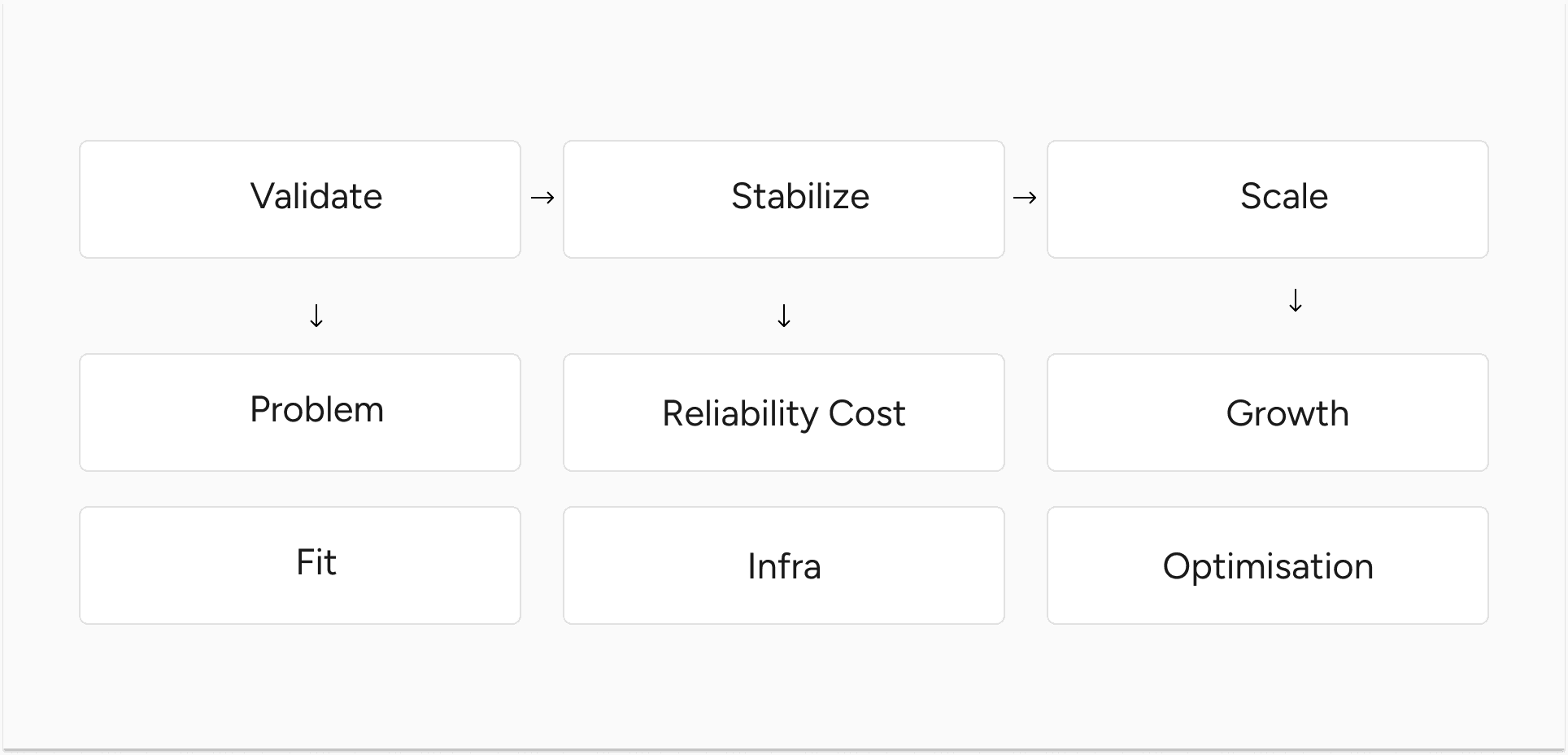
Moving from a prototype to a market-ready asset requires a shift from experimentation to engineering rigor. While an MVP proves that the AI can work, production readiness ensures it stays reliable, secure, and cost-effective under real-world pressure. This framework breaks the transition into three distinct phases to de-risk the journey from the initial demo to a global scale-up.
Phase 1: Validate (Weeks 1-4)
Focus on Problem-Solution Fit. Use rapid prototyping to prove the AI can actually solve the core business pain point with existing data.
Phase 2: Stabilize (Weeks 5-12)
Focus on Production Hardening. Implement security guardrails, MLOps monitoring, and legacy middleware connections.
Phase 3: Scale (Month 4+)
Focus on Economic Optimization. Apply FinOps strategies, refine token usage, and expand to broader user bases.
Top Industries Where AI MVPs Successfully Scale to Production
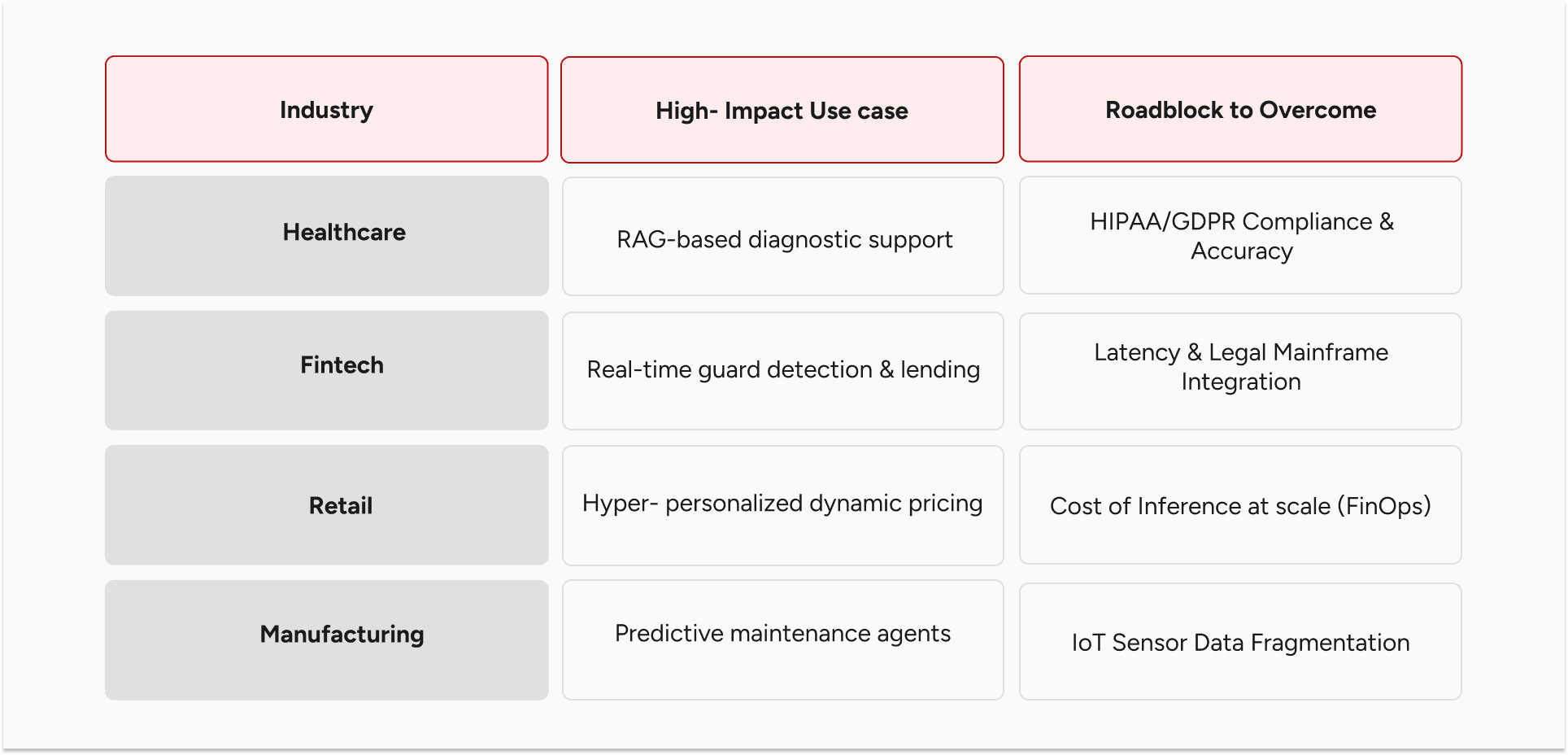
While AI is a horizontal technology, the MVP-to-Production conversion rate in 2026 is highest in sectors where the cost of human error or manual delay is steepest. These industries have moved past general-purpose chatbots and are now deploying specialized agents that interact directly with core business logic.
The following table highlights where the most significant capital is being deployed and the specific engineering hurdles that stand in the way of full-scale production.
AI Production Readiness: A Decision Framework for Enterprise Leaders
Transitioning from a successful experiment to a permanent production asset requires a clinical assessment of risk and value. This decision framework helps leaders determine if their AI MVP is ready for the enterprise stage or if it needs further refinement in the stabilization phase.
The Production Readiness Checklist
Before committing to a full-scale rollout, ensure your MVP meets these three critical benchmarks:
The Build vs. Buy vs. Partner Matrix
Deciding how to execute your AI strategy depends on the proximity of the solution to your core intellectual property.
- Build (In-house): Choose this for core competitive advantages where you own the proprietary logic and data. It offers maximum control but requires significant time and high-cost talent acquisition.
- Buy (Off-the-shelf): Choose this for commodity functions (e.g., general HR bots or email summarizers). It is the fastest route but offers zero differentiation and creates vendor lock-in.
- Partner (Product Engineering): Choose this for complex enterprise integrations. Partnering with specialized AI engineering firms like GeekyAnts provides the speed of buying, with the customization of building, bridging the gap between raw models and legacy systems.
Build vs Buy vs Partner Matrix
Approach | When to Use | Pros | Cons |
|---|---|---|---|
Build | Core IP, proprietary logic | Full control | High cost, slow |
Buy | Commodity use cases | Fast deployment | No differentiation |
Partner | Complex enterprise AI | Speed + customization | Dependency |
Internal vs. External Execution Strategy
Most enterprises fail because they attempt to build specialized AI systems with generalist internal IT teams.
Internal Execution works best for long-term transformations and retaining knowledge within the organization. Nevertheless, it tends to become too slow because of bureaucratic processes and the absence of specific expertise in MLOps.
External Execution (Strategic Outsource) is the best option for managers focused on fast time-to-market. Your external teams will have rich experience in dealing with Model Drift and optimizing FinOps, while you'll be able to concentrate on solving business challenges.
If your AI MVP requires integration with more than two legacy systems or handles sensitive customer data, an external partnership often reduces the time-to-production by 40% to 60% compared to internal development.
Before scaling your AI MVP, ensure:
- Data readiness: Clean, unified, and production-grade pipelines
- Infrastructure readiness: Scalable, monitored, and fault-tolerant systems
- Business alignment: Clear ROI metrics tied to business outcomes
- Model reliability: Guardrails, evaluation pipelines, and fallback mechanisms
- Compliance readiness: Security, auditability, and regulatory alignment
Overcome Roadblocks with GeekyAnts, AI MVP Development Company
At GeekyAnts, we build systems. We understand that the success of an AI product depends on how well it talks to your 10-year-old ERP and how much it costs to run at 3 AM on a Tuesday.
Our Achievement Benchmarks:
- Pillar Engine: Developed a document intelligence platform that processes 10,000 pages in 120 seconds with 99% accuracy, replacing a team of 50 manual reviewers.
- DollarDash: Architected a fintech AI system that reduced inference costs by 60% through model distillation and semantic caching.
- Dentify: Integrated AI agents into a legacy healthcare CRM, reducing patient onboarding time by 40% while maintaining 100% HIPAA compliance.
Scaling AI is an engineering and economic problem. We help enterprises stop playing with AI and start profiting from it.
 Kumar PratikFounder & CEO
What Enterprises Must Get Right
The enterprise world demands AI that is stable, secure, and cost-effective. By addressing legacy integration, focusing on FinOps, and aligning organizational squads, your AI MVP can move from a boardroom slide to a production-grade engine of growth.
FAQs
What are the main hurdles to creating an MVP for AI?
The top three barriers to MVP creation are data silos, FinOps issues, and legacy technical debt.
Why do most AI MVPs not succeed in getting into production?
The reason is that most are created as isolated experiments and lack enterprise muscle—security, scalability, and regulatory requirements.
How is AI MVP development different from traditional MVP development?
Traditional software is deterministic and static. AI is probabilistic and dynamic. This means AI requires constant monitoring for drift and a specialized infrastructure to handle massive compute requirements.
How do you control AI infrastructure and inference costs at scale?
The most effective way is through AI FinOps. This involves using model distillation (switching to smaller models for easy tasks) and implementing semantic caching to reduce redundant API calls.
What role does rapid prototyping play in AI success?
It allows for failing fast. By testing the problem-solution fit with a prototype in 2-4 weeks, enterprises can avoid spending millions on a production system that users do not actually need.
Sources & Citations: