

Key Takeaways
- Choosing the wrong development partner in the USA leads to hidden costs, ranging from delays and rework to compliance risks, that can multiply your budget.
- Success lies in proactive due diligence: evaluating contracts, team expertise, and communication models before committing.
- A structured recovery roadmap, audit, stabilize, and realign priorities, helps businesses regain control and protect long-term value.
In software development, the most expensive mistakes are not made in code; they are made in choosing who writes it.
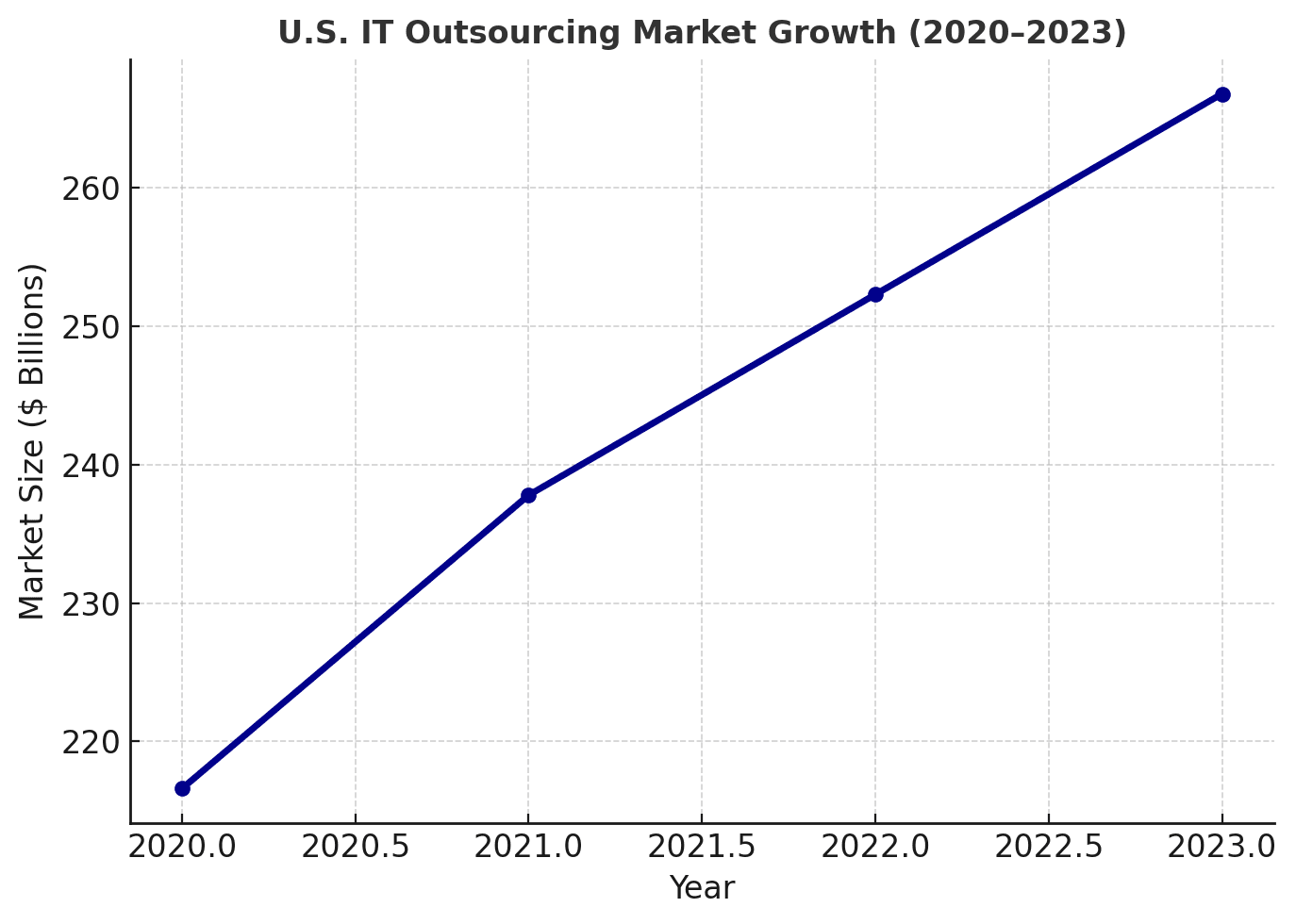
The global IT outsourcing market surpassed $460 billion in 2023, and the U.S. accounted for nearly 58% of that spend, making it the largest outsourcing hub worldwide. Businesses poured billions into projects aiming to move faster, scale smarter, and innovate ahead of the curve. Yet, the reality tells a different story: over 50% of outsourced projects in the U.S. run over budget or miss timelines, while 31% fail before completion.
The consequences extend beyond the balance sheet. Delayed launches can open the door for competitors, poor execution can lead to mounting technical debt, and misaligned processes can trigger compliance challenges or erode user trust. For many companies, these impacts remain hidden until the damage is already done.
This blog examines the visible and hidden costs of working with the wrong development partner, highlights the specific risks that rarely surface in early proposals, and shares a practical framework for making the right choice from the start, ensuring your investment delivers on both speed and quality.
Defining the Wrong Software Development Partner
The strength of a development partnership is measured by how seamlessly it integrates with a company’s vision and operations. The most successful outcomes happen when technical expertise, process discipline, and business alignment work in unison. In my experience, the right partner operates as a natural extension of the team—anticipating challenges, protecting quality, and accelerating progress toward strategic goals.
 Kunal KumarChief Revenue Officer
adding that the opposite scenario defines a wrong development company or partner—one that fundamentally misaligns with your business goals, processes, and quality expectations.
This misalignment can appear in many forms:
- Promising delivery speed at the expense of long-term stability
- Overlooking industry regulations or security requirements
- Operating without transparent communication and accountability
- Lacking the technical depth or scalability your product demands
- Retaining ownership of code, assets, or intellectual property
Such gaps introduce friction into every stage of a project, eventually translating into higher costs, delayed launches, and missed market opportunities.
Speed Without Strategy: The Silent App Killer
In app development, speed without strategy is a shortcut to failure. Many vendors position rapid delivery as their key selling point, launching apps that appear polished in demos but falter under real-world demands.
The issue is not moving fast; it’s moving fast without building the right foundation. Skipping discovery sessions, ignoring scalability planning, or cutting corners in testing may save weeks in the short term, but those savings vanish when performance issues, security vulnerabilities, or integration failures surface after launch.
Industry data highlights the scale of the problem: 80% of mobile apps fail within their first year, often due to poor market fit, usability issues, or lack of long-term vision (Jobera, BetaBreakers, TechBullion, Enlight Vision). Looking at the broader software industry, only 39% of projects are delivered on time, on budget, and with required features, while 43% are considered “challenged”—late, over budget, or missing key functionality (Project Management Works).
True delivery speed is sustainable only when it’s backed by:
- Clear business alignment – Development choices tied directly to your growth and monetization goals
- Robust architecture – Scalable codebases designed for evolving feature sets and user loads
- Rigorous testing – Automated and manual QA to validate real-world performance before release
- Proactive risk management – Identifying and resolving compliance, security, and operational risks early
Most software companies that fail you do so not because they lack coding skills, but because they focus on the finish line without securing the path to get there. The result: a product that struggles to perform, costs more to maintain, and requires expensive rework to stay competitive.
What Are the Visible and Hidden Costs of a Wrong Software Development Partner?
Choosing a software development partner shapes the product’s architecture, delivery speed, scalability, and compliance readiness. In the U.S., where budgets are high and launch windows are tight, the impact falls into two categories: visible costs during the project and hidden costs that emerge after launch.
Visible Costs
These are costs that enter the balance sheet during the active engagement, typically traceable to contractual gaps, delivery errors, or project misalignment.
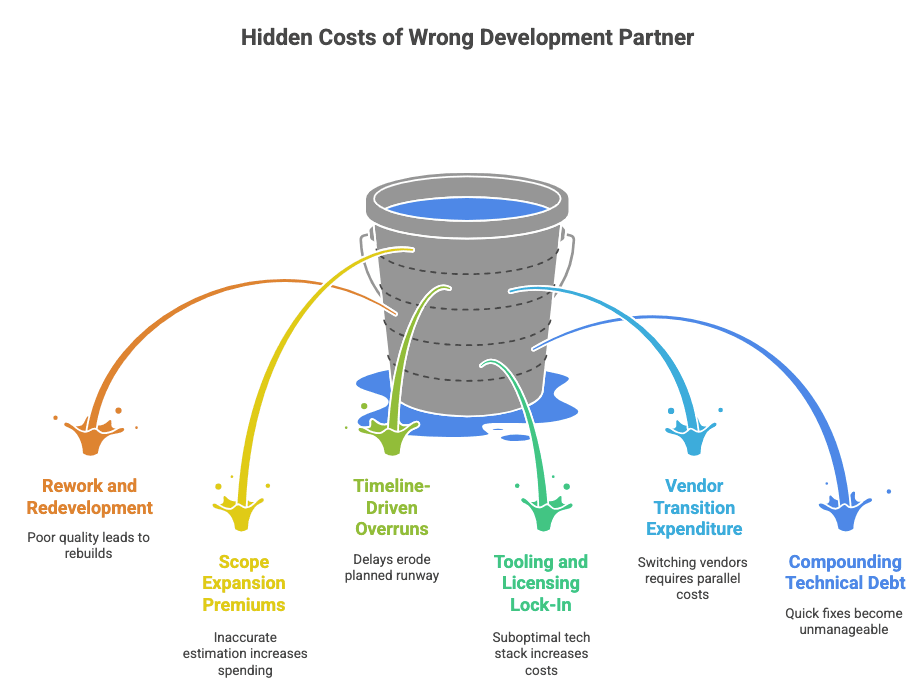
1. Rework and Redevelopment Cycles.
Inadequate requirements capture, poor code quality, or misaligned feature development lead to rebuilds. In U.S. projects where senior engineering rates can exceed $150–$200/hour, a four-week rework sprint can consume $100,000+ in additional budget. The cost multiplies when refactoring affects core modules such as authentication, payment gateways, or integrations with third-party APIs.
2. Scope Expansion Premiums.
Inaccurate estimation during discovery forces scope changes mid-project. In time-and-materials models, each added sprint can increase total spend by 10–15%, especially when additional infrastructure (cloud hosting, database scaling) is required to accommodate new functionality.
3. Timeline-Driven Cost Overruns
Every month of delay in a product launch can trigger extended payroll for internal teams, prolonged infrastructure usage (AWS, Azure, or GCP), and higher vendor billing. For a venture-funded startup, a three-month delay can erode planned runway by 20–25%, shifting fundraising timelines.
4. Tooling and Licensing Lock-In
Suboptimal tech stack choices—such as selecting enterprise frameworks or databases without evaluating the long-term cost of ownership—can result in annual licensing bills in the tens of thousands. Migrating later incurs downtime and reintegration costs.
5. Vendor Transition Expenditure
Switching vendors midstream requires parallel run costs: codebase audits, new onboarding cycles, and duplicated infrastructure during migration. In high-complexity builds (ERP, healthcare platforms), this phase alone can consume 15–20% of the original budget.
Hidden Costs & Fail Stories: What Nobody Tells You
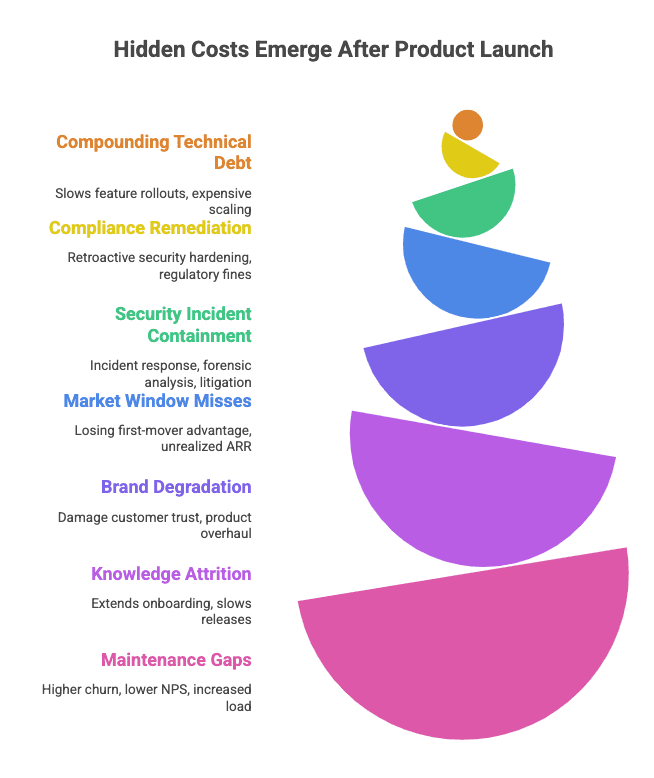
These costs are not line items during the build but emerge over time as the product scales, markets evolve, or compliance rules tighten. They often exceed the original build budget.
1. Compounding Technical Debt:
Quick fixes and minimal viable architecture can balloon into unmanageable technical debt. A poorly structured microservices environment, for example, can increase deployment times from minutes to hours, slow feature rollouts, and make scaling prohibitively expensive. Addressing accumulated debt in a live system can require multi-quarter engineering efforts.
2. Compliance Remediation in Regulated Markets
Failure to embed U.S. compliance requirements like HIPAA (healthcare), PCI-DSS (payments), or CCPA/CPRA (data privacy) from day one often results in post-launch audits, retroactive security hardening, and in some cases, regulatory fines. Corrective work frequently costs 1.5–2x more than proactive compliance integration.
3. Security Incident Containment
A vulnerability exploited in production triggers costs well beyond patching—incident response teams, forensic analysis, customer notification requirements, and potential litigation. Average breach containment in the U.S. can exceed $9 million (IBM Cost of a Data Breach Report, 2023).
4. Market Window Misses
In competitive verticals such as on-demand delivery or fintech, missing a seasonal or regulatory launch window can mean losing first-mover advantage. For subscription-based models, even a two-month delay can translate into millions in unrealized ARR.
5. Brand Degradation and Recovery Spend
Performance bottlenecks, downtime, or UX flaws damage customer trust. Recovery requires coordinated marketing, user engagement incentives, and product overhaul—costing 1.5–3x more than delivering quality upfront.
6. Institutional Knowledge Attrition
When vendor engineers rotate out without detailed technical documentation, internal teams inherit incomplete knowledge. This can extend onboarding for new developers by weeks, slowing subsequent releases and increasing dependency on the original vendor.
7. Post-Launch Maintenance Gaps
Absence of a structured support SLA leads to reactive firefighting—critical patches delayed, integrations breaking after upstream changes, and security updates missed. The cumulative effect is higher churn, lower NPS, and increased operational load on in-house teams.
Critical U.S. Risks Every Software Development Project Must Address
Developing software for the U.S. market comes with unique operational and regulatory challenges that can significantly influence cost and delivery outcomes. Based on our experience, these are the critical risks to address upfront:
1. Regulatory Compliance Complexity
Laws like CCPA/CPRA (data privacy), HIPAA (healthcare), and PCI-DSS (payments) require compliance from the first line of code. Delaying compliance integration often results in extensive post-launch remediation, re-architecture, and potential penalties.
2. Intellectual Property (IP) Ownership
U.S. IP laws demand clear “work-for-hire” agreements, code assignment clauses, and repository control. Without these, disputes over ownership can delay funding rounds or product launches.
3. High Labor and Operational Rates
U.S.-based senior engineers often bill $150–$200/hour. Any inefficiency in planning, scope management, or vendor productivity has a magnified budget impact compared to offshore markets.
4. Data Residency and Security Posture
For sectors like finance, defense, or healthcare, data residency in U.S.-based servers is often a regulatory necessity. Non-compliance risks contract terminations and legal exposure.
5. Export Control and Technology Restrictions
Certain technologies—such as encryption in defense-adjacent software—fall under U.S. export control laws, requiring additional review and licensing before deployment.
6. Timezone Coverage and Communication Overlap
U.S. product teams expect a minimum of a 4-hour workday overlap. Insufficient overlap slows decision-making and escalates coordination costs in multi-timezone teams.
7. Litigation and Contractual Liability
U.S. contracts often include stricter liability clauses, performance warranties, and termination rights. Misunderstanding these terms can lead to expensive disputes or loss of revenue continuity.
The True Cost of Choosing the Wrong Software Development Partner
The financial impact of a wrong development partner compounds quickly in the U.S. market due to higher labor rates, tighter compliance requirements, and shorter market cycles. Below is an illustrative estimation based on typical mid-sized product builds (e.g., MVP to V1 stage):
Scenarion 1 | Direct Vendor Costs | Opportunity Loss | Total Potential Impact |
|---|---|---|---|
Rework due to poor code quality (4-week senior engineering sprint at $175/hr) | $112,000 | N/A | $112,000 |
3-month launch delay (extended vendor + infra + internal team costs) | $150,000 | $200,000 in missed revenue window | $350,000 |
Compliance remediation (HIPAA, PCI-DSS post-launch) | $80,000 | Risk of $50,000+ in fines | $130,000+ |
Security breach containment (incident response, patching, legal) | $100,000 | $250,000 in churn and recovery marketing | $350,000 |
Vendor transition mid-project (audit, onboarding, code stabilization) | $75,000 | $50,000 in delay-driven opportunity loss | $125,000 |
Downtime during critical season (e.g., e-commerce Black Friday) | $20,000 | $180,000 in lost sales | $200,000 |
The financial impact of a misaligned development partnership can escalate to two or three times the original budget. These aren’t the overruns captured in initial forecasts; they are unplanned losses that emerge when delays, rework, and missed opportunities align.
Choosing the Right Software Development Company in the USA: What to Look For and Why It Matters
Selecting the right software development company for the U.S. market means choosing a team that understands local performance standards, regulatory requirements, and delivery expectations. Based on our experience, here’s a clear framework to help you make that choice.
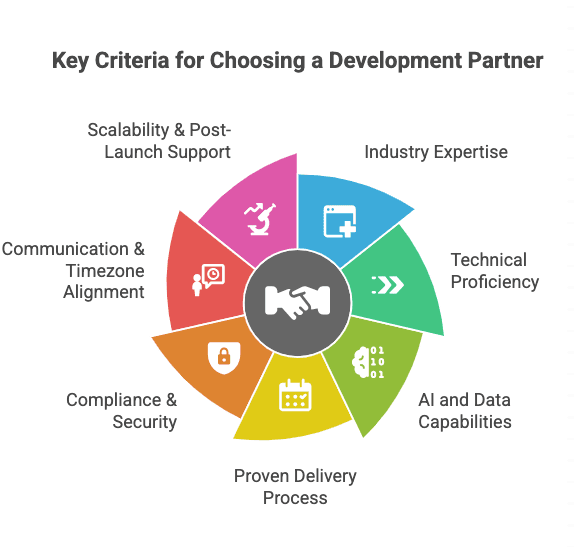
1. Industry Expertise
A partner should have verifiable experience in your sector, whether healthcare, fintech, retail, or SaaS. For example, a healthcare-focused partner should be fluent in HIPAA compliance, electronic health record (EHR) integration, and secure patient data handling.
2. Technical Proficiency & Tech Stack Versatility
Look for mastery in the latest frameworks and languages relevant to your project, as well as adaptability to integrate emerging tools. This includes cloud-native architecture (AWS, Azure, GCP), modern front-end frameworks (React, Next.js), and mobile platforms (Flutter, React Native).
3. AI and Data Capabilities
The best partners integrate AI models and analytics pipelines where relevant—whether it’s embedding predictive analytics in an e-commerce platform or leveraging natural language processing in a customer support tool.
4. Proven Delivery Process
Partners should offer a well-defined delivery model—Agile or hybrid—backed by transparent reporting, sprint tracking, and stakeholder alignment. U.S. clients expect clear visibility into progress and the ability to pivot based on market or user feedback.
5. Compliance & Security Competence
A U.S.-ready partner must have in-house compliance expertise for CCPA/CPRA, HIPAA, PCI-DSS, and SOC 2. Security best practices—such as secure code reviews, penetration testing, and DevSecOps pipelines—must be baked into delivery.
6. Communication and Timezone Alignment
Ensure at least 4 hours of working-day overlap to support real-time decision-making. Strong English communication skills, structured meeting cadences, and documentation standards are essential for clarity.
7. Scalability & Post-Launch Support
Look for partners with proven scale-up capability, adding specialized engineers, expanding cloud resources, and supporting growing user loads without disrupting service. Post-launch maintenance SLAs should cover performance monitoring, bug fixes, and feature iteration.
Comparing Fixed-Price and Time & Materials Contracts
The table below highlights the core differences between fixed-price and time-and-materials contracts to help you choose the model best suited for your project.
Factor | Fixed-Price | Time & Materials (T&M) |
|---|---|---|
Ideal For | Well-defined scope with stable requirements | Projects where the scope may change or evolve |
Risk Profile | The vendor bears more risk if the estimates are inaccurate | The client carries more risk if the project takes longer |
Cost Control | Pre-agreed lump sum, easy to budget | Costs vary based on actual time and resources used |
Flexibility | Limited—changes need formal approval and revised contracts | High—scope can adapt during the projec |
Duration | Typically shorter with set milestones | Can extend as needed until goals are me |
Management Style | Heavy upfront planning and documentation | Ongoing planning with iterative adjustments |
Client Involvement | Lower after the scope is agreed | Higher, with active participation throughout |
Smart Strategies to Prevent Hidden Software Development Costs
Managing app development costs starts with foresight. The most effective way to prevent budget surprises is to address potential risks before they surface. The strategies below focus on building with precision, ensuring resources are used efficiently, and keeping costs under control from the very first sprint.
Expert-Level Tactics to Avoid Hidden Costs
1. Anchor the Project in a Lean Discovery Phase
Conduct rigorous requirement workshops and stakeholder interviews. A disciplined discovery process can cut later rework by at least 20–30% by clarifying feature intent and aligning expectations, saving time and budget.
2. Use Transparent Estimation and Change Management Protocols
Apply modular estimates (per feature or sprint) and enforce strict change-request policies. This provides visibility into cost implications before new work is accepted or scoped—instead of after it has already been done.
3. Integrate CI/CD & Automated Testing Early
Automate integration, testing, and deployment pipelines. Projects that introduce CI/CD from the start reduce post-launch bug fixes by as much as 30%, lowering long-term maintenance load.
4. Embed Compliance & Security Engineering Upfront
Build regulatory and security requirements into architecture design (e.g., HIPAA, PCI-DSS, encryption). This approach cuts rework and post-release audit costs by 1.5–2×, compared to retrofitting them after deployment—especially critical in the U.S. market.
5. Prioritize Feature Phasing with ROI-Based Planning
Sequence work using a phased MVP+ approach—delivering core value first. Delaying secondary features ensures resources go to the highest impact areas, reducing wasted effort and enhancing time-to-market.
6. Standardize Documentation & Knowledge Transfer
From day one, maintain living documentation, runbooks, code comments, and onboarding guides. This cuts transition and training overhead, particularly during vendor handoffs or personnel changes.
7. Govern with Real-Time KPIs & Stage-Gate Reviews
Use measurable project thresholds (e.g., code quality score, defect rate, achievement of functional milestones) as go/no-go indicators. This prevents drift into unplanned scope creep and budget bloat.
What is Your Recovery Strategy If the Partner Isn’t Working Out?
When a development partner fails, the instinct is often to cut ties immediately. But abrupt exits without a structured plan can create more damage than the initial misstep. Recovery requires a disciplined approach, balancing technical stabilization with business continuity, so you regain control of the project while minimizing further loss.
A Structured Recovery Roadmap
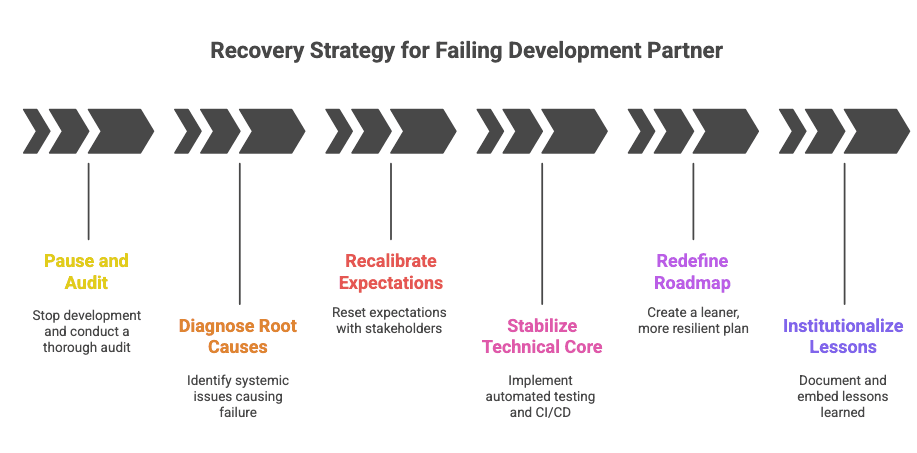
1. Pause and Audit Before Moving Forward
Stop new development temporarily and conduct a rapid but thorough audit. This includes a code review for quality and maintainability, backlog assessment, sprint velocity analysis, and compliance checks. The objective is to establish a factual baseline, not assign blame. Without this visibility, any next step risks amplifying failure.
2. Diagnose the Root Causes
A struggling project rarely fails from one issue—it’s often a mix of misaligned requirements, skill shortages, weak project governance, or overlooked risks. Identifying systemic versus isolated problems is critical. For example, recurring defects point to poor QA pipelines, while unclear acceptance criteria indicate process gaps at the product management level.
3. Recalibrate Expectations and Communicate Clearly
Once issues are mapped, leadership must reset the conversation with stakeholders—executives, investors, or customers. This means revisiting scope, timeline, and cost with realistic projections. Many successful turnarounds begin with narrowing focus: launching a stable MVP first, then layering additional features once stability is achieved.
4. Stabilize the Technical Core
Before introducing new features, protect what exists. Set up automated testing, implement CI/CD pipelines, and harden infrastructure against outages or breaches. Stabilization ensures that every incremental change adds value without risking regression. Think of this step as laying down scaffolding around a damaged building before repairs begin.
5. Redefine the Roadmap and Execution Model
Recovery isn’t about recreating the old plan—it’s about creating a leaner, more resilient one. Re-sequence features by business priority, assign clear ownership for deliverables, and introduce stage gates tied to quality metrics. In some cases, this may also mean bringing in an external audit team or onboarding additional engineering talent for critical areas.
6. Institutionalize Lessons Learned
After stabilization, the real value lies in ensuring the same mistakes aren’t repeated. Conduct a structured retrospective, document lessons, and embed them into governance models. This can include strengthening vendor selection criteria, adopting stricter compliance checklists, or revising escalation protocols for early warning signals.
At GeekyAnts, we believe great partnerships are built on clarity, accountability, and execution. Our teams blend deep technical expertise with business-first thinking, enabling clients in the U.S. to innovate with confidence and scale without disruption.
Kunal KumarChief Revenue OfficerWhat Makes GeekyAnts a Trusted Technology Partner for U.S. Enterprises
GeekyAnts stands out as a trusted software development partner in the U.S. and globally, thanks to our AI-first approach, deep industry knowledge, and scalable architecture that delivers measurable impact.
Showcase of Impactful U.S.-Embedded Case Studies
- Pepperfry Design System: Collaborated with this prominent U.S. e-commerce brand to build a design system that achieved 100% responsive layouts across five screen sizes, boosted design consistency by 80%, and slashed design time by over 300 hours.
- IoT Healthcare for Athletes & Amputees: Developed connected healthcare solutions using Flutter, delivering real-time hydration monitoring and clinician dashboards that drive personalized care for U.S. users.
- Fact-Checking Platform (Repustar): Built an AI-powered editorial tool for a U.S.-based benefit corporation to counter misinformation. Our solution structured fact discovery through scalable data pipelines and interactive review workflows.
- North American Payments App: Engineered a mobile-first subscription and global payments platform for a U.S. client, processing over 400 million transactions annually with 120,000+ active users—leveraging scalable architecture, seamless compliance, and precise milestone delivery.
Why U.S. Clients Choose Us
- AI-Driven, User-First Design: We build intuitive products grounded in AI-powered insights and human-centric design.
- Scalable Architecture & Proven Processes: Whether it is cloud-native builds or component libraries, our systems are built to grow with demand, efficiently and reliably.
GeekyAnts anticipated challenges before we even did and delivered clean, high-performing code that exceeded expectations.
Kunal KumarChief Revenue OfficerLet’s Build What’s Next, Together
At GeekyAnts, we collaborate with U.S. businesses to design, build, and scale digital products that create lasting impact. From AI-driven innovation to enterprise-grade platforms, our dedicated development teams bring global expertise with a deep understanding of local business needs.
Talk to our experts today and take the first step toward your next success story.
Conclusion
In the U.S. market, where speed, compliance, and innovation define competitiveness, the right development partner is not simply a vendor but a strategic ally. From safeguarding investments to accelerating product launches, the right choice ensures every dollar spent translates into measurable outcomes, scalability, security, and customer trust. Businesses that align with proven partners set themselves apart, gaining the agility to adopt emerging technologies while staying grounded in reliability.
The takeaway is clear: success in digital transformation comes down to who you build with. The right partner doesn’t just deliver software, they deliver long-term business advantage.
FAQs
1. What are the hidden costs of hiring the wrong software development partner in the USA?
Hidden costs often show up as delays, poor code quality, constant rework, compliance gaps, or expensive team replacements. These don’t appear in the initial budget but can double or triple the total spend once projects go off track.
2. How much money can you lose by choosing an inexperienced app development team?
On average, businesses can lose 2–3x the original budget. Beyond direct costs, there’s also the opportunity loss of delayed launches, missed revenue windows, and reduced investor or customer confidence.
3. What should I ask before hiring a development company in the USA?
Ask about their industry expertise, case studies, tech stack capabilities, team size, compliance standards, and communication model. The right partner should give you clarity on costs, timelines, and risks upfront—not vague assurances.
4. How can I recover from a failed app development project?
Start by pausing new work and auditing the current state. Identify root causes, reset expectations with stakeholders, stabilize the technical foundation, and redefine a leaner roadmap. If needed, bring in an experienced partner to regain control.
5. What are the top red flags when choosing a dev partner for U.S.-based projects?
Watch out for vague contracts, lack of transparency in pricing, limited experience with U.S. compliance standards, no proven case studies, and poor communication practices. These are early warning signs of potential failure.