

Key Takeaways:
- Nearly 60% of health systems plan to boost RCM software spend, reflecting the urgent need to automate denial management, charge capture, and complex claims processing.
- Agentic AI and predictive models can cut cost-to-collect by 30–60% and reduce denials by ~18–30%.
- The most effective denial avoidance starts before claims are filed. Advanced platforms engineer predictive denial-scoring and rule-based checks into eligibility, registration, coding, and prior-authorization workflows.
- Modern RCM must be built for HIPAA/GDPR audits from day one. Production-ready platforms enforce fine-grained API access, encryption, audit trails, and RBAC/ABAC controls.
Each of these insights – drawn from leading industry analyses and case studies – will be explored below as we outline a practical framework for moving beyond RCM AI pilots to fully operational platforms.
Why Revenue Cycle Management Healthcare Platforms Must Move Beyond AI Pilots
Healthcare organizations are under growing financial pressure to modernize revenue cycle operations as payer complexity, denial rates, administrative costs, and reimbursement delays continue to rise. According to industry research from Bain & Company and McKinsey, healthcare providers are increasing investments in AI-enabled operational platforms, particularly across claims processing, coding automation, and denial management workflows.
At the same time, denial pressure is becoming a major operational challenge for providers. Industry studies show that claim denial rates continue to rise annually, while a significant percentage of denied claims remain unrecovered due to fragmented workflows, inconsistent documentation, and slow appeals processes. For health systems operating on thin margins, even small inefficiencies in coding accuracy or eligibility verification can create substantial downstream revenue leakage.
This guide is designed for VP Engineering leaders, CIOs, digital transformation teams, and healthcare operations executives evaluating how to move from isolated RCM AI pilots to production-ready revenue cycle management platforms. Rather than focusing on AI hype, this article provides a practical framework for building scalable RCM systems that support denial prevention, coding accuracy, workflow automation, payer integration, audit readiness, and smarter billing operations.
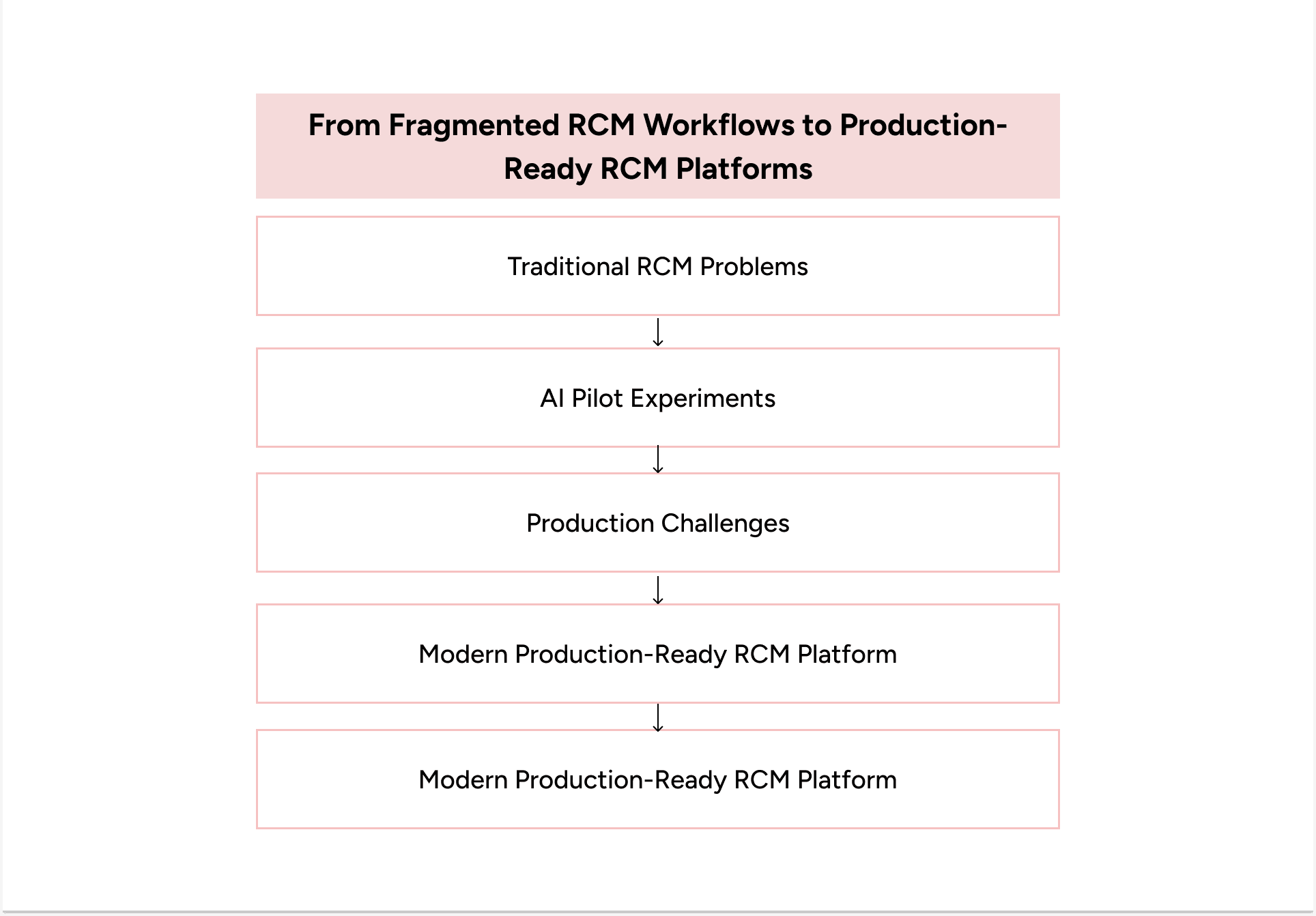
Why Do Revenue Cycle Management AI Pilots Fail to Scale Into Production Platforms?
Many health systems launch RCM AI pilots (denial prediction, coding automation, etc.) only to see them stall before enterprise deployment. Common blockers include fragmented data, siloed workflows, and a lack of integration. For example, an RCM AI demo might flag potential coding errors, but without embedding that capability into the claims workflow (with live EHR/EHR feeds, payer APIs, and analytics), it remains a standalone tool.
Practically, scaling from pilot to production means transitioning from “proof of concept” to “platform engineering.”
Bain & Co. notes the common mantra – pilot, prove, scale – and warns that true scale requires rethinking architecture. Pilot projects often emphasize model performance but neglect engineering needs like data pipelines, APIs, and operational monitoring. In practice, production-readiness signals include: full integration with existing EHR/PM systems, real-time event-driven processes, version-controlled models and code, continuous data feedback loops, and measurable KPIs (denial rates, AR days, etc.) across live claims.
Put simply, RCM is a workflow and data problem as much as an AI problem. Cutting-edge models alone won’t reduce write-offs unless embedded in a cohesive platform that routes patient, billing, and payer data through shared logic and standard interfaces. Industry experts confirm this: “With clear, quantifiable outcomes such as improved denial overturn rates, accelerated AR, or reduced task times, you can translate pilot momentum into enterprise transformation”.
Critically, our target readers – VP Engineering, RCM leaders, and CIOs – know that healthcare billing is highly interconnected. A denial-prediction pilot might flag 20% of claims as “high-risk,” but unless that system automatically feeds back to coders, schedulers, and billing staff via operational alerts, the insights don’t change behavior. In our experience, production-scale RCM solutions succeed by treating AI models as one component of an automated workflow platform, not as a flashy add-on.
In the pilot phase, we saw promising denial-score accuracy, but to really move the needle, we had to rework our data architecture – stream patients from registration through claims, feed denials back into our model loop, and integrate with the billing engine. Only then did our efficiency jump.
 Kunal KumarChief Revenue Officer
What Does a Production-Ready Revenue Cycle Management Platform Architecture Look Like?
A robust RCM platform for healthcare has multiple modular layers that span the front-end patient journey to back-end revenue operations. Below is a high-level reference architecture that such systems typically include:
- Data Ingestion Layer: Real-time intake of patient demographics, clinical codes, and financial data. This often leverages FHIR/REST or HL7 feeds from EHR/EMR systems, as well as APIs from payer portals and clearinghouses. In practice, this means connecting to sources like Epic/Cerner via FHIR or HL7, and to clearinghouse eligibility (270/271) and claim (837) endpoints.
- EHR/EMR Integration: APIs or FHIR interfaces that pull encounter details, diagnoses, and provider notes. A modern RCM platform may include its own FHIR server (e.g., HAPI FHIR) to ingest clinical data and run AI-driven coding suggestions within the workflow.
- Eligibility & Benefits Verification: Automated checks via X12 270/271 or FHIR InsurancePlan/EligibilityResources. This module flags coverage gaps or missing authorizations before services are scheduled, ensuring claims have a valid payer path.
- Prior Authorization Workflows: Digitized PA processes, often using HL7/Da Vinci PAS or custom APIs. Integrations with payer APIs allow end-to-end tracking of auth requests in the platform.
- Charge Capture & Coding/CDI Support: NLP-powered charge capture and coding modules. These use clinical notes to suggest ICD-10/CPT codes (with confidence scoring), and flag documentation queries. However, they feed into “human-in-the-loop” review queues so that coders can accept or correct suggestions (for traceability and audit compliance).
- Claims Validation & Submission Engine: Rule-based and AI-enhanced claim scrubbing. This applies payer-specific edits, syntax validation, and duplicate checks before filing. Integrations include HIPAA 837 outbound EDI, as well as X12 835/ERA inbound for remittance reconciliation.
- Denial Prediction & Prevention: Machine-learning models score each claim pre-submission for denial risk. High-risk claims can trigger preemptive actions (e.g. secondary review, patient follow-up, correction). This upstream approach – an essential shift – makes “denials management” a front-end check rather than a late-stage cleanup.
- Appeals Workflow: For inevitable denials, the platform routes cases into an automated appeals process. AI tools can suggest denial reversal strategies, but appeal decisions remain under coder oversight.
- Payment Posting & Reconciliation: Automated intake of insurance and patient payments (via X12 835/EOB or APIs). This module matches remittances to claims, identifies underpayments (sometimes via AI contract-compliance tools), and posts balances to patient accounts.
- Analytics & Reporting: Dashboards and BI services that correlate operational metrics (e.g. first-pass acceptance, AR days, denial root causes) with financial outcomes. Modern platforms use data warehouses or data lakes to aggregate multi-channel inputs, enabling executive-level revenue intelligence.
- Security, Access Control & Audit: Built-in compliance at every layer. Production RCM platforms enforce OAuth 2.0/OpenID Connect authentication, RBAC/ABAC controls, TLS encryption, and full audit logs. Every claim edit or code change is time-stamped, creating a complete trail for HIPAA audits and payer disputes.
- Observability & Workflow Monitoring: Production RCM platforms require centralized monitoring across APIs, claim workflows, model performance, payer response latency, and operational exceptions. Engineering teams typically implement distributed logging, tracing, alerting, and workflow observability tools to ensure SLA compliance and reduce operational bottlenecks.
In every RCM platform project we have taken on, the first instinct from the client side is to lead with the AI component. Our approach has been to define how data moves through the system first, where it stops, who reviews it, and how the results return to the workflow. Building the AI layer on top of that structure is what allows the platform to hold when claim volumes grow.
 Manav GoelPrincipal Technical Consultant.
RCM platform architecture projects surface integration challenges that are easy to underestimate at the planning stage. On one engagement, the client had mapped out a clean architecture on paper, but the EHR data coming into the billing workflow was inconsistent across departments due to years of system customization. The inconsistency was not visible until claims began failing several weeks into the project. From that point forward, we made a dedicated data normalization layer between the EHR and the RCM platform a standard part of every delivery.
Importantly, production-grade RCM platforms are API-first and event-driven. All modules communicate through secure APIs (often with GraphQL or REST gateways) and message queues (Kafka, etc.) for asynchronous workflow orchestration. This microservices approach ensures each layer – from eligibility checks to coding engines – can scale independently and be updated without monolithic downtime. The diagram below illustrates a sample architecture of an RCM platform (courtesy ScienceSoft), showing front-end interfaces, API gateways, FHIR server, and back-end modules integrating with external systems:
In practice, every production RCM system must also accommodate the US market’s complexity: both professional and institutional claims, multiple payers’ business rules, layered benefits, and evolving regulations (e.g., CMS’s FHIR mandates for eligibility and prior authorization). Therefore, architecture must be modular and configurable. For instance, we often build support for HL7 837 institutional vs. professional claims, tiered benefits, and flexible EOB reconciliation – all as pluggable components.
The biggest challenge in scaling RCM platforms is not building a denial model — it’s orchestrating workflows across EHRs, payer APIs, coding systems, and operational teams without creating latency or audit gaps. In our experience, production-ready healthcare platforms succeed when interoperability, workflow automation, and observability are treated as architectural priorities from day one.
 Kumar PratikFounder & CEO
How Do Revenue Cycle Management Healthcare Platforms Reduce Denials Before Claim Submission?
“Prevention > cure” in RCM. Denial avoidance starts well before claims hit the mail. A production-ready RCM platform treats denial prevention as a core workflow, not an afterthought. This means embedding checks and predictions into each earlier stage of the cycle:
- Predictive Denial Models (Pre-Submission): Machine learning models score claims on denial risk using historical denial patterns (payer+procedure rules, coding issues, patient eligibility gaps). High-risk claims can be flagged for coder review before submission. For example, one hospital’s denial-prediction tool cut denials ~19% within 6 months. Industry studies suggest that predictive denial prevention programs can significantly reduce avoidable denials when integrated directly into eligibility, authorization, and claim validation workflows. In practice, we feed thousands of past claims into ML models that learn which diagnoses or combinations trigger denials by specific payers. The model outputs can also drive auto-remediation (e.g. prompt a prior-auth check).
- Rules Engine + AI Hybrid: Many denials are predictable by fixed rules (e.g. missing modifiers, invalid service dates). Platforms should use configurable rules engines alongside ML to catch these. For instance, before final billing, a rule might block an ICD-10 code known to require a particular authorization. AI then handles the fuzzy cases or cross-field anomalies. This hybrid approach combines human knowledge with AI’s pattern-finding.
- Real-Time Alerts for Front Desk/Coders: If a scheduling or registration error is detected – say a policy lapsed or copay not collected – the system sends an immediate alert to intake staff. By interfacing the RCM platform with the registration system, we ensure that payer eligibility and coverage details are verified at check-in. Modern solutions can even present financial responsibility estimates to patients upfront.
- Payer Response Feedback Loop: Once claims go out, payer remittance advice and denial codes are automatically ingested into the platform. Advanced RCM systems loop this data back to refine predictions (“we thought claim X would be denied, and it was for exactly this reason”). Continuous learning ensures models improve over time.
In summary, denial prevention is built into the patient-to-claim journey. Good RCM platforms have denial-avoidance checkpoints at eligibility, authorizations, coding, and claim scrubbing phases. This end-to-end design reflects McKinsey’s observation that providers are moving focus upstream: “…automating denials management today and underpayments tomorrow” as sequential steps, rather than treating denials as a separate cleanup.
How Do Revenue Cycle Management Healthcare Platforms Improve Coding Accuracy and CDI Workflows?
Accurate coding (ICD-10, CPT) is foundational to revenue integrity. AI can assist, but coding accuracy remains a human-in-the-loop problem requiring tight workflow integration:
- NLP Models for Coding Suggestions: Modern RCM systems embed NLP/AI that scans clinical documentation and suggests codes. For example, an AI model might parse an operative note and propose CPT codes or HCC diagnoses. These suggestions come with confidence scores indicating how sure the model is.
- Confidence-Driven Review Workflows: Low-confidence or complex cases are routed to a coder/clinical documentation specialist (CDS) for verification. High-confidence suggestions might still go through a quick audit. The platform tracks reviewer changes, using these corrections to retrain the model. This creates continuous learning loops – each coder’s decision becomes training data.
- Specialty-Specific Rules and Validation: A production RCM system encodes payer and specialty coding rules. For example, if a cardiology code requires a relevant ICD, the platform flags mismatches. Combined with AI, this hybrid ensures AI doesn’t make clinically impossible coding suggestions.
- Documentation Completeness Checks: The platform can also highlight missing documentation needed for accurate coding (e.g., lack of specificity for COPD coding). By integrating with clinical content, it might auto-generate a query for the clinician to clarify. This closes the gap between care documentation and billing needs.
- Human Oversight & Explainability: Crucially, AI code suggestions must be traceable. Each suggestion should link back to the source text or rule so coders can understand “why” a code was proposed. All changes are logged for audit. In fact, we always include a caution in the UI: coders can override AI, and the system logs the rationale.
What to measure?
KPIs like first-pass coding accuracy, coder review time per claim, charge capture rate (how many services were initially missed), claim acceptance rates, and query/audit exception rates are critical. Leading RCM platforms embed dashboards for these. For instance, we typically track “percent of codes changed after AI suggestions” and strive to reduce it as the AI learns.
In essence, coding accuracy becomes a production workflow problem: it’s not just about building a better model, but about end-to-end human+AI processes. As one analyst noted, “Coding accuracy software must integrate with documentation workflows, CDI programs, and payer policy repositories – it can’t just spit out codes in isolation.” By linking CDI, payer policies, and audit feedback into the coding engine, production-ready RCM platforms turn coding into a managed workflow with AI as a smart assistant.
DevOps, MLOps, and Security Engineering for Production-Ready Revenue Cycle Management Software
Building a secure, compliant RCM platform requires rigorous engineering practices. Here are key measures that production-grade solutions implement:
- DevOps for Healthcare: Use Infrastructure-as-Code (IaC) for reproducible environments. Enforce automated testing for each release (including security scans). Maintain immutable container images and deployments. For RCM, this means each update (even a minor rule change) is versioned and can be rolled back or audited.
- MLOps Controls: Models need the same lifecycle rigor. Track model versions and training data snapshots. Implement approval gates for new models or data transformations. For example, if a new denial-prediction model is deployed, keep parallel logs to compare outputs before fully switching it on. This ensures traceability of AI decisions – essential for compliance with emerging AI regulations and HIPAA.
- Encryption & Data Protection: All patient and financial data must be encrypted in transit (TLS 1.2+) and at rest (AES-256). This includes FHIR exchanges, database storage, and analytics platforms.
- Access Control: Adopt fine-grained RBAC/ABAC. For instance, coders see only claims assigned to them; payer API accounts have scoped permissions (read-only for certain transactions). Apply “least privilege” principles. As Edenlab advises, treat security as an architectural principle – an API token should only allow that user’s actions.
- Audit Logging: Every action on a claim (code edit, status change, user login) is logged with the user ID and timestamp. These logs go to an immutable audit trail system. For HIPAA audits or contract disputes, the platform can generate reports of all activity on a given claim or patient file.
- Secrets & Key Management: API keys and database credentials are stored securely (e.g., Vault) with automatic rotation. This prevents credential leakage across services or to external vendors.
- Regulatory Frameworks: Beyond HIPAA/GDPR, RCM platforms must adapt to policies like CMS’s prior auth rule. That means building compliance features into code (e.g., supporting the Da Vinci FHIR C4B, CRD, and DTR Implementation Guides). Automated tests should continuously validate that the platform honors the latest payer rules and regulatory schemas.
- Workflow Observability & Monitoring: Production RCM platforms require centralized monitoring for API latency, payer response failures, claim-processing bottlenecks, model drift, and workflow exceptions. Distributed tracing and operational dashboards help engineering teams maintain SLAs and reduce revenue disruption.
In short, security and compliance engineering closes audit-readiness gaps. By baking in these controls, the platform not only protects PHI but also ensures reliable financial workflows. The result is a system that can survive a health system IT audit or a CMS policy check with minimal last-minute scrambling.
How Can Revenue Cycle Management Platforms Deliver Smarter Billing and Revenue Intelligence?
On one project, we repositioned the denial scoring process to the eligibility verification step, before the encounter reached the coding team. Within two quarters, the client recorded a measurable reduction in front-end denials. The result came from placing the right check at the right point in the process, not from changing the model.
Manav GoelPrincipal Technical Consultant.Denial prevention projects reveal where the real gaps in the revenue cycle sit. On one engagement, the client had invested in a denial prediction tool while eligibility verification at the front desk remained a manual process. The denial rates were not improving because the intervention was placed too late in the workflow. Moving eligibility checks to the scheduling step produced a greater reduction in front-end denials than the prediction tool had achieved on its own. The decision that drove the improvement was about process placement, not technology selection.
Smarter billing goes beyond printing patient statements. It means end-to-end financial visibility and automation:
Claim Status Visibility:
A unified RCM platform tracks each claim through submission, adjudication, and payment. Rather than logging into multiple payer portals, staff see a dashboard of claim statuses. Automated status pulls (via clearinghouse/EHR APIs) feed into the platform in real-time.
Automated Payment Posting & Reconciliation
Connecting to payers (835/ERA feeds) and payment gateways, the system auto-posts payments to accounts. Intelligent matching flags discrepancies (e.g., partial payments or denials) immediately.
Patient Financial Estimates & Statements
By integrating benefits data and contract rules, the platform can calculate patient responsibility up front. It can also send bills and reminders through patient portals or SMS, improving collections and satisfaction.
Underpayment Detection
Advanced platforms use analytics to spot when payers underpay (e.g., payment is $X less than expected by contract). These tools aggregate remittance data and use predictive logic to highlight patterns. A well-known case: a provider uncovered underpayments in orthopedics and renegotiated contracts, boosting margins. RCM intelligence should incorporate that capability.
Payer Performance Analytics
The platform should report on each payer’s denial rate, payment lag, and appeal outcomes. This can drive the negotiation strategy. For example, one large system found that Payer A’s coding-related denial rate was twice Payer B’s – a metric surfaced by unified RCM analytics.
AR Aging and Executive Dashboards
Modern platforms include dashboards showing AR aging buckets, net collection rates, cash forecasts, and key drivers (e.g., top denial reasons). By connecting clinical and financial data, they answer questions like “how did our changes in prior authorization processes improve cash flow?” in real time. Modern revenue cycle management healthcare platforms increasingly function as operational intelligence systems for CFOs and revenue leaders, enabling proactive financial decision-making rather than retrospective reporting.
In essence, a smarter billing solution is a strategic analytics engine as much as an operational system. It synthesizes data from all RCM touchpoints (claims, payments, patient payments) and turns it into insights and automated actions.
Build vs Buy vs Modernize: How Should Providers Approach RCM Platform Strategy?
When upgrading revenue cycle technology, healthcare organizations must weigh several paths:
- Build Custom RCM Platform: Developing in-house offers maximum control and customization. It’s suitable for large systems with unique workflows or those with strong IT teams. However, building enterprise RCM software is complex: costs from ~$40,000 (basic MVP) up to $600,000+, for full-featured platforms. These costs reflect complexities like AI coding modules, integration layers, and compliance features. Building means owning the roadmap, but it requires ongoing resources for maintenance and upgrading.
- Buy a Commercial System (with AI): The market has many RCM products (legacy and newer SaaS). Buying can be faster to deploy and often includes vendor support. However, off-the-shelf solutions may lack specialized features or require costly customization. Vendors may not update as fast as regulations change. Integration challenges can be significant: a hospital CIO once noted that their packaged RCM was “built as a silo” with limited EHR linkage, forcing heavy manual work. Careful vetting is needed to avoid vendor lock-in and ensure interoperability (preferably open APIs and FHIR support).
- Modernize/Extend Legacy Systems: For providers with an existing RCM, a strategic modernization (e.g. re-architecting monolith to microservices, or adding AI modules) can be cost-effective. This avoids “rip-and-replace” disruption. It might involve building an API layer on top of legacy, or connecting best-of-breed AI tools (for coding, denials, etc.) to the existing engine. The Edenlab team advises a phased approach: update one workflow at a time and gradually refactor the stack.
- Best-of-Breed AI Integration: A hybrid route is to keep core billing systems but integrate specialized AI/cloud services for specific tasks (e.g. outsource denials management to a third-party AI service via API). This can deliver quick wins but requires a strong integration layer and caution on data sharing agreements.
For decision-makers (VPs of Engineering/Platforms or CIOs), the choice depends on priorities and constraints. Key considerations:
- Time to value vs control. Buying often wins on speed, building on control.
- Existing infrastructure. A large hospital heavily invested in one vendor’s suite (e.g. Epic) may opt for build/extend to avoid vendor lock, whereas a smaller network might buy.
- Regulatory readiness. If audit/compliance is a huge gap, a custom or modernized platform (with full visibility and logs) may be safer than a black-box tool.
- Budget. Apart from development cost estimates, factor in maintenance (typically 15–20% of initial cost per year). A custom RCM system can avoid recurring license fees but requires skilled staff.
Strategy | Best For | Advantages | Risks |
|---|---|---|---|
Build Custom Platform | Large enterprises with unique workflows | Full control, extensibility | High engineering investment |
High engineering investment | Faster deployment needs | Vendor support, quicker rollout | Vendor lock-in, customization limits |
Modernize Legacy Systems | Existing RCM investments | Lower disruption, phased transition | Integration complexity |
Integrate Best-of-Breed AI | Targeted optimization | Faster innovation | Workflow fragmentation risk |
In practice, many organizations adopt a mix: for example, building a core platform while licensing AI modules, or vice versa. Importantly, this choice must align with a long-term roadmap. The McKinsey report notes that success in RCM AI is as much about people and process as tech. Whichever path is chosen, a clear implementation plan (proof-of-concept to enterprise rollout) and change management strategy will make the difference between pilot purgatory and transformative impact.
Why Choose GeekyAnts for RCM Platform Development in Healthcare?
GeekyAnts is a product engineering and platform modernization partner with deep healthcare expertise. We specialize in turning complex RCM challenges into secure, scalable solutions. Our experience includes:
- AI-Powered Product Engineering: We design and build AI/ML modules for healthcare workflows. From training denial-prediction models to creating human-in-the-loop coding interfaces, we handle both data science and robust integration into your platform.
- Healthcare Application Development: Our teams have delivered compliant apps for providers, ensuring alignment with HL7/FHIR and HIPAA. We emphasize user-centered design for complex tasks (e.g., coder dashboards, clinician queries).
- Enterprise Backend Engineering: We implement microservices and APIs following industry best practices. This includes FHIR API servers, EDI translators (837/835/270/271/278), and real-time event buses to support workflows end-to-end.
- DevOps & Cloud Infrastructure: GeekyAnts builds infrastructure-as-code pipelines (CI/CD) that automate testing, security scans, and compliance checks. We deploy RCM systems on HIPAA-compliant clouds (AWS, Azure, etc.) with multi-region failover to ensure high availability.
- Security and Compliance Engineering: Recognizing that “compliance must be built in”, our development practices enforce encryption, audit logs, scoped access (RBAC/ABAC), and regular penetration testing. We help clients implement the controls needed for HIPAA/GDPR audits and CMS rules.
- AI Strategy and Consulting: Beyond coding, we advise on RCM AI roadmap – identifying high-value use cases, defining success metrics, and selecting build vs partner approaches. We help healthcare leaders assess pilot results and plan their “pilot→production” journey.
- Business Analysis & UX for Complex Workflows: Our experts work closely with revenue cycle managers and clinical staff to map pain points. This ensures that new platforms address real needs (e.g., integrating CDI queries into chart review or designing exception-based dashboards) rather than just flashy tech features.
We have successfully partnered with organizations building AI-enabled healthcare backends and complex operational software. In every project, we emphasize “secure by design” – for example, implementing end-to-end traceability for every billing action. Our clients gain not only software but a strategic advantage: faster reimbursements, stronger revenue integrity, and flexible infrastructure that adapts to new payer regulations.
Kumar PratikFounder & CEOConclusion
Modern healthcare revenue cycle management software demands more than proof-of-concept AI – they require integrated, production-ready platforms. By investing in a well-architected RCM system that embeds denial prevention, coding accuracy, and tight security, organizations can transform revenue cycle challenges into strategic gains. Industry analyses confirm that prioritizing RCM automation yields hard-dollar ROI. As healthcare leaders move from pilots to enterprise scale, the right technology partner – one experienced in healthcare compliance and engineering – can make all the difference.
Sources and Citations
- https://www.bain.com/insights/healthcare-it-global-healthcare-private-equity-report-2024/
- https://www.mckinsey.com/industries/healthcare/our-insights/agentic-ai-and-the-race-to-a-touchless-revenue-cycle
- https://www.mckinsey.com/industries/healthcare/our-insights/healthcare-revenue-cycle-management-at-a-strategic-turning-point-survey-insights
- https://www.hfma.org/ai/why-ai-is-such-a-promising-tool-for-eliminating-a-hospitals-revenue-leakage
- https://www.researchgate.net/publication/389987994_Optimizing_Revenue_Cycle_Management_in_Healthcare_AI_and_IT_Solutions_for_Business_Process_Automation