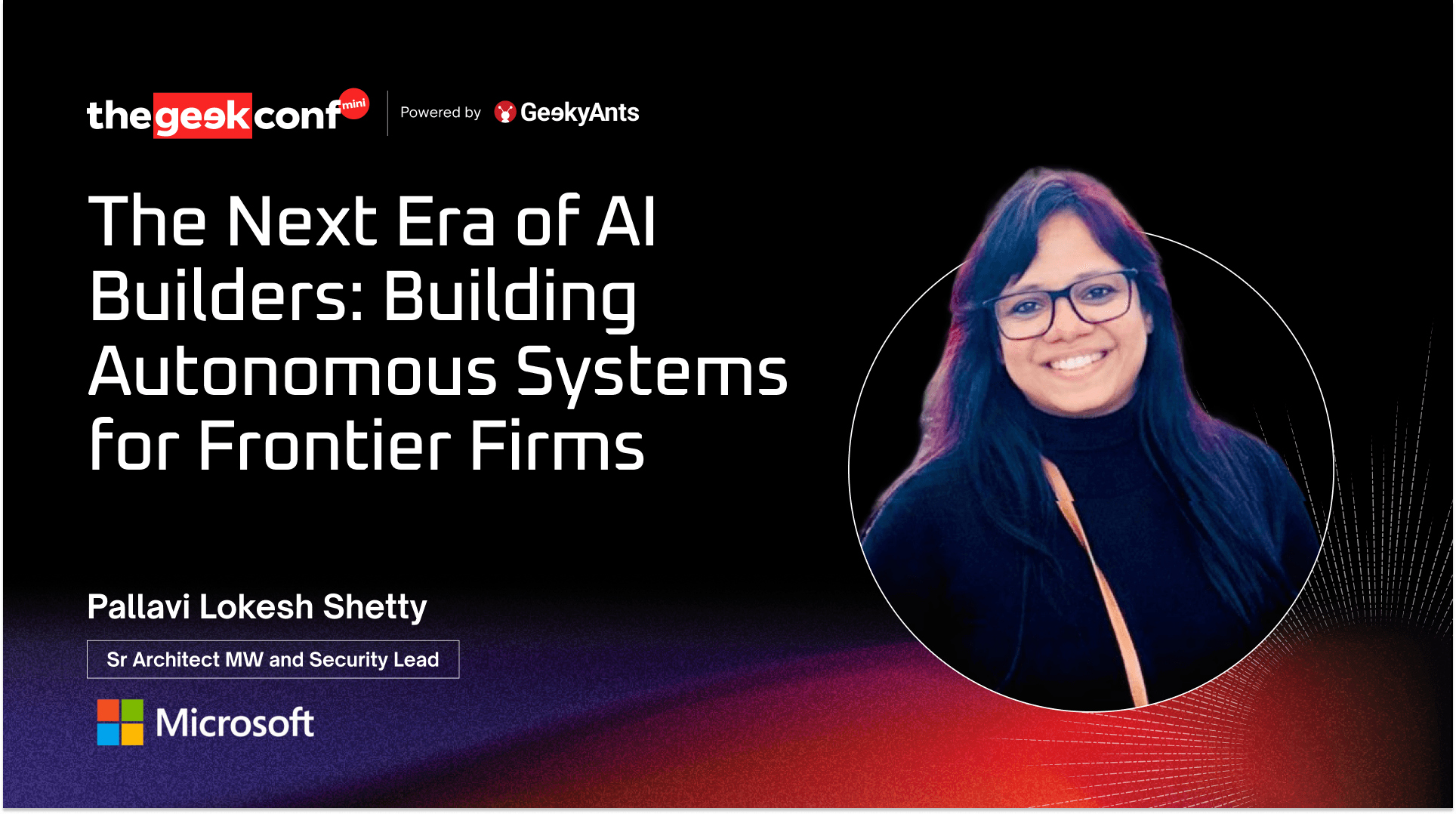

Editor's Note: This blog is adapted from a session by Pallavi Lokesh Shetty at thegeekconf mini 2026. As a Senior Enterprise Architect at Microsoft with experience spanning AI transformation, agent architecture, and enterprise security, Pallavi brings a practitioner's lens to the agent era. Her talk cuts through the hype around AI agents, drawing a sharp line between organizations that use AI to cut headcount and those that use it to amplify human potential, and makes the case for why data quality and agent security, not the agents themselves, will determine who earns the trust to scale.
The Next Era of AI Building
I'll keep it short, but I want to land the key message before I close. It is tough to convey everything I had planned, so I'll skip through parts of the journey. There's a short video I want to play first. Let's see how much of the messaging you catch.
I'm sure you all loved that. With the layoffs we hear about today, the message is clear: AI should add value to every employee and every organization — not replace people. If anyone thinks they can build an AI agent solution and cut 10 employees, they are on the wrong track. That is what I want to land today.
Where We Are Heading
By 2028, we will have about 1.3 billion agents. That is roughly one agent for every six people on the planet. With low-code and no-code tools growing the way they are, that number will likely go even higher.
I engage with customers across IT, banking, the public sector, and manufacturing. All of them are looking at how they can take on AI transformation. The first thing we tell them: leverage what is already available.
We started with "ask me anything," — and everyone has played with that. Even my daughter, when she was stuck on a topic during exams, turned to my husband and said, "Dada, I have a question." He was happy because he loves to teach. She then said, "No, I want your phone — I need to ask ChatGPT." That is the kind of experience we have today for learning any new topic.
We have shifted from "ask me anything" to AI that takes action. Today, in every solution you touch as part of your day job, AI is infused into it. You can prompt and get a full web page built in minutes. When things move at that speed, you need to know where to invest your time and what to understand in depth.
From App-Centric to Agent-Centric Workflows
Let me walk you through the framework we call the Frontier Firm.
We started with humans using AI assistance. Then we moved to human-agent teams. Today, when my manager lists our team of ten, five of those are agents. Humans and agents work together. We are not replacing anyone — we are handing off the mundane and repetitive tasks to agents so humans can focus on higher-value work.
In the next phase — human-led, agent-operated — agents work on their own. For example, an RFP request comes in late evening. Instead of starting on it right then, an agent reads it, pulls information from across the organization, and builds a draft document. By the time you log in the next morning, the report is ready. That is what autonomous agent behavior looks like.
My own org chart at Microsoft reflects this. As a Senior Enterprise Architect, I have a few agents reporting to me — one is my M365 Copilot personal assistant, and there are agents I supervise and agents that assist me.
Scaling AI: Intelligence and Trust
When you want to scale AI, two things matter above everything else.
First: Intelligence. Data matters. Garbage in, garbage out. If you do not feed the right data to an agent, the responses will not meet your expectations.
Second: Trust. Agents are being built at speed and scale — within a single organization, a single employee can build dozens of agents. When that happens, you need security, compliance, and governance in place.
That brings me to Agent 365.
Agent 365 gives every agent a unique identity — similar to an employee ID. It is not a black box. You get a full capture of what every agent does, whether it was built by Microsoft, a third-party application, or on Google or AWS. You get one consolidated, unified view of all the agents across your organization.
The Intelligence Stack: Work IQ, Fabric IQ, Foundry IQ
There are two oceans of data — structured and unstructured. The gap between them is what we are trying to close. Real-time signals and the data generated every minute is enormous. You need an intelligent layer sitting over a data fabric or a unified lake — and that is what drives the agents.
Work IQ is about productivity. It covers every activity you perform — emails, meetings, and collaboration. You do not have to pull that context together by hand. Work IQ understands what you are doing and surfaces the right information. It works like a shadow that knows your work and gives you what you need.
Fabric IQ puts an intelligence layer over structured data. Data across an organization is often in silos. Fabric IQ builds a semantic understanding of all available data and connects it. When a leader asks a question in a conversation, Fabric IQ does not just return data points — it helps make decisions. Think back to the earlier example of someone who was about to lose a deal and saved it because AI unearthed intelligence hidden in disconnected silos. That is what Fabric IQ enables.
Foundry IQ lets you build that intelligence layer from scratch. You bring in data from multiple sources, build a knowledge base, select a model, define the orchestration, and create agents grounded in your organization's knowledge. Every prompt gets split, routed to the right data source, evaluated, sent to an SLM, and refined — so the response is accurate. Those knowledge bases are reusable across multiple agents.
Bringing It All Together: UI for AI
Once you have all this intelligence, you need one interface to surface it. Before the AI era, organizations were drowning in apps and chasing super apps to unify them. Now, the question is: how do you unify the agent experience?
This is where UI for AI and the platform maker come in. The platform maker enables not just pro developers, but citizen developers and business users to build agents themselves.
Here is a trend I see inside Microsoft: earlier, HR leaders and finance leaders would come to us and say, "Can you build an app for me?" Today, they say, "This is what I want to achieve — can you guide me the first time? I want to build it myself from here on." Business users understand their own processes best. They no longer want to brief a developer and wait through cycles. They want to build it themselves.
For organizations that want out-of-the-box SaaS solutions, those are available. For organizations that need agents grounded in domain knowledge — legal, healthcare, or other areas — the pro-code path through AI Foundry lets them select models, build orchestration layers, and create agents from the ground up.
Gartner predicts that 70% of the agents built by 2027 will be built on low-code or no-code platforms. That tracks with what we see — vibe coding is real, and anyone can share a prompt and build an agent.
Copilot Cowork in Practice
Let me show you how this works in a real workflow.
I start my day by asking my Copilot personal assistant what my top priorities are. It gives me a view of what needs attention, what follow-ups are pending, and how to close my day. From that, I identify the five most critical tasks. I hand three of them off to Copilot Cowork — the mundane and repetitive ones. Cowork takes them all at once with a single prompt. I focus on the remaining two.
Cowork is a cloud-based agent powered by Anthropic models. It can send emails — you give it a prompt with the recipients, context, and intent, and it either drafts for your review or sends on your behalf. It can schedule meetings by checking availability across all attendees. It runs on the cloud, so you can hand off tasks, close your laptop, board a flight, and the tasks are done by the time you land.
Inside Copilot Cowork, Opel handles computer use tasks. It spins up a virtual PC and runs tasks the way you would — navigating to a page, capturing screenshots, and storing them in a folder for a compliance audit. Expense reimbursement is another use case: you tell it where the data is, and it builds and submits the expense report on your behalf. Opel stops and asks for human input wherever it determines intervention is needed. Once you provide that input, it continues on its own.
Agent Security
A key takeaway: having a tool and being able to build agents is not enough. Data quality and agent security are critical.
Just as we are empowered to build agents and take a quantum leap with the technology in our hands, bad actors have the same tools. They look for agents and solutions that can be exploited. If security is not in place, you lose trust — and speed without trust is worthless.
Every agent enrolled in Agent 365 gets a unique identity through Entra ID, just like an employee. It has an org chart — its skills, who it reports to, and who else uses it. The same security, compliance, and regulatory rules that apply to employees apply to agents.
When you build agents from the ground up through Foundry or other platforms, you also need to think about token optimization, jailbreak prevention, and the orchestration layer. The orchestration layer pulls information from multiple sources, sends it in one communication to the LLM, receives the processed response, and returns it to the user. Build that architecture right — and build it to scale across all agents in the organization, not just one.
Agent 365 is not limited to first-party agents. Agents built on Google, AWS, or any other platform can be onboarded and given a unique identity — similar to how a contractor gets a vendor ID within an organization. No organization runs on a single platform, and the governance layer needs to reflect that reality.