

For a company building digital products, compliance has to show up in everyday delivery. It affects how teams define responsibilities, handle information, manage changes, respond to incidents, review quality, and improve their processes over time.
GeekyAnts is an AI-powered digital product engineering and consulting company. Its work spans product strategy, design, software engineering, modernization, AI engineering, quality assurance, and managed IT services. Clients may entrust its teams with source code, business information, system access, product requirements, and sensitive workflow data.
GeekyAnts holds three ISO certifications covering quality management, IT service management, and information security: ISO 9001:2015, ISO/IEC 20000-1:2018, and ISO/IEC 27001:2022. Together, they provide an independently assessed foundation for how the company manages quality, services, and information security. These certifications are currently listed on the GeekyAnts Security and Compliance page.
What Does ISO Compliance Mean for an IT and Design Services Company?
ISO develops internationally recognized standards for management systems, processes, and other areas of organizational practice. An ISO certification means that an independent certification body has assessed a defined management system against the requirements of a particular standard.
For an IT or design services company, this is different from certifying a single application, interface, or project. The certification applies to the organization and scope stated on its certificate. It shows that defined policies, responsibilities, controls, records, reviews, and improvement processes are in place for that scope.
These systems influence practical delivery decisions. A design team may need handling rules for research data and prototype access. Engineering teams may need controlled changes, peer reviews, separated environments, and incident procedures. Managed services teams may need defined responsibilities, monitoring, continuity planning, and escalation paths.
Certification does not remove project risk or replace client-specific requirements. It gives the engagement a more disciplined operating foundation.
Which ISO Certifications Does GeekyAnts Hold?
GeekyAnts currently holds three active ISO certifications for its management systems.
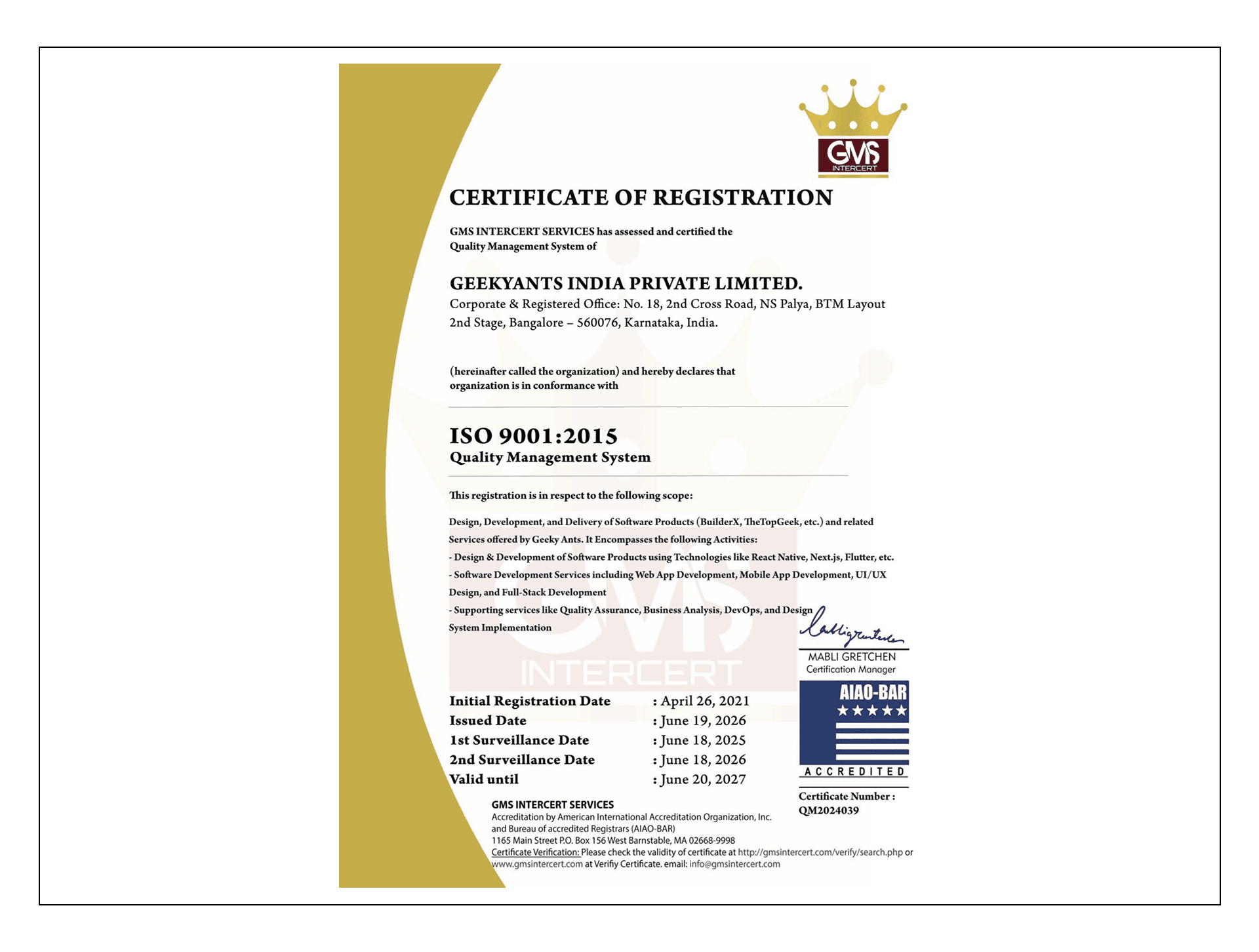
ISO 9001:2015 for Quality Management
ISO 9001:2015 concerns the Quality Management System. At GeekyAnts, this supports defined responsibilities, documented processes, measurement, corrective action, and continual improvement.
For clients, quality management is relevant across discovery, design, development, testing, and delivery. It encourages teams to define deliverables, follow agreed processes, review results, correct problems, and improve future work. It provides a repeatable framework without forcing every project into an identical delivery model.
This is particularly relevant in digital product engineering, where requirements, priorities, and technical decisions may change throughout an engagement. A quality management system provides a structure for recording decisions, reviewing outputs, addressing deviations, and improving delivery processes.
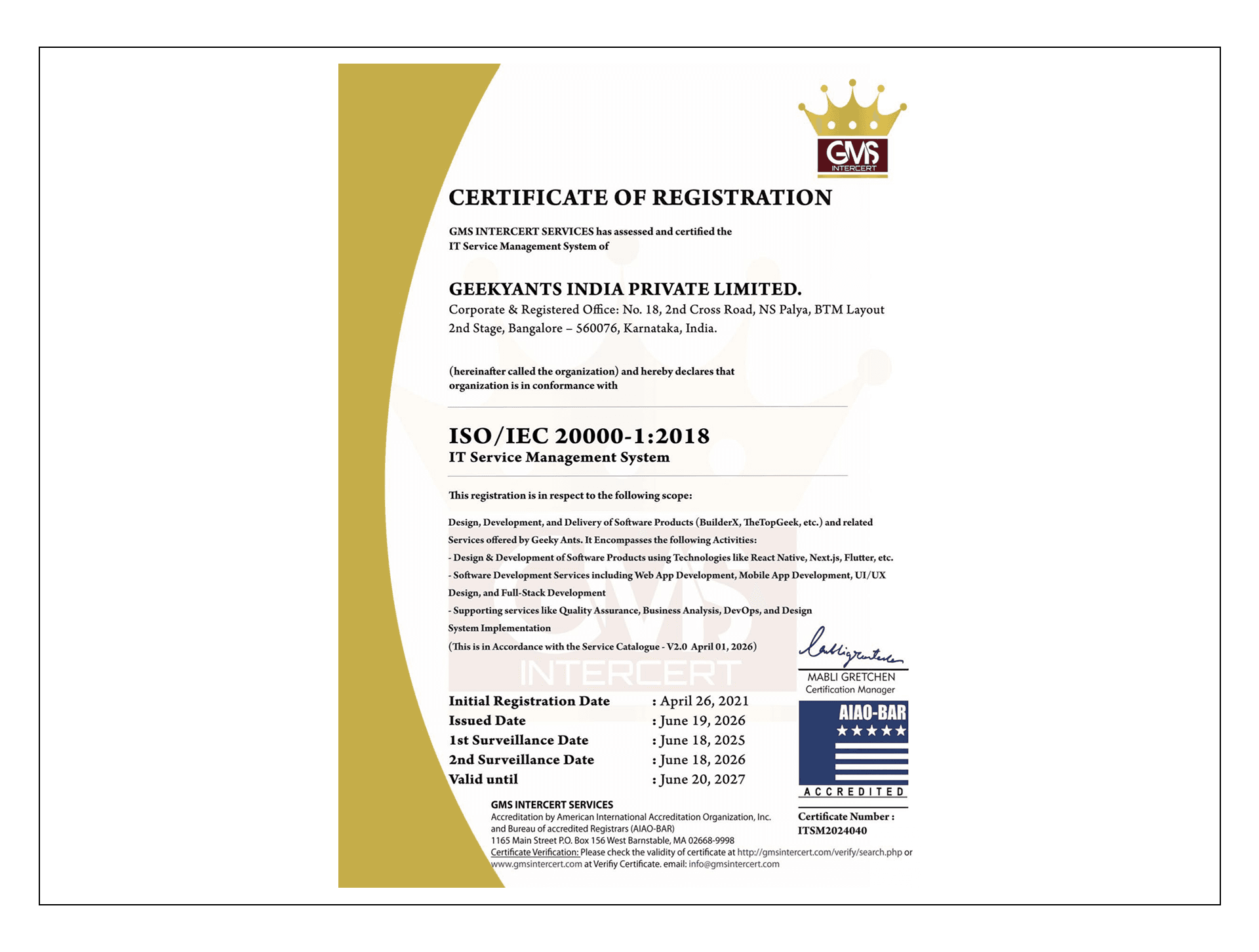
ISO/IEC 20000-1:2018 for IT Service Management
ISO/IEC 20000-1:2018 concerns the IT Service Management System. It covers structured practices for service planning, change management, incident handling, continuity, monitoring, and service improvement.
This matters when an engagement extends beyond building and handing over software. Ongoing support, infrastructure operations, release coordination, and production maintenance require clear ownership. A service management system helps define how teams assess changes, handle incidents, monitor performance, and correct recurring problems.
For clients working with GeekyAnts on managed services or long-term product support, this certification provides evidence of an established approach to IT service delivery. The specific service levels, responsibilities, response times, and continuity requirements still need to be defined within the engagement.
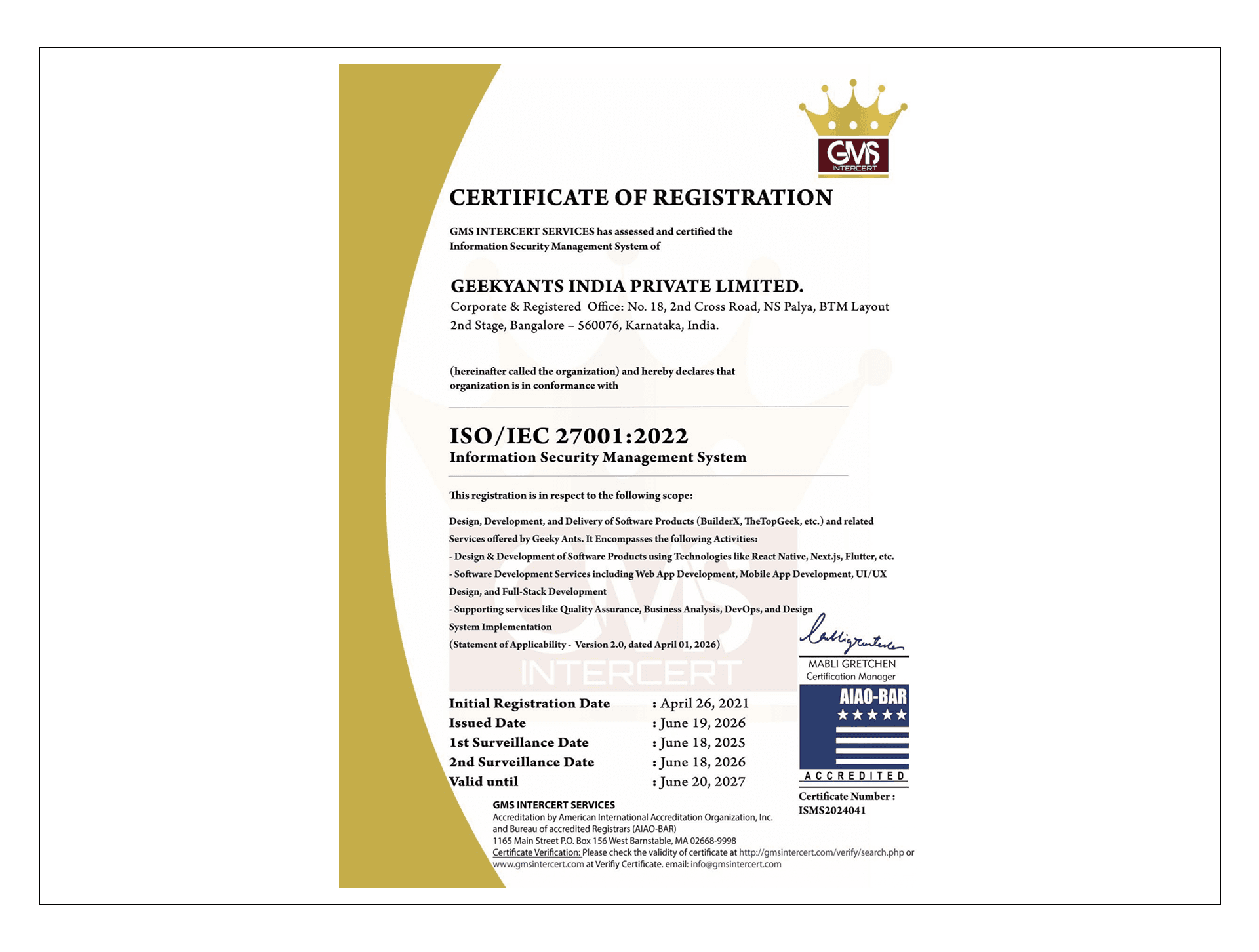
ISO/IEC 27001:2022 for Information Security Management
ISO/IEC 27001:2022 concerns the Information Security Management System. It provides a risk-based structure for protecting information through governance, access controls, incident response, and ongoing control improvement.
That structure is especially relevant to digital product engineering. Teams may work with code repositories, cloud environments, credentials, test data, architecture documents, and proprietary business logic. Information security management helps identify risks, assign responsibility, manage access, maintain procedures, and review controls.
The standard focuses on managing information security risk across people, processes, and technology. It should not be reduced to a claim that a particular tool, product, or cloud platform is secure by default.
What Can Clients Expect From an ISO-Certified Partner?
Clients can expect compliance considerations to enter delivery conversations early. GeekyAnts addresses security and compliance decisions across discovery, design, development, verification, and operations. The precise controls depend on the product, its threat profile, applicable obligations, and the agreed engagement scope.
In practice, an engagement may include:
- Mapping sensitive data, critical workflows, user roles, third-party dependencies, and jurisdictional requirements during discovery
- Designing identity, data, API, infrastructure, logging, recovery, and privacy controls around the product’s risk profile
- Applying peer review, secure coding, dependency checks, separated environments, automated testing, and change controls during development
- Conducting internal security reviews, vulnerability assessments, penetration testing, remediation tracking, and retesting where applicable
- Supporting monitoring, incident handling, resilience, service management, and control improvement during operations
The certifications address connected parts of delivery. Quality processes affect how teams manage requirements and defects. Service management affects changes, incidents, and continuity. Information security management affects how teams govern sensitive information and system access.
Clients should still discuss which controls apply to their product. The resulting requirements should be documented as part of the delivery and operating scope.
Does GeekyAnts’ ISO Certification Make Every Client Product Compliant?
No. GeekyAnts’ certifications cover its management systems within their certified scope. Product-level compliance depends on the product’s business model, data flows, vendors, operating procedures, users, jurisdiction, and contractual scope.
A healthcare application, payment platform, or financial product may need separate regulatory or industry controls. Responsibilities may sit with GeekyAnts, the client, hosting providers, or specialist vendors.
GeekyAnts can design solutions to support applicable standards and regulatory requirements, but the required controls must be identified and agreed upon for the specific engagement. This distinction keeps compliance claims precise and gives both parties a clearer view of ownership.
What Compliance Evidence Can Procurement and Security Teams Request?
Security and procurement reviews often require more than a statement on a website. Subject to confidentiality, applicability, engagement scope, and legal approval, GeekyAnts can support reviews with relevant documentation.
Available materials may include:
- ISO certificate information and applicable scope
- Security and privacy questionnaire responses
- Policy and control summaries
- Architecture, testing, and remediation summaries
- Relevant NDA, data-processing, and contracting documentation
The precise evidence available will depend on the review and proposed engagement.
Clients should share their vendor-risk requirements, data classifications, regulatory obligations, and evidence requests during procurement or discovery. An early review allows both teams to identify ownership, documentation requirements, and possible gaps before development progresses.