
Editor's Note: This article was originally written by Kumar Pratik, Founder & CEO, and published in April 2025. It was reviewed and updated in September 2026 by Sathavalli Yamini, Technical Writer, to reflect developments in Agent-to-Human (A2H) communication, human-in-the-loop controls, agent protocols, and production AI workflows. The core perspective and technical argument from the original article have been retained.
As autonomous agents move into production workflows, protocols are emerging to help agents connect with tools, communicate with other agents, and involve people when human judgment is required. Model Context Protocol (MCP) supports connections between AI applications and external tools and data, while Agent-to-Agent (A2A) supports communication and collaboration between agents.
Yet a critical gap remains: agents need a structured mechanism to involve humans when a workflow requires information, approval, feedback, or escalation.
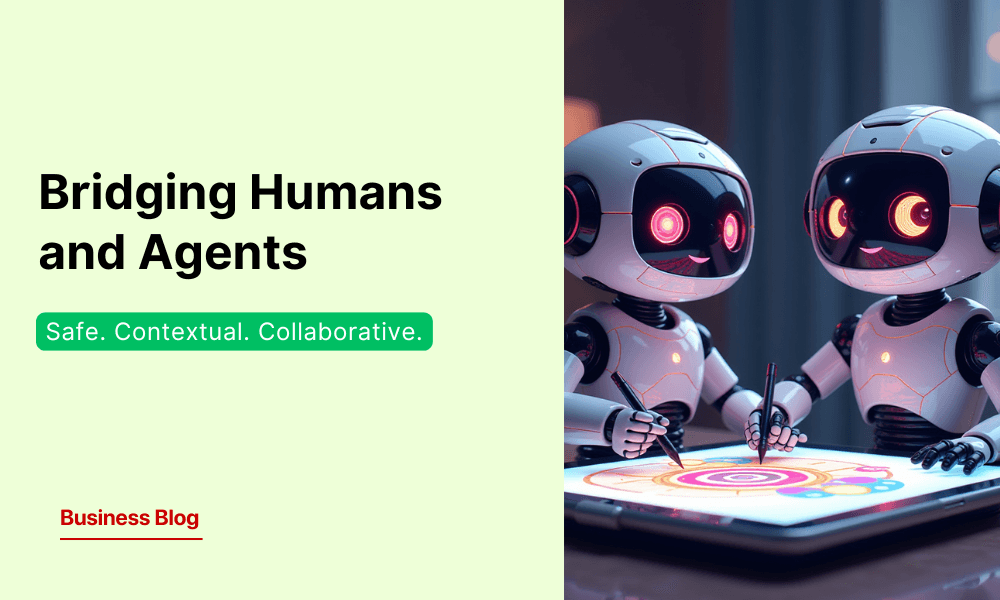
This is where Agent-to-Human Protocol (A2H) comes into play. A2H provides a structured interaction model for communication between AI agents and people, helping teams building AI systems define when an agent can continue within its boundaries and when a human needs to enter the workflow.
Why Do We Need an Agent-to-Human Protocol?
Autonomous agents are great at performing repetitive tasks, generating content, or even coordinating complex workflows. But in many real-world applications, full autonomy is neither possible nor desirable.
Here’s where Human-in-the-Loop (HITL) becomes critical.
Scenarios where HITL is necessary:
- Sensitive actions: Agents proposing financial transactions, legal changes, or irreversible updates.
- Low confidence: When the agent isn’t sure of its decision or prediction.
- Creative ambiguity: Design, writing, or ideation tasks that require human judgment.
- Learning feedback: To fine-tune agents or reinforce positive behavior.
- Auditing and compliance: Ensuring every major decision has a human approval trail.
A2H can make these intervention points explicit by defining when an agent should continue and when it should request information, approval, feedback, or human intervention.
What is the Agent-to-Human Protocol (A2H)?
A2H is a communication protocol and interaction model that enables structured collaboration between agents and human users.
Key Components
Field | Purpose |
intent | What the agent wants to do. |
justification | Why does it want to do it (with trace/context)? |
confidenceScore | How confident it is in the decision. |
approvalRequest | The actual request sent to the human. |
responseType | The human’s action (Approve / Reject / Modify / Defer). |
traceId | Unique ID for tracking and auditing. |
These fields represent one approach to structuring A2H interactions rather than a universal A2H specification. A structured schema can carry the agent’s intent, context, requested human action, response, and trace information across the workflow.
Practical A2H Decision Model
A production workflow also needs rules for deciding when the agent should continue and when human involvement is required.
Agent situation | Human interaction | Example |
Action is within approved permissions | Continue and record | Retrieve approved internal information |
Human needs visibility | Inform | Report workflow completion |
Required information is missing | Collect | Request a missing requirement |
Human authority is required | Request approval | Approve a financial transaction |
Agent reaches a defined boundary | Escalate | Route an exception to a person |
Example Interaction Flow
Let’s walk through a simple example in a product design workflow:
- An agent receives a request: “Design a landing page for a fitness app.”
- It generates a layout and copy but is unsure about the visual hierarchy.
- It sends an A2H request to the human:
“I have created a draft, but I’m 70% confident about the header section layout. Please review.”
- The human modifies the layout or clicks Approve.
- The agent stores the feedback and continues execution.
In enterprise setups, this can happen through email, Slack, a dashboard, or even WhatsApp.
The interaction should provide enough context for the person to understand why the agent needs input and what action will follow the response.
How This Changes the Game
A2H creates a bridge between autonomous agents and human oversight, bringing a host of benefits:
1. Controlled Autonomy
You define when and how agents escalate actions for approval. This allows safe automation without giving up full control.
2. Explainability & Trust
Every decision is backed by justifications and confidence scores. Humans can understand, evaluate, and improve agent decisions.
3. Compliance & Governance
A2H logs can support audit trails and traceability by recording the agent request, available context, human response, and resulting action. This creates a documented approval path for workflows that require human oversight, including those in healthcare, finance, and other regulated or high-impact domains.
4. Active Learning Loops
You can feed human feedback back into agent training loops, enhancing decision-making over time.
Human feedback should enter a defined evaluation or improvement process rather than becoming training data by default. Teams need controls for how feedback is reviewed, stored, and used.
Potential Implementation Layers
- Transport Layer: HTTP, WebSocket, Slack API, WhatsApp, etc.
- Interaction Layer: Dashboards, chat interfaces, or mobile apps.
- Protocol Layer: Structured schemas for A2H requests, context, responses, and subsequent actions.
- Security Layer: Identity verification, authentication, permissions, and access control for human responders.
- Memory Layer: Records of requests, decisions, and outcomes stored in an appropriate system for traceability.
Production Note
In production, A2H design should account for more than the interaction protocol. Model and tooling choices should match the task, data requirements, cost, and deployment environment. Access controls should limit the data available to agents and reviewers. Evaluation should test agent behavior and escalation conditions. Guardrails should define actions that require approval, while observability should record requests, tool calls, errors, human responses, and outcomes. Human review should remain part of workflows where incorrect actions can create financial, legal, security, compliance, or customer impact.
The Future: AI That Collaborates, Not Merely Automates
Since this article was first published, agent protocols have moved from emerging concepts toward defined standards and production implementations. Yet the central A2H question remains relevant: what should happen when an autonomous agent reaches a decision or action that requires human authority or judgment?
A2H provides one approach to defining that interaction. It can complement protocols that connect AI applications with tools and context or enable agents to communicate with each other by providing a path for information requests, approvals, feedback, and escalation to a person.
The goal is controlled autonomy. Teams can build intelligent agents to perform the work they are authorized to handle, while human judgment, accountability, and oversight remain part of the workflow where required.