
Traditional wallets hold cash and cards. Crypto wallets hold access to assets, payments, digital identities, and the broader decentralized ecosystem. What began as a simple token storage solution has rapidly evolved into a critical interface for borderless, real-time finance.
Today’s wallets are redefining the role of financial infrastructure. They enable instant transactions without reliance on banks or intermediaries, support settlement via stablecoins, and integrate seamlessly with DeFi protocols and point-of-sale systems. In short, they are reshaping how value moves—securely and globally.
According to the Chainalysis Crypto Adoption Index 2023, wallet usage is accelerating, especially in regions where confidence in traditional financial systems is eroding.
In this blog, we examine how crypto wallets are addressing long-standing payment limitations, driving enterprise innovation, and unlocking a more scalable and compliant path to digital transactions.
What is Broken in Traditional Payments?
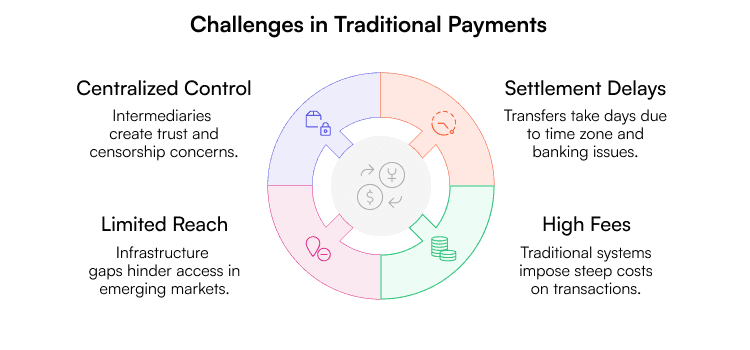
Despite decades of digitization, the global payments infrastructure remains slow, costly, and fragmented—particularly for cross-border transactions. Settlement delays, high fees, and inconsistent access to financial services continue to create friction for enterprises and end-users alike.
- Settlement delays: International transfers often take days to clear, especially across time zones or jurisdictions with limited banking interoperability.
- High fees: Traditional rails—banks, SWIFT, and remittance providers—extract fees at every step. According to the World Bank, the average cost of remittance remains above 6% globally.
- Limited reach: In emerging markets, infrastructure gaps and currency restrictions hinder financial inclusion and real-time commerce.
- Centralized control: Relying on a small group of intermediaries raises concerns about trust, censorship, and single points of failure.
According to McKinsey’s 2023 Global Payments Report, businesses are increasingly seeking payment solutions that offer speed, transparency, and compliance—without being tied to legacy systems.
How Crypto Wallets Are Transforming the Game
In 2023 alone, MetaMask reported over 30 million monthly active users—a signal that wallets have matured from niche tools into mainstream financial interfaces. But beyond user adoption, what is more notable is how wallets are evolving to support enterprise-grade use cases: faster settlements, broader reach, and programmable money flow.
For CFOs, CTOs, and payment leaders, crypto wallets are redefining how value is exchanged and verified:
- Peer-to-peer with near-zero fees: Wallets eliminate intermediary costs by enabling direct, low-cost value transfers—ideal for high-frequency or microtransactions.
- Global payments, 24/7: No currency conversion. No clearing windows. Wallets enable borderless payments with round-the-clock availability.
- Instant settlement via stablecoins & L2s: Technologies like USDC on Polygon or Optimism offer secure, low-latency transfers for B2B transactions, payroll, and vendor payouts.
- DeFi & POS integrations: Wallets support QR-based payments, NFC tap-to-pay, and smart contract automation—bridging the gap between Web3 protocols and real-world commerce.
- Identity meets finance: Increasingly, wallets double as digital IDs, streamlining onboarding, authentication, and access control within compliance frameworks.
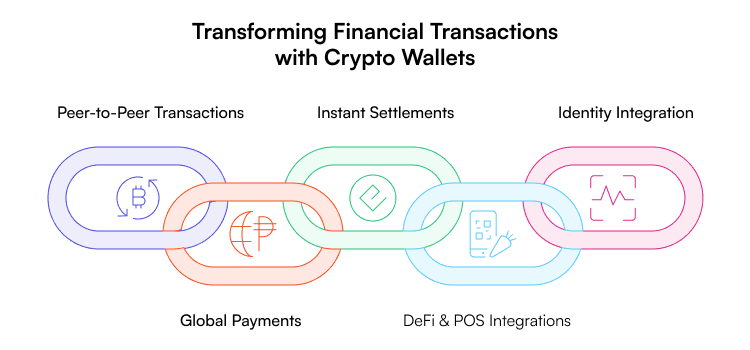
From consumer spending to enterprise settlement, wallets are proving they can scale. Backed by pilots from Visa and ecosystem research from the Ethereum Foundation, they’re already enabling payment systems that are faster, cheaper, and built for the decentralized internet.
Real-World Adoption: From Emerging Markets to Global Brands
The growing adoption of crypto wallets is not limited to crypto-native users—it is spreading across industries and economies with real transactional value.
- Argentina & Nigeria: With high inflation and limited access to stable financial infrastructure, these regions are seeing rapid wallet adoption as users seek more stable alternatives for everyday transactions.
- El Salvador: The government’s Chivo Wallet enables Bitcoin-based payments for goods and services, aiming to drive financial inclusion and reduce remittance costs.
- Shopify & Stripe: These platforms now allow merchants to accept crypto payments through integrated wallet solutions—expanding reach without changing backend systems.
- Starbucks: The coffee giant piloted a blockchain-based loyalty wallet, exploring tokenized rewards and user engagement beyond conventional point systems.
Reports from CoinDesk, TechCrunch, and Reuters show that businesses and governments alike are validating the wallet-first model—not as a trend, but as a long-term payment strategy.
Business Impact: What This Means for Startups & Enterprises
For enterprises, crypto wallets present opportunities that extend far beyond payments:
- New revenue streams: Tokenized loyalty programs, NFTs, and community incentives open up new monetization models.
- Operational efficiency: Cross-border payments to partners, freelancers, or vendors can be settled instantly, without bank delays or currency fees.
- Streamlined onboarding: Wallets can double as KYC-compliant digital IDs, enabling seamless user registration and secure logins.
- Market expansion: Wallet-based systems offer access to previously unbanked populations and younger, crypto-native demographics.
According to a16z and Binance Research, wallets are quickly becoming the “super app” layer of Web3, combining finance, identity, and access under one secure interface.
The Future: Wallets as Your Digital Financial Passport
Crypto wallets are changing. They are now more than payment tools. They are becoming multi-functional gateways to the digital economy. They combine payments, identity, and asset ownership in one interface.
Soon, wallets will be access points for holding digital assets like crypto, tokens, and NFTs. They will also enable cross-border payments in both crypto and fiat. Additionally, they will verify identity with secure credentials for KYC and access control.
Advancements like multi-party computation (MPC), hardware wallet integration, and cross-chain interoperability are paving the way for secure, enterprise-grade use.
As global regulations catch up, wallets will not only be compliant but also essential for any organization in the digital finance or Web3 ecosystems.
Final Thoughts
Crypto wallets are not simply an upgrade to payment tools—they signal a broader shift toward programmable, borderless financial infrastructure. For forward-looking enterprises, they offer a chance to rethink how money, identity, and assets flow—securely, instantly, and without the constraints of legacy systems.
As regulation evolves and real-world adoption accelerates, wallets are positioned to become foundational to digital finance—merging compliance, user experience, and cost efficiency into one strategic layer.
Consult our blockchain experts at GeekyAnts to design and deploy a secure, compliant crypto wallet tailored for your enterprise.