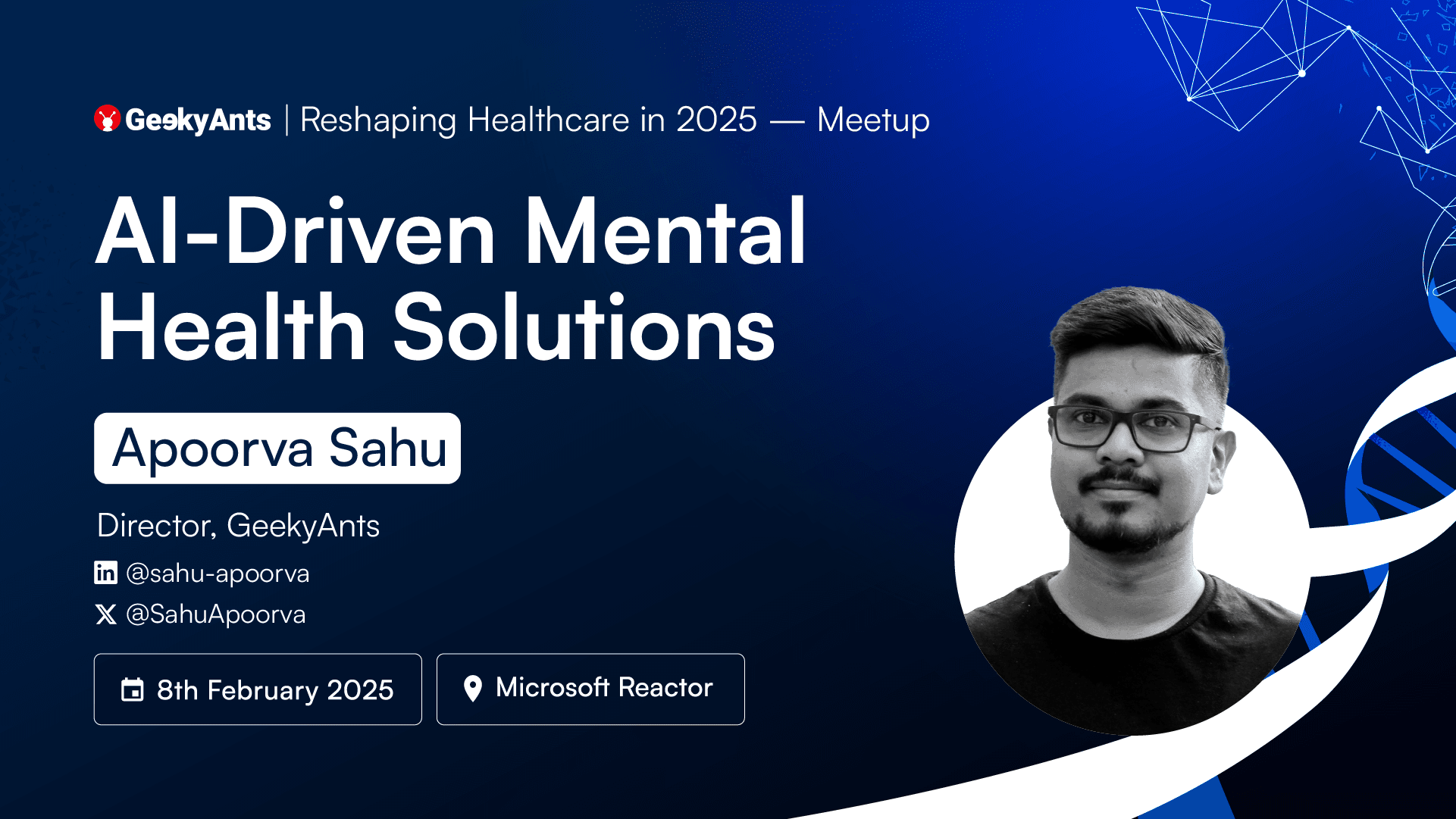

Editor’s Note: This blog is an adapted transcript of Apoorva Sahu's talk at the GeekyAnts React Native Meetup. Apoorva, a Director at GeekyAnts, delved into the potential of AI-driven solutions for mental health. While refined for clarity and brevity, this transcript captures the depth and essence of the session.
Understanding Mental Health Challenges
Hello, everyone! Today, we are going to talk about a serious topic: mental health. But let me try to keep this session as light as possible. I want to take a different, more holistic approach, looking beyond technology. So, let's see how it goes.
Every face has a story to tell, and every sound is waiting to be heard. How many of you have heard this before? No one? Well, that’s because I wrote it yesterday! But it emphasizes a crucial point—every individual here has a different face, a different expression, and perhaps, a different unspoken struggle.
There is a famous saying that people in a crowd often feel the most alone. But why is that? Why do some voices go unheard? Having worked in this field for several months, I came across an intriguing research paper primarily focused on Canada but relevant worldwide.
Mental health is a fundamental aspect of human well-being. But before we go deeper, let's establish some context. What is mental health? Does anyone want to answer? Humans are built of two primary aspects: the physical—what you see, like the face, bones, and skin—and the emotional—our feelings, thoughts, and interactions. Some refer to it as the soul. This emotional aspect is significantly underserved in healthcare due to many factors.
One of the biggest barriers is financial constraints. Mental health treatment is among the most expensive healthcare services. In Bangalore, a single session costs approximately ₹2,000 per hour. In Western countries, it can range between $200 to $1,000 per hour, making it unaffordable for almost 90% of the global population. Social stigma is another major factor. Many hesitate to seek help due to societal judgment, making privacy a top concern. Lack of awareness compounds the issue—most people don’t even realize they have mental health challenges. For instance, if you wake up, argue with your spouse, nearly get hit by a car, and then have a stressful day at work, you might quit impulsively. What you needed was simply a two-minute break to talk to a friend, but you never recognized the stress building up. Lastly, the limited availability of mental health professionals is a critical problem. According to WHO, there are approximately 720,000 mental health professionals globally, serving a population of 8 billion. That equates to just 7-8 seconds per person—not even enough time for a greeting.
AI-Powered Solutions: A Holistic Approach
At GeekyAnts, we are leveraging AI to tackle these challenges. Our approach revolves around four key segments: facial expressions, speech patterns, social engagement, and fitness data. Facial expressions convey a lot about emotions—are people smiling, frowning, or neutral? AI models like Google’s MediaPipe and Facebook’s DeepFace help analyze muscle movements and establish personalized emotional baselines. Speech patterns also provide valuable insights. The tone, speed, and pitch of speech reveal emotional states. Tools like Hume AI and Librosa analyze voice modulation to detect stress or anxiety.
Social engagement is another critical factor. People now spend more time on social networks than in direct conversations. By analyzing online behavior, such as post-engagement patterns, AI can detect subtle mood shifts and emotional distress. Fitness data also plays a role. Wearable devices and fitness apps track physiological signals like heart rate variability, which correlates with stress levels. Our AI integrates these insights to build a holistic mental health profile.
AI for Real-Time Mental Health Insights
Our system employs deep learning and real-time data analysis. Every person’s "normal" emotional state is unique. We create individualized baselines by analyzing data over time, breaking it into smaller time segments to capture daily emotional fluctuations. Facial analysis with CNN models like YOLO helps detect micro-expressions that say emotional changes. Speech pattern analysis leverages AI-powered APIs to assess voice dynamics and linguistic patterns for detecting emotional shifts. Meanwhile, social media monitoring tracks behavioral trends on platforms like Twitter to identify potential distress indicators based on engagement with certain types of content.
AI Avatars: The Future of Emotional AI
We are also developing AI-powered virtual companions that adapt to user emotions. These avatars provide a conversational interface where users can express themselves without fear of judgment. Whether someone is experiencing anxiety or joy, the avatar’s responses dynamically adjust to create a comforting experience. We’ve even mapped emotional fluctuations over time using 3D visualizations. The results are fascinating—people’s digital expressions change depending on whether they are at work, at home, or on weekends. Understanding these behavioral patterns allows AI to provide more tailored mental health support.
Ensuring Ethical AI Implementation
AI in healthcare must adhere to strict ethical and regulatory standards. We focus on data privacy and consent, ensuring users explicitly grant permission for data collection and analysis. All data is handled securely and anonymously. Regulatory compliance is another priority. Adhering to HIPAA, GDPR, and region-specific laws ensures global applicability. Diverse training data is essential to prevent AI biases that could lead to skewed results. Finally, risk management is crucial. AI is a support system, not a replacement for human professionals. We continuously check outputs to prevent misinformation.
The Road Ahead
Our ultimate goal is to make AI-driven mental health support affordable and accessible. Imagine reducing consultation costs from ₹5,000 to just ₹50 per session! Through AI, we aim to democratize mental health care, ensuring no one suffers in silence due to financial constraints or social stigma. However, challenges remain. AI systems must process vast amounts of data in real-time while maintaining accuracy and privacy. Verification mechanisms are essential to prevent incorrect or potentially harmful recommendations.
The mental health landscape is evolving rapidly, and AI is at the forefront of this transformation. While AI won’t replace human empathy, it can provide immediate, scalable support that bridges critical gaps in awareness, affordability, and accessibility. Let’s collaborate to refine and expand these solutions. Thank you!