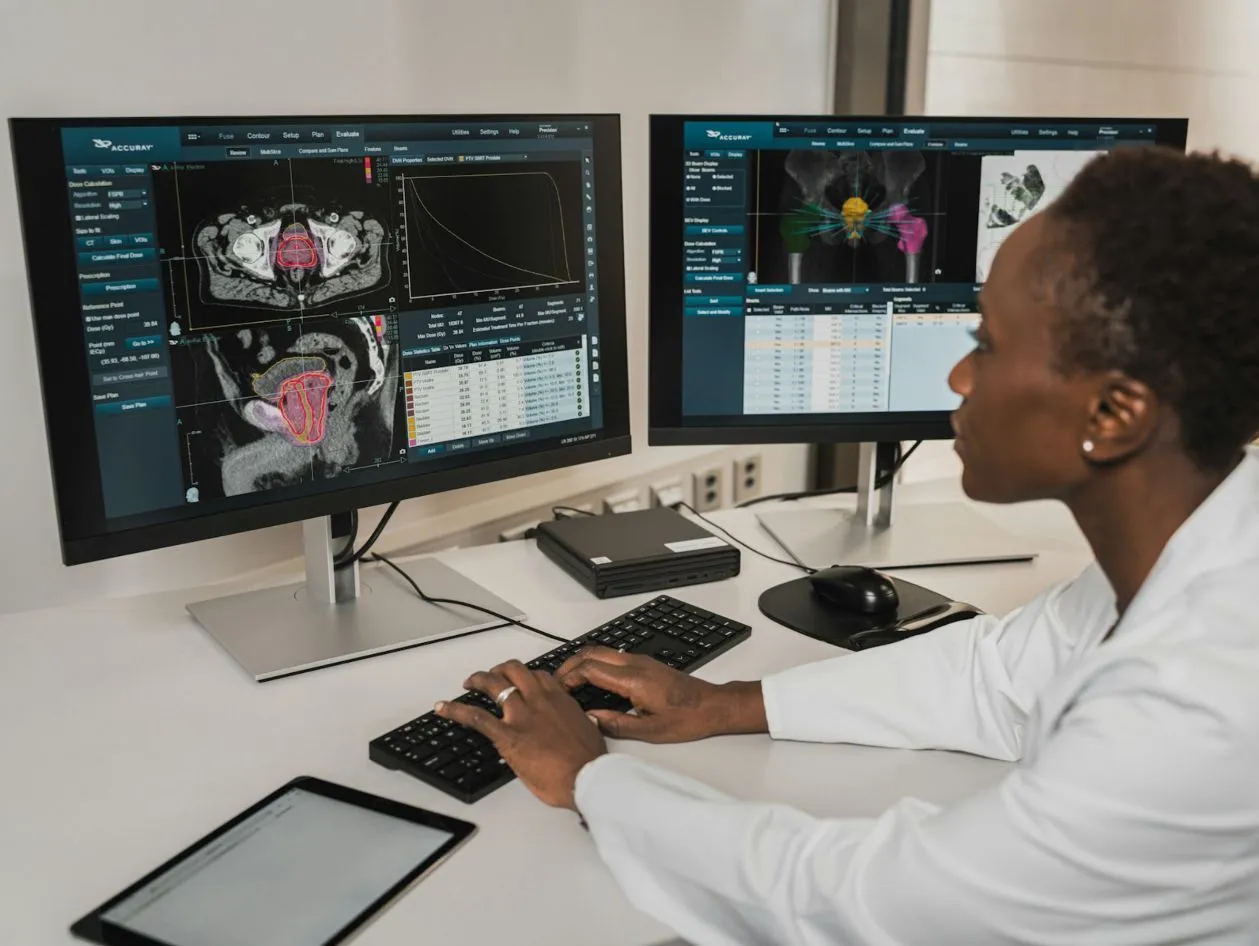


An engineer writing integration code on a monitor

HL7 FHIR Integration

HL7 FHIR Integration Services

Our HL7 FHIR integration services convert HL7 messages, C-CDA documents, and clinical files into standardized resources, then expose them through secure APIs. Hospitals, EHR vendors, payers, and digital health teams use those APIs to read patient information across systems they already run.

Challenges

FHIR Interoperability Challenges We Help Solve

Clinical information reaches each system in a different shape, and the gaps surface when a team tries to read one patient’s history across facilities. Our FHIR integration services address the access, consistency, and exchange problems that follow.
  • Clinical Data Arrives in Older Formats

    HL7 v2 messages, C-CDA documents, and vendor XML still carry most clinical information, and the segment structure shifts between sending systems and versions. Applications that expect resource-based FHIR APIs cannot read any of it directly. Our HL7 to FHIR conversion makes those feeds readable to the applications that need them.
  • Patient History Sits in Separate Systems

    A single patient accumulates records at hospitals, laboratories, and diagnostic centers that each hold a different identifier for the same person. Care teams reviewing a history cannot tell what is missing. We help applications assemble a fuller view from the sources that are available.
  • Every System Needs Its Own Interface

    Each new connection brings its own mapping, credentials, and failure behavior, and the count of interfaces grows faster than the count of partners. Maintenance effort rises with every addition. We replace that surface with one FHIR API, so connections stop multiplying.
  • Patients Cannot Reach Their Records

    Results, medications, and visit summaries sit behind systems that offer no interface a patient application can call. Requests get handled by staff, and authorized care teams hit the same wall. We open controlled access through FHIR APIs to the people entitled to see it.
  • Provider and Payer Data Move Apart

    Clinical details, encounter history, and authorization decisions cross between providers and payers through portals, faxes, and spreadsheets. Prior authorization waits while someone retypes information a system already holds. Our healthcare API integration connects those exchanges so the data moves once.
  • Codes Differ Between Sending Systems

    The same laboratory test or diagnosis arrives under different identifiers depending on which system sent it. Downstream applications treat those entries as unrelated, and reporting drifts from what happened. We make the coding consistent before the data is exchanged.

Highlights

Why Choose GeekyAnts for FHIR Integration Company?

Healthcare API integration succeeds or fails on what the source systems actually send. GeekyAnts is an HL7 FHIR integration company that has processed ADT, C-CDA, laboratory and radiology feeds before, which is what shapes the resources built on top of them.
  1. 01

    Feeds We Have Already Processed

    Our HL7 integration services grew out of building the EHR-connected platform that receives ADT, C-CDA, laboratory, radiology, ELR and syndromic feeds through SFTP gateways and turns raw HL7 and XML into patient histories, encounters and events.
  2. 02

    FHIR Integration Over What You Already Run

    FHIR integration sits over the infrastructure you already run. Your file-based exchanges keep operating while the integration layer maps supported information into resources.
  3. 03

    Scope Set by Your Available Data

    What FHIR can deliver depends on the data available, the implementation guides in play, the integration partners involved and the authorization model. We scope against those four before quoting capability.
  4. 04

    Testing Covers Access and Performance

    We validate resource structures and implementation-guide requirements, then test FHIR API behavior, access controls and integration performance. Conformance alone does not tell you whether the exchange holds under load.
  5. 05

    Traceability Back to the Source File

    Processed records stay linked to the original HL7, XML and clinical documents behind them. Authorized users can open the source file to check a value or investigate a discrepancy.
  6. 06

    Mappings That Get Reused

    Our healthcare API integration services produce reusable endpoints in place of the custom interface each new system would otherwise need. Mapping work done once, carries across compatible integrations.

Put Your Clinical Data Behind Standardized FHIR APIs

Legacy feeds, authorized patient access, and provider and payer applications run on one set of FHIR resources. Tell us which systems need connecting.
Discuss Your FHIR Integration Project
Dedicated Healthcare Engineers
20+
Years in Healthcare Technology
6+
Healthcare Projects delivered
10+
Concurrent Users Supported
1M+

Work

Our Healthcare API Integration Experience

FHIR integration depends on the applications that consume it. The projects below cover clinical records, role-scoped access and live patient signals across three healthcare builds, including EHR and EMR platform work.
View all
Secure Patient Communication for Marigold Health
Mental Health

Secure Patient Communication for Marigold Health

Patients and clinicians work in separate applications on one platform. Role-based access, structured forms and in-app messaging carry communication that holds protected health information, under applicable HIPAA requirements.
Applications across patient and professional roles
2
Milestones focused on integration
3
Read case study

Make Your Legacy Clinical Data Readable to Modern Applications

HL7 and C-CDA sources become FHIR resources your patient portals, provider systems and payer platforms can call, each under its own access scope and mapped once.
Discuss Your FHIR Integration Project

Services

Healthcare API Integration Services We Build

Our HL7 FHIR integration services cover the full path from raw clinical file through FHIR server to authorized FHIR API call, and each one can start independently of the others.
A clinical data interface on screen

FHIR API Development and Integration

We design the FHIR API endpoints your partners call, covering search, retrieval, creation and update behavior, pagination rules and the documentation integrators work from. Monitoring tells you when an exchange stops behaving.
Radiology monitors showing results

HL7 and C-CDA to FHIR Conversion

Our HL7 to FHIR conversion maps HL7 v2 messages and C-CDA documents onto the resources they belong in. An ADT message feeds Patient and Encounter, while laboratory and radiology results land in Observation and DiagnosticReport.
A healthcare operations dashboard

FHIR Server, Validation and Terminology

We stand up the FHIR server behind your resources, handling storage, search, versioning and access control, then check each resource against the profiles your partners expect. Coding runs on SNOMED CT, LOINC and ICD where licensed.
A patient using a health app on a phone

FHIR-Based Patient Access Solutions

Patients reach their own records, encounters, laboratory results, medications and allergies through applications that call your FHIR APIs. Each request runs inside the scope the patient has been granted.
Health plan documents

FHIR Provider-Payer Interoperability

Patient Access, Provider Access, Payer-to-Payer and prior authorization each run on their own implementation guide. We build the FHIR integrations that carry clinical, encounter, claims and authorization data between the two sides.
A diagnostics laboratory

FHIR Bulk Data Export and Population Health

Large datasets leave through FHIR bulk data export rather than thousands of individual calls. Analytics, population health, research pipelines and operational reporting read from those exports under your data-use rules.

Technologies

Technologies We Use for FHIR Integration

Technology choices follow two things, the formats arriving from your source systems and the implementation guide your partners hold you to. The six groups below cover each layer, from the resources themselves through to the testing that proves they hold.
  • FHIR R4
  • FHIR REST APIs
  • FHIR servers
  • Resource modeling
  • Resource search and validation
  • Implementation guides

Specialist Services

Specialist FHIR Integration Services We Deliver

These are the builds that come up once a FHIR integration is underway. Each runs on its own or alongside the services above.
  • SMART on FHIR App Development

    Apps that launch inside Epic, Oracle Health, athenahealth or MEDITECH with the patient already in context and scoped access granted.
  • CDS Hooks Integration

    Decision support that fires at the point of care, returning cards into the clinician's workflow rather than a separate screen.
  • EHR Vendor Integration Layer

    One FHIR API your product calls, with per-EHR adapters underneath, so a new customer's EHR does not mean a new build.
  • FHIR Facade Over Legacy Systems

    A standard FHIR API in front of a system that cannot move yet, so consumers read resources while the source stays where it is.
  • Cloud FHIR Store Deployment

    Azure Health Data Services, Google Cloud Healthcare API or HAPI FHIR stood up, configured and wired into your identity provider.
  • Interface Engine Integration

    Mirth Connect and similar engines stay in place, with FHIR routes added alongside the HL7 v2 channels already running.
  • FHIR Subscriptions and Notifications

    Resource changes pushed to subscribed applications, so downstream systems react without polling the server on a timer.
  • Sandbox and EHR Certification Support

    App registration, sandbox testing and the production access request each EHR vendor requires before go-live.

Engagement

FHIR Integration Engagement Models

Pick the model that matches where your FHIR work stands, a mapping assessment, one scoped integration, or a team that keeps the exchange running.
  • 01 / 03

    FHIR Readiness Assessment

    A fixed-scope review of your source formats, available data, required resources, target implementation guides and authorization model, ending in a phased roadmap.
    • Source format inventory
    • Resource and profile mapping
    • Authorization model review
    • Validation and testing plan
    • Phased implementation roadmap

    Best for: Teams deciding what FHIR work is feasible

  • 02 / 03

    FHIR Integration and Build Sprint

    A defined engineering sprint that takes one FHIR API, HL7 to FHIR conversion layer or FHIR server implementation through to release.
    • Scoped integration backlog
    • Cross-functional delivery pod
    • Resource mapping and validation
    • Conformance and load testing
    • Deployment and release checks

    Best for: Teams building one specific FHIR interface

  • 03 / 03

    Dedicated Healthcare Engineering Pod

    An ongoing team that maintains your FHIR services, extends resource coverage and responds to conformance and partner issues.
    • Resource coverage expansion
    • Conformance maintenance
    • Partner integration support
    • Monitoring and issue response
    • Platform updates and testing

    Best for: Teams running FHIR services in production

Partners

Technology Partners Behind Our Healthcare Integration Work

Partner relationships cover the infrastructure, APIs and delivery tooling our FHIR builds run on. The set below spans cloud deployment and scaling, API layers over exchange and patient record data, and evaluated AI processing applied to clinical documents. Tiers shown are the ones GeekyAnts currently holds.

Compliance

Security and Compliance for FHIR Integration

Privacy and security requirements become access controls, audit evidence and tests inside the build rather than a review at the end. Which ones apply depends on your participants, the data they exchange and how that exchange is used. The items below cover the regulations that shape this work and the management systems GeekyAnts operates behind it.
HIPAA

HIPAA

Health Information Privacy and Security

Shapes how PHI moves through resources, which scopes each participant receives, and what the audit trail records for applicable US organizations.
HITECH

HITECH

Health Information Technology for Economic and Clinical Health Act

Supports breach-response workflows, incident records and notification responsibilities alongside applicable HIPAA obligations.
GDPR and UK GDPR

GDPR and UK GDPR

Personal Data Protection

Covers lawful processing, access rights, retention and transfer rules for resources holding EU and UK personal data.
ONC / Cures Act

ONC / Cures Act

Electronic Health Information Access

Shapes how access, export and API availability are planned against applicable information-blocking rules, with exceptions reviewed by responsible stakeholders.
HL7 and FHIR

HL7 and FHIR

Healthcare Interoperability Standards

FHIR resources validated against profiles and implementation guides, with authenticated access and monitored exchange.
SOC 2

SOC 2

System and Organization Controls 2

Independent examination of service-provider controls within an agreed scope. GeekyAnts currently lists SOC 2 as upcoming.
ISO/IEC 27001:2022

ISO/IEC 27001:2022

Information Security Management

Our certified management system covers risk assessment, information protection, access control and incident response across delivery operations.
ISO 9001:2015

ISO 9001:2015

Quality Management

Our certified management system covers documented processes, delivery reviews, corrective actions and continuous improvement.
ISO/IEC 20000-1:2018

ISO/IEC 20000-1:2018

IT Service Management

Our certified management system covers service planning, change control, incident management and operational continuity.

Process

Our HL7 to FHIR Integration Process

Our HL7 integration services start at the gateway a file already arrives on. Seven stages carry that file through to the endpoint an application calls. The first two run against infrastructure you have in place, and the five after them add the FHIR resource layer.
  1. A connected care network

    Step 01

    Receive Healthcare Information

    Phase 01

    Files land on the gateway each facility already sends to. Nothing changes on the sending side, so facilities keep their current transfer method and schedule.
  2. A team reviewing work together

    Step 02

    Parse and Normalize Source Data

    Phase 02

    Each file is parsed against the format rules of the system that sent it. Missing or malformed fields surface here, rather than downstream once a resource has already been built on them.
  3. Two people mapping a design at a whiteboard

    Step 03

    Map Elements Into FHIR Resources

    Phase 03

    Elements move into Patient, Encounter, Observation, Condition, DiagnosticReport, DocumentReference and Organization. The rule behind each mapping is recorded, so any value traces back to the decision that placed it.
  4. A tester checking an application

    Step 04

    Validate and Verify Relationships

    Phase 04

    Resources are checked against the profiles your implementation guide requires. References between patients, encounters, observations and reports are verified too, since a resource that validates on its own can still point at nothing.
  5. An engineer writing code on a monitor

    Step 05

    Expose Secure FHIR API Endpoints

    Phase 05

    Endpoints go live behind authentication, scope control and audit logging. Each consumer receives the scope it needs and nothing beyond it, decided before the first external call.
  6. A doctor using a health app on a phone

    Step 06

    Connect Downstream Applications

    Phase 06

    Patient portals, clinical dashboards, provider applications and payer integrations read through documented FHIR APIs. One mapping serves all of them, so adding a consumer becomes a scope decision instead of a build.
  7. A clinician checking a record on a tablet

    Step 07

    Preserve Source Traceability

    Phase 07

    Every resource keeps a link to the file it came from. When a clinician disputes a value, the original HL7 or XML is one click away instead of a support ticket.

Insights

HL7, FHIR and Healthcare Interoperability Resources

Three pieces on FHIR interoperability worth reading before a build starts. The first covers what a production integration actually requires, the second how exchange works across hospitals, laboratories and payers, and the third what standardized access changes for patients.

Interoperability and Data Exchange in Healthcare cover
Sep 7, 2023

Blog

Interoperability and Data Exchange in Healthcare

Join Abhishek Anand, Tech Lead at GeekyAnts, as he delves into the world of healthcare interoperability and its profound implications on the seamless exchange of vital medical information.

Using FHIR to Improve Patient Engagement cover
Apr 13, 2023

Blog

Using FHIR to Improve Patient Engagement

Learn how FHIR (Fast Healthcare Interoperability Resources) enables better personalized healthcare delivery by making patient data transfer easier between healthcare providers, through standardization and increased interoperability.

Contact

Start Your FHIR Build With the Engineers Who Will Run It

Send over the shape of the problem and we come back with scope, sequence and the team who would do the work. Nothing committed either way at that point.

Contact us

FAQ

Frequently Asked Questions About Our FHIR Integration Services

Start a project

The Right Conversation Can Save You Six Months.