
Stop rewriting your data access code every time you switch databases.
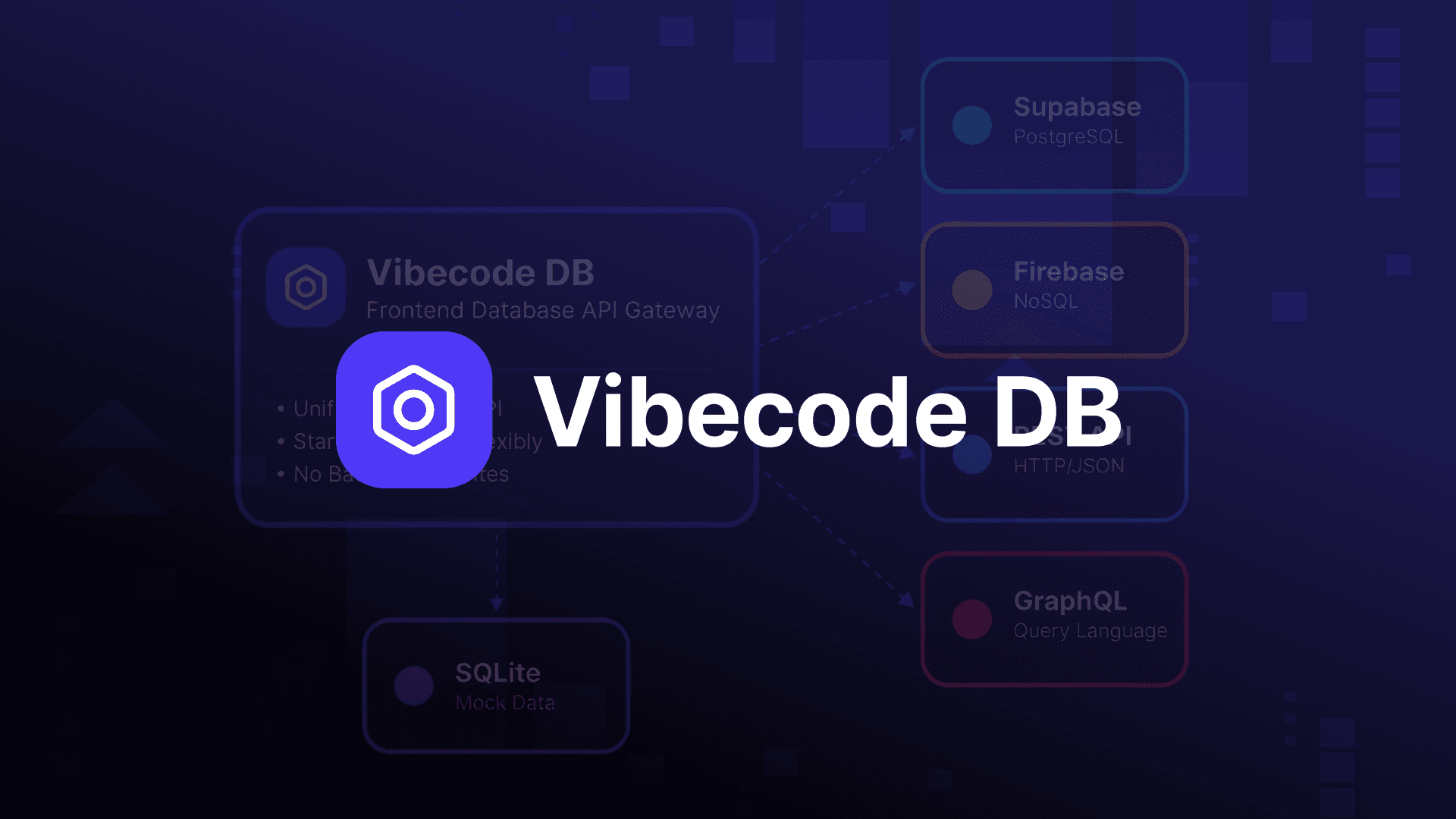
Because Vibecode DB is an open-source, type-safe abstraction layer that enables seamless switching between SQLite, Supabase, Firebase, and REST APIs without requiring you to change your application code.
The modern frontend development workflow has a recurring huddle— developers spend too much time wrestling with database integrations instead of building features. You start a project with SQLite for quick prototyping, then migrate to Supabase for authentication, only to realise later that you need a custom backend—and now you are rewriting half your data access layer. Each transition means different APIs, different query patterns, and a week of refactoring that could have been spent shipping.
So, we are open-sourcing Vibecode DB—a type-safe database abstraction layer that lets you switch between SQLite, Supabase, Firebase, GraphQL, and REST APIs without changing a single line of your application code.
The Database Fragmentation Problem in Frontend Development
Let us be honest about the current state of frontend data management. Most web application projects follow a familiar pattern:
Week 1: "Let's prototype this quickly with an in-browser SQLite database."
Month 2: "We need auth and real-time subscriptions. Time to migrate to Supabase."
Quarter 3: "Our enterprise client requires a custom backend. Complete rewrite incoming."
Each transition is a fundamental restructuring of how your application interacts with data: different query builders, different type systems, different error handling patterns. Your carefully crafted components are now tightly coupled to implementation details that were never meant to leak into the UI layer.
We have tested this pattern extensively while building apps for theappmarket, and the friction was undeniable. Every database migration cascaded into days of refactoring, testing, and bug fixes. The problem was not the databases themselves—they are all excellent tools. The problem was the tight coupling between application logic and the specifics of each database's API.write your code
What Is Vibecode DB? A Database-Agnostic Solution
Vibecode DB solves this with a deceptively insightful: your web application should not know (or care) where its data lives.
Here is what database abstraction looks like in practice:
import { createClient } from '@vibecode-db/client'
import { dbSpec } from './schema'

// Day 1: Prototype with SQLite - no backend required
const vibecode = createClient({
  dbSpec,
  adapter: (ctx) => new SQLiteWebAdapter(ctx, { sqliteOpts })
})

// Your application code
const activeUsers = await vibecode
  .from('users')
  .select('*')
  .where('active', true)
  .limit(10)
This works immediately. No backend setup, no API configuration, no authentication headaches. Just pure, fast prototyping with an in-browser database.
Here is where it gets interesting. Three months later, when you are ready for production:
TypeScript:
// Production: Switch to Supabase - exact same application code
const vibecode = createClient({
  dbSpec,
  adapter: (ctx) => new SupabaseAdapter(ctx, { supabaseOpts })
})

// This query? Unchanged.
const activeUsers = await vibecode
  .from('users')
  .select('*')
  .where('active', true)
  .limit(10)
Same query. Same logic. Same code. Different database. That is the promise of Vibecode DB's adapter-based architecture.
How Vibecode DB Works: Adapter-Based Architecture
The magic happens through an adapter pattern that decouples what you want from how it is retrieved.
At the heart of Vibecode DB is a schema definition—your single source of truth for database structure:
const dbSpec = {
  tables: {
    users: {
      columns: {
        id: { type: 'uuid', primaryKey: true },
        email: { type: 'string', unique: true },
        active: { type: 'boolean', default: true },
        createdAt: { type: 'timestamp', default: 'now' }
      }
    },
    posts: {
      columns: {
        id: { type: 'uuid', primaryKey: true },
        userId: { type: 'uuid', references: 'users.id' },
        title: { type: 'string' },
        content: { type: 'text' }
      }
    }
  }
}
This database schema drives everything: TypeScript types, query validation, and adapter behaviour. Define it once, and Vibecode DB handles the rest.
Built-in Database Adapters
Vibecode DB ships with adapters for the most common database scenarios:
- SQLiteWebAdapter: In-browser SQLite for prototyping and offline-first progressive web apps
- SupabaseAdapter: Full integration with Supabase's database, authentication, and storage
- CustomAdapter: Map any REST API to Vibecode DB's unified query interface
Each database adapter implements the same core interface, guaranteeing consistency across your entire application.
The CustomAdapter: Integrate Any REST API Backend
One of the most powerful features is the CustomAdapter, which lets you integrate with existing REST APIs:
const vibecode = createClient({
  dbSpec,
  adapter: (ctx) => new CustomAdapter(ctx, {
    baseURL: 'https://api.yourcompany.com',
    endpoints: {
      users: {
        list: 'GET /users',
        get: 'GET /users/:id',
        create: 'POST /users',
        update: 'PATCH /users/:id',
        delete: 'DELETE /users/:id'
      }
    }
  })
})
This means you can adopt Vibecode DB incrementally. Just map your existing API endpoints and start using the unified interface.
Type-Safe Database Queries with TypeScript
Vibecode DB leverages TypeScript's advanced type system to provide compile-time guarantees about your database queries:
const user = await vibecode
  .from('users')
  .select('email', 'active')
  .where('id', userId)
  .single()

// TypeScript knows:
// - user.email is a string
// - user.active is a boolean
// - user.id doesn't exist (not selected)
// - typos in column names fail at compile-time
This is a fundamental reduction in runtime errors. Invalid database queries fail in your editor, not in production.
Benefits of Database Abstraction for Web Applications
The advantages of this database-agnostic approach become clear when you're building actual applications:
1. Faster Prototyping and Development
Start building immediately with SQLite. No backend setup, no deployment, no configuration. Just code.
2. Risk-Free Database Experimentation
Want to try a different database solution? Change one line of configuration and see if it works for your use case. No migration scripts, no refactoring.
3. Simplified Testing
Swap production databases for lightweight local alternatives in automated tests. Same code, faster test suites.
4. Incremental Adoption
Integrate with existing backends via CustomAdapter. No big-bang migrations, no complete rewrites.
5. Future-Proof Architecture
When a new database solution emerges (and they always do), add an adapter instead of rewriting your entire app.
6. No Vendor Lock-In
Switch between Supabase, Firebase, PostgreSQL, or custom backends without rewriting application logic. True database portability.
Real-World Testing: Battle-Tested at TheAppMarket
We have been using Vibecode DB internally to build apps for theappmarket, and the results have validated the approach. Development teams prototype faster, ship features without backend dependencies, and transition to production databases without the typical migration headaches.
One team started with SQLite for an offline-first mobile experience, then added Supabase for cloud synchronisation without changing their component logic. Another team integrated with a legacy REST API using CustomAdapter, giving them Vibecode DB's query builder while maintaining compatibility with existing infrastructure.
Getting Started with Vibecode DB
Vibecode DB is open source and ready to use today. Here is a minimal example to get started:
Shell
npm install @vibecode-db/clientimport { createClient, SQLiteWebAdapter } from '@vibecode-db/client'
// Define your database schema
const dbSpec = {
tables: {
todos: {
columns: {
id: { type: 'uuid', primaryKey: true },
title: { type: 'string' },
completed: { type: 'boolean', default: false }
}
}
}
}
// Create database client
const vibecode = createClient({
dbSpec,
adapter: (ctx) => new SQLiteWebAdapter(ctx)
})
// Start querying
const allTodos = await vibecode.from('todos').select('*')
const incompleteTodos = await vibecode
.from('todos')
.select('*')
.where('completed', false)That is it. You are now database-agnostic.
The Philosophy Behind Database Abstraction
At its core, Vibecode DB embraces a single truth that the "best" database solution is not universal. A startup's needs differ from those of an enterprise. A prototype's constraints differ from a production app's scale. What remains constant is the need for clean, maintainable code that does not crumble when architectural decisions change.
By decoupling your application logic from database implementation details, Vibecode DB gives you the freedom to make pragmatic choices without sacrificing code consistency. It is not about picking the perfect database upfront but about building flexible systems that can evolve with your needs.
What is Next for Vibecode DB
Vibecode DB is just getting started. We are actively working on:
- Additional database adapters: Firebase, PlanetScale, Turso integration
- Advanced query features: Joins, aggregations, and database transactions
- Real-time subscriptions: Live data updates across all adapters
- Enhanced TypeScript inference: Better autocomplete for complex queries
However, the foundation is solid, open source, and ready for production use today.
Try Vibecode DB: Build Database-Agnostic Web Applications
We built Vibecode DB because we were tired of rewriting data access layers every time project requirements changed. If you have ever felt that same frustration or ever hesitated to try a new database because of the migration cost, Vibecode DB is for you.
Check out the documentation at vibecode-db.geekyants.com, explore the source code on GitHub, and start building database-agnostic applications today.
Write once, run anywhere, because the best database is the one that does not lock you in.
Key takeaways:
- Write your data access code once, run it on any database
- Type-safe queries catch errors at compile-time
- Switch between SQLite, Supabase, Firebase, and REST APIs seamlessly
- No vendor lock-in, no database migration rewrites
- Open source and production-ready today