

Key Takeaways
- Modern supply chain risk management must continuously detect operational exposure instead of relying only on annual assessments and compliance evidence.
- AI can connect supplier, logistics, geopolitical, weather, and internal operating data to identify emerging risks earlier and prioritize the events that require action.
- Production-ready risk platforms need governed data pipelines, explainable scoring, enterprise integrations, workflow orchestration, auditability, and human approval for high-impact decisions.
- Enterprises or supply chain technology leaders should select build, buy, or modernization paths based on data readiness, workflow complexity, integration depth, and the level of control they need.
What Supply Chain Risks Are Driving Demand for AI-Powered Risk Systems?
Supply chain leaders already receive signals about tariffs, port closures, cyber incidents, supplier failures, and extreme weather. The operational challenge lies in connecting each signal to the affected supplier, material, route, purchase order, plant, margin, and customer commitment before the response window closes.
The World Economic Forum’s Global Risks Report 2026 ranks geoeconomic confrontation, state-based armed conflict, and extreme weather among the most consequential near-term risks. Each can restrict access to markets, materials, transportation routes, and critical suppliers.
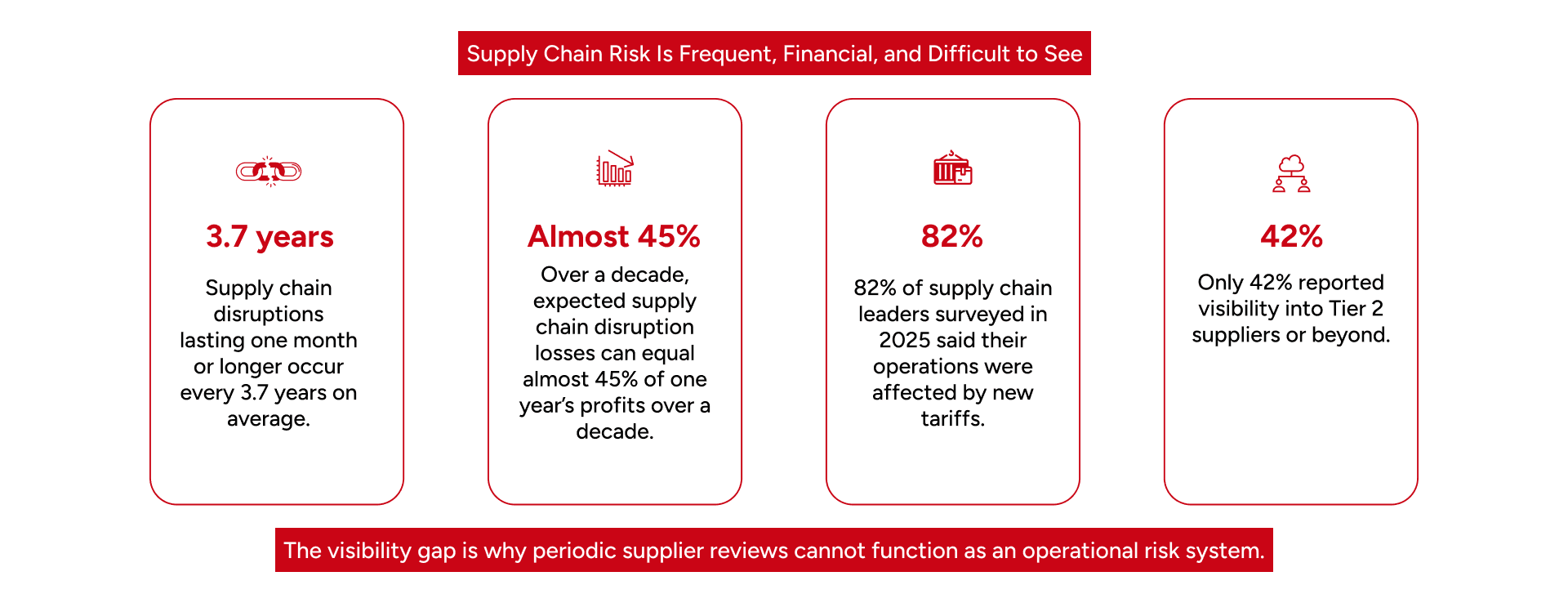
The financial exposure is significant. McKinsey estimates that supply chain disruptions lasting one month or longer occur every 3.7 years on average. Over a decade, major disruptions can eliminate almost 45 percent of one year’s profits.
Visibility remains a major constraint. McKinsey’s 2025 survey of 100 global supply chain leaders found that 82 percent had been affected by new tariffs, with respondents estimating that 20 to 40 percent of their supply chain activity had been affected. Only 42 percent reported visibility into Tier 2 suppliers or beyond.
For executive leaders responsible for supply chain, procurement, operations, risk, or enterprise technology, the path forward is clear: resilience requires continuous visibility into operational exposure, connected enterprise data, and coordinated mitigation.
AI-powered supply chain risk management systems create value when the enterprise can connect an emerging event to the affected supplier, material, route, order, plant, margin, and customer commitment; then place the decision with the right owner while there is still time to act. This guide explains the data, workflows, architecture, and engineering required to build that capability.
Why Is Compliance-First Supply Chain Risk Management No Longer Enough?
Compliance programs establish essential baseline controls. Supplier certifications, contractual requirements, sustainability disclosures, security questionnaires, and audit records help enterprises confirm that suppliers meet defined standards.
However, these controls usually capture conditions at a specific point in time. A completed questionnaire cannot show that a port closure is delaying an active shipment, flooding has affected a Tier 2 supplier, or a geopolitical event has increased exposure around a critical material.
What Are The Limitations Of Annual Supplier Risk Assessments?
Traditional supplier risk workflows often depend on:
- Static questionnaires that capture supplier conditions at one point in time
- Annual supplier assessments that miss changes occurring between reviews
- Spreadsheet-heavy processes that make risk information difficult to update, compare, and share
- Delayed incident response caused by manual investigation and fragmented ownership
- Disconnected data across procurement, compliance, finance, and logistics systems
These processes primarily answer an assurance question:
Can the enterprise demonstrate that it assessed the supplier?
Operational resilience requires a more immediate question:
What has changed, which business commitments are exposed, and what action should the enterprise take now?
This distinction becomes especially important beyond Tier 1. A direct supplier may appear stable while depending on a geographically concentrated sub-supplier, a high-risk transportation corridor, or a single producer of a critical component. McKinsey’s recent research continues to identify weak multi-tier visibility as a major source of supply chain vulnerability.
Compliance-first workflows also separate information from execution. Procurement may receive a supplier alert, logistics may detect a delayed route, and finance may see a margin impact, but no shared workflow connects those observations. By the time teams reconcile the data, the disruption may already have affected inventory or customer delivery.
The concern is already visible at the procurement level. Gartner Supply Disruption Survey found that 42 percent of surveyed procurement leaders considered supply disruption the leading threat to procurement success, ahead of macroeconomic, geopolitical, and compliance concerns.
AI-powered supply chain risk management shifts the operating objective from proving that controls existed to detecting exposure and coordinating mitigation.
Most supply chain risk programs are designed to prove that a control existed at the time of an audit. The commercial problem is different. Leaders need to know which supplier, material, route, or customer commitment is exposed now, and who should act before that exposure becomes a disruption.
 Kunal KumarChief Revenue Officer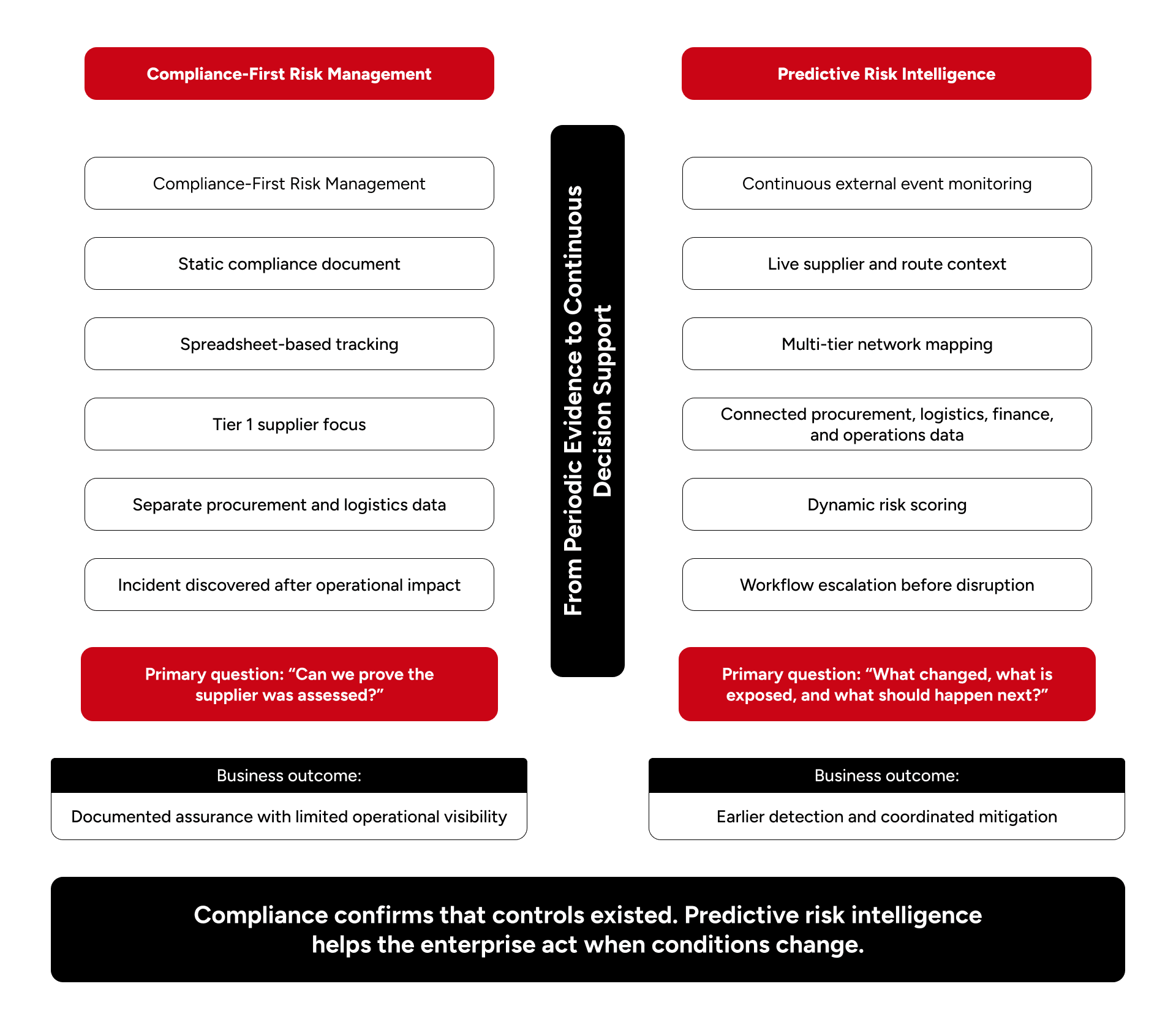
What Is the Business Case for AI-Powered Supply Chain Risk Management Solutions?
The business case should not begin with the number of alerts a platform can generate. It should begin with the decisions the organization needs to make faster and with better evidence.
Many organizations are already redesigning their supply networks around resilience. Gartner found that 73% of surveyed companies had added or removed production locations during the previous two years. Resilience, flexibility, and agility had overtaken lowest-cost operations as the primary drivers of these network changes.
Supply chain technology leaders can evaluate the business case through the following outcomes:
How Can Earlier Risk Detection Reduce Disruption Costs?
Earlier detection gives teams more time to reserve inventory, reroute shipments, change production schedules, negotiate with suppliers, or qualify an alternative source.
The system cannot eliminate disruption costs, but it can preserve more response options before delays become unavoidable.
How Can an Integrated Risk Platform Accelerate Mitigation?
Traditional incident management loses time while teams collect information from different systems. A well-integrated digital platform can connect an event to the affected suppliers, products, purchase orders, routes, and customers before notifying the responsible owner. This gives teams the context required to begin mitigation sooner.
How Can Risk Intelligence Improve Supplier Diversification Decisions?
Supplier count alone does not establish resilience. Two vendors may depend on the same region, sub-supplier, port, transportation provider, or raw material.
Risk intelligence helps procurement teams evaluate correlated exposure and determine whether an alternative supplier provides meaningful diversification.
How Can Supply Chain Risk Intelligence Protect Margins and Customer Commitments?
Supply disruption can create expedited freight costs, missed production targets, contractual penalties, lost sales, and inventory imbalances. Risk intelligence gives finance, operations, and customer teams a shared view of which commitments may be affected.
It also protects customer experience continuity by giving account, logistics, and operations teams earlier visibility into which orders, delivery timelines, or service commitments may be at risk.
How Can Supply Chain Risk Management Strengthen Audit and Decision Readiness?
The platform can retain the event source, risk classification, score changes, recommended action, approval record, and resolution. This creates a defensible history of how the organization identified and managed an incident.
The value comes from better operational decisions. Gartner found that high-performing supply chain organizations were investing in AI and machine learning to optimize processes at more than twice the rate of lower-performing peers. These organizations were also more likely to focus on productivity and decision quality rather than treating digital investment only as a cost-reduction exercise.
What Makes an AI-Powered Supply Chain Risk Management System Effective?
Enterprise supply chain risk management solutions need four connected capabilities:
1. Connected Supply Chain Data
The system should combine supplier records, purchase orders, bills of materials, inventory, shipment data, facility locations, and historical incidents with external signals such as weather, geopolitical events, tariffs, cyber incidents, port disruption, and supplier financial risk.
Entity resolution and network mapping connect these signals to the relevant suppliers, materials, routes, plants, orders, and sub-tier dependencies.
2. Explainable Risk Intelligence
AI and analytics can classify events, assess business exposure, and prioritize risks based on severity, supplier criticality, inventory, location, time to impact, alternative sources, and customer or financial exposure.
Scores and recommendations should remain explainable, showing which signals changed the assessment and what evidence supports the result.
3. Alerts and Decision Workflows
Any good supply-chain risk management system should group related events, suppress duplicate alerts, assign accountable owners, and track each incident through mitigation and resolution.
AI may recommend actions such as contacting a supplier, rerouting a shipment, adjusting production, or evaluating an alternative source. High-impact decisions should remain subject to human approval.
4. Enterprise Integration and Governance
The supply chain risk management solution should integrate with ERP, procurement, logistics, manufacturing, compliance, and business intelligence systems.
Audit trails should record the source, risk assessment, recommendation, approval, action, and outcome. Role-based access, monitoring, security controls, and model governance help the platform operate reliably in production.
Organizations may buy these capabilities through an established platform, build a custom system, or modernize existing tools with stronger data, AI, workflow, and integration layers. The right approach depends on data readiness, supplier-network complexity, workflow requirements, and the level of control the enterprise needs.
Building Promethean, an AI-Powered Global Watchtower - a GeekyAnts R&D Experiment
GeekyAnts built Promethean as an internal R&D initiative to explore how external risk signals could be converted into supplier-level intelligence. It should be understood as an engineering experiment and research asset rather than presented as a completed client implementation.
A manufacturer provides its supplier network, including names, locations, and supplied materials. Promethean then evaluates external signals and produces supplier- and manufacturer-level risk views. The experiment covers weather, news, geopolitical events, and shipping disruption, while also generating mitigation recommendations and updated risk scores.
The platform separates analysis into three specialized programs:
- Weather Program: Builds location-specific risk timelines using conditions such as wind, rain, visibility, snow, and ice.
- News Program: Searches for supplier, location, and commodity-related coverage and converts relevant events into structured risk information.
- Shipping Program: Evaluates transit routes, overlays weather conditions, and identifies potential delay exposure.
The programs run concurrently before combining their outputs into a broader supplier risk score. The interface streams progress and presents manufacturer-level, supplier-level, weather, news, and shipping views.
The experiment produced three useful engineering lessons.
First, specialized analysis produced more testable behavior than one broad AI request. Each program could use different sources, prompts, and scoring logic.
Second, simple additive scoring could understate accumulated exposure. Promethean therefore explored a non-linear scoring model in which multiple moderate risks can create a materially higher combined score.
Third, provider abstraction reduced model dependency. The system was designed to support multiple AI providers and a self-hosted option without rewriting the central business logic.
The next research questions include multi-tier risk propagation, commodity tracking, historical calibration, false-positive measurement, and testing whether recommended mitigations improve real operating outcomes.
The difficult part of the watchtower experiment was not generating alerts. It was converting weather, news, and route signals into a consistent supplier-level risk view without hiding uncertainty behind a single score. The system still needs to show which inputs changed the score and what evidence supports the recommendation.
 Nischit Jagdish ShettySenior Software Engineer - II
How Do Data Foundations Separate AI Pilots from Production Supply Chain Risk Systems?
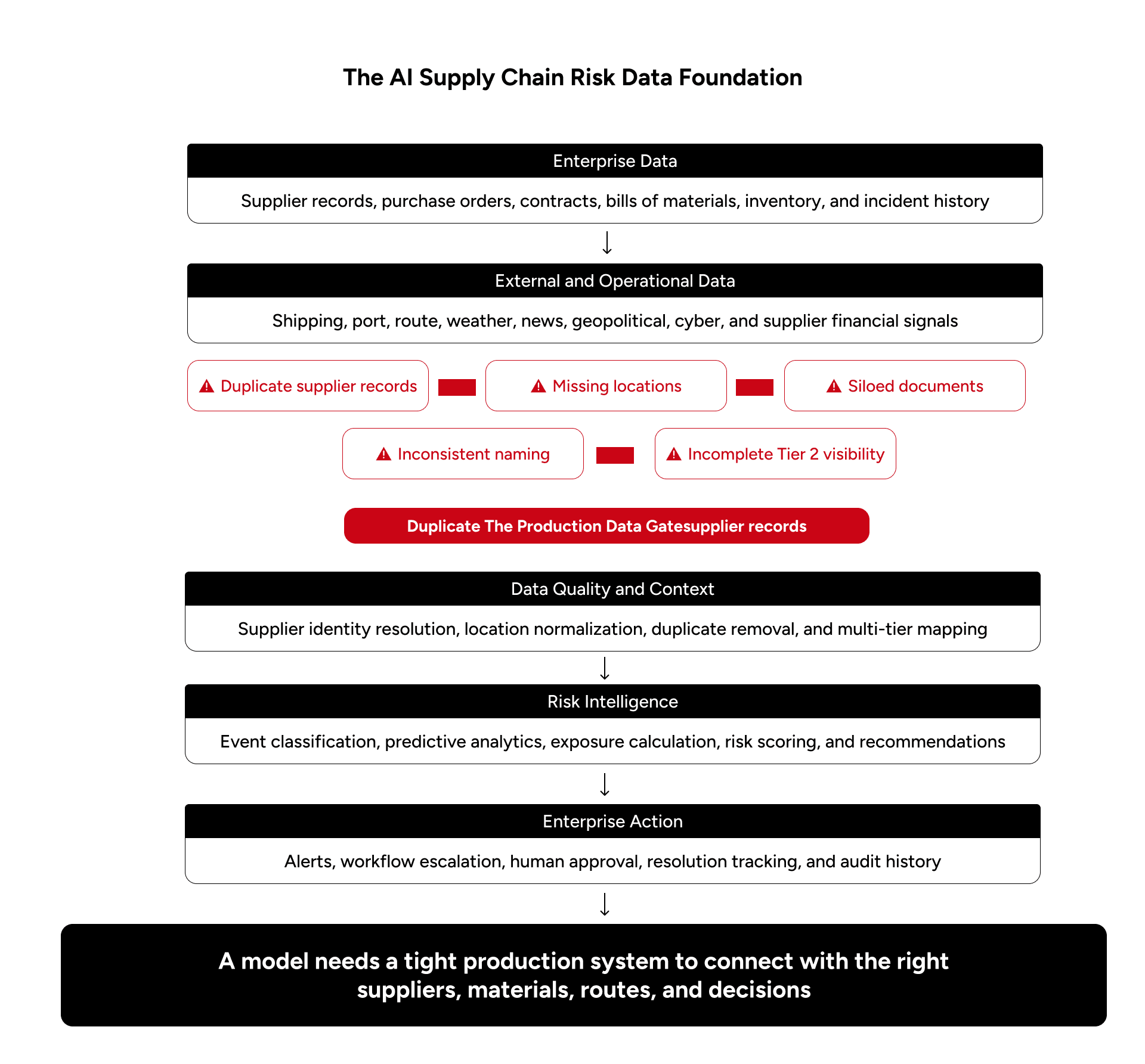
Production performance depends on whether the platform can connect each risk signal to a verified supplier, facility, material, route, order, and inventory position.
That data foundation may need to connect:
- Supplier master records
- Product, material, and bill-of-materials data
- Supplier and manufacturing locations
- Shipping routes and logistics feeds
- Purchase orders and inventory positions
- Compliance and certification documents
- ESG and sustainability records
- Weather, news, geopolitical, and port data
- Internal incidents and supplier performance history
Common data problems include duplicate supplier records, inconsistent legal names, missing coordinates, outdated addresses, unstructured documents, incomplete bills of materials, and limited Tier 2 visibility.
Duplicate supplier records, missing facility locations, inconsistent legal names, and incomplete bills of materials directly affect exposure mapping. These defects can hide a real dependency or associate an event with the wrong part of the network.
For example, a typhoon warning has limited operational value until the platform can establish that:
- A supplier facility lies within the affected area.
- That facility produces a critical component.
- The component supports specific products or plants.
- Current inventory covers only a limited operating window.
- An alternative supplier or route exists.
The prototype-to-production gap appears when a model can summarize a weather alert but the enterprise cannot reliably map it to the affected material and operating decision. Production engineering must add validated data pipelines, identity resolution, monitoring, access control, testing, and failure handling around the AI capability.
How Should Supply Chain Risk Signals Trigger Alerts, Workflows, and Human Decisions?
A signal creates value only when it reaches the correct decision-maker with enough context to act.
A governed workflow should:
- Detect the event through approved external or internal sources.
- Validate and classify it by source reliability, event type, location, and confidence.
- Map the exposure to suppliers, routes, materials, facilities, products, orders, and customers.
- Calculate priority using event severity and business criticality.
- Prepare mitigation options based on approved rules, available capacity, and prior incidents.
- Notify the responsible owner through the system where that team already works.
- Track decisions and actions until the event is resolved or accepted.
- Document the outcome for audit, model evaluation, and future planning.
Human oversight remains essential for supplier termination, major sourcing shifts, contractual action, inventory allocation across strategic customers, and decisions with significant financial or regulatory consequences.
The system should make the decision boundary explicit. It may automatically collect evidence or open a case while requiring approval before changing a purchase order, rerouting a high-value shipment, or replacing a critical supplier.
What Architecture Supports Enterprise-Grade Supply Chain Risk Management Solutions?
An enterprise platform should separate data acquisition, risk intelligence, workflow execution, and governance. This reduces coupling and allows individual components to evolve without compromising the entire system.
Data Ingestion Layer
Connectors ingest batch and streaming information from ERP, procurement, logistics, manufacturing, supplier, and external-data systems. Validation services standardize schemas, identify missing fields, and quarantine unreliable records.
Supply Chain Context Layer
This layer resolves supplier identities and maintains relationships among suppliers, sites, materials, routes, bills of materials, plants, orders, and customers. Graph-based models may help represent multi-tier dependencies and propagation paths.
External Intelligence Layer
The platform collects approved weather, shipping, geopolitical, financial, cyber, regulatory, and news feeds. Every signal should retain source, time, geography, licensing status, and confidence information.
AI and Risk Analytics Layer
Machine-learning and statistical models classify events, identify anomalies, estimate potential impact, and update risk scores. Generative AI can summarize evidence or prepare mitigation options, but deterministic rules should control actions that require consistent policy enforcement.
Rules and Policy Engine
The rules engine applies business thresholds, supplier classifications, inventory limits, contractual requirements, and escalation policies. Keeping core authorization rules outside the generative model improves consistency and auditability.
Workflow Orchestration Layer
A durable workflow engine assigns ownership, handles retries, records state, manages timeouts, coordinates approvals, and prevents duplicate actions. This is the layer that converts intelligence into accountable execution.
Dashboard and Reporting Layer
Role-specific interfaces provide operational views for procurement and logistics, exposure views for finance and risk, and portfolio-level summaries for executive leadership.
API and Integration Layer
APIs and event-based integrations exchange information with ERP, SCM, TMS, WMS, procurement, business intelligence, collaboration, and ticketing platforms.
Security and Governance Layer
The platform requires role-based access, data minimization, encryption, secrets management, audit logging, model and prompt versioning, evaluation records, retention policies, and incident-response procedures. NIST recommends incorporating AI risk governance throughout design, deployment, evaluation, and operation rather than treating it as a final compliance review.
Cloud-native deployment is particularly useful where the system needs:
- Event-driven processing
- Scalable message queues
- Parallel data collection
- Elastic analytics workloads
- Centralized observability
- Structured logging and alerting
- Controlled model deployment
- Tenant isolation for SaaS platforms
- Backup, recovery, and regional resilience
Cloud-native does not mean cloud-dependent by default. Architecture decisions should reflect data residency, latency, sovereignty, integration, and operational requirements.
Build, Buy, or Modernize: Which Supply Chain Risk Management Path Fits?
The implementation path should reflect the enterprise’s data, decisions, workflows, integration requirements, and long-term ownership model.
Path | Choose this path when | Primary advantage | Main constraint |
|---|---|---|---|
Buy | Risk workflows are standardized, vendor data coverage is sufficient, and the organization needs established capabilities quickly | Faster access to proven features, external intelligence sources, and existing compliance controls | The platform may restrict scoring logic, integrations, workflows, data ownership, and user experience |
Build | The enterprise has proprietary data, differentiated risk models, complex supplier networks, or workflows that create a strategic operating advantage | Greater control over architecture, data, models, workflows, deployment, and platform evolution | Requires sustained product, engineering, data, security, governance, and operational capacity |
Modernize | An existing GRC, procurement, control-tower, or SCM platform remains valuable but lacks contextual data, predictive intelligence, automation, or usable workflows | Preserves existing investments while improving intelligence, integration, and decision support | Legacy architecture, data quality, and vendor limitations may restrict the achievable outcome |
A buy strategy fits organizations with standardized processes and a vendor platform that satisfies their integration, governance, deployment, and data requirements.
A build strategy fits enterprises where risk intelligence, scoring logic, supplier context, or mitigation workflows create a meaningful competitive or operational advantage.
A modernization strategy fits organizations with a valuable system of record that requires stronger data pipelines, AI-assisted analysis, workflow orchestration, dashboards, or operational integrations.
The decision should consider:
- Supplier, facility, and location count
- Multi-tier network complexity
- Data quality and ownership
- External intelligence requirements
- Regulatory and contractual exposure
- Custom scoring and workflow requirements
- Integration depth
- Internal product and engineering maturity
- Security and deployment constraints
- Budget, implementation timeline, and long-term ownership
Many enterprises will use a blended strategy. They may purchase external intelligence, retain an existing enterprise platform, and build the data-context, scoring, workflow, or user-experience layers that differentiate their operating model.
A bounded risk workflow provides a practical starting point: one event class, one decision owner, one set of affected entities, and one measurable operational outcome. The pilot findings can guide the wider build, buy, modernization, or blended implementation strategy.
Why Build AI-Powered Supply Chain Risk Management Solutions with GeekyAnts?
Supply chain risk systems sit at the intersection of AI, enterprise data, cloud infrastructure, workflow engineering, and user experience. Building one requires more than training a model or adding another dashboard.
GeekyAnts combines:
- AI product strategy and engineering
- Enterprise platform modernization
- Cloud-native architecture
- Data and API integration
- Risk dashboards and workflow experiences
- AI evaluation and benchmarking
- Production infrastructure, observability, and security
- Dedicated product-engineering teams
Promethean demonstrates the organization’s active R&D in supplier-level risk scoring, external signal monitoring, concurrent analysis, mitigation recommendations, and model-provider flexibility.
Adjacent delivery work further supports the required engineering capabilities. GeekyAnts developed an IoT-connected asset management dashboard for a manufacturing organization, bringing real-time equipment data, logs, charts, and operational monitoring into web and mobile experiences.
For Nexus, GeekyAnts created modular AI agents and automated benchmarking frameworks that integrated experimental AI into existing business-process workflows. The engagement reported a 50 percent reduction in manual validation cycles and 30 percent faster internal testing.
These examples should not be presented as identical to implementing an enterprise supply chain risk platform. They demonstrate the underlying capabilities required to move from an AI experiment to an integrated, testable, observable, and production-ready operational system.
The implementation decision should begin with the workflow and operating model, not with the model. Once the enterprise agrees on the event it needs to detect, the decision it needs to make, the person accountable, and the outcome it will measure, the right product and engineering path becomes much clearer.
Kunal KumarChief Revenue Officer
What Comes Next for Predictive Supply Chain Risk Management?
Supply chain resilience depends on turning fragmented signals into coordinated decisions.
AI can help enterprises detect events, map exposure, prioritize incidents, and prepare mitigation options. Durable performance comes from the system around that intelligence: governed data, explainable scoring, enterprise integration, clear ownership, human approval, and continuous evaluation.
The strongest supply chain risk management solutions will not just focus on producing the most alerts, but on helping the right people make well-informed decisions in time.
Sources & Citation
- McKinsey Global Institute — Risk, Resilience, and Rebalancing in Global Value Chains
- McKinsey — Supply Chain Risk Pulse 2025: Tariffs Reshuffle Global Trade Priorities
- McKinsey — Reimagining Supply Chain Resilience
- Gartner — Supply Chain Leaders Should Prioritize Advanced Data Visibility and Scenario Planning
- Gartner — Supply Chain Disruption and AI-Enabled Automation Forecast
Enterprise supply chain risk management depends on an architecture that keeps intelligence, policy, and execution clearly separated. AI can interpret signals and recommend responses, while deterministic rules govern critical decisions and workflow systems ensure accountable action. Cloud-native infrastructure adds the scale, resilience, and observability needed to operate this model across complex enterprise environments.
Kunal KumarChief Revenue Officer