

Editor’s Note: This article was originally written by Amrit Saluja and published in June, 2025. It was revised and updated by Shivangi Agarwal in July, 2026 to include current technologies, implementation practices, industry requirements, and examples. The technical content was reviewed by Robin, Senior Business Analyst.
Key Insights: Building AI Personal Finance Apps in 2025
- AI personal finance apps are primarily about tracking—they predict, coach, and act in real-time.
- Users want smart money assistants, not spreadsheets. AI makes that shift possible.
- How to build apps with NLP, predictive analytics, goal tracking, and fraud detection.
- Discover the real cost to build an AI-powered finance app in 2025—from MVP to full-scale product.
- Explore proven strategies to cut development costs without cutting corners.
- See how apps like Mint and Digit set the standard—and how you can build better.
People do not want more spreadsheets. They want answers.
Personal finance apps are typically limited to expense logs, budget planners, and monthly charts. But users today expect them to explain spending patterns, anticipate cash- flow problems, detect unusual/ suspicious transactions and recommend what to do next.
In the U.S, AI has made this shift possible over the past few years. It is capable of categorising transactions, forecasting balances, personalizing budgets, identifying anomalies, and answering your financial questions using natural language.
However, the objective of the process should not merely be incorporating AI into the already existing budgeting application. It is about providing the user with better financial choices while minimizing his efforts.
The problem that emerges as financial software is becoming increasingly intelligent is not in the ability to implement the technology but in the capacity to do it reliably, safely, and effectively enough to ensure trust from the users.
Banks have responded. Startups have surged. Together, they have turned financial self-management from a niche into a norm. As demand rises and competition tightens, there is only one question: How does one build such a finance-driven app that learns, evolves, and earns trust, line by line?
The following guide will provide you with insights on how to determine the correct use case, develop an MVP, design UX, prepare the technological stack, incorporate effective AI capabilities, test your software, control the development costs, and improve your product.
The State of the Personal Financial Assistant Market
Evolution of AI in Personal Finance, Rise of Fintech in the U.S., and the Demand for Smarter Money Management
It started with worksheets. Rows, columns, formulas—and a lot of guesswork. Then came budgeting apps: helpful, but still reactive. Today, a new kind of tool is taking shape. In the U.S., AI-powered personal finance assistants are moving from niche utility to everyday necessity.
People no longer want to track their money—they want to know where it’s going next. They want a system that understands when rent is due, when spending spikes, and when saving stalls. And they want that system to adjust, without being told.
According to Plaid’s 2025 research into fintech, consumers are becoming more aware of the need for frictionless and trusted financial experiences; features powered by AI that will make their financial life better, and educational tools rather than monitoring ones.
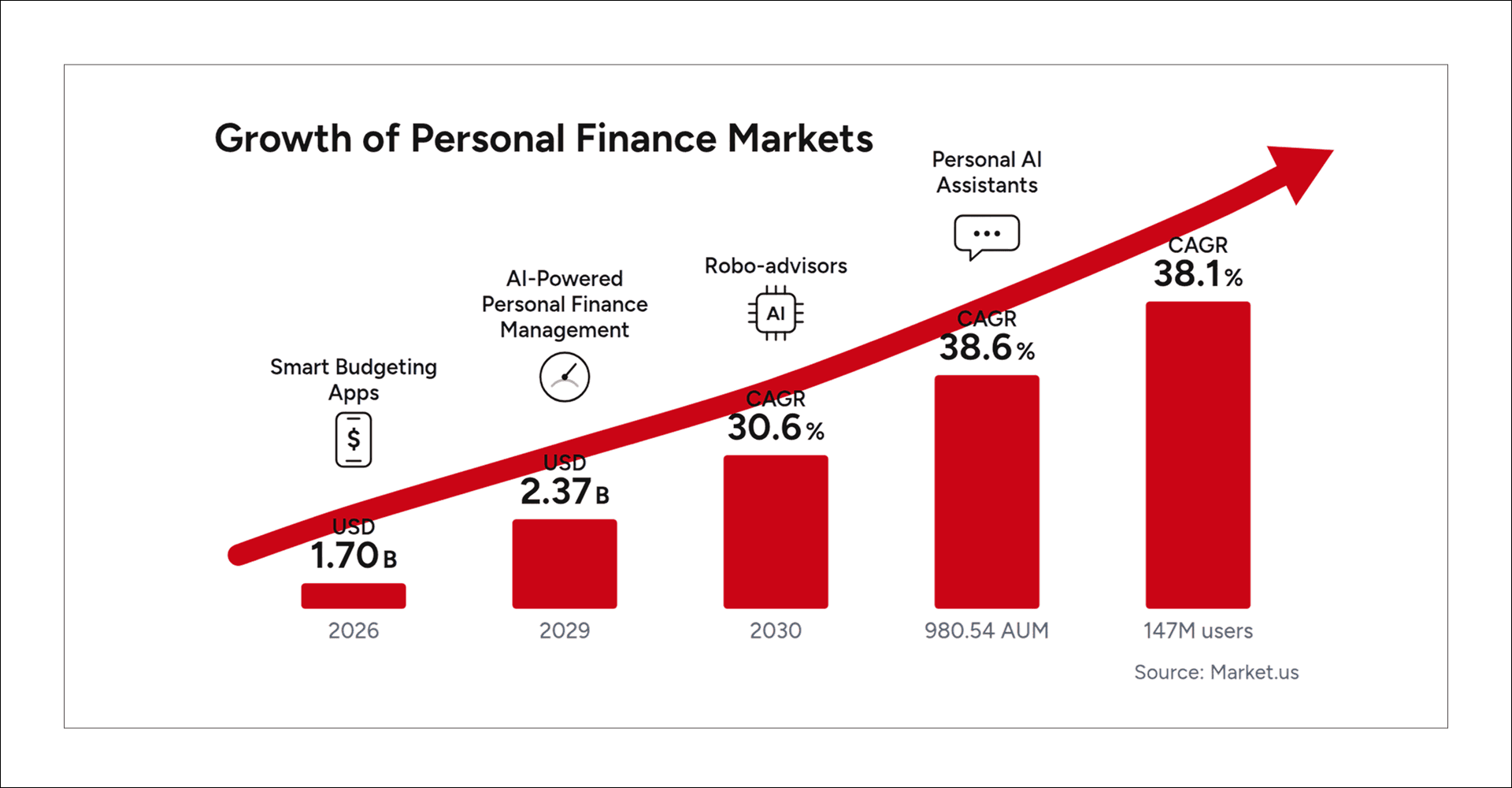
Adoption is also evidenced in the wider finance app category. Cash App had about 39 million US downloads in 2025, while PhonePe was responsible for around 128.5 million downloads globally. Even though these products are not as narrow as personal finance assistants, their numbers show that users are willing to conduct critical financial operations using mobile apps.
It must be noted that the size of the market varies depending on which categories of financial applications the research included, like budgeting tools, banking platforms, wallets, investment products, etc. The value of the personal finance app market is estimated at $38.2 billion in 2026 and projected to grow to $173.6 billion by 2035- ResearchNester. Hence, the number should be seen as an industry estimate rather than a universally accepted market size.
In the U.S. region, apps built on AI—tools that adapt to income changes, predict future expenses, and recommend next steps—are seeing the strongest adoption among millennials and Gen Z.
The development of personal finance apps is not about adding new features but changing their purpose from trackers to interpreters, predictors, and advisors. The winning products will do more than just crunch the numbers. They will provide guidance on what is going on, what is likely to happen next, and what can be done about it.
About AI-Driven Personal Finance App—and Why It Matters Now?
Money moves, but most people only see it in hindsight. That gap between what users know and what their finances are doing defines the core problem AI aims to solve.
An AI-driven personal finance app works as a real-time analyst, coach, and assistant. It processes patterns users miss, delivers guidance before decisions get made, and turns raw numbers into intelligent action. This is not an upgrade to traditional budgeting tools—it is a departure from them.
Types of AI-Powered Personal Finance Apps
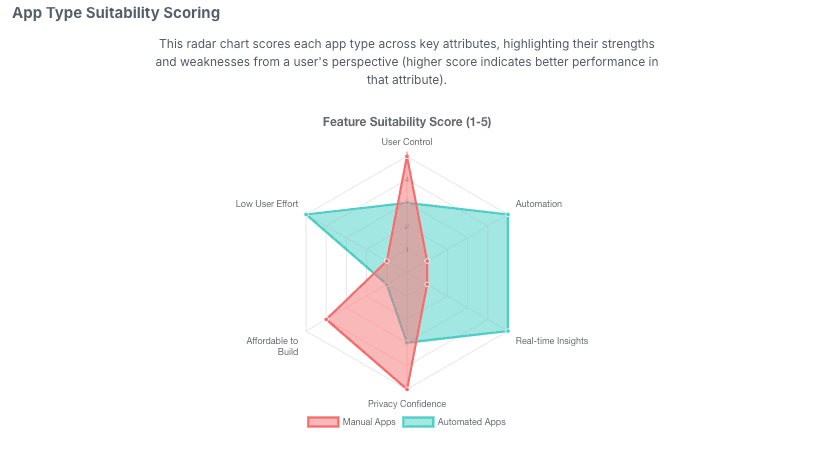
In a market shaped by both simplicity and intelligence, personal finance apps fall into two clear camps—those that give full control to the user, and those that take the load off entirely. Understanding this split is the first step to building or choosing a product that fits the way real people live and manage their money.
1. Manual Personal Finance Apps: Control in Simplicity
These are the DIY tools of personal finance. Users enter their expenses, incomes, and categories manually. There’s no automation, no data sync from your bank—just you and your numbers.
Think of it as your digital notebook: simple, private, and under your complete control.
Why people choose them:
- Full control: You input what matters—nothing gets tracked without your consent.
- Safe & secure: No need to link sensitive accounts. Great for privacy-conscious users.=
- Affordable to build: Ideal for MVPs or basic use cases with a tight development budget.
Trade-offs:
- Manual work = more effort: Entering every transaction can get tedious.
- High error potential: A missed entry or typo can throw off your entire budget.
- No real-time insights: You only see what you’ve entered, which may lag behind actual spending.
Best for: Minimalists, spreadsheet lovers, and users just starting their money-tracking journey.
2. Automated Personal Finance Apps: Smart, Seamless, Scalable
These AI budgeting apps take the heavy lifting off your shoulders. By connecting directly to bank accounts, credit cards, and wallets, they automate tracking, budgeting, and even investing.
You get real-time insights, categorized spending, predictive alerts, and tailored advice—often without needing to open the app every day.
Why people love them:
- Set it and (mostly) forget it: Syncs your financial data in real-time.
- Rich insights: AI categorizes, analyzes, and even warns about potential issues.
- Feature-rich: Many support goals, savings plans, subscriptions, credit tracking, and more.
Trade-offs:
- Higher development cost: Building secure integrations and data pipelines isn’t cheap.
- Privacy considerations: Linking financial accounts requires trust in the app’s security and intent.
Best for: Busy professionals, goal-driven users, and anyone who wants smarter money habits without micromanagement.

Key Benefits of AI Personal Finance Apps
Your Money Needs a Coach—AI Is Here to Fill the Role
Personal finance apps traditionally gave snapshots of your finances. AI-driven apps shift the role from reporter to coach, and in this piece, we explore the key benefits that come with that transformation.
1. Enhanced Financial Literacy
These apps do not tell—they teach. AI clarifies patterns and explains how small decisions echo across your financial life. Apps like Zogo, used by 700K+ users, turn banking behaviors into bite-sized lessons, making education feel like engagement.
2. Automated Budgeting
Manual tracking wastes time. AI categorizes spending instantly, builds budgets tailored to real-life habits, and creates frictionless money management. Tools like Copilot and Monarch Money are leading here, removing friction while giving users full visibility.
3. Personalized Financial Advice
Advice that fits someone else is noise. AI sees financial stories behind data and crafts recommendations shaped by individual goals, behavior, and life stages. Albert’s Genius, for instance, offers smart suggestions—and even lets users text a human advisor when they want a second opinion.
4. Predictive Analytics
By analyzing trends and habits, AI sees what's ahead. Apps highlight gaps before they widen and surface growth opportunities before they fade.
5. Goal Tracking and Motivation
AI helps users set goals, track progress, and adjust plans based on changing financial behavior. Platforms like Capital embed saving rules that trigger based on user activity—such as rounding up transactions or saving after workouts—which contributed to a 20% boost in 6-month user retention.
6. Fraud Detection and Security
AI constantly scans for behavior that feels “off” flagging fraud, forgotten charges, or billing spikes. Rocket Money and Emma users routinely discover surprise subscriptions and billing errors before their banks even alert them.
7. Time Savings
AI automates routine financial chores—categorizing transactions, paying bills, balancing portfolios—freeing users to focus on what matters. Users of Rocket Money reported saving 3–5 hours a month thanks to intelligent bill detection and automation, translating to higher app satisfaction and improved daily engagement.
8. Behavioral Nudging
Instead of overwhelming users with dashboards, AI creates subtle behavioral cues. In Capital, goal-linked rules like “save $5 when I skip coffee” led to consistent savings behavior. These micro-automations created a sense of progress, which directly influenced user stickiness and habit formation.
AI-powered personal finance apps do not overwhelm users with data. They remove noise, surface action, and fit quietly into daily life. That is their role—and their edge.
What AI Does Inside a Personal Finance App?
Most apps show users where their money went. AI shows where it will go—and what to do next. This difference defines whether a tool stays in the background or becomes essential.
Here is what AI enables when built right—not as features, but as decisions made faster, smarter, and in real time.
1. NLP That Understands Finance
Typing feels like friction. Speaking feels natural. With advanced Natural Language Processing, users ask real questions: “How much did I spend on food last month?” or “Can I afford that laptop?” AI understands intent, fetches data, and responds like an assistant, not a search bar.
It does not guess. It knows what the question means and why it matters.
2. Forecasting, Not Guesswork
AI watches spending patterns, payment cycles, and income shifts to see what’s next. It warns about upcoming overdrafts, tracks progress toward goals, and adapts to real-world changes like market movement or a dip in income.
No user needs to ask “What if?”—AI answers before the question forms.
3. Advice That Fits, Not Floats
Generic tips go unread. AI watches real behavior, then recommends what matters—adjusting budgets, highlighting better deals, or flagging smarter debt repayment paths. It learns the user's goals and risks, then nudges toward better decisions without needing a dashboard deep dive.
4. Fraud, Found Before It Spreads
AI notices when something looks off, not by flagging every large purchase, but by knowing what is normal for the user. A card swipe in a new city. Ten small charges in under a minute. AI catches subtle shifts and alerts fast.For example, Random Forest for fraud detection, LSTM for forecasting can be used.
Security moves from reactive to predictive.
5. Categorization That Learns
Manual tagging dies off in week two. AI tags, organizes, and enriches every transaction—cafe visits, ride shares, subscriptions—without prompts. It adapts to corrections, sharpens accuracy, and adds details users never typed.
The app builds a financial narrative, not a spreadsheet.
6. Dynamic Goal Setting That Adjusts, Not Hopes
Savings goals should shift when life does. AI recalculates timelines, suggests adjustments, and shows users how to stay on track—even when conditions change. It turns goals into adaptable systems that course-correct automatically.
7. Emotion-Aware Interaction
Some users feel in control. Others feel stuck. Sentiment analysis listens—not to what users ask, but how they ask. A note of stress? AI shifts tone, offers human help, or simplifies the next step.
It responds to both the balance sheet and the person reading it.
AI, when done right, understands, predicts, reacts, and adapts. That is the leap from tool to companion, where finance moves from task to guidance.
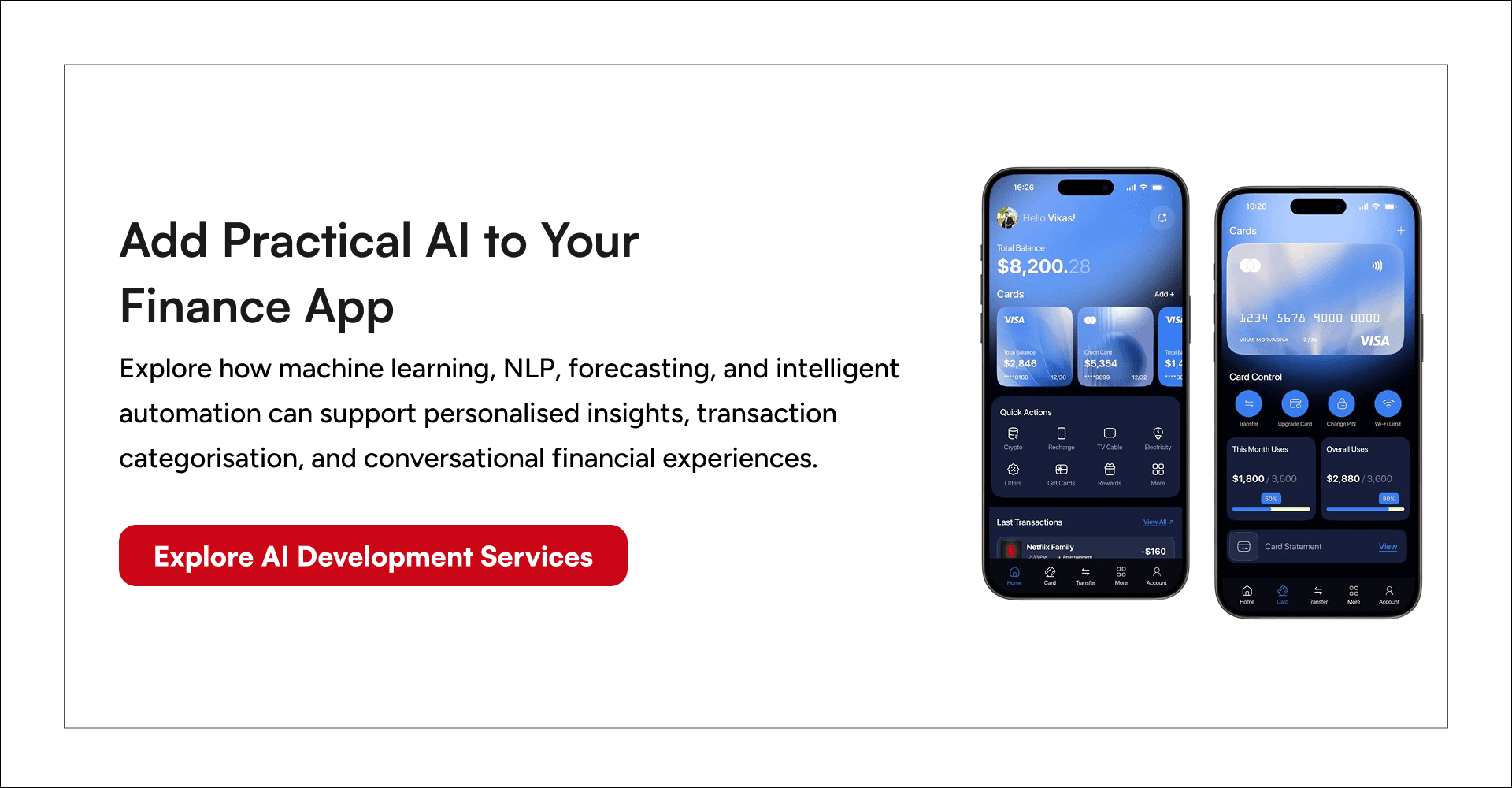
How to Create an AI driven Personal Finance App: Step-by-Step Development Process

Developing an AI-driven personal finance app is a multi-stage journey that requires a structured approach and expertise across various domains. That is where a digital product studio like ours comes in. We don’t just build—we guide. From shaping the first idea to launching at scale, we bring structure, speed, and experience to every stage.
The steps outlined below are shaped by what we've learned building intelligent finance apps for real-world users.
STEP 1: Discovery and Research
Duration: 2-3 weeks
Product success begins with precision. CB Insights states 70% of successful fintech apps begin with deep discovery. Every great product starts by asking the right questions. Who are we building for? What’s broken? And where can we be 10x better?
Discovery isn’t about assumptions—it’s about uncovering truths.
We dive into market trends, decode user behavior, and map out gaps that existing apps overlook. Using tools like Miro, Notion, and Google Workspace, we shape user personas grounded in real spending patterns. From there, business goals turn into functional priorities—what to build, what to automate with AI, and how to do it without compromising compliance from day one.
STEP 2: Strategic Planning and MVP Definition
Duration: 2-3 weeks
Not everything great needs to launch at once. The challenge here isn’t ambition—it’s focus. We zero in on one core problem, one primary user journey, and define an MVP that solves it beautifully.
Behind the scenes, we shape a release roadmap, prioritize features by impact, and lay down the tech architecture for AI-readiness. Data planning runs parallel, because intelligent products launch and learn.
This is where your vision gets trimmed, shaped, and made real.
STEP 3: UI/UX Design
Duration: 3-4 weeks
Before visuals or polish, design starts with mapping how users move through the app—where they begin, where they hesitate, and what leads them forward. These flows shape early wireframes, built to test logic and flag friction. Interactive prototypes follow, adding transitions, feedback, and interface logic that mirror real use.
Once the flows are clear, visual design brings tone. Every layout reduces noise. Every color leads to attention. The interface should build trust. AI interaction design is layered in next—how users engage with chatbots, where recommendations surface, and how feedback cycles complete. Every element adjusts to diverse needs without compromising clarity or control.
STEP 4: Backend Development and AI Model Training
Duration: 4-6 weeks
Function meets structure here. APIs are built using Node.js, Python (Django or FastAPI), and data flows into scalable databases like PostgreSQL, MongoDB, or Firebase.
AI pipelines are designed with Scikit-learn, Prophet, or TensorFlow, depending on the use case. NLP features like categorization or chatbots tap into spaCy or Hugging Face Transformers. Data cleaning and enrichment is managed via Pandas, and pipeline orchestration uses tools like Apache Airflow or DVC. Security wraps around it all—encryption, API throttling, and access control handled via AWS IAM or Firebase Auth.
STEP 5: Frontend Development
Duration: 4-5 weeks
Frontend development begins by translating design into code using frameworks like React.js, React Native, or Flutter, chosen for their flexibility and cross-platform consistency. Shared components and responsive layouts should ensure the experience remains seamless across devices, screen sizes, and user contexts. Third-party integrations can be added to meet core financial needs, from connecting banks via Plaid to supporting payments and syncing budgeting data. Real-time data flows feed dashboards and insights that respond as users interact. The goal should be clarity. The interface makes complexity usable, guiding actions without requiring new habits.
STEP 6: Quality Assurance and Testing
Duration: 2-3 weeks (with overlap)
Now, every feature must work together. Quality assurance ties it all together. Functionality is verified through Jest or Cypress, performance is load-tested, and vulnerabilities are scanned via tools like OWASP ZAP or SonarQube.
For mobile, Detox and BrowserStack help simulate device usage. Usability testing identifies friction points, while AI models are tested for fairness and alignment using synthetic and real datasets. QA isn’t just about bug-fixing—it’s about ensuring trust across tech, logic, and experience.
STEP 7: Deployment and Post-Launch Support
Duration: 1-2 weeks (ongoing thereafter)
Deployment marks the beginning of product evolution. Code is shipped to Google Play and Apple App Store, while backend infrastructure is deployed on AWS, GCP, or Azure with automated CI/CD pipelines using GitHub Actions, Bitrise, or Jenkins.
Live monitoring kicks in with Sentry, Datadog, or Firebase Crashlytics, ensuring stability. Product usage is tracked through Mixpanel, Segment, or Google Analytics, while AI models are retrained periodically using secure cloud workflows.
When done right, the personal finance app becomes a system of guidance. A digital product studio brings the structure, skill, and foresight needed to make that happen, turning complexity into clarity and ambition into execution.
The only question is “Who will build them right?”

Core Features of AI-powered Personal Finance Apps:
The strength of an AI personal finance app lies in how intelligence drives action. Below are the features that separate tools from systems—each one designed to shift you from awareness to control.
- Seamless Account Aggregation (Powered by AI)
Connecting financial accounts is now standard. What sets modern apps apart is what they do with that data. Using secure APIs, the app pulls in checking, savings, credit cards, loans, and investment accounts into one unified view. AI then cleans messy transaction descriptions, groups recurring payments, and identifies behavioral patterns. It knows that “NETFLIX *US” and “Netflix.com” refer to the same subscription and categorizes them accordingly. The result? A clear, consolidated financial snapshot—no spreadsheets, no toggling between accounts.
- Intelligent Budgeting and Expense Tracking
Budgets often fail because they don’t adapt. AI fixes that. It continuously monitors user spending, sets personalized limits, and adjusts those limits as income or lifestyle changes. The system flags overspending patterns before they spiral, like frequent micro-transactions or seasonal splurges. It doesn’t just remind you; it recalculates.
Example: “You’ve used 80% of your dining budget with 10 days left this month. Consider eating more to stay on track.”
- Personalized Insights and Financial Recommendations
AI here works like a financial analyst—studying income, spending, debt, risk, and goals—then offering decisions that fit. It spots patterns: overspending compared to peers, irregular income spikes, or missed opportunities in saving habits. Recommendations go beyond alerts: increase savings frequency, reorder debt payoff strategy, and reallocate investment exposure. Advice adapts to the user’s financial capacity, not a universal rule.
- Goal-Based Planning and Optimization
Say you are aiming to save $10,000 for a down payment in 18 months. AI calculates what you need to set aside, then adjusts as your income or expenses change.
Whether it is a down payment or a trip, the system builds the plan, adapts to cash flow, and keeps progress on track. If you fall behind, it suggests smart trade-offs—no micromanaging required.
- Automated Bill and Subscription Management
Beyond simple reminders, AI actively identifies recurring bills and subscriptions, even those with vague transaction descriptions. It alerts users to upcoming payments, detects duplicate subscriptions, highlights price increases, and can even suggest ways to negotiate bills or cancel unused services, saving users money and preventing overdrafts.
- Credit Score Monitoring and Improvement
Your credit score affects more than loans—it shapes your financial flexibility. The personal finance app goes beyond the numbers. It tells you what is helping, what is hurting, and what you can do next. Whether it is paying off one card, fixing an error, or adjusting your utilization, you get clear, direct steps that fit your actual situation, not some vague advice.
- Enhanced Security and Fraud Detection
Fraud does not wait, and neither should your app. AI constantly checks for unusual activity—location changes, duplicated charges, spending that does not match your habits. When something looks off, you get alerted right away with a prompt to act. Add that to biometric logins and encrypted data, and it is not just secure—it is smart about how it protects you.
- Conversational AI for Natural Financial Queries
Users interact with money daily. But few apps speak back with clarity. Powered by NLP, the chatbot enables real-time queries. Ask about last month’s grocery spending or set a savings goal in plain language. The bot retrieves, computes, and responds. It can break down patterns, guide goal setting, and surface trends on demand. It is a financial guide, available anytime, through words, not clicks.
This kind of app guides, listens, learns, and adapts to your world. That is what separates smart apps from helpful ones—and helpful ones from the ones people rely on. If it is built right, it stops feeling like software and starts working like part of your life.
Together, these features define the roadmap—Seamless Account Aggregation, Intelligent Budgeting, Goal-Based Planning, and Enhanced Security form the MVP foundation, while Personalized Insights, Automated Subscription Management, Credit Score Monitoring, and Conversational AI represent advanced capabilities for V2 and beyond.
Cost to Build an AI Budget Planner App
Building a personal finance app today isn’t just a tech decision—it’s a product, budget, and growth strategy rolled into one. Whether you're launching a simple expense tracker or a full-blown AI money coach, your cost will vary depending on whether you're targeting the US market or going global, and will ultimately depend on how far you want to go and how fast you want to scale.
- Starting small? A core MVP with budgeting, tracking, and a clean UI can run between $61K–$152K—enough to get you live with solid foundations.
- Looking for more polish and smarts? With better UX, APIs, and basic AI like smart alerts, expect $142K–$305K.
- Going all-in on AI? Real-time insights, goal tracking, savings paths, and nudging can push costs to $305K–$700K+, with AI alone often ranging from $50K–$200K.
Component | India Estimate | Offshore (Non-India) Estimate | |||
Basic MVP | $35K–$90K | $45K–$120K | |||
Moderate Complexity App | $90K–$180K | $110K–$250K | |||
Advanced AI-Driven App | $180K–$400K+ | $250K–$600K+ |
There are also some extras—marketing, product management, and post-launch support scale with your user base.
Start with clarity. Define what your users need. Build around that. Every feature adds cost, but the right ones create lasting value.
Component Area | Basic APP (MVP) | Moderately Complex App | Advanced AI-Driven App |
UI/UX Design | $800-$15,000 | $15,000-$30,000 | $30,000-$60,000+ |
Frontend Development | $15,000 - $30,000 | $30,000- $60,000 | $60,000-$120,000+ |
Backend Development | $20,000 - $40,000 | $40,000-$80,000 | $80,000-$150,000+ |
API Integration | $5,000 - $10,000 (basic) | $10,000-$25,000 (multiple) | $25,000-$50,000+(complex) |
Database Setup | $3,000 - $7,000 | $7,000-$15,000 | $15,000-$30,000+ |
AI/ML Model Development & Integration | Minimal/None | $20,000-$50,000 | $50,000-$200,000+ |
Quality Assurance | $5,000 - $10,000 | $10,000-$25,000 | $25,000-$50,000+ |
Project Management | $5,000 - $10,000 | $10,000- $20,000 | $20,000-$40,000+ |
Total Estimated Cost | $61,000-$152,000 | $142,000-$305,000 | $305,000-$700,000 |
NOTE: These figures are estimates and can vary based on the specific development team, their location (e.g., U.S. vs. offshore), and the hourly rates. Maintenance, support, and future updates are additional costs not included here.
Ongoing costs typically range from $2,000 to $8,000/month, covering cloud infrastructure, AI model retraining, API usage (e.g., Plaid), and monitoring—scaling with user base and feature complexity.
Metric | Typical Range |
Customer Acquisition Cost | $5–$15/user (organic), $15–$60/user (paid) |
Payback Period | 9–18 months (MVP) / 12–24 months (AI-led platforms) |
Revenue Models | Subscription, premium tier, referral/affiliate, SaaS API licensing |
This table helps you model product ROI at every stage—from lean MVPs to full-scale AI platforms.
Strategies to Optimize Development Costs for AI Personal Finance Apps
Developing a high-quality AI personal finance app does not have to break the bank. Here are strategies to optimize costs without compromising quality:
1. Start with a Lean MVP and Iterate:
Your first release does not need to do everything. Focus on a lean MVP with only the essential features users care about—budgeting, transaction tracking, maybe one AI-led insight.
Ship it, gather real user feedback, and iterate fast. At GeekyAnts, we follow a “build-measure-learn” loop where the MVP hits market in weeks, and iterations happen in response to actual usage, not assumptions.
2. Embrace Cross-Platform Frameworks
Instead of building separate native apps for iOS and Android (which doubles development effort and cost), leverage cross-platform technologies like React Native or Flutter. These frameworks allow developers to write a single codebase that runs on both platforms.
3. Offload Execution, Keep the Vision
Building in-house works—but at a price. Keeping strategy internal while outsourcing build to trusted offshore teams saves cost and time. The right partner understands scope, delivers fast, and scales with your product.
GeekyAnts’ clients routinely save up to 35% vs in-house hiring with this model, without losing quality, speed, or ownership.
4. Build Only Essential AI Features for the First Release
AI adds value—but only if it is used well. Avoid overbuilding in early stages. Start with AI that learns user patterns or cleans transaction data. Once the app collects real behavioral data, scale advanced models—like forecasting or fraud detection.
5. Leverage Cloud-Native Services & Serverless Architecture
Use AWS Lambda, Firebase, Supabase, or Cloudflare Workers to auto-scale, cut backend overhead, and launch faster. These serverless tools handle uptime, security, and scaling—so your team ships, not maintains.
Offload the ops. Build what matters.
6. APIs Before Screens
Start with the backend. An API-first structure means cleaner data flow, faster development, and easier updates. It also makes it easier to connect with banking APIs and other third-party services later, without rewriting code.
7. Embrace Modular, Component-Driven Frontends
Do not rebuild what you can reuse. At GeekyAnts, we use our internal component libraries (like NativeBase and gluestack.io) to rapidly assemble clean, consistent interfaces, reducing both design and development cycles. You get speed, uniformity, and a frontend that’s built to scale.
How to Monetize an AI Personal Finance App?
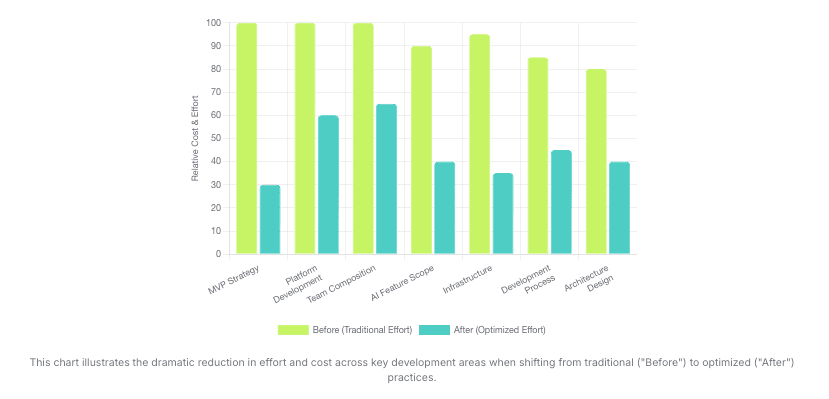
You built more than a finance app. You built an AI tool people trust with their goals, their fears, and their futures. The value is real. The results are real. The next step? Make the business just as strong as the product.
Here is how to turn your AI personal finance management app into a revenue engine—without losing user trust.
1. Start Free, Earn Loyalty, Then Unlock Premium
Most users won’t pay on day one—and that’s fine. Start with a free tier: basic budgeting, expense tracking, helpful nudges. Let users build habits and small wins. Once they trust your AI, offer upgrades they’ll value.
Apps like Rocket Money follow this model: users get basic spending insights for free, but pay for premium features like subscription cancellations and bill negotiation. It works—Rocket Money hit 3.4M+ users and claims to have saved users over $245M, much of that from paid services.
2. Charge for Outcomes, Not Access
A subscription model only works when users feel the ROI every time they open your app. This is not about locking features—it is about solving real pain.
If your AI helps them avoid overdrafts, lower debt, or save without thinking, they will not hesitate to pay monthly. Keep the pricing fair, but the value clear. People will pay for control over their money—if you prove you can give it.
YNAB is a perfect example—charging users ~$99/year, and showing that new users save $6,000+ on average in their first year, according to company reports.
3. Recommend Products, Not Ads
Your app knows when someone is paying too much in interest or missing out on better offers. Use that knowledge. Partner with banks, cards, and lenders—but recommend only what fits the user’s needs. Let your AI do the matchmaking.
When they act, you earn a referral fee. No banners. No distractions. Just real-time value that feels like advice, not selling.
Credit Karma does this at scale, matching users with credit card and loan offers based on their credit profiles. It built a $ 7 B+ business doing exactly that, without ever charging its users directly.
4. Connect Users with People Who Can Help
Sometimes, users need more than an algorithm—they need a human advisor, a tax expert, a mortgage coach. Your app can be the bridge.
Pre-qualify users with your AI, then pass those insights to trusted professionals. For instance, Empower routes users from its AI-driven app experience to financial planners for tailored advice, while Facet Wealth offers dedicated CFPs as part of its subscription model. You become the lead engine—and get paid for every match. The more trust your app builds, the more valuable those leads become.
5. Monetize Insights—Not Individuals
You do not have to charge users to make revenue. The data behind the scenes—when anonymized and aggregated—holds insights that banks, fintechs, and researchers want.
What are young users saving for? When do people increase spending? Which habits lead to financial growth? You can offer answers safely and ethically. Zero personal data shared. Just patterns, at scale. Revenue without friction.
Companies like Plaid and MX already offer this model, providing anonymized financial behavior insights to institutions without compromising user privacy.
- Sell Your Platform to Businesses
You can help more people without adding users one by one. Package your app for employers who want to offer financial wellness to staff. Or license it to fintechs who need a proven tool.
White-labeling opens enterprise revenue streams. You get recurring income while they get a trusted solution. It is growth without fighting for every download.
You can help more people without adding users one by one. Package your app for employers who want to offer financial wellness to staff. Or license it to fintechs who need a proven tool.
Brightside and Origin do this well, offering financial wellness platforms to HR teams. Even Digit began exploring white-label licensing before being acquired by Oportun.
7. If You Use Ads—Make Them Invisible
Personal finance and ads rarely mix well. If you include them, make them feel like content. Credit health tips. Financial literacy partners. Nothing random. Nothing flashy.
Truebill (now Rocket Money) also took this route, offering partner deals and recommendations that appear as part of the user’s financial insights, not as banner ads.
Your product is built on trust. Every click should strengthen it, not sell it.
The best monetization strategy respects your users, reflects your mission, and rewards the trust your product has earned. If your app makes money management feel simple, secure, and personal, users will pay, partners will join, and the business will grow.
How GeekyAnts Can Help You Build fully custom AI-Powered Personal Finance Products
At GeekyAnts, we bring deep experience in fintech software engineering, spanning secure investment tools, neobanks, budgeting apps, and AI-driven insights. With a sharp focus on user trust, privacy, and performance, we’ve helped startups across the US and UK go from idea to launch at speed and scale.
From real-time stock data integrations to smart savings nudges, we bake AI into every layer of the experience, combining full-stack product thinking with advanced machine learning, NLP, and embedded finance expertise. We build software products hat users trust—and investors back.
Our Track Record in Fintech AI
We’ve delivered high-impact solutions across digital banking, wealth management, and intelligent financial planning.
- Neobank Habit Assistant – Embedded AI nudges and NLP-driven chat to drive savings behavior and reduce churn.
- Investment Tracker Suite – Cross-platform tool for retail investors with real-time portfolio analysis and predictive performance modeling.
- AI-Powered Budget Coach – Integrated Plaid, spending analysis, and dynamic budget suggestions tailored to user cash flow and goals.
All platforms were designed with bank-grade security, built cloud-native, and tailored for U.S. compliance and scale.
Built for Trust. Engineered for Growth.
Our systems follow a compliance-first architecture—supporting PCI DSS, SOC 2, and evolving U.S. regulatory frameworks. We integrate seamlessly with APIs like Plaid, Stripe, and financial data providers, ensuring your app scales securely as user needs grow.
We are also aligned with EU data standards like GDPR, ensuring data protection and user consent are baked into every flow. For regions like India, we adapt to frameworks such as the Account Aggregator ecosystem, enabling secure, user-permissioned financial data sharing across banks and institutions.
And because growth is tied to adaptability, we keep your product ready for innovation—whether it is conversational AI, behavior-based automation, or future-ready fintech integrations.
One Team. One Vision.
No silos. No handoffs. Just one agile team—from strategy to shipping.
If you’re looking for a partner who gets fintech, understands speed, and builds with long-term trust in mind, let’s talk.
Proof That AI Can Handle Money Smarter Than You? Start Here.
Before you build your AI-driven personal finance app, it helps to see what success looks like. These real-world apps are growing and reshaping how people manage money every day.
Mint: The Aggregator That Started It All
With over 25 million users, Mint popularized account aggregation and AI-backed expense tracking. It auto-categorizes transactions, highlights spending patterns, and builds dynamic budgets. More than a dashboard, it helps users understand their money.
Expense Tracker → Account Aggregation + Auto-Categorization + Budget Suggestions
YNAB: Budgeting, Backed by Smarts
"You Need A Budget" has built a cult following of 1M+ paying users by combining behavior-driven finance with intelligent automation. Recurring payments, savings goals, and real-time insights are managed behind the scenes—keeping users on track with minimal input.
Budgeting App → Behavioral Analysis + Dynamic Budgeting + Goal Tracking
Marcus Insights: AI That Cuts the Waste
Part of a platform serving millions of U.S. consumers, Marcus Insights uses AI to flag forgotten subscriptions, highlight cash flow gaps, and simplify financial planning. It doesn’t overwhelm—it quietly fixes what’s broken.
Expense Optimization → Subscription Detection + Anomaly Detection + Spend Analysis
Empower: For Wealth Builders
With 1.5M+ users and $1B+ in managed assets, Empower combines AI with wealth tracking. It analyzes portfolios, suggests rebalancing, flags high-fee funds, and helps users grow beyond just budgeting into long-term wealth strategies.
Wealth Management → Portfolio Analysis + Rebalancing Nudges + Fee Optimization
Rocket Money: Subscription Slayer Meets Bill Negotiator
Trusted by over 3.4M users, Rocket Money’s AI detects unused subscriptions and negotiates lower bills. What makes it sticky? Real, measurable savings. Its smart financial assistant has saved users over $245M to date.
Bill Management → Subscription Recognition + Bill Optimization + Smart Alerts
Digit: Save Without Thinking
Acquired by Oportun, Digit boasts 1M+ users who trust its algorithm to automate savings. It monitors income and expenses, then moves small amounts to savings goals—without needing user input. Quiet, consistent, and helpful: AI at its best.
Automated Savings → Predictive Saving + Goal-Based Transfers + Passive Budgeting
The Takeaway? Users Trust AI That Helps, Not Hypes.
Each of these apps solves a real money problem. They use AI not for flash, but for function. They simplify decisions, save time, and build confidence. If you are building your solution, let that be your north star.
Make it useful. Make it trusted. Revenue will follow.
What Can You Do With This Insight?
You need tools that act, guide, and grow with you. An AI-powered personal finance interprets, protects, and adapts. From spending analysis to predictive alerts and smart goal setting, each feature must earn trust through relevance. Building it means solving for behavior, not features. That clarity drives retention, growth, and revenue. If the product learns and delivers where banks fail, it will lead. Build with purpose, scale with intelligence, and stay ahead.
Key Features | Cost Range | AI Model Suggestions | Monetization Types |
1. Smart Budgeting | MVP: $40K–$60K | - Pattern detection (LSTM, Prophet) | - Freemium + subscription |
2. Expense Categorization (AI) | Full Build: $80K–$120K+ | - NLP for merchant normalization | - Transaction-based (interchange) |
3. Goal-Based Planning | $50K-$80K | - Rule-based savings logic | - White-label API for banks |
4. Subscription Detection | $60K-$90K | - Anomaly detection (Isolation Forest) | - Affiliate/referral integrations |
5. Conversational Assistant (NLP) | $100K-$180K+ | - GPT-style chat for finance queries | - Tiered SaaS (for advisors/tools) |
Final Verdict (Summary):
Section | Completeness | Depth | Presentation | Suggested Improvement |
Step-by-Step Development Process | Good | Good | Needs Visual Flow | Add stakeholder roles, tech stack mapping |
Core Features | Very Good | Strong | Overlaps a bit | Add MVP vs Advanced matrix |
Cost Estimation | Clear | Strong | Great table | Add ROI/payback framing, ongoing costs |
Cost Optimization Strategies | Actionable | Strong | Needs more visuals | Add examples, architecture samples |
Conclusion
An AI-powered personal finance application does not involve picking the best AI model. It involves addressing a practical finance problem via data, product design, security, and guidance.
The best apps start with defining a specific user journey and creating an MVP of minimal value. Security-related aspects of account creation, transaction tracking, and transactions themselves come before any AI-powered features, which in turn appear where they help avoid manual efforts or make a decision easier.
Predictive alerts, adaptive budgets, transaction categorization, fraud detection, and conversation queries become valuable only once users know what insight there is and how to use it.
AI must complement financial wisdom, not generate false certainty. Important suggestions and decisions must be explainable, reversible, and controllable by the user.
Those teams that will validate users' trust from the start, monitor how their AI behaves in the real world after release, and add new features based on actual user feedback will be much better prepared to keep users loyal. If an app simplifies and streamlines users' finances, makes it less stressful to manage, and gives clear actions to take, AI turns from another product feature into its very purpose.