
The average organization scrapped 46% of AI proofs-of-concept before reaching production. Of those that did make it, only 48% of AI projects make it into production at all, and it takes an average of 8 months to go from AI prototype to production.
Eight months. For a technology that moves in weeks.
Every month your AI product sits between prototype and production, the cost compounds. Not just in infrastructure spend. In competitive position, in team morale, in investor confidence, and in the organizational credibility required to get the next AI initiative approved.
The failure is rarely the model. It is data readiness, workflow integration, and the absence of a defined outcome before build starts. The delay is an infrastructure and architecture problem. And it is one of the most expensive mistakes a product organization can make.
The Numbers That Should Be in Every AI Project Review
Before examining what causes production delay, it helps to understand the scale of the problem.
In 2025, global enterprises invested $684 billion in AI initiatives. By year-end, over $547 billion of that investment had failed to deliver intended business value.
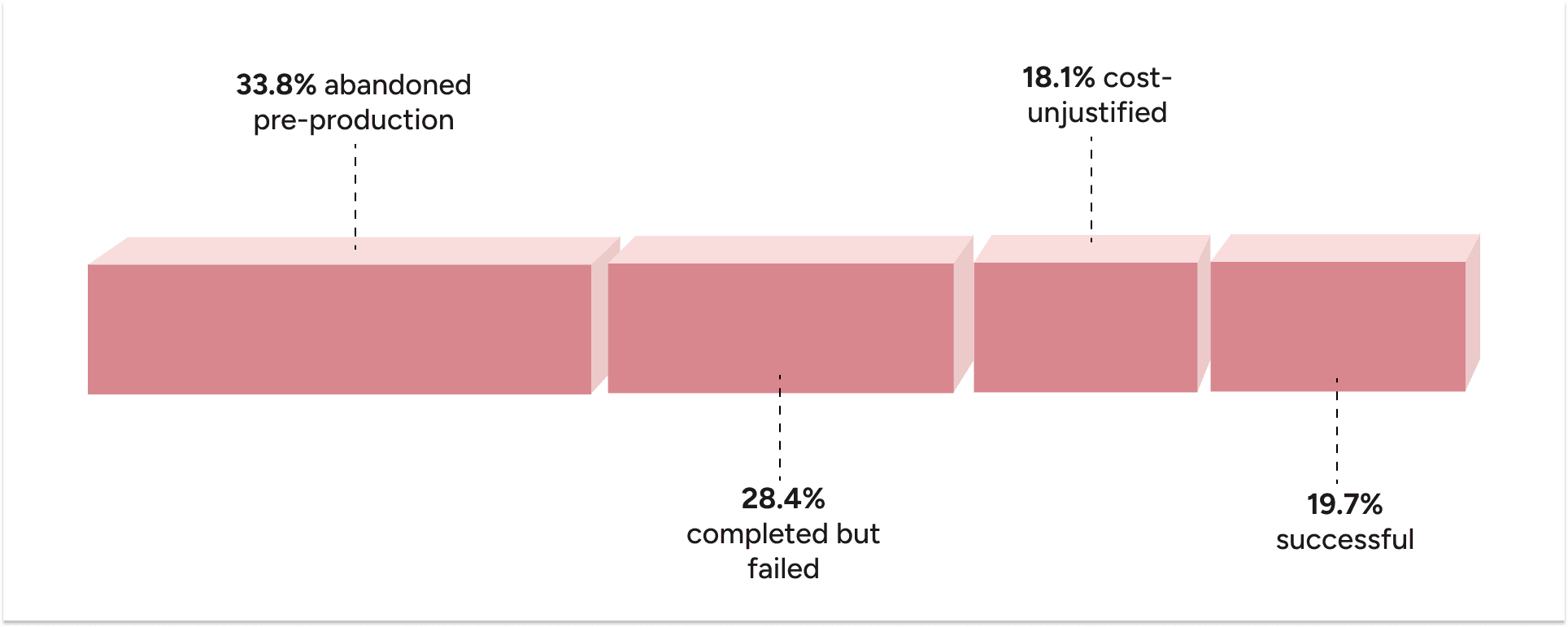
Abandoned projects cost an average of $4.2 million. Completed-but-failed projects cost $6.8 million while delivering only $1.9 million in value, a 72% ROI. Large enterprises lost an average of $7.2 million per failed initiative in 2025.
This is the default outcome when production readiness is treated as something to figure out after the prototype works.
What Production Readiness Actually Means
Most teams conflate a working prototype with a production-ready system. They are different things entirely.
A prototype proves that a model can do a task. A production-ready AI system proves that the model can do that task reliably, at scale, under real-world data conditions, with monitoring in place when it drifts, security controls when it's attacked, and cost controls when inference bills arrive.
The gap between those two states is where most AI initiatives die.
Production readiness has six components. Each one, if absent, creates a different failure mode:
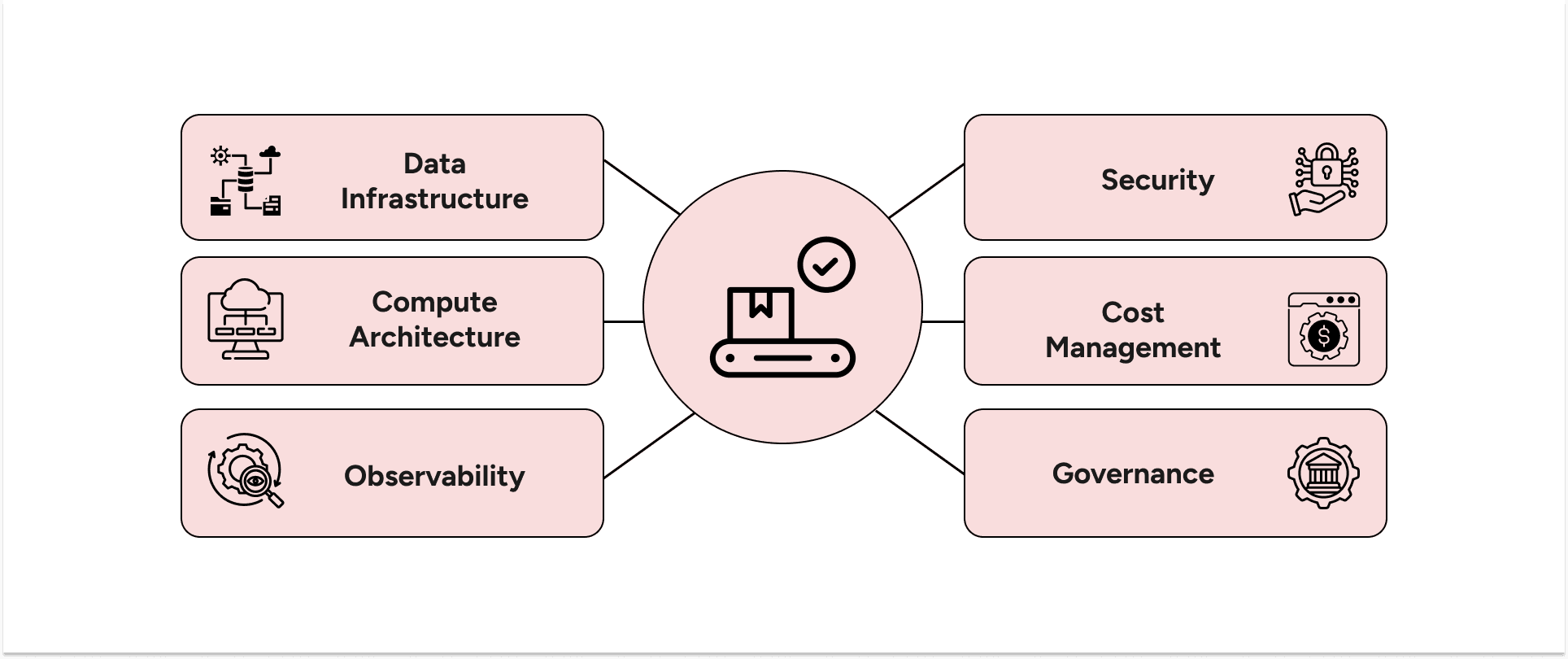
1. Data infrastructure
The model you trained a prototype on was clean, curated, and small. Production data is none of those things. Only 12% of organizations report data of sufficient quality and accessibility for AI applications. If the data pipeline was not designed for production volume before the prototype was built, it will not survive the transition.
2. Scalable compute architecture
A prototype running on a single instance behaves nothing like a system handling thousands of concurrent requests. Container orchestration, auto-scaling policies, and load management need to be designed before traffic hits — not after.
3. Observability and monitoring
AI systems degrade in ways that traditional software does not. Model drift, data distribution shift, and latency spikes do not throw standard error codes. Without purpose-built monitoring — model performance metrics, inference latency tracking, output quality evaluation — you will not know the system is failing until users do.
4. Security and access controls
Production AI systems are attack surfaces. Prompt injection, data exfiltration through model outputs, and unauthorized API access are production-specific risks that prototypes never encounter. They need to be designed into the architecture, not patched in later.
5. Cost management
Post-launch operations represent 40–60% of the total 3-year cost of ownership for most AI systems. A pilot almost never predicts production cost — pilots typically run at 15–25% of full deployment cost but skip 70% of the hard problems. Inference costs at production scale, particularly for generative AI, routinely exceed what finance approved for the prototype phase.
6. Compliance and governance
The EU AI Act creates the world's first comprehensive AI regulatory framework, with penalties reaching €35 million or 7% of global revenue for violations. High-risk AI systems face mandatory compliance requirements including risk assessments, technical documentation, human oversight, and accuracy reporting. Governance built after deployment is remediation. Remediation costs 2.8 times more than governance built in from the start.
Why Teams Delay Production Readiness Anyway
The delay follows a predictable logic:
The prototype works. Leadership is excited. The pressure to ship is high. The team makes a rational short-term decision: get it to users, then fix the infrastructure.
Three things make this logic fail every time.
1. Tech debt compounds faster than you can pay it down.
Every feature built on top of an unproduction-ready architecture makes the fix harder. Teams that planned to retrofit production readiness in "the next sprint" find themselves doing it six months later, under worse conditions, with a live system they cannot take offline.
2. First production incident resets trust.
One failure in front of a real user — a hallucinated output with no guardrails, a latency spike that crashes the interface, a data exposure through a poorly secured endpoint — does not just create a support ticket. It creates doubt about the entire initiative at the executive level. That doubt is expensive to rebuild.
3. The market does not wait for your infrastructure.
The patience window for returns on AI investments is narrowing. Investors want scale, productivity gains, and revenue growth within timelines — a requirement that AI, as currently deployed across most enterprises, is not meeting. A competitor that ships a production-ready system while yours is still in remediation does not just capture market share. They capture the narrative.
The Specific Costs That Don't Appear on the Project Plan
When teams calculate the cost of delaying production readiness, they count engineering hours and infrastructure spend. They miss the costs that do not have a line item.
Opportunity cost of delayed revenue. Every week between a working prototype and a production system is a week the product is not generating returns. For B2B AI products where average contract values are six figures, eight months of delay is not a technical inconvenience. It is a material revenue impact.
Rework cost. Organizations that skip production readiness steps pay 2.8 times more in remediation costs later. The engineering hours required to rebuild an architecture that was not designed for production from the start consistently exceed what a proper upfront design would have cost.
Talent cost. Senior engineers hired to build AI products do not stay on teams that cannot ship. The cycle of building prototypes that never reach production is a retention problem as much as a technical one.
Organizational credibility cost. 42% of companies abandoned most AI initiatives in 2025, up from 17% in 2024. In most cases, the decision to abandon was not made because the technology failed. It was made because the organization lost confidence in the team's ability to deliver. That confidence erodes with every delayed launch.
What Separates the 5% That Ship Successfully
Projects with dedicated change management resources achieve 2.9 times the success rate. User-centered design approaches drive 64% higher adoption.
But the technical differentiator is consistent across every study: the teams that ship production AI treat infrastructure as a product requirement, not a post-launch task.
They define production criteria before writing the first line of model code. They build data pipelines that handle production volume from day one. They instrument the system for observability before it touches real users. They design cost controls before the invoices arrive. They test for failure modes that the demo environment never surfaced.
This means they do not have to move backward.
The Decision That Determines Everything
Production readiness is not a phase you enter after the prototype is done. It is a design constraint you apply from the first architectural decision.
Teams that treat it as a phase pay for the prototype twice, once to build it, once to rebuild it for production. Teams that treat it as a constraint ship once, ship right, and compound the advantage of being first.
MIT defines successfully implemented AI as systems that deliver sustained productivity gains and documented P&L impact, verified by both end users and executives. By that standard, most enterprise AI deployments in 2026 do not qualify.
The difference between the 5% that do qualify and the 95% that do not is not the quality of the model. It is the quality of the decision made at the beginning about what "done" actually means.
Done is not a working demo. Done is a system that runs in production, scales under load, stays observable when it drifts, and delivers the business outcome it was built to create.
Everything else is a prototype with a deadline.