

Key Takeaways:
- Fraud prevention works best when built into digital card systems, not added as after-the-fact detection.
- Compliance frameworks and intelligent design together create the foundation of trust in the U.S. payments market.
- Institutions that embed resilience through secure architecture and adaptive intelligence turn fraud management into a competitive strength.
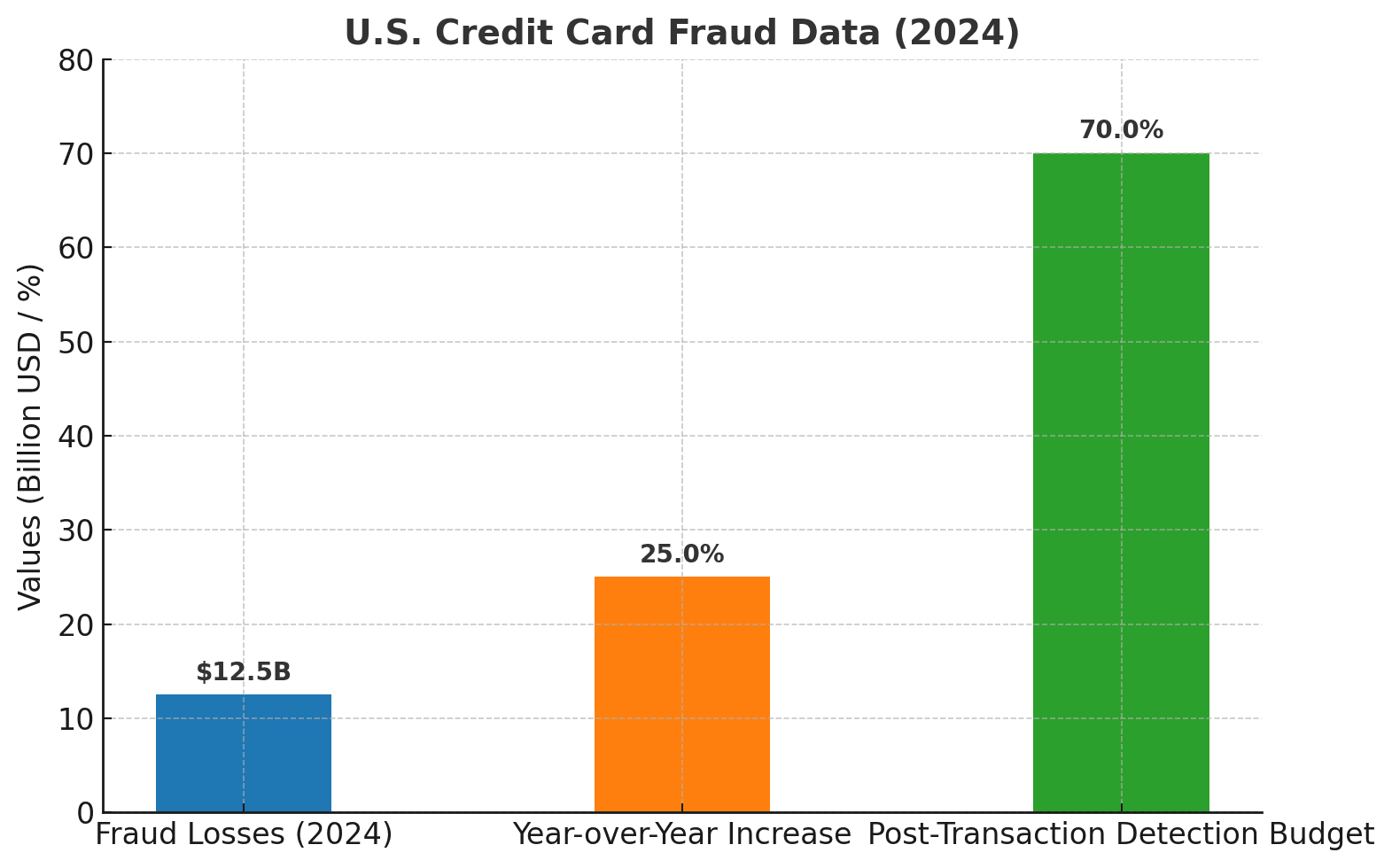
Every 16 seconds, an American falls victim to credit card fraud. In 2024, U.S. losses surged to $12.5 billion, a 25% year-over-year increase, even as banks allocated nearly 70% of their fraud budgets to post-transaction detection. The flaw is structural. Traditional fraud systems detect fraud after the fact, leaving institutions to chase losses instead of preventing them.
The institutions that have reduced fraud losses by 30–40% reveal a different path. Detection remains part of their toolkit, but it is no longer the foundation. The real gains come from reengineering digital card systems—embedding risk controls in the software architecture, designing user flows that limit misuse, and aligning compliance with frameworks such as PCI DSS v4.0 and state-level mandates.
This design-first model shifts fraud prevention from reactive monitoring to structural resilience, transforming fraud management from a cost burden into a source of competitive strength.
This blog explores how digital design and regulatory alignment are redefining fraud prevention in the U.S. market.
What Is Digital Credit Card Design?
Digital credit card design is the integration of fraud prevention into software architecture, user experience, and compliance frameworks. Unlike physical features such as chips or holograms, it focuses on how systems are built to make fraud harder to commit in the first place.
Strong digital design strengthens defenses by combining system resilience with user behavior. Real-time alerts shorten the gap between fraud attempts and customer response. Intuitive reporting flows enable quick flagging of suspicious activity. One-tap freeze and unfreeze functions give cardholders direct control over risk. Spending limits act as behavioral nudges, containing exposure before it escalates. AI-driven anomaly detection surfaces unusual patterns in real time, allowing proactive intervention.
This approach is a structural strategy that reduces dependence on after-the-fact detection and shifts fraud management toward design-led resilience. In practice, digital card design embeds defense into every transaction, every interaction, and every system layer.
The future of fraud prevention is in the way in which we design digital systems. Detection will never be a dull thing, but the resiliency is placed in the system of security into the foundations of credit card systems. Those institutions that consider design the initial barrier of protection will establish the new standard of trust in the U.S. payments market.
 Kunal KumarChief Revenue Officer
Types of Credit Card Fraud & Their Impact
Credit card fraud occurs when stolen or compromised credentials are used to authorize transactions without the cardholder’s consent. In the United States, it has become the fastest-growing financial crime, fueled by the rise of digital payments and the sophistication of organized fraud networks. Losses go beyond financial impact: fraud undermines consumer confidence and erodes trust in the payments system.
Card-Not-Present (CNP) Fraud
In 2024, CNP fraud continues to be the number one U.S. fraud threat, comprising almost 65% of all credit card fraud. Without the card in hand, the merchants use the digital verification, often being cheated using stolen credential details from data theft. It is the first risk point in digital commerce for issuers and merchants.
Lost or Stolen Credentials
Stolen cards and taken login information allow attackers to reset passwords, alter account information, and empty accounts. These account-takeovers (ATOs) combine identity theft and payment fraud, and unfortunately, the victim is often left in the lurch for weeks. Their persistence serves to remind people the importance of quick notifications, as well as of efficient account lockdown measures.
Fraud prevention is not achieved by a single tool but by a layered system of defenses. Based on GeekyAnts’ experience working with financial institutions, the strongest results come from combining architecture, user controls, analytics, and compliance-first design. Together, these elements reduce risk at every stage of the credit card lifecycle. The following methods reflect the practices shaping today’s fraud prevention landscape.
Account Takeovers
Digital services themselves are also being exploited by the fraudsters. By breaking into a bank’s app or card management system, they take over real accounts, authorize transactions and raise limits. These attacks illustrate the need for secure infrastructure and multi-layered authentication to secure all points of access.
Phishing and Vishing
Fraudsters frequently trick users into revealing card details, login credentials, or one-time passwords through deceptive emails, texts, or phone calls. Phishing and vishing campaigns exploit human trust rather than technical flaws, making them harder to defend against with traditional tools. This type of fraud underscores the need for continuous user education alongside strong authentication controls.
The Impact
The consequences of fraud ripple across the ecosystem of merchants; deceitful transactions result in chargebacks, inflated operating costs, and ruined reputations with customers who lose confidence. The cost to consumers is deeply personal and may linger over the long term: bruised credit scores, emptied accounts, months of proving they can be trusted. On a systemic level, mounting fraud eats away at the trust in digital payments and stunts the uptake of innovative financial technologies.
How Can Credit Card Fraud Be Prevented and Detected?
Fraud detection is not an algorithm or tool, it is an ecosystem. Systems that are resilient through a combination of secure architecture, adaptive intelligence and compliance-first design are the most effective.
 Robin
RobinTo prevent fraud it should be equipped with systems that predict risk throughout the credit card lifecycle. Based on the experience of GeekyAnts with financial institutions, we pay attention to secure architecture, smart user controls, sophisticated analytics, and compliance-first design. The practices below are examples of how the practice of fraud prevention is changing nowadays.
Secure Payment Processing
The defence against fraud starts at the level of transaction. End-to-end encryption and tokenization make sure that cardholder data-sensitive information is never transported as plaintext. All of these standards are reinforced by PCI DSS v4.0, yet the most robust implementations take it a step further and integrate security into APIs and payment gateways so that intercepting fraud becomes much more difficult.
EMV Chip Card Technology
The counterfeit fraud has been minimized with chip technology, which comes up with unique codes in every transaction. However, what is even more valuable is that it can be integrated with the digital ecosystem: EMV with biometric authentication or mobile wallets will form multi-factor protection at the point of use.
Data and Database Design for Fraud Detection
Data organization is the key to prevention. A properly configured database enables the collection of transaction data, device fingerprints, and location data into a single lake of fraud data. The architecture allows the detection of anomalies in real time and reduces the blind spots that the fragmented systems introduce.
Multifactor Authentication (MFA)
Passwords alone are no longer sufficient. MFA adds behavioral and contextual checks--biometrics, one-time passcodes, device recognition--that make unauthorized access significantly harder. Effective MFA is not about adding friction but about calibrating it intelligently so risk is reduced without compromising customer experience.
Machine Learning and Anomaly Detection
Basic, address verification (AVS) and CVV checks remain foundational controls for Card-Not-Present transactions. Their value is not in isolation but in orchestration--when paired with machine learning models and velocity checks, they provide the baseline verification on which higher-order defenses build.
AVS and CVV Checks
Address Verification System (AVS) and Card Verification Value (CVV) checks remain essential first-line defenses in Card-Not-Present transactions. While simple, they are highly effective in filtering out obvious fraud attempts. Their true strength emerges when integrated with machine learning models and velocity checks, creating a layered defense system that strengthens accuracy and reduces false positives.
Advanced Detection and Response Strategies
Response-less detection is inadequate. The new advanced systems use real-time rules engines, which may block authentication, flag or step up in real-time. Orchestration platforms align between channels-cards, wallets, and merchant systems, such that responses are uniform and real-time.
Fraud Detection Tools and Market Solutions (2023–2025)
Vendors now provide platforms that have in-built AI, device intelligence and orchestration. In combining analytics and real-time decisioning, Feedzai, Forter, and Kount are in the genre of setting standards. The environment is moving towards point solutions to integrated fraud ecosystems among U.S. issuers.
Model and Operational Risk Management
Even the machine learning models are a risk in themselves when not controlled. Governance structures establish transparency, bias and compliance. Operational risk management is not limited to technology but also to processes-incident response, staff training and periodic audits.
Credit Card Lifecycle Risk Mitigation
Fraud risk does not end at transaction approval. From issuance to closure, lifecycle risk must be managed—securing onboarding with KYC, monitoring ongoing usage, and ensuring secure deactivation. Lifecycle design prevents vulnerabilities from appearing at the edges of the system.
Continuous Monitoring, Alerts, and Feedback Loops
The prevention systems against digital fraud are required to keep pace with fraud. Real-time alerts are made possible through continuous monitoring across transactions, geographies and channels. Feedback Loops Feedback loops, in which user reports and verified fraud are used to input to detectors, result in systems that become smarter with each reported incident.
U.S. Risk Frameworks & Regulatory Compliance
Compliance and fraud prevention cannot do without one another in the U.S. Data security, ongoing monitoring, and enterprise risk management frameworks are defined by such frameworks as the PCI DSS v4.0, NIST Cybersecurity and COSO governance. At the state level, rules such as CCPA and the NY DFS Cybersecurity Regulation widen these standards, introducing more rigid supervision and privacy demands. To financial institutions, compliance is worth more than mere fines- it has been proven to inspire trust in customers, mitigate systemic risk and make them resilient in the face of dynamic fraud strategies. In GeekyAnts, we build systems with compliance in architecture where fraud prevention and regulatory alignment are aligned as a strategic benefit.
Industries Most Exposed to Credit Card Fraud and a U.S. Banking Case Study on Real-Time Detection
Credit card fraud is not affecting every sector equally. Industries that have high transactions, where interactions are digital or low-margin are the most exposed. Online retail and e-commerce continue to be top targets because Card-Not-Present frauds take up digital commerce. Travel, gaming and hospitality platforms are the main targets of fraudsters due to the frequent cross-border transactions as well as the stored payment information. Services that are subscribed to are sensitive since the stolen credentials can be reused until it is detected. Legacy infrastructure and poor authentication frequently lead to ethe xploitation of fuel stations and other retail environments that have high POS. Last, although they can generate innovations, fintechs and neobanks are of a high-risk category where quick onboarding and online access open new attack paths. Fraud prevention is not optional in the case of these businesses since it is a core component of maintaining trust and competitiveness.
Case Study: Real-Time Fraud Detection in a U.S. Bank
One of the largest U.S. banks was experiencing increasing chargebacks and losses due to its fraud detection system, based on batch processing overnight. One could easily clear fraudulent transactions, and then they were detected late, resulting in financial loss and customer frustration.
The bank reacted by initiating a breakdown of its fraud systems. It has substituted legacy systems with a real-time streaming architecture that can accept transaction data in real time and run the fraud models as the payments take place. Such a change allowed the bank to recognize abnormalities on the swipe, rather than hours post-facto.
The findings were conclusive; the detection time was reduced, the losses caused by chargeback were minimized sharply, and the customers were treated better because of the lower number of false declines. The bank has incorporated real-time detection into its system design and therefore, fraud management becomes not just a reactive response but also a competitive advantage.
How GeekyAnts Builds Resilient Credit Card Fraud Detection Systems
Fraud detection delivers real impact only when compliance and intelligence are embedded into the architecture itself. Our focus is on building PCI DSS–aligned platforms with AI-driven anomaly detection that reduce losses and minimize false positives. That is the level of resilience we aim to deliver with every partnership
Kunal KumarChief Revenue OfficerCredit card Fraud prevention demands precision in both design and execution. At GeekyAnts, we combine fintech expertise, regulatory alignment, and engineering depth to help institutions move from reactive monitoring to proactive fraud defense. Our work spans secure payment integrations, transaction monitoring platforms, and compliance-first mobile banking solutions, designed for banks, neobanks, and fintech startups operating in high-risk markets.
Why Institutions Choose GeekyAnts
- AI-Driven Detection → Adaptive machine learning models flag anomalies in real time across high-volume transactions.
- Compliance by Design → Architectures aligned with PCI DSS v4.0, GDPR, and SOC 2, ensuring regulatory trust from day one.
- Engineering Depth → Secure APIs, encrypted gateways, and cloud-native platforms that scale with evolving threats.
- Lifecycle Protection → Continuous monitoring across the card lifecycle—issuance, activation, usage, and closure.
- Proven Partnerships → Delivered white-labeled fintech platforms for financial institutions, strengthening resilience and accelerating time-to-market.
Fraud evolves quickly. Institutions that embed resilience into their systems will stay ahead. GeekyAnts enables this shift, turning fraud management from a cost burden into a structural advantage. Connect with our experts to build secure, compliant, and scalable fraud detection systems.
Conclusion
Fraud prevention is part of the system architecture, user experience, and compliance frameworks, and this is where resilience is realized. Secure design, dynamic intelligence and continuous monitoring make fraud management a cost of defence to a source of confidence and competitive power. Ambidexterity between these ideas in the card lifecycle will enable institutions to be in the best position to safeguard customers, their expectations by the regulations and keep up with the changing threats.
FAQs
1. How is the best prevention of credit card fraud done?
The best solution is a multifaceted system of secure architecture, compliance-first design, and AI-based anomaly detection to prevent fraud prior to its occurrence.
2. What are the effects of the PCI DSS compliance on the detection of fraud?
PCI DSS will make sure the data of the card-holders is encrypted, guarded and tracked throughout the systems, preventing exposure and setting a standard upon which proper fraud detection is achievable.
3. What is the best ML model to use with real-time fraud scoring?
The best accuracy is provided by ensemble models which integrate supervised learning and anomaly detection, which provide a compromise between the detection of fraud cases and the minimization of false positives.
4. Which behavior design brings behavioral changes to lessen misuse?
Limits on spend, on-tap alerts and account controls encourage more responsible use and minimize the chances of committing fraud.
5. What is the best way of dealing with model risk in banks?
Banks use governance framework, ongoing model validation, and bias testing to maintain the accuracy of the fraud detection system and compliance with it.
6. What are the advantages of fuel fraud?
Detection of fraud eliminates losses of money, safeguards consumer confidence, maintains regulatory adherence, and enhances the competitive stance of the institution.